
Amalfi Coast Engagement Photographer: Five Towns, Three Kinds of Light
THREE TOWNS, THREE PALETTES, ONE DAY
How I photograph engagement sessions across the Amalfi Coast: the towns I use, the light I chase, what to wear, when to come, and how a three-hour afternoon turns into a gallery with three different palettes.

Send your dates and I will draw the route around the light.


I have worked as an Amalfi Coast engagement photographer since 2011. In that time I have shot in cloisters, on boats, on stairways that end at locked gates, and on beaches you can only reach by water. I have learned that the coast has more photogenic locations per kilometer than almost any stretch of Mediterranean shoreline, and that an engagement session is the one type of work where I actually get to use most of them.
An engagement session is different from everything else I do. A wedding has a fixed schedule: the ceremony starts at a given time, the venue dictates the angles, and the light is whatever the light happens to be when the couple walks out of the church. A honeymoon shoot is relaxed but usually stays in one place for an hour, one outfit, one mood. With an engagement session, the control is mine. Nobody is married yet. There is no gown, no tuxedo, no reception timeline. I choose the towns, the route, the timing. I build the afternoon around where the sun will be at 4 PM, at 6 PM, and at dusk. The couple shows up in their own clothes and we walk.
Most of my engagement sessions cover two or three towns in a single afternoon. We start somewhere when the light is high and warm, move to a second town when the sun drops behind the ridge, and finish in a third during the blue hour when the streetlamps come on and the sky turns deep blue. That format produces a gallery with three distinct color palettes instead of one. It is the format I recommend to every couple who contacts me, and it is the reason this page exists: to explain how it works, where we go, and what you need to know before you book.
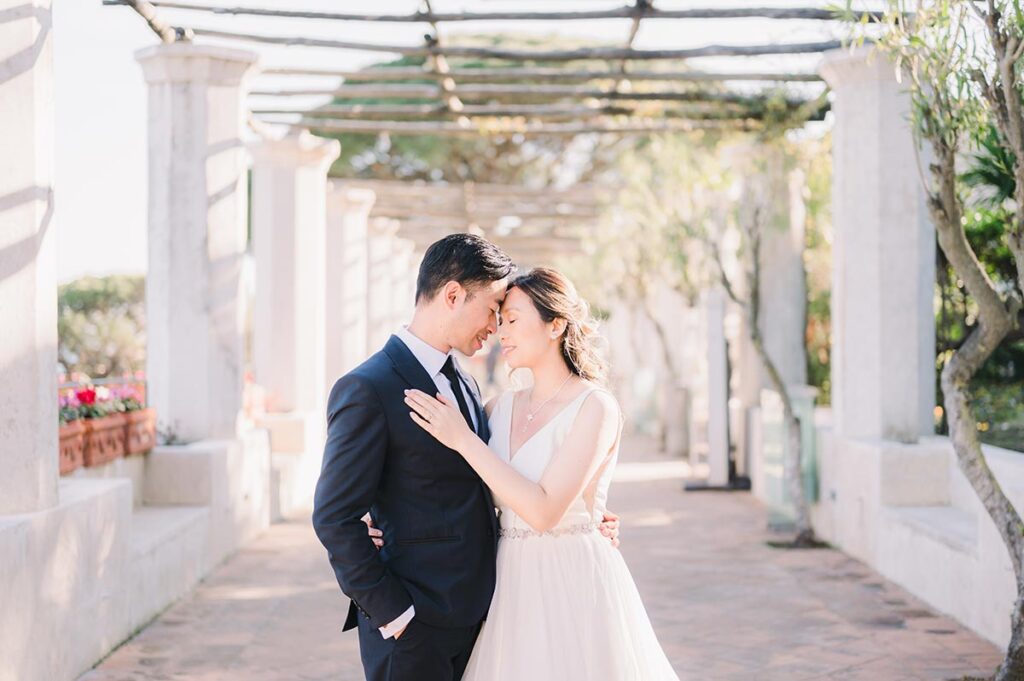
Five Towns, Five Different Galleries
I shoot engagement sessions in Positano, Amalfi, Ravello, Atrani, and Praiano, five of the towns I work in as an Amalfi Coast wedding photographer. Each town gives me a different type of image, and the right choice depends on what you want your gallery to feel like.
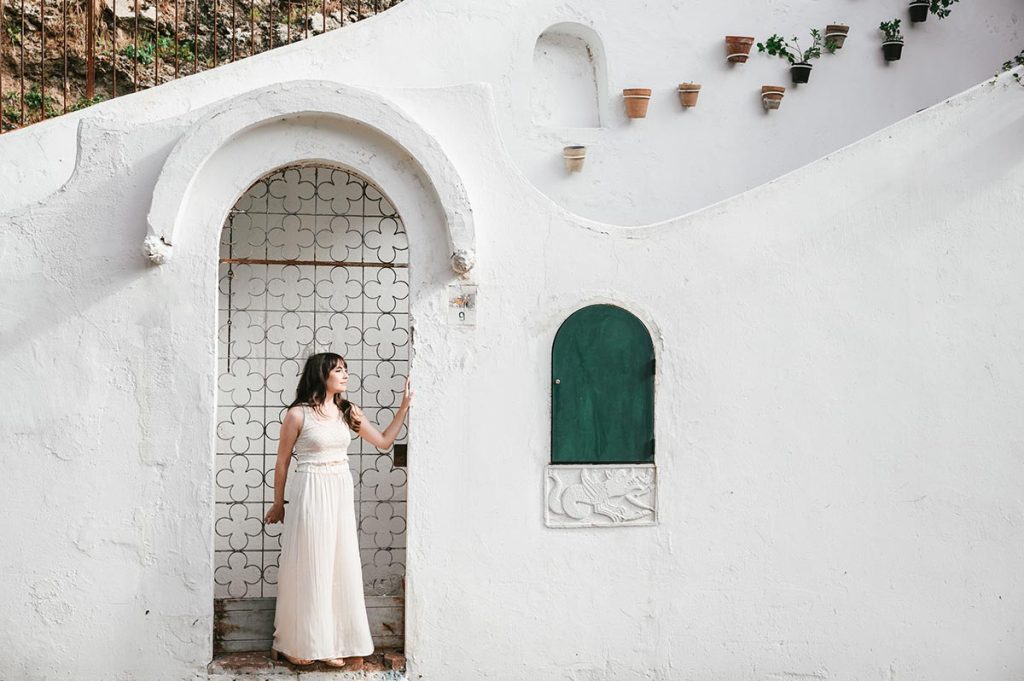
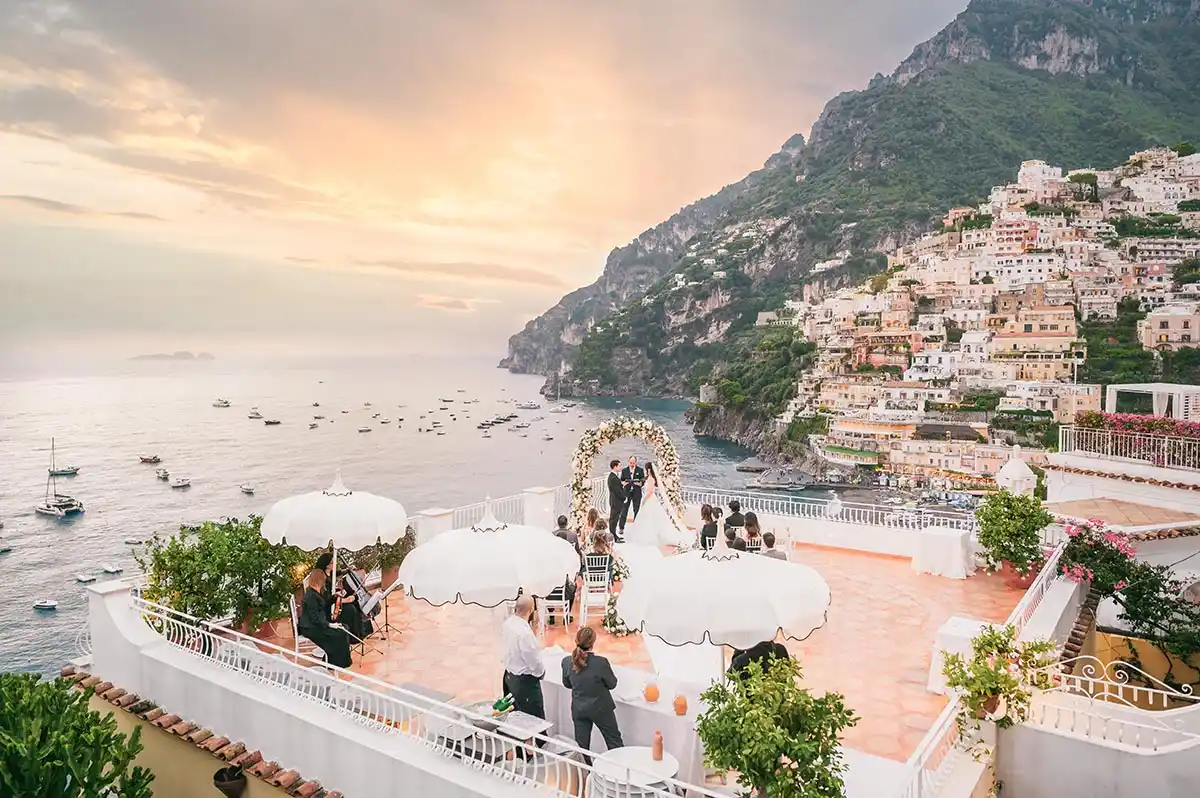
Positano is vertical. The town climbs from the beach to the hilltop in a wall of pastel and terracotta, and the strongest frames use that height: you on a stairway with the colored buildings stacked behind you, or on a balcony with the boats and the Tyrrhenian below. The problem with Positano is density. From May through October the narrow steps are full from 9 AM until evening. I shoot Positano at sunrise or in the final hour before dark, when the day-trippers have left and the town empties out. If the session starts here, we meet at 6:30 AM. By 8:00 AM we are in the car heading to the next stop. That early start is not negotiable if you want empty streets in the photos. If you are also considering a wedding in Positano, the same crowd rules apply to the ceremony timeline.
Amalfi has architecture that Positano does not. The Cathedral of Sant’Andrea, the Arab-Norman cloister of the Chiostro del Paradiso, the white stone of the Anantara Convento on the cliff above the harbor, the old paper mills in the Valle delle Ferriere. The town sits in a narrow valley facing south, so the light hits the harbor straight on in the morning and carves deep shadows into the side streets by early afternoon. I prefer Amalfi between 10 AM and noon, when the Duomo steps are lit evenly and the Convento cloister reflects light off every wall. A couple from Chicago came last October with four outfits in a carry-on: a red dress for the Duomo stairs, linen for the gardens, a black cocktail look for the blue hour, and jeans with sneakers for the walks in between. We used every one, and started the day right here on those steps with the red dress against the white stone.

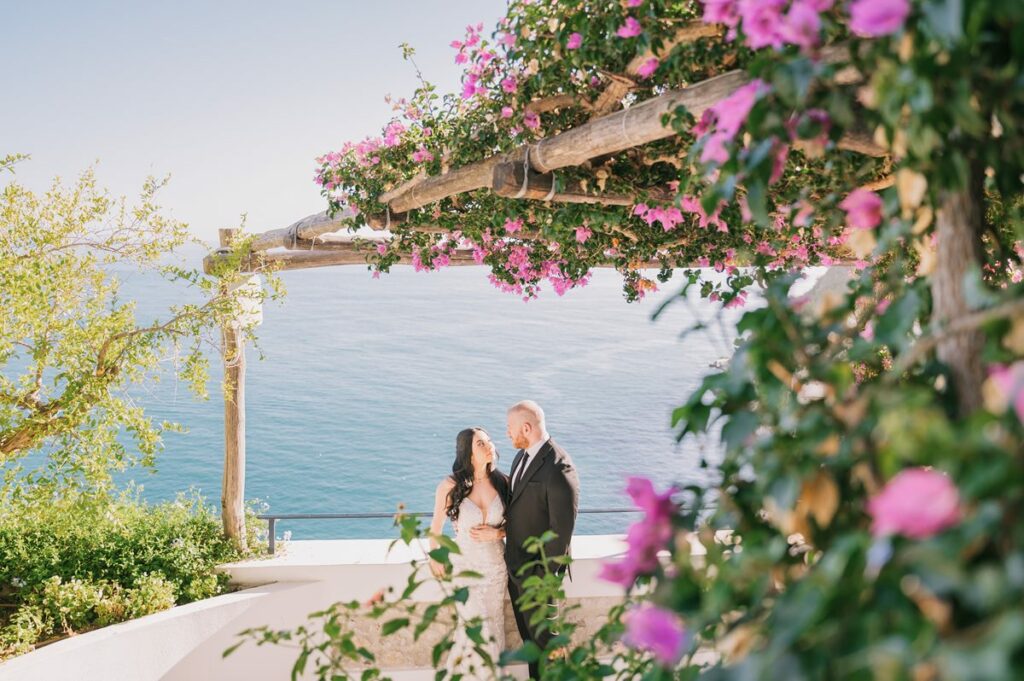
Ravello sits 365 meters above the sea, and the difference shows immediately in the light. Down on the coast the air is thick with salt and humidity, and the light softens and scatters. In Ravello the air is drier, the sky is bluer, and the afternoon sun has a clarity I do not get at sea level. The gardens of Villa Rufolo, the Terrace of Infinity at Villa Cimbrone, and the gardens of the Principessa di Piemonte are the locations tourists know, but I use the town itself just as much: ivy-covered walls along the back streets, pergolas with a hundred-kilometer view of the coastline, stone staircases that get no foot traffic because they lead to private houses. Ravello works at almost any hour between 10 AM and sunset, which makes it the ideal middle segment of a multi-town session. I have photographed engagement sessions here in every month of the year, and December in Ravello, with the empty streets and the low winter sun hitting the stone walls at two in the afternoon, is something I actively look forward to. You can see what a full engagement session in Ravello looks like in Mary and Blake’s gallery.
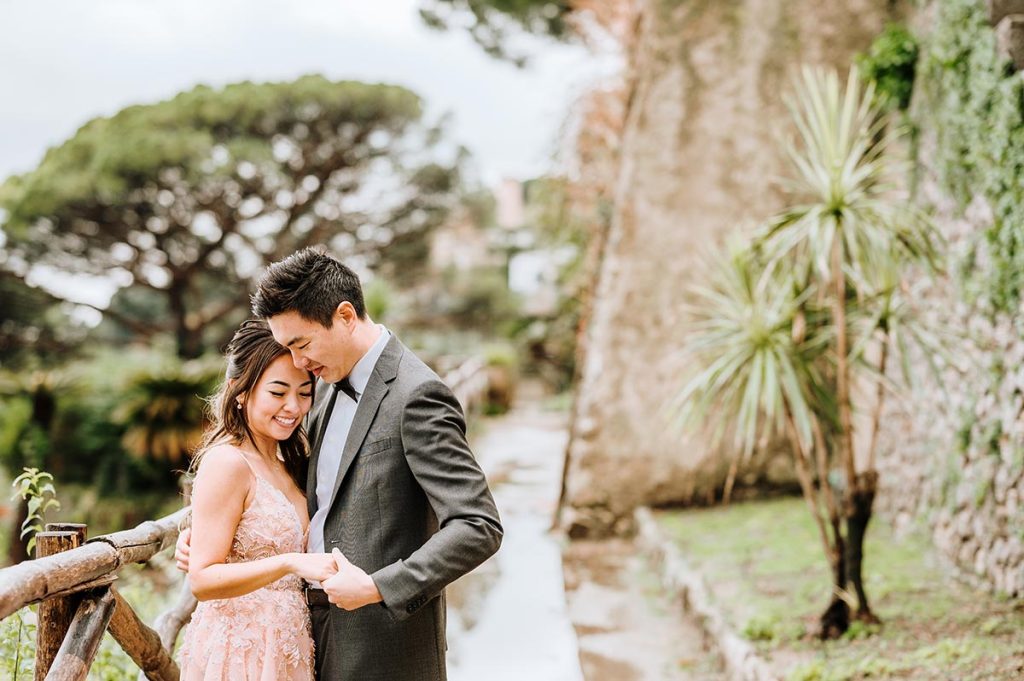
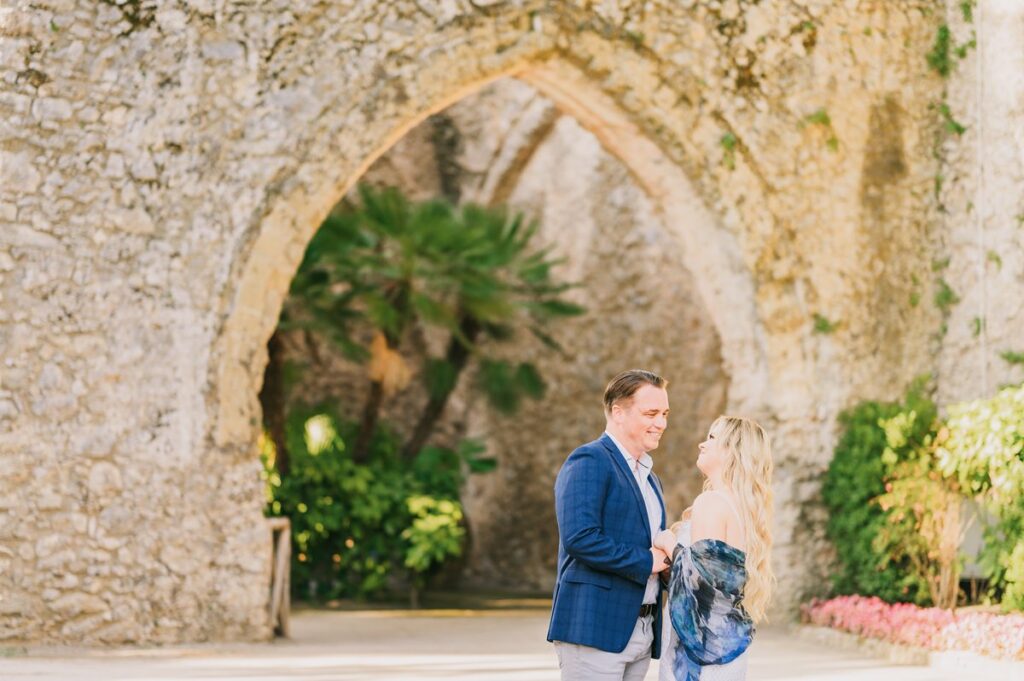
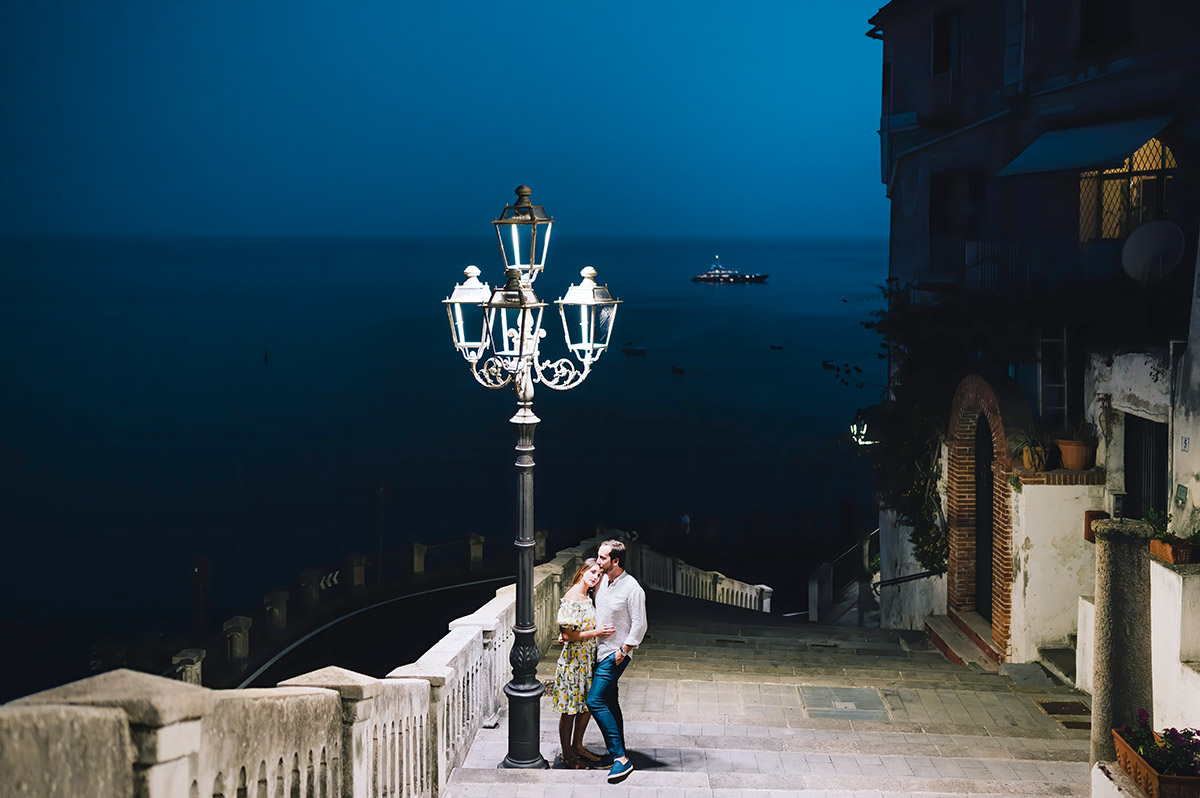
Atrani is the smallest municipality in southern Italy, and most tourists drive past without stopping. One piazza, one church on a terrace, one small beach, zero crowds. The Collegiate Church of Santa Maria Maddalena sits above the piazza with old iron streetlamps that switch on at dusk, and during the blue hour the warm gold of those lamps against the cooling sky creates a color contrast I cannot reproduce with any editing. It lasts about fifteen minutes. Then the sky goes dark and it is gone. I use Atrani almost exclusively as the final stop of a session, timed to those fifteen minutes. The Marisa and Jake gallery ended there, and those Atrani frames were the ones they posted first.
Praiano faces west, and that matters. When the rest of the coast is already in shadow after sunset, Praiano still gets direct light. The Marina di Praia is a small beach inside a rocky inlet, and in September and October the sun drops straight into the water at the mouth of the cove while the cliffs on both sides frame it. I bring couples here when they want something rougher, more sea than stone, more wind than gardens. It is not for everyone, but when it works, the photos have an energy that polished Ravello gardens cannot produce.
I plan the route before the session based on the calendar date, the sunset time, and what the couple tells me they want. A couple who wants architectural, editorial shots starts in Amalfi and ends in Atrani. A couple who wants soft garden light and wide coastal views starts in Ravello and ends in Praiano. I have planned a great many of these routes and never repeated one exactly, because the light on this coast is never in the same place at the same time twice.
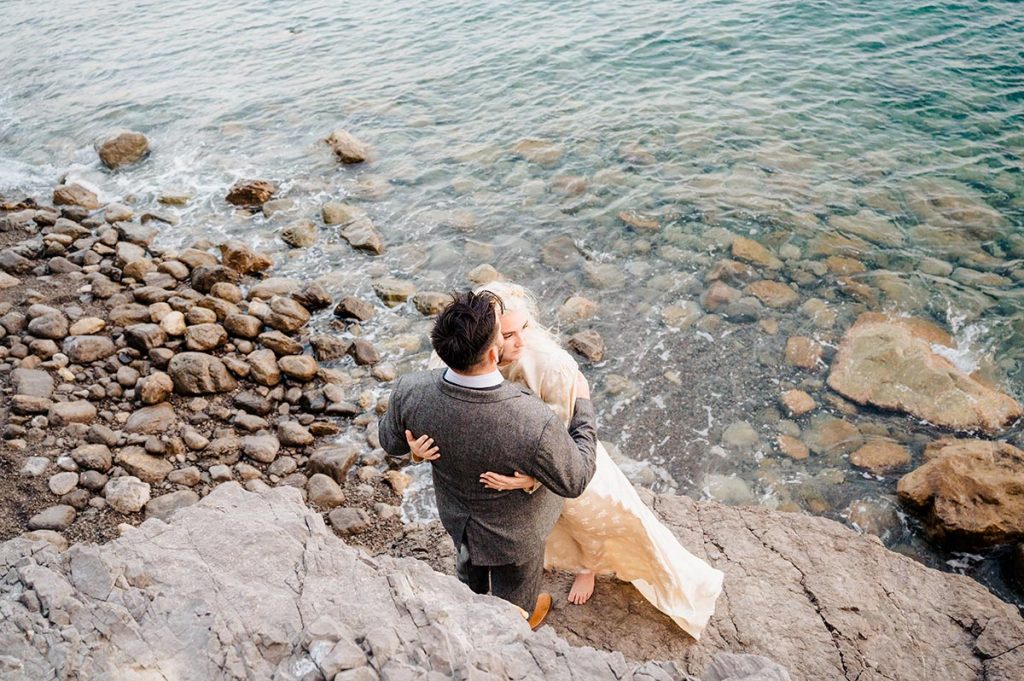
Engagement, Honeymoon, Proposal: Three Different Jobs
People confuse these, and the confusion matters because each type of session requires a different approach from me.
A honeymoon session happens after the wedding. Married by then, the two of them are relaxed and often tired from traveling. The pace is slow. I shoot honeymoons in one location, usually ninety minutes, late afternoon. The gallery is quieter and more intimate. The couple does not want to climb stairs or change outfits. They want to be together in a beautiful place and have someone capture it without asking too much of them.
A proposal session is controlled chaos, and I have written about it at length in my guide to Amalfi Coast proposal photography. One person has a plan and the other has no idea. I position myself in advance with a telephoto lens, usually passing for a visitor waiting for someone. The coordination happens over weeks of WhatsApp messages: the exact spot, the exact time, which direction the couple will be facing so the light is correct and my angle is clear. I shoot the moment from thirty to fifty meters, close enough for the expressions to read in the frame. After the ring goes on and the surprise settles, we do a short portrait session with the new energy of two people who just became engaged. I have a proposal gallery from Villa Cimbrone that shows how that transition looks.
An engagement session sits between those two. You have energy and time, and you are willing to walk, change outfits and visit several places. I get three to four hours instead of ninety minutes. I control the route and the light. And the couple arrives in clothes they have chosen for the session, which means I can coordinate outfits with locations in a way that is not possible during a wedding or a honeymoon.
This is why engagement sessions are the most creatively flexible work I do. Nothing is fixed except the sunset time. Everything else, I build.

What to Wear on the Amalfi Coast
Outfit choice matters more here than at most destinations because the backdrop is very specific. The buildings are pastel, the stone is warm cream and terracotta, the sea is deep blue and there are lemons everywhere. If you wear a loud printed shirt, you fight the background for attention. If you wear all black, you become a silhouette against a wall of color.
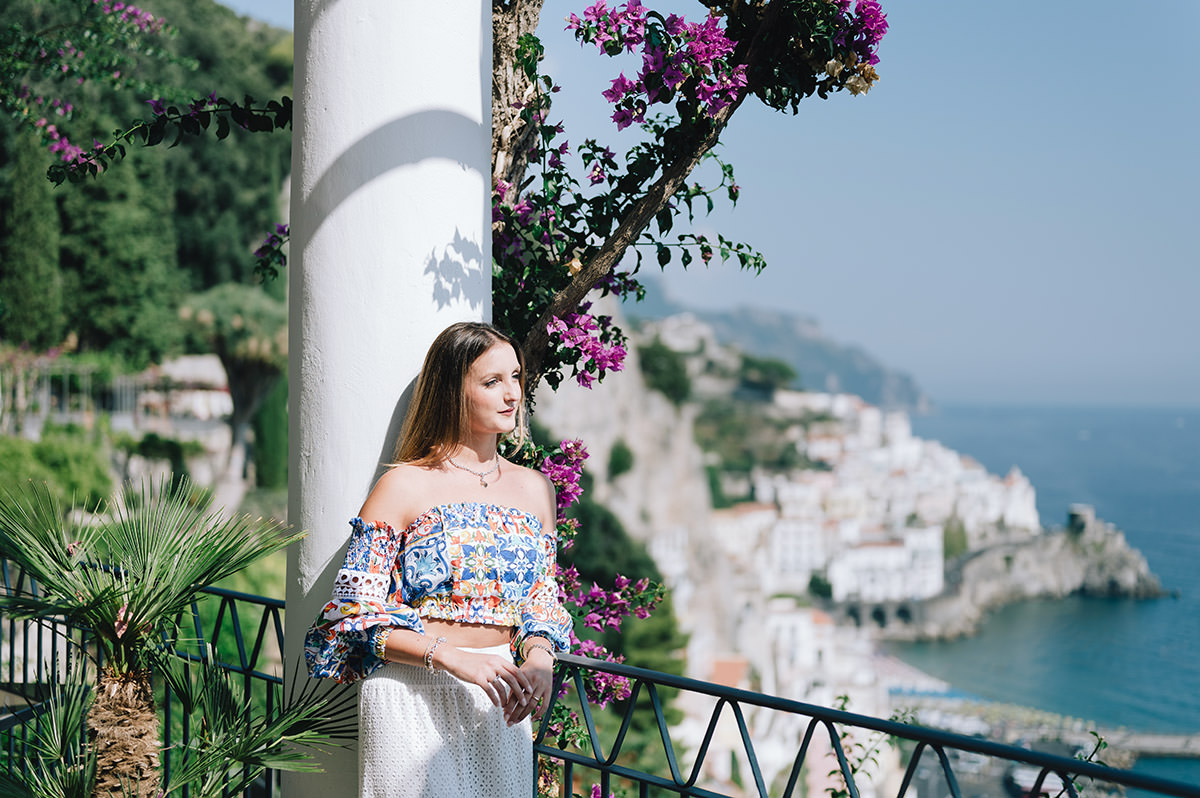
For women: solid colors in the warm-to-neutral range work best. White, cream, dusty rose, sage, soft yellow. Flowy fabrics that catch the coastal breeze, because fabric that moves adds motion to a still photograph. Linen and chiffon are ideal. Stiff structured dresses do not move and they photograph flat. One specific note on prints: a couple once wore matching Hawaiian shirts as a joke, and then could not understand why every photo looked busy. The shirts had more visual information in them than the town behind the couple.
For men: linen. A white or light blue linen shirt with chinos or pressed trousers, sleeves rolled, works in every season except deep winter. Skip the jacket unless it is December in Ravello.
Shoes are a logistics problem. Positano has over a thousand steps from the top of the town to the beach. Ravello is all cobblestones. Atrani has wet stone near the water. I tell every couple the same thing: bring the heels if you want them for a few composed shots, but wear flats for walking. We stop, you change, I shoot, you change back. Nobody has ever regretted bringing flat shoes. Several couples have regretted not bringing them.
If you want to change outfits during the session, leave a garment bag in the car. We drive between towns, so there is always a moment. Two outfits is standard. Three works if we have four hours. More than three is ambitious, but I have done it.
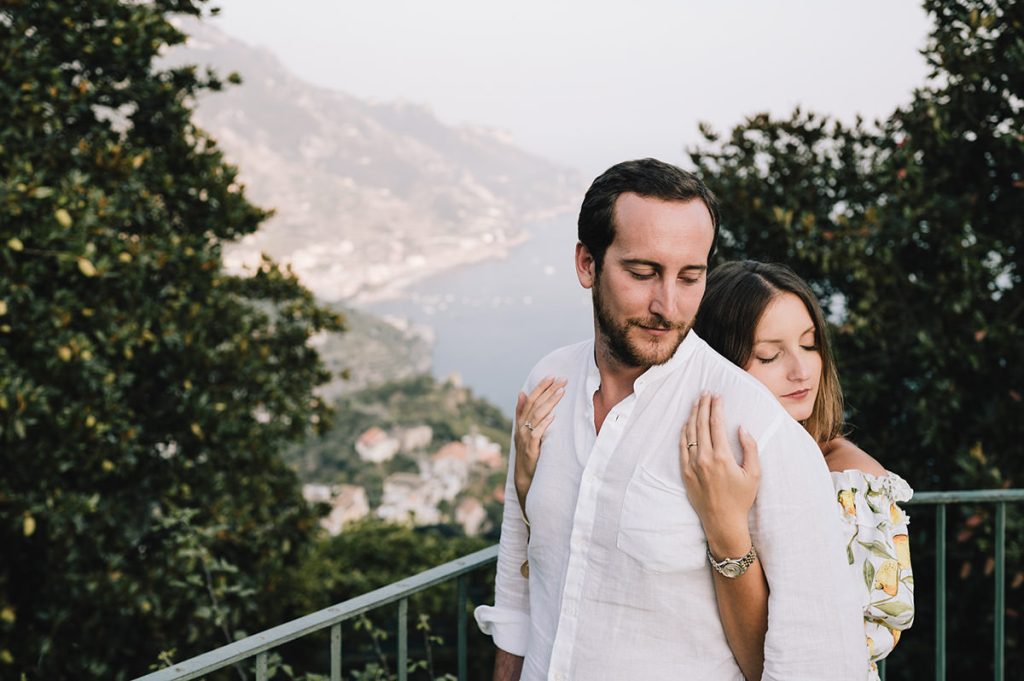
When to Come
The strongest months for an engagement session are May, June, September, and the first half of October. The weather is warm, the light lasts long enough for a full three-town route, and the crowds are manageable if you time the session correctly.
July and August are the hardest months to shoot. Temperatures above 35 degrees, humidity that fogs lenses when you step from an air-conditioned car into the open air, and towns packed from morning to night. I still work in July and August, but the format changes. We start at sunrise, 6:30 AM, and finish by 9:00 AM before the heat and the crowds make everything harder. The tradeoff is worth it: a summer sunrise session in Positano gives you golden light on empty streets, and by the time the tourists arrive you are already in the car with your gallery half done.
April is unpredictable. It can be 24 degrees and clear, or it can rain for two days. But rain on the Amalfi Coast has a photographic quality that clear skies do not. Wet stone reflects light. Clouds create soft, even illumination that removes harsh shadows from faces. The crowds vanish. Some of my strongest galleries were shot in April rain, with the couple under a single umbrella on an empty Positano staircase and the colored buildings washed clean behind them. On a wet day I change the route rather than the date: the cloister at Villa Rufolo and the arcades in each town photograph well under a gray sky, and I keep a list of covered spots for every town. Only exceptionally, when the rain is too heavy to shoot at all, do we move the session to the day before or after, if it is free and dry and you are still here.
November through March is the quiet season. Hotels close, restaurants thin out, and many of the smaller towns go dormant. Ravello stays open, and Ravello in winter is a different place. The sun is lower and more golden. The air is crisp. A couple from Portland booked a December session last year and said it felt like we had rented the entire town. We shot for three hours in Ravello alone and never saw another tourist until we stopped for coffee in the piazza.
Time of day: I almost always start mid-afternoon and end at sunset. The window from 3 PM to 7 PM in summer (or 2 PM to 5 PM in winter) gives me the full progression of light. Warm afternoon sun, golden hour, blue hour. Three lighting conditions, three palettes, one continuous session.

From First Message to Gallery With Your Amalfi Coast Engagement Photographer
Working with me as your Amalfi Coast engagement photographer starts with an email or a WhatsApp message: your travel dates, how many days you have on the coast, and whether you have a hotel booked. I reply with a route proposal within 48 hours: which towns, in which order, at what times, with alternate locations in case of weather.
Before the session, we do a fifteen-minute video call. I want to see your faces, hear how you talk to each other, and understand what kind of images you are looking for. Some couples want editorial, some candid, most a mix of the two. That call shapes everything: the route, the pacing, and how much direction I give during the shoot.
On the day, we meet at the first location. There are two of us, a second photographer or an assistant, who also drives between stops, carries the gear bag and holds a reflector in tight spaces where the light needs a push. You bring your outfits. That is all you need.
During the session I direct when we are doing composed portraits on a balcony or a staircase, and I step back and shoot with a long lens when you are just walking and talking. The galleries I am most proud of alternate between both: a formal portrait under a colonnade, followed immediately by a candid frame of one of you laughing at something the other said while walking down a street. I do not pose every frame. I set up the first one and then I watch what happens.
You will have something to look at within two days and the finished set within fifty, and fifty is the outer limit rather than the usual wait. Every image is color graded by hand to match the light and palette of each location, and the edited set arrives in a private gallery with full-resolution downloads. My photography packages page covers the full breakdown of what each session includes, the deliverables, and how I structure the pricing.
The Engagement-to-Wedding Path
A good share of the couples who book me as their Amalfi Coast engagement photographer come back for the wedding, sometimes as an Amalfi Coast elopement rather than as the big day they first described, and by then an Amalfi Coast wedding planner is usually already involved. The session becomes a scouting trip without anyone calling it that. The couple sees the coast, learns the towns, stands in front of venues at the hour when the light is right, and when they start planning the wedding, they already know which place felt like theirs.
The pattern repeats often enough that I plan for it. A couple books the engagement session, falls for Ravello during the afternoon walk, and six months later writes to ask about planning a wedding there, or about a wedding in Amalfi Coast somewhere else along the same road. Now I know their faces, their comfort level in front of a camera, which light suits their skin tones, how they move together. The wedding day is easier for everyone because we have already worked together.
If you are thinking about both, the engagement session is the place to start. It is shorter, simpler to plan, and it answers the question that every couple planning a destination wedding quietly asks themselves: will this place actually feel right when we stand in it? For those who are considering something smaller than a full wedding, the Ravello elopement page covers that option as well.
Three questions
Cost, Dogs and Sessions Beyond the Coast
What an engagement session costs on the coast, bringing your dog, and sessions elsewhere in Italy.
How much does an engagement photographer cost on the Amalfi Coast?
My engagement sessions on this coast start at 1,800 euros for two hours, with a photographer and an assistant, and about 150 edited photos within 50 days. A route through three towns needs four hours, at 2,400 euros with about 250 photos. I send a detailed quote after we’ve talked about the towns you want.
Can we bring our dog?
Yes, and it works well here. The only issue is stairs: if your dog can’t handle steep climbs, I leave Positano out and use the flatter streets of Ravello or Atrani. Tell me when you book, so I plan the route around it.
Do you shoot engagement sessions outside the Amalfi Coast?
Yes. I live on the coast, but I photograph sessions and weddings across Italy, and the rest of that work sits on my page as an Italian wedding photographer.
MORE ENGAGEMENT DAYS ON THE COAST
WHAT TO READ BEFORE YOUR ENGAGEMENT SESSION

 Written By Emiliano Russo