
Amalfi Coast Proposal Photographer
ONE MINUTE HIDDEN, THEN THE YES
Which town suits which kind of question, where I stand while you ask it, what a proposal booking on this coast costs, and how far ahead you need to write to me.
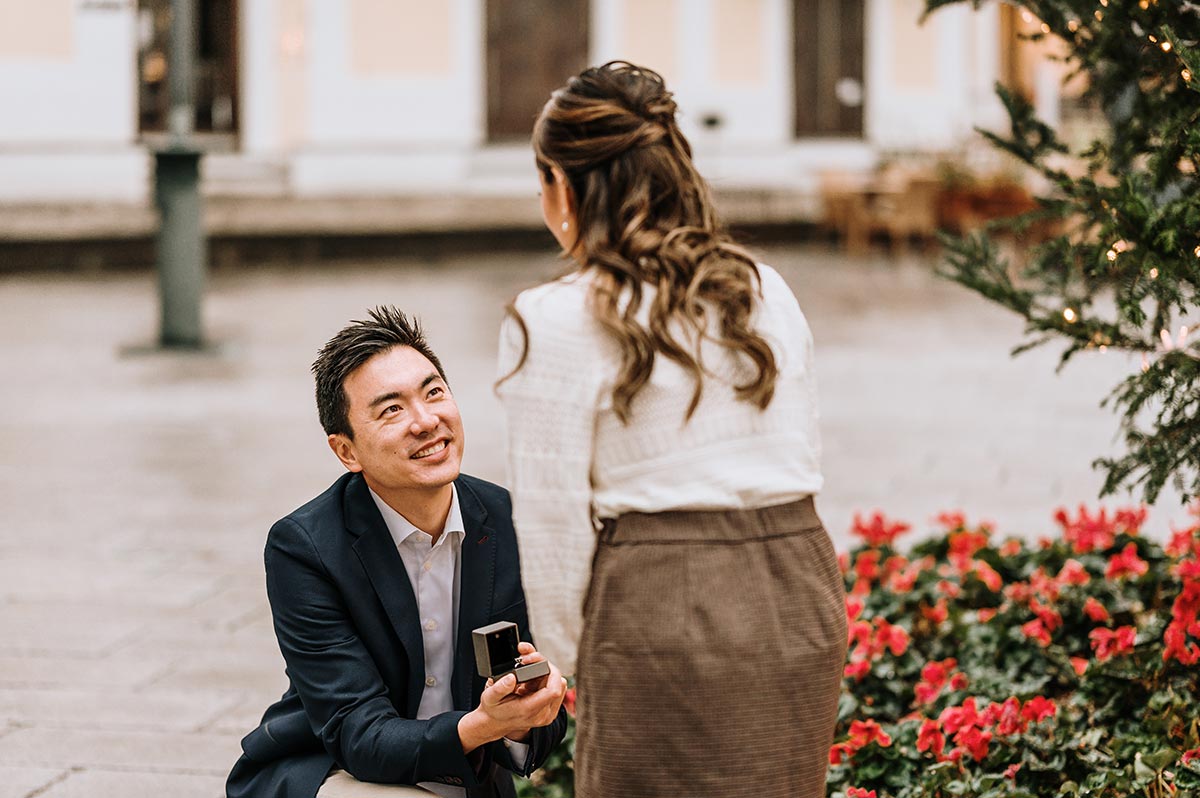
Send me two mornings and I will build the plan around them.
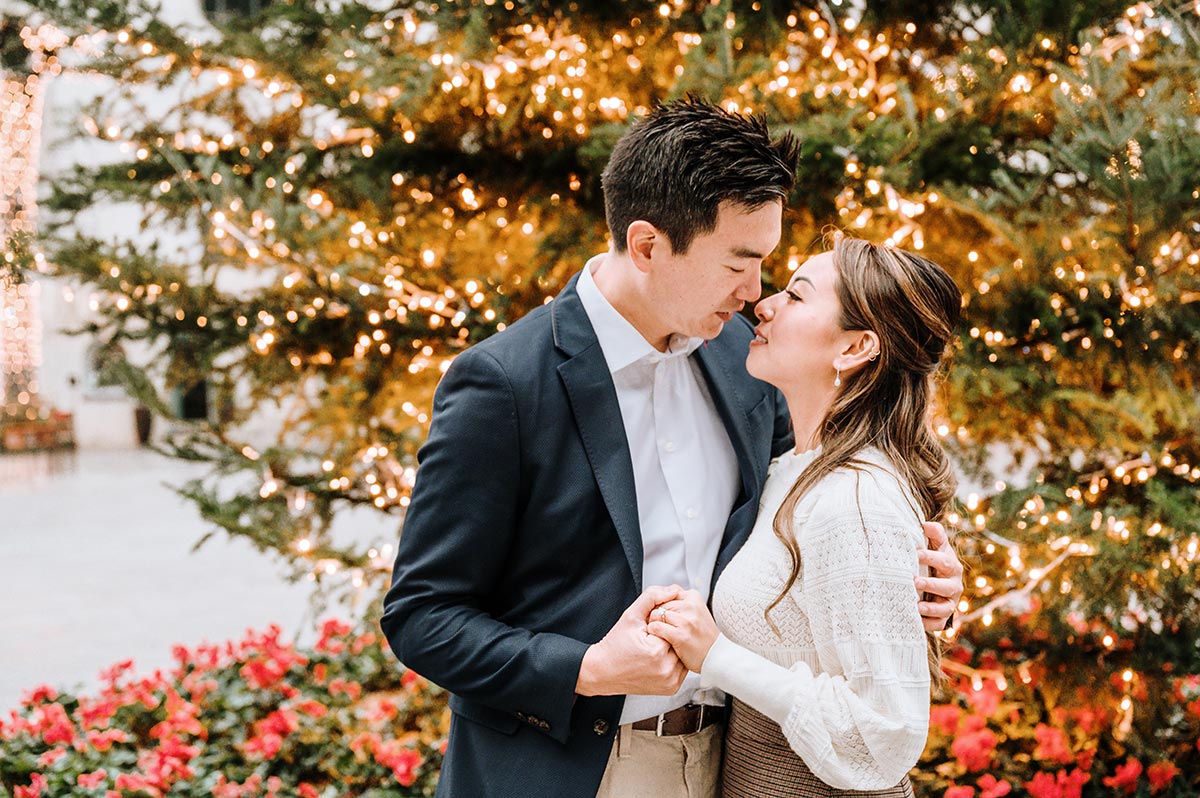
An Amalfi Coast proposal photographer does two jobs that pull against each other. For the sixty seconds that matter I have to read as one more tourist with a camera, standing far enough back that your partner never registers me. For the two hours around those sixty seconds I have to be the most organized person in the plan: the one who knows where the sun sits at twenty to ten, which way the tour groups leave the piazza, and what we do if the ferry runs late.
The opening move almost never changes. Someone writes from the United States four to eight weeks before the trip, and the message contains the words “she has no idea” or “he cannot find out.” Everything after that happens on a channel the other person cannot see. The part that rarely gets written down is everything in between: how the town gets chosen, how a secret survives a week of traveling together in the same room, and what the pictures look like when they are made from forty meters instead of two.
This is a different booking from a session with an engagement photographer in Amalfi, where both of you know the plan, both of you dressed for it, and I can say move left, chin down, walk toward me. Here I direct nothing until the ring is on a finger.
What an Amalfi Coast Proposal Photographer Is Hired to Do
The photography is the smaller half of it. What you are paying for, in the weeks before, is someone who has been standing in these specific places at these specific hours since the early 2010s, and who can tell you that the spot you found on Instagram is in full shade by four, or that the terrace in the photograph sits inside a hotel that will not let you through the gate unless you are a guest.
On the day itself the work splits into three parts. Before: I am at the location fifteen minutes ahead of you, I have chosen my position, and I have watched the traffic of strangers through it long enough to know its rhythm. During: I shoot in bursts and I do not move, because movement at the edge of someone’s vision is what gets a photographer noticed. After: I walk over, introduce myself, and turn into a normal photographer for an hour, which is when most of the pictures you will actually frame get made.
Proposal planning, the flower arch on the beach and the candles arranged in the shape of a question, is a separate service from the photography. I do offer it, through the planning side of my work, but it is quoted on its own and never folded into the photography price, because a setup that takes two people ninety minutes to build means real hours and real suppliers. For a simple proposal at a viewpoint you usually do not need it at all, and I will say so before you spend the money.

The Spot Decides the Picture, the Town Decides the Day
Almost everyone arrives with a spot in mind and no town in mind, which is backwards. The spot decides the photograph. The town decides whether you get there relaxed, whether there are forty strangers behind you, and whether the rest of the day works. Pick the town first, and the shortlist of spots inside it is short enough to choose from in one conversation.
Ravello If You Want Gardens and Quiet
The crowd behaves differently up in Ravello than it does in the towns on the coast road. People arrive later, leave earlier, and gather inside two properties, which leaves the ground between those properties genuinely quiet at nine in the morning. It is where I send couples who want a garden, a balustrade, and the sound of nothing much. The full breakdown of where to stand and what each garden costs to enter is on the guide to a wedding proposal in Ravello.
The cost is the climb. From Amalfi it is twenty to thirty minutes of switchbacks, and in August that estimate stops meaning anything. If you are staying in Positano and proposing in Ravello, that morning is a commitment and not a detour, and it needs a driver booked the week before rather than a taxi found on the day.
Positano If You Want the Town in the Picture
Nothing else on this coast puts a recognizable place behind two people the way Positano does. The houses stack, the colors read even in flat light, and anyone who sees the photograph later knows exactly where it was taken. That is the whole argument for it, and for a lot of couples it is enough.
The price is people. Between June and September the walkable part of town has a stranger crossing any given sightline every few seconds, and the beach is a working beach with sunbeds and noise. I solve it by going up rather than along: a position slightly above the path lets me shoot over heads instead of through them. It also means the two of you should be somewhere with a wall or a railing at your backs, so the frame has one clean edge.
The Towns Nobody Suggests to You
When couples tell me they want privacy, I ask them for a number: how many strangers are they willing to have within earshot at the moment the question gets asked. For some people the answer is sixty and the applause is the whole point. For most it lands closer to zero, and once that number is on the table the map changes shape.
Atrani, Minori, Scala, Cetara. None of them appear on a first list, none of them have coach parking, and all of them have a small piazza where a proposal at the right hour has an audience of four people and a cat. The photographs are quieter and the place is less identifiable, which is a real trade and I say so out loud. What you get back is a partner who is not performing for a crowd, and reactions that look like reactions instead of composure.
The same logic runs west toward Sorrento, where the towns are working towns before they are scenery. If your instinct is away from the postcard rather than into it, start with the guide to a wedding proposal in Sorrento.
Keep going past it and the peninsula narrows into coves that no road reaches, which is the most private end of the whole coast and the least convenient. That trade is the entire subject of the guide to a wedding proposal in Massa Lubrense, and it is where I send the couples who tell me that nobody at all should be watching.
A Week in the Same Room, and Nobody Finds Out
In my experience the plan gets given away in the four days before it happens, by a phone left face up on a restaurant table, or by someone who cannot stop checking the forecast for one specific afternoon. The planning therefore has to be built in a way that keeps all of it somewhere your partner cannot stumble into.
One channel, agreed at the start, and it is usually WhatsApp on a phone with notification previews turned off. No shared email thread. No calendar entry with my name on it. If you need a cover story for the morning, we invent it together and it stays boring, because an elaborate cover story is itself suspicious. A walk before breakfast is boring. A surprise reservation at an undisclosed location at nine in the morning is not.
The Signal We Agree On
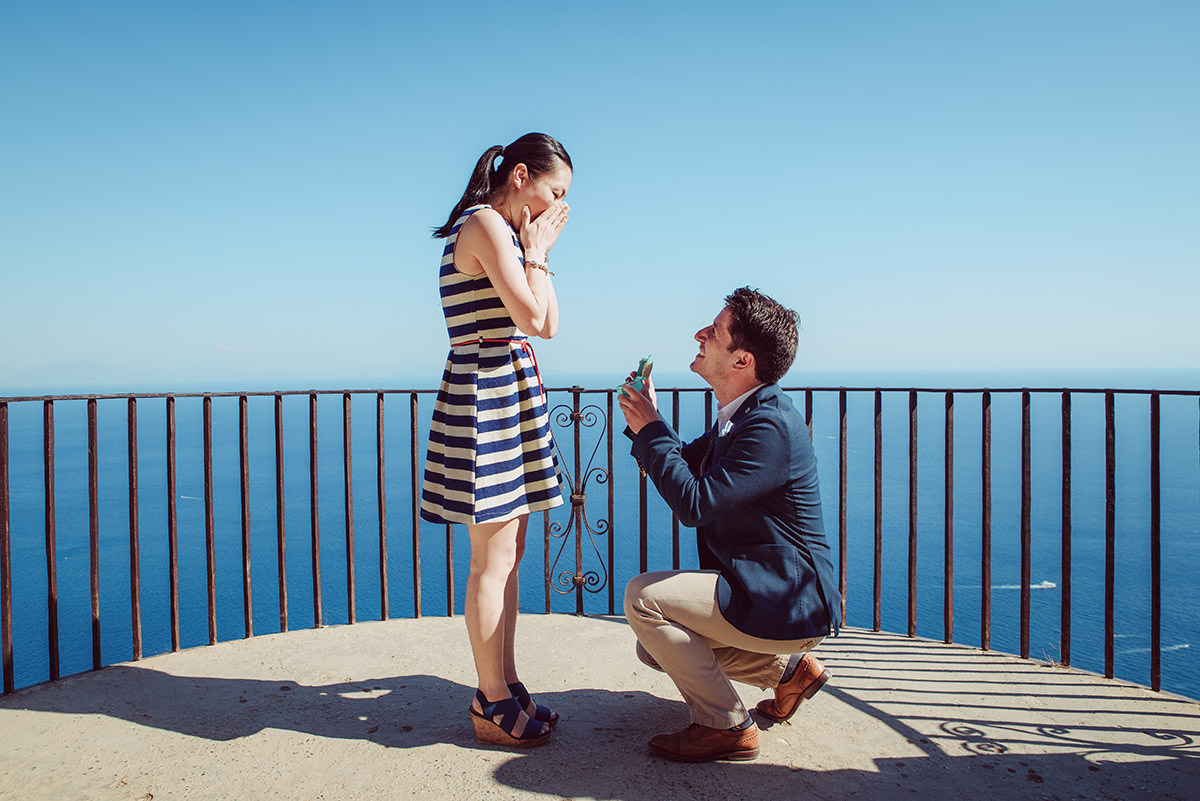
I need two seconds of warning to frame and focus, and no more than that. The signal is something small enough that nobody else would read it as anything: stopping to retie a shoe, pointing at something out at sea, pausing at one specific bench. One client told his girlfriend he had to fix a strap on his backpack, and while she turned to look at the view he had the box out of the front pocket. It does not need to be clever. It needs to be a thing you would plausibly do anyway.
What I Wear So You Can Find Me
The day before, I send you a photograph of what I will have on. Shorts, a hat, sunglasses, a shoulder bag that could belong to anybody. You send me one of what the two of you will be wearing, which matters more than it sounds: at forty meters, in a crowd, in summer, I am identifying you by color and shape and nothing else. Both photographs go on my phone and stay there until the morning. Then you do not look for me, because looking for me is the single most common way a partner works out that something is happening.
Shooting From Forty Meters Without Being Seen
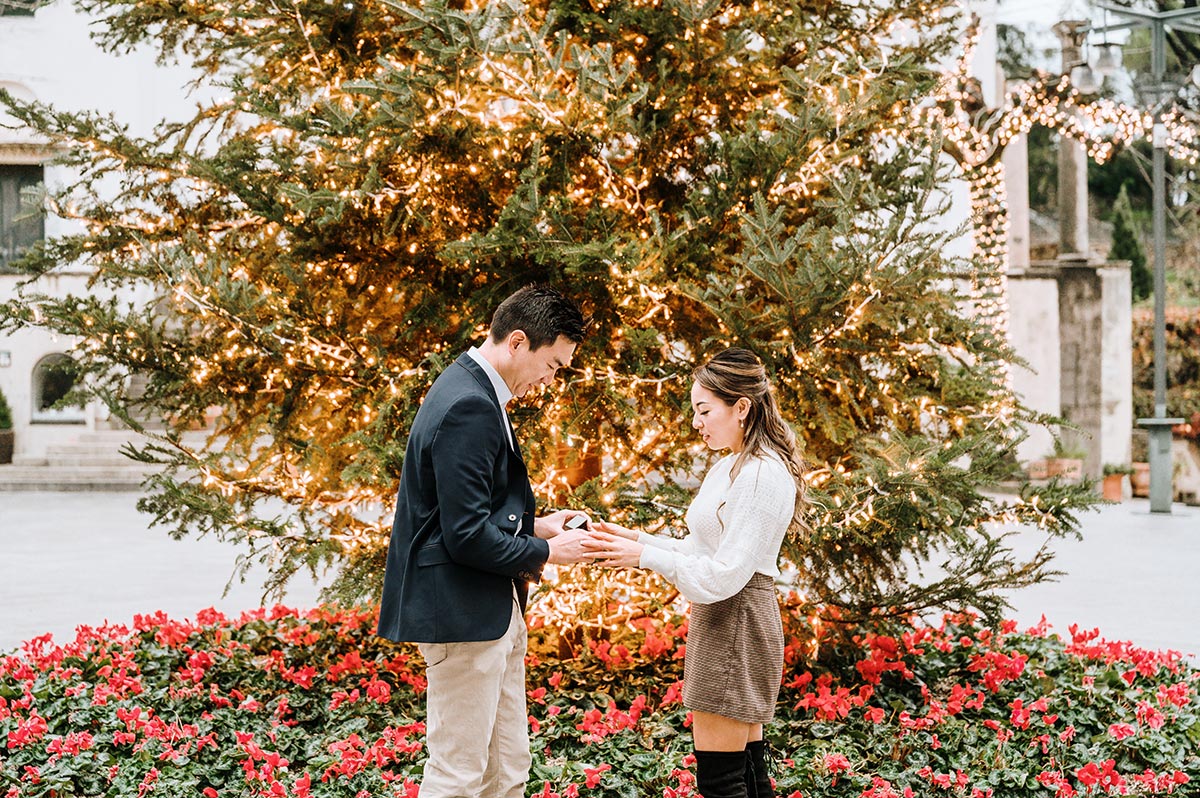
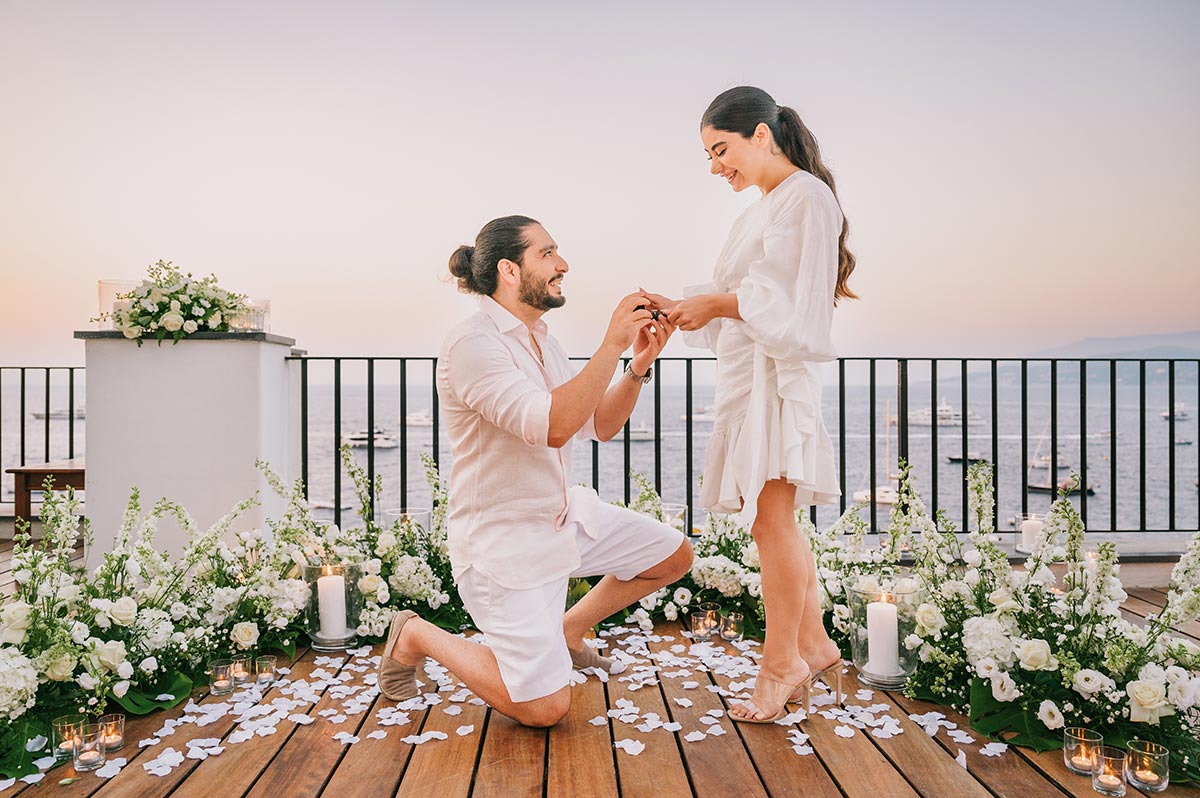
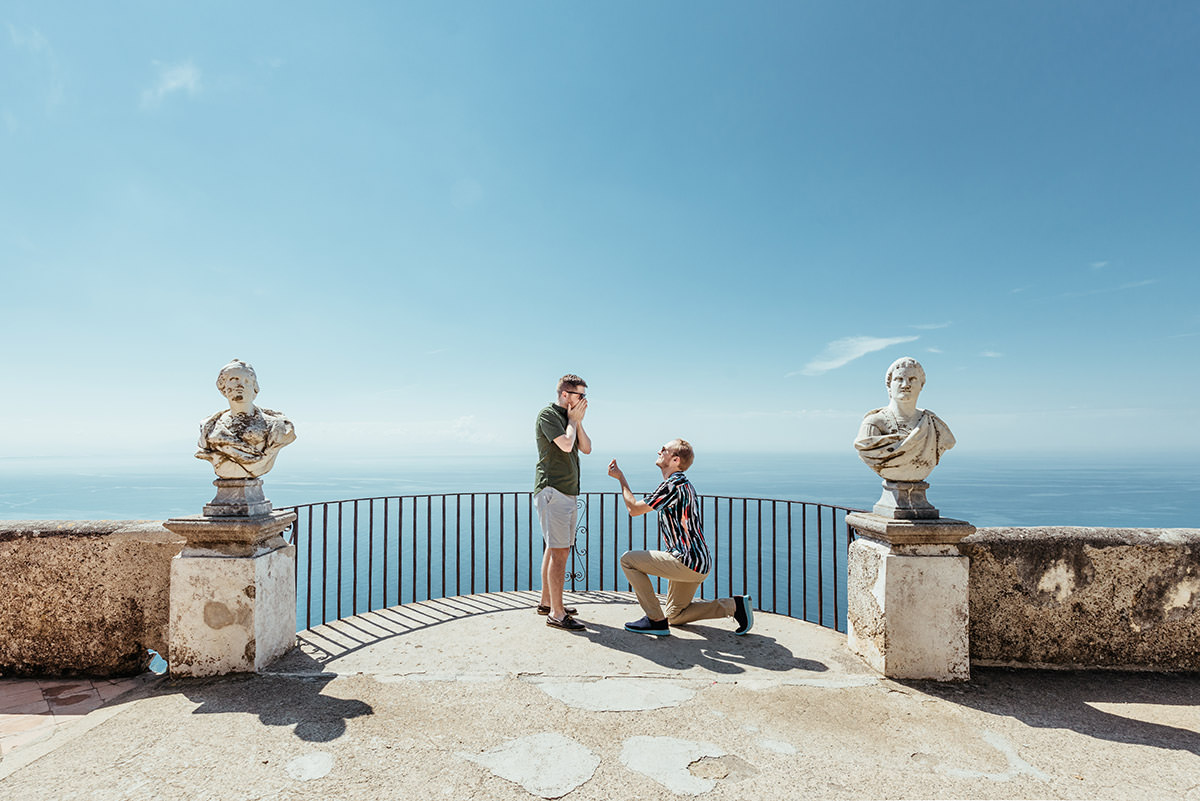
This is telephoto work. I use a 70-200mm, sometimes with a 1.4x extender that takes it to 280mm, which fills the frame with two people from thirty to fifty meters away. A long lens does something useful beyond the reach: it compresses the background into a wash of color, so tourists and parked cars a few meters behind you stop being objects and become texture. Everything in this Villa Cimbrone wedding proposal was made from about thirty meters, and none of it looks like it was.
Why I Never Bring a Tripod
A tripod at a viewpoint announces a professional, and looking professional is the one thing the job does not allow. So I brace. A wall, a railing, a column, the edge of a cafe table, my elbows locked against my ribs. At 280mm a small movement in my hands is a blurred picture, and there is no second attempt at the moment someone kneels down.
The Pedestrian Problem
A stranger stepping into the gap between me and you at the exact wrong second costs me more frames than the distance ever does. I plan for it two ways. I choose positions with elevation, so the line of sight travels over the heads of people at ground level rather than through them, and I keep the shutter running through the whole sequence rather than trying to time single frames. If one second is lost to a passing shoulder, the frames on either side of it are still there.

The Hour I Push Almost Everyone Toward
Early morning, and I say it before anyone asks. Between seven and nine the light is coming in low and sideways instead of straight down, the piazzas and viewpoints are close to empty, and the heat has not started. You get privacy and good light in the same hour, which for the rest of the day you have to choose between.
The obvious alternative is the hour before sunset, and it does produce warmer photographs. It also puts you in the busiest ninety minutes of the day in every town on this coast, with the sun low and directly behind the view, which means either your faces are dark or the sea behind you is white. It is workable and I shoot it often. It is just not the hour I would pick if the only thing that mattered was the pictures.
Midday I argue against. Overhead sun puts shadow in the eye sockets of everyone standing outside, and the reaction on someone’s face is the entire product here. If midday is genuinely the only window you have, we go somewhere with open shade and I plan the position around the shade rather than the view.
April, May and October, When the Piazzas Thin Out
April, May, early June, late September and October are the easiest months for an Amalfi Coast proposal photographer to stay hidden. The reason is crowd density. Fewer people in a piazza means more positions available to me, more clean background, and a shorter walk between where I hide and where you stand. It also means a hotel terrace or a garden is likelier to say yes to a request that in August they simply cannot accommodate. They are the same months I recommend to couples planning a wedding on the Amalfi Coast, for exactly the same reasons.
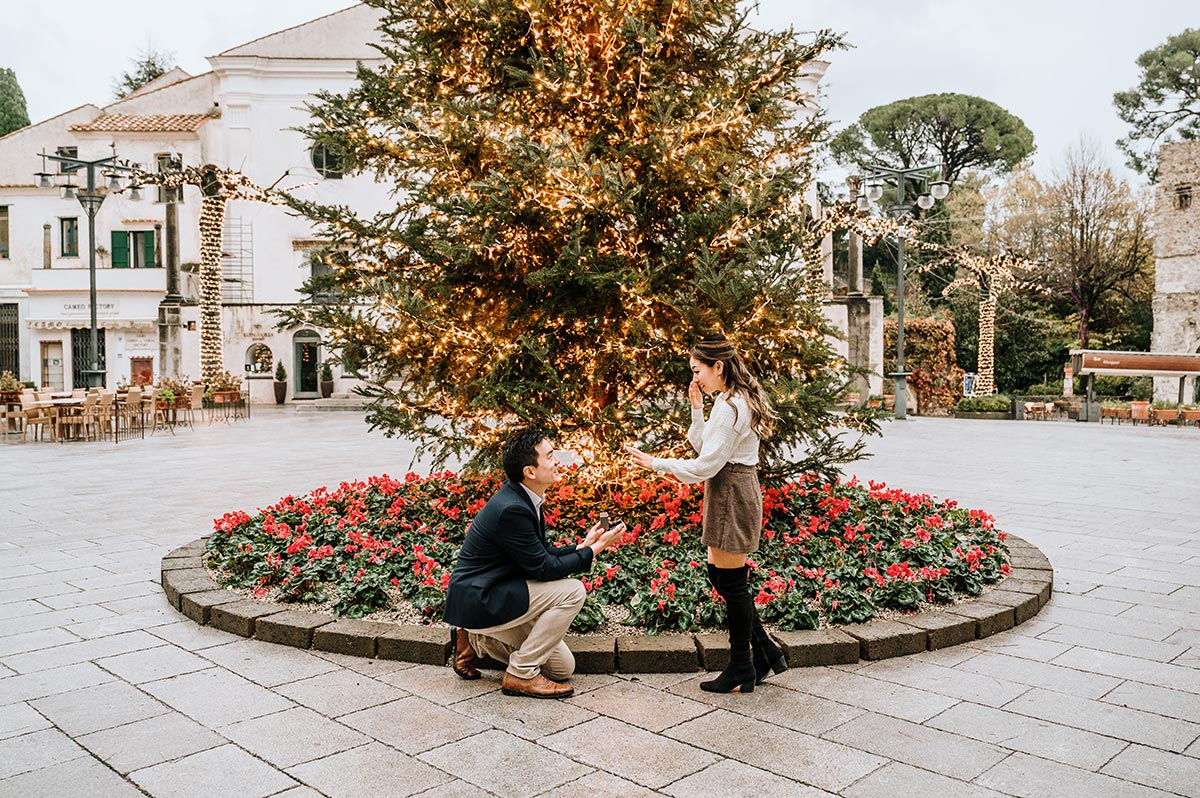
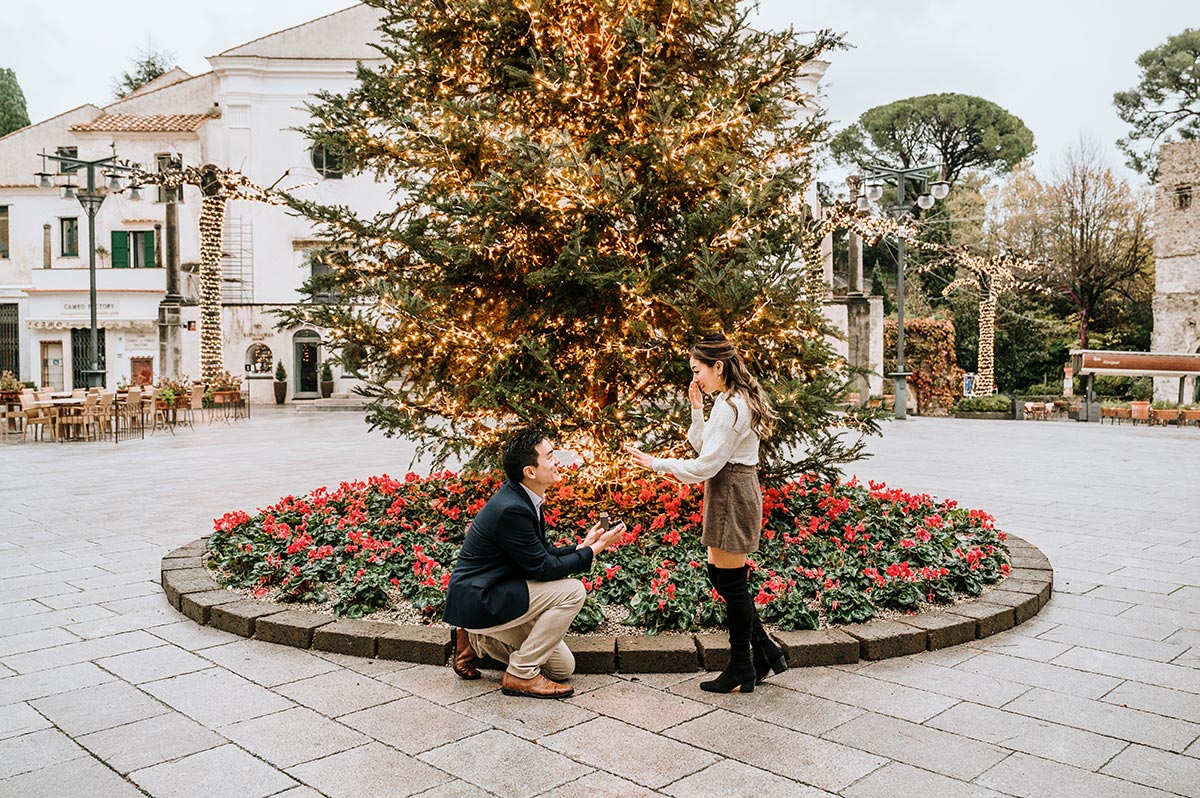
July and August work, and plenty of proposals happen then because that is when people can travel. It just changes my planning: earlier start, smaller and less famous locations, and a firmer conversation about what a recognizable view is going to cost you in strangers. Winter is the quietest of all and the light is excellent, with the caveat that some gardens close and the sea can take a day off the table entirely. Many hotels and restaurants close for part of the season too, so check that yours is open; in December I photographed a proposal under the Christmas tree in Piazza Vescovado, in Ravello, with Villa Rufolo almost empty that afternoon.
Two Logistics Problems That Ruin Proposals
Neither of these is photographic, and both have come close to wrecking a morning I was booked for as an Amalfi Coast proposal photographer. They deserve more attention than the choice of viewpoint, which is where most couples put their planning energy.
Getting the Ring Through Security
Do not carry the box in a pocket. The outline shows, and if it does not show it will appear on a body scanner and an agent will ask you about it out loud while your partner is standing next to you putting her shoes back on. The ring goes in the carry on, out of its box, wrapped inside a sock or a rolled shirt. Several clients have brought a flat silicone travel case instead of the original box, which takes up almost no space and has no recognizable shape. Keep it in the bag that does not leave your shoulder, and do not put it in checked luggage on a route that connects.
Why I Tell Nobody to Drive Themselves That Morning
The SS163 is two lanes cut into a cliff, with blind curves, buses that need the whole road, and no shoulder to speak of. If you have never driven it, you will arrive with your hands still shaking and your head still on the road. Book a driver, take the ferry, or use the SITA bus, and give yourself an hour more than the map suggests. I can put you in touch with drivers I use. Arriving early and bored is the correct state to be in.
When I Stop Hiding and Walk Over
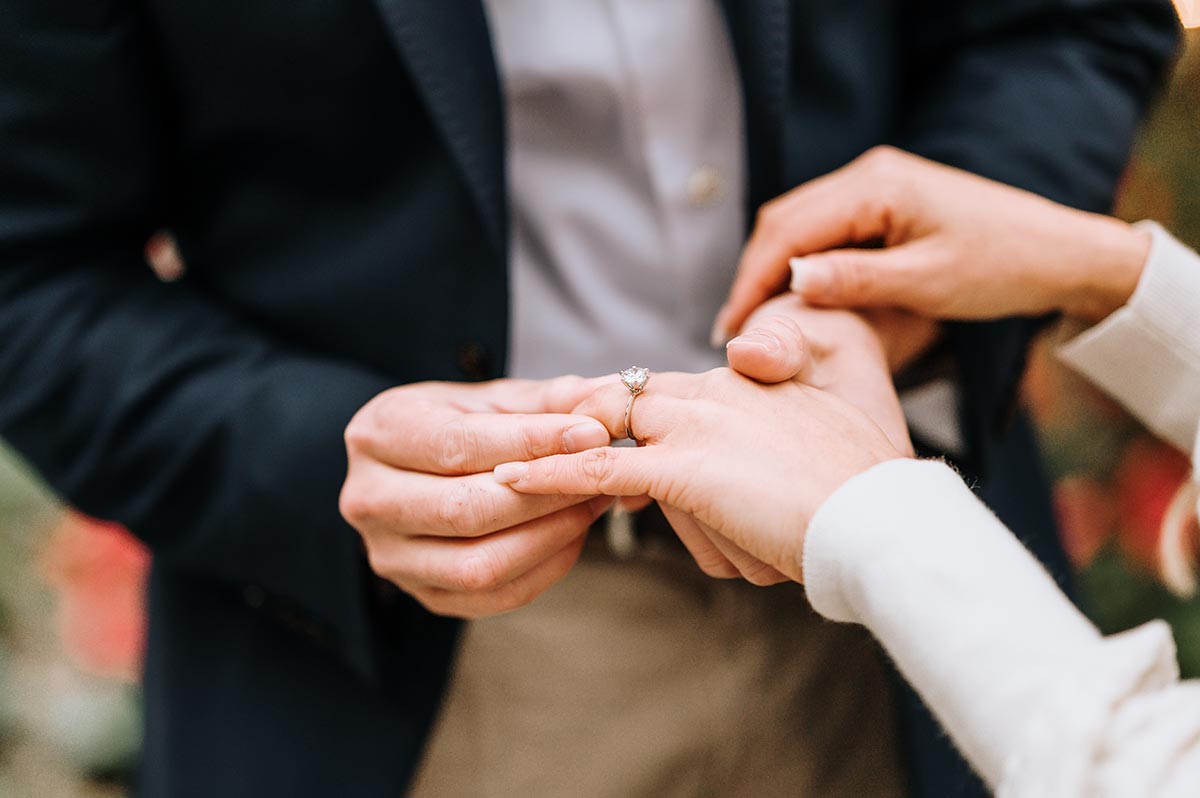
The ring is on, one or both of them are crying, and they are standing there holding each other and looking at a hand. I give it thirty seconds, then I walk over and introduce myself and explain that this was arranged weeks ago. There is usually a beat of confusion, then laughing, then more crying. Then somebody calls their mother, and I have watched hundreds of those phone calls: the voice goes on the second sentence, every time.
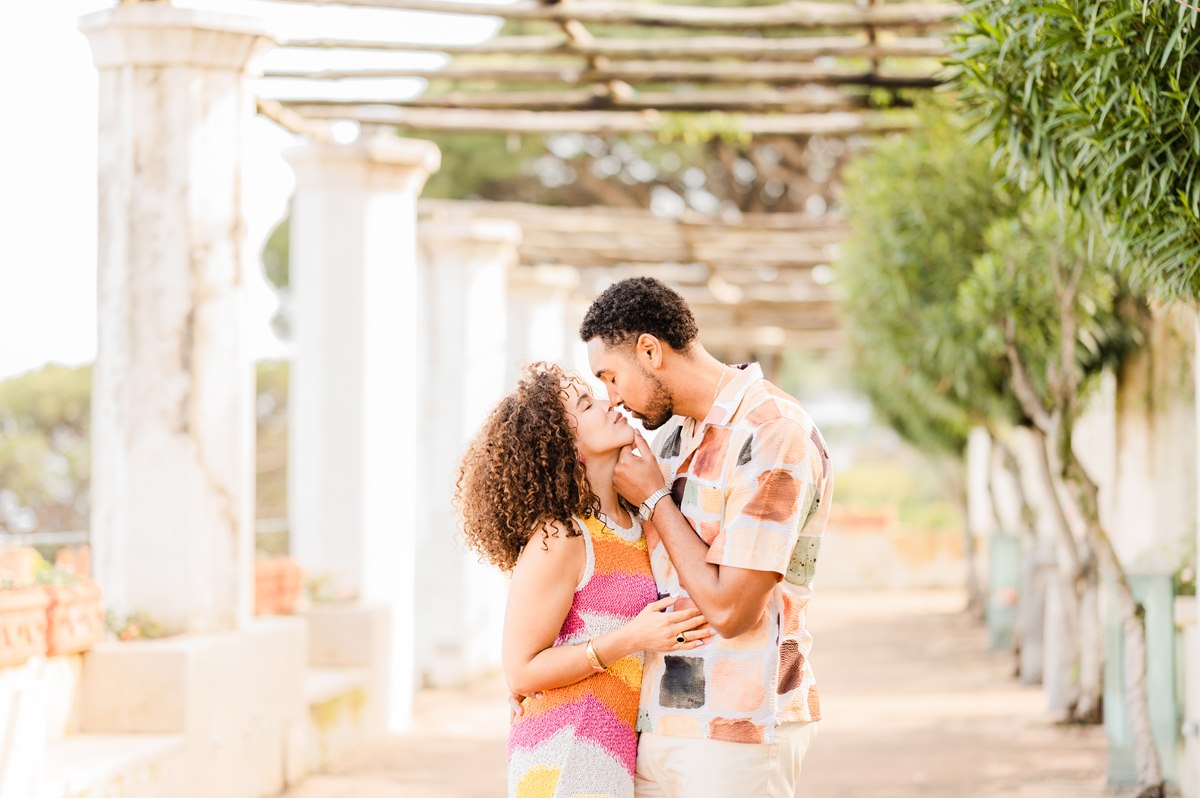
After that we shoot properly, for sixty to ninety minutes. The energy in that hour is unlike anything I get from a planned session, because nobody is composed and nobody is thinking about their posture. They laugh too loudly, they cannot stop looking at the ring, they keep grabbing each other. I do not settle any of it down. Those frames are the most honest work I produce in any part of my job, and you can see how that hour tends to go in this Hotel Caruso wedding proposal.
What I avoid is a car ride. The instinct after a yes is to go and see three more towns, and the reality is that both of you are running on adrenaline and will be flat within the hour. We stay where we are and work with the streets around us. If you want a second location in different clothes, it belongs to the afternoon or to another day.
What an Amalfi Coast Proposal Package Includes, and What It Costs
Hiring an Amalfi Coast proposal photographer is priced differently from booking a wedding, because the shape of the work is different: weeks of planning, a short window of shooting, and then a portrait session that is decided on the morning itself rather than scheduled months out.
What is in it as standard: the planning of the shoot, on the private channel, for as long as it takes; my scouting of the specific position at the specific hour, which for a location I have not shot in a while means going there beforehand; the proposal itself; and the portrait session immediately after. Delivery is the full edited gallery within fifty days at the outside, and if you want a few photos sooner, to send home while everyone is still asking, tell me and I’ll send a preview first.
What sits outside it: coverage of a celebration dinner afterward; boat hire, when the plan involves being on the water; and any setup with flowers or candles, which goes through my planning service with its own quote and with each supplier’s cost on top.
Two numbers, and the only thing separating them is how many cameras are pointed at the moment. A proposal on this coast starts at 1,800 EUR with a photographer and an assistant, and that is the version I recommend: one of us holds the tight frame on faces while the other keeps the wide view of the place, so nothing gets traded away in the few seconds that matter. One photographer alone costs 20% less, and on a quiet spot with a simple plan it can work. The photography packages page carries the wider structure, and boat and dinner are quoted per plan rather than listed, because they change with the town and the hour. Outside the Amalfi Coast, on Capri or anywhere else in Italy, my travel and accommodation are already inside the figure.
Dates, and What I Need From You to Start
Write with the dates you are on the coast rather than a single fixed day. Almost every proposal I have shot has moved by at least a few hours between the first message and the morning itself, usually because of weather or because a ferry timetable turned out to be different from what a website said. Two candidate mornings is the most useful thing you can give me.
Then: where you are staying, whether you have a driver, who else is traveling with you, and anything your partner has said out loud about places she wants to see. If a wedding is already the next step in your head, say that too, since a good share of the couples I photograph proposing here come back for an Amalfi Coast elopement within the year, and I would rather hold the two conversations together. That last one is the most valuable sentence in the whole exchange, and it is the reason I ask for it. If she has already mentioned a garden, the plan builds itself and the cover story writes itself with it.
Three weeks is the minimum that lets me do this properly, and it is much shorter notice than an Amalfi Coast wedding planner would ever accept for an event, which is one of the few advantages a proposal has. Six to eight weeks is comfortable, and between May and October it is what I would aim for, because the mornings go before the afternoons do. Couples on Capri and the islands should allow more, since the crossing has to be built into the timing as well, which is the sort of thing that shapes a whole plan in a Capri wedding proposal.
Send me the dates you are on the coast and the name of your hotel, write to me, and tell me what she has been talking about.
Six questions
Permits, Boats, Terraces and Shorter Bookings for a Proposal
Permits on beaches and gardens, a boat, the Terrace of Infinity, a restaurant dinner, your own hotel terrace, and booking only the moment.
Do we need a permit to propose on a beach or in a public garden?
Asking the question needs no permit. Photographing it sometimes does, and the rule belongs to the place: in Ravello the Giardini della Principessa di Piemonte let me take portraits freely as long as nothing is set up, while Villa Cimbrone sets its own fee for a professional shoot. An arch of flowers or a row of chairs on a public beach turns the moment into an event, and an event needs the town’s permission.
Can we get engaged on a boat?
You can, but I’d ask the question on land. On a small deck my team has nowhere to hide unless your partner thinks it’s an ordinary couple session, and then half the surprise is gone. Propose on land, then go out on the water with nothing left to hide.
Can I propose on the Terrace of Infinity at Villa Cimbrone?
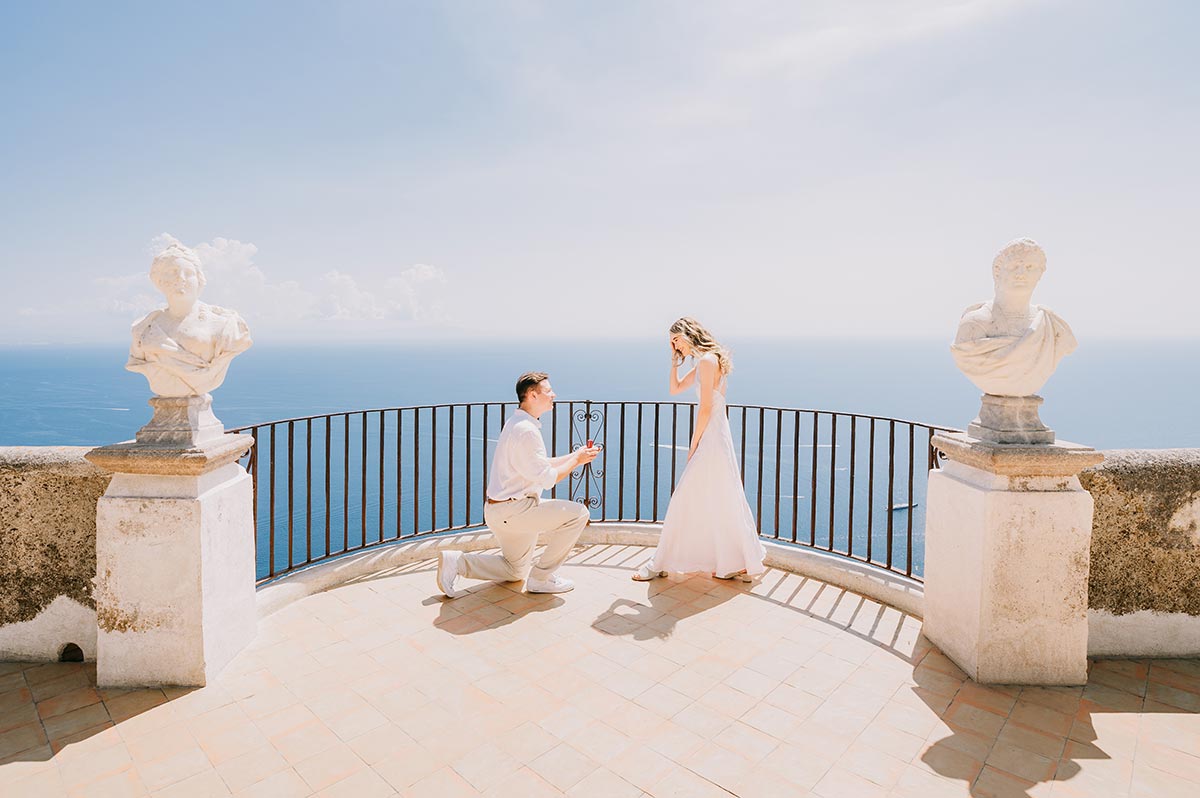
You can, with three things known in advance. The villa is private and sets its own fee for a shoot, so you write to them first; it books proposals only from January of the same year; and the terrace stays open to visitors, so the only quiet window is from 7 to 9 in the morning, at the full fee. If an audience doesn’t bother you, the afternoon light there is beautiful.
Can I propose during dinner at a restaurant?
Yes, if the restaurant agrees, since it’s private premises and the owner decides where I can stand. I’d still suggest asking on its terrace before you sit down, while there’s light, because a dim dining room hides faces; the dinner itself, if you want it photographed, is priced on its own.
Can I propose on our hotel room’s terrace?
Yes, your terrace is yours. The question is where I stand: I need a spot the hotel lets me use, often another terrace or the garden facing yours, and that’s agreed with the hotel in advance. Some hotels, the Caruso among them, don’t let a room alone open the rest of the property to a photographer.
Can we book just the proposal, without the portrait session after?
You can keep the session after as short as you like, but the price doesn’t change, because most of what you pay for is the planning and the scouting before the day, and a short session still needs all of it.

MORE PROPOSALS ALONG THIS COAST
OTHER COUPLES WHO ASKED ON THE AMALFI COAST



 Written By Emiliano Russo