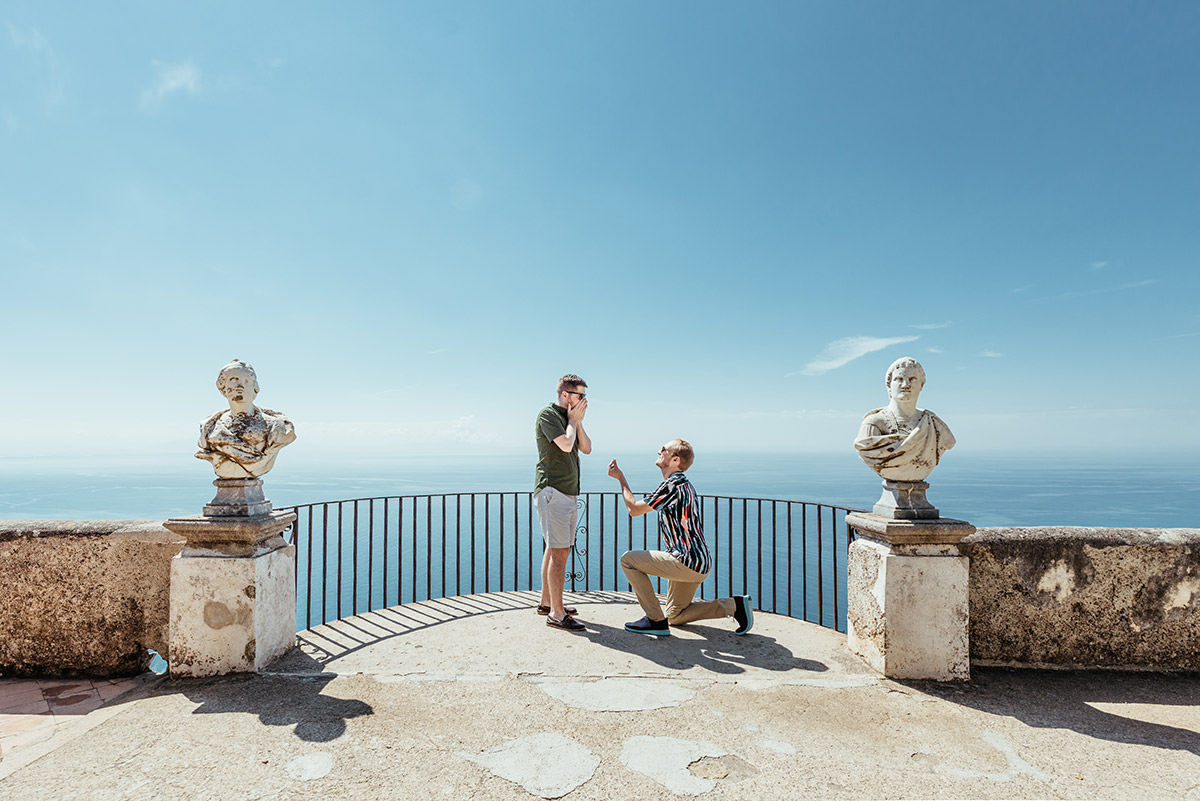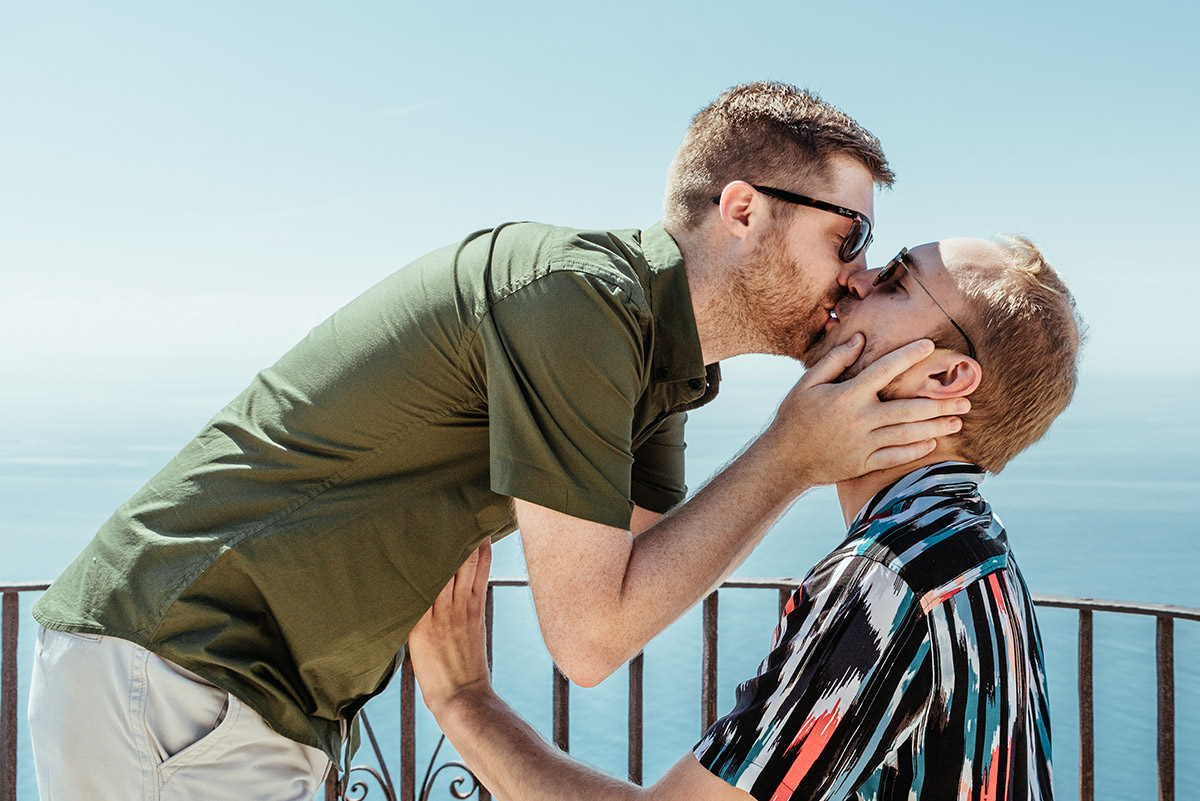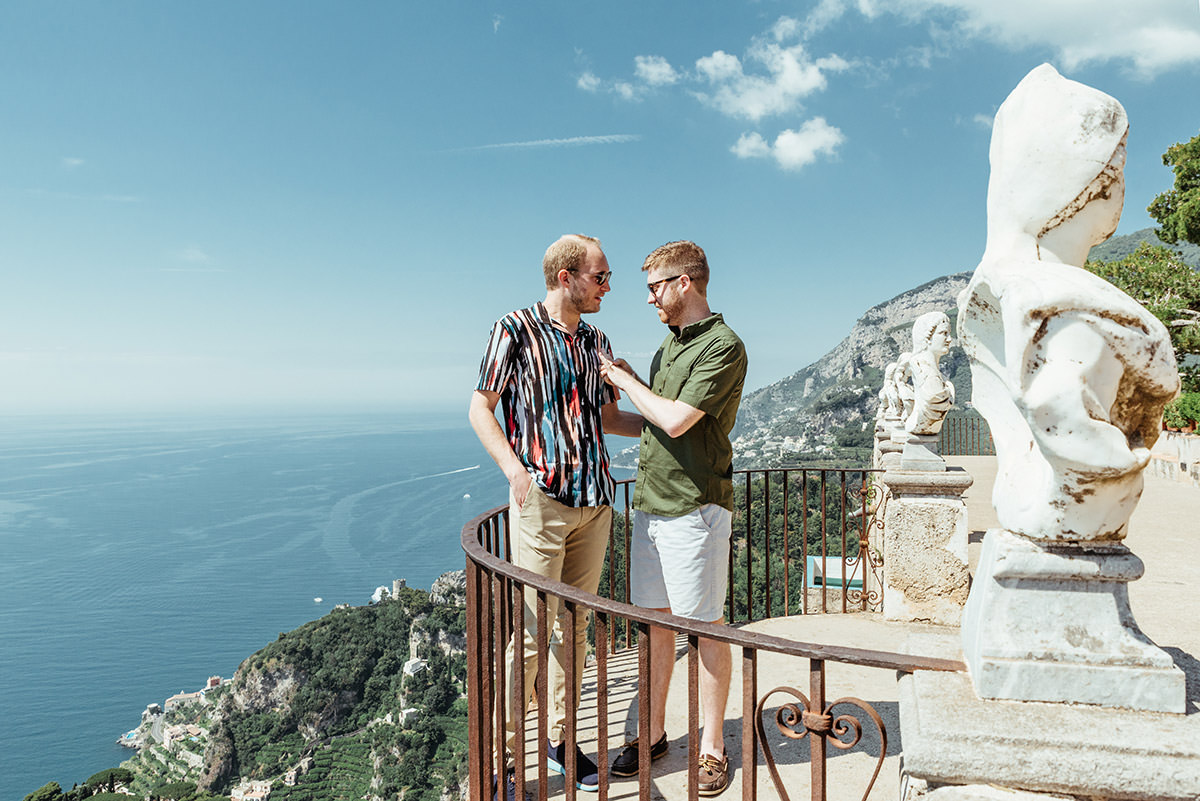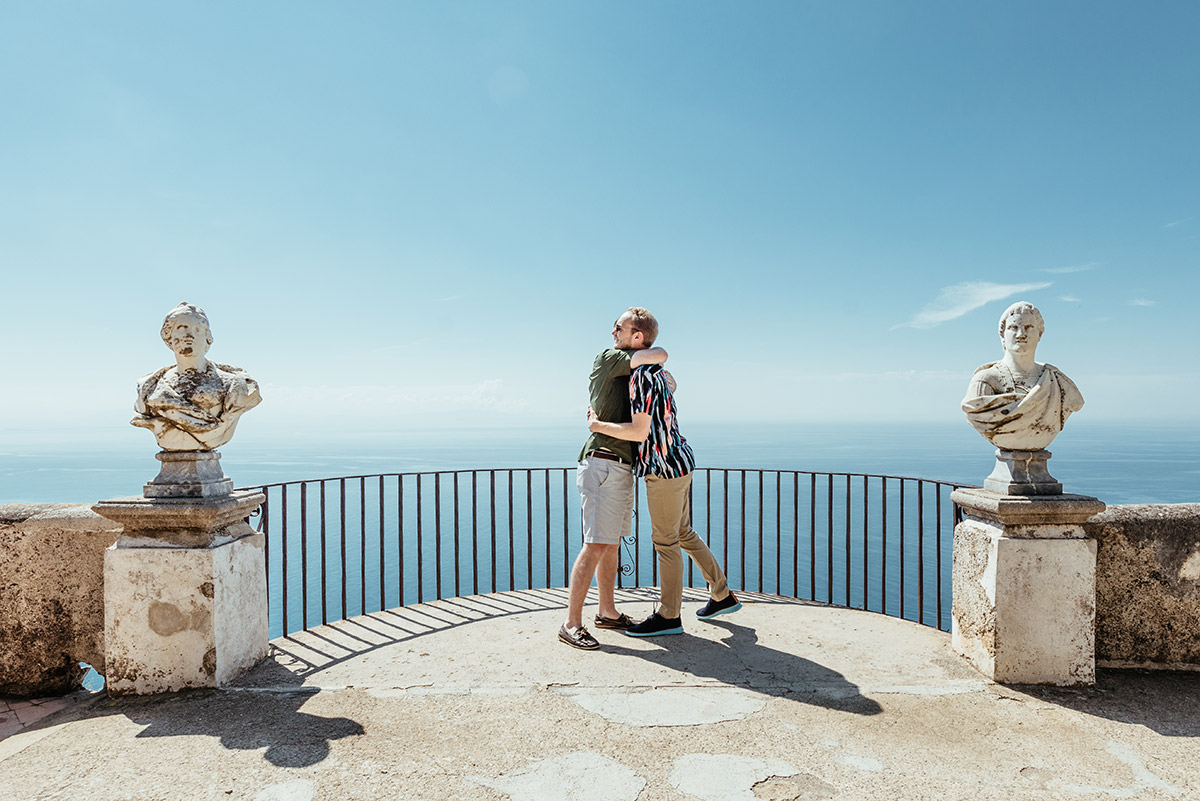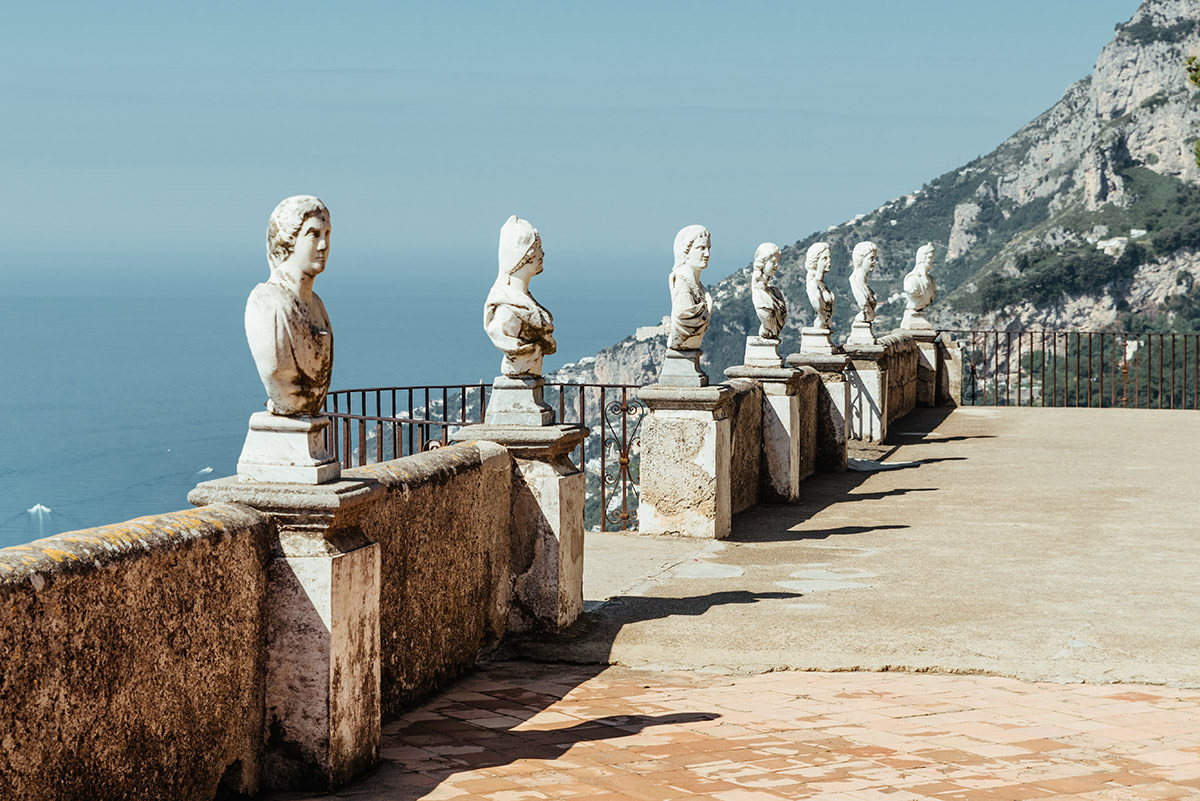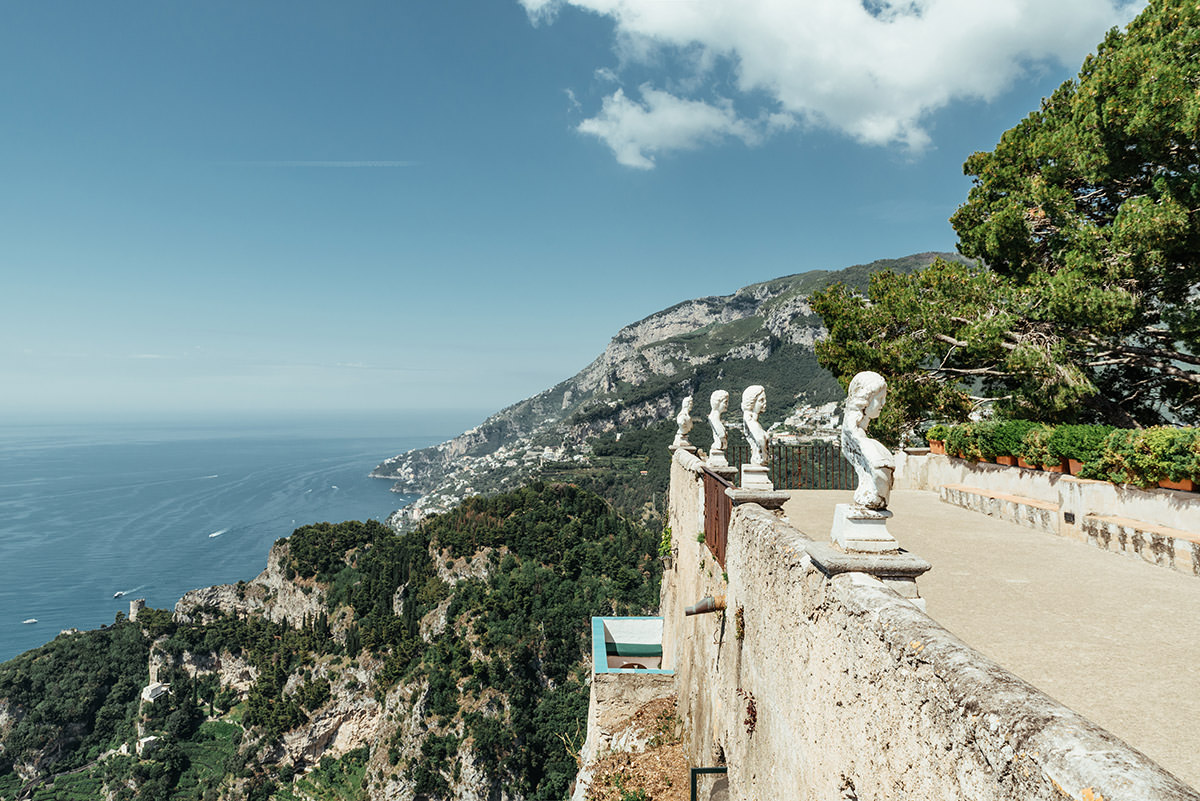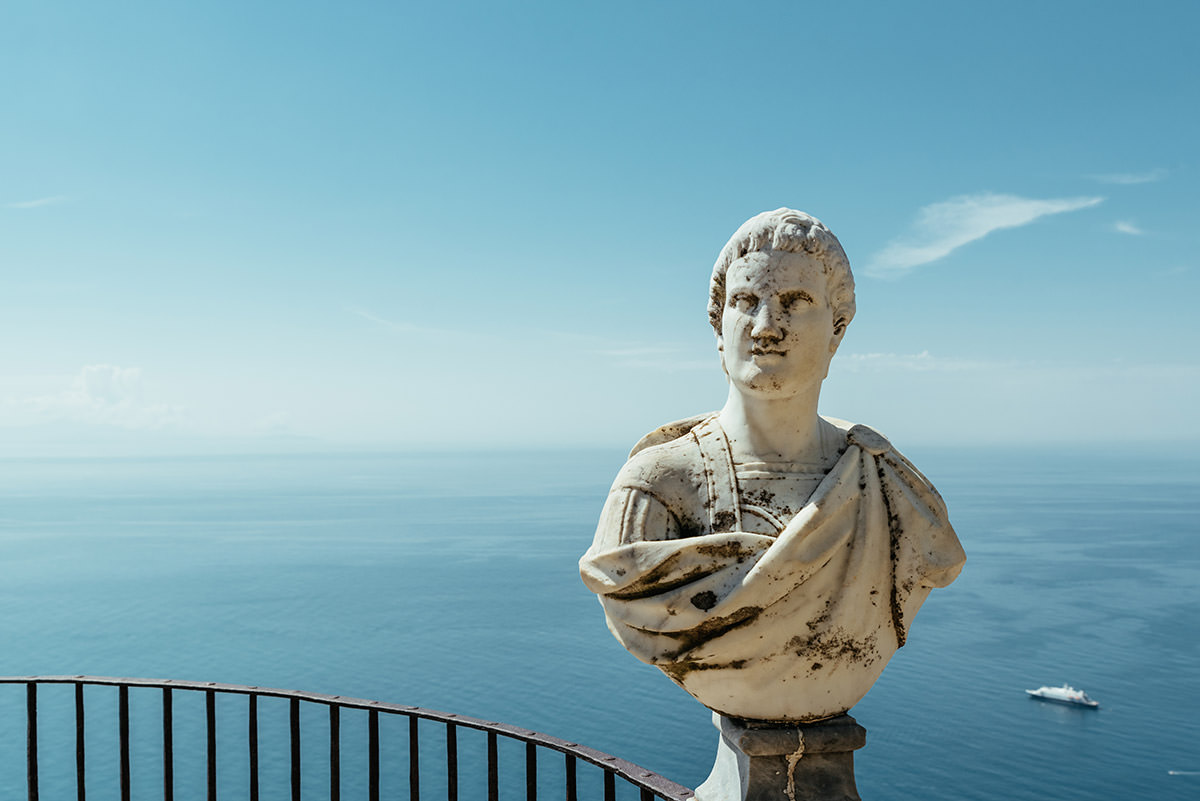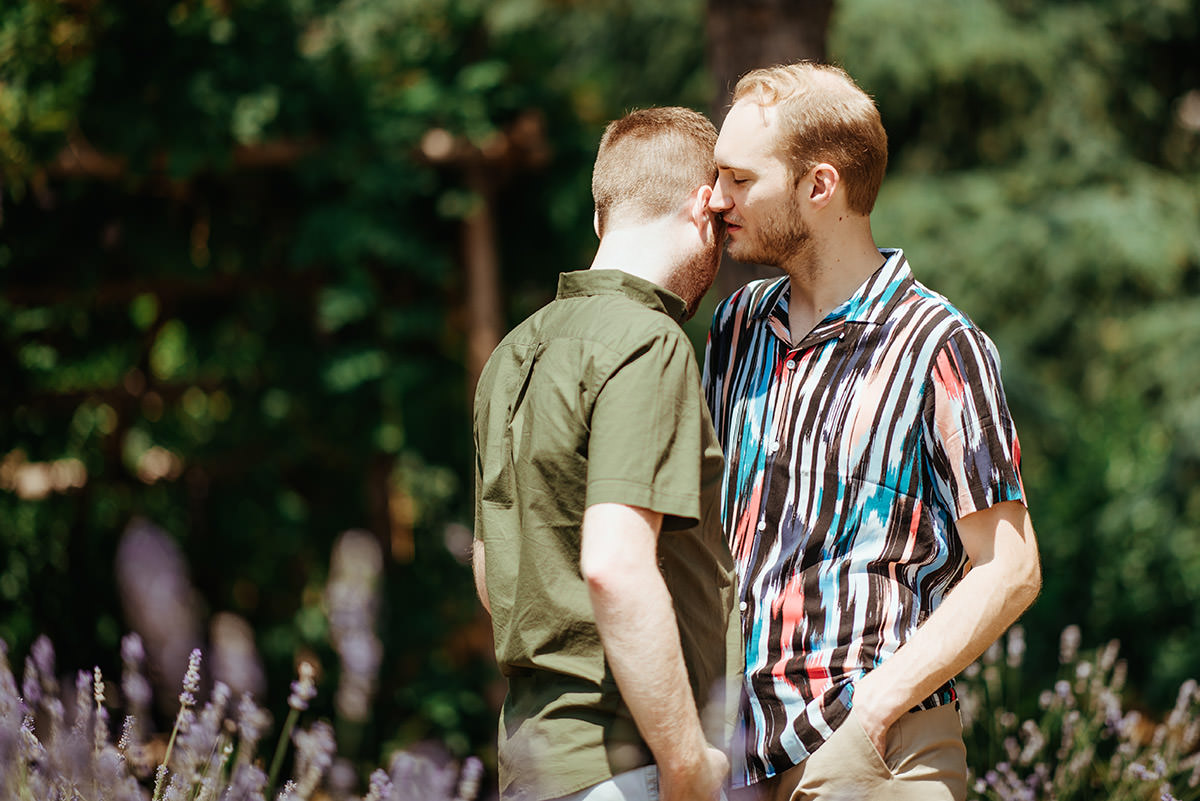
The morning light on the Villa Cimbrone balcony at 9:15 AM in June falls from the left side, low enough to carve shadows across the marble busts that line the railing, warm enough to turn the stone gold. I was standing in the doorway of the garden entrance with a 70-200mm f/2.8 at 135mm, close enough to read body language, far enough to stay invisible. One man led the other to the stone railing. They looked at the sea. He reached into his jacket pocket, pulled out a small box, and dropped to one knee on the terracotta floor between two busts overlooking the Mediterranean.
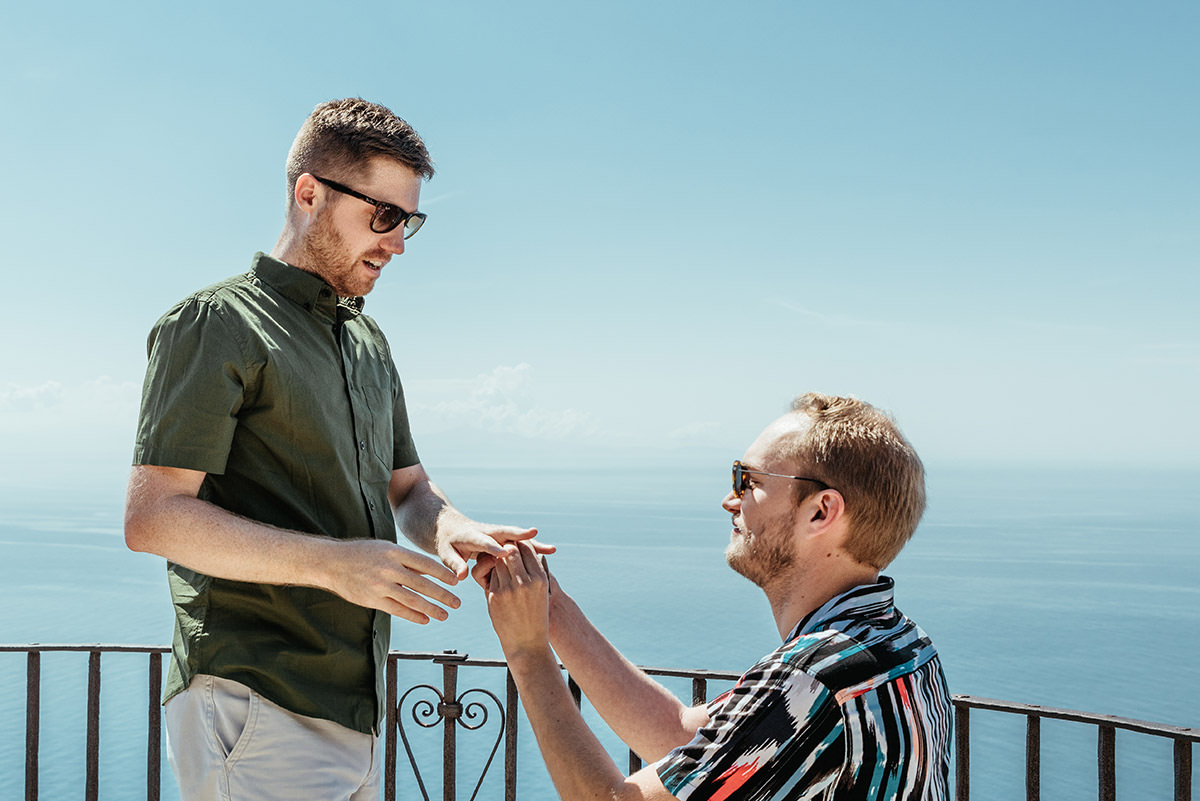
The man standing had his back to me. His partner was facing the sea, looking up at him. Then the box opened. His hands went to his face, and his shoulders started shaking before any words came out. I shot sixteen frames in that sequence. The one I keep coming back to is the wide frame: one man kneeling, the other standing with his hands pressed against his mouth, the busts watching from their pedestals on either side, and the sea filling the entire background from railing to horizon. No tourists in the frame. No clouds. Just stone, two people, and the flat line of the Mediterranean cutting across the top third of the image. It is one of the spots I return to most often when a couple asks me where to propose in Ravello, alongside the others covered in my Ravello proposal guide.
How Morning Light Works on the Cimbrone Balcony
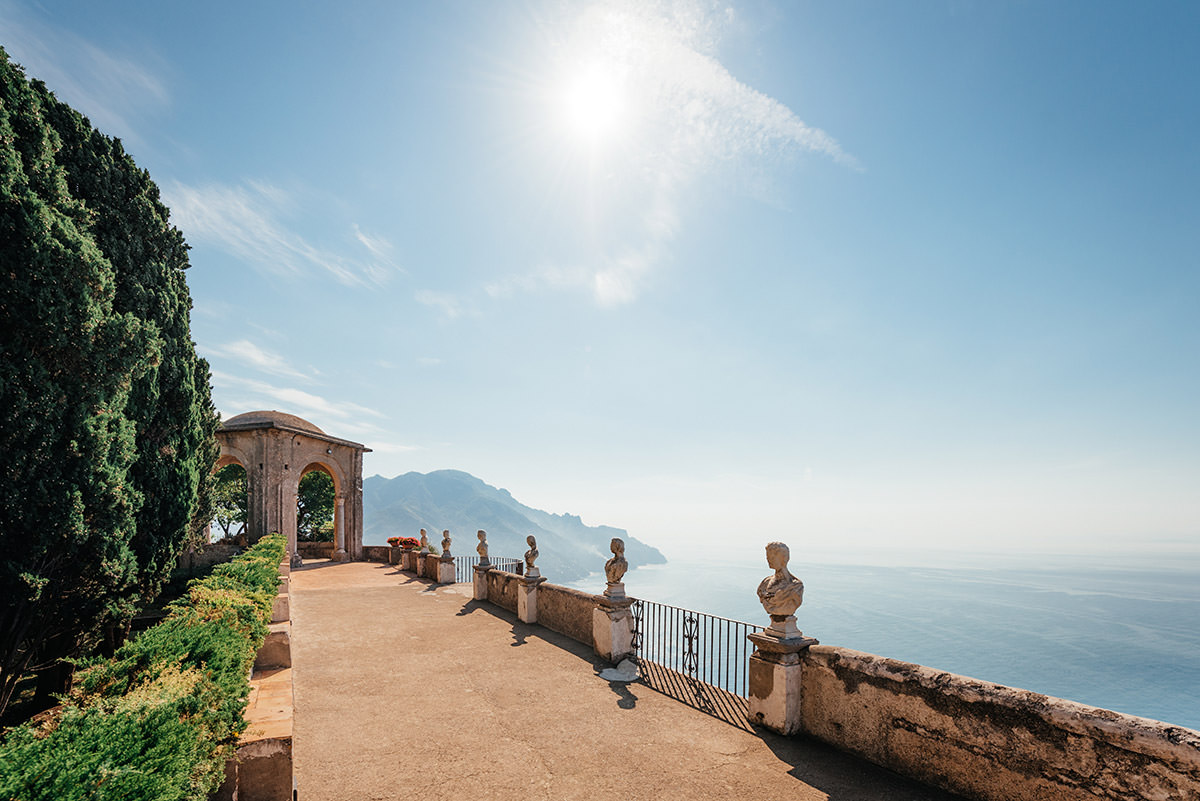
I recommend mornings for every engagement proposal at Villa Cimbrone for two reasons: fewer visitors and better light. The afternoon sun at Cimbrone hits the balcony from behind, which means your faces become silhouettes against a bright sky. In the morning, the sun rises over the mountains to the east and lights the couple from the side or front, depending on where they stand along the railing. At 9:15, the light angle creates a warm side-light that separates faces from the background without hard shadows under the eyes.
For this session, the couple chose a Tuesday. Villa Cimbrone opens at 9:00 AM, and between 9:00 and 10:00 on a weekday, the balcony has maybe five or six visitors at any given moment. Compare that to 3:00 PM on a Saturday, when you might share the railing with thirty people and their selfie sticks. I arrived at 8:55, entered as a visitor, walked directly to the garden entrance near the balcony, and positioned myself where the path curves before the open terrace. When the couple walked past me, I was pretending to photograph a bust. They did not look twice.
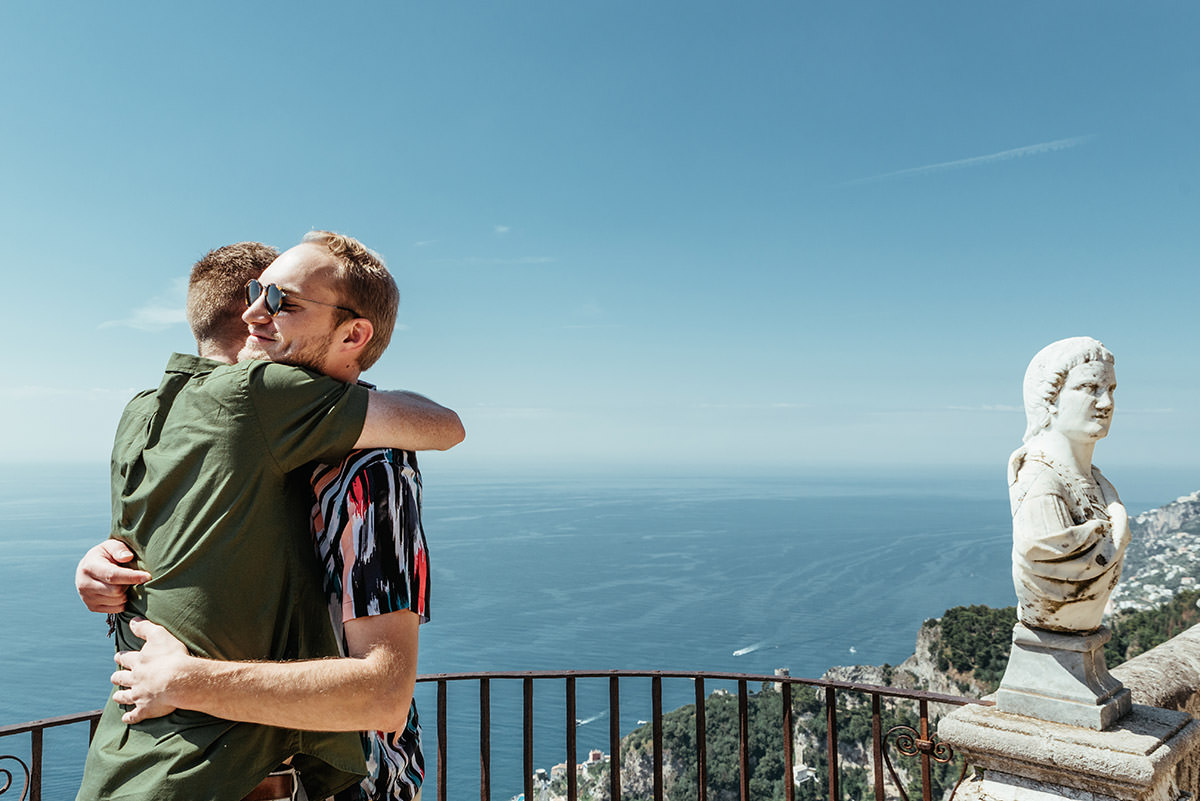
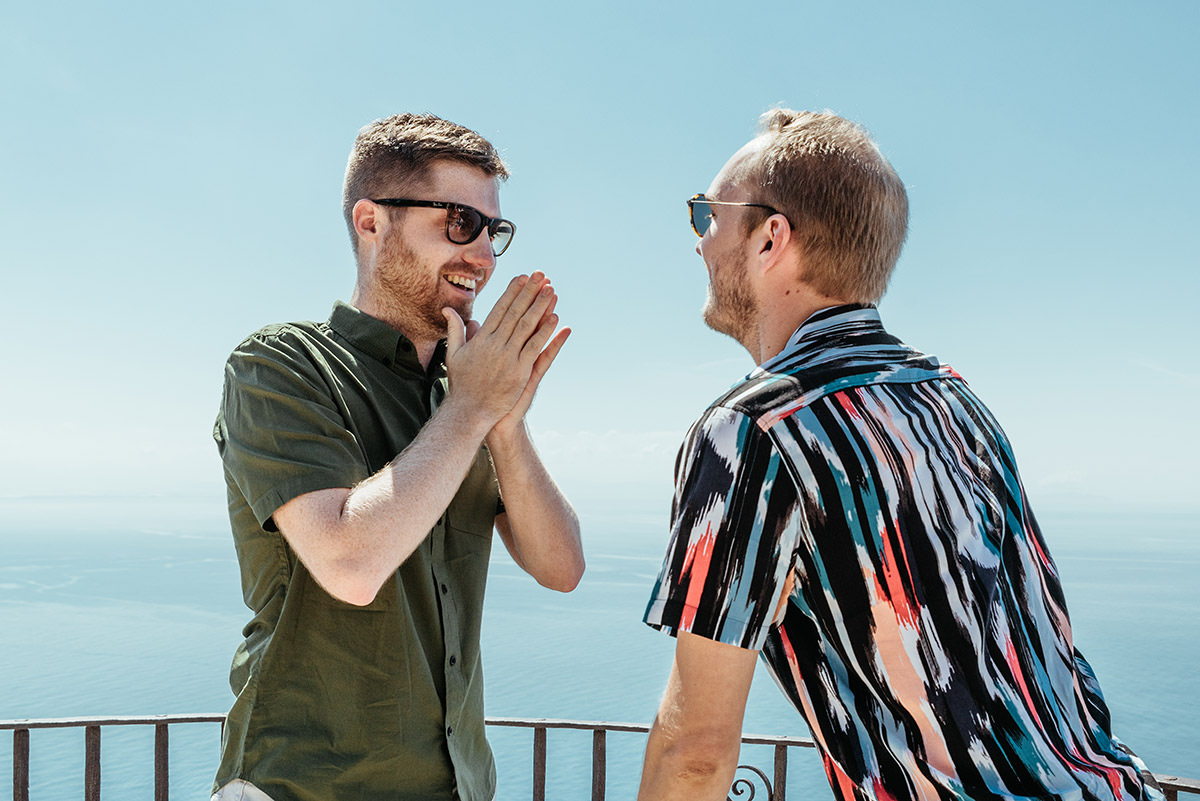
The proposal itself lasted about twenty seconds. After the ring went on, they stood at the railing and held each other, looking at the coast below. I stayed in position and kept shooting at 200mm. Post-proposal frames at a distance have a specific quality: the relief, the laughter that comes out in short bursts, the way one person keeps wiping their eyes while the other holds them steady. These frames are honest because the couple forgets there is a world behind them. I shot for about five minutes before I walked over and said hello.
Inside the Cloister
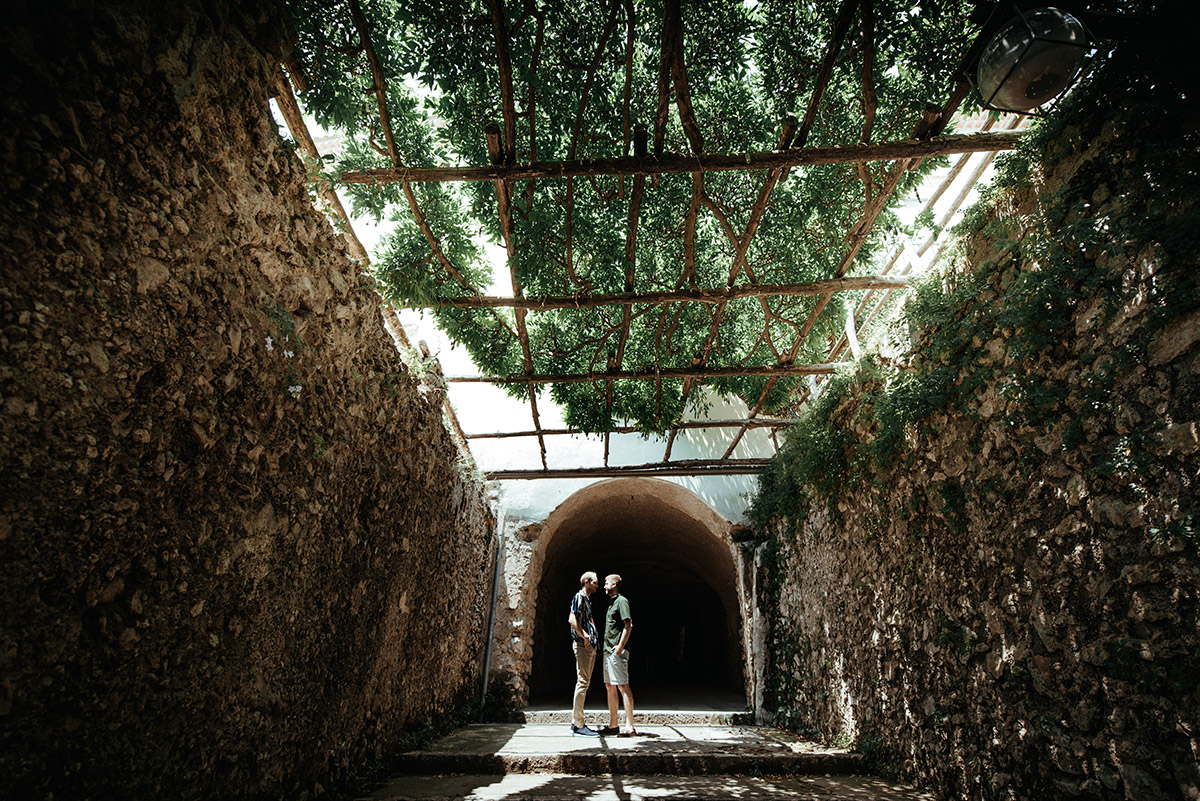
After the introduction, we moved into the Moorish-style cloister deeper inside the Villa Cimbrone gardens. This is the section most visitors walk through quickly on their way to the balcony, but for photography it has something the terrace does not: controlled, even shade.
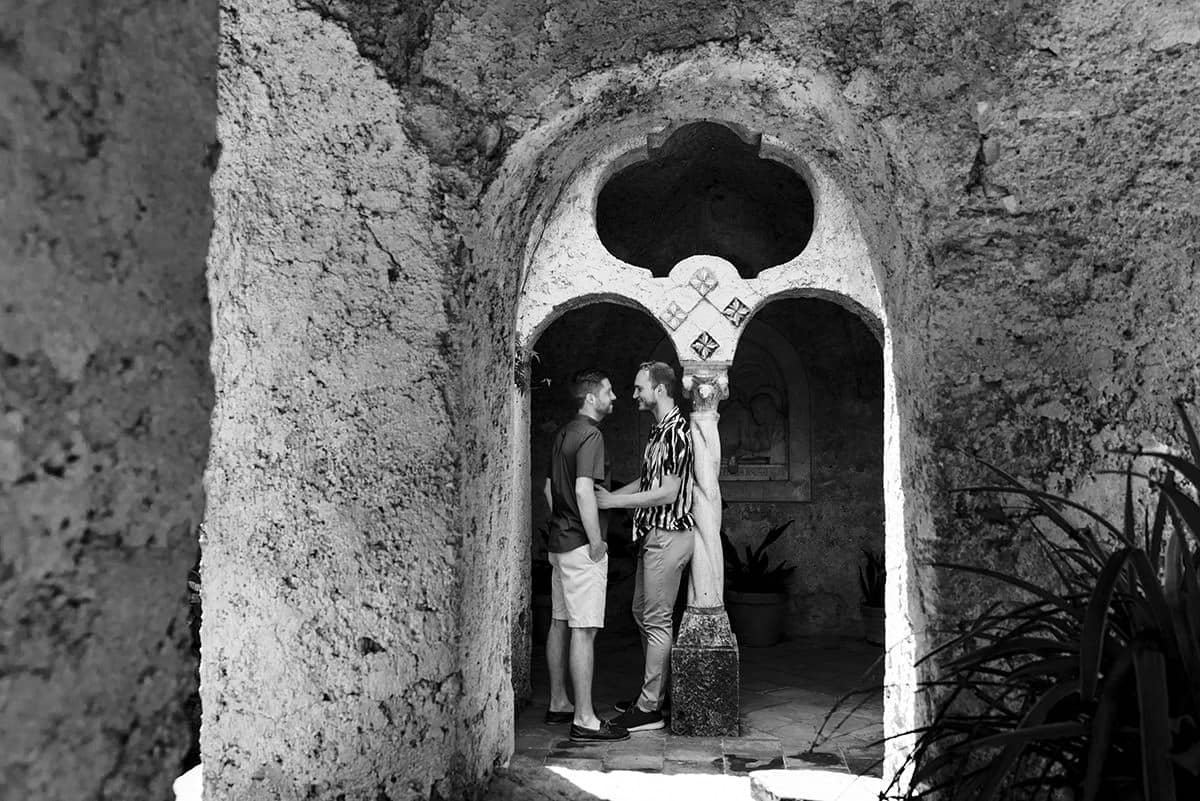
The cloister is built around an ancient stone well. Ornate columns support arched openings on all sides, and the thick walls block direct sunlight while letting in diffused ambient light from the open center. The result is soft, directional illumination with no squinting, no harsh shadows, no overexposed sky competing with the exposure on the faces. I switched from the telephoto to a 35mm f/1.4 for this section. At f/2.0, the columns behind the couple fall into a smooth blur while their faces stay sharp, and the interplay between the focused foreground and the soft architecture creates depth that a plain wall or a flat background cannot provide.
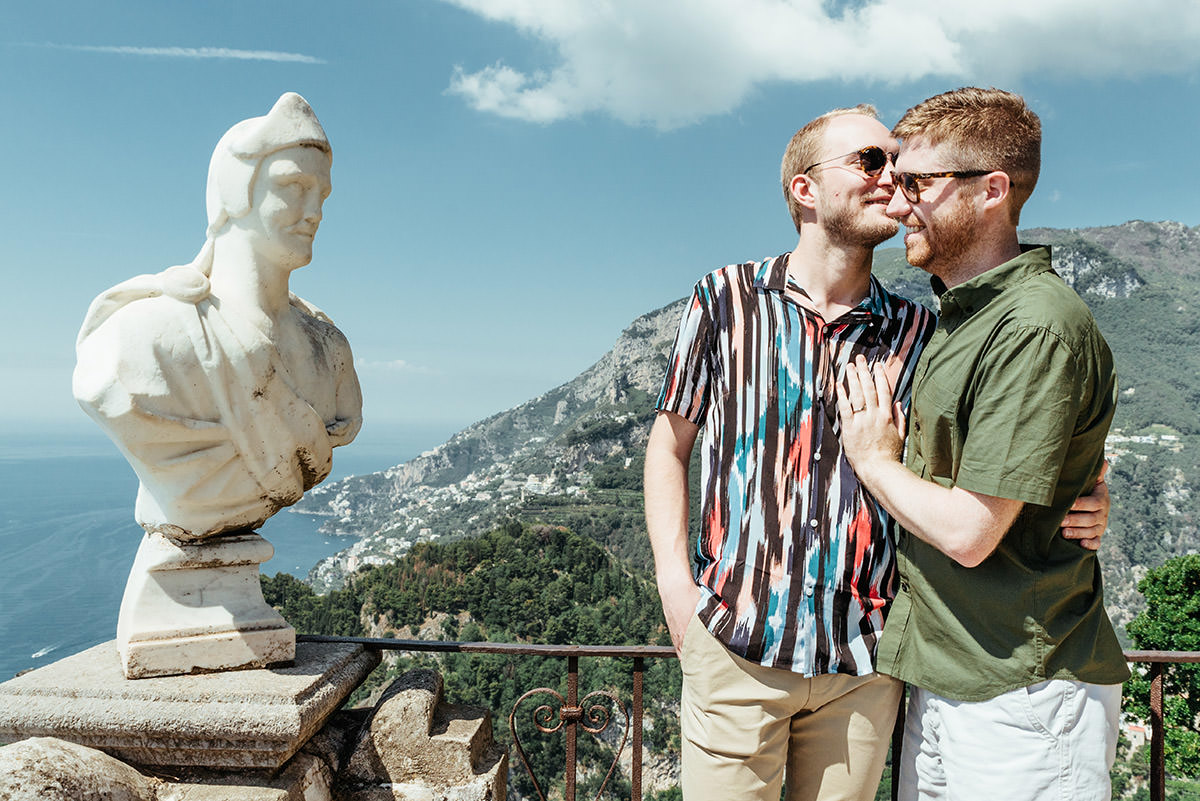
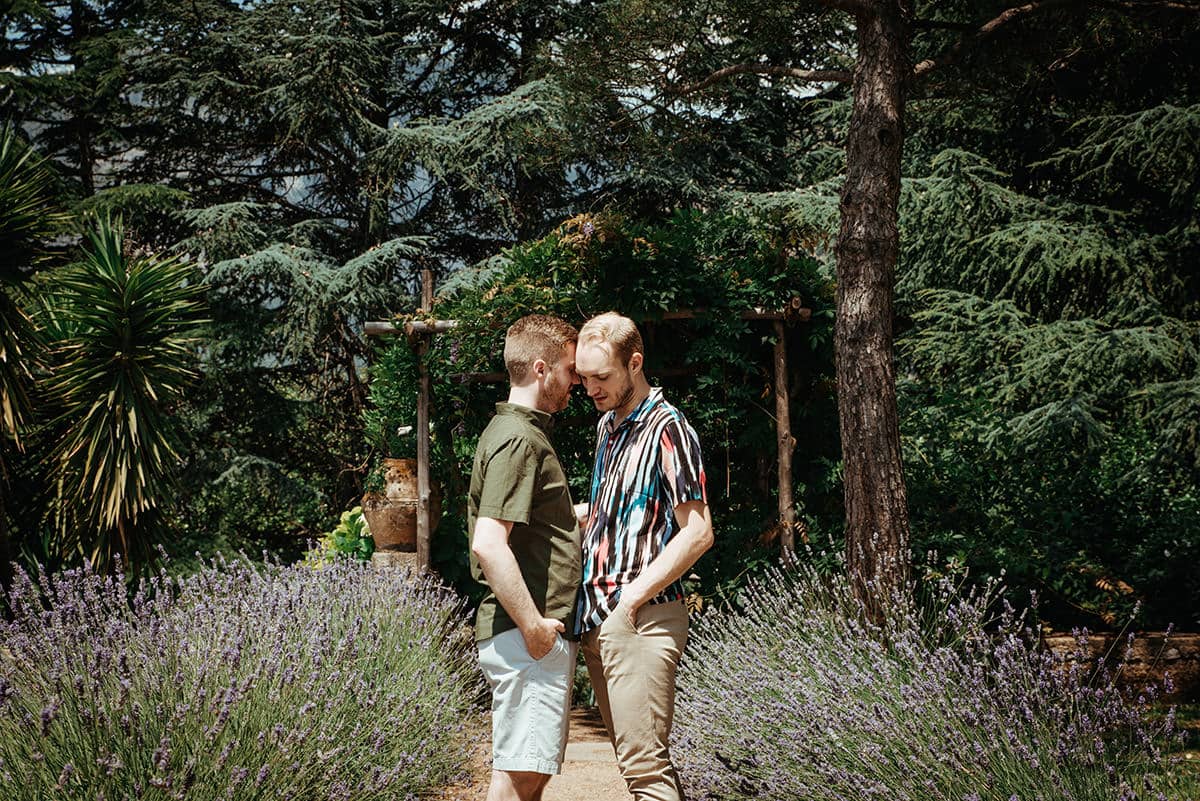
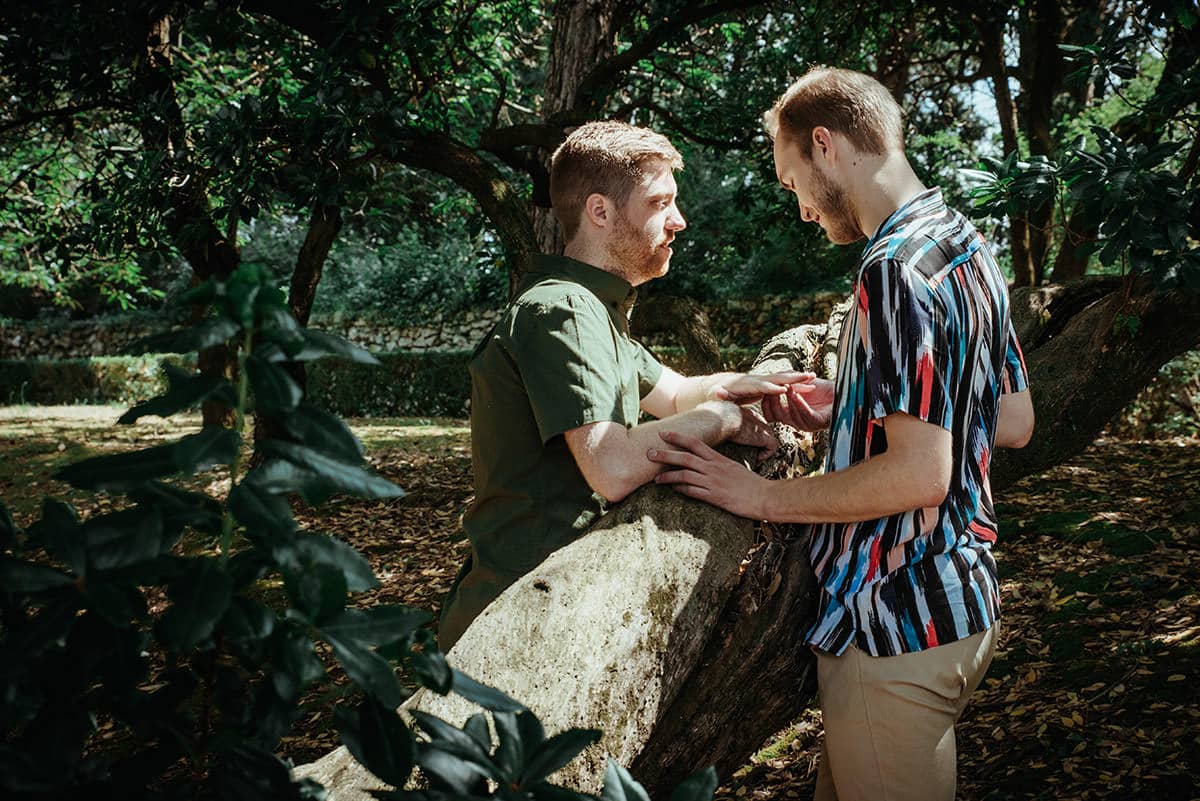
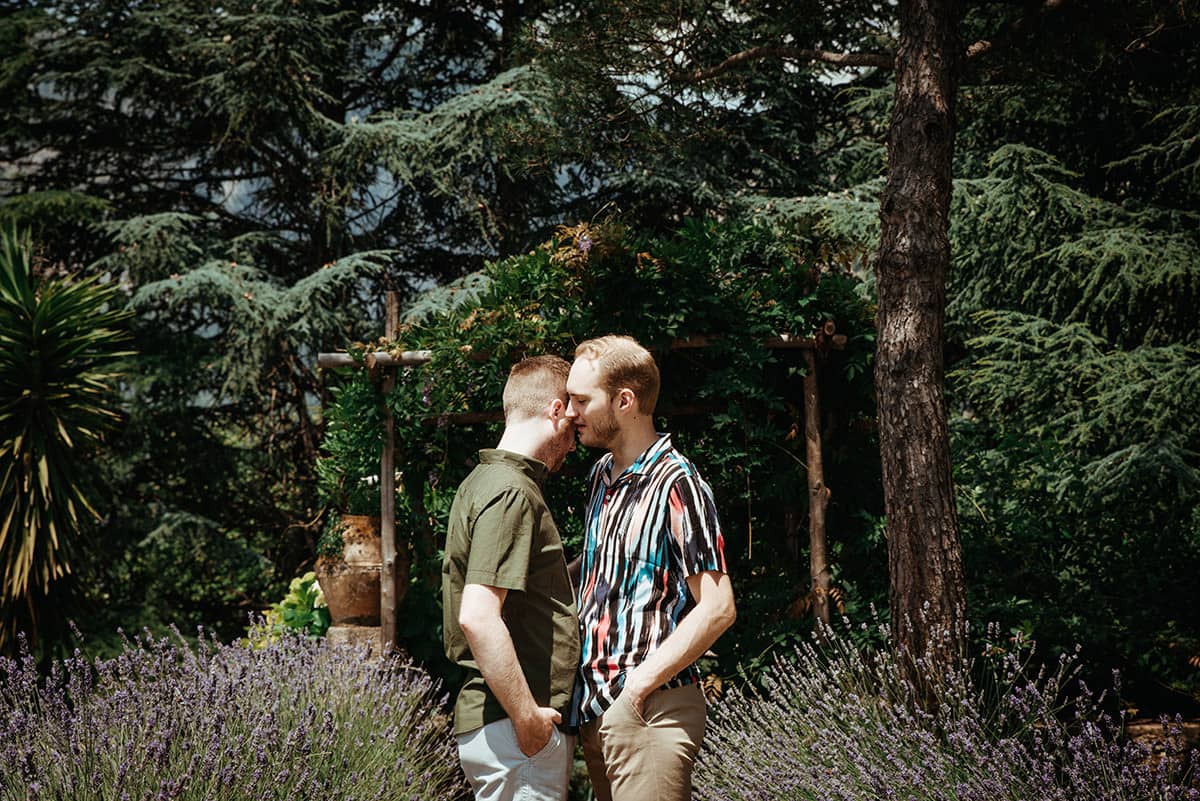
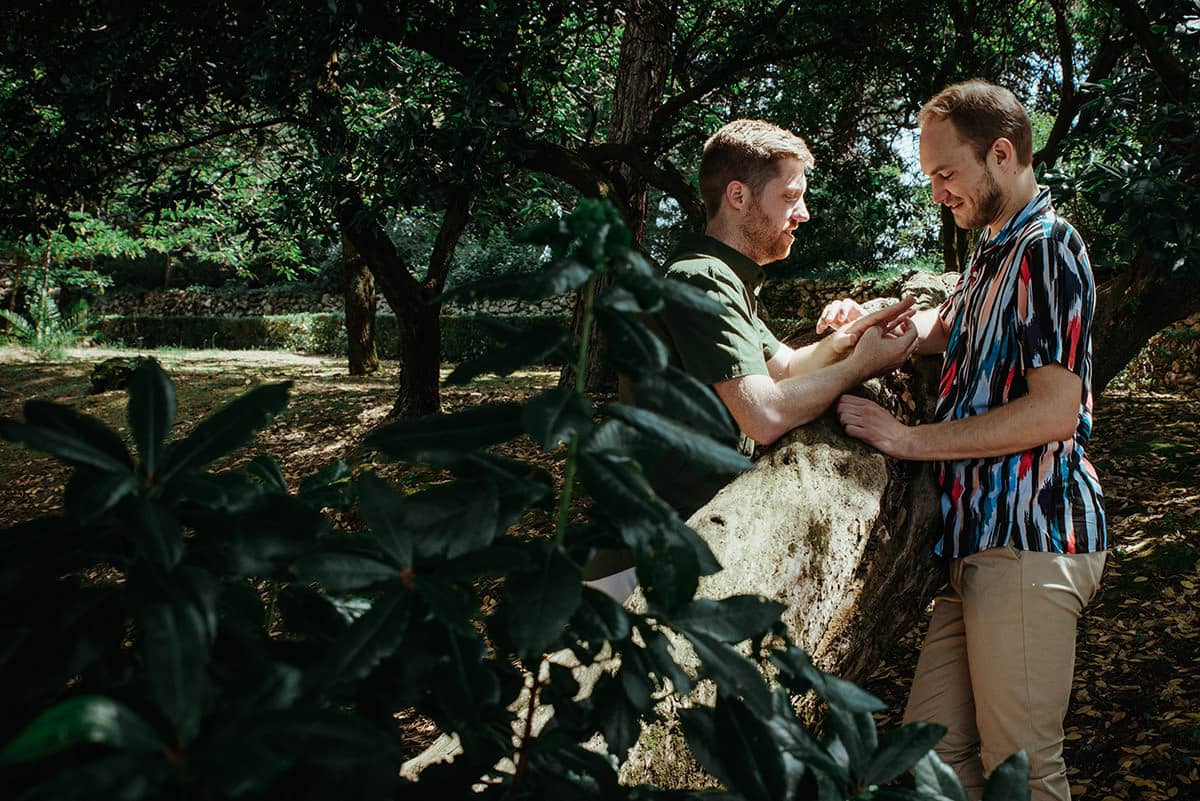
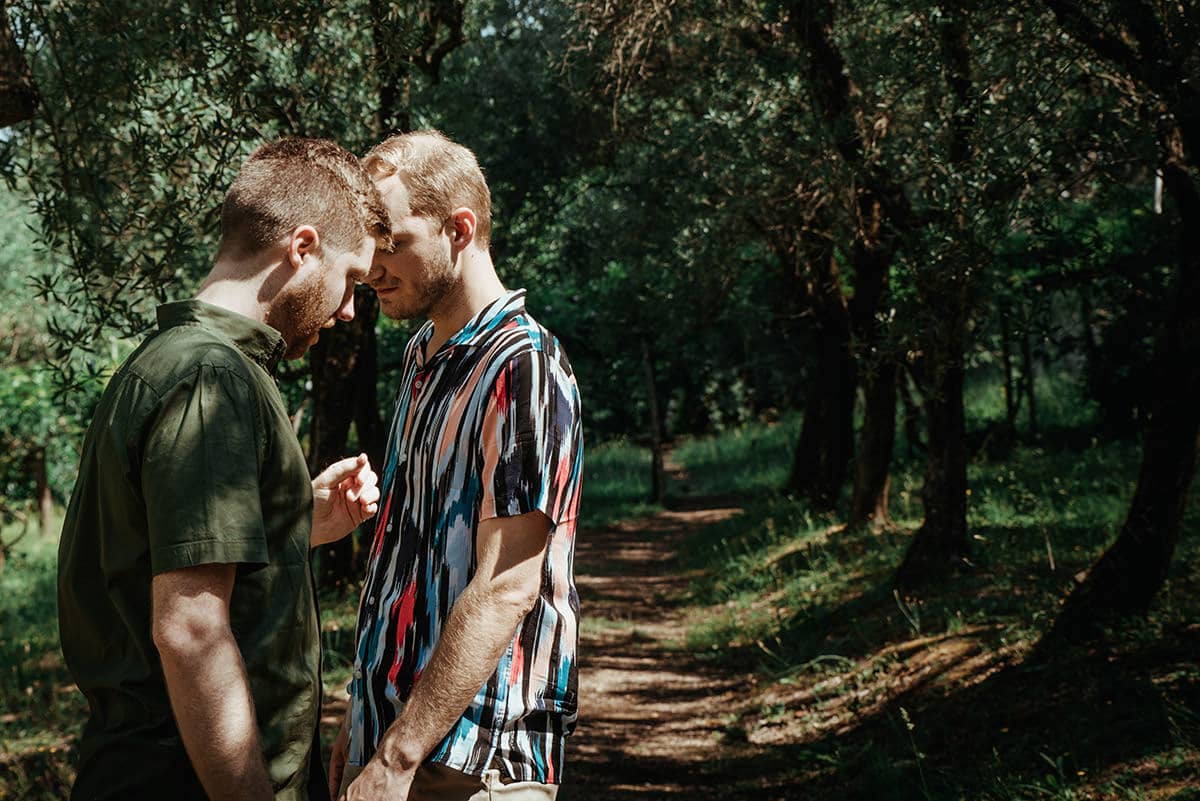
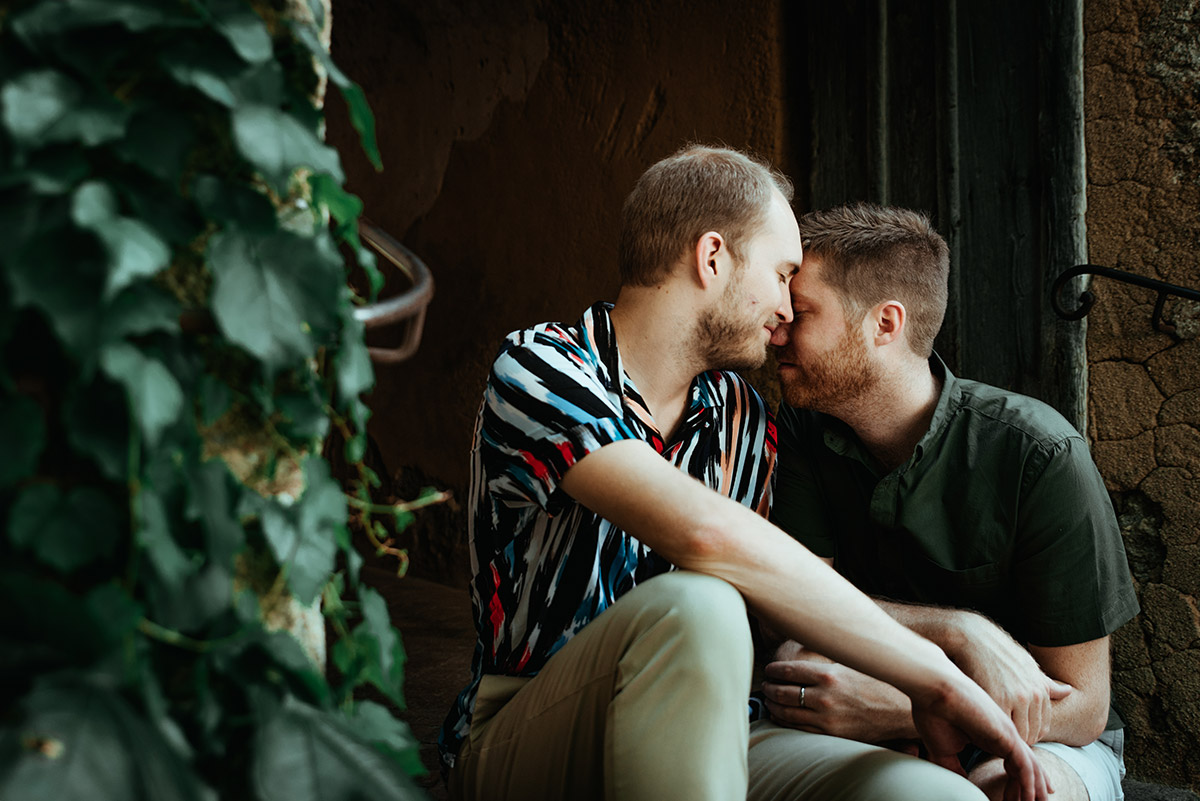
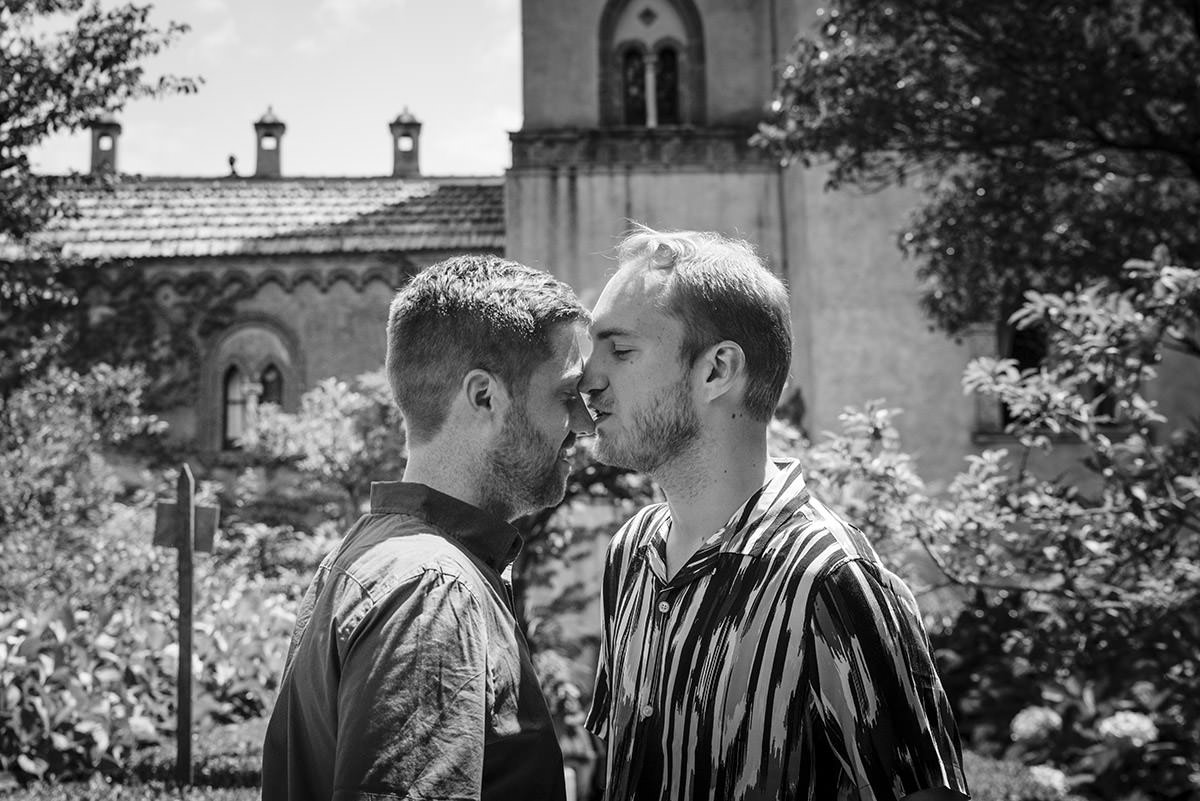
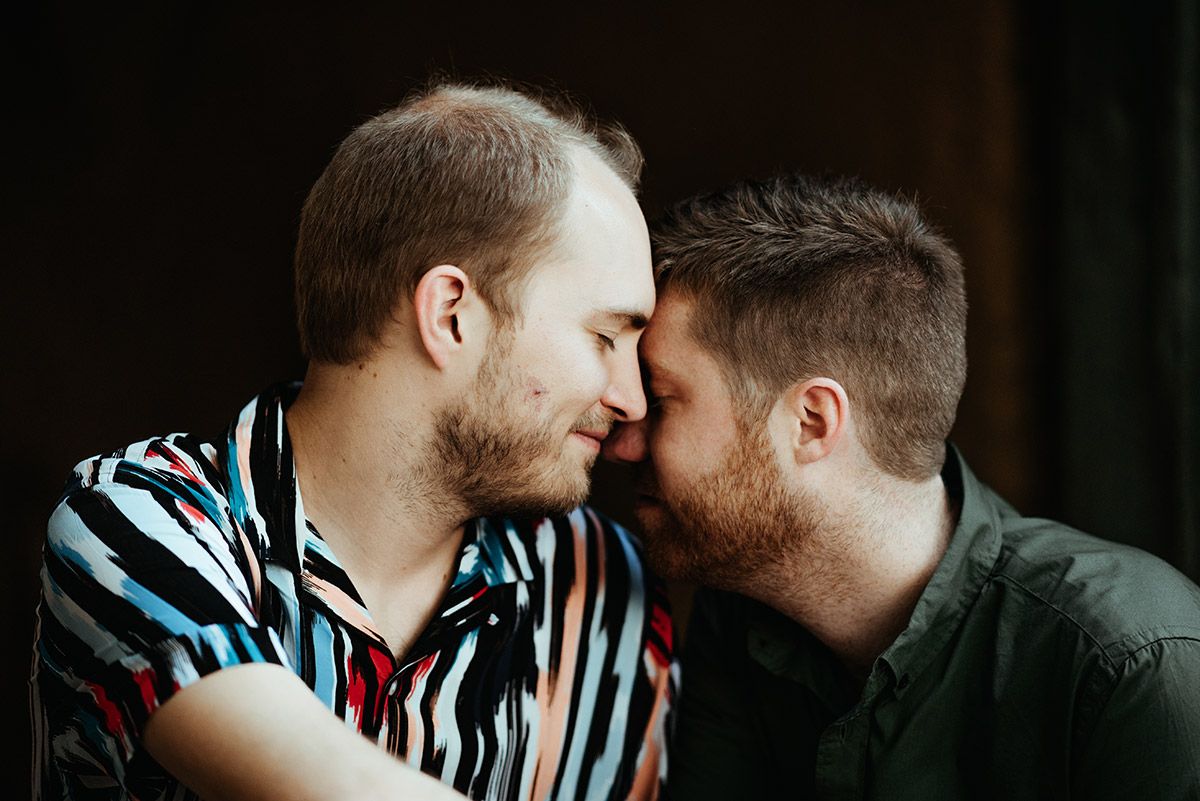
I sat them on the lip of the well, facing each other, their knees touching. Both were in short-sleeved button-down shirts, one light blue, one off-white, with sunglasses pushed up on their heads. When two people are dressed in similar clothing and have similar builds, the compositional challenge is separation: the camera needs to distinguish one body from the other, or the frame becomes a single mass. I solved it through angles. I shot from slightly above, using the well as a base and the columns as vertical lines that break up the background, so each man occupied his own visual space even though they were close enough to touch.
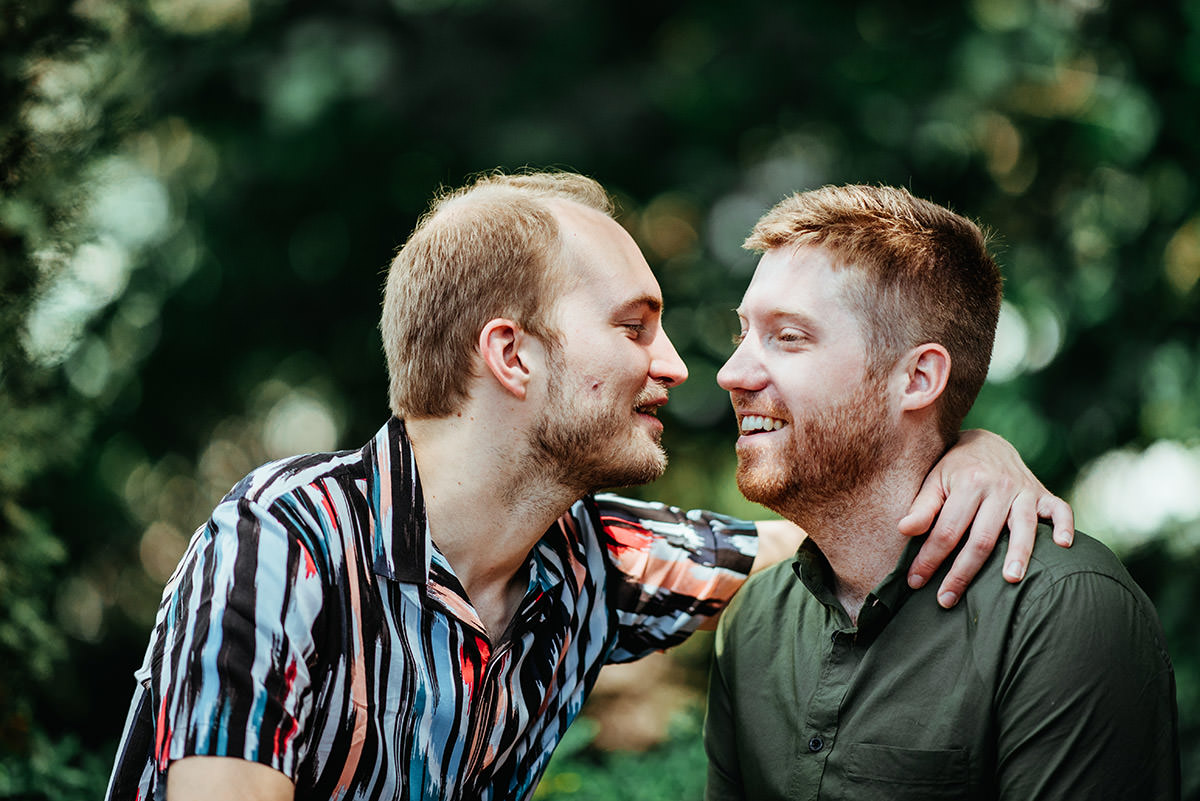
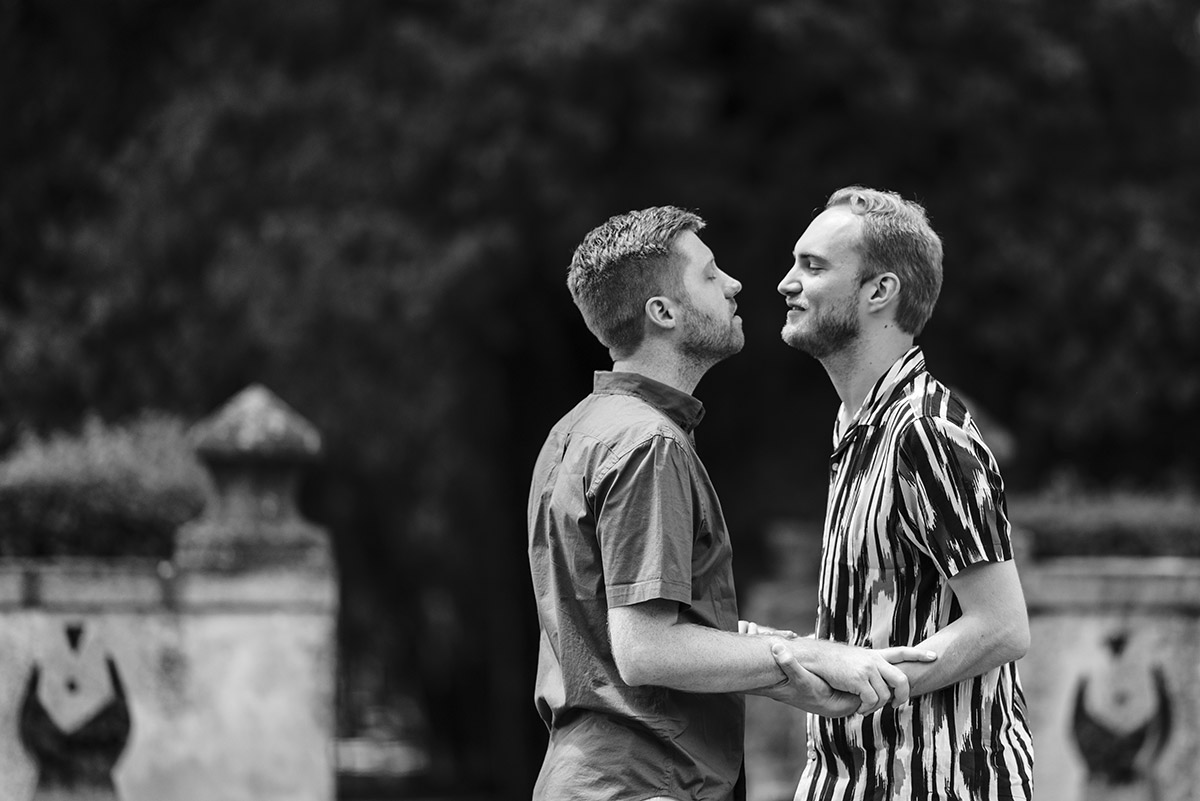
Some of the best frames from the cloister are the quiet conversational shots. One man leaning forward, saying something, the other listening with his chin resting on his hand. The ornate stonework of the cloister columns frames their heads like a carved picture frame. No posing instructions from me. I told them to talk about where they wanted to eat dinner, and the conversation produced natural expressions that no direction could replicate. One looked at the other and laughed, chin tilted up, beard catching the light. The other smiled back, still, steady. That contrast between movement and stillness in two people who know each other well is something a photographer waits for, and when it happens in a setting like this cloister, the frame has a weight to it that a posed portrait cannot reach. The cloister section of the gallery has nine images. Six of them were made during that dinner conversation.
The Garden Paths and Stone Arches
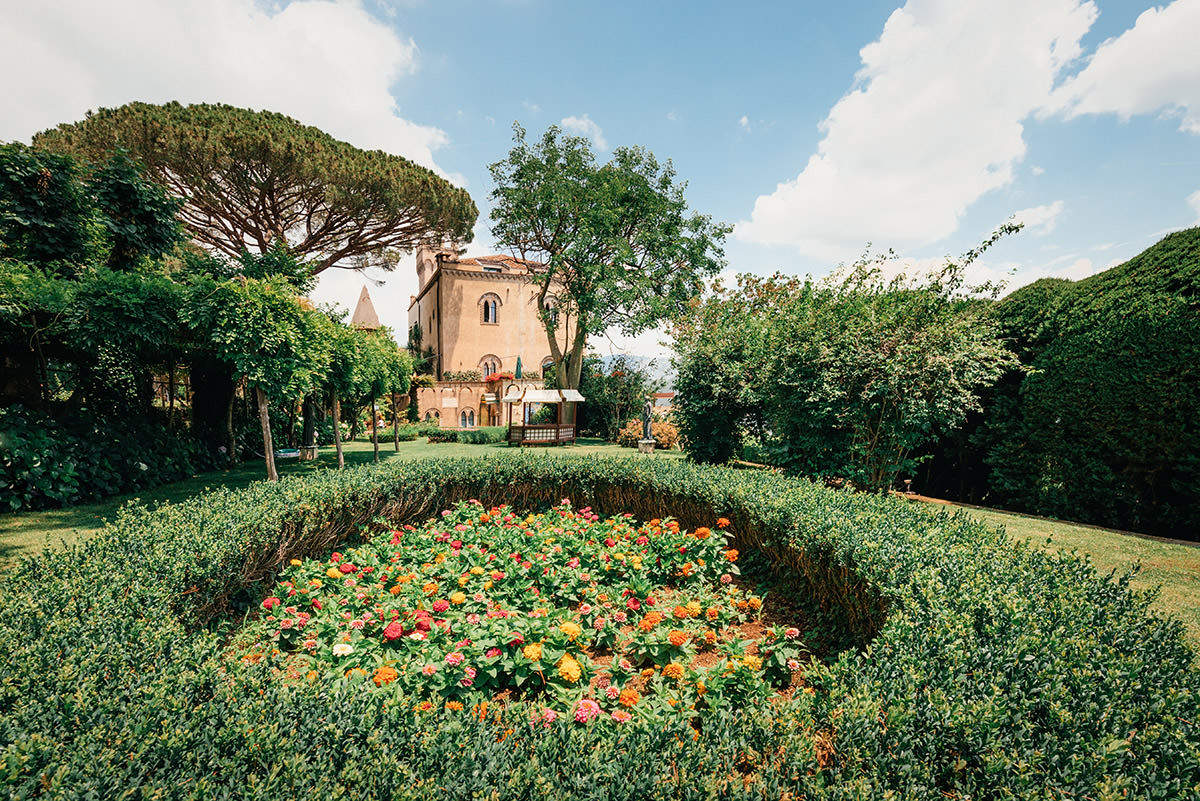
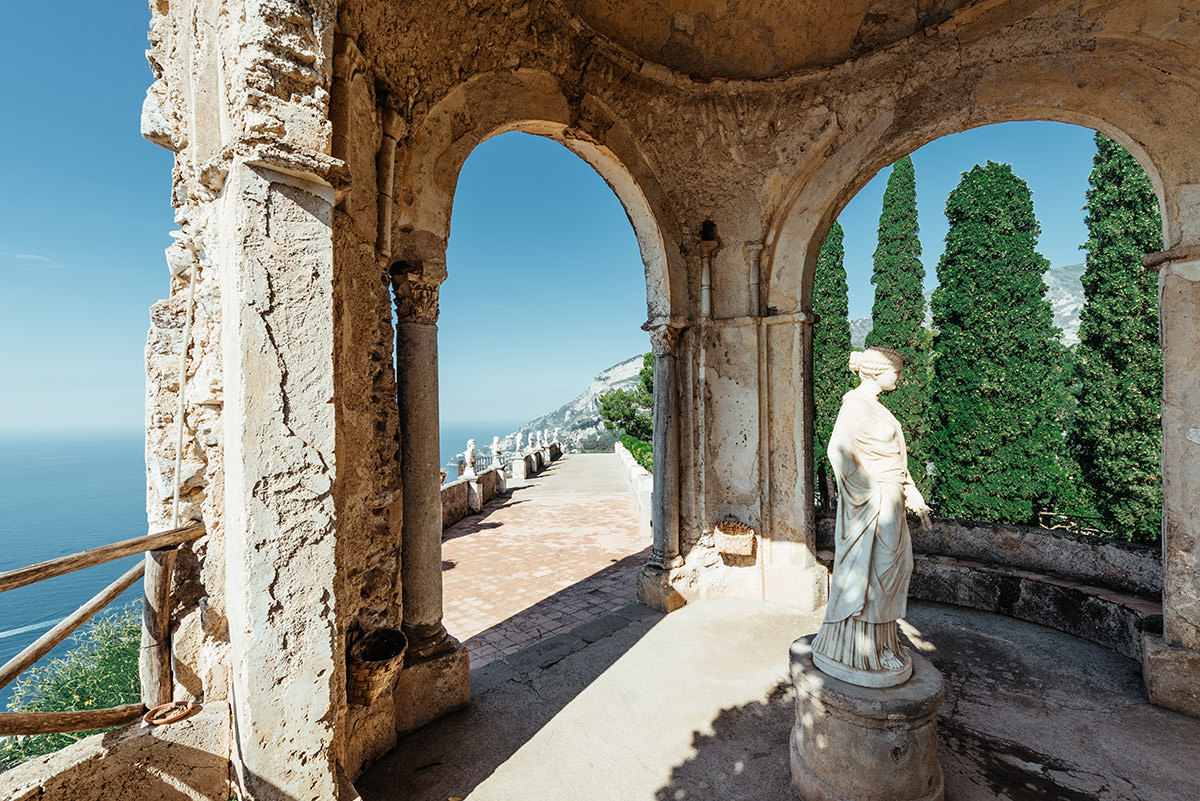
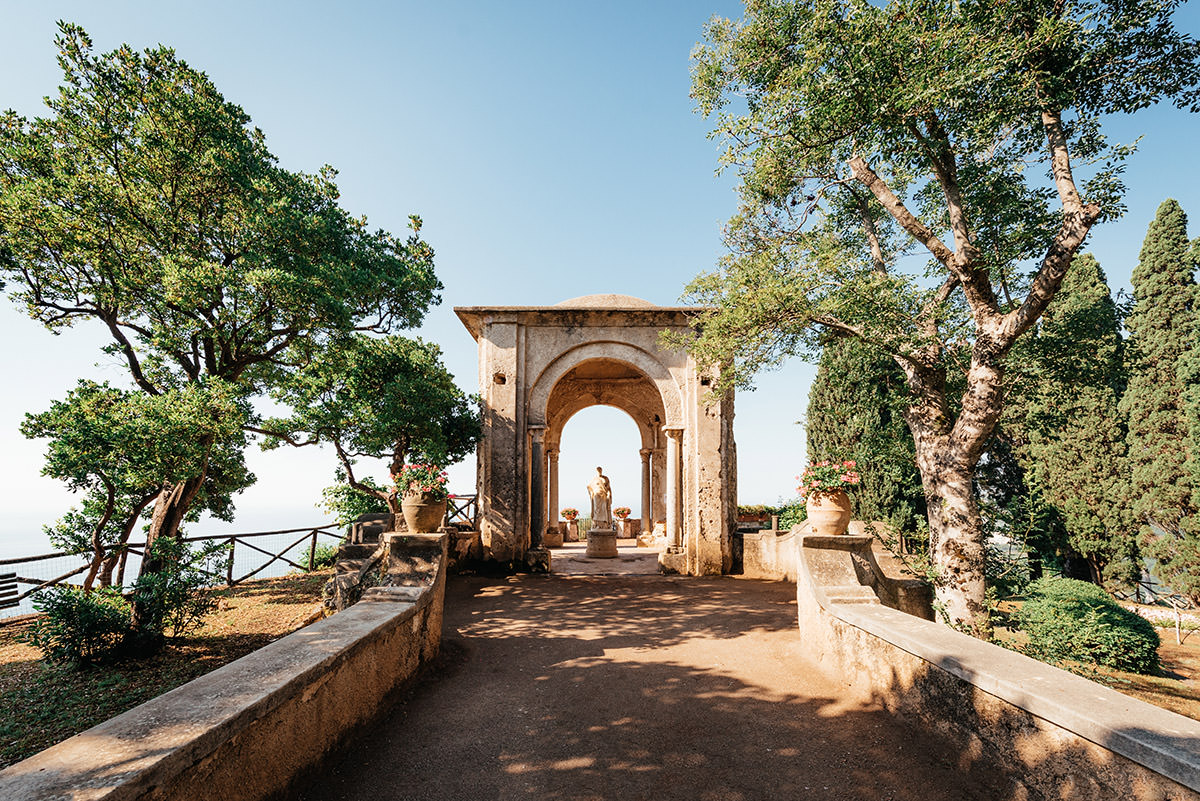
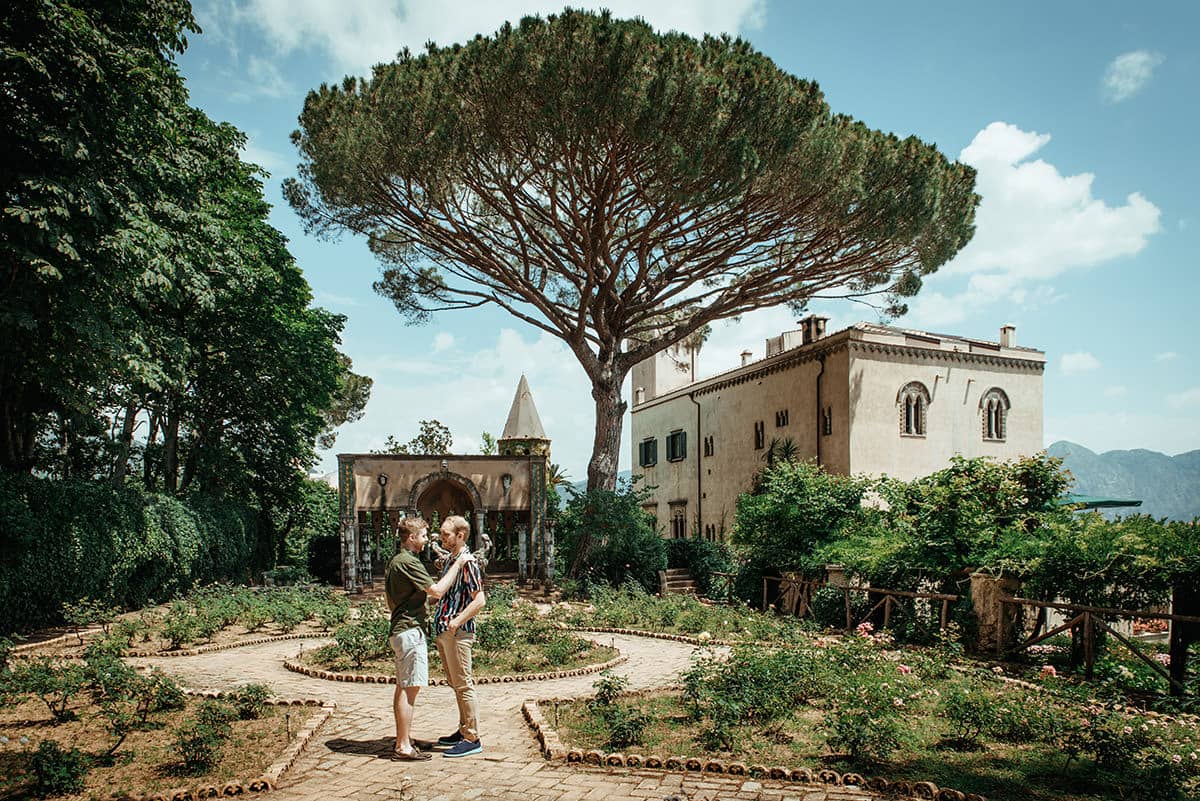
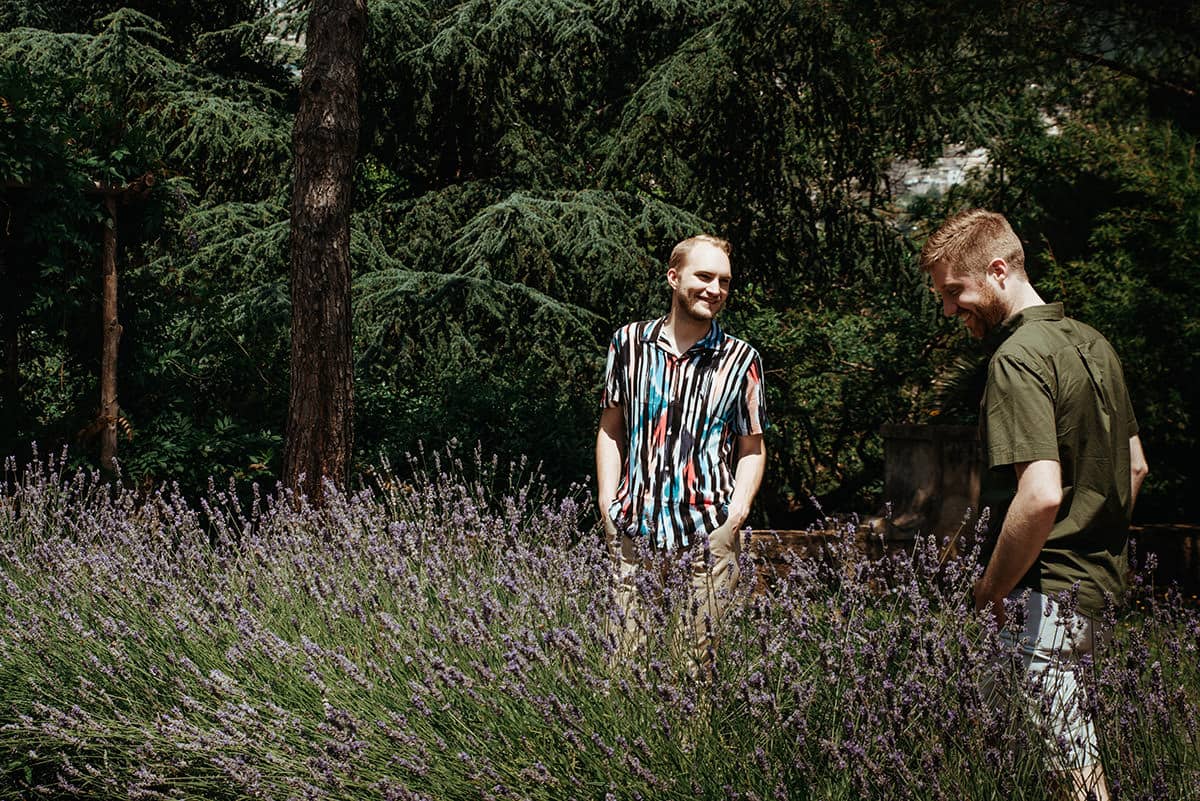
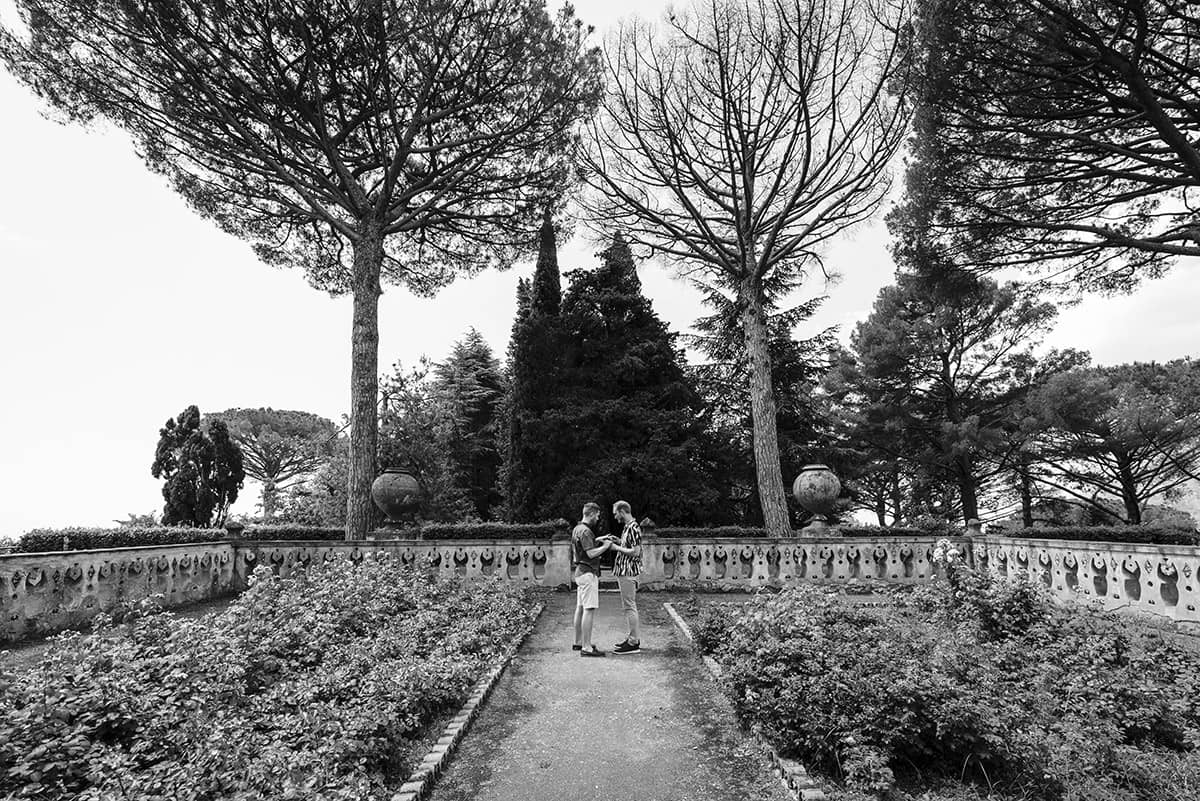
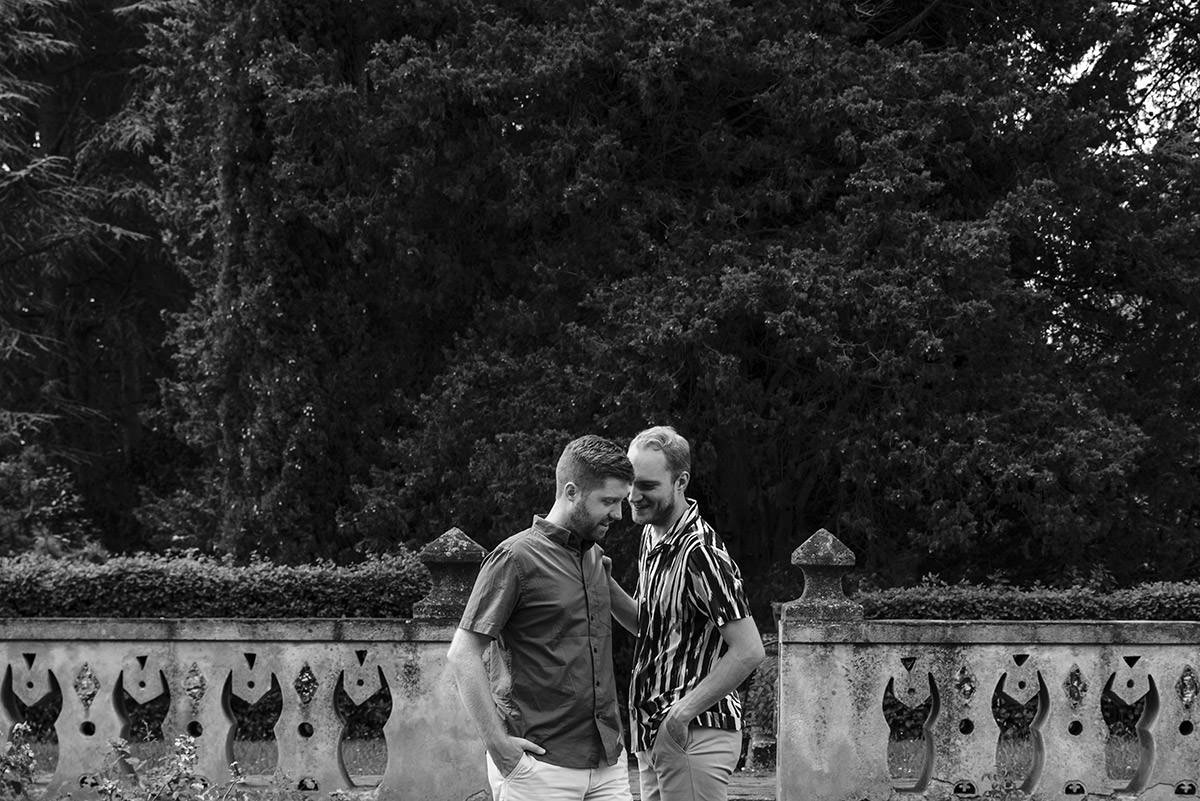
From the cloister, we walked through the formal gardens of Villa Cimbrone. The property has several levels connected by stone stairways and gravel paths, and each level offers a different background: cypress avenues, terraced beds overlooking the coast, stone arches framing statues and sea views, and a long walk lined with marble busts on pedestals.
I worked the garden in a specific order. First the stone arches near the northern wall, where a classical statue stands in an alcove with the Mediterranean visible through the opening. I placed the couple in the foreground with the arch framing them and the statue and sea behind. The composition has three layers: couple, arch with statue, and sea. At f/4 on the 35mm, all three layers are recognizable, which gives the image a sense of place that a tighter portrait would lose.
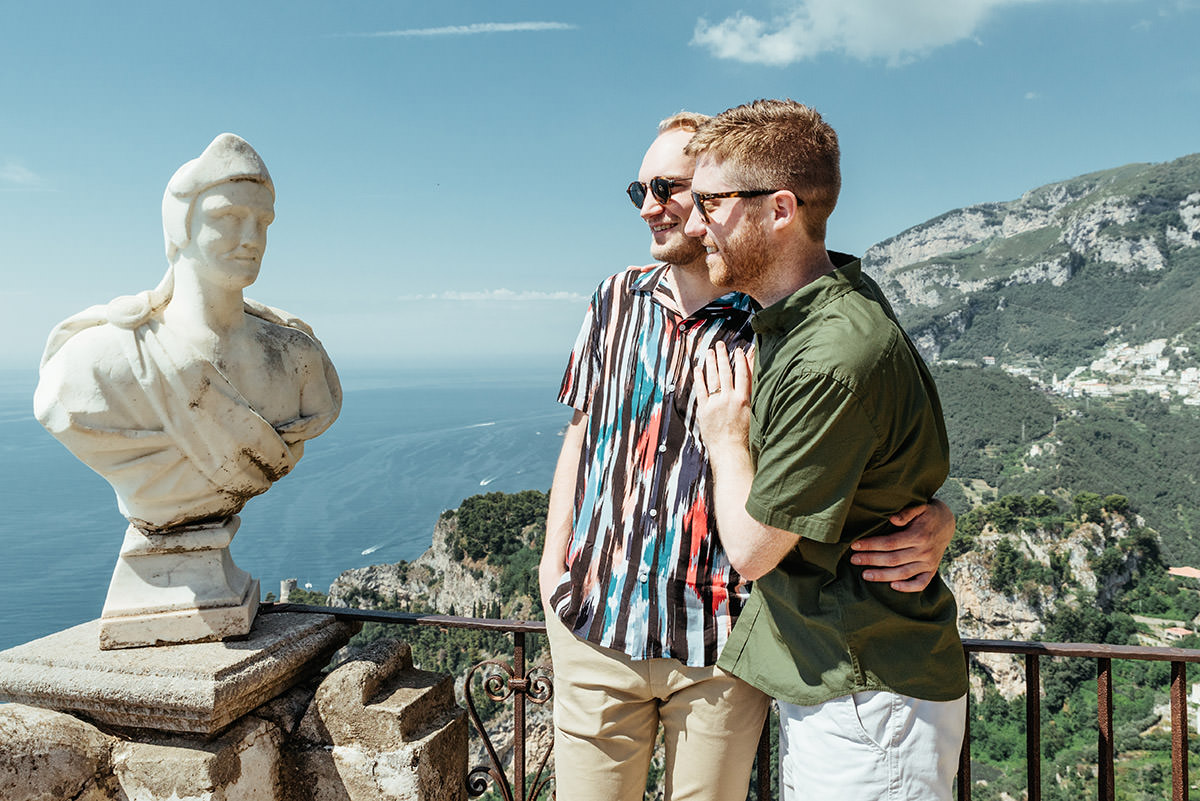
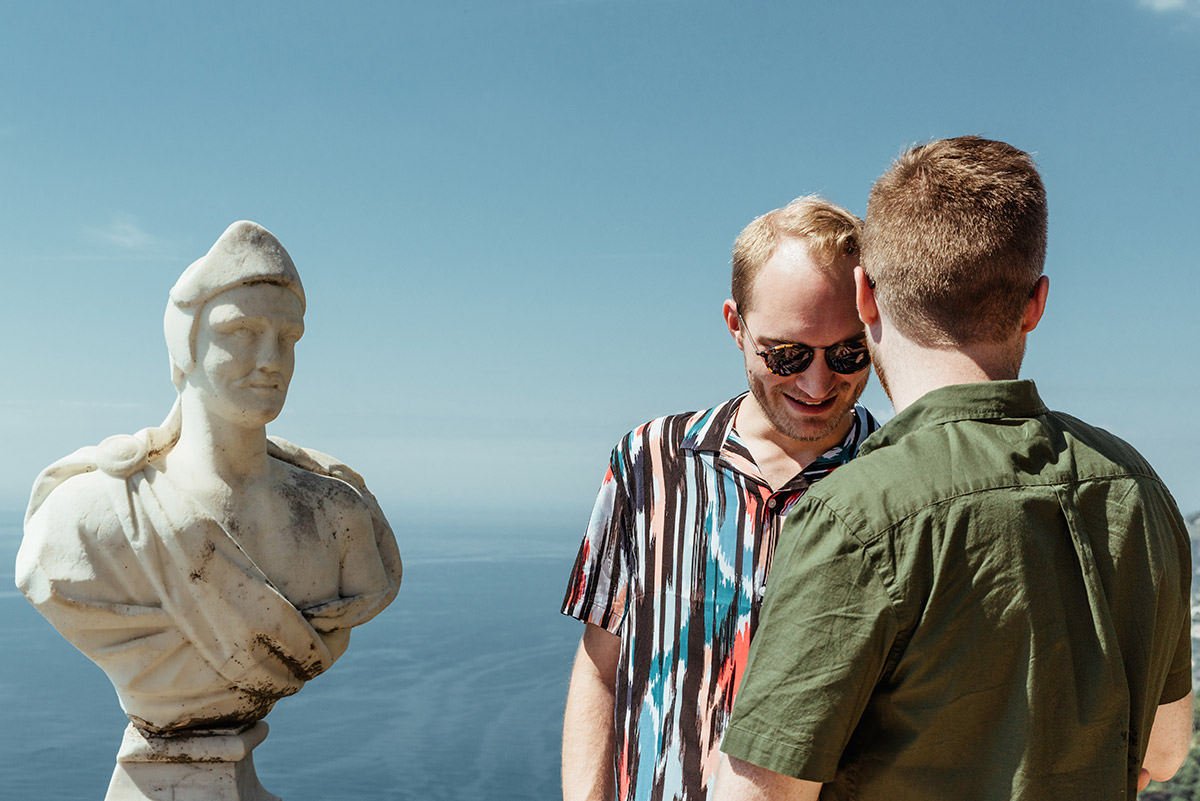
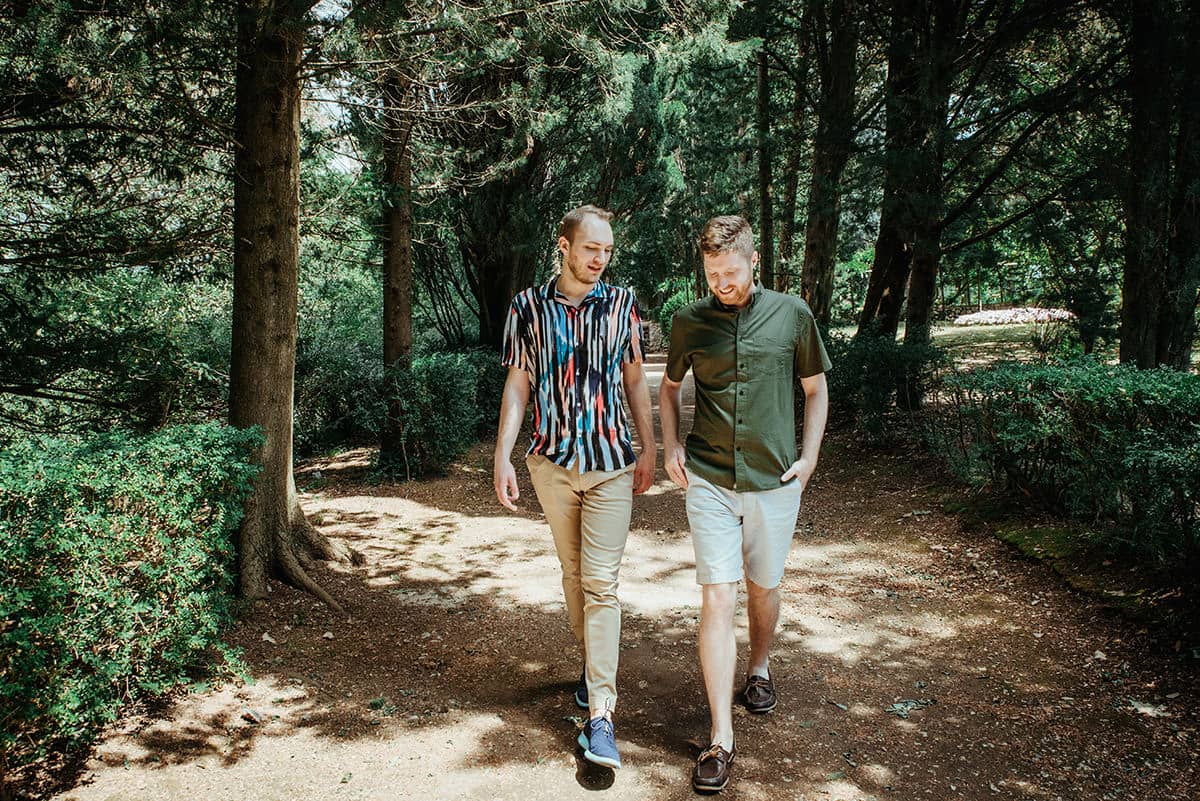
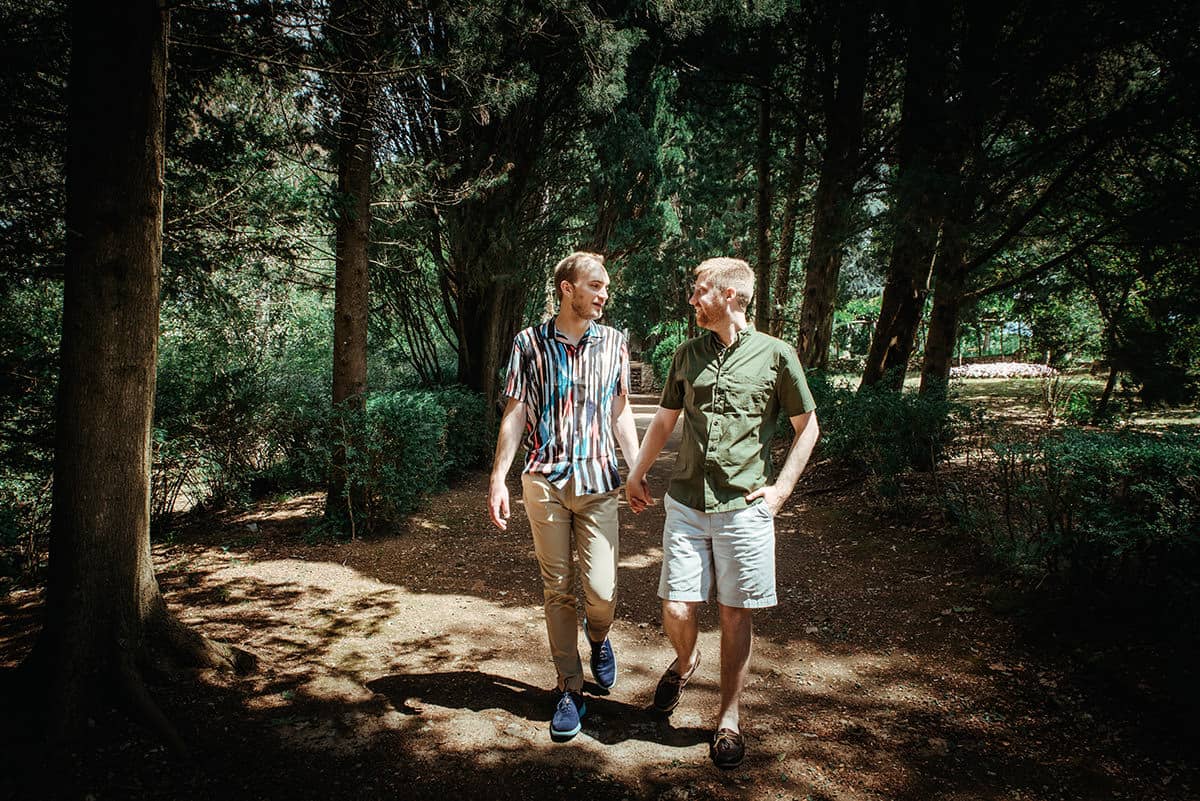
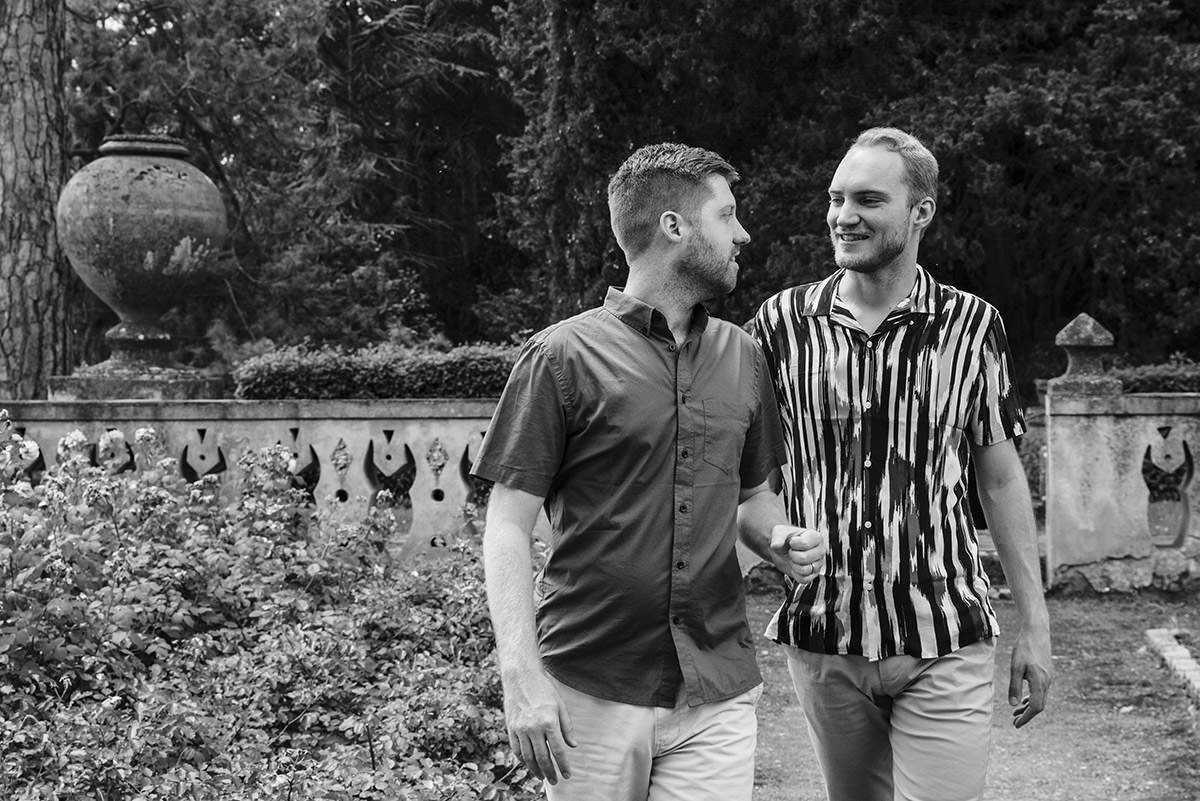
Then the avenue of busts. This is a straight path with marble heads on pedestals lining both sides, leading to a viewpoint where the coast drops away into blue. I walked ahead of the couple and shot them approaching, hand in hand, with the row of busts receding behind them. The line of white marble creates a strong perspective that pulls the eye through the frame. I took several variations: them walking toward me, them stopping to look at one of the busts, them standing at the viewpoint with the entire Amalfi Coast below. One bust in particular, a Roman figure on a tall pedestal with the sea behind, became a visual anchor. I framed it in the left third of the image with the couple small in the right third, the scale difference emphasizing the age and permanence of the setting against the very recent, very human event that had happened twenty minutes earlier on the same property.
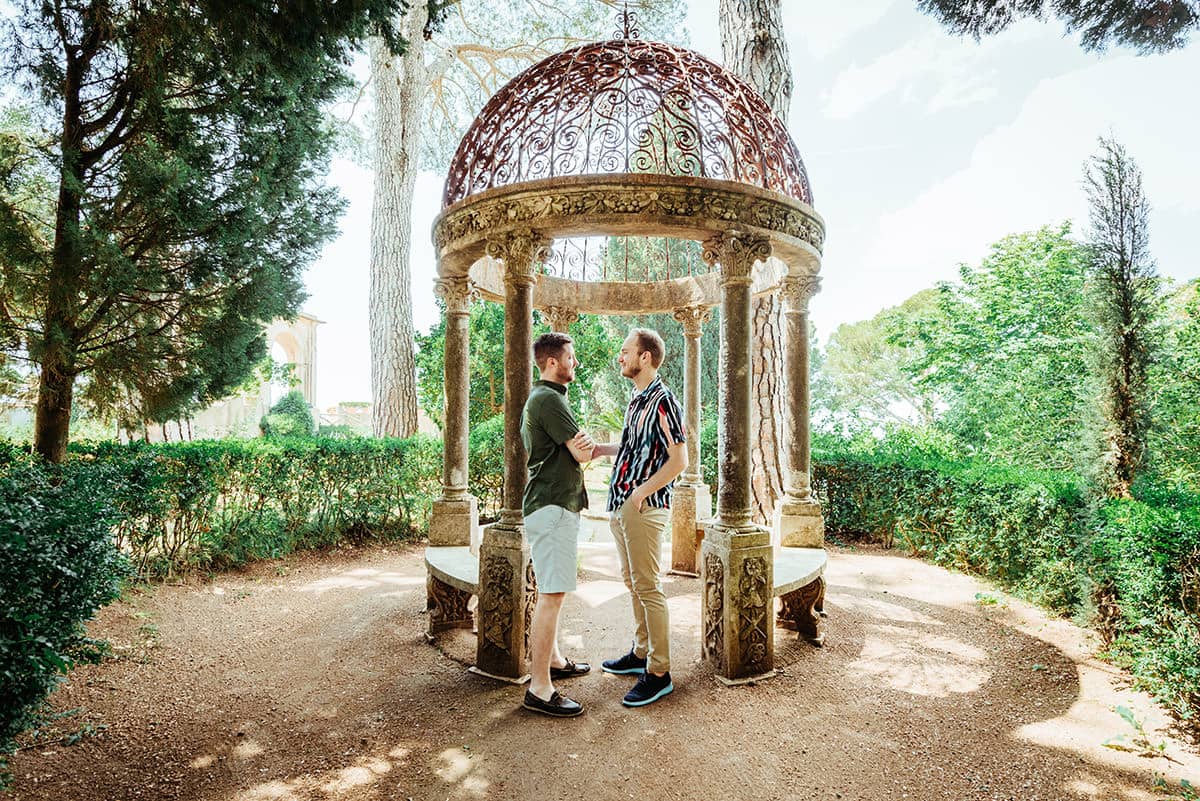
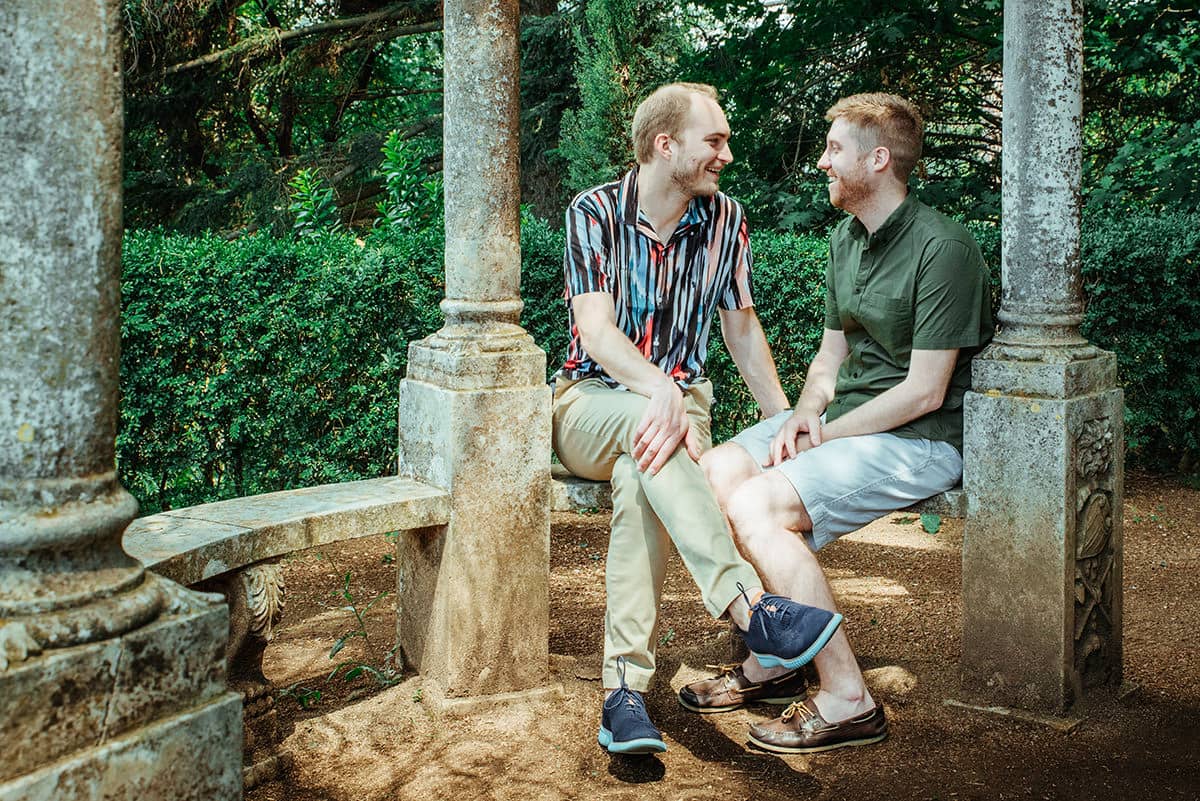
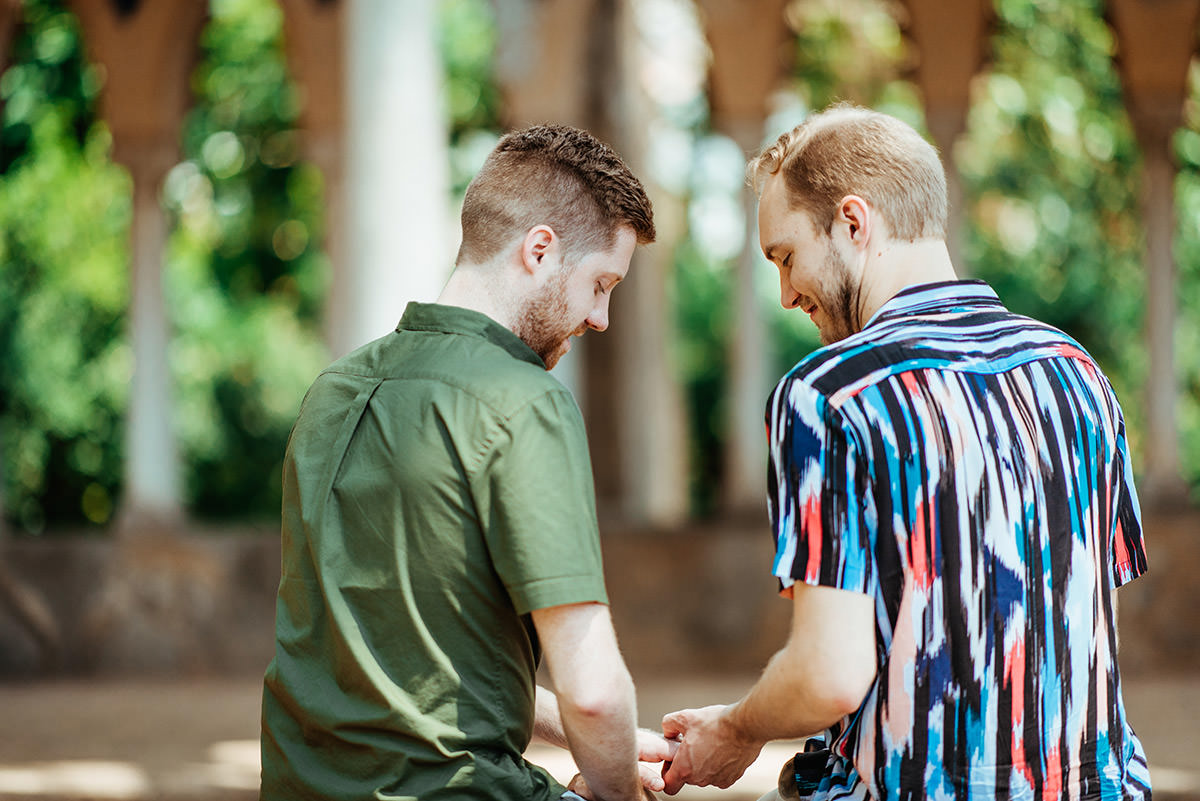
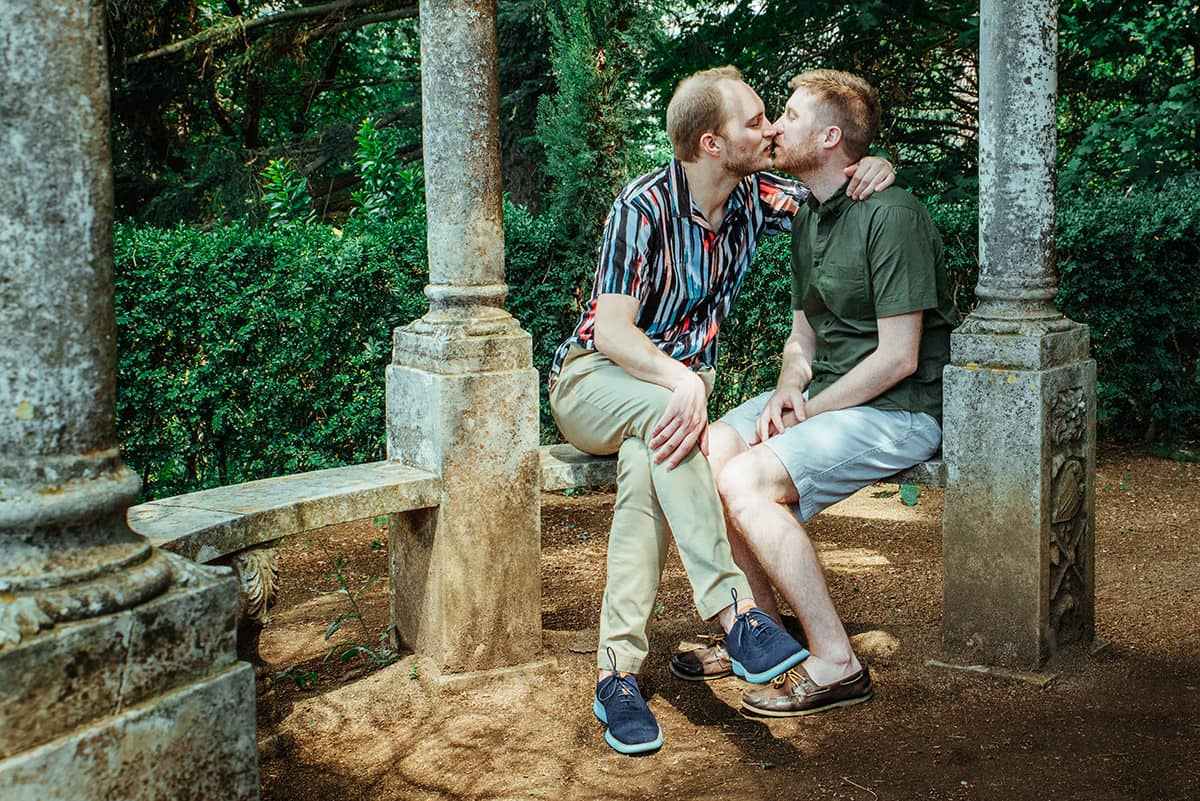
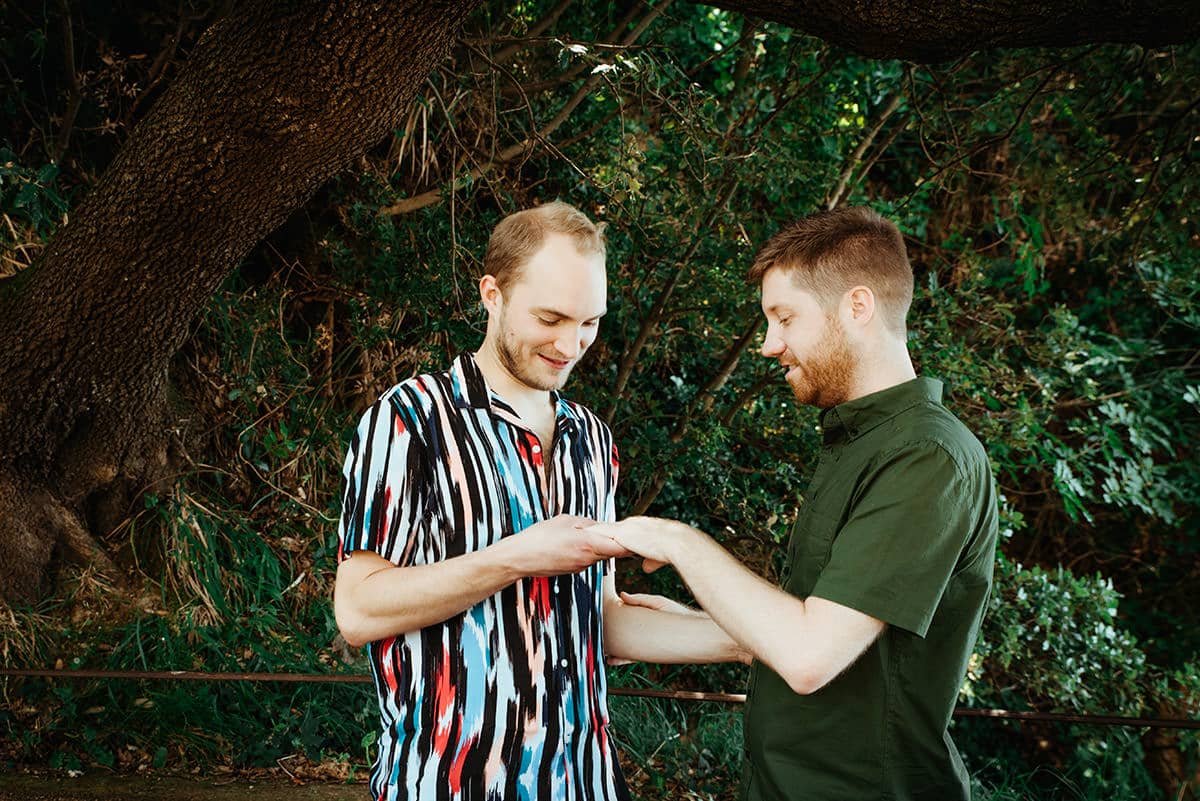
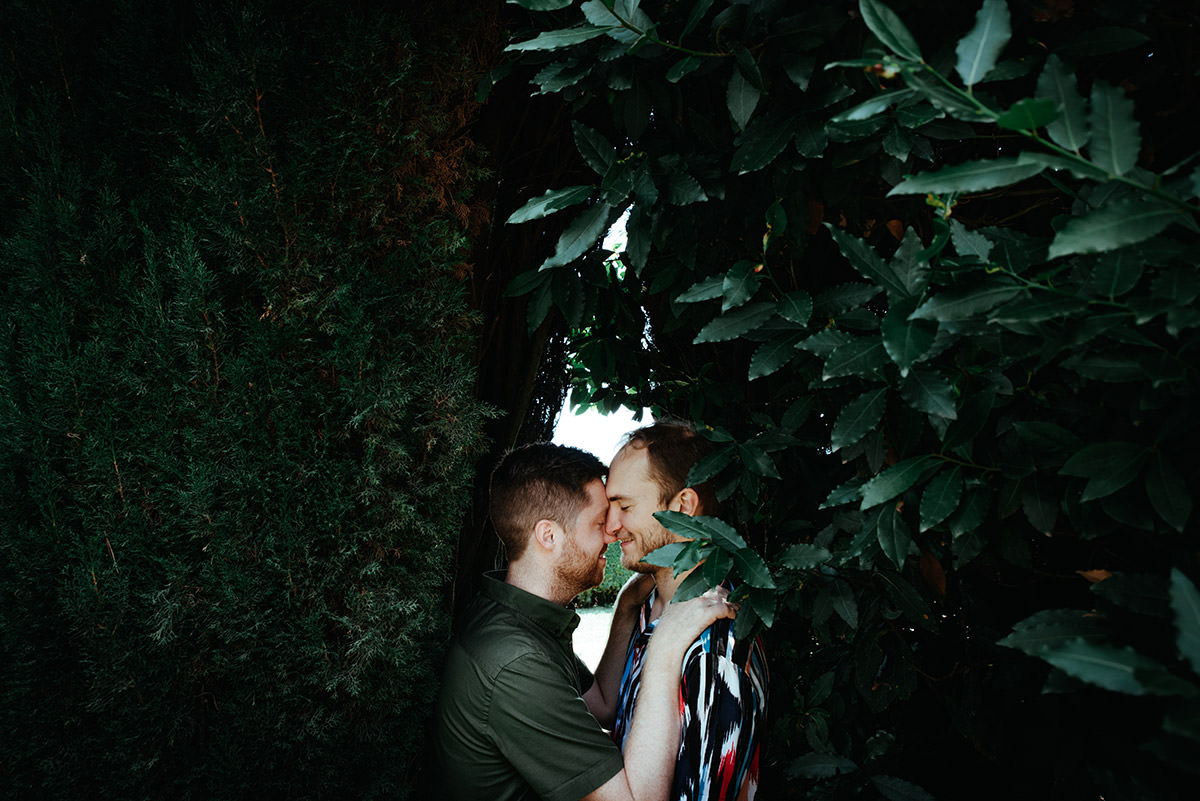
The decorative gazebo surrounded by dense green planting was our next stop. The shade inside was deep and even, and the couple’s lighter shirts stood out against the dark foliage. I shot through the entrance of the gazebo so the frame was surrounded by green on all sides with the couple lit by the ambient light filtering through the leaves. Then on a stone bench nearby, where they sat shoulder to shoulder, close enough that the frame was mostly them, with a blur of green and stone in the background. This is where I got the hand-holding detail: their fingers interlaced, both left hands, the new ring visible on his finger, the veins and tendons and texture of their skin sharp at f/1.4 against a background that was pure color, no detail, just a wash of garden green.
Planning an Engagement Proposal in Ravello
A few practical points from this session that apply to anyone considering a proposal at Villa Cimbrone. The gardens charge a 10-euro entrance fee per person, and there is no option to reserve any section privately. That means timing is everything. Weekday mornings between 9:00 and 10:00 give you the best odds of finding the balcony empty or nearly empty for the actual proposal moment. If you want a Saturday, arrive when the gates open and move quickly to the balcony before the tour groups arrive.
For the proposal itself, the balcony railing between two marble busts is the strongest composition. The busts create natural framing, the railing provides a clean horizon line, and the sea behind removes any distracting background. I position myself in the garden path before the terrace, using a telephoto lens so I can stay thirty or more meters away. At that distance, with no shutter sound (I shoot silent electronic shutter on mirrorless), the person being proposed to has no reason to notice me.
After the proposal, the gardens offer at least forty minutes of portrait locations within walking distance: the cloister, the rose garden, the cypress avenues, the stone arches, the avenue of busts. Most proposal sessions I photograph at Villa Cimbrone run about ninety minutes total, with fifteen minutes for the proposal and the rest for the portrait session in the gardens. The mix of open sunlight on the balcony and deep shade in the cloister means the gallery has visual variety without needing to leave the property or drive anywhere.
The result is a gallery that starts with raw, unguarded emotion on the terrace and transitions into composed, relaxed portraiture in the gardens. Two modes of the same morning, two sides of the same couple, one location. Every proposal I photograph in Ravello follows this structure, and it works because the shift from documentary to directed gives the couple time to settle into the moment. By the time we reach the garden paths, the adrenaline has faded and what remains is a calm, genuine connection that reads clearly in the portraits.
My Ravello photography page covers how proposal sessions work, including pricing and what you receive. If you want to explore what a ceremony in Ravello would look like after the yes, the elopement page walks through every format. Send me a message with your dates and your venue preference, and I will put together a plan for the morning.
OUR WEDDING PROPOSAL STORIES
Hotel Caruso proposal
Sean and Lorree – Villa Cimbrone
Naomi and Theo – Proposal at Hotel Caruso
Capri wedding proposal
Proposal in Rome – Linda and Nir
Engagement Amalfi
PLAN YOUR WEDDING PROPOSAL IN ITALY WITH US