Reid and Corinne: A Sailing Yacht Wedding, Married by the Captain
Reid and Corinne were married at sea in September by the captain of the boat they were standing on, in front of five guests and two lengths of rope.

FIVE GUESTS, ONE CAPTAIN, TWO LINES AT SEA
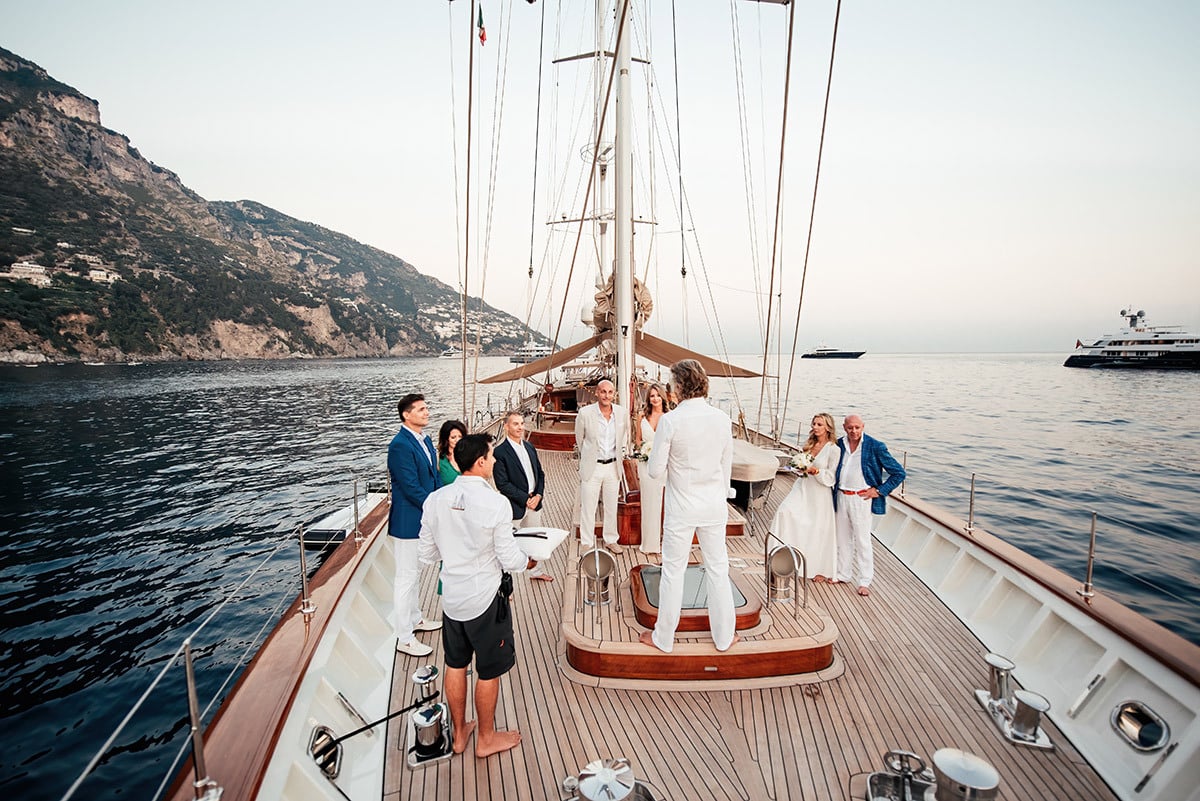
A sailing yacht wedding was what Reid and Corinne wanted, and in September they had it, on the deck of a wooden yacht called Roxane, with five guests and the coast at a distance. The man who married them was the captain of the boat they were standing on. The ritual they had chosen was a knot, two working lines pulled together by the two of them, brought forward on a white cushion by one of the crew.
A boat turns up in a lot of the weddings I shoot, nearly always at the same point in the day: the ceremony happens on a terrace, and afterward everyone goes down to the marina for portraits with the coast sliding past. This was the other arrangement, the one where the boat is the venue and there is no terrace at all, and it changes almost everything about how the day has to be photographed. If you are weighing that up, it is worth talking to an Amalfi Coast wedding photographer who works from boats as often as from terraces before you book anything.
They Chose the Sea First, and Everything Followed
The sea meant something to these two long before any of this was planned. I will leave it at that, because how and why is their business, but it is the fact the whole day rests on.
Once you know that, the decisions stop looking like styling choices. A couple who books a boat because it photographs well will hold the ceremony on land and use the boat for an hour afterward, which is the sensible way to do it. A couple for whom the water is the point will do what Reid and Corinne did, which is put the ceremony itself out there and accept the constraints that come with it.
Those constraints are real and worth naming up front. There is no shade except what the awning gives you. There is no second room to move to. Nobody can leave. If the sea gets up, the ceremony happens anyway, on a floor that is tilting. For couples considering a wedding in Amalfi Coast held entirely on the water, that list is the honest version of what you are signing up for.
A Boat Called Roxane, and What Wooden Yachts Do to Pictures
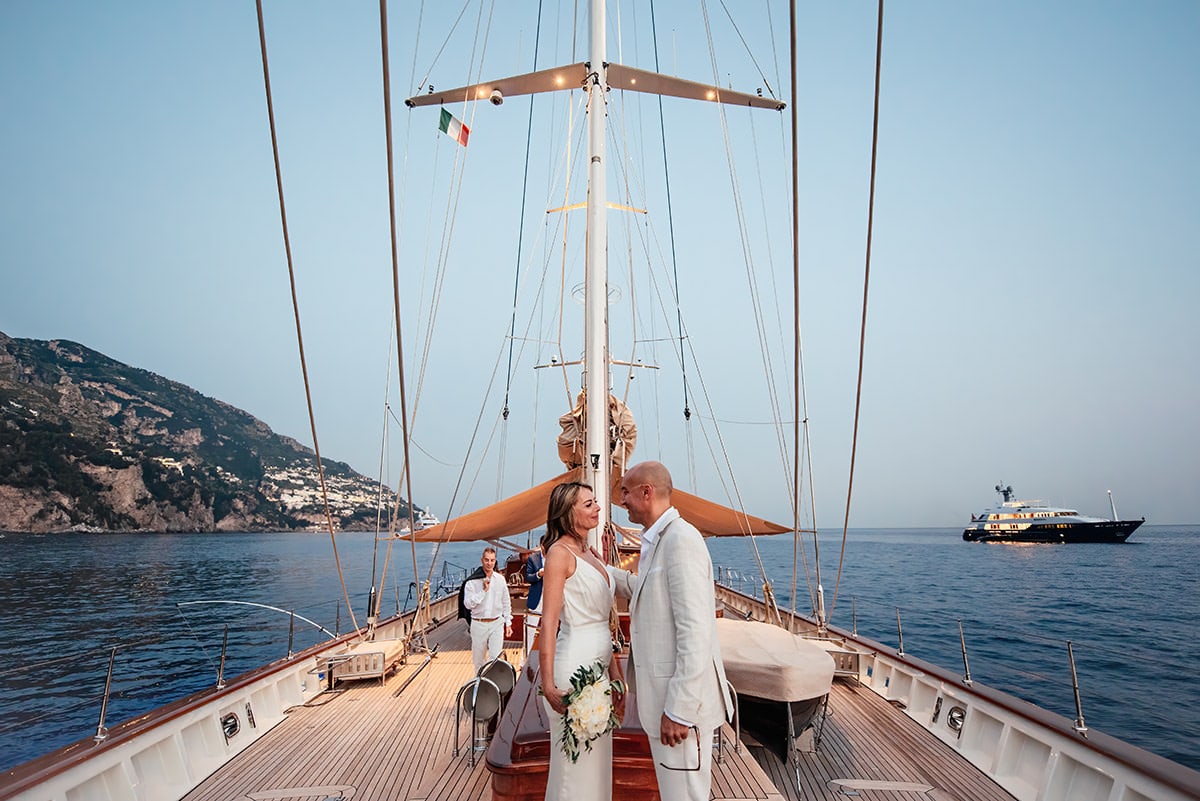
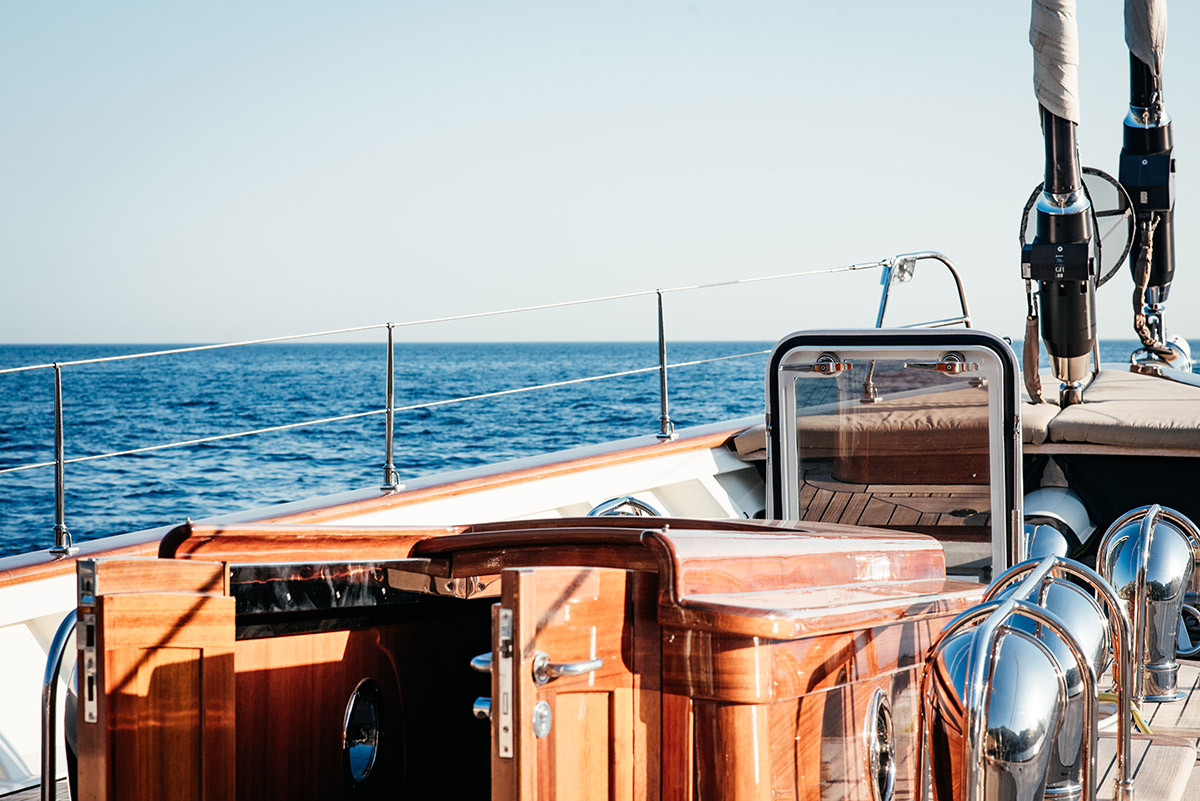
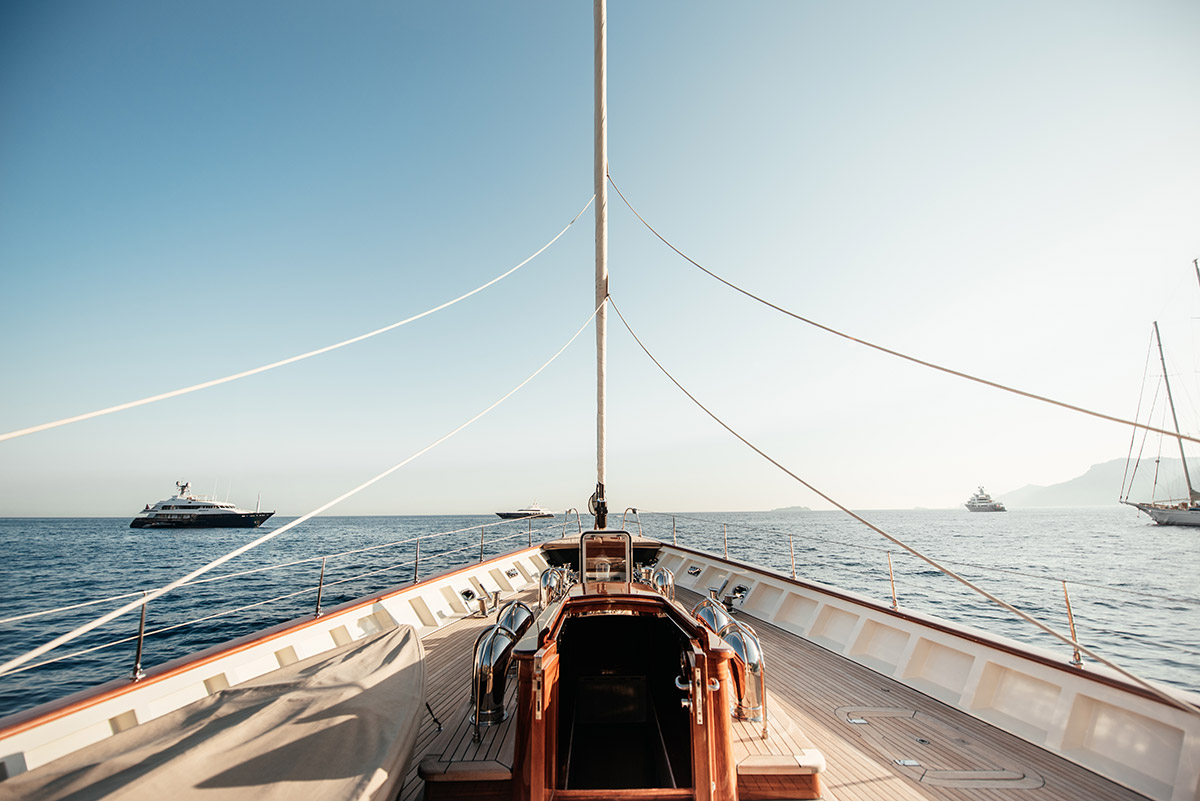
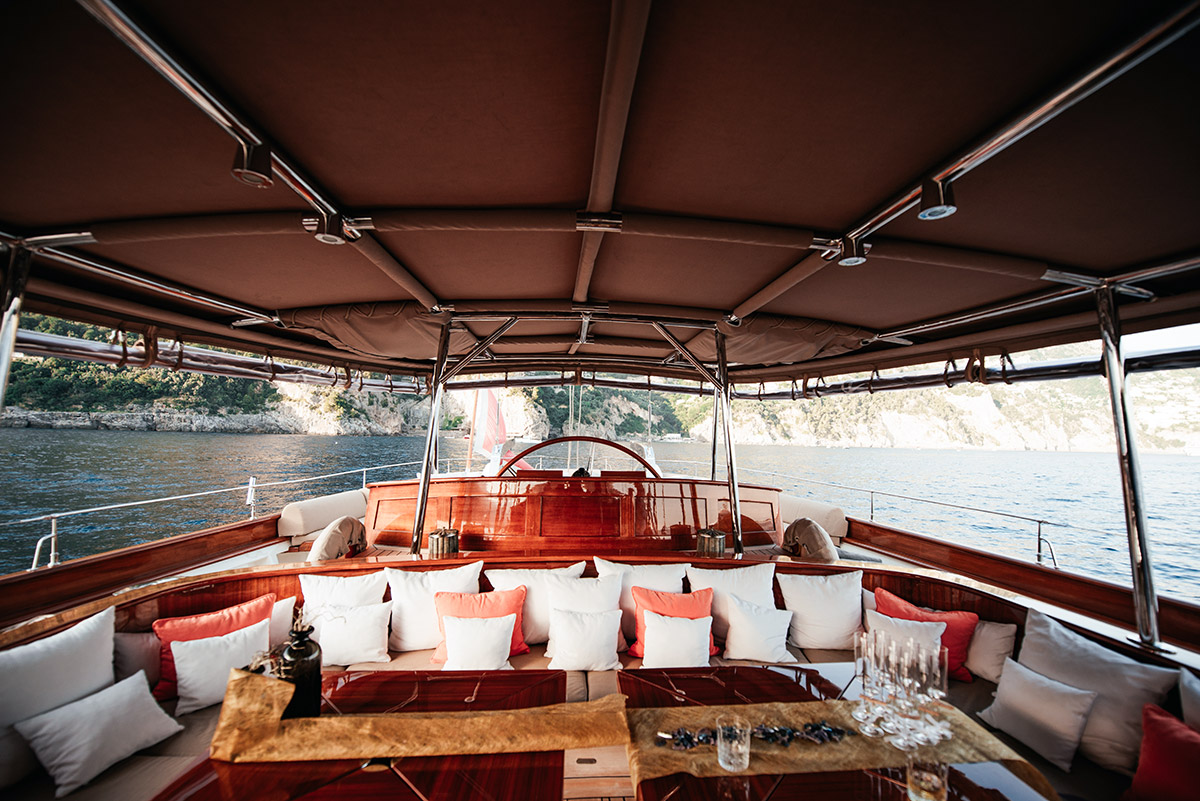
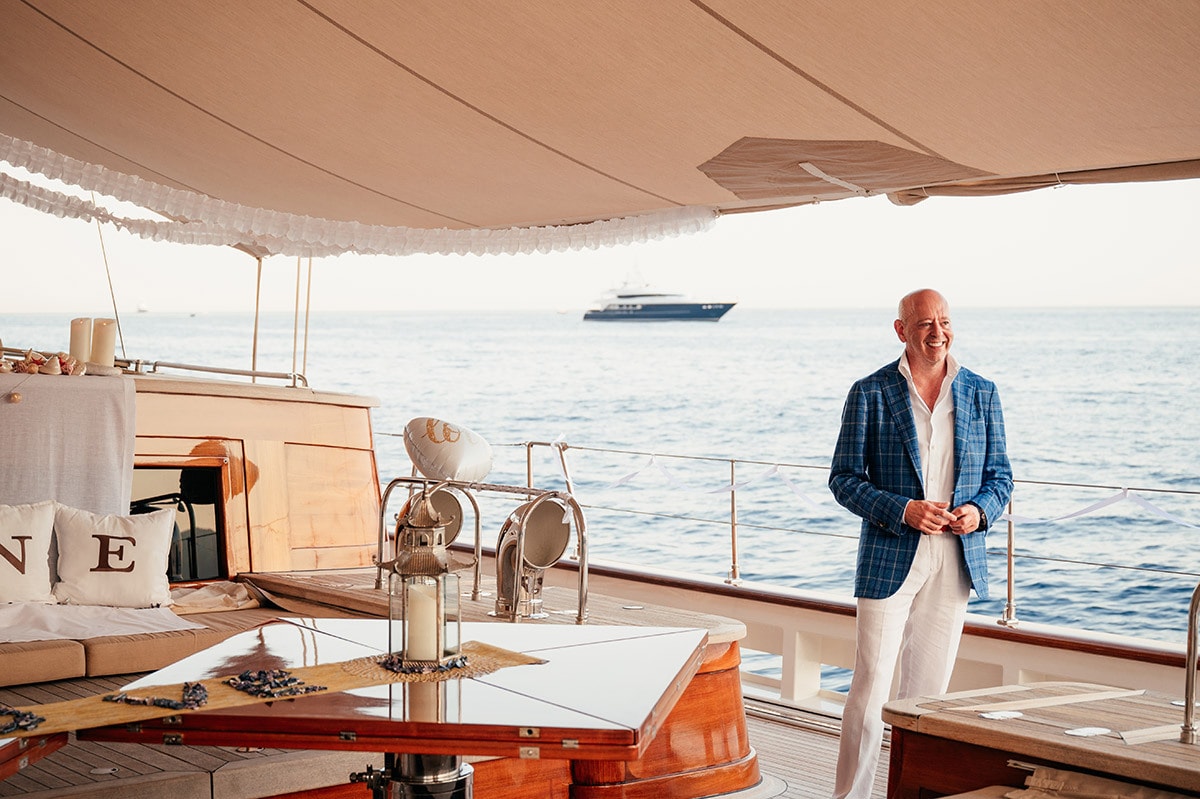
Roxane is a classic sailing yacht with two masts, a teak deck, a great deal of varnished red wood and an Italian flag flying high in the rig. White and red cushions around the table, a canvas awning hung with a paper garland over the aft deck. That description is as far as I will go, because everything else about her is the owner’s business and I photograph boats rather than survey them.
Six Cushions, Black Shells and a Word
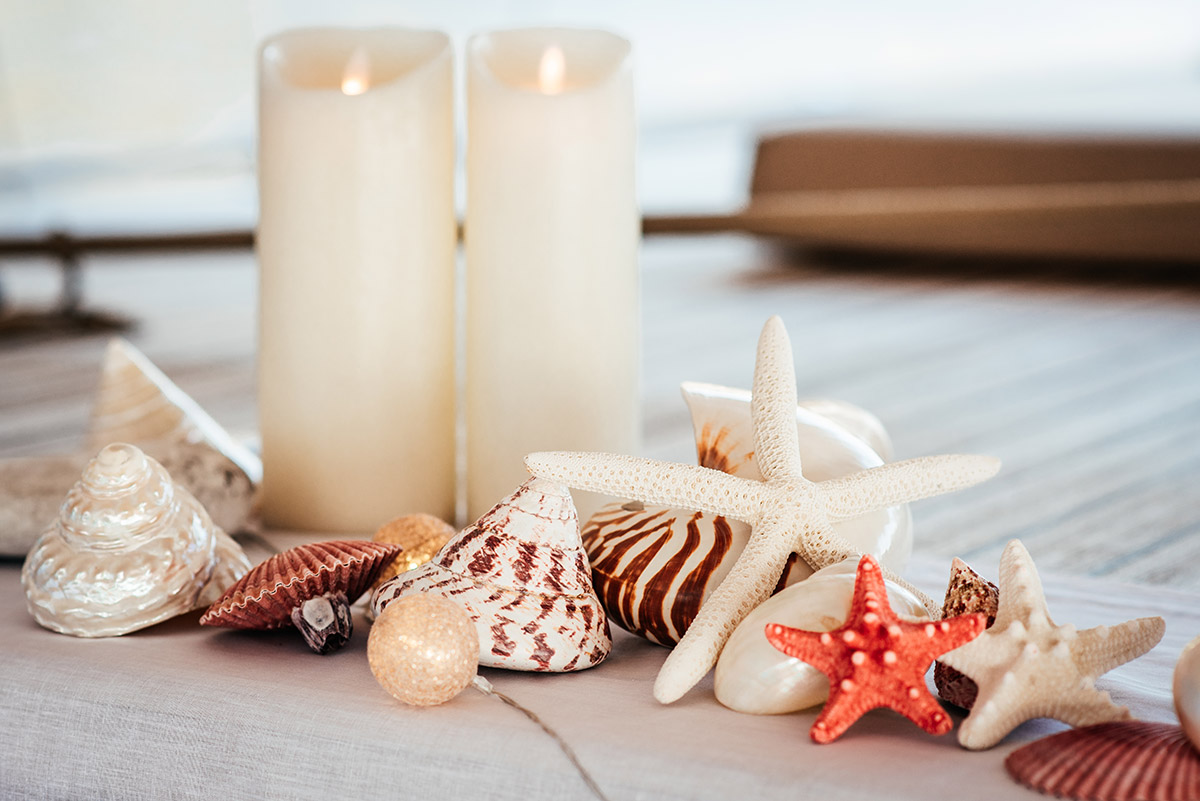
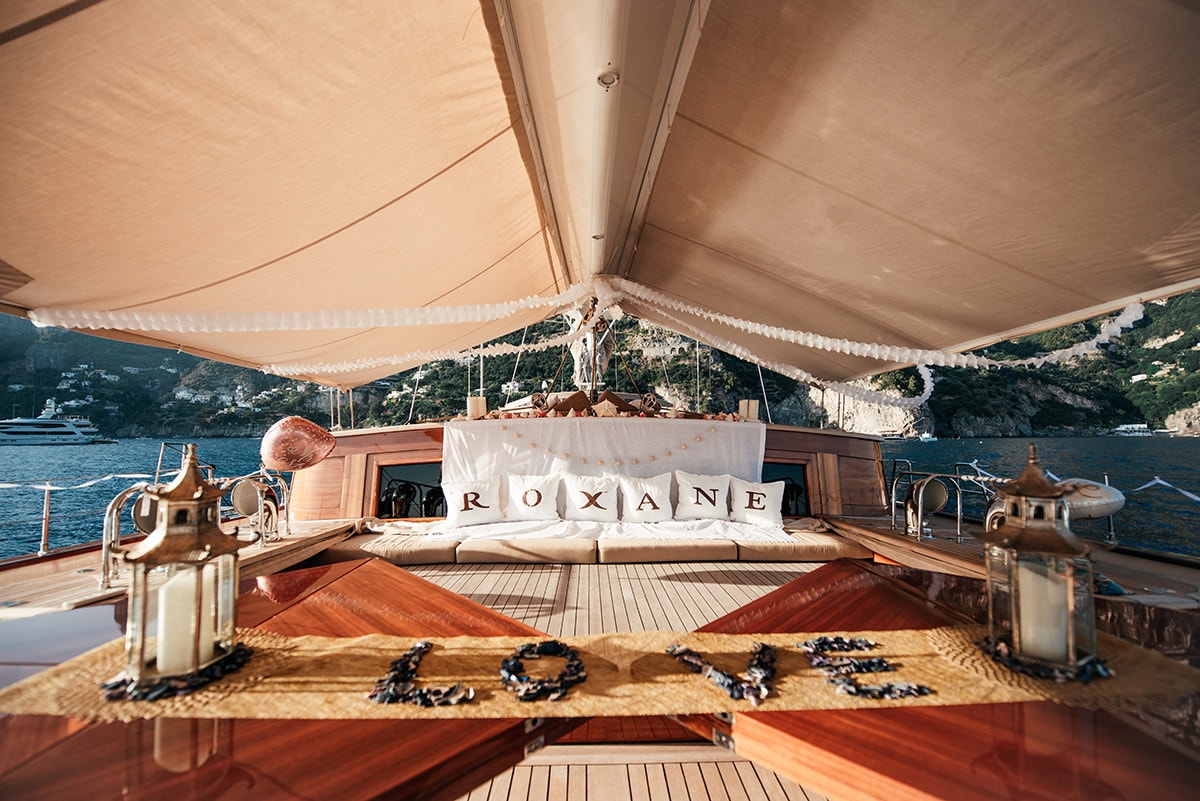
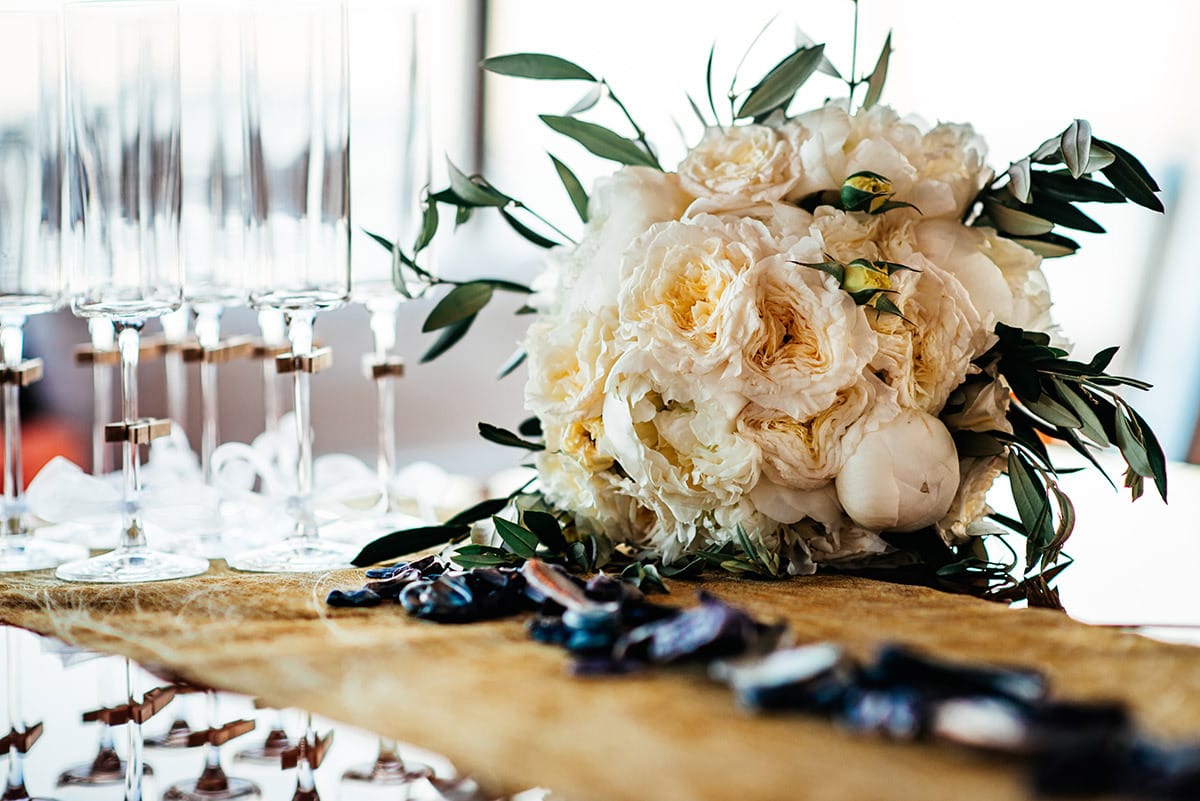
Before anyone was on deck I went around the boat for the details, because a dressed table on a yacht has a short life. Six white cushions along the aft bench spelled out ROXANE, one letter each. Across the table, on a woven gold runner, somebody had laid out the word LOVE in black shells between two brass lanterns. Further along there were tall candles with conch shells and starfish around them, and a bouquet of white flowers and olive leaves resting next to the champagne flutes.
Very little of that was brought in from outside the world of the boat. Shells, rope, lanterns, canvas. It is why the frames sit so comfortably together, and I would suggest the same restraint to anyone dressing a deck: a yacht already has plenty of things to look at, and flowers shipped in by the crate only compete with them.
Teak, Rigging, and Lines That Cut the Frame
A wooden deck is the most forgiving surface I ever work on. It is warm in color and it does not throw glare back at you the way white fiberglass does. Standing somebody on teak is close to having a reflector under their chin that nobody has to hold.
The rigging is the opposite problem. Stays, halyards and shrouds run diagonally through every frame you might want to make, and on a two-masted boat there are dozens of them. You cannot move them. So you either compose around them, which means shooting from a small number of positions the boat allows, or you use them deliberately as lines that carry the eye toward the couple. I did the second thing most of the day, and several of the strongest frames in this gallery have a wire running right across them on purpose.
Five Guests and Nowhere to Wander Off
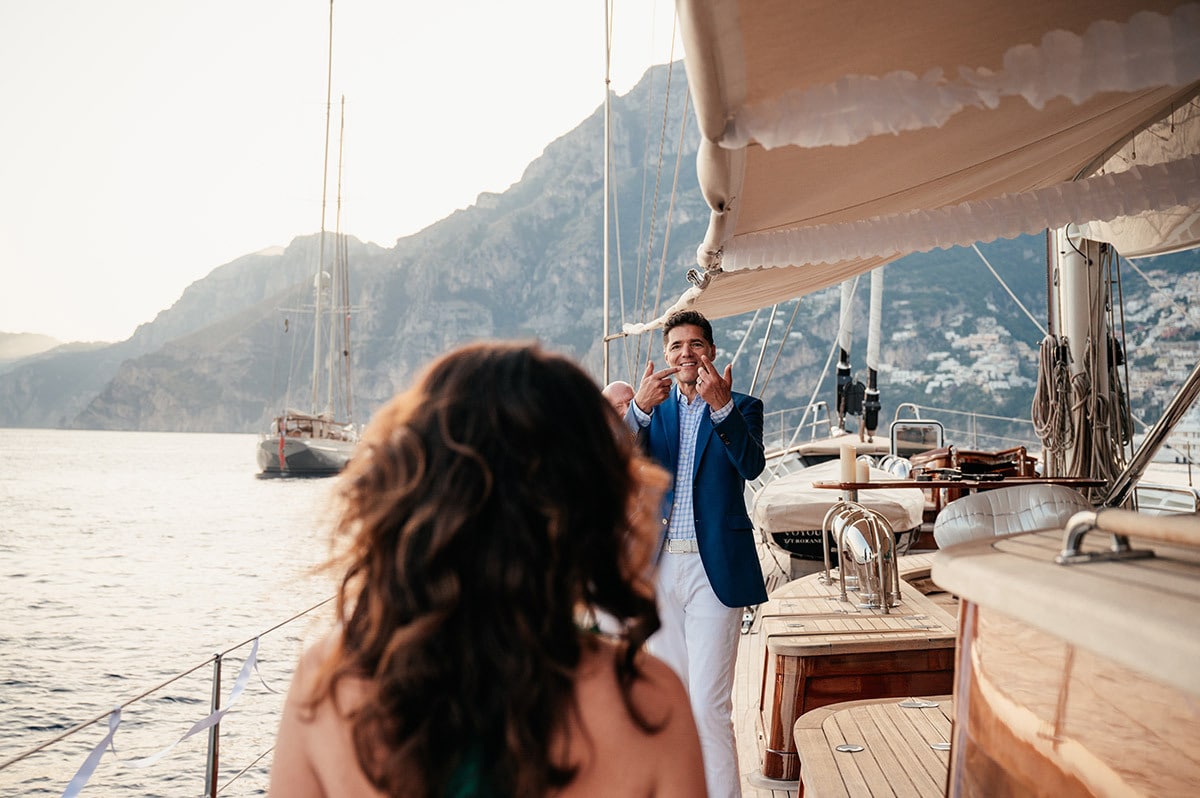
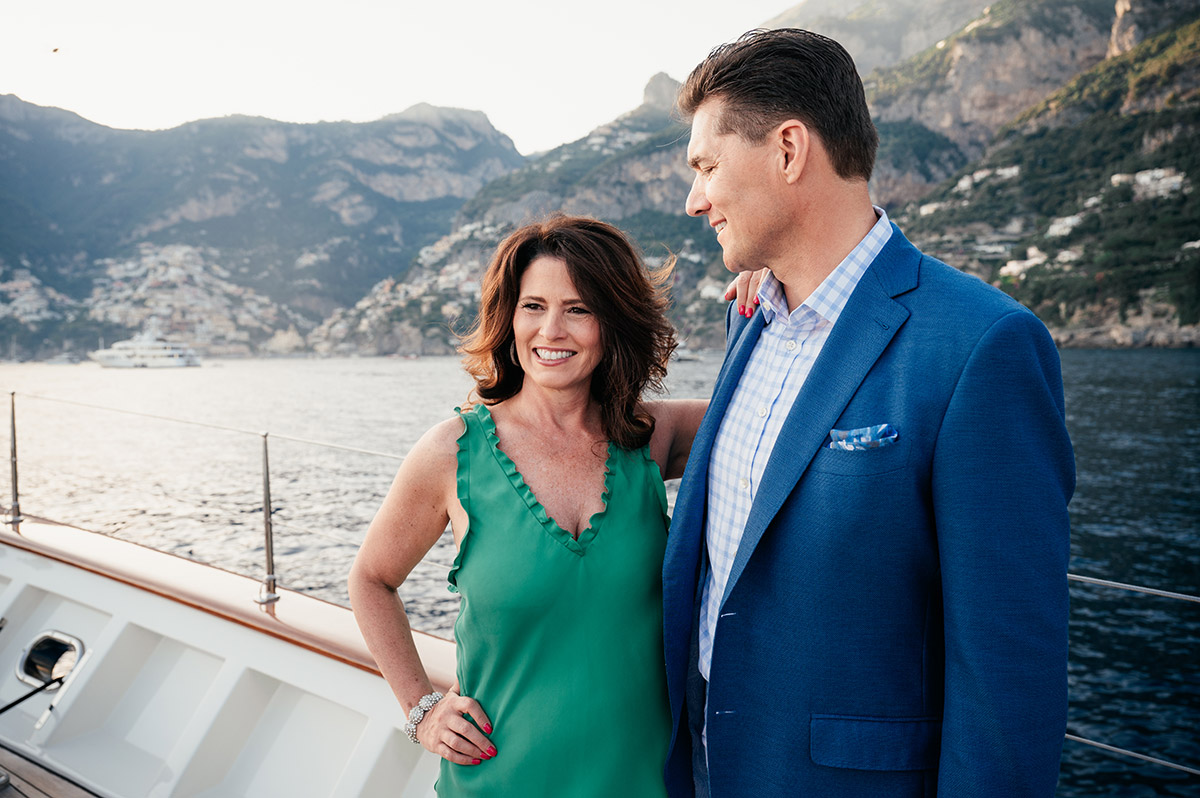
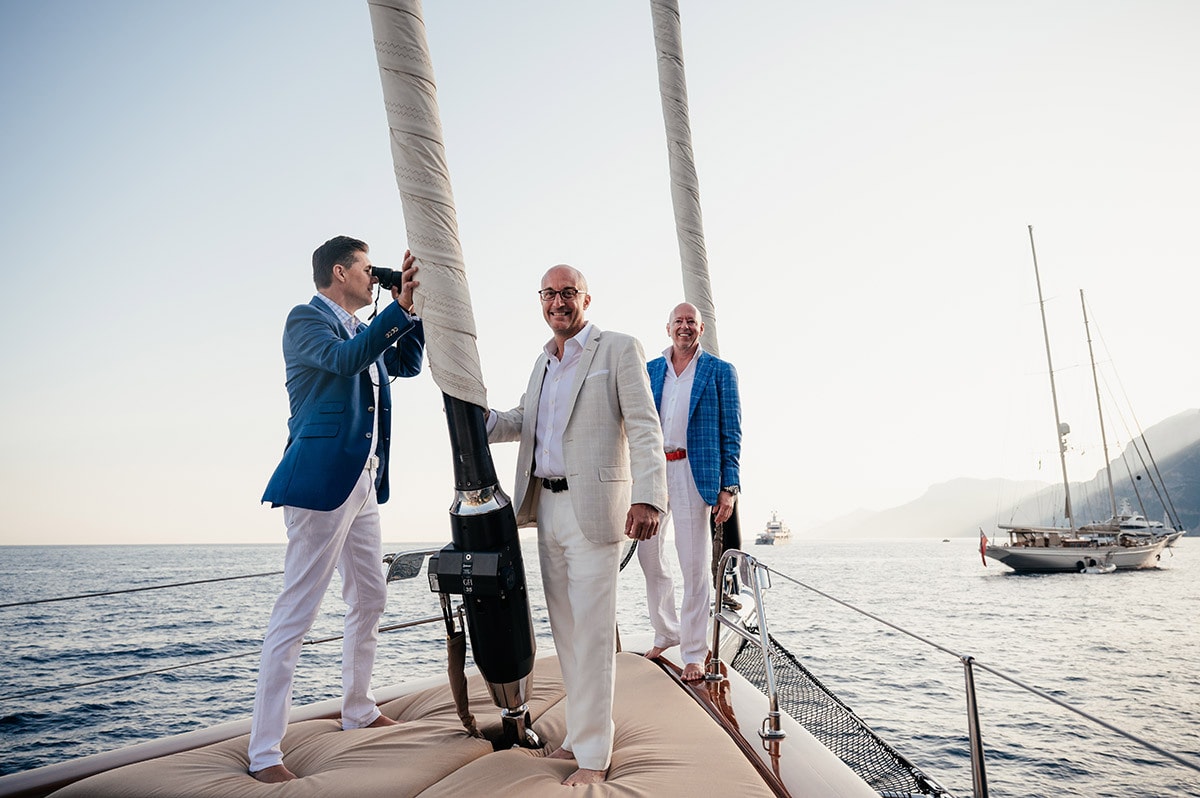
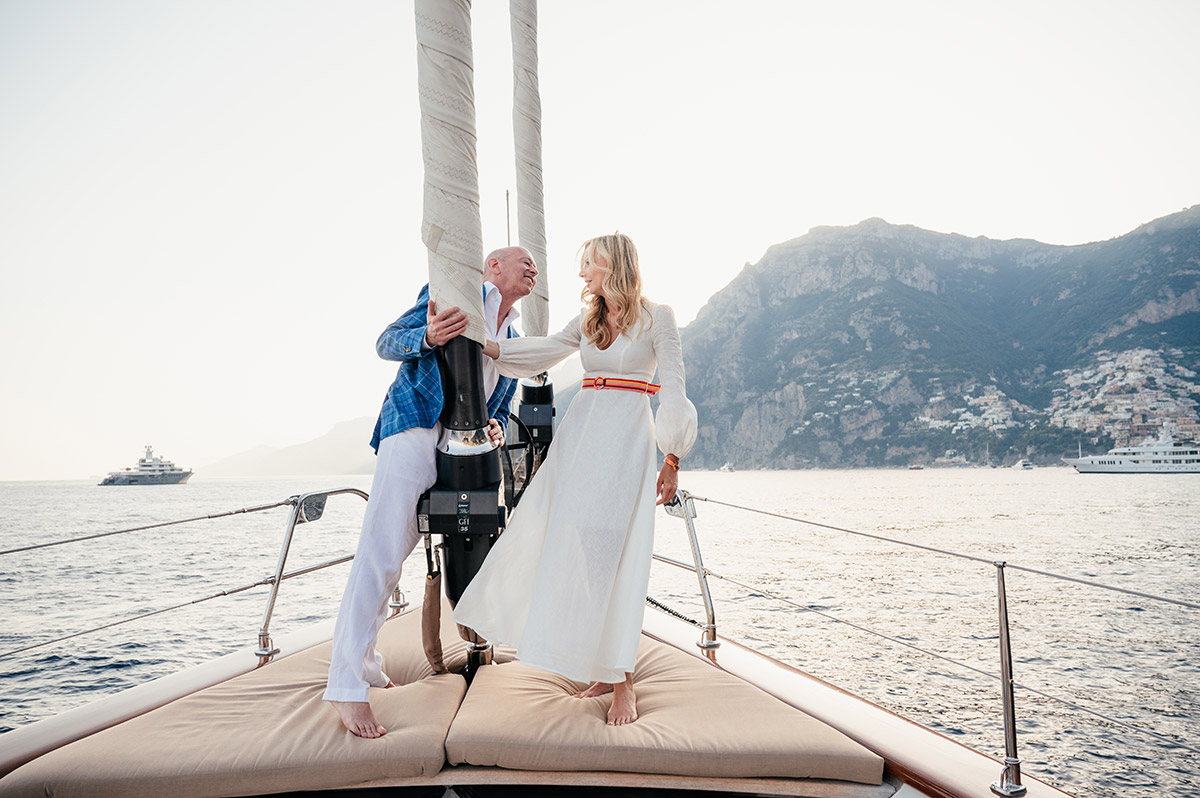
Five people came. A man in a blue blazer with a woman in a green dress, a man in a blue check jacket with a woman in a long white dress, and a man in a dark blazer. On a deck that size five is an easy number, and I had all of them in a few frames before anything formal started. One of the men climbed up onto the foredeck cushions with Reid to take pictures on his phone, which tells you the mood better than I can.
A Deck That Never Stops Moving
The floor moves. Not dramatically on a calm September day, but constantly, and it moves you and your subjects independently of each other. Focus that was correct half a second ago is not correct now.
The way to work is to give up on precision framing and shoot more than you would on land, accepting that a proportion is going in the bin. I also stopped using the deck as a level reference entirely, because a horizon that is straight in the viewfinder is often crooked in the file, and the sea is the only thing in these pictures that tells the truth about which way is down.
The Superyachts Stayed in Frame
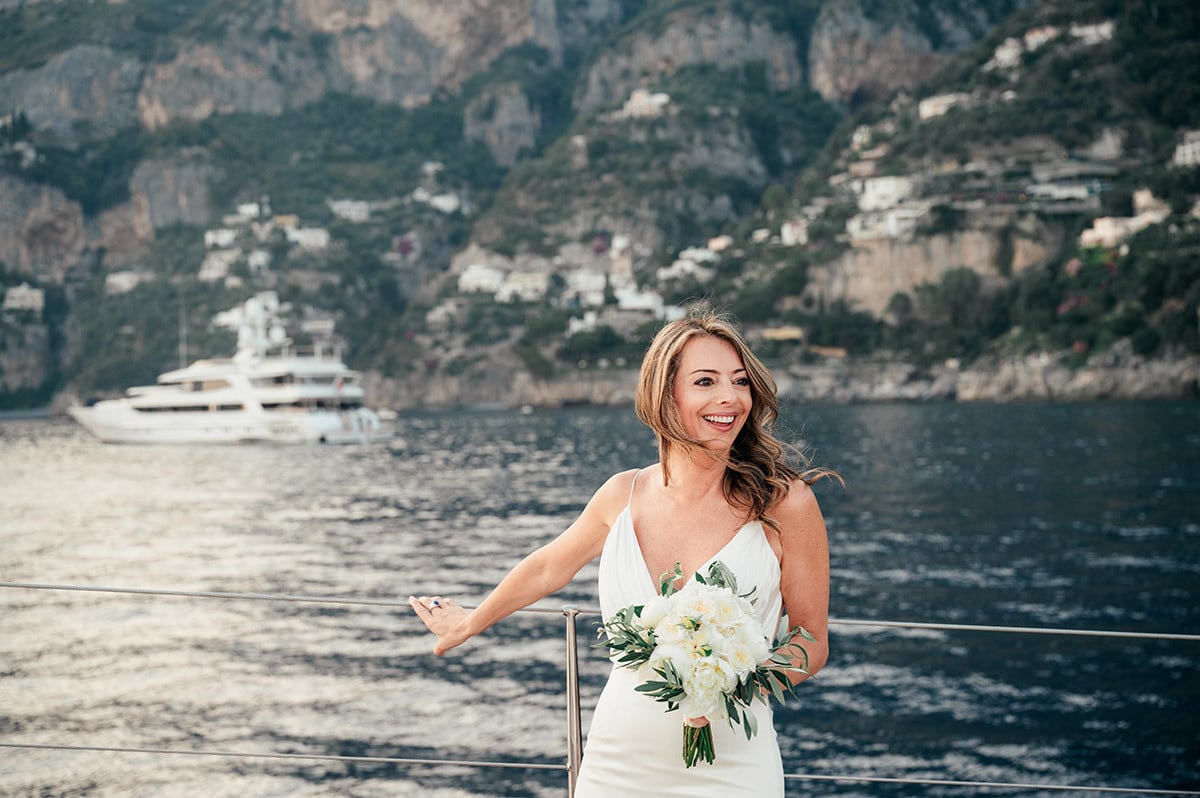
Positano sat behind the boat for most of the day, and so did the big white motor yachts anchored off it. You cannot ask a superyacht to move. I left them in, small and out of focus at the edge of the frame, because they tell you where you are and what time of year it is, and because cropping them out every time would have cost me the coastline as well.

Below Deck, Where There Is No Room
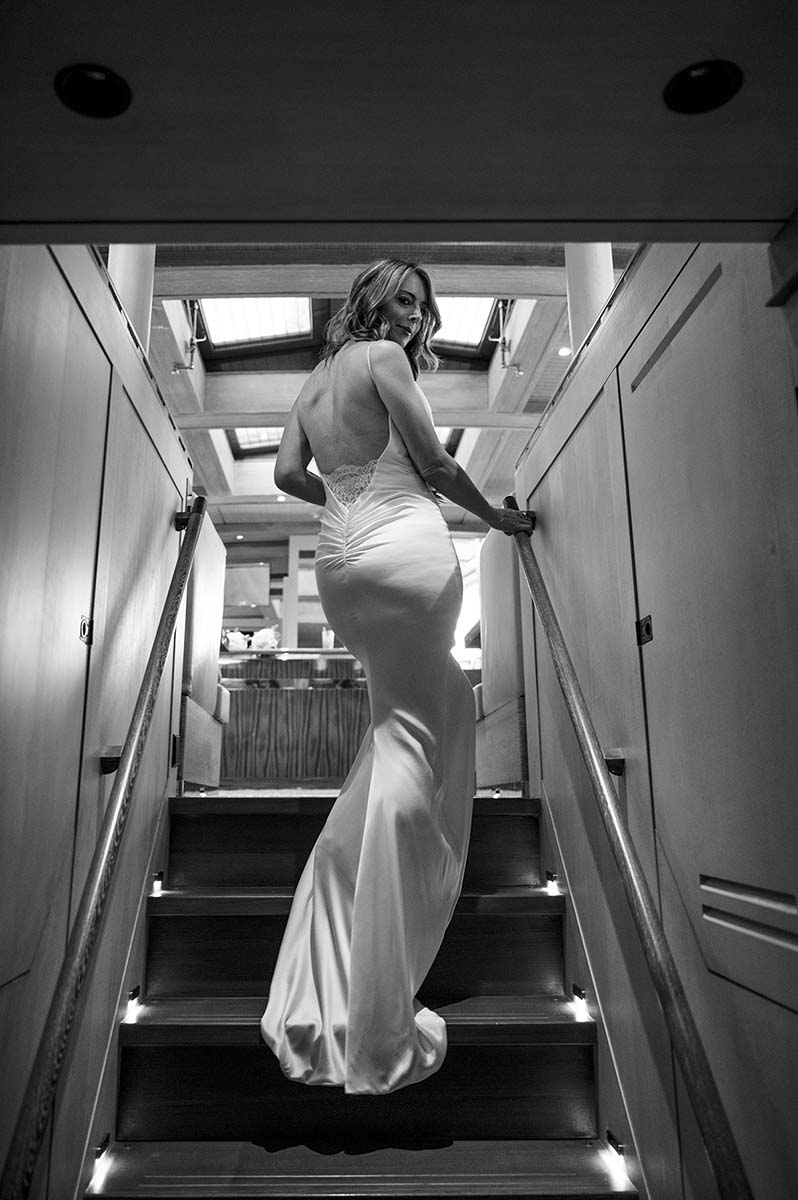
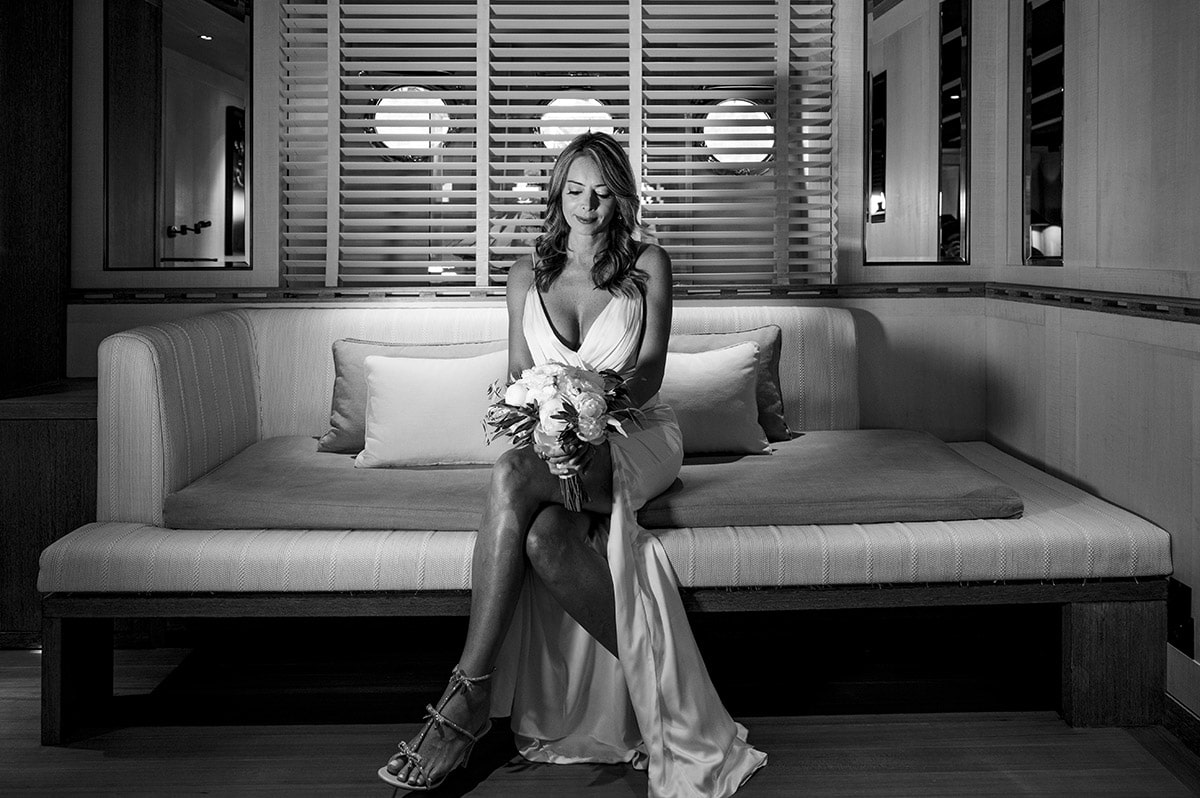
There are exactly two frames of the preparations in the gallery, both in black and white, and that is a fair description of the space available.
Below deck on a sailing boat is a corridor with rooms off it, and there is very little distance to work with. I made one of Corinne from the foot of the stairs, climbing toward the deck with a hand on each rail and her bare back to me, the steps lit from below. The other has her sitting on the long bench in the saloon with the bouquet in her hands and the slatted panels of the window behind her.
In black and white what is left is the shape of a narrow space around a person, which is the honest subject of both pictures anyway.
The Whole Length of the Deck Was the Aisle
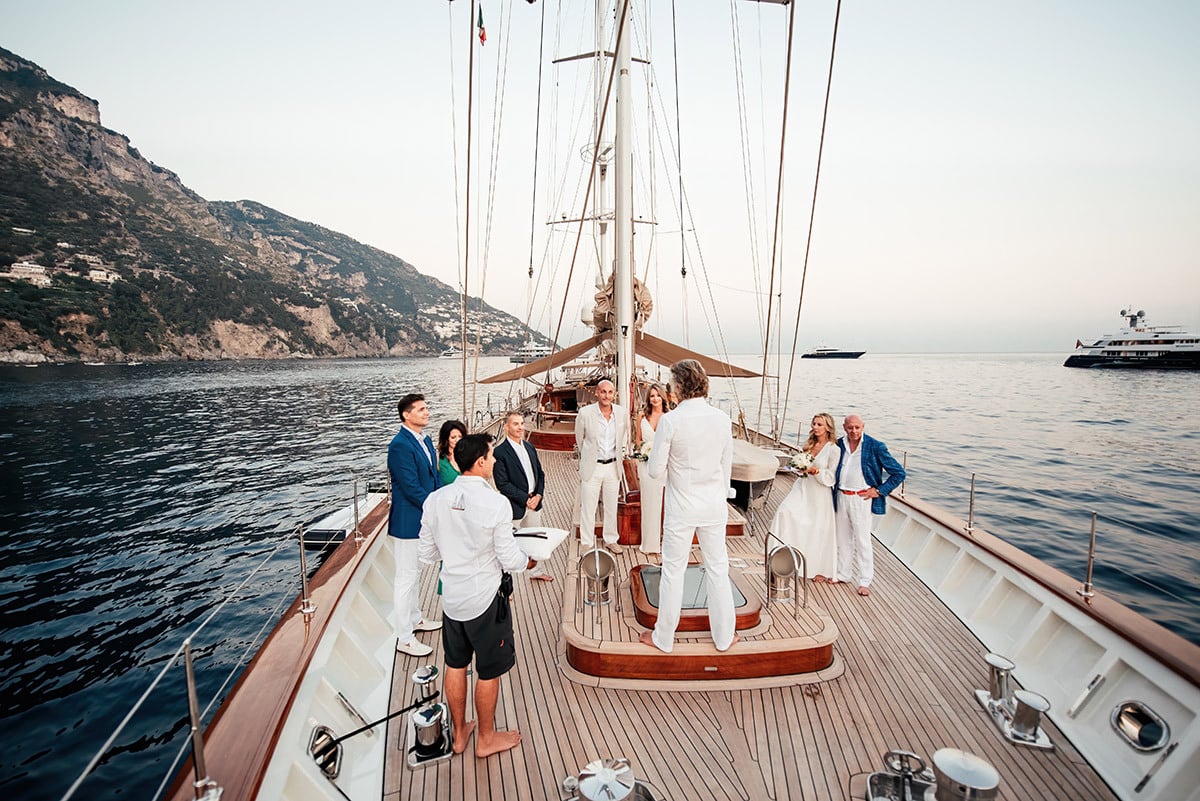
The ceremony happened on the foredeck, in front of the main mast, so Corinne’s walk ran along the teak from the aft deck forward. It is a long, wide stretch of wood with the sea on both sides, and very few aisles on this coast are that long.
A Satin Dress Among the Shrouds
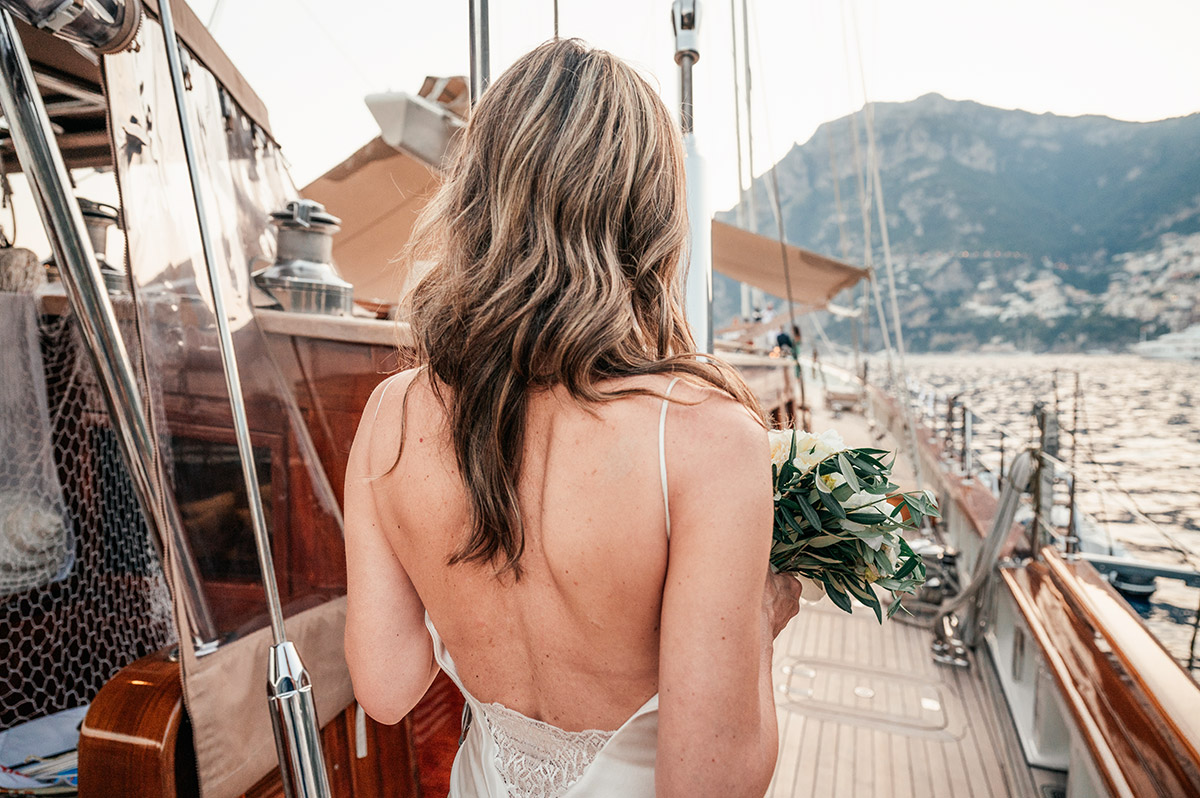
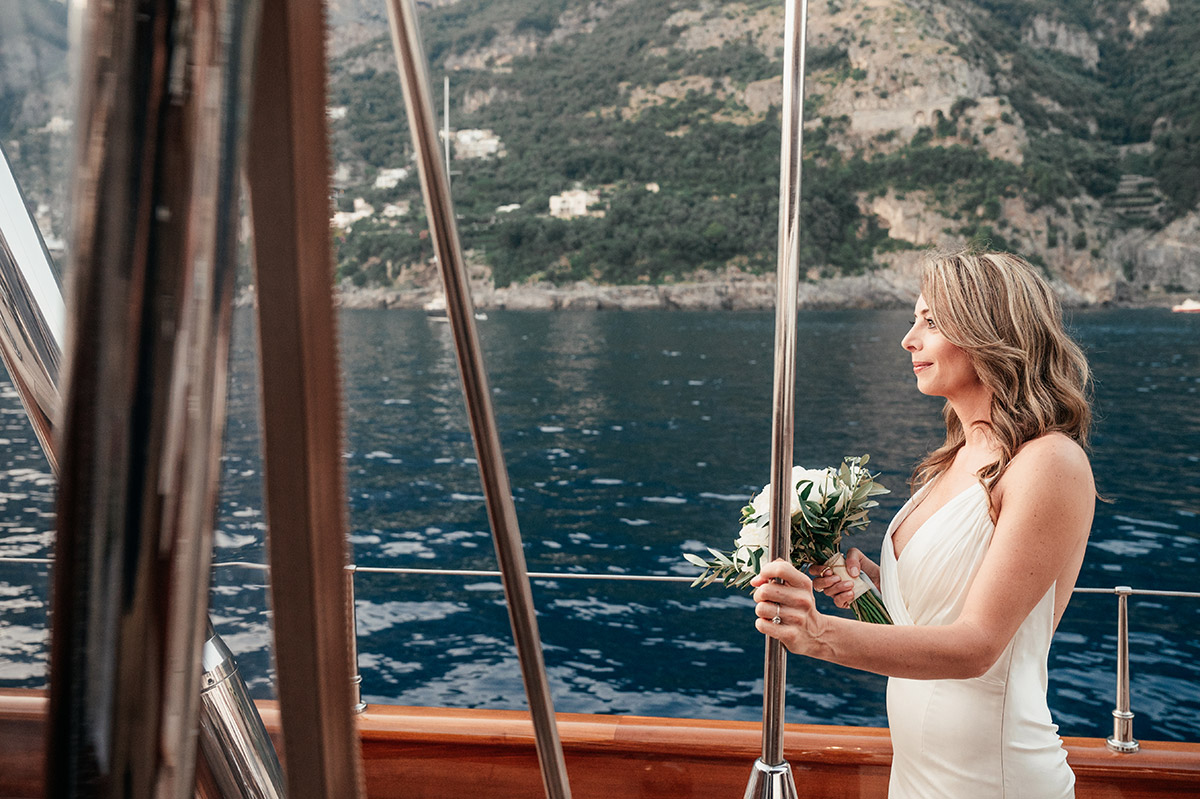
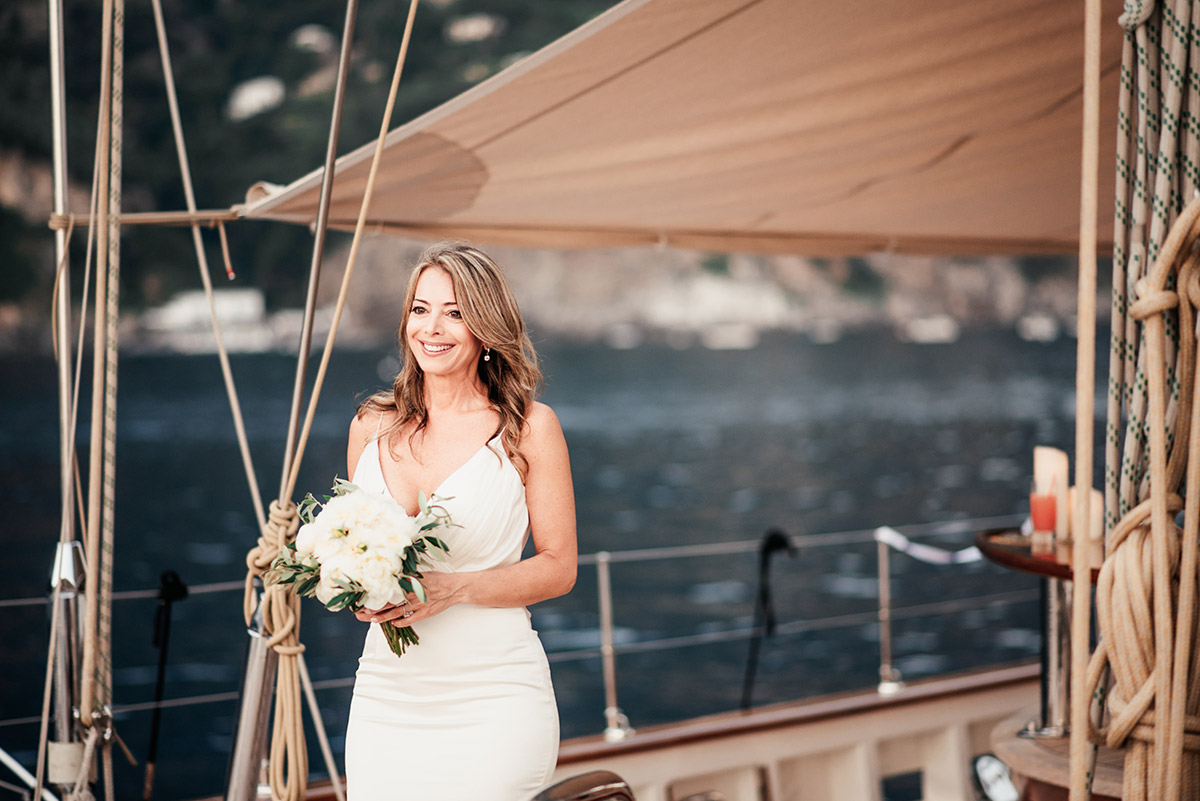
Before she walked I had a few minutes with her on her own, along the rail and among the rigging. She wore a white satin dress with a deep V at the front, thin straps, a line of lace across a low back and a slit up one side, and she held the white bouquet low in one hand. The dress is simple enough that the boat does the rest: dark blue water behind her, the varnished wood of the deckhouse beside her, a coil of rope at her shoulder.
Shooting Past Reid’s Shoulder
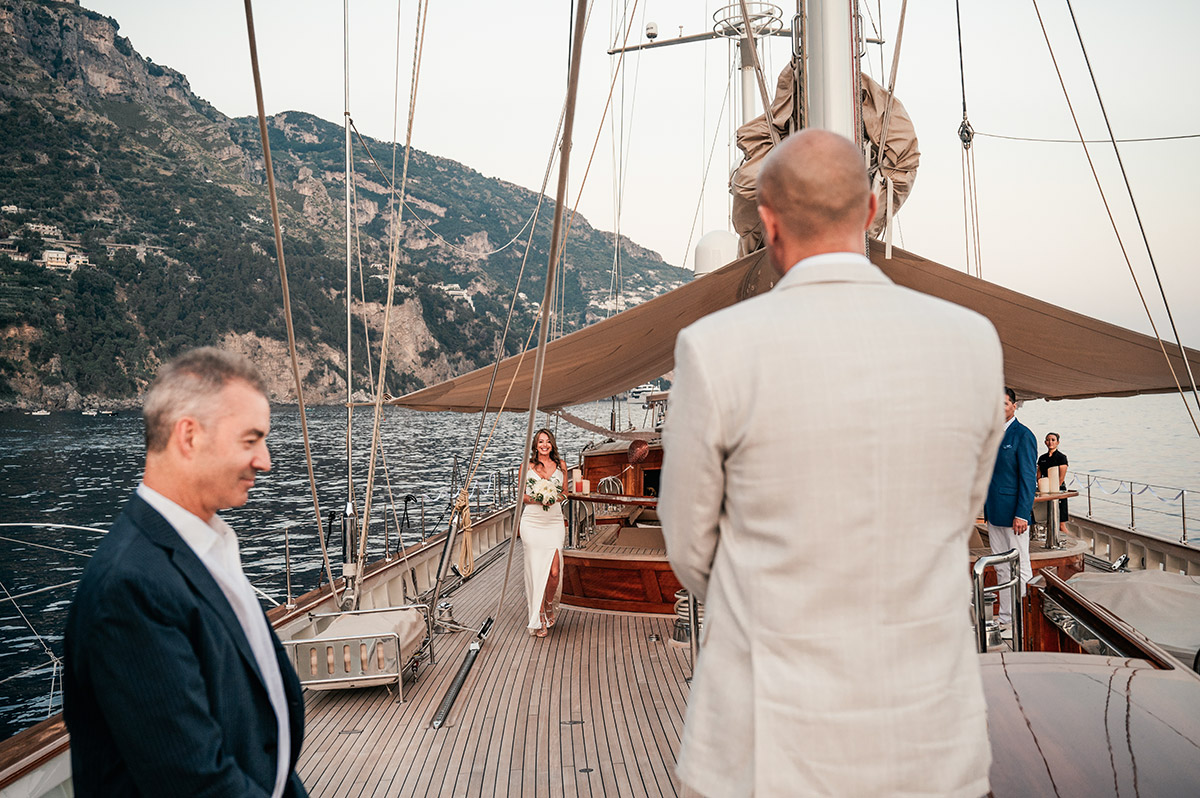
On land I would work an aisle from the side, moving as the bride comes, then swing behind for the reverse. Here the side is the sea. So I stayed forward with Reid and shot past the shoulder of his cream linen jacket, straight down the length of the boat.
That gives you Corinne small on the teak, the awning stretched over the deck behind her and the mountain falling into the water on one side, with Reid’s back filling a third of the frame. It is a composition the boat hands you for free, and I am not sure I would have found a better one with a whole garden to move around in.



Can a Boat Captain Marry You?
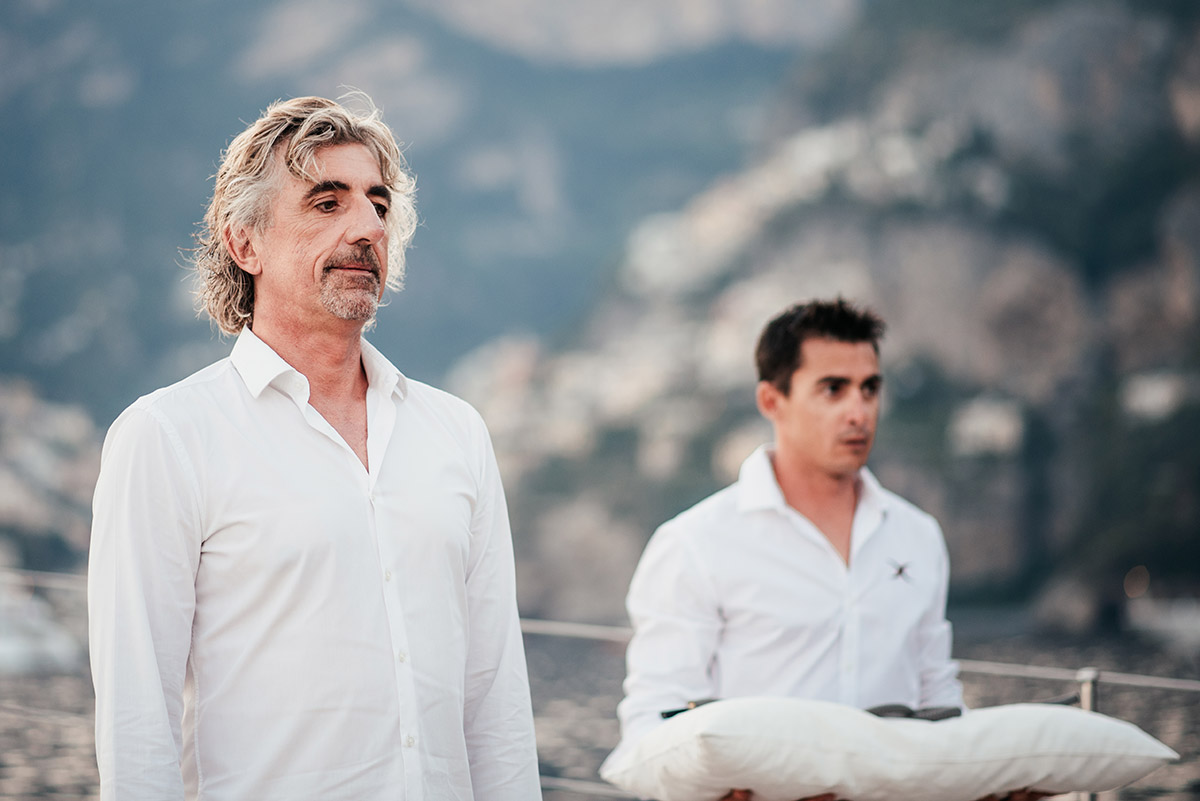
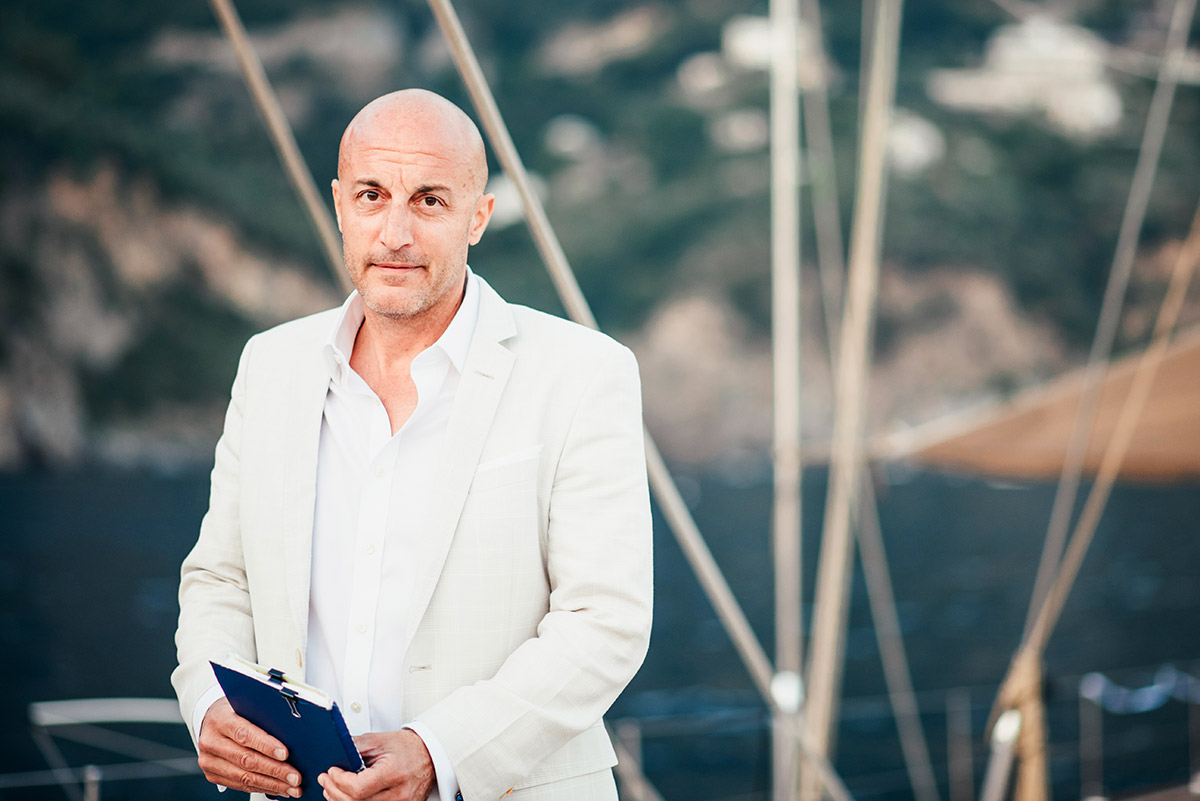
The captain, in a white shirt and white trousers, stood facing them on the foredeck and married them. He had a boat to run and he went back to running it afterward.
Getting married by a boat captain is a symbolic ceremony rather than a legal one. In Italy a captain cannot marry anybody on an ordinary day, and couples who want the legal side handled do the paperwork at a town hall before or after, usually at home. It is the same point that comes up with couples asking about eloping on a boat in Positano, where the ceremony is symbolic for exactly the same reason. It took nothing away from the afternoon.
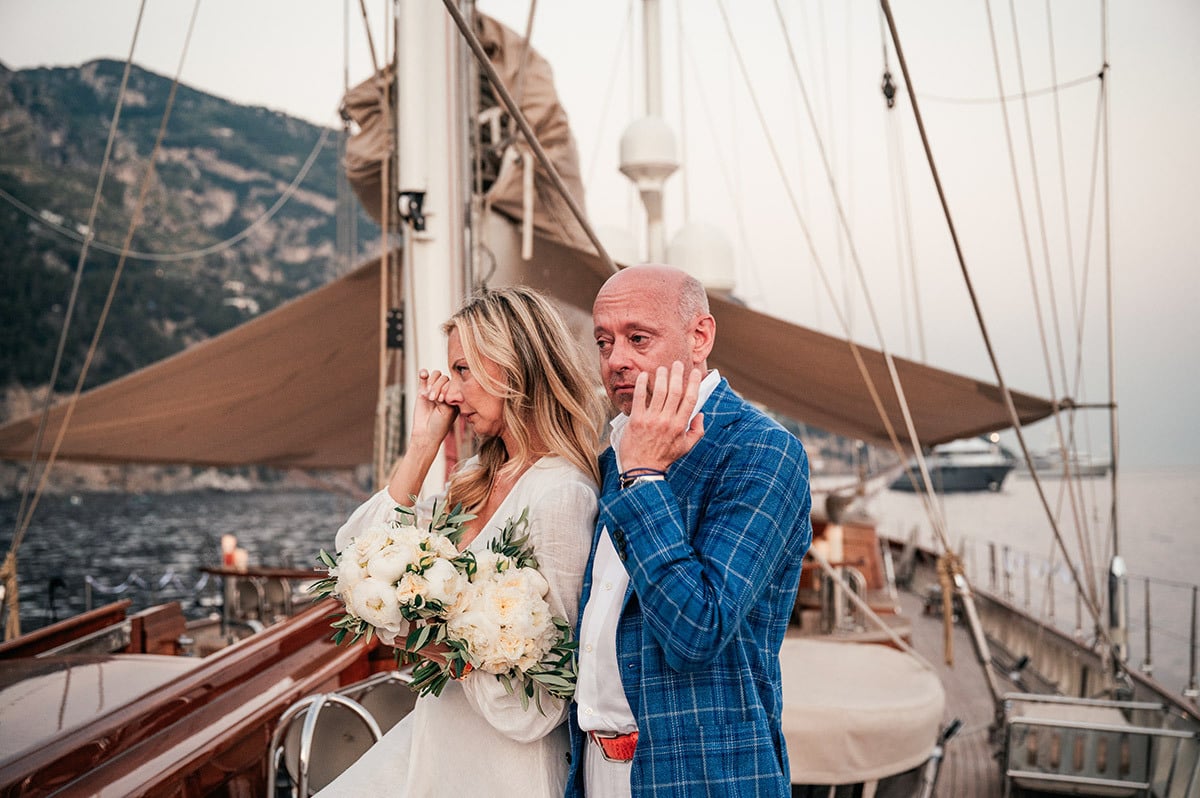
What it added was a different quality of attention. A professional celebrant is an outsider who arrives, performs, and leaves, and however good they are, the couple has usually met them twice. A captain belongs to the deck you are standing on. The frame I would show you from that part of the ceremony is of the guests, though: the woman in the long white dress and the man in the blue check jacket standing side by side, both wiping their eyes.
A Black Line Tied to a Gray One
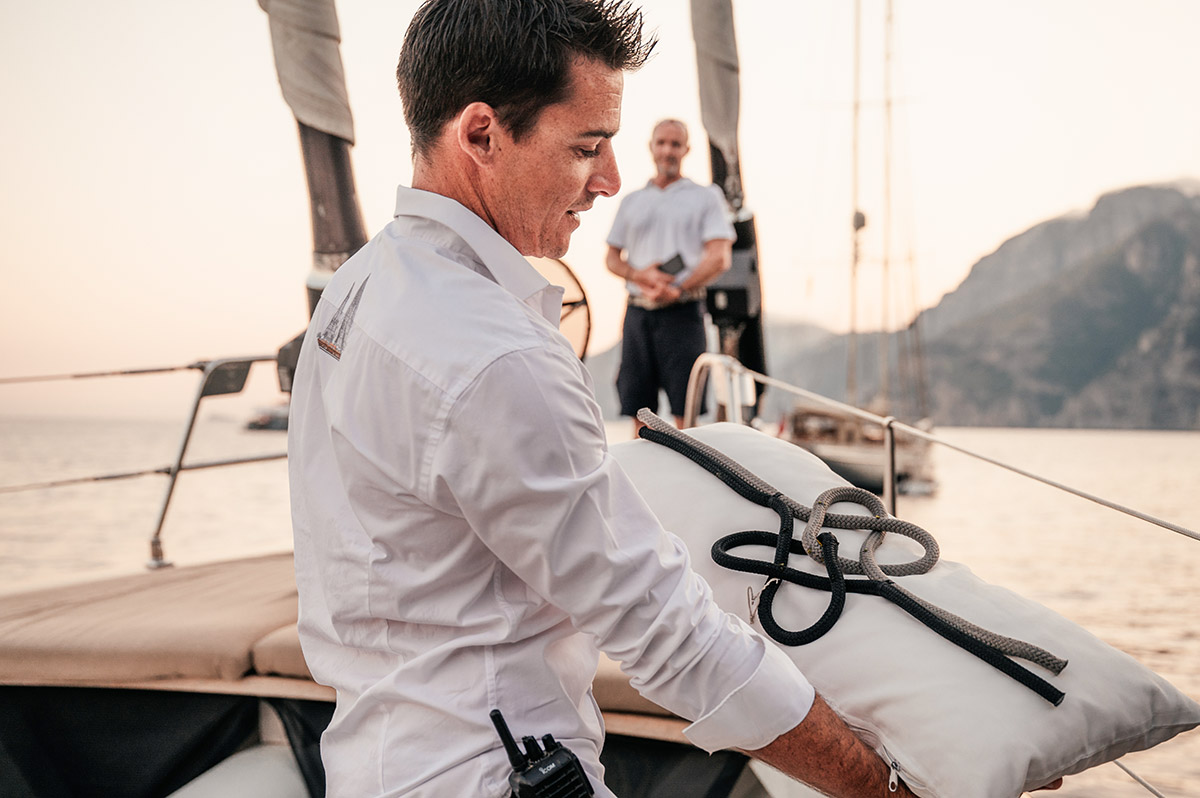
The ritual in the middle of the ceremony was a knot. One of the crew, a radio clipped to his belt, carried a white cushion forward with two lengths of line on it, one black and one gray, and Reid and Corinne took hold of them and pulled them together.
Why a Working Line and Not a Ribbon
They chose this themselves. It was not suggested by the boat or by the captain, and it matters, because the object they chose is a real one. These are thick braided lines, the kind of thing you find coiled on a deck. They do not drape prettily. They hold whatever shape you force them into and they fight you a little while you do it.
That resistance is exactly why it photographs better than a ribbon. Two people tying a length of ceremonial silk make an elegant picture with no effort visible in it. Two people pulling on stiff rope have to actually do something, and their hands show it: knuckles, tension, one of them holding while the other pulls. The gesture reads as work, which is a more useful metaphor for a marriage than anything a florist can supply.
Photographing Hands and Two Lengths of Rope
Technically this is a small, fast subject happening between two bodies, which is a difficult combination. Shoot it wide and the knot is a dark smudge at waist height. Shoot it tight and you lose who is doing it.
I let the frame of the crew member with the cushion do the wide job and went in tight for the knot itself: their hands, the cream of his jacket and the white of her dress at the edges of the frame, and the two lines crossing in the middle. Ten years from now that is the one they will actually look at.
A Blue Folder in a Light Breeze
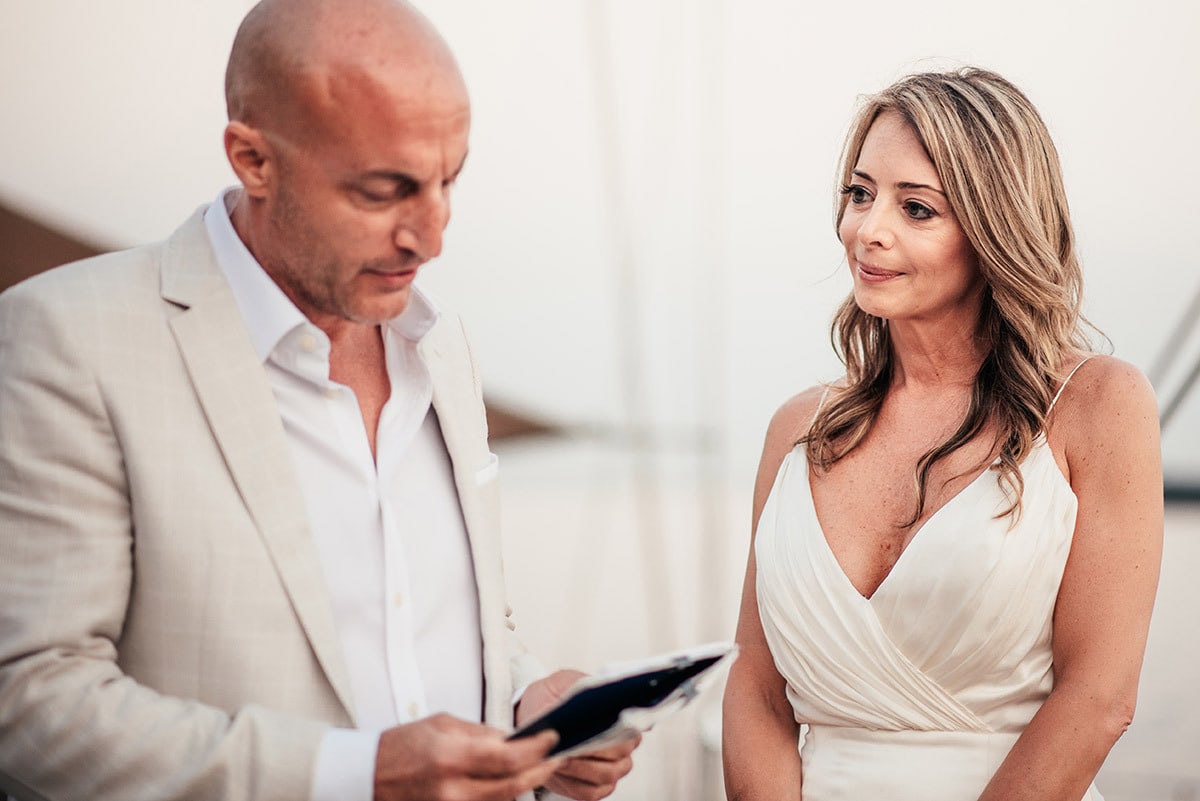
Reid read from a small blue folder and Corinne kept a folded sheet in her hand. On open water there is always some breeze, and it takes the words away sideways before they reach anybody standing at a distance. Nobody minded. With so few people on deck, the guests could stand close enough to hear.
One practical thing at sea: a folder or a card beats loose paper, because paper flaps and folds and ends up covering a face. A good Amalfi Coast wedding planner who can coordinate a charter will think of that sort of thing before you do, along with where the flowers go so they do not end up in the water.
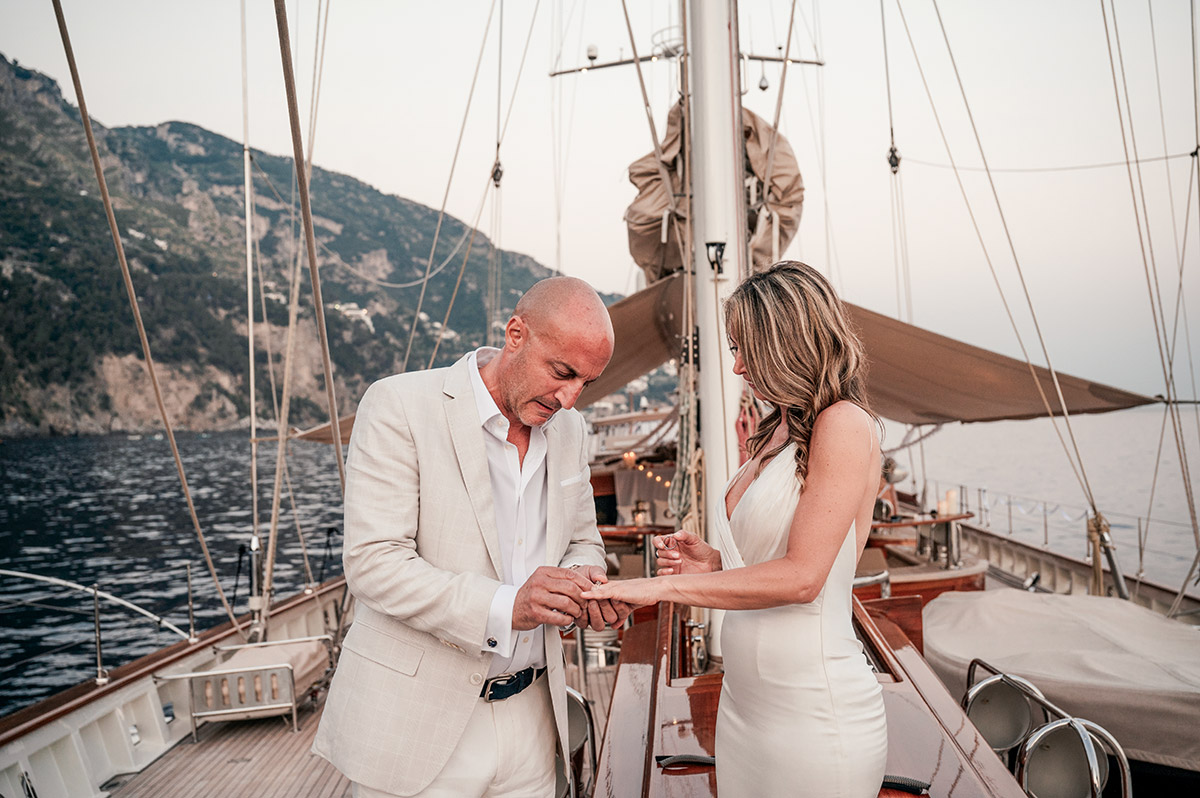
Rings, and Hands That Had Just Held Rope
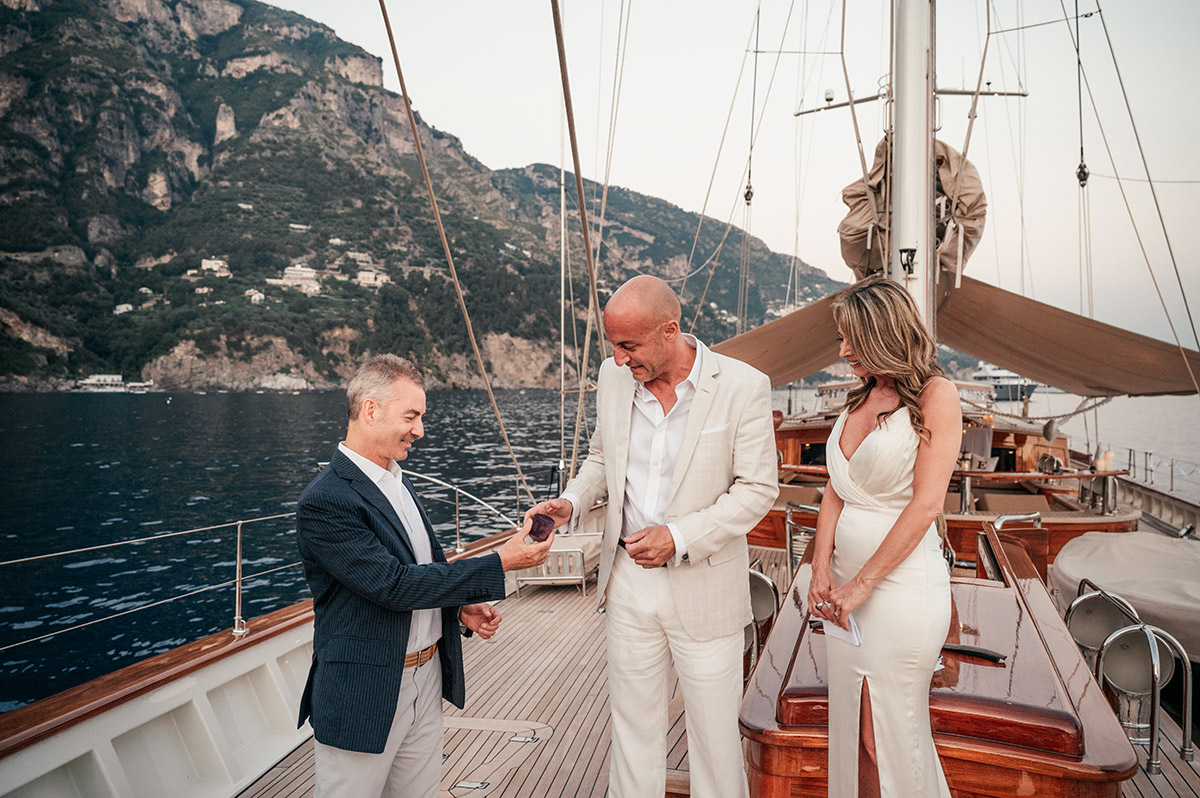
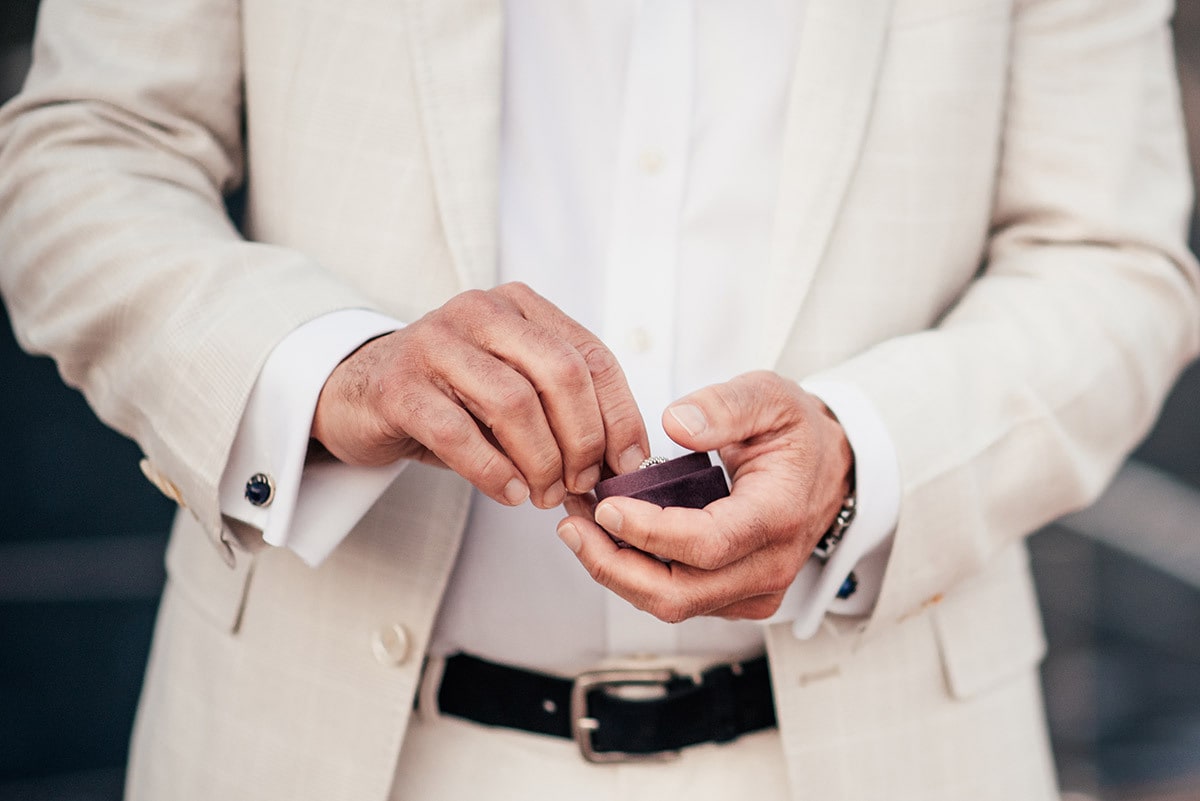
The rings came out of a small dark box, handed over by the guest in the dark blazer, and the sequence of frames is one of my favorites in the set for a reason that has nothing to do with jewelry.
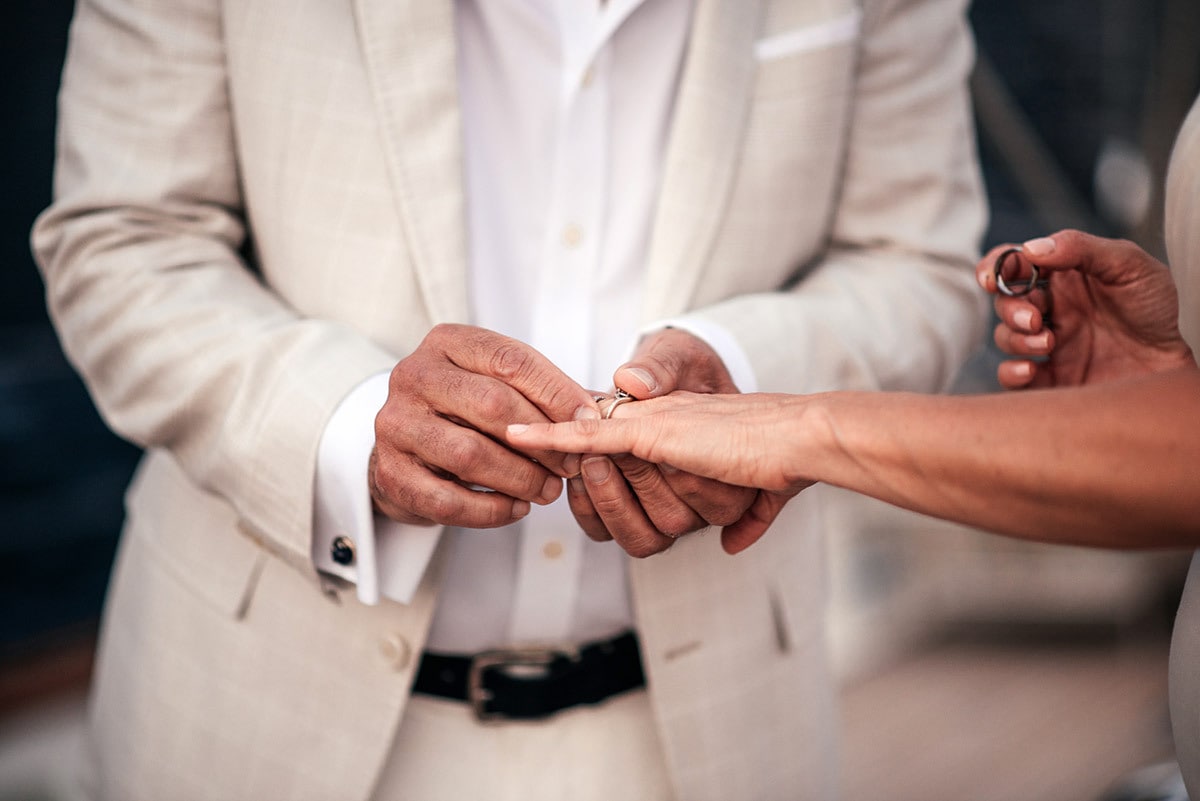
Reid opened that box with the same hands that had just been pulling on rope, and there is a visible change in how he was using them: careful now, slow, holding Corinne’s fingers flat. I shot it tight from the front with the cream linen of his jacket filling the background, which turned the frame into two hands and a piece of metal against a warm neutral field. No sea, no boat, nothing.
That is a deliberate break. Everything else in this gallery insists on where you are, because that is what the day was about. The ring frames are the ones where I took the location away completely, and they land harder for sitting between pictures that are full of horizon.

Everyone on One Stretch of Teak
From the bow, looking back along the deck, the whole ceremony fits on one stretch of teak: the captain, the two of them, the crew member with the cushion and the guests in a loose half circle, with nothing but water behind them. No back row, no chairs, no aisle runner, nobody’s head blocking anybody. A land ceremony almost never gives me that, and it is the frame I would use to explain to anyone what this day looked like.

One Guest, Carried Sideways
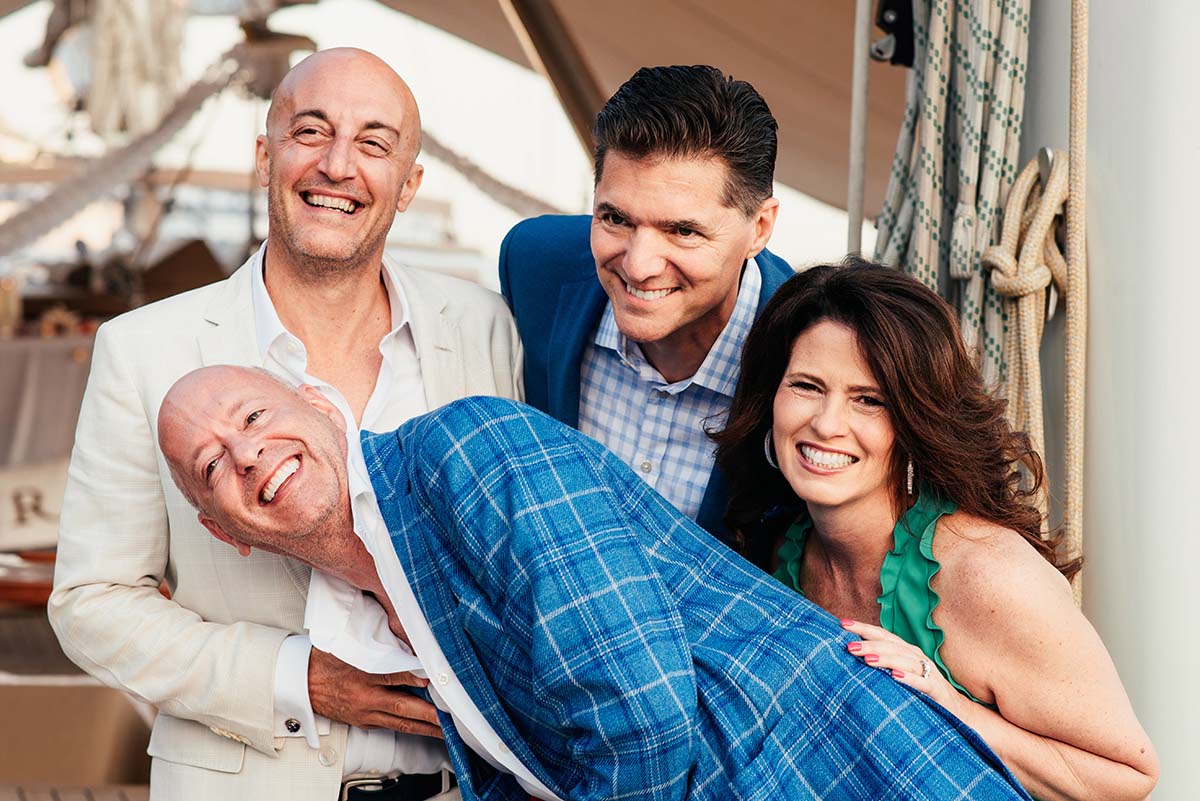
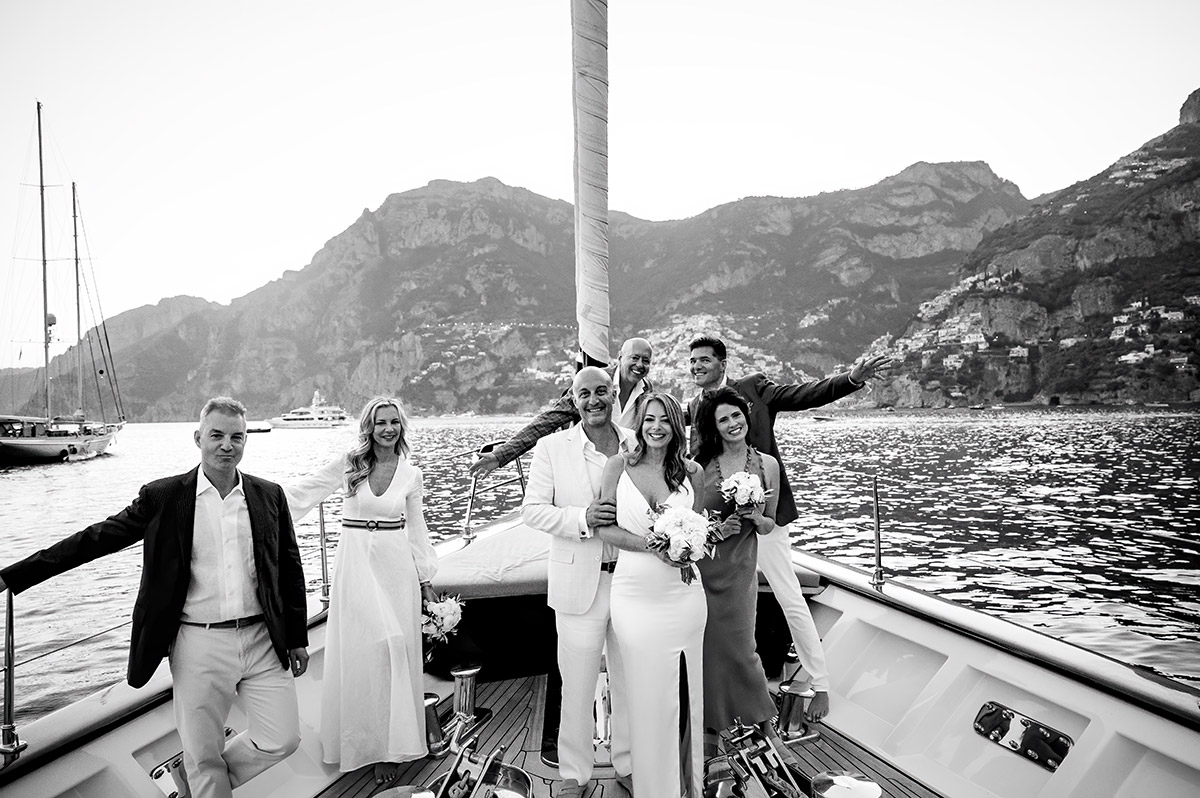
The picture I would print first came right after. The man in the blue check jacket lay back across the arms of Reid, the man in the blue blazer and the woman in the green dress, and all four of them laughed straight at my lens. That happens on boats more than at land weddings, and my working theory is that people who cannot leave a space eventually stop being formal in it.
Seven People, One Bow
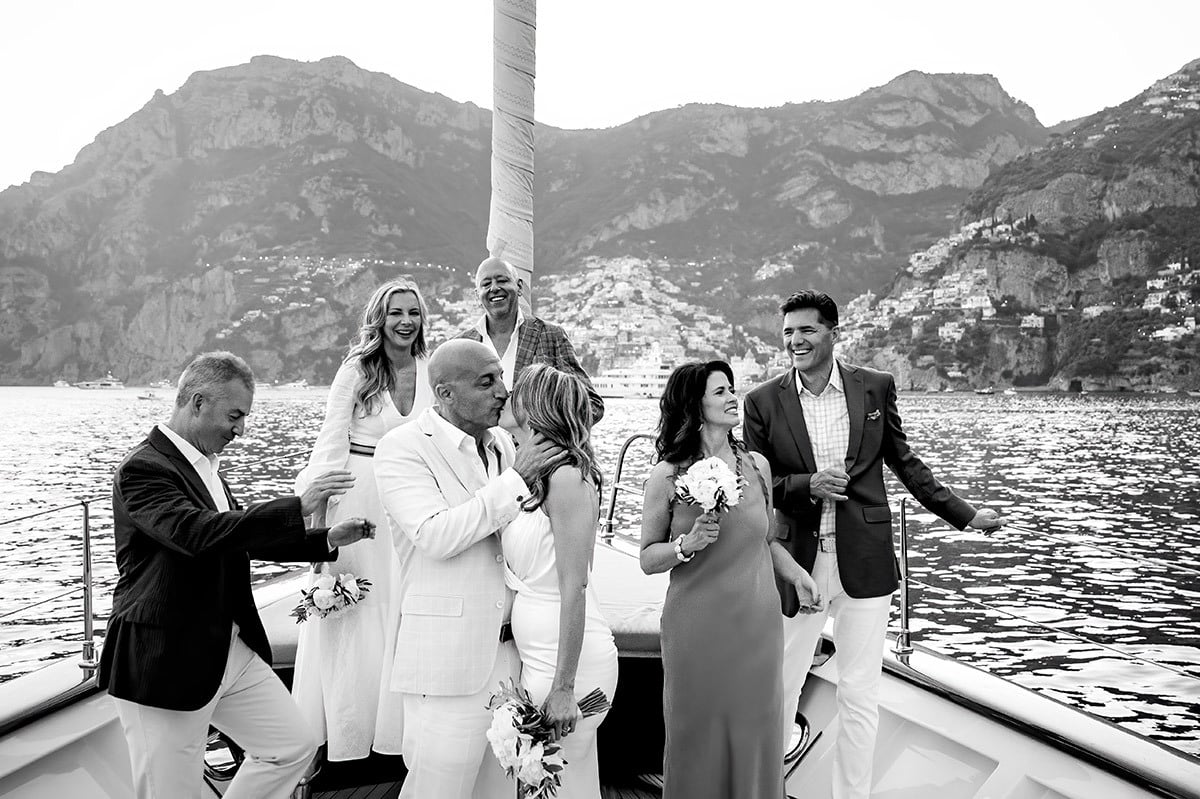
Group portraits on a boat are simpler than on land, because the boat has already decided where everybody stands. The bow is the place on Roxane where all seven of them fit facing the same direction. The deck narrows toward the point, which arranges people into a wedge without anybody having to be told, and the rails keep the sides from drifting.
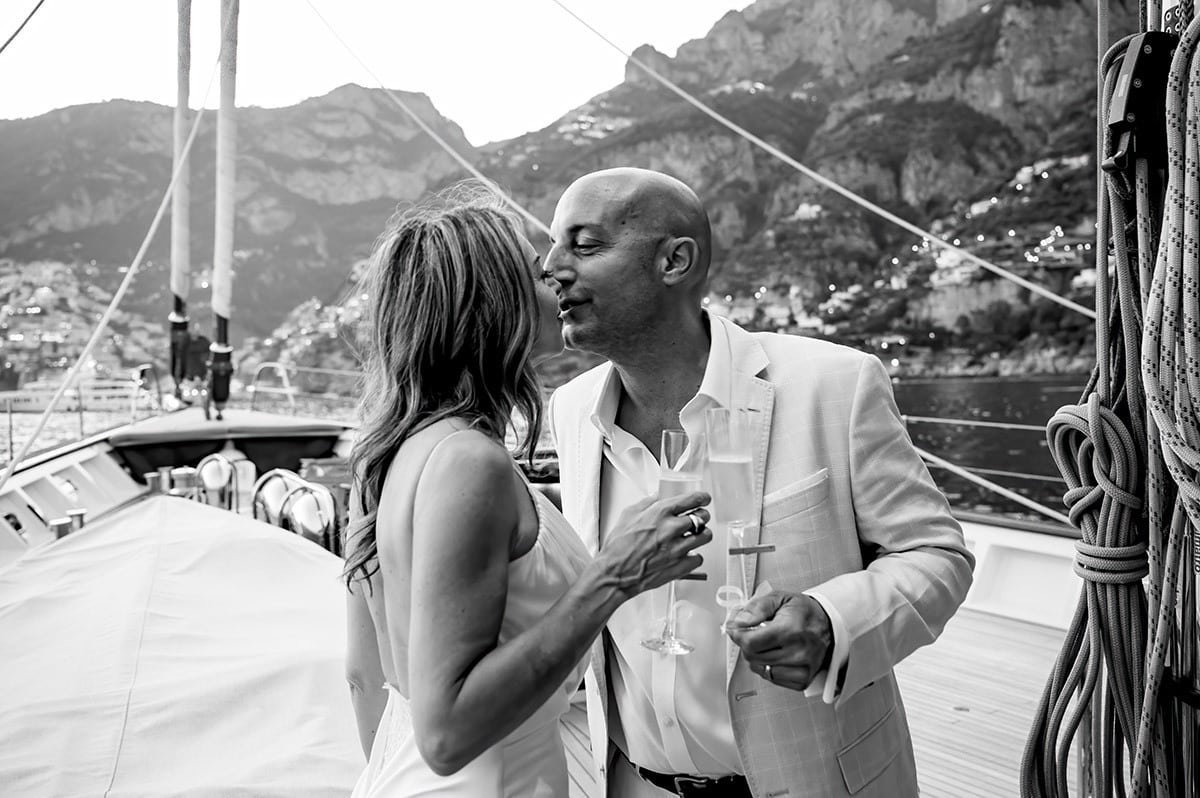
Those frames are in black and white in the gallery, along with a toast on deck, two flutes touching next to a coil of line, and the mountains and the town standing behind everyone as a gray wall.

September Light With No Sun on the Deck
The ceremony ran toward the end of the day, which on this coast in September is the difference between a usable day and a difficult one.
September Beats August on Deck
August out here gives you a white sky, haze on the horizon that swallows the coastline, and sun hard enough that anybody standing on an open deck is squinting for most of the day. September gives you clearer air, a sea that has kept its summer color, and an evening that arrives earlier.
The second reason counts for more on a boat than it would on land. The water is calmer. A September evening off this coast is often flat enough that a ceremony can happen without anybody bracing, and that is not reliably true in spring. If you are choosing a month for a day like this, choose it for the sea state before you choose it for the light.
Portraits Under a Pink Sky
There is no hard sun on any of the ceremony frames. By then the deck was in soft, even light, the sky pale and turning pink, the water dark blue under the mountains. On a boat that is a gift, because you cannot walk a couple into the shade: the shade has to come to you.
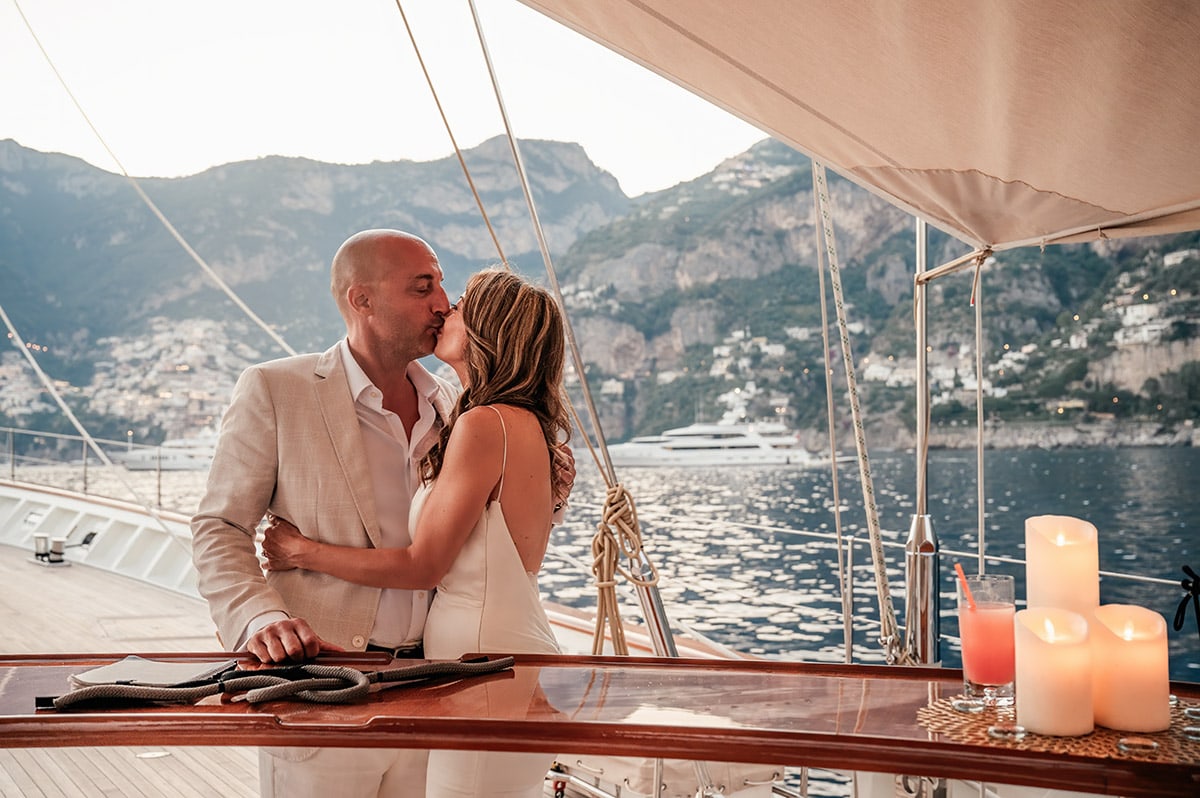
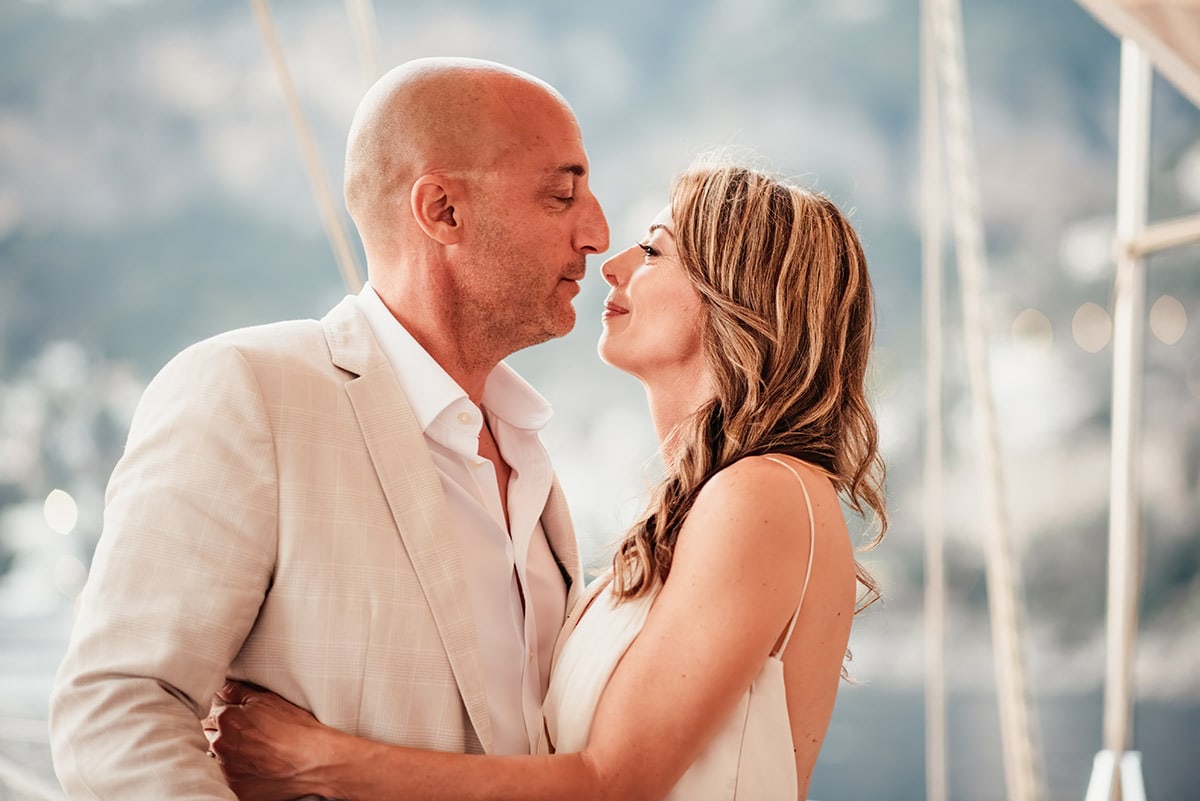
Afterward I took the two of them aside for a few minutes. One frame has them kissing behind the varnished table with three candles lit on it and the coast behind them. In the last one I went close, and the masts and the town dissolve into soft color around their two faces.
What a Sailing Yacht Wedding Costs You in Control
The pictures make this look easier than it was, so it is worth setting out what the format costs.
You give up the ability to change your mind. On land, if the light is wrong where the ceremony is set, you move the ceremony across the garden. On a boat you can turn the whole vessel, which takes time and involves the captain, or you accept what you have. You also give up any backup for weather: there is no indoor option out there, and a forecast that turns means the day changes shape rather than moves rooms. And you give up guests. A sailing yacht wedding works for a handful of people, and the deck decides how big that handful is.
What you get back is that nothing intrudes. No other wedding party in the next garden, no tourists in your background, no service road, no noise. It is the most private ceremony arrangement available on this coast, more private than any villa, and for some couples that trade is obviously worth it. The same reasoning pushes couples toward an Amalfi Coast elopement that never touches land, where the guest list problem disappears entirely because there is no guest list.
Who Belongs on a Boat for This
A sailing yacht wedding suits people for whom the sea is already part of the story. Reid and Corinne did not choose a boat as a backdrop, and it shows in every decision they made, down to choosing two lengths of rope as the object at the center of their ceremony instead of something that would have looked better and meant less.
It suits people who can tolerate a plan with no alternatives in it. And it suits a short guest list, genuinely short, the sort of number where everybody on board is somebody the couple would have called on a Tuesday.
If you are drawn to it, the first question worth answering is not which boat but how many people. That number decides everything else about the day, and it is the one couples put off. Tell me how many people you want standing on that deck and I can tell you what the ceremony will look like from the bow.
 Written By Emiliano Russo