A Rainy Day Elopement in Amalfi, and a Sea That Vanished
Nicole and Michael married at Hotel Santa Caterina with two other people present, an officiant and a violinist, on an afternoon when the sea and the sky had merged into one white field and the horizon was simply not there. A walk down to an empty harbor pier under the hotel’s own umbrella, and dinner for two behind lancet windows with the rain running down them.
Tell me your date, even if it falls in the rainy months.
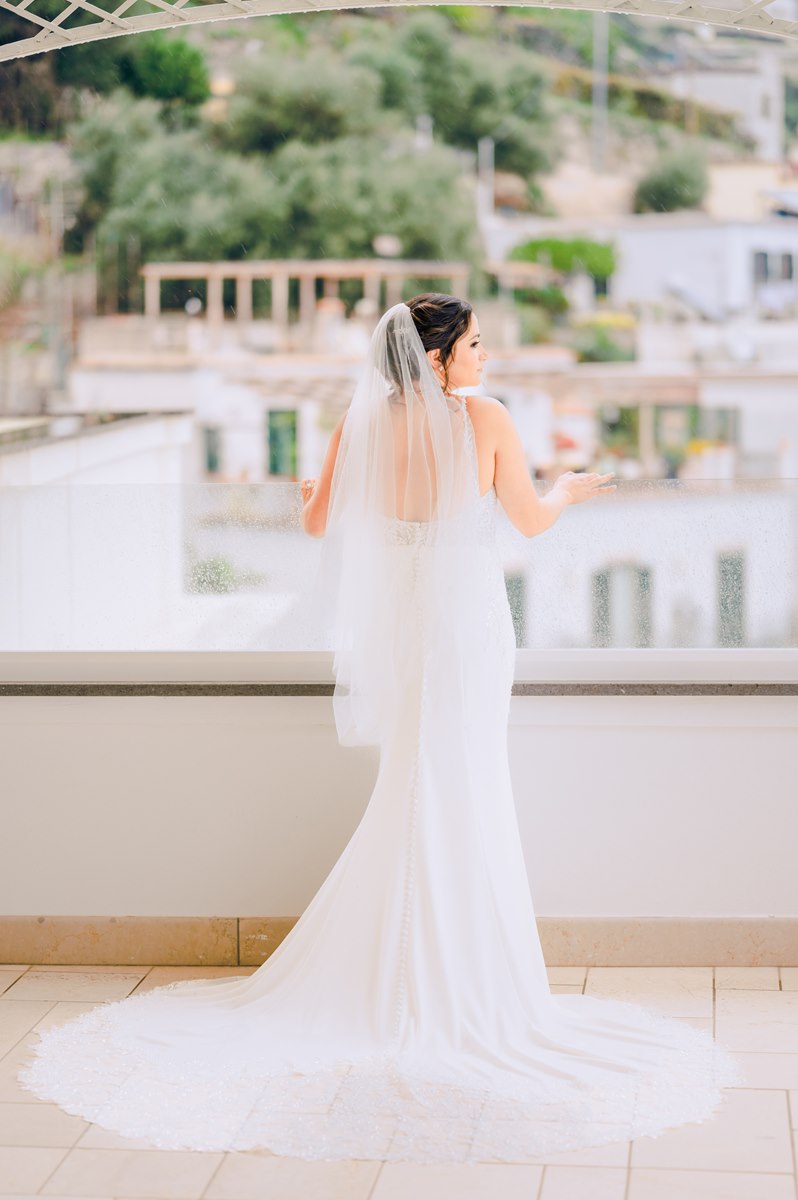
The first frame I made of Nicole’s dress has a rectangle of pure white behind it. That rectangle is the Gulf of Salerno, photographed from a hotel that sells that exact view, on the day the view had stopped existing. This was a rainy day elopement in Amalfi, and the single fact that shaped every picture I took was that the horizon line was gone from breakfast until dark.
Nicole and Michael married at Hotel Santa Caterina with two other people present, their celebrant and a violinist, on a covered terrace near the top of the property. Afterward they walked down into town and along the harbor pier in the rain on purpose, then came back up and ate dinner at a table for two behind a wall of glass. No guests. No ceremony rehearsal, no seating chart, no father waiting at the back of an aisle. What follows is how a day like that gets photographed when the thing everybody comes here for has been taken off the table.


The Sea Went Missing Before the Dress Came Off the Hanger
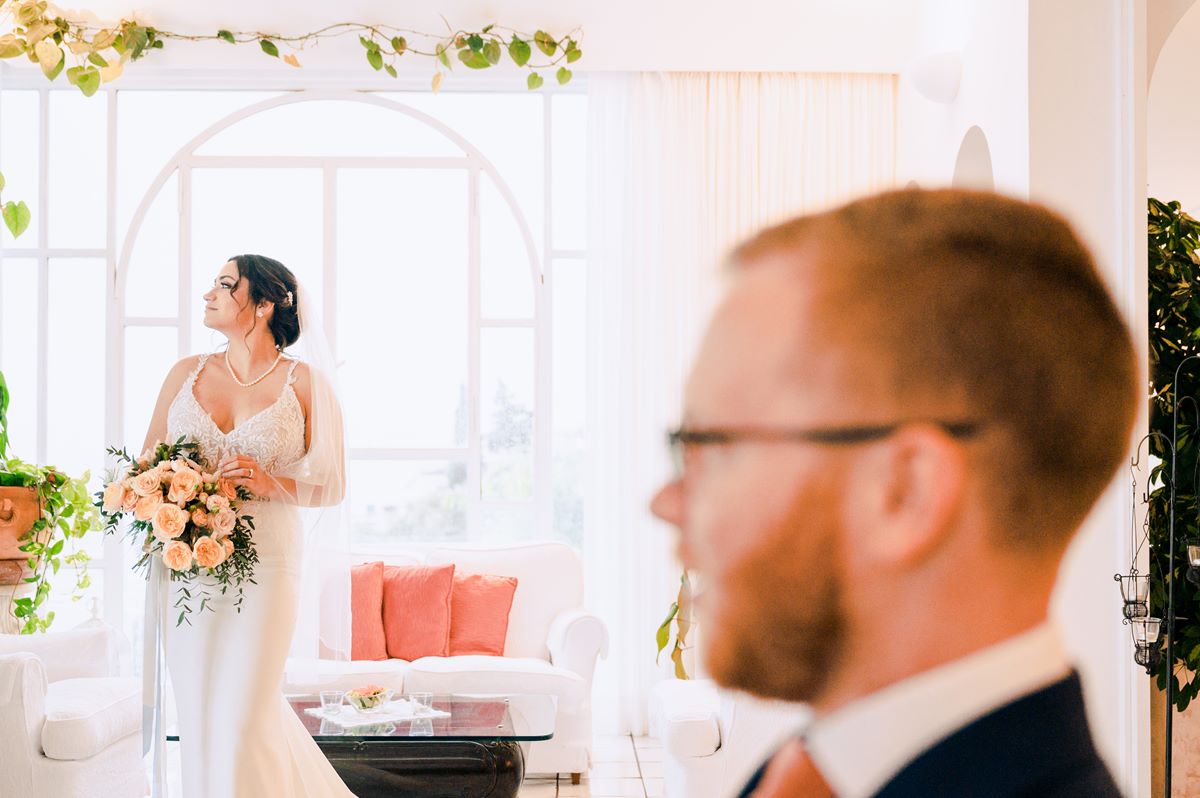
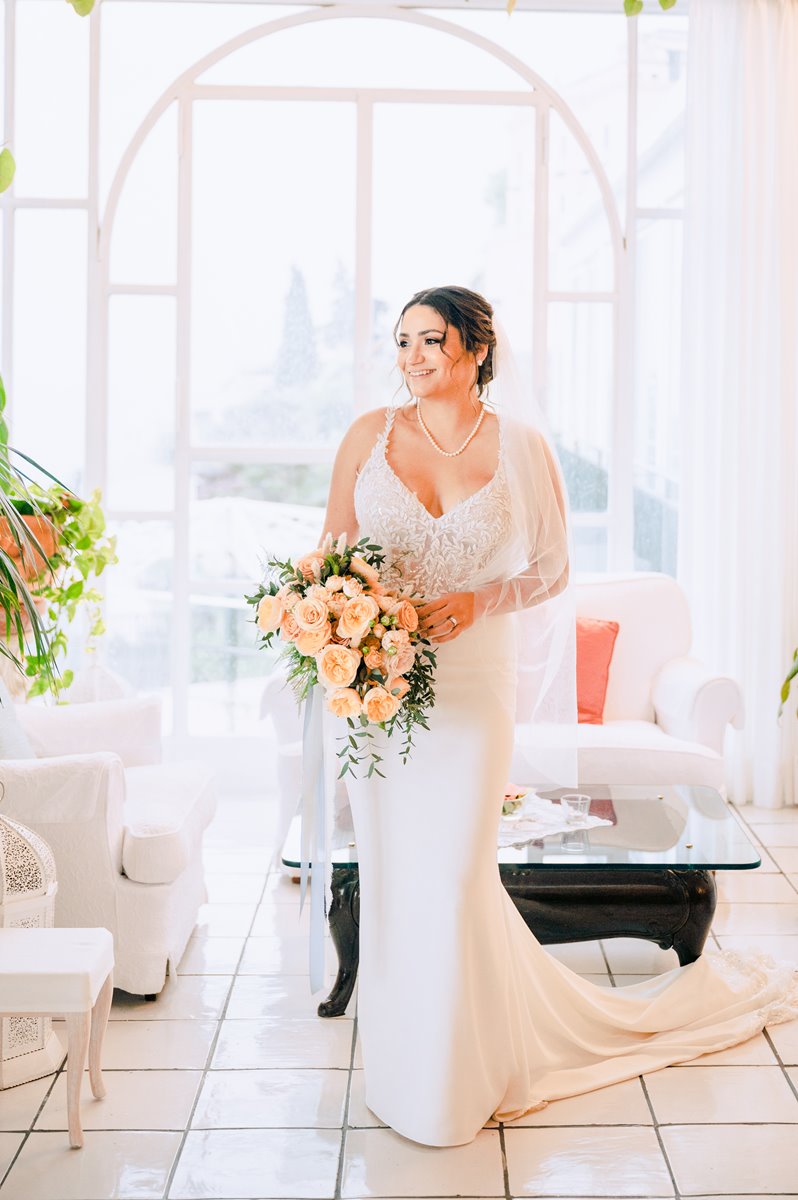
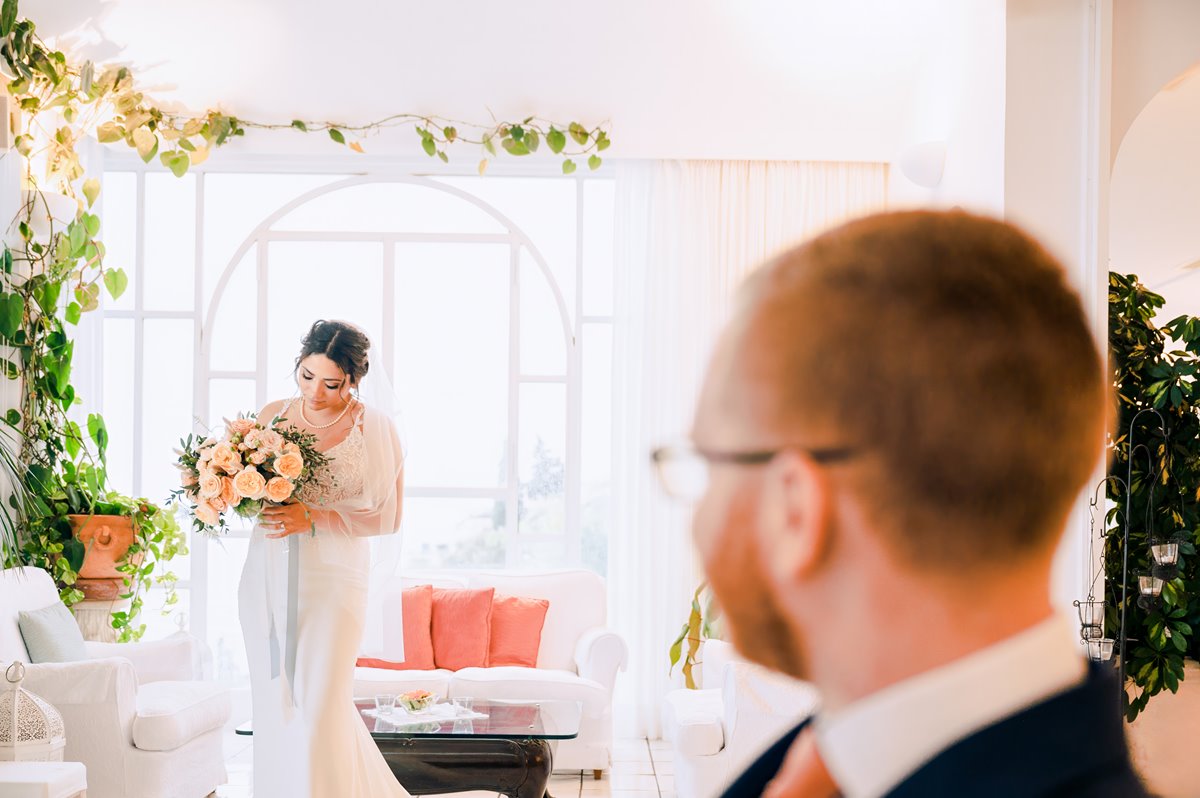
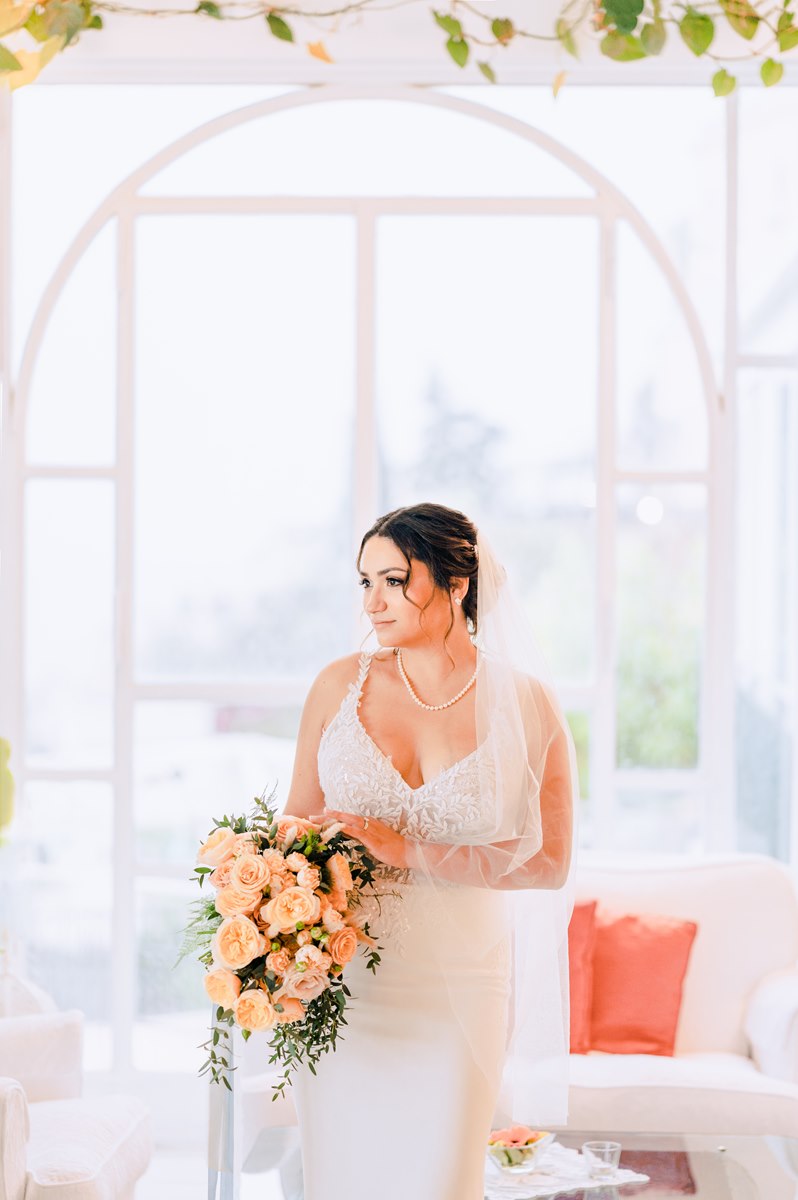
The hotel put Nicole in a room with glass doors that open onto a vine-covered terrace, and her dress was hanging in the middle of that doorway when I arrived. Behind it, framed neatly by the arch, was nothing. Gray clouds over a gray sea would at least have given me two tones. What hung there instead was one continuous field of white, the color of an unexposed wall, with a thin dark line of railing floating in it.
I have worked at this hotel enough times to know what that doorway is supposed to give me. On a normal day you get Amalfi stacked up the ravine on the left, the harbor arm, the water going from turquoise to ink as it drops off the shelf. If you want to know how the hotel behaves on a day with a view, the Hotel Santa Caterina wedding venue page covers that. On this morning the doorway was a light box, and the dress was a silhouette, and I decided within about four minutes that I was going to stop trying to put the coast into the background of anything.
That sounds like a loss. For the first hour it felt like one.






Celadon Tile, Flat Light, a White Dress
The rooms at Santa Caterina have floors of pale blue-green tile, somewhere between celadon and sea foam, laid in big squares with white grout. On a sunny morning that floor is a nuisance, because the sun coming off the water bounces up through it and puts a green cast under everybody’s chin. That day it was the best surface in the building. With flat, colorless light pouring in from the terrace and nothing warm anywhere in the room, the tile became a soft, cool ground that I could lay things on and shoot straight down at.
Powder Blue Sandals on a Sea Green Floor
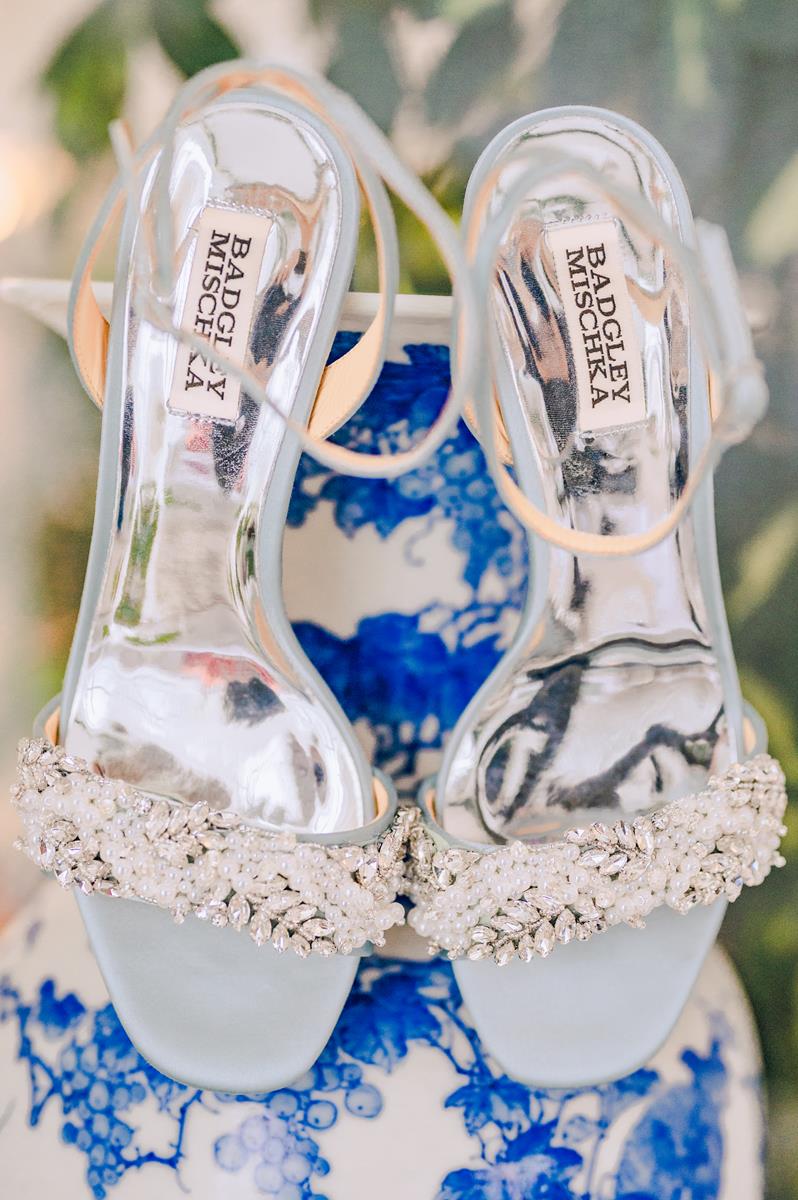
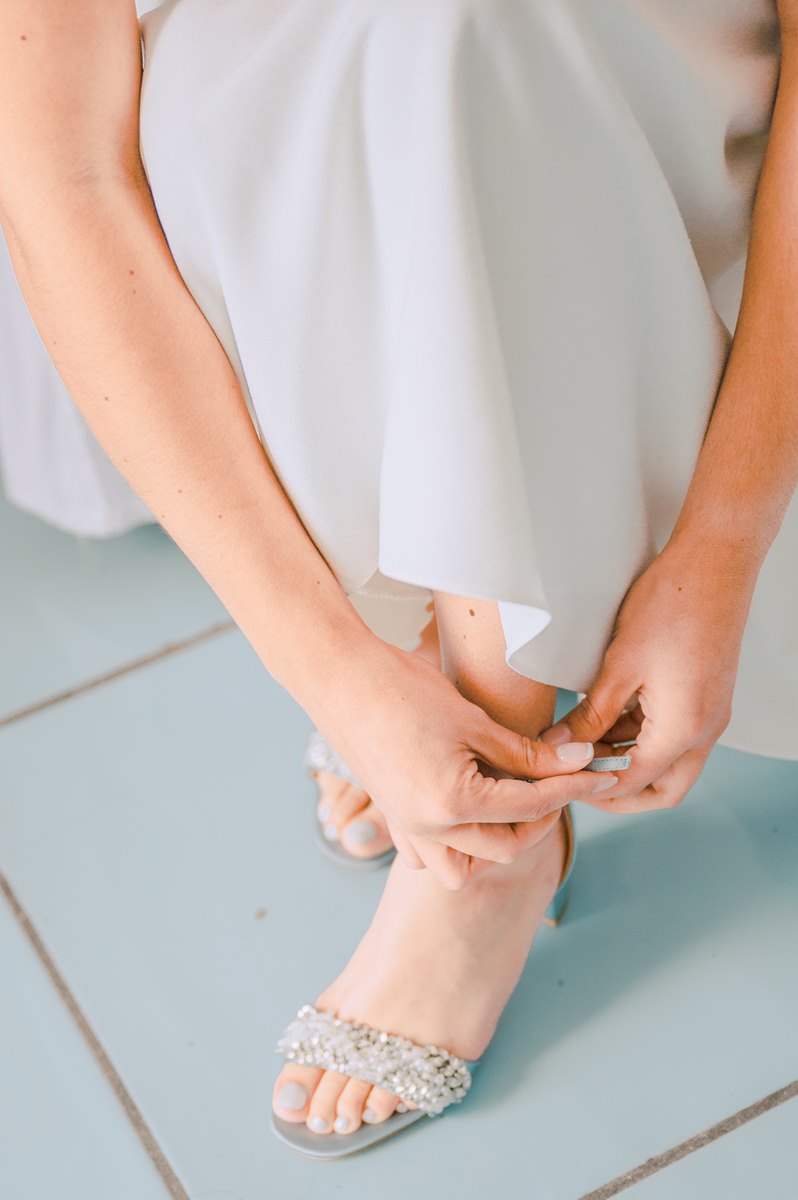
Nicole’s shoes were pale blue satin, Badgley Mischka, with a band of crystals and small pearls across the toe and a mirrored silver footbed. She had put them on a piece of blue and white ceramic, the standard grape-and-vine pattern you see all over the coast, and the picture ended up being three shades of the same color with a little glitter in the middle of it.
Then she put them on, and I shot her feet against the floor, and it turned into one narrow band of blue-green running from the tile to the satin with the ivory of the dress cutting across it.
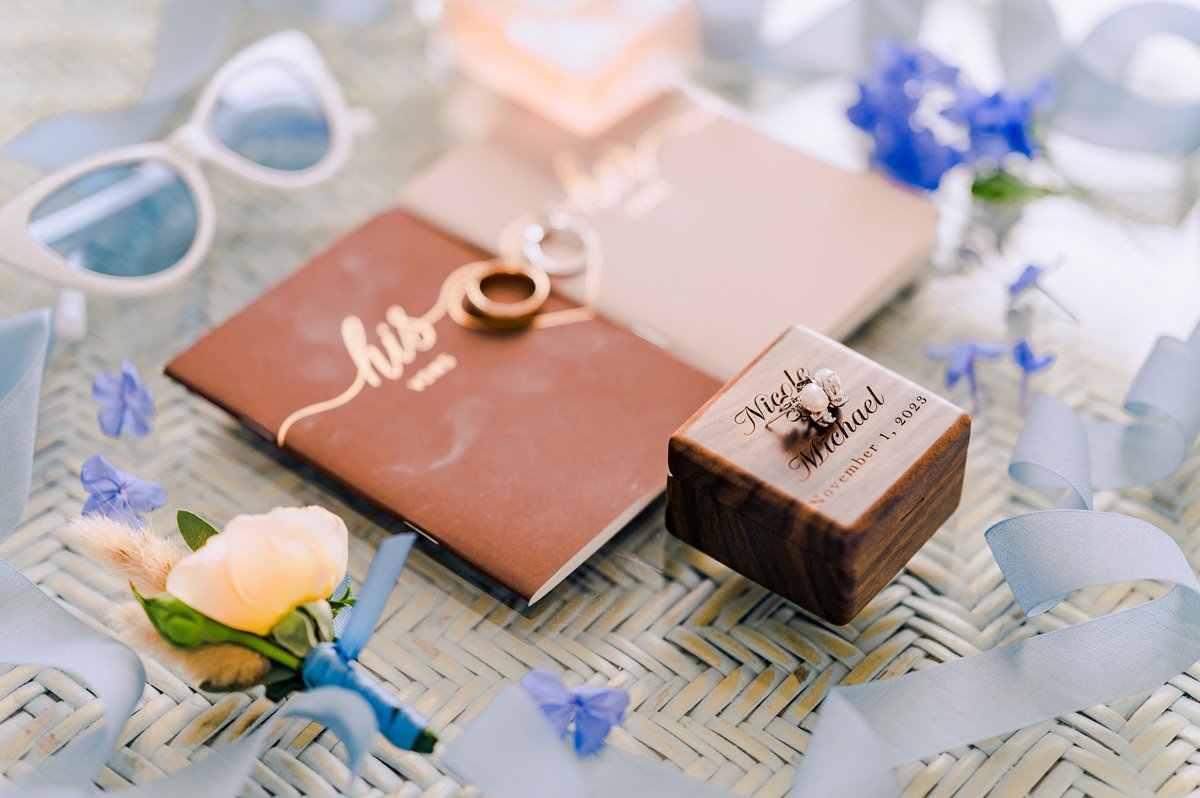
The detail table was the same story in reverse. Two vow books, one rust leather and one blush, a bottle of Coco Mademoiselle, white cat-eye sunglasses, a length of dusty blue silk ribbon looped around all of it, and sprigs of blue plumbago picked from somewhere on the property. Michael’s boutonniere was a single peach rose with a stem of pampas grass, tied with the same blue ribbon. The couple had chosen a palette of peach and dusty blue months earlier, in another country, and it happened to be the only palette in the building that afternoon that the weather could not wash out.


Nobody Helped Her With the Shoes
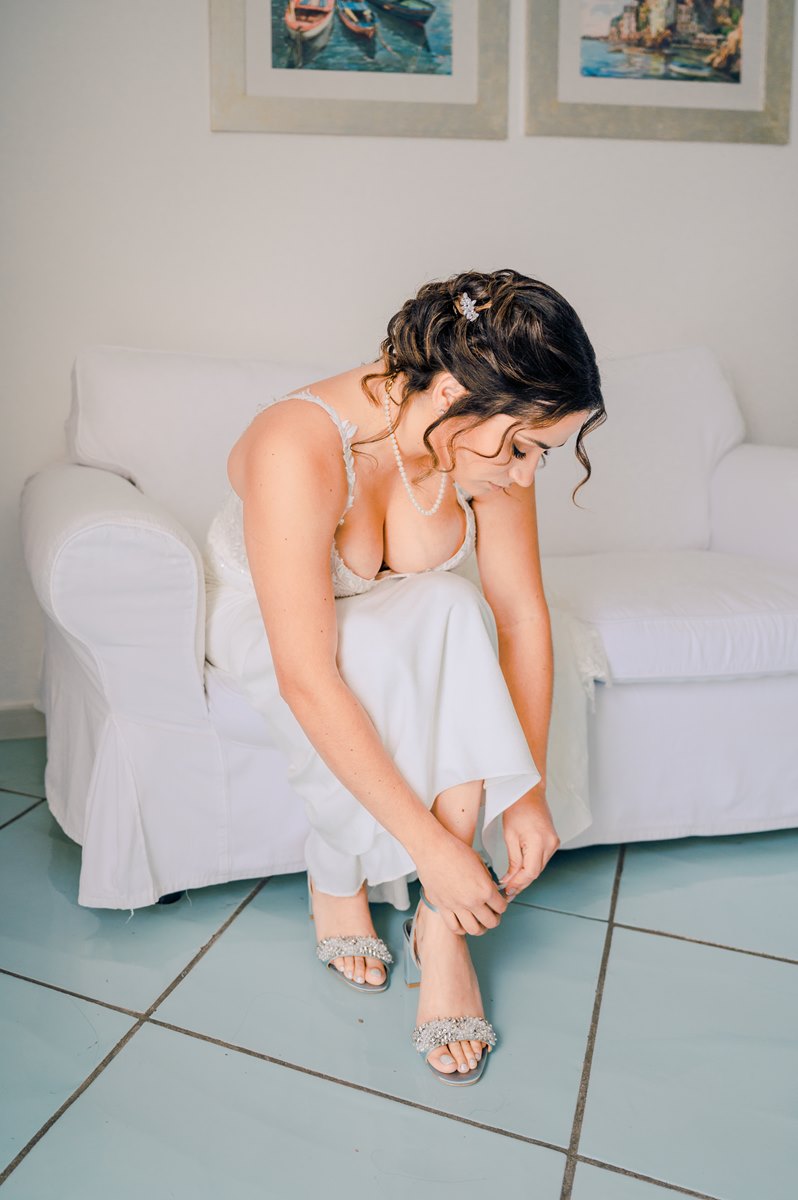
One photograph from that hour keeps pulling me back. Nicole is sitting on the edge of a white slipcovered sofa, already in the dress, bent forward with her hair falling past her face, doing up the ankle strap of her own shoe. No bridesmaid holds her elbow, no mother crouches at her feet, nobody else is in the picture at all. Above her on the wall hang two small framed watercolors of fishing boats that somebody put there decades ago.
That is the honest picture of an elopement, and it is not a sad one. She was fine. She had been ready for a while. She just had nobody to hand the job to, and I think a lot of couples who are considering doing this without guests deserve to see what that actually looks like, rather than a version where invisible hands do everything.
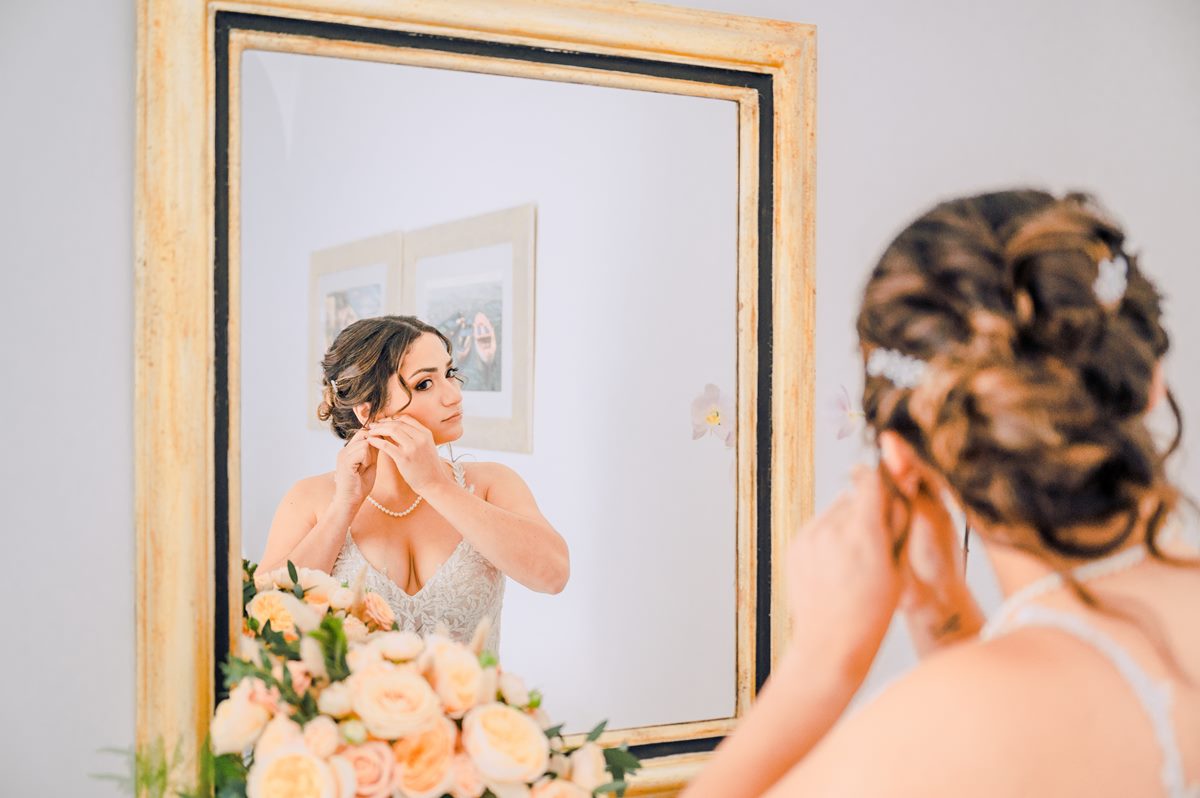
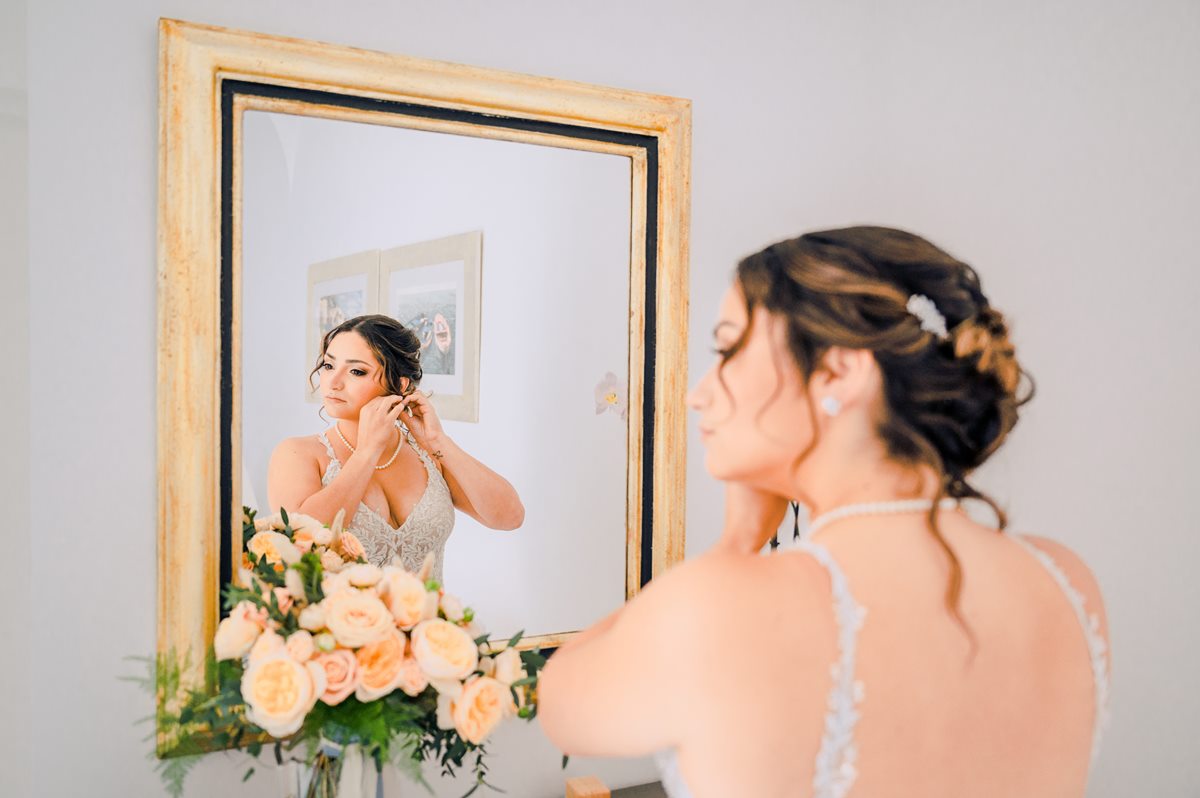
She did her earrings in front of a mirror with a distressed gold and black frame, with somebody’s stray orchid stem tucked into the corner of it, and I shot it as a double: her real face turned away in the foreground, her reflection looking straight back. The room was so evenly lit that I could hold both at the same exposure.


A Coral Tie and Coral Cushions
Michael got ready two floors away in a sitting room I have walked past a hundred times without photographing.
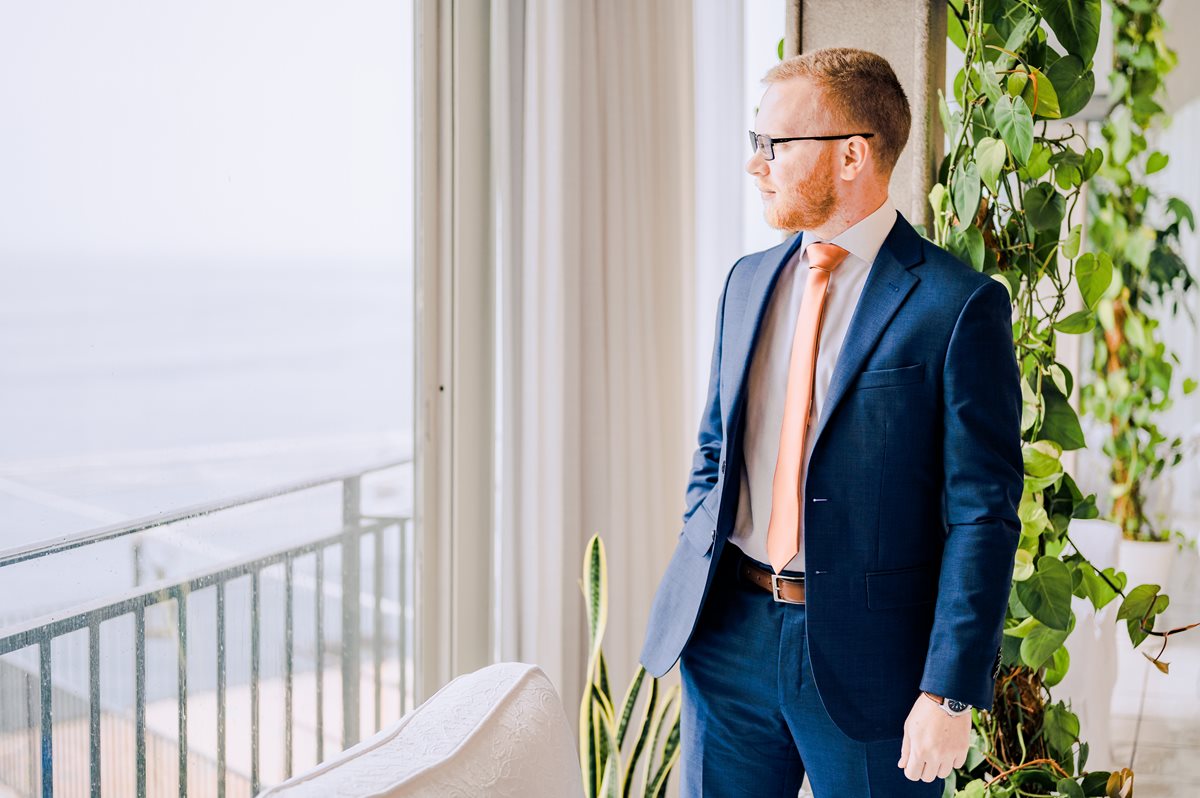
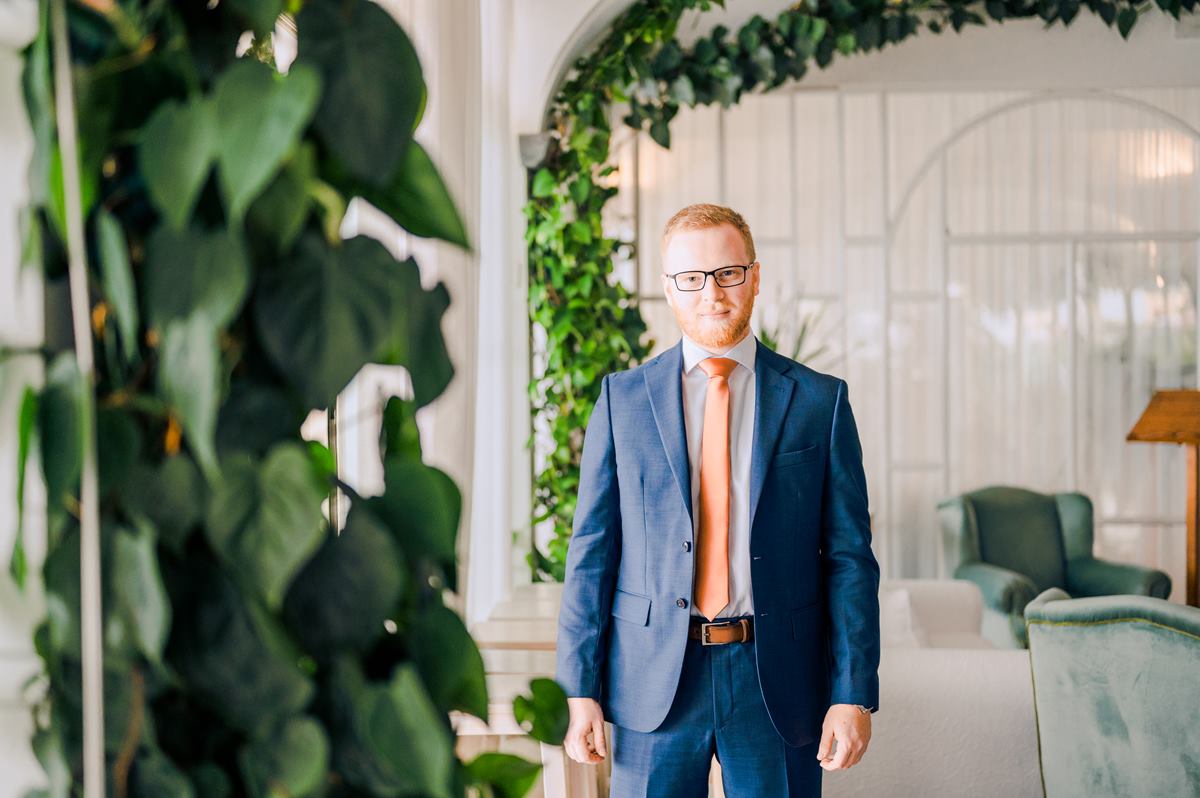
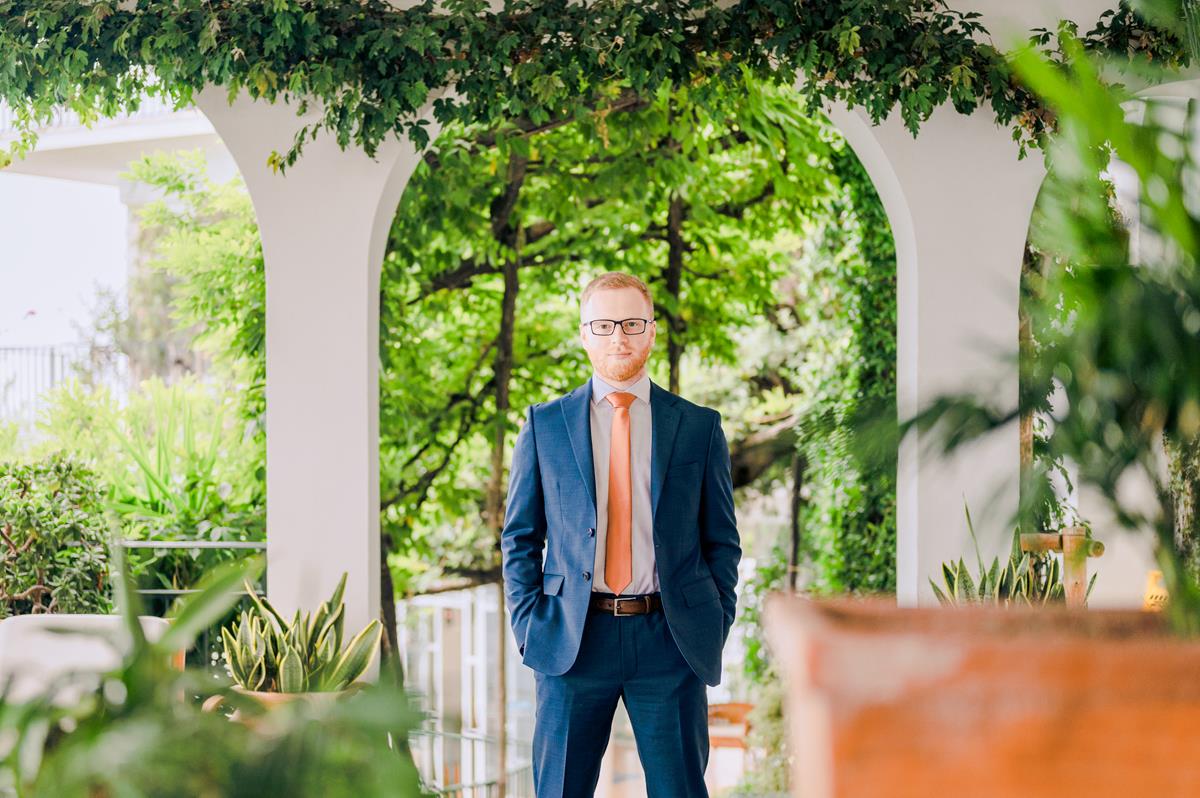
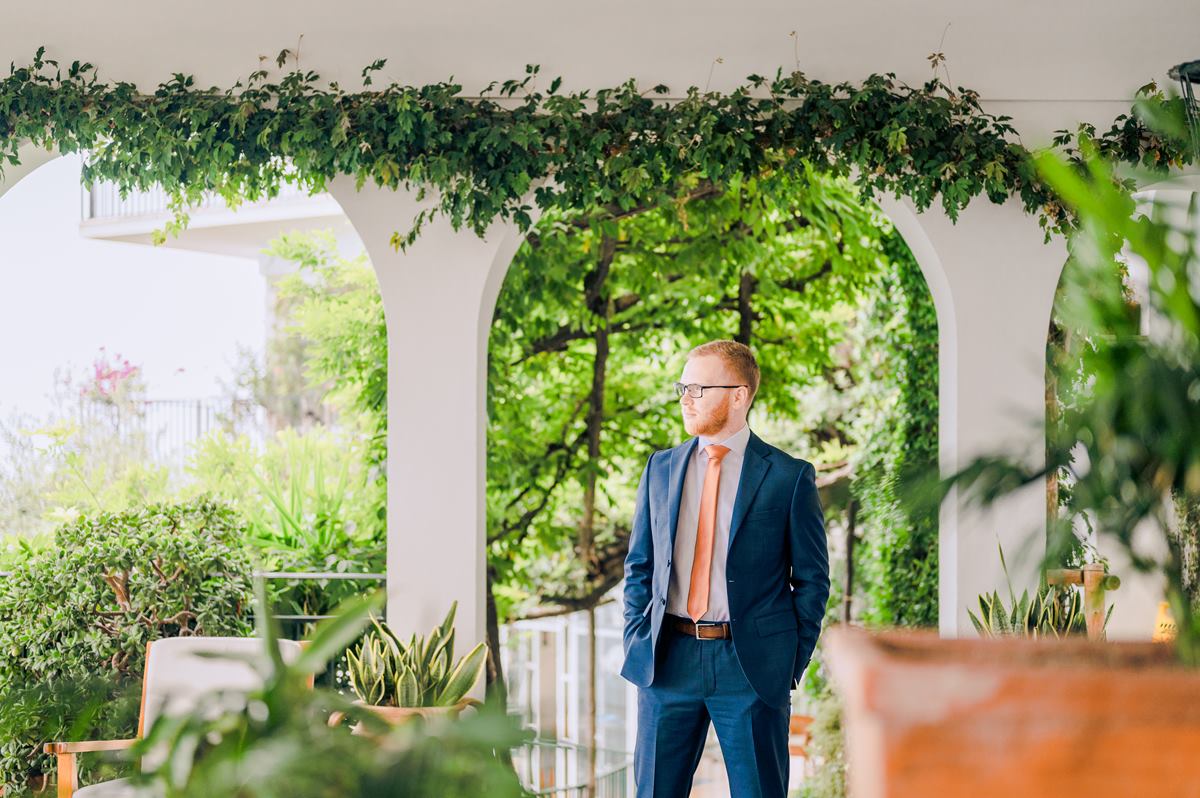
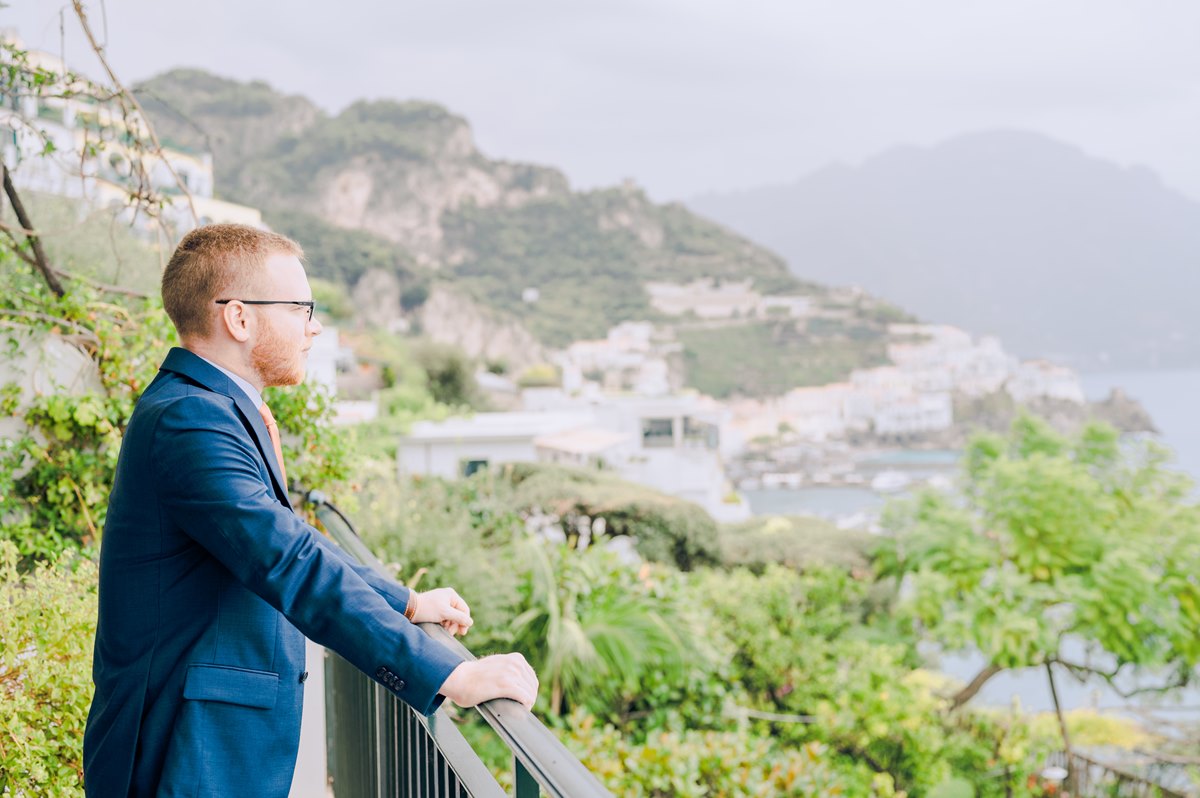
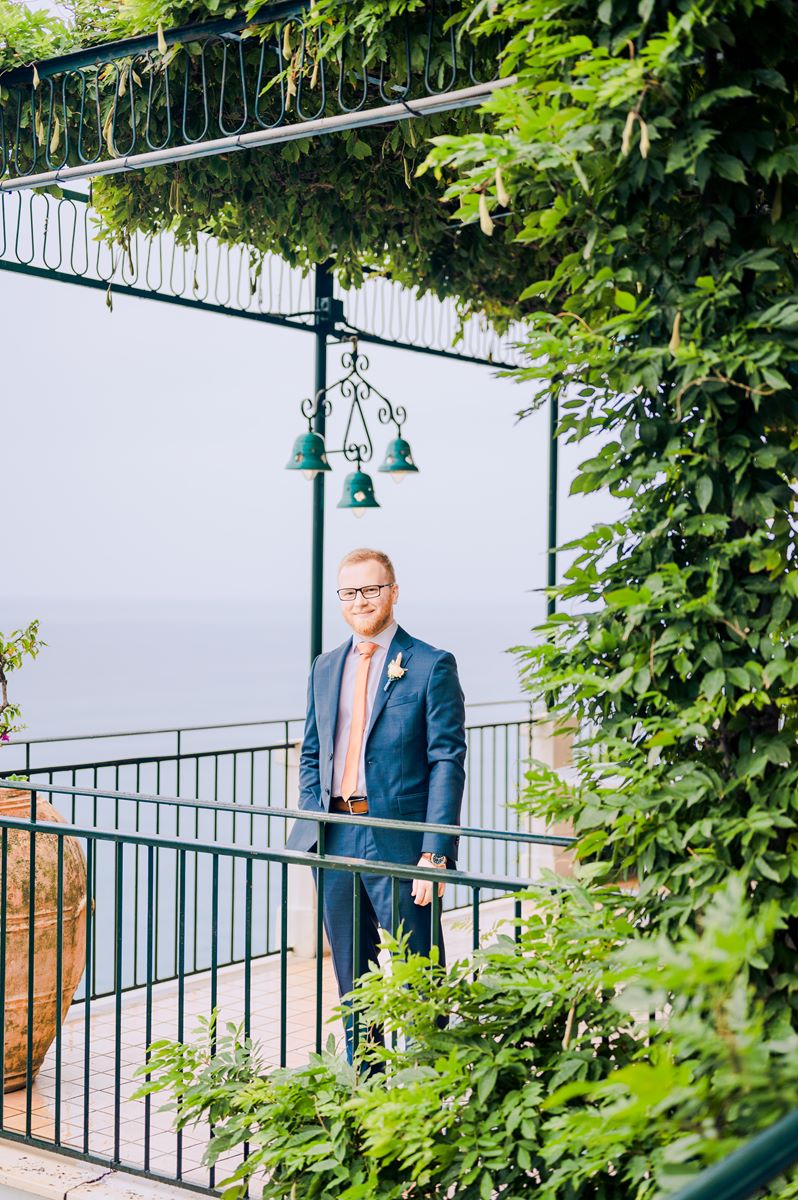
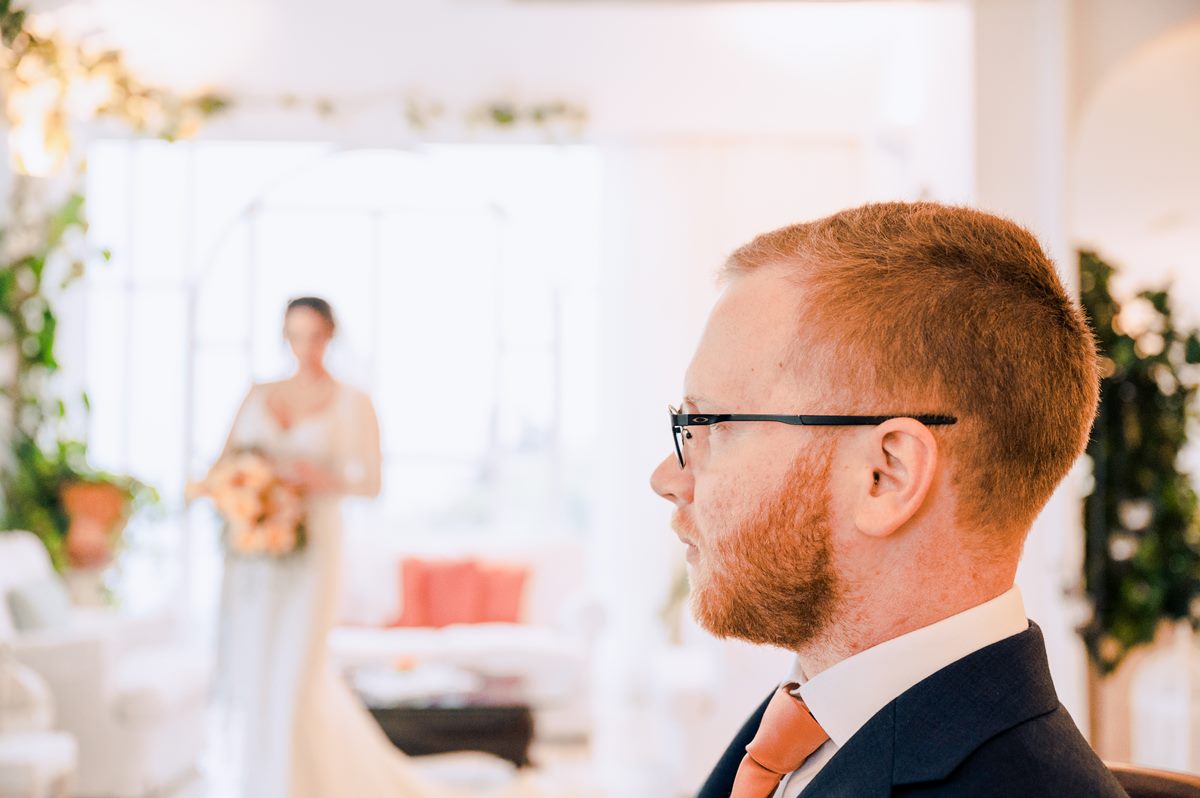
Royal blue suit, brown belt, brown shoes, glasses, a red beard, a beaded bracelet on the wrist that he never took off, and a coral tie over a gray-taupe shirt. He is the kind of person who checks his watch when he has nothing to check it for.
The room has white slipcovered sofas with coral throw cushions. The tie and the cushions were, as far as my eye could tell, the identical color. I sat him down in the middle of the sofa with a cushion on either shoulder and shot it flat and symmetrical, straight on, because it is not a coincidence I could have arranged and it is the sort of thing that only turns up when the light is boring enough that you go looking at furniture. He thought I was joking. It is one of the best portraits of him from that day, and it exists because the sky had nothing to offer.
Out on his balcony, the glass balustrade was beaded with water. The sea beyond it was the same blank nothing. I stood him against it with the plants crowding in from the right and let the entire left half of the picture be weather. It reads as a deliberate high-key portrait, and all I did was stand him in front of a sky that had been switched off since breakfast. You can see the same instinct running through the rest of my work as an Amalfi Coast wedding photographer, but I get to use it perhaps twice a year here, because normally this place is drowning in sun.




Corridors, Stairs, and No Garden at All
With no ceremony procession to build and no guests to keep out of the way, the walk from Nicole’s room to the ceremony terrace was completely mine to choose. On a dry day I would have taken her out through the gardens. Instead I took her through the middle of the hotel, a building most couples pass through at speed on their way to something better, and which turns out to be full of things nobody photographs.
A Rococo Clock, a Painted Urn, and a Doorway Wrapped in Pothos
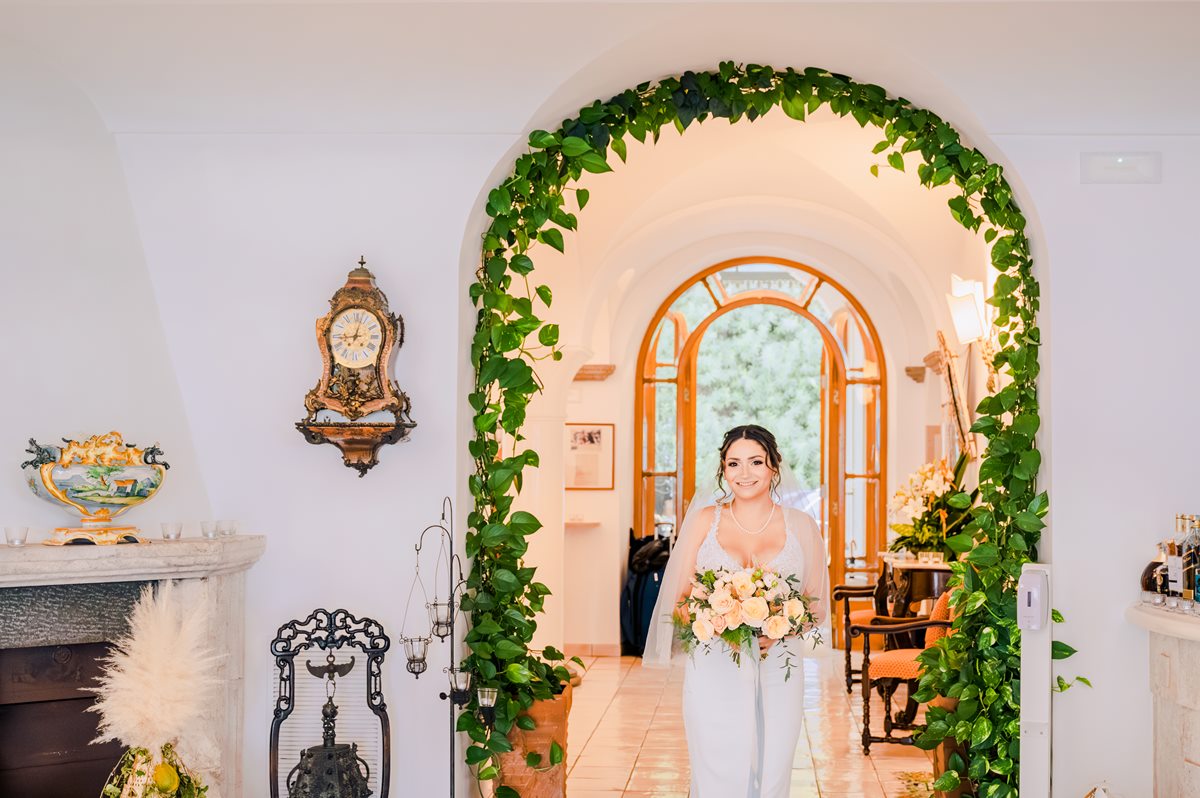
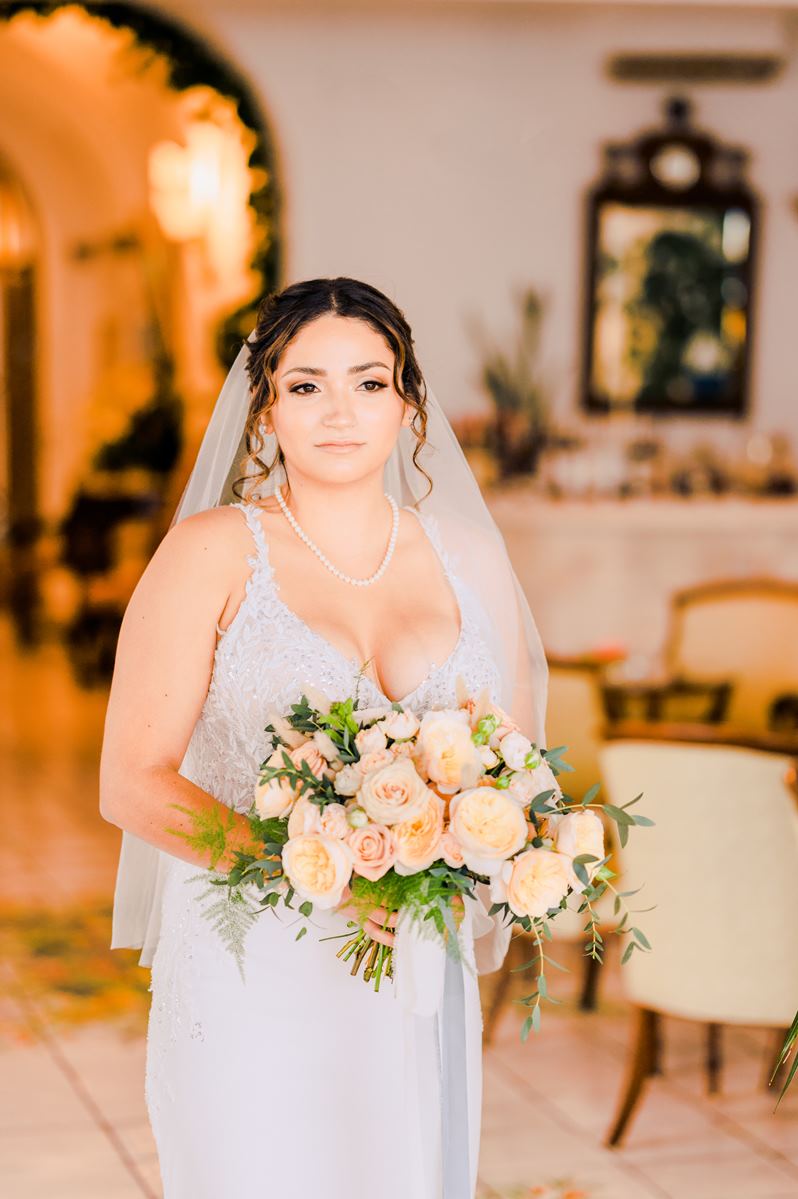
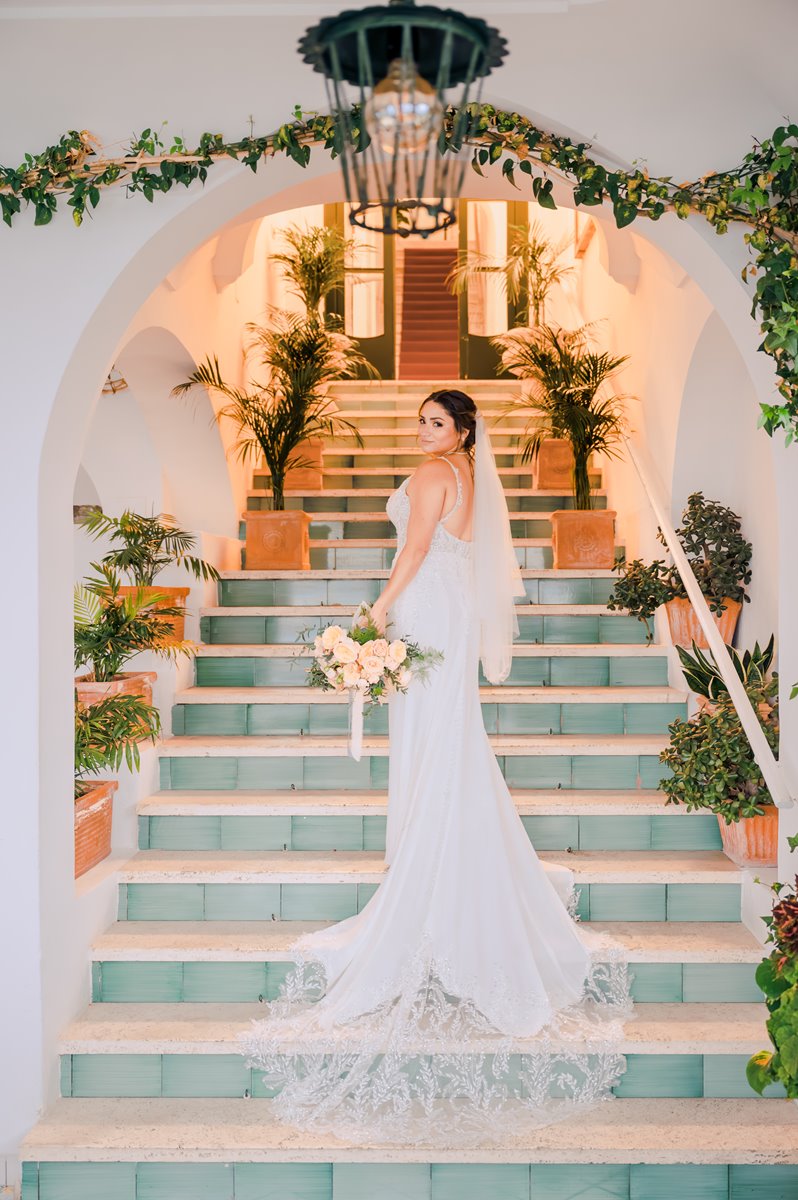
The main hall has an arched opening dressed with live pothos vine, trained around the curve so thickly that it reads as a green frame. To the left of it hangs a gilt rococo cartel clock, the kind with scrolled foliage bursting out of the top, and below that a stone mantel holding a big hand-painted urn in yellow and green with a little pastoral scene on the belly of it. Somebody had put dried pampas in the fireplace. There are wrought-iron candle stands, terracotta floor tiles worn smooth, and a pair of antique armchairs upholstered in a strong yellow-orange.
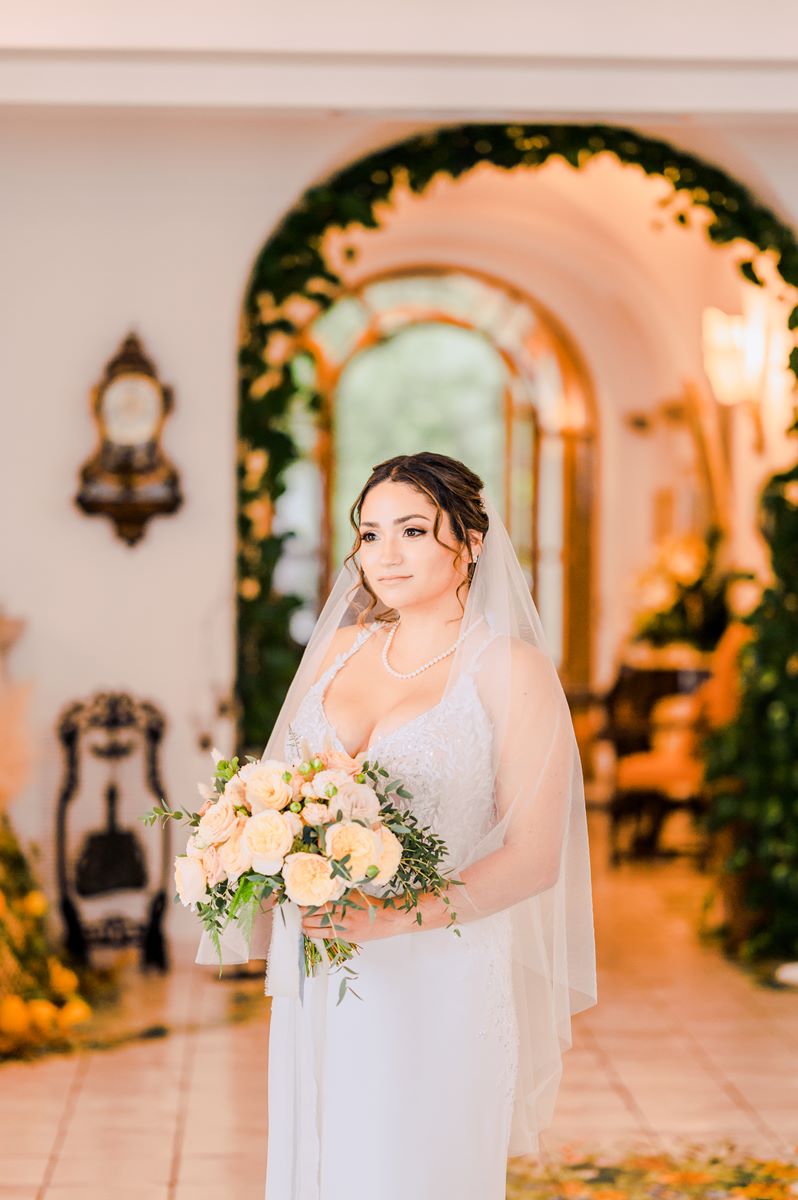
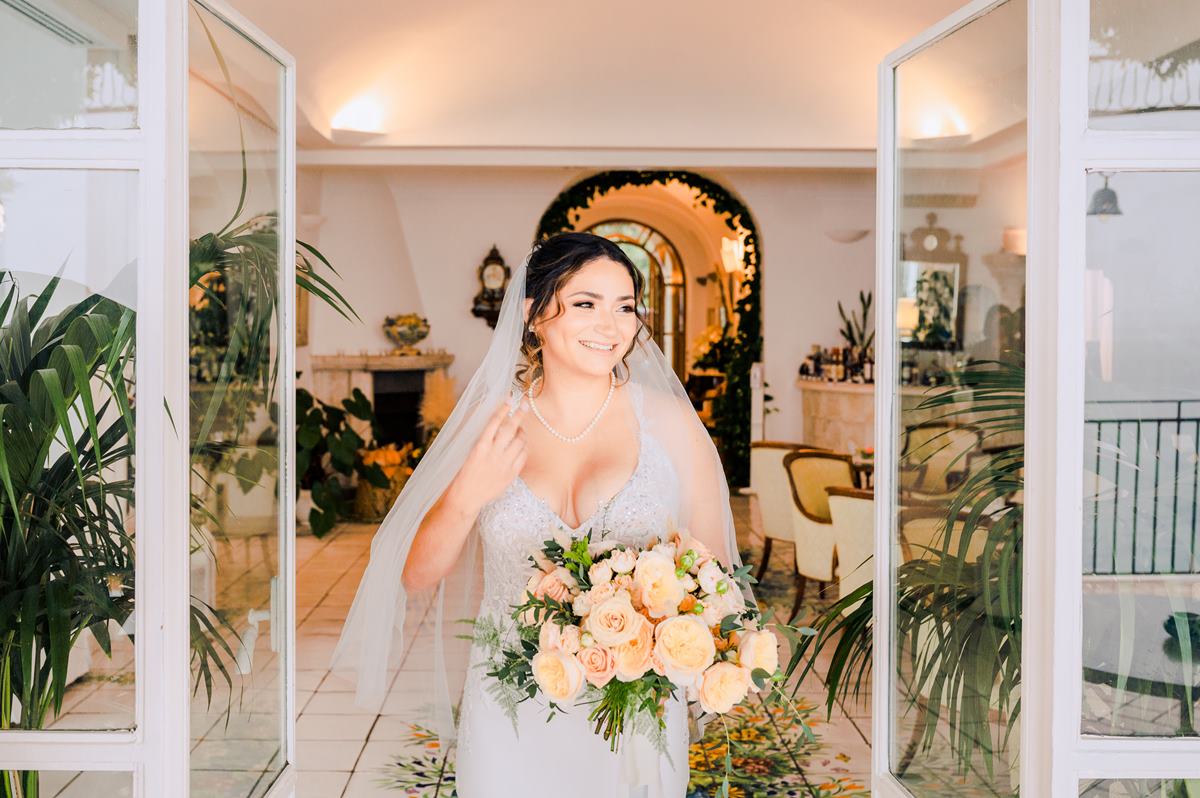
I put Nicole at the far end of that hall and let her walk toward me through the vine arch, with the clock and the urn holding down the left side of the image. It is an interior, warm where everything outdoors was cold, and unmistakably this hotel rather than any other. That combination is worth a great deal when your establishing shot of the coastline is unusable.
The Painted Floor Panel That Works Like an Aisle Runner
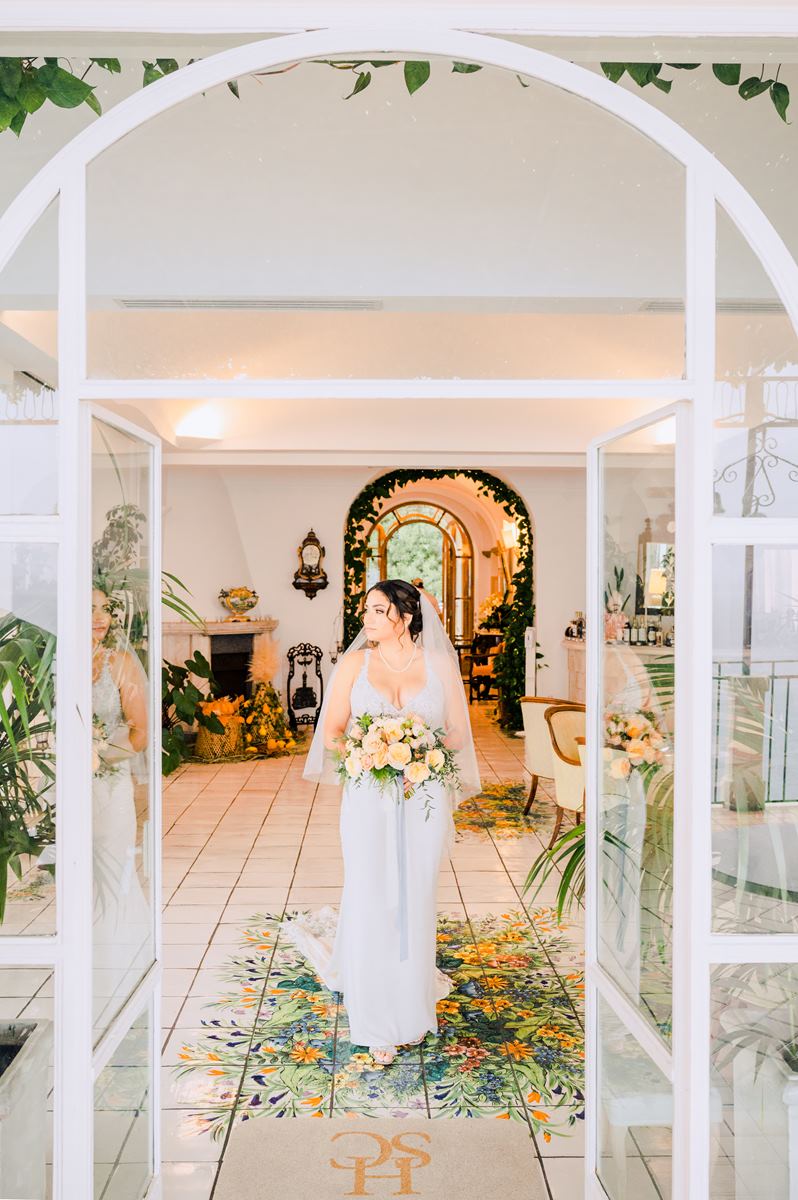
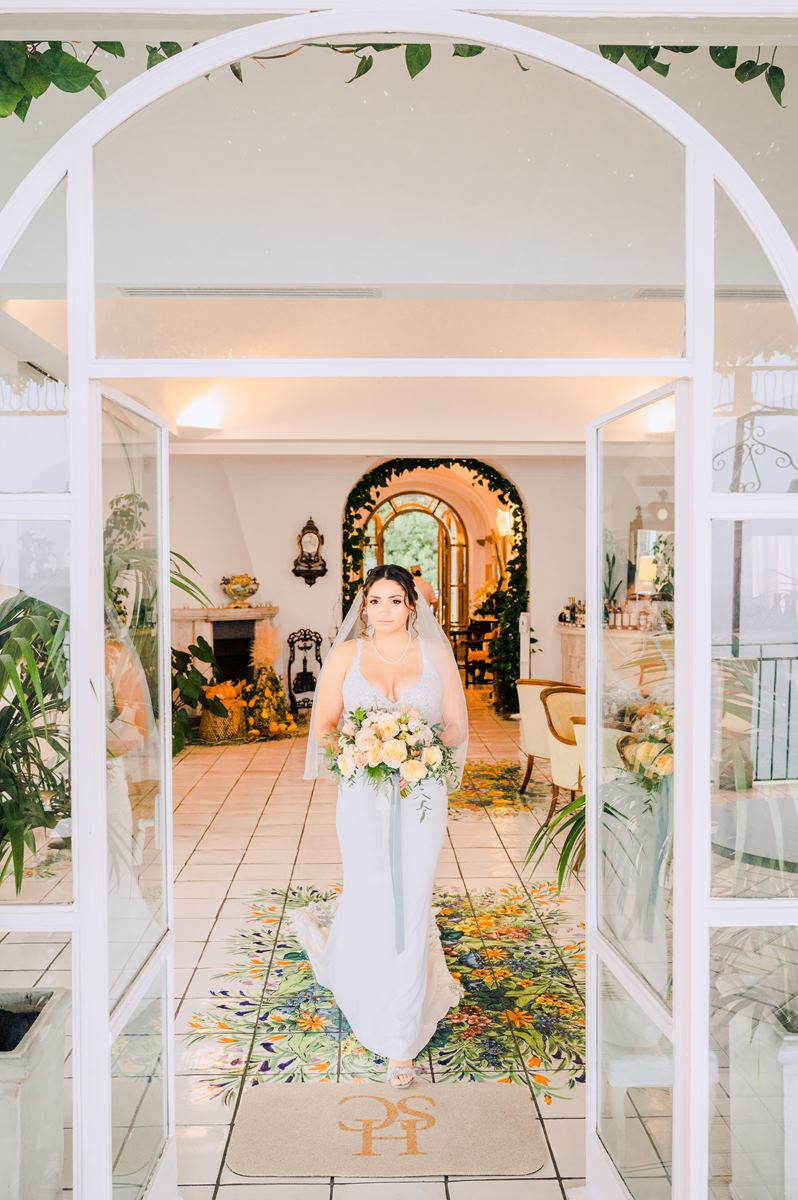
Set into the plain terracotta floor near the doors sits a large rectangle of hand-painted majolica, a botanical panel with birds of paradise, sunflowers and blue irises drawn across it like a rug that somebody fired into the ground. I had genuinely never used it. It is the sort of thing you walk over on a busy wedding day without looking down.
I shot Nicole standing on it, framed by the open glass doors, with the vine arch and the clock receding at her back and the hotel’s monogrammed doormat in the bottom of the image. Her train and the painted flowers occupy the same plane. On a day with sun coming through those doors the panel would have been half in hard shadow and unreadable. Flat light rendered every color in it evenly, the one thing overcast is genuinely, mechanically better at, and I would rather say that plainly once than dress it up.










Ceramic Bells Over the Moment He Turned Around
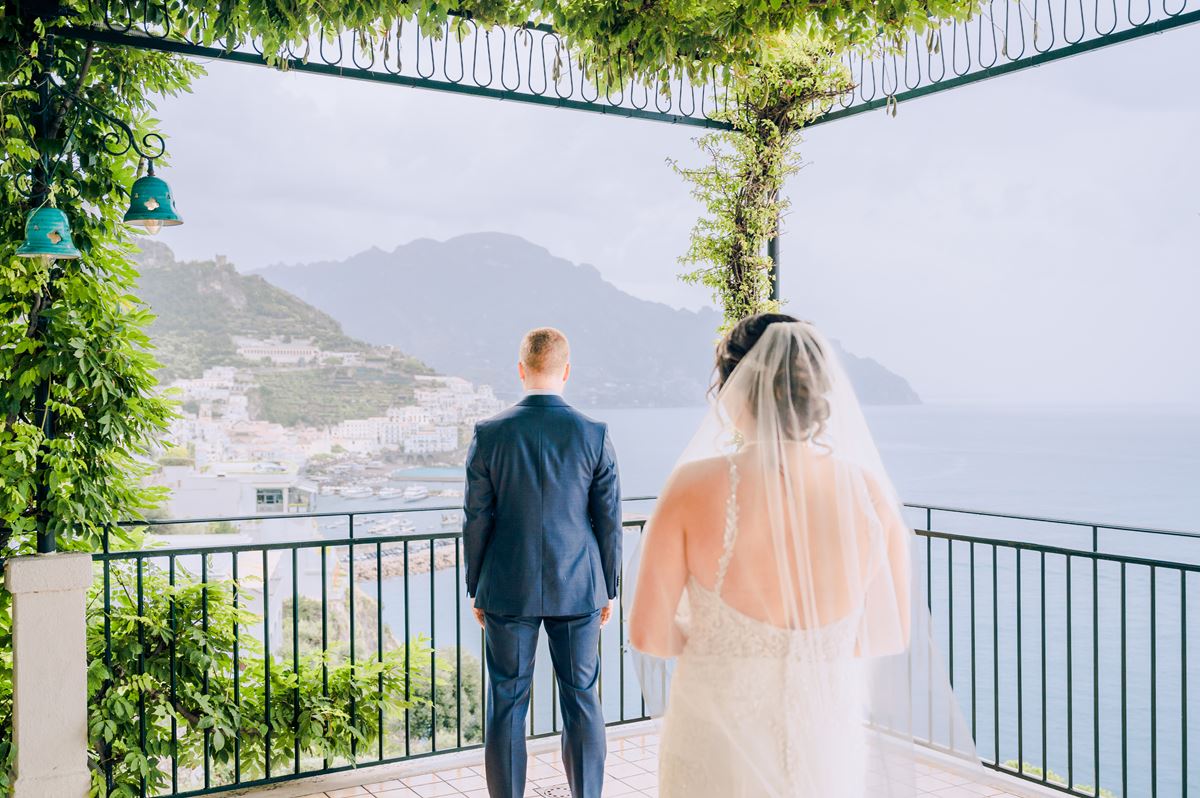
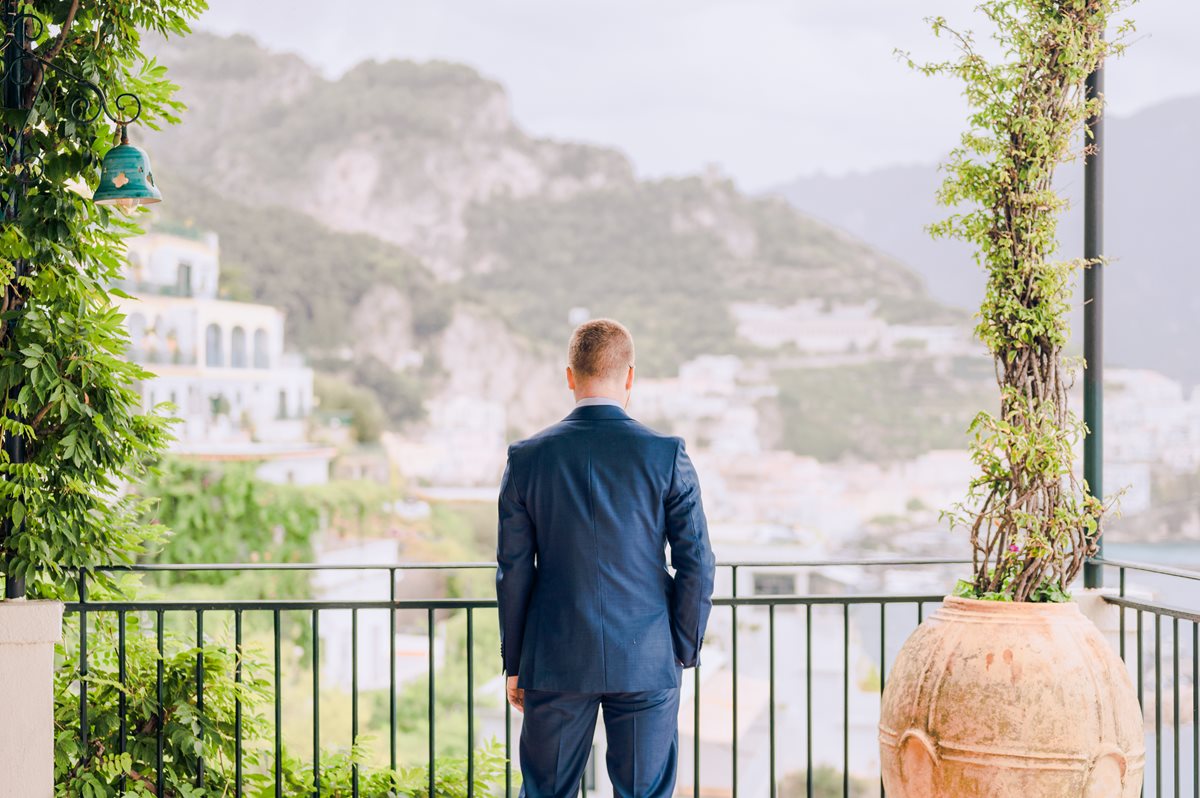
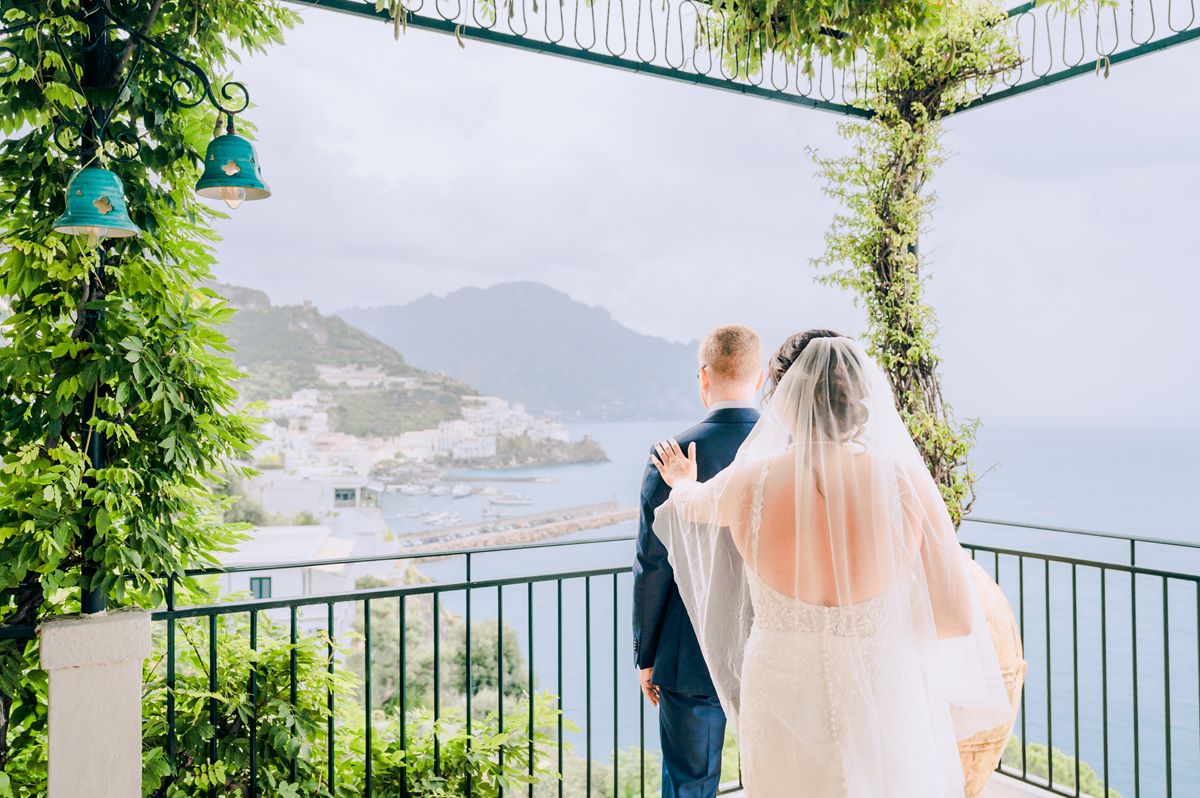
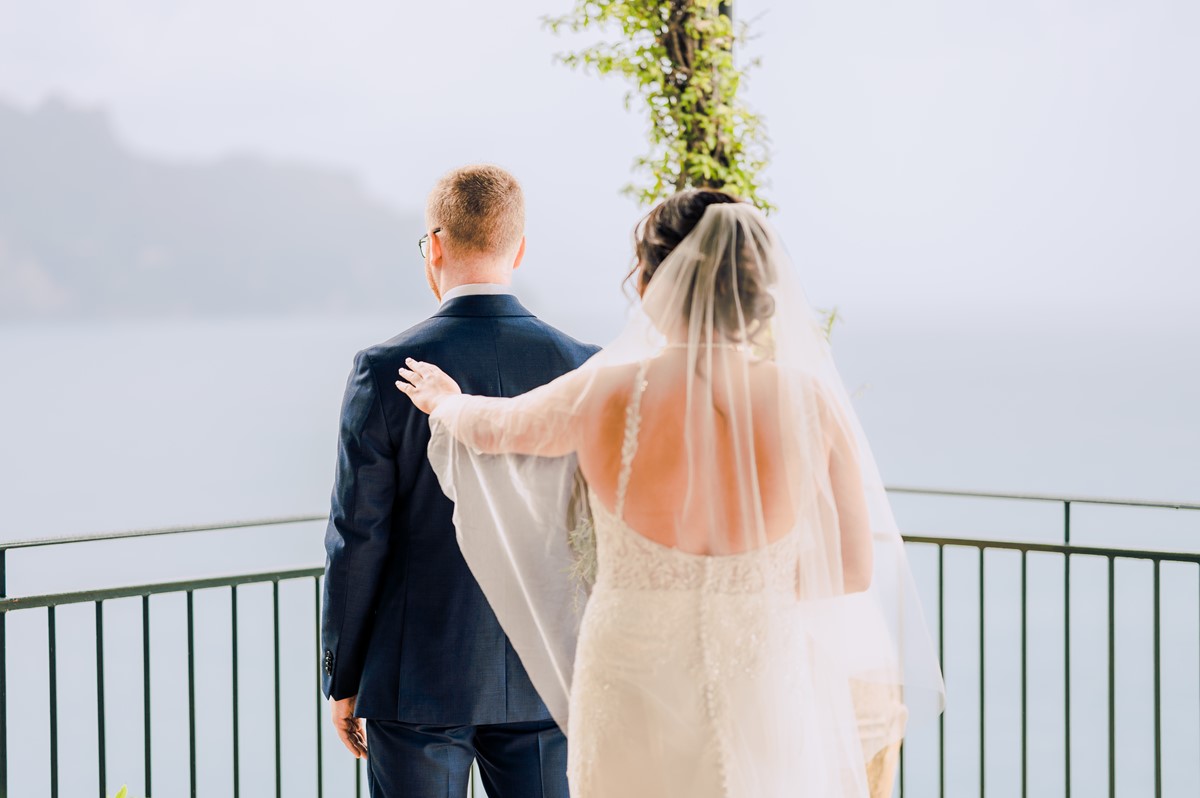
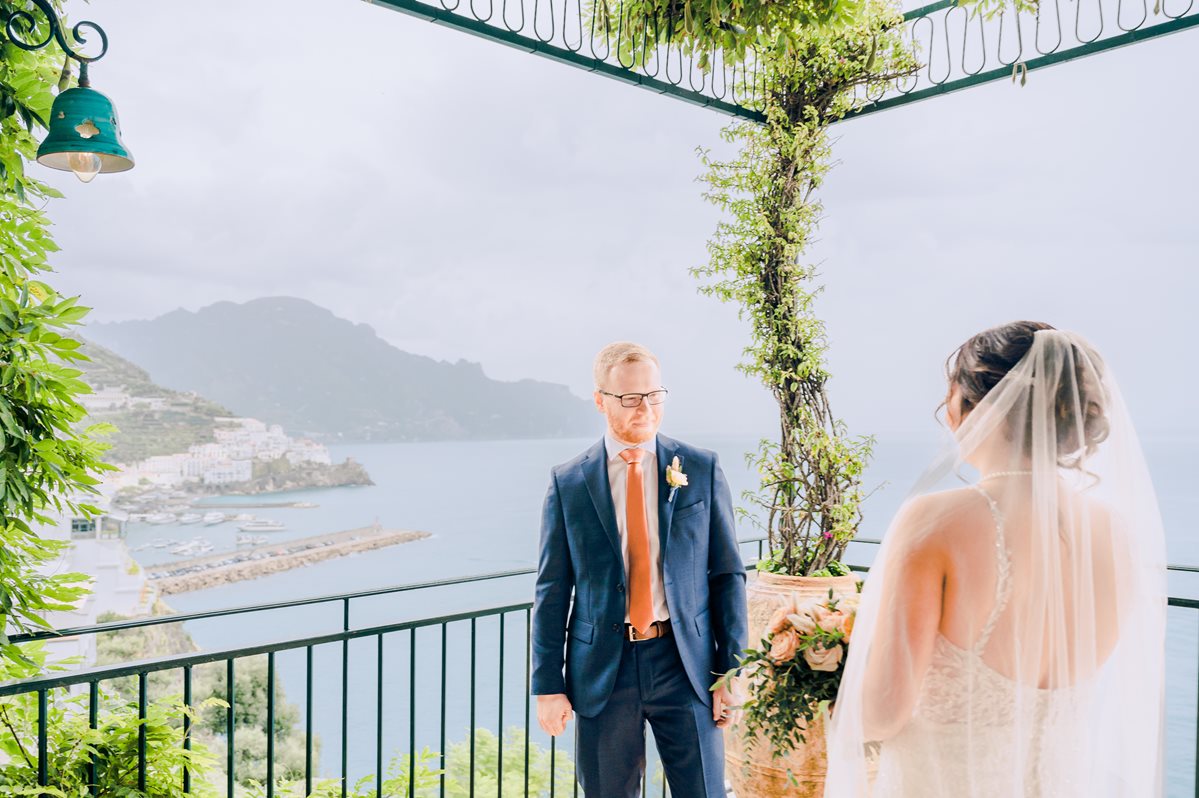
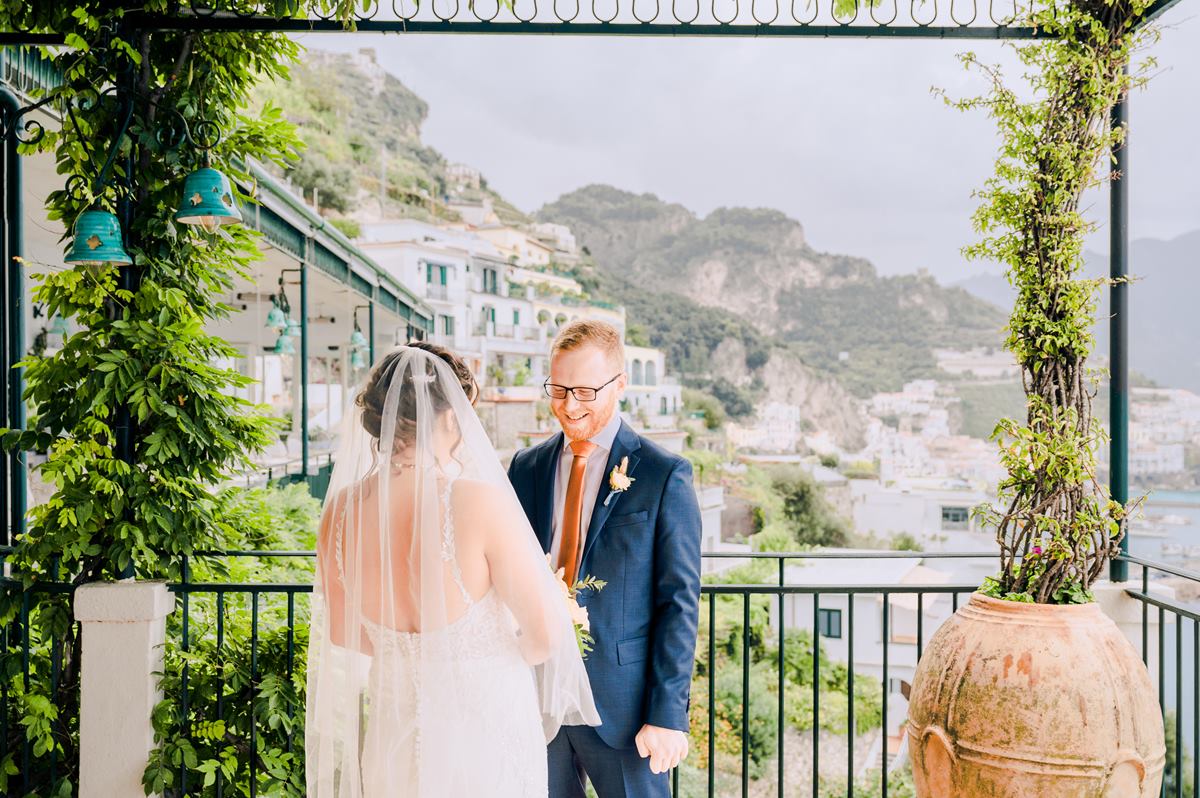
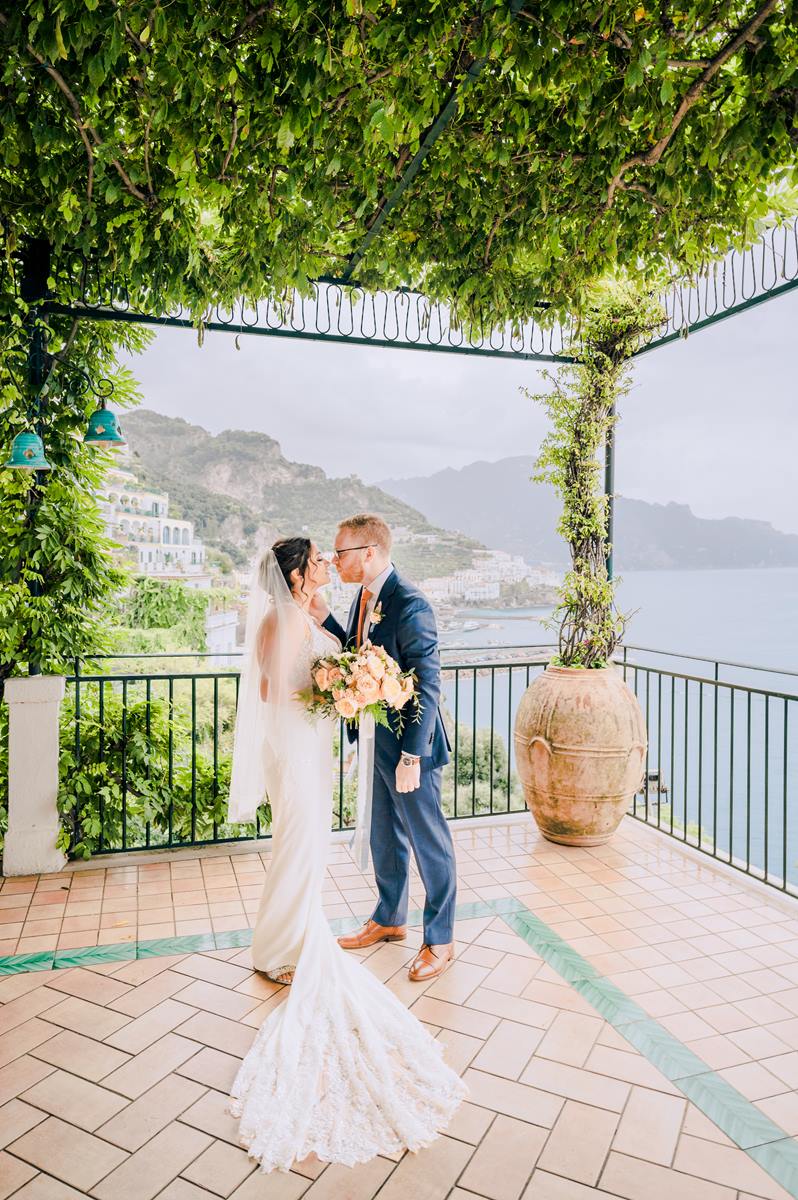
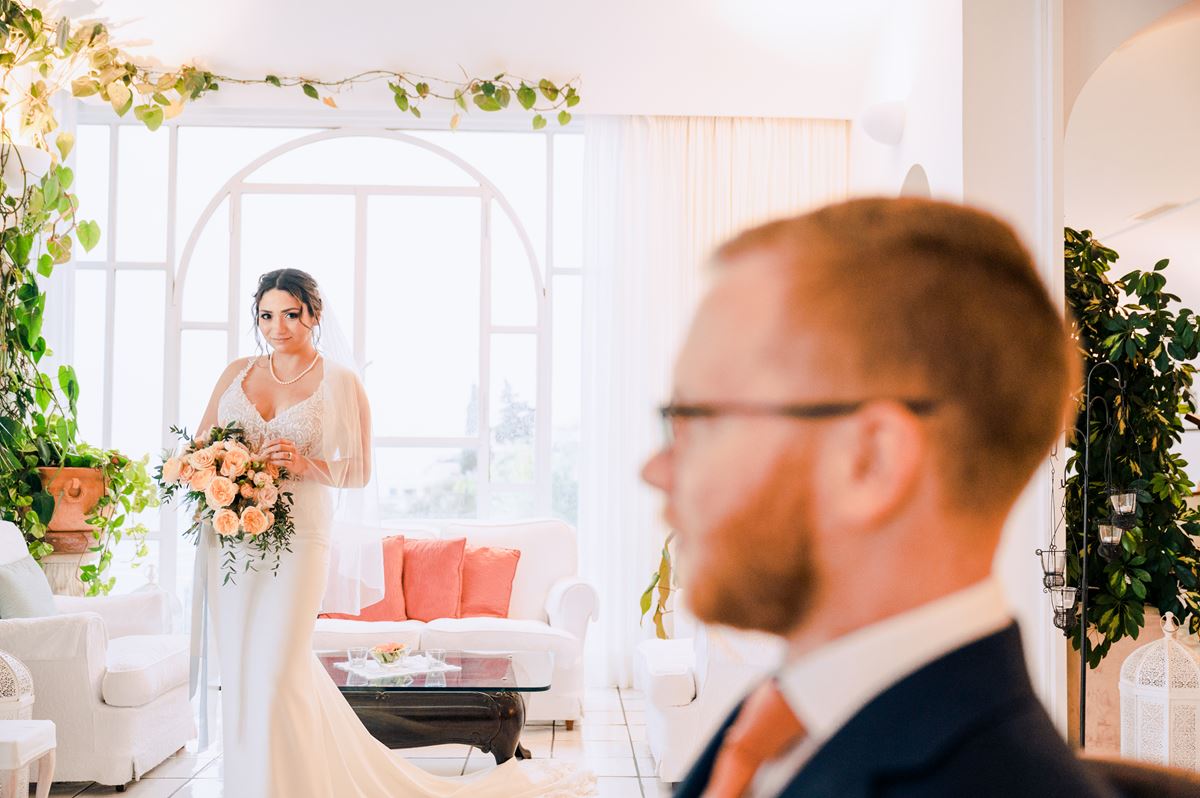
The first look happened on a small terrace off the main pergola, chosen because nobody else would wander through it. The pergola over it is dark green wrought iron, with wisteria grown over the top of it, already carrying its long seed pods, and hanging from the ironwork are glazed ceramic bells in a strong turquoise. Some are decorative and some are light fittings, three bells to a bracket, and they are the single most recognizable object on this property.




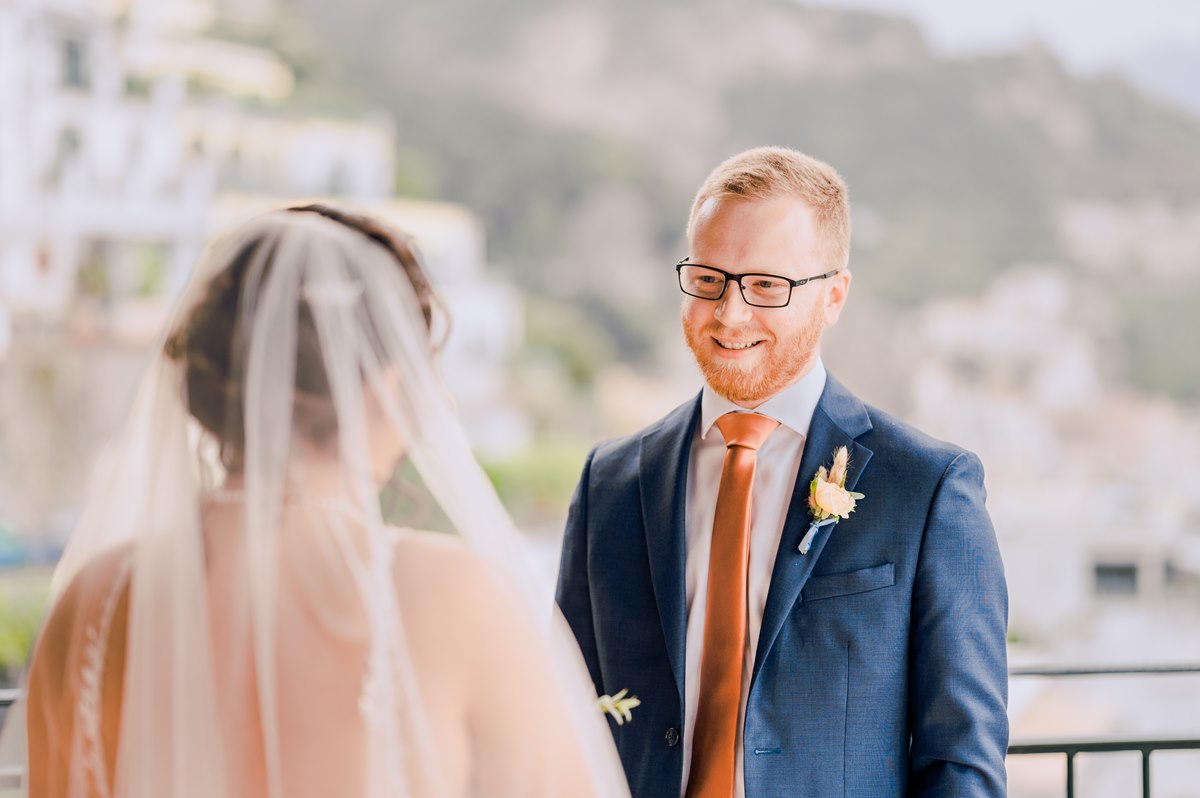
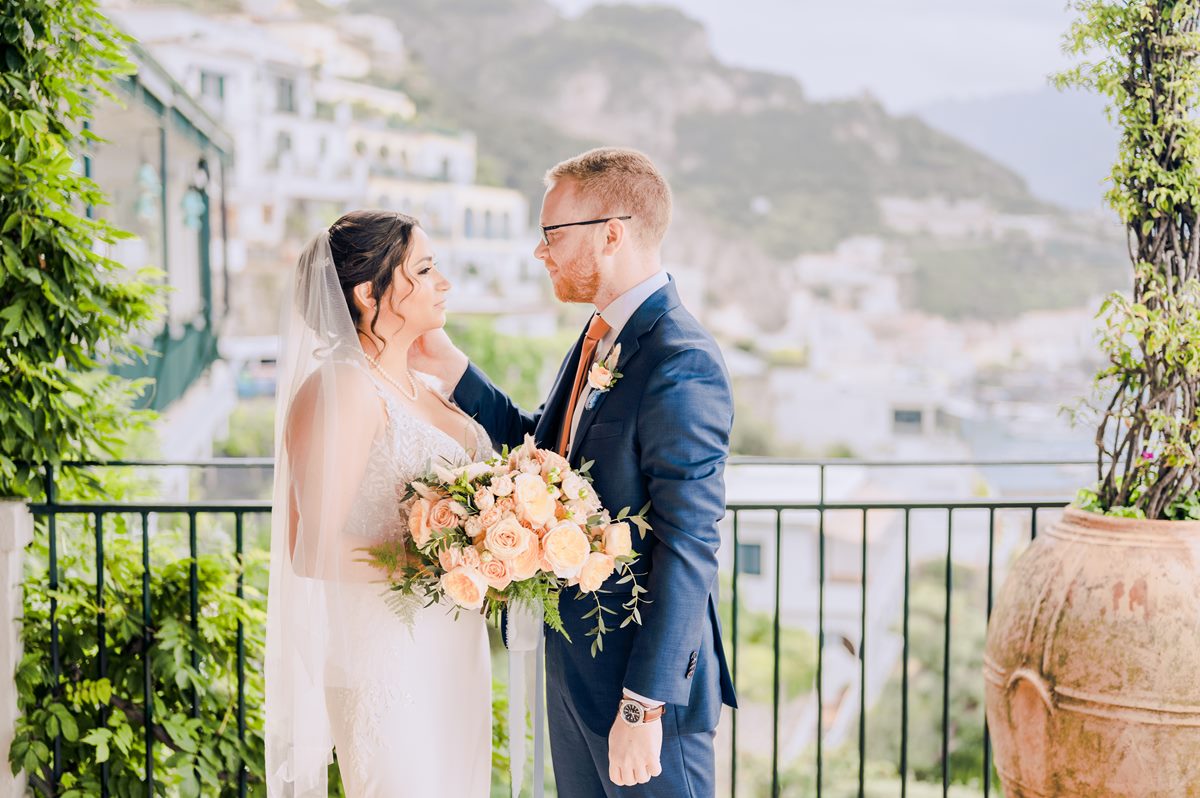
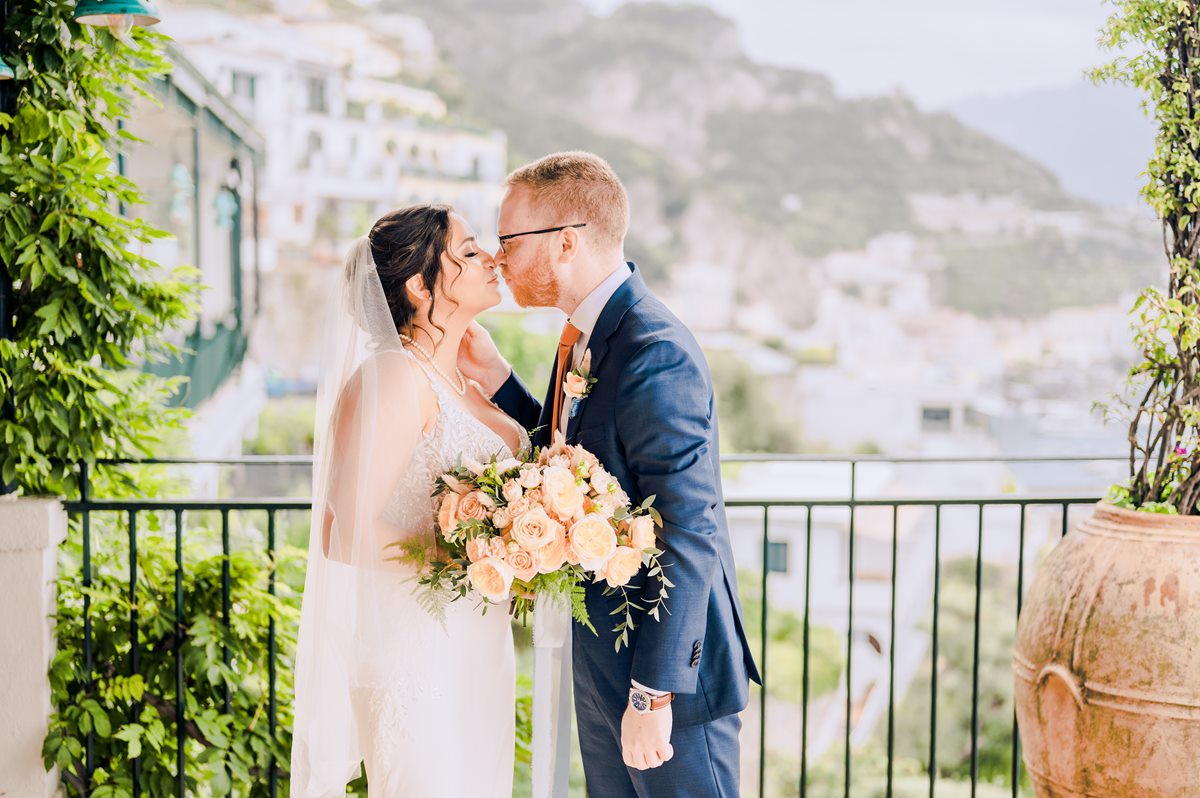
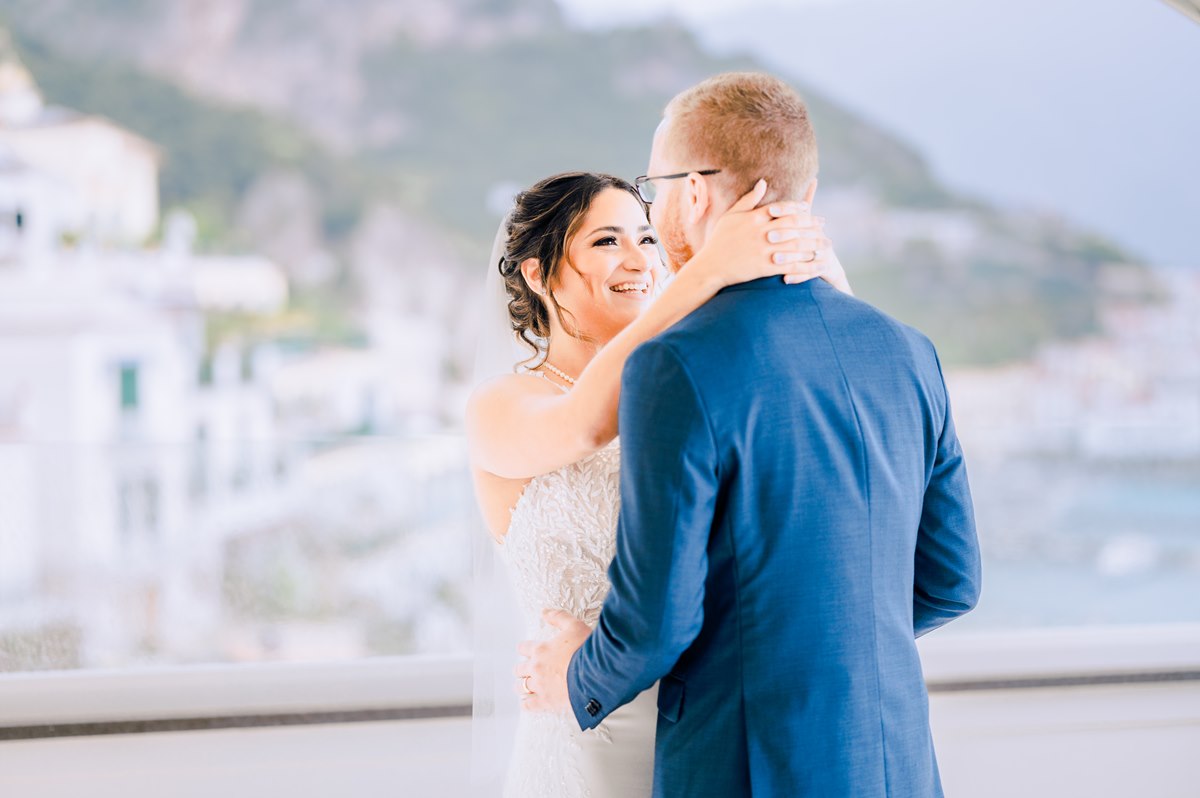
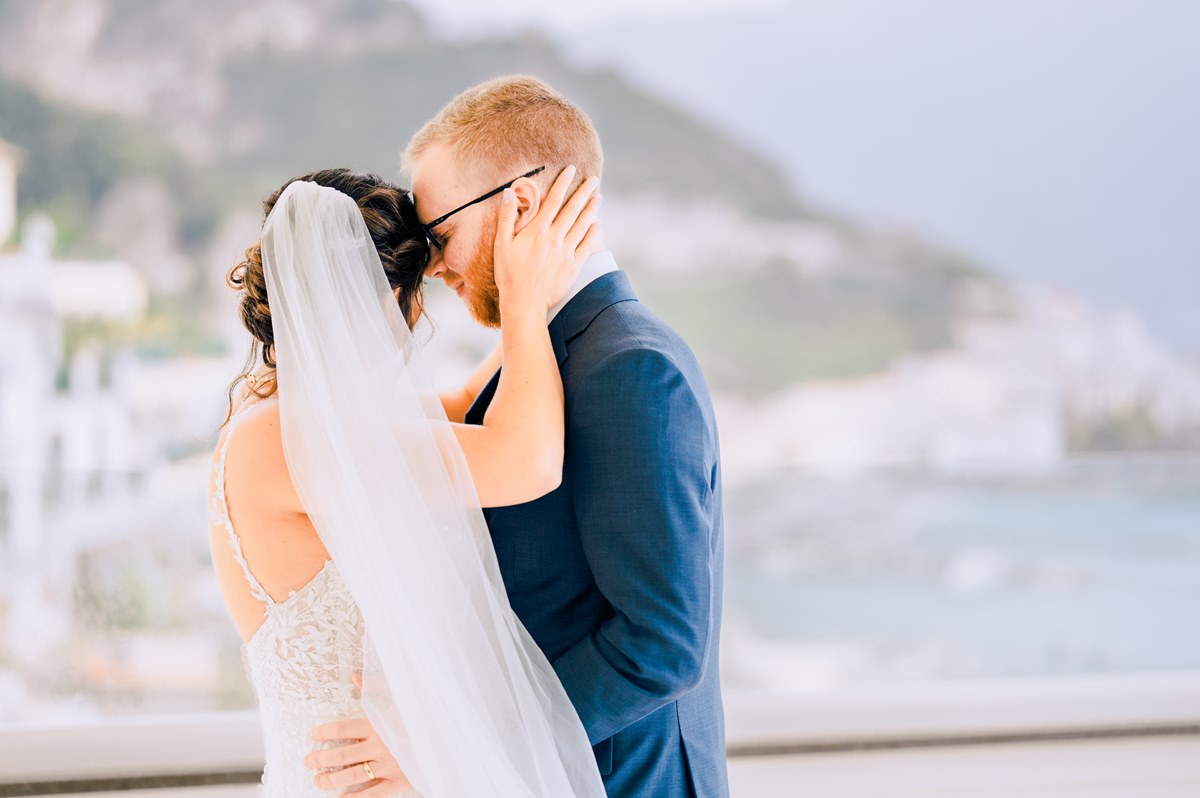
I put Michael at the railing with his back to her, framed between two vine-wrapped posts, with the bells top left and a mossy terracotta amphora bottom right. Amalfi sat behind him, soft and low in contrast, the harbor with its handful of boats and the ridge above town with cloud sitting on it. When he turned, he looked at the ground for a second before he looked at her, which is a thing men do more often than anyone admits, and the shot where his face finally comes up has the bells hanging over the top of it like punctuation.




Then it started raining harder, and we all moved under the roof, and that was the last of the outdoors for a long while.


Three of Us, a Violinist, and a Table the Size of a Dinner Plate
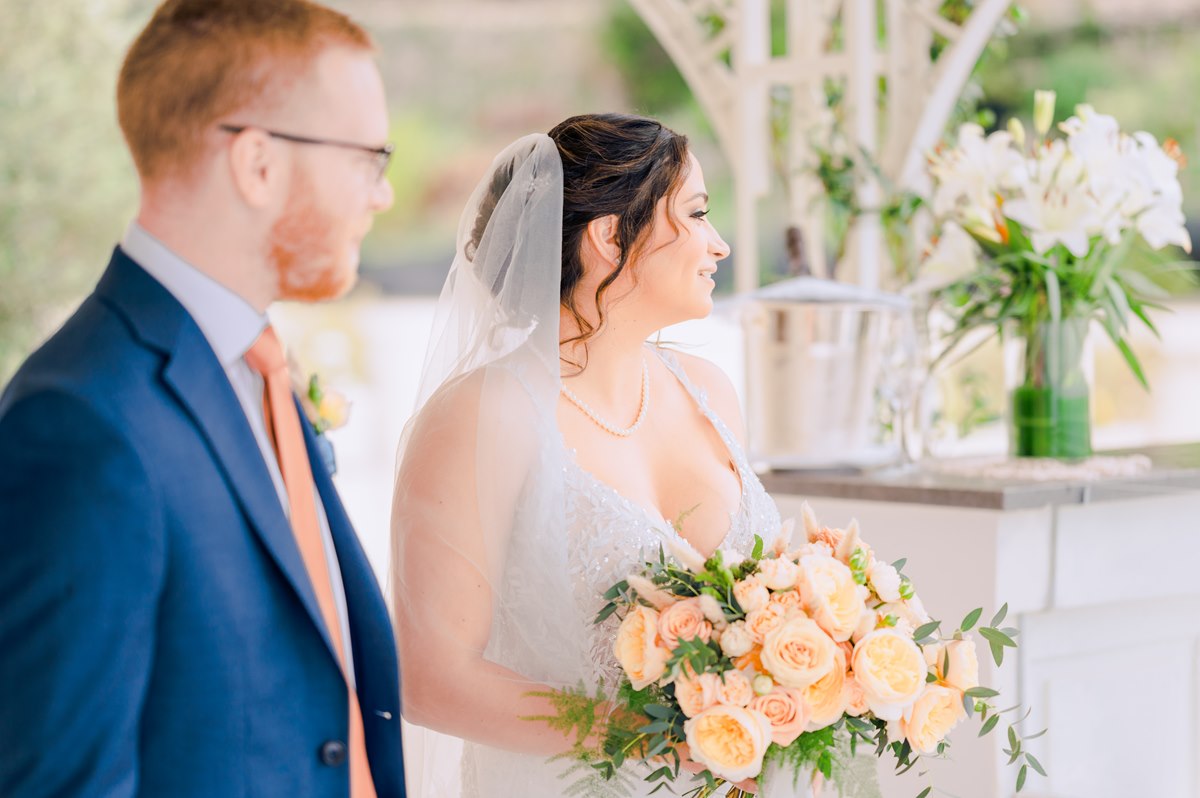
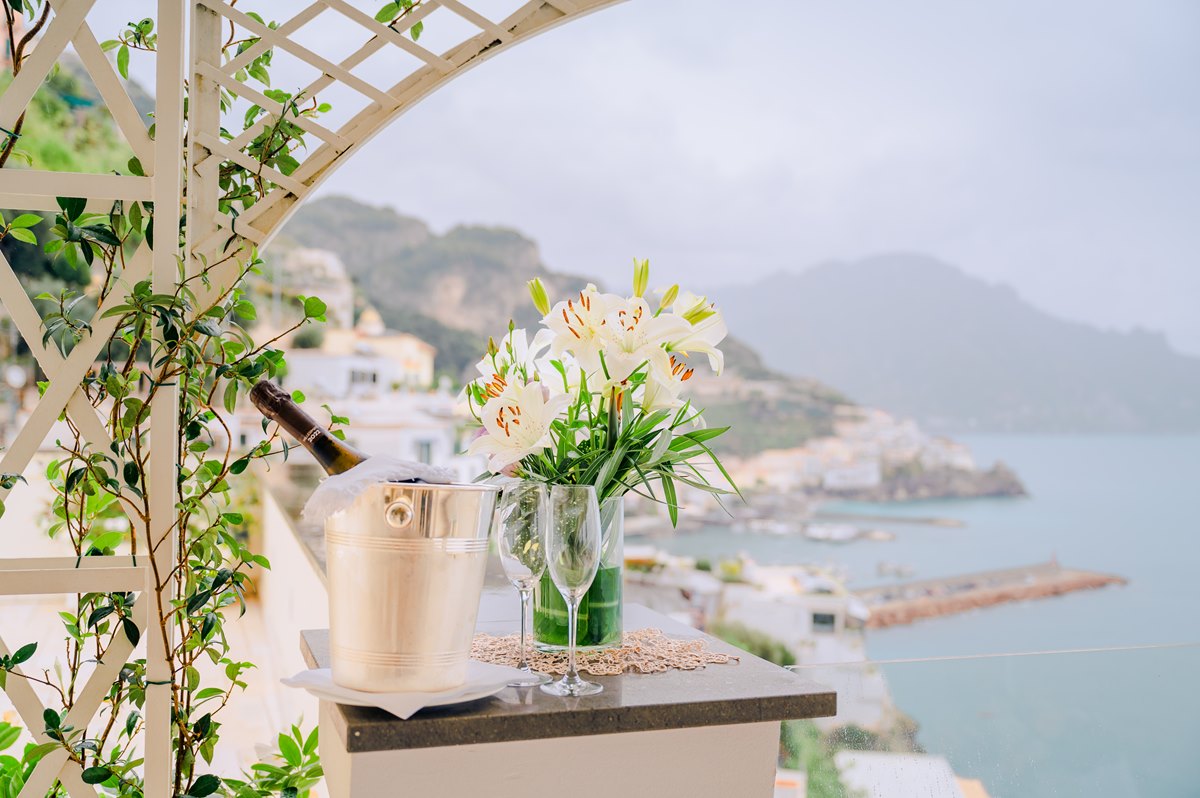
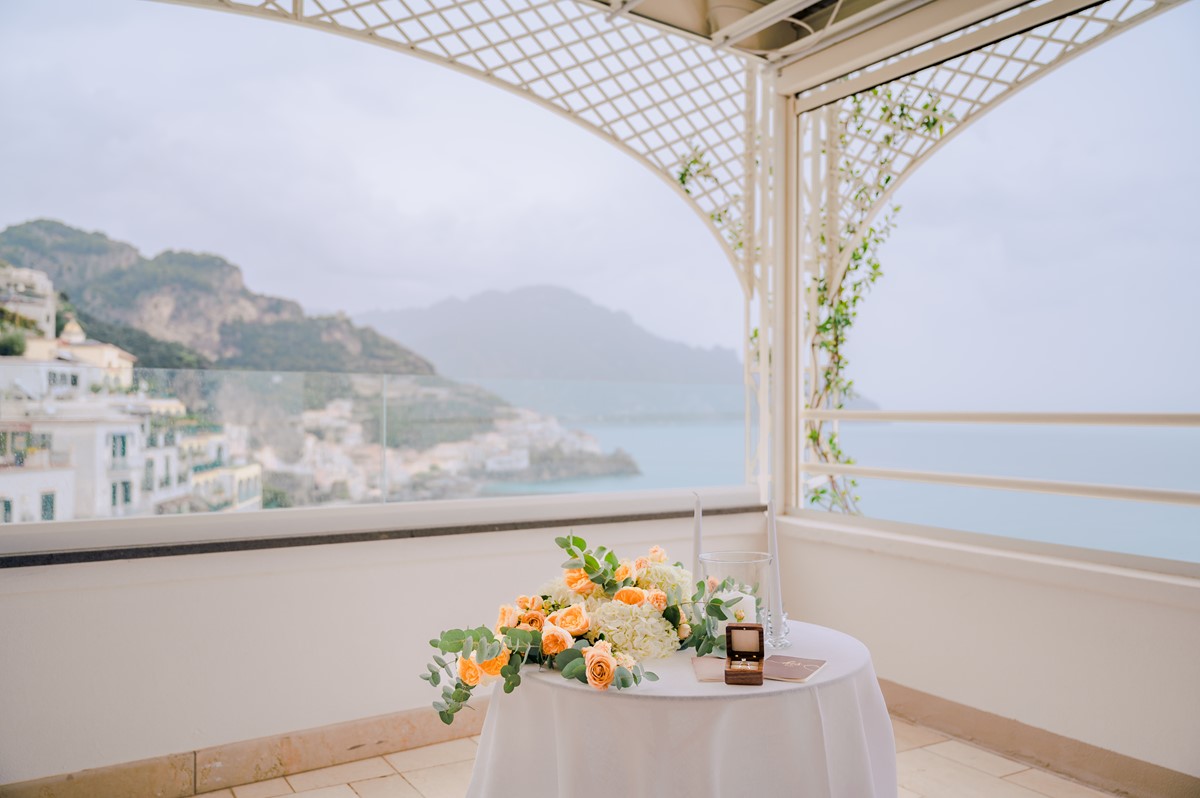
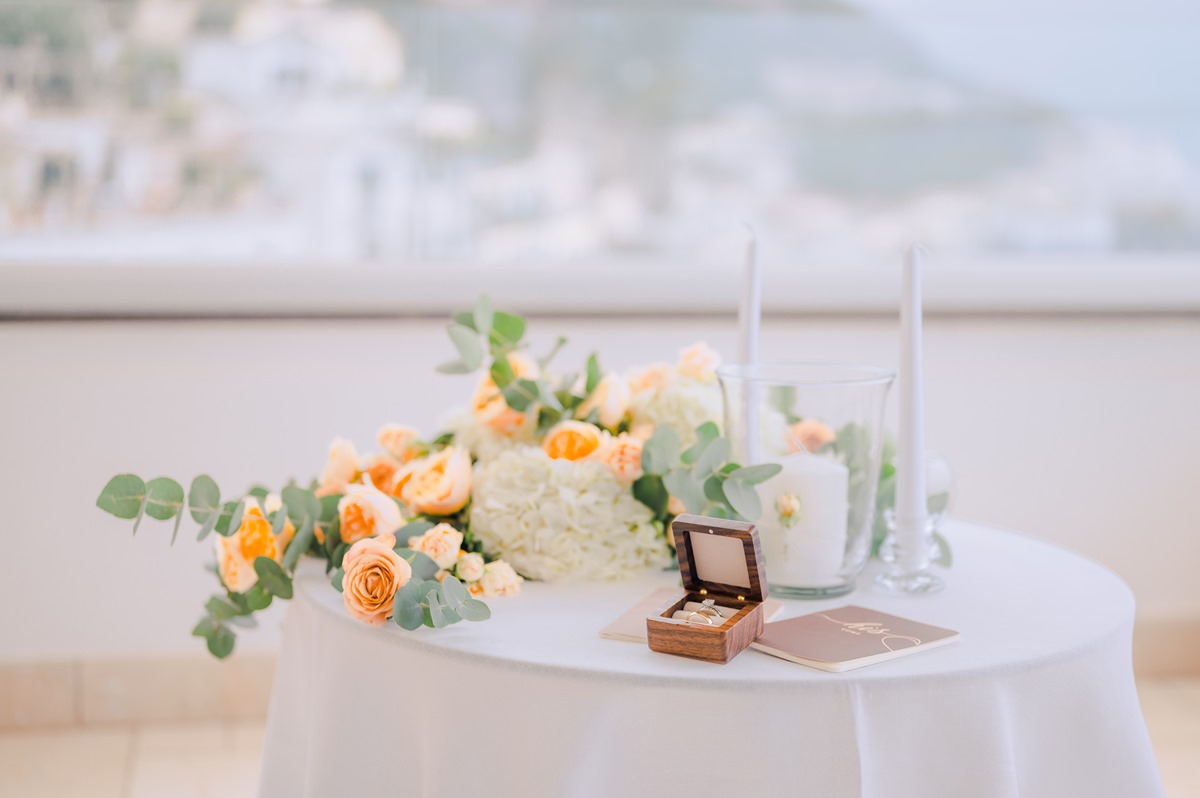
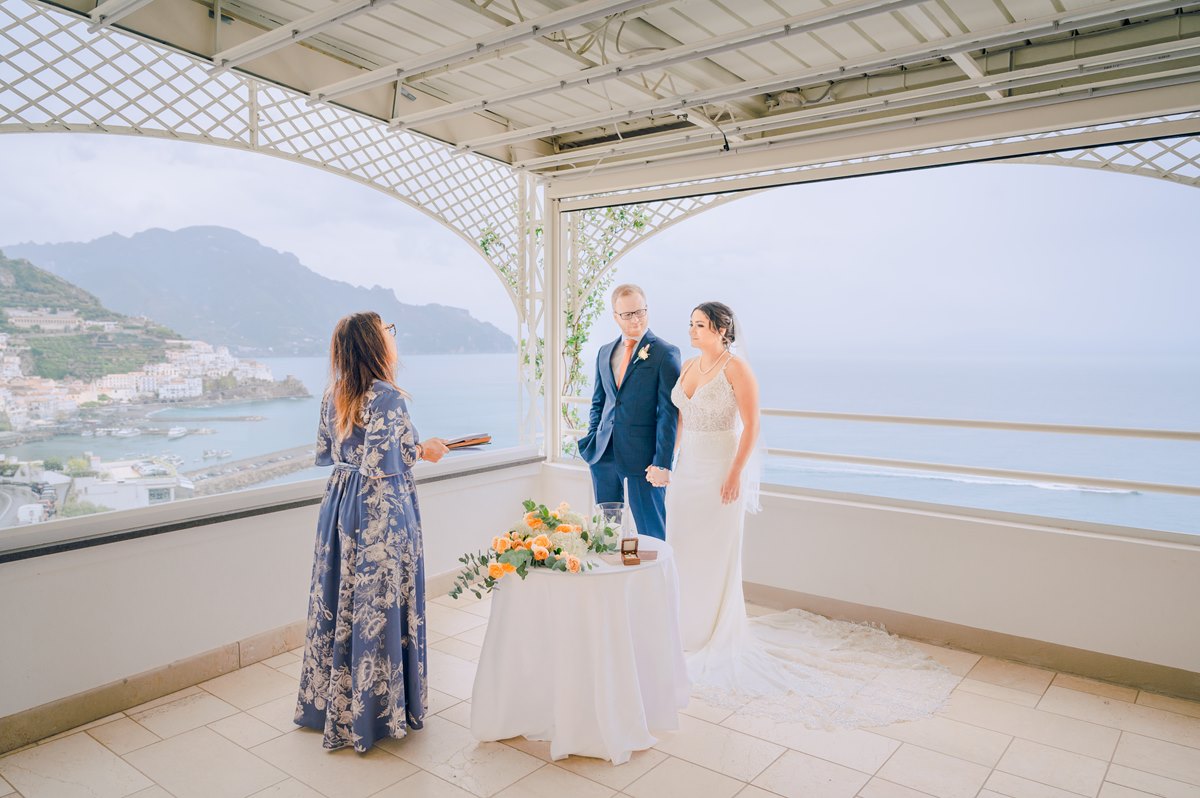
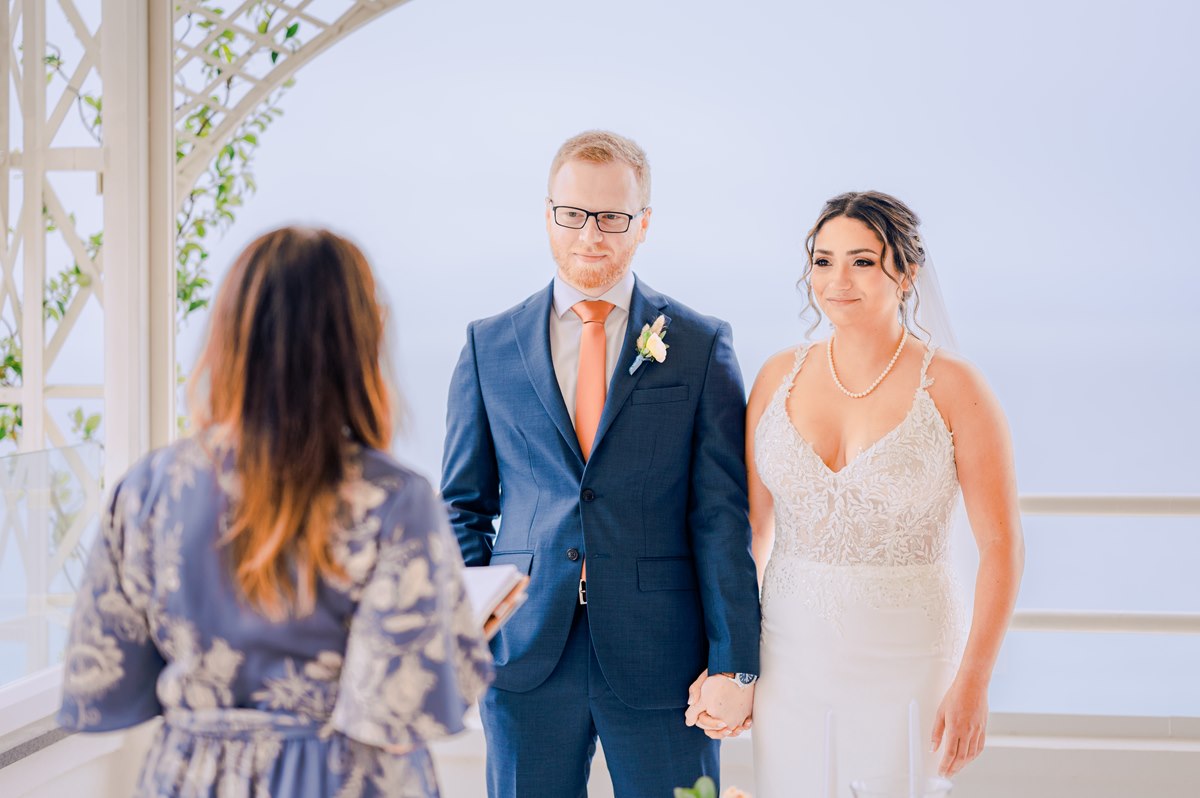
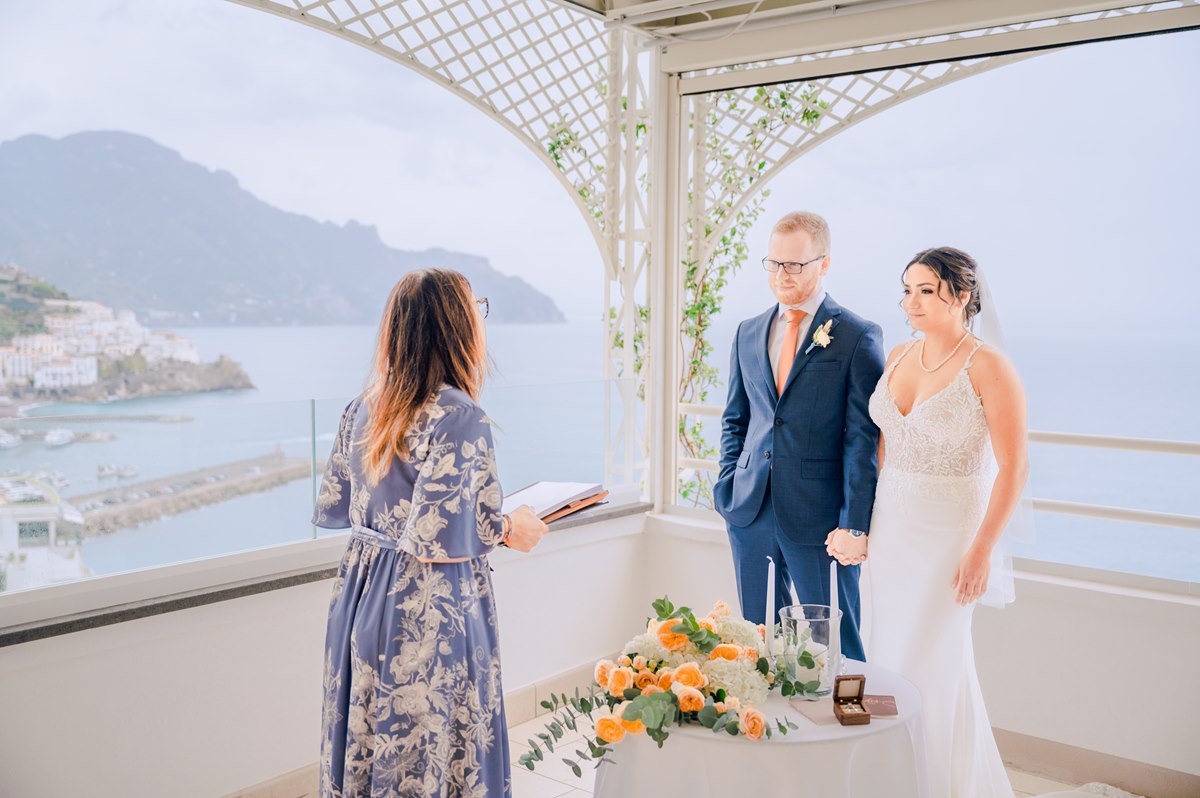
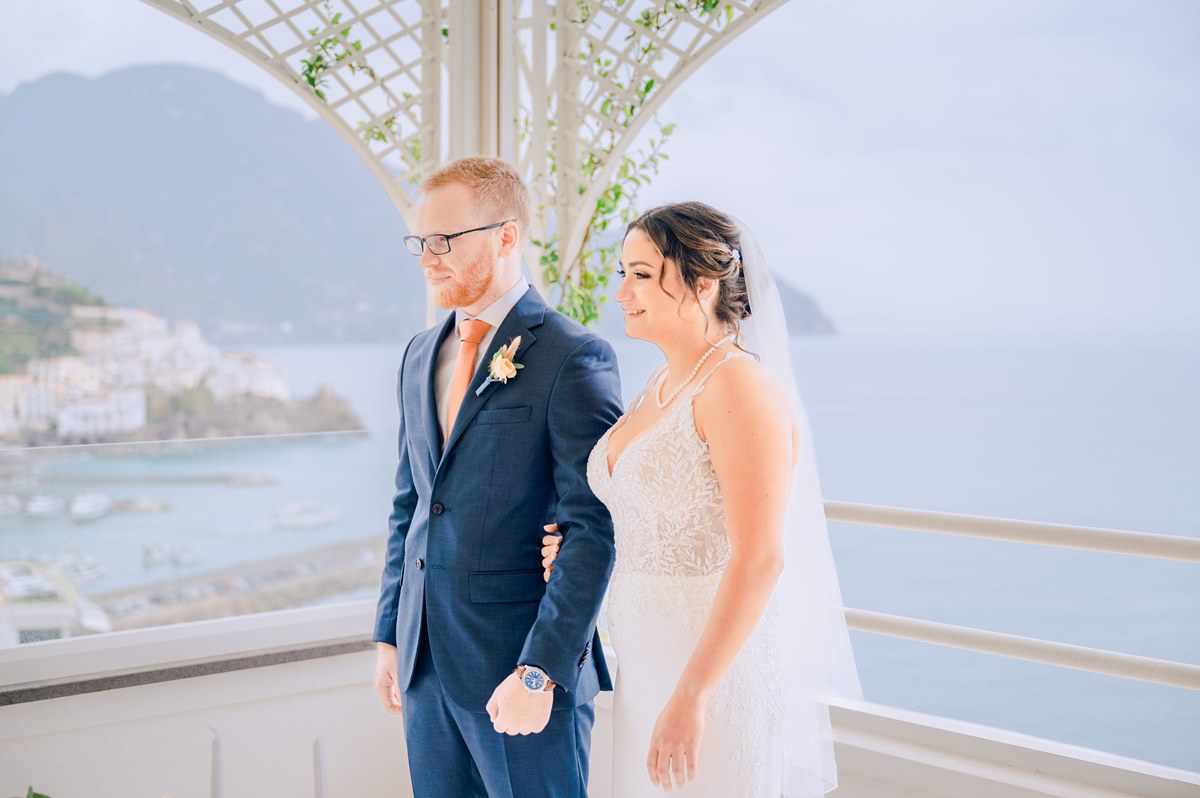
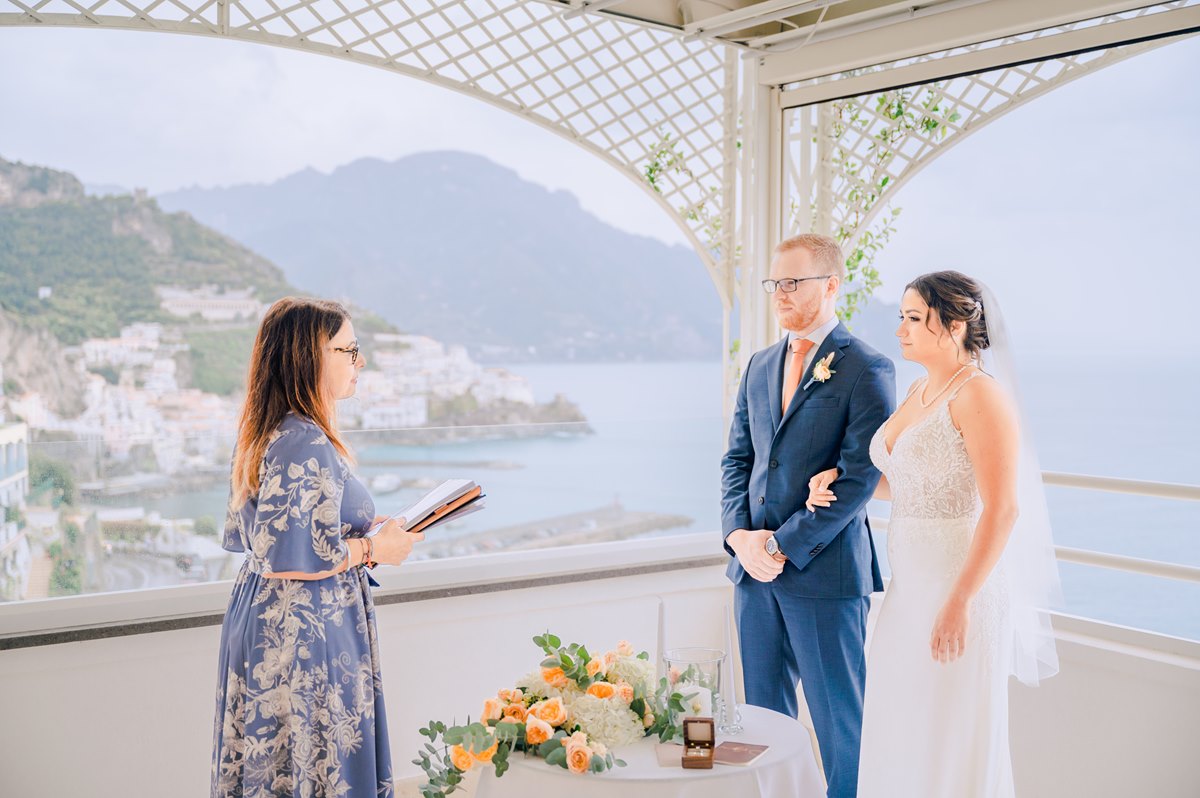
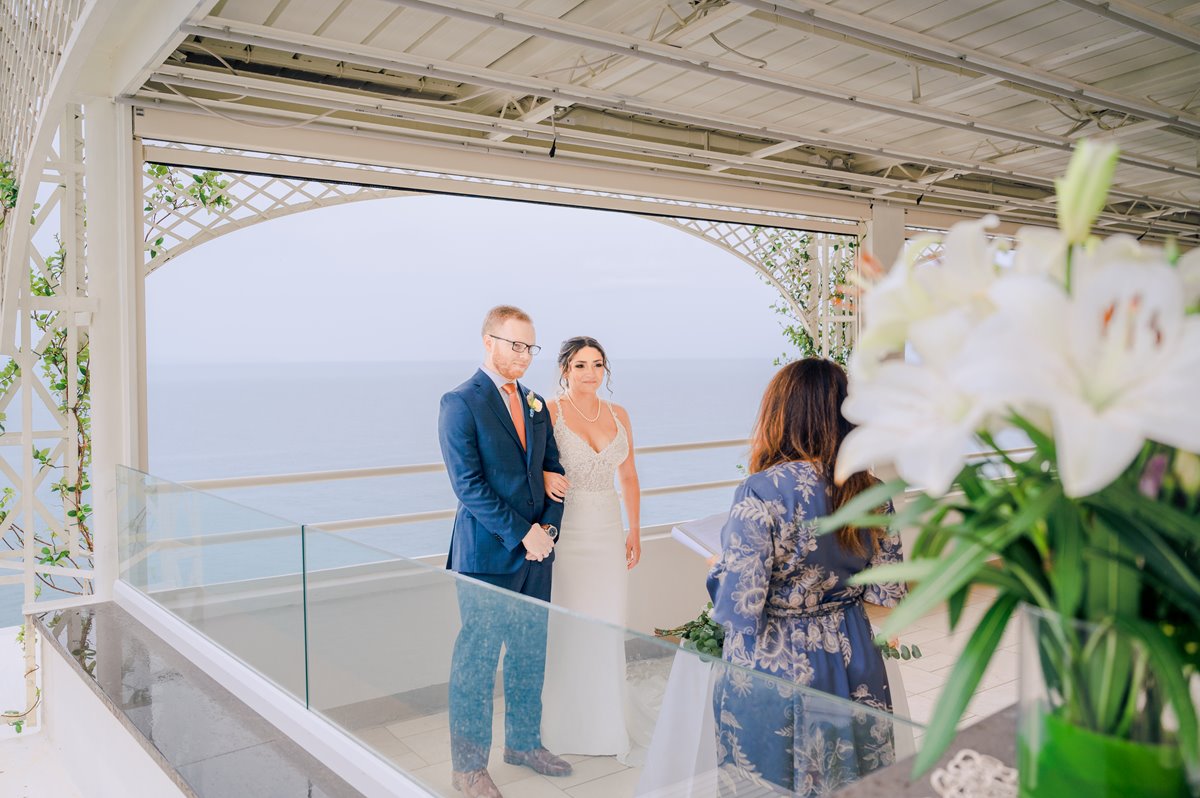
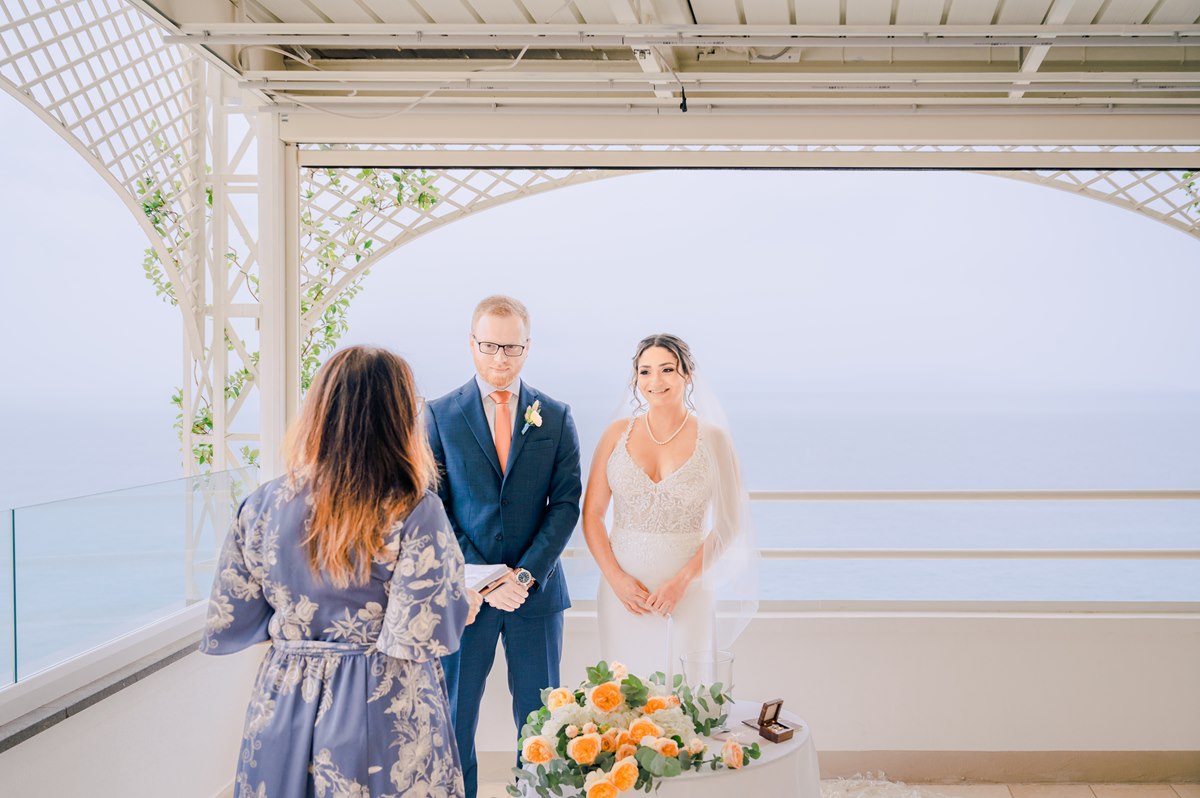
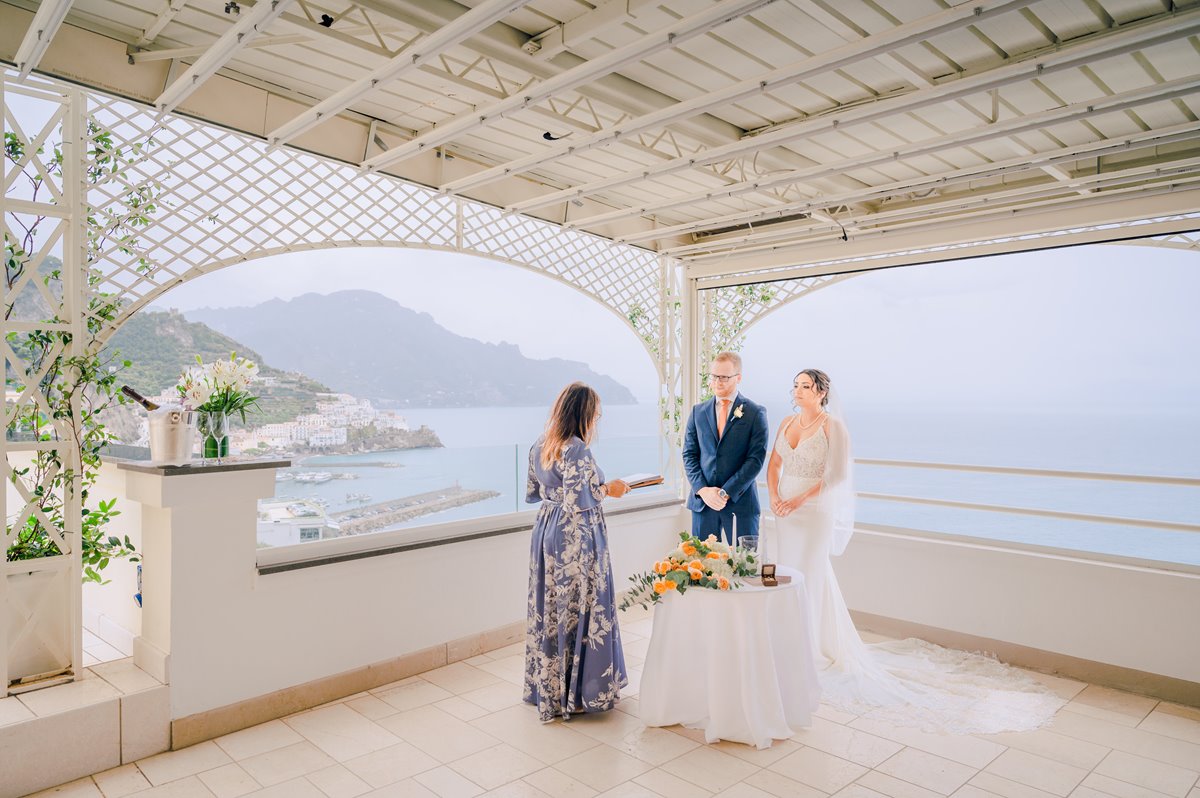
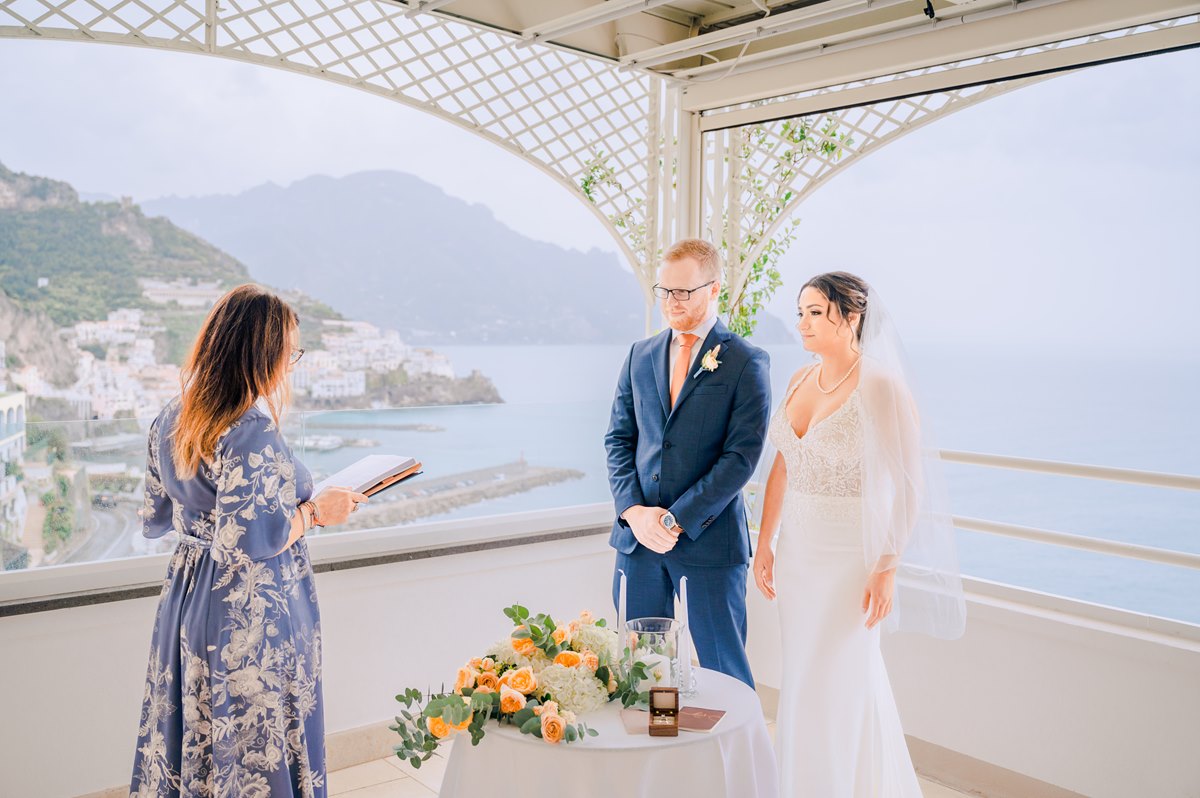
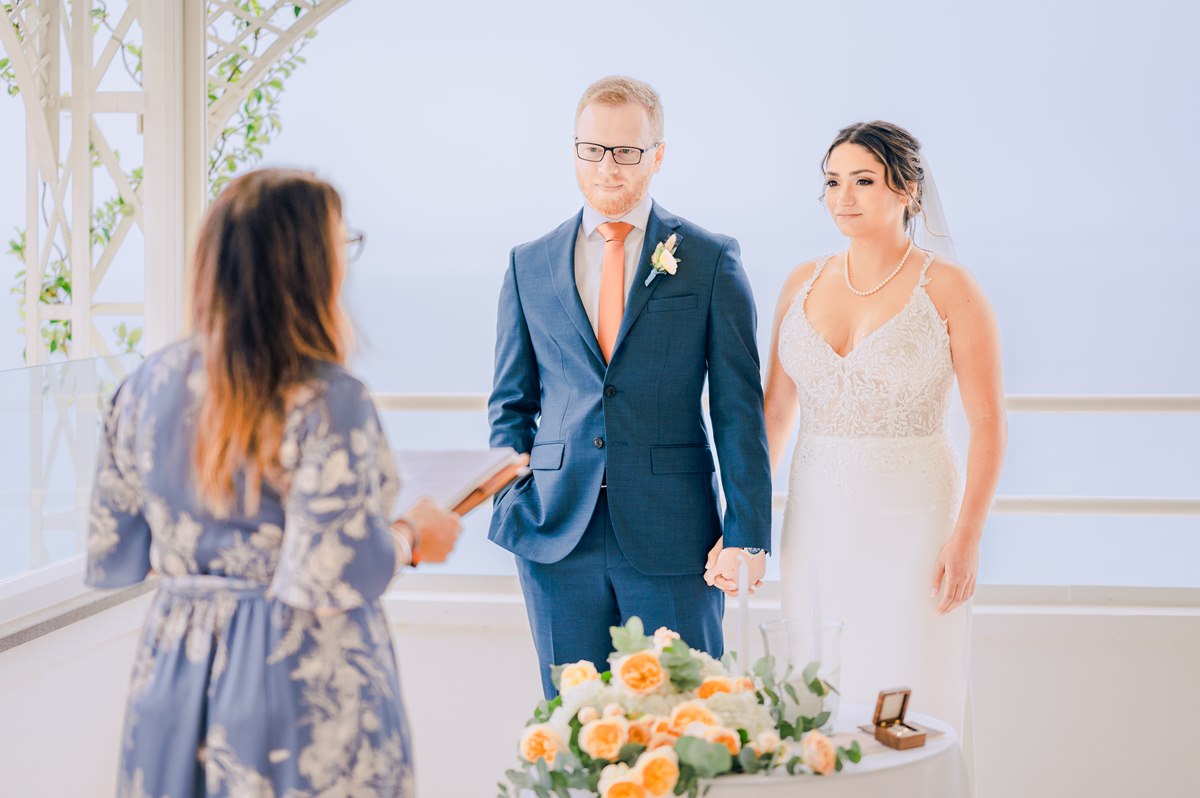
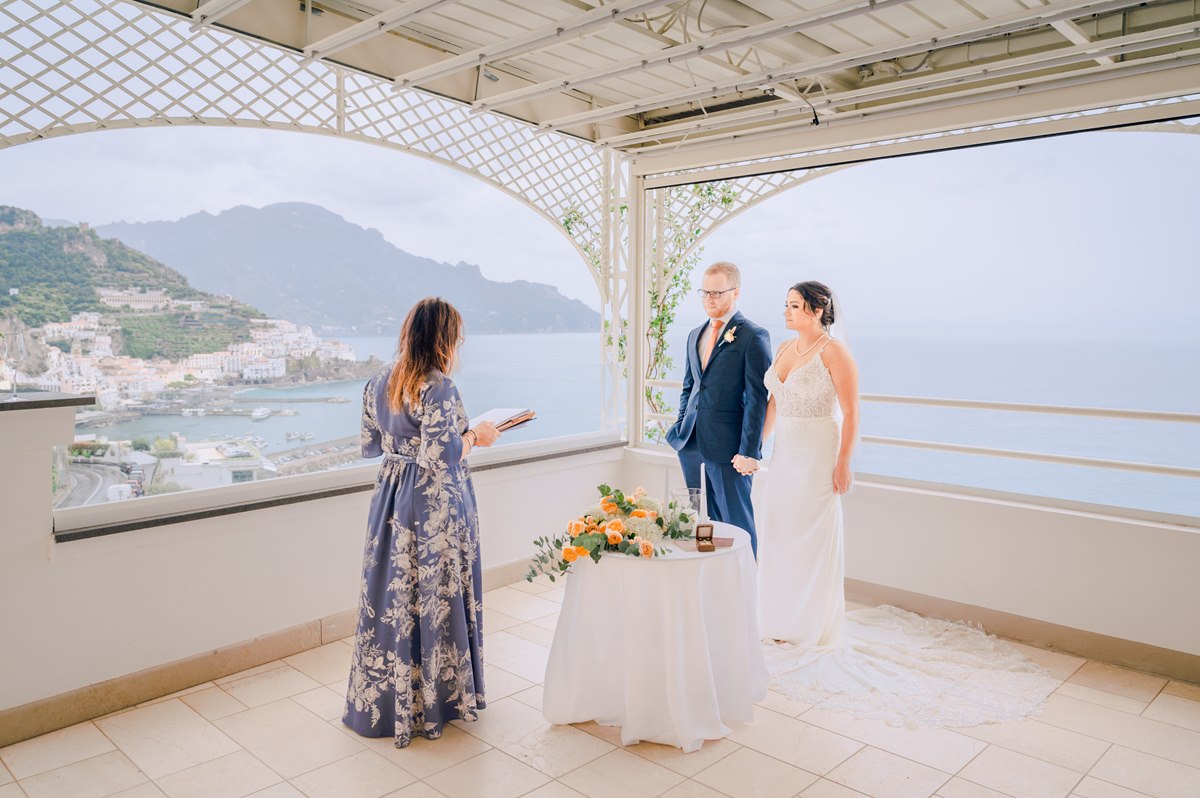
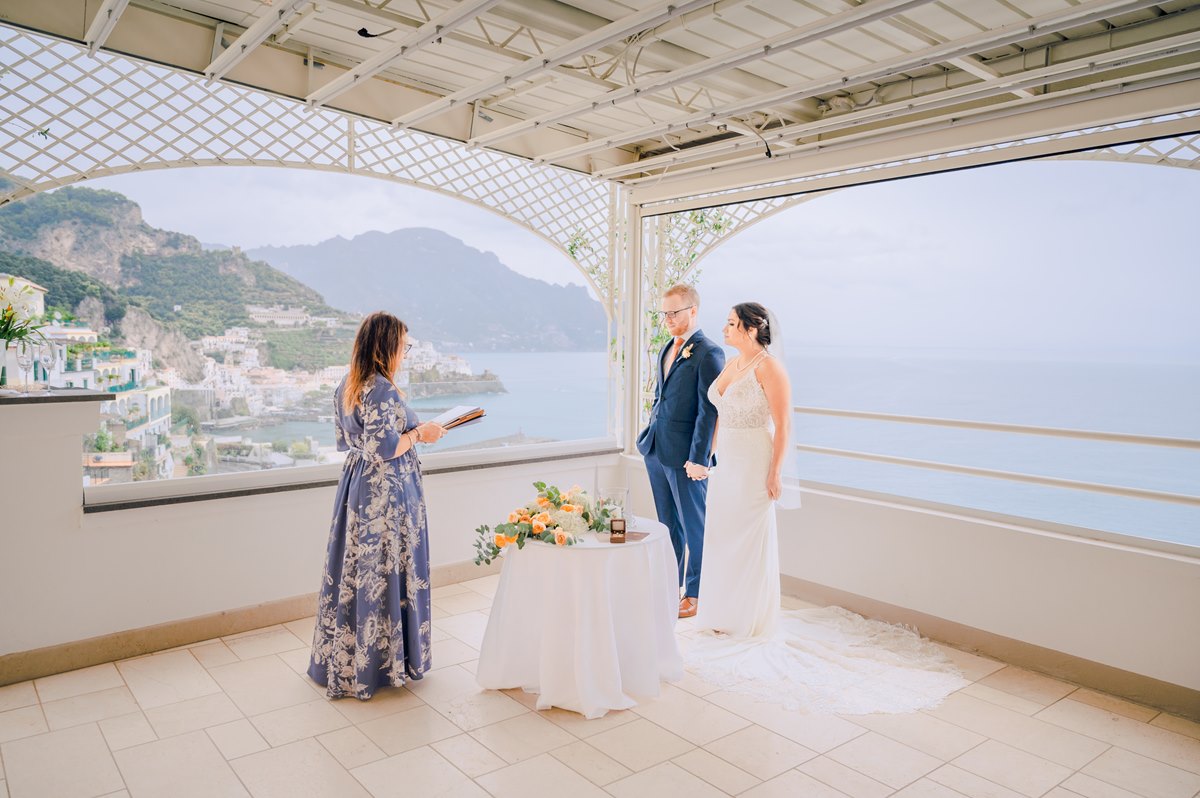
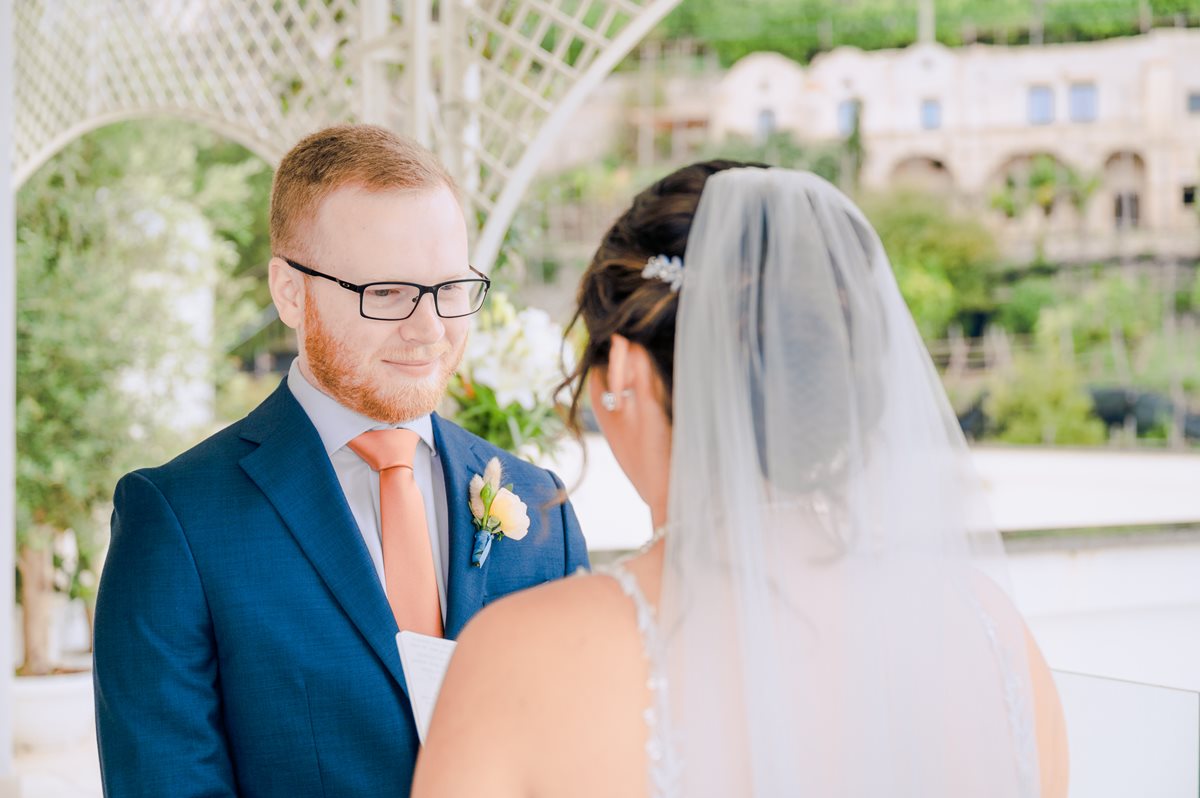
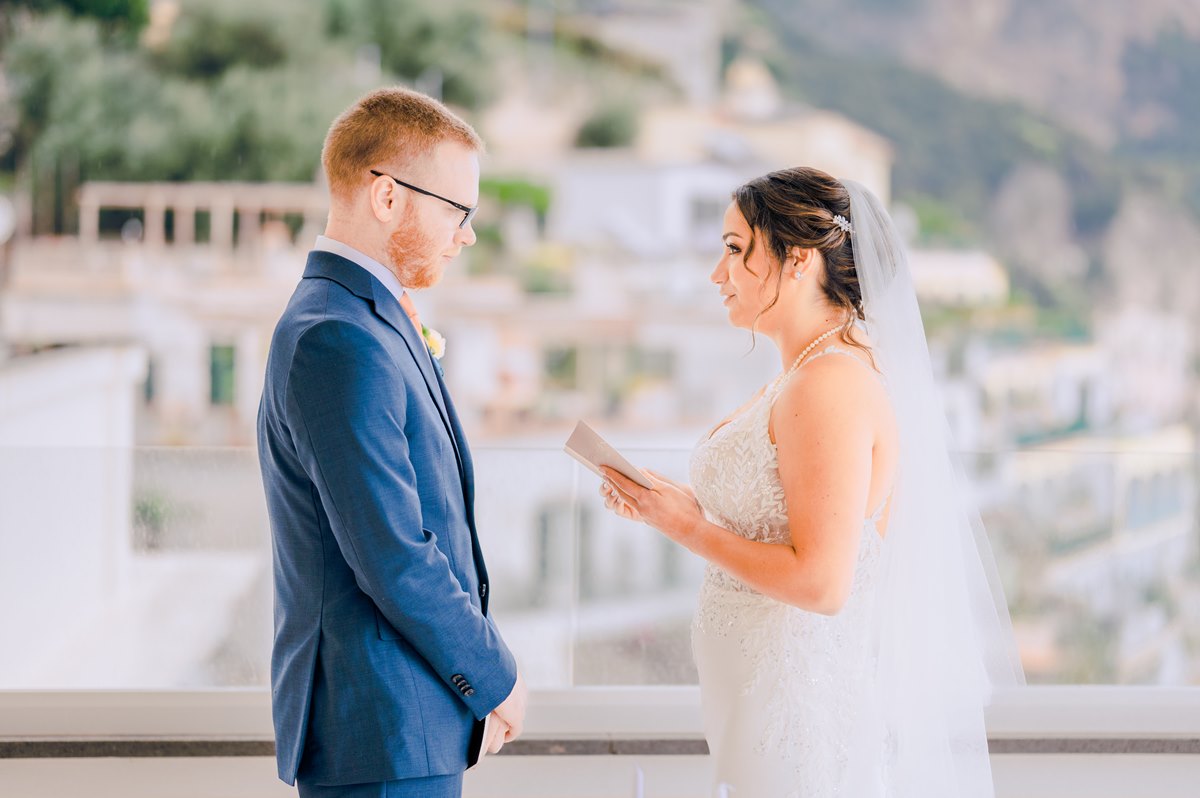
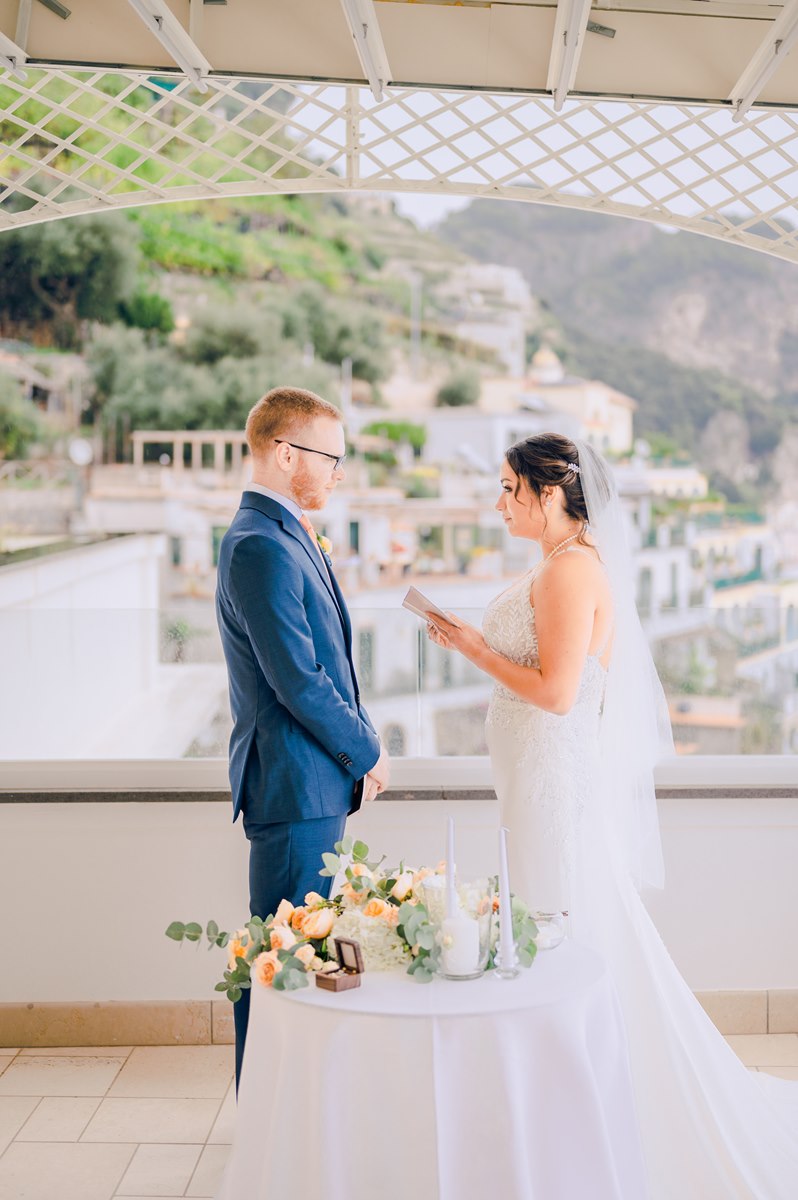
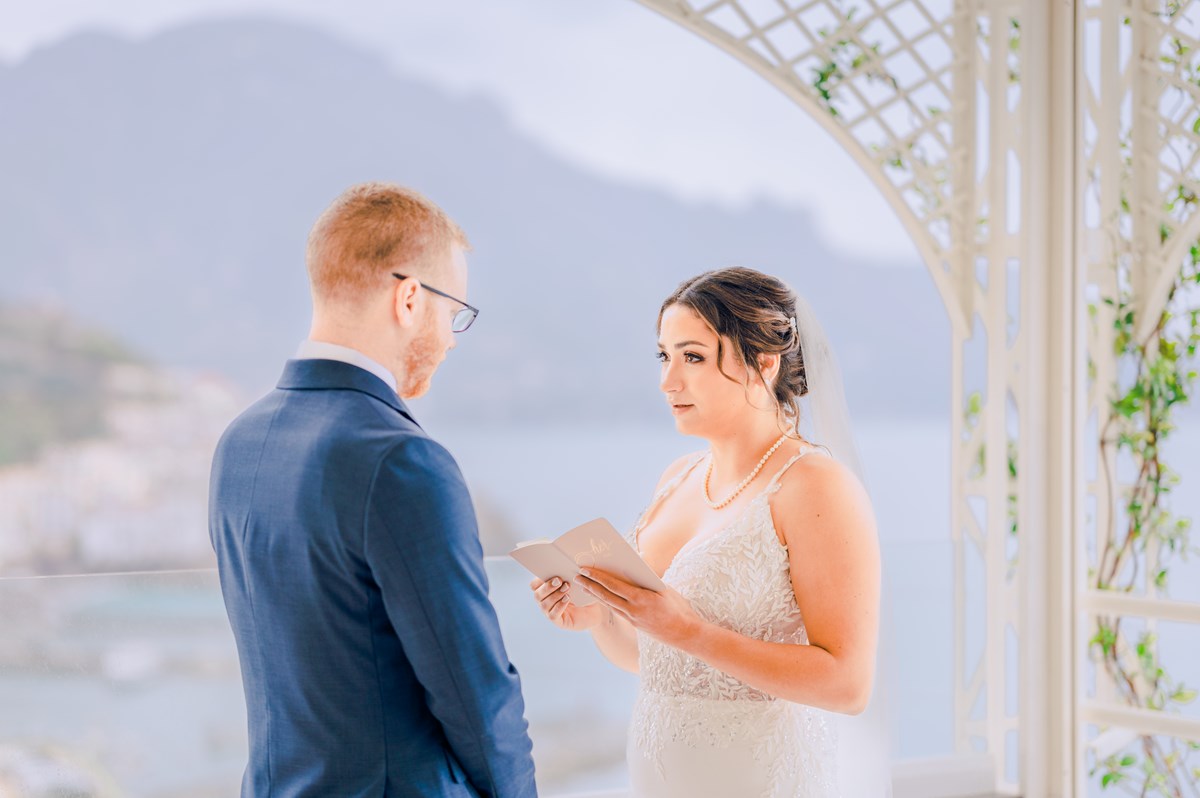
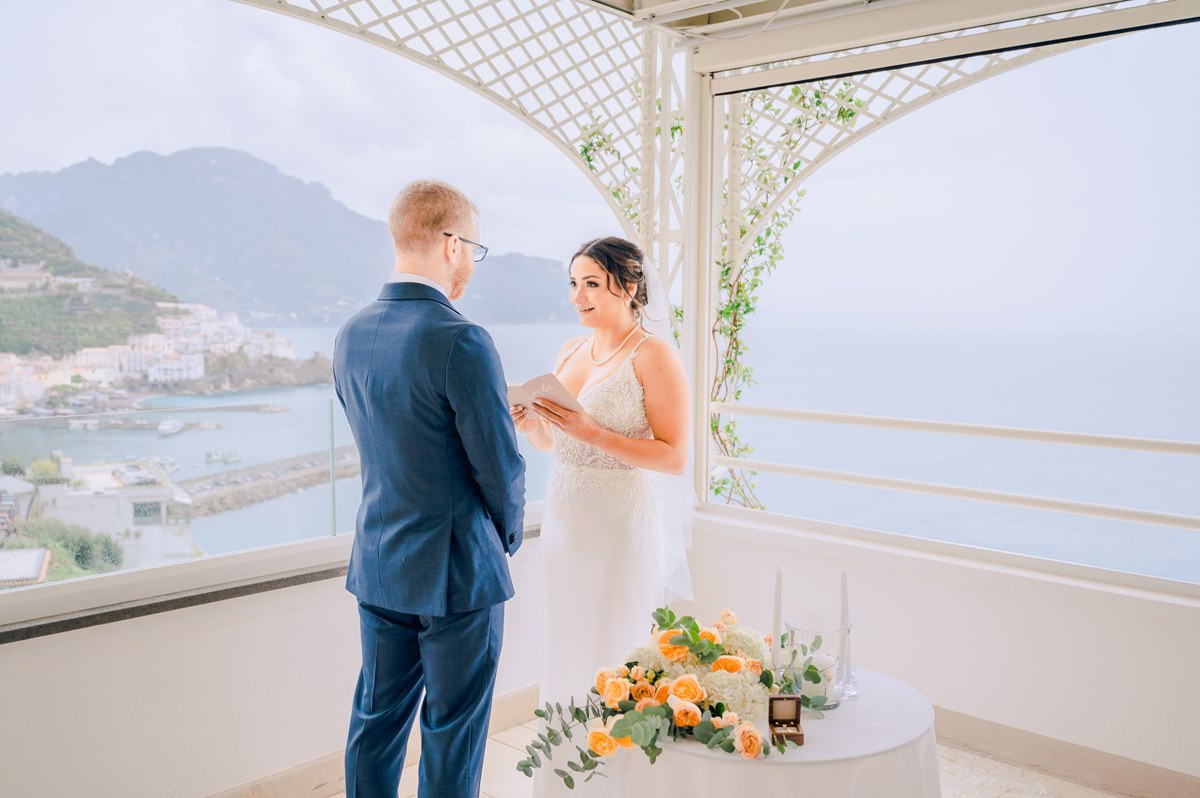
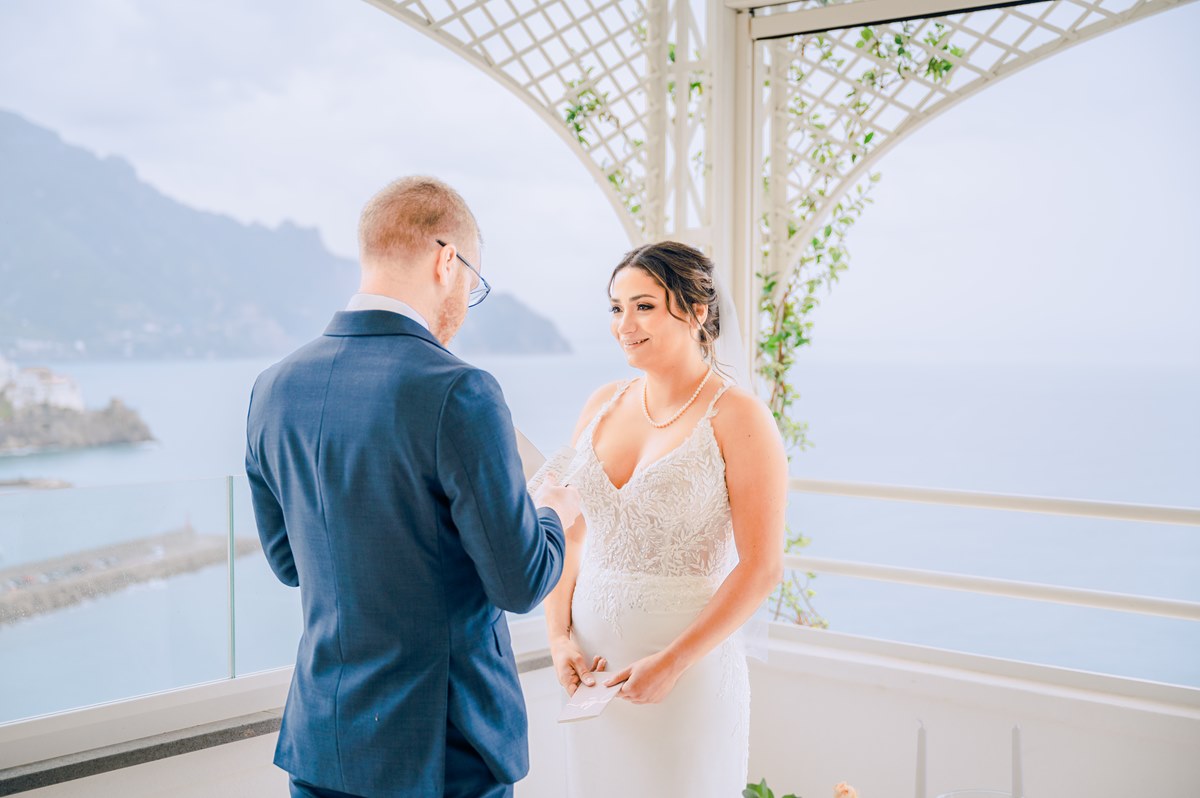
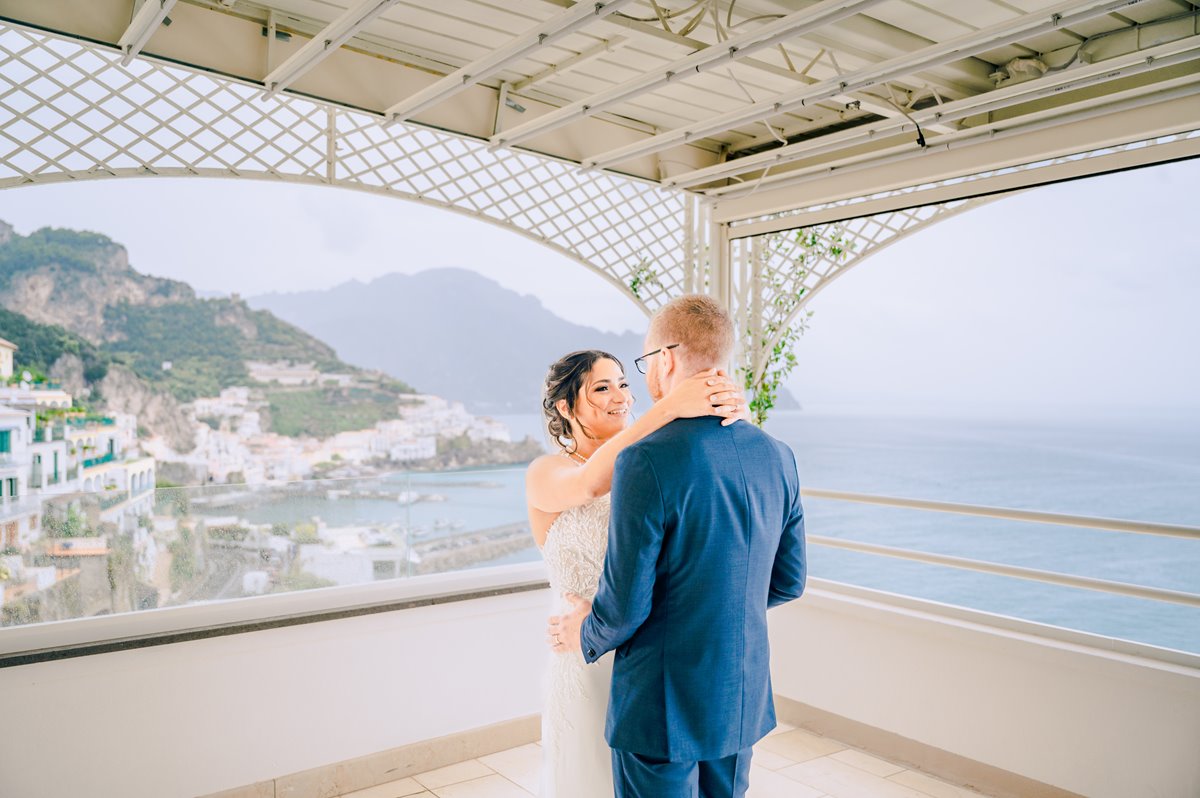
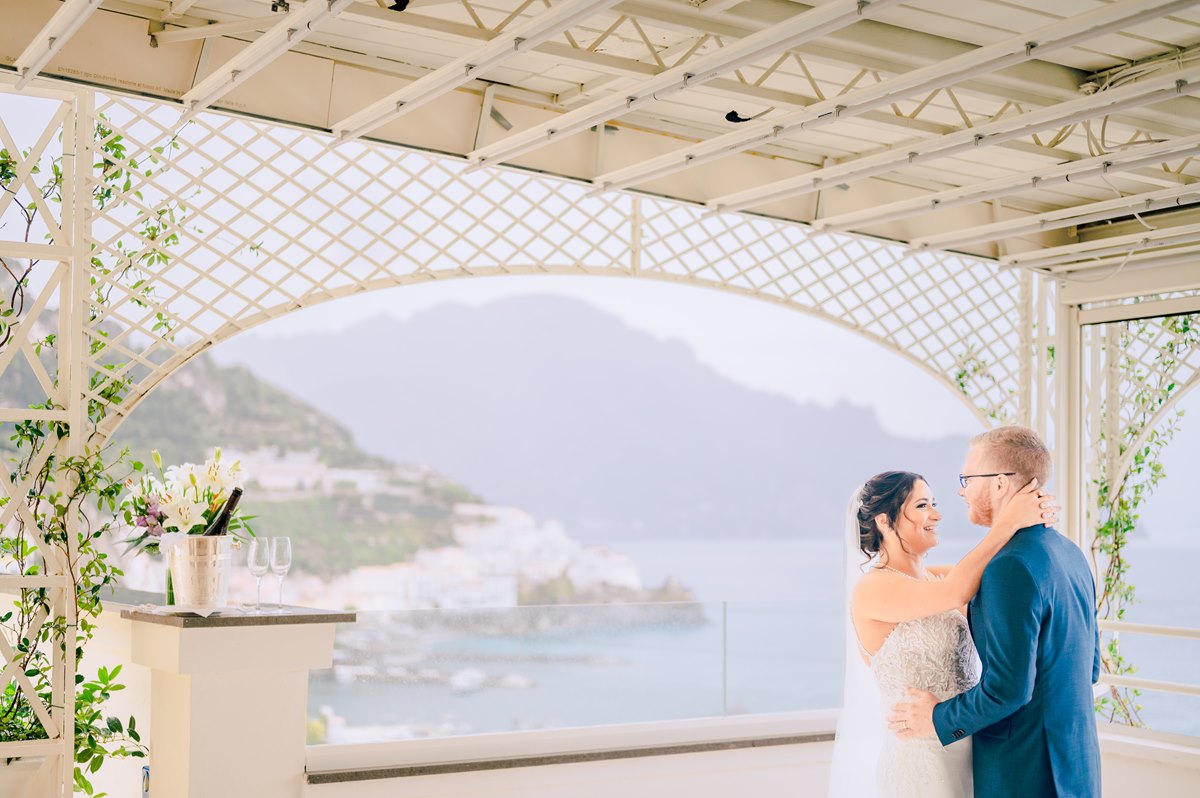
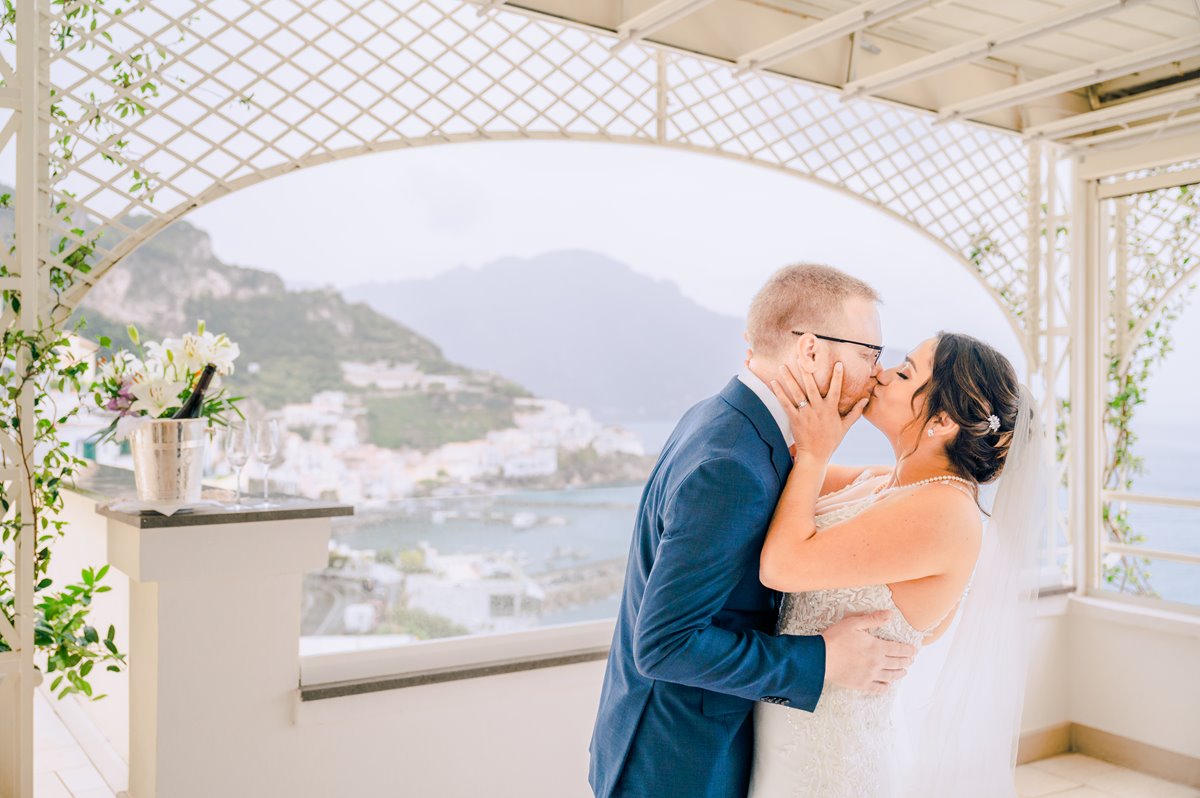
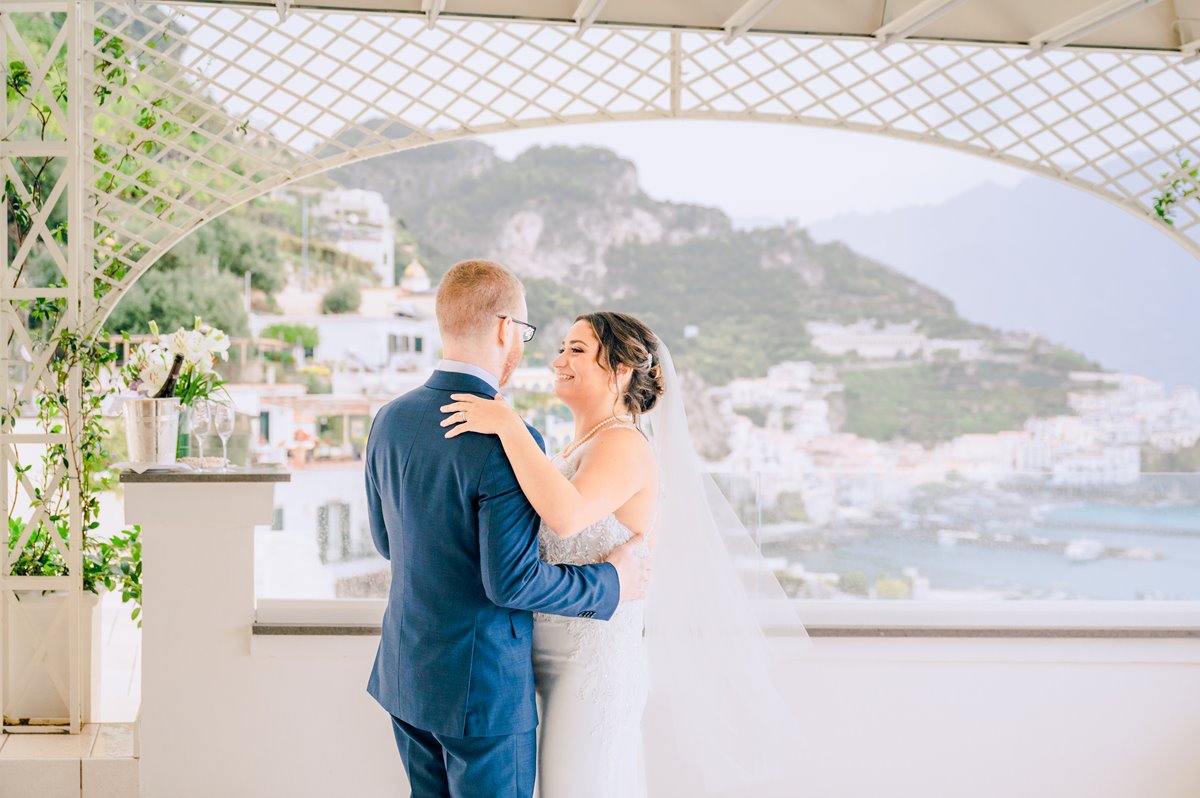
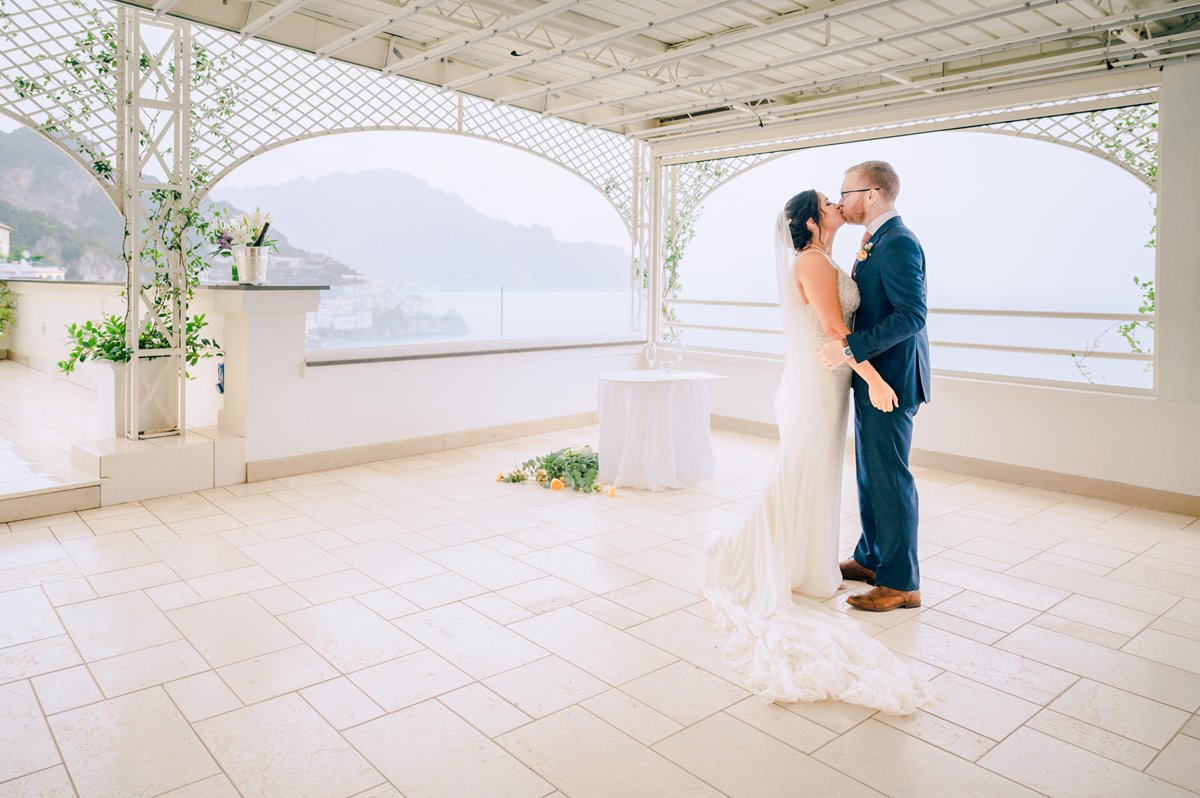
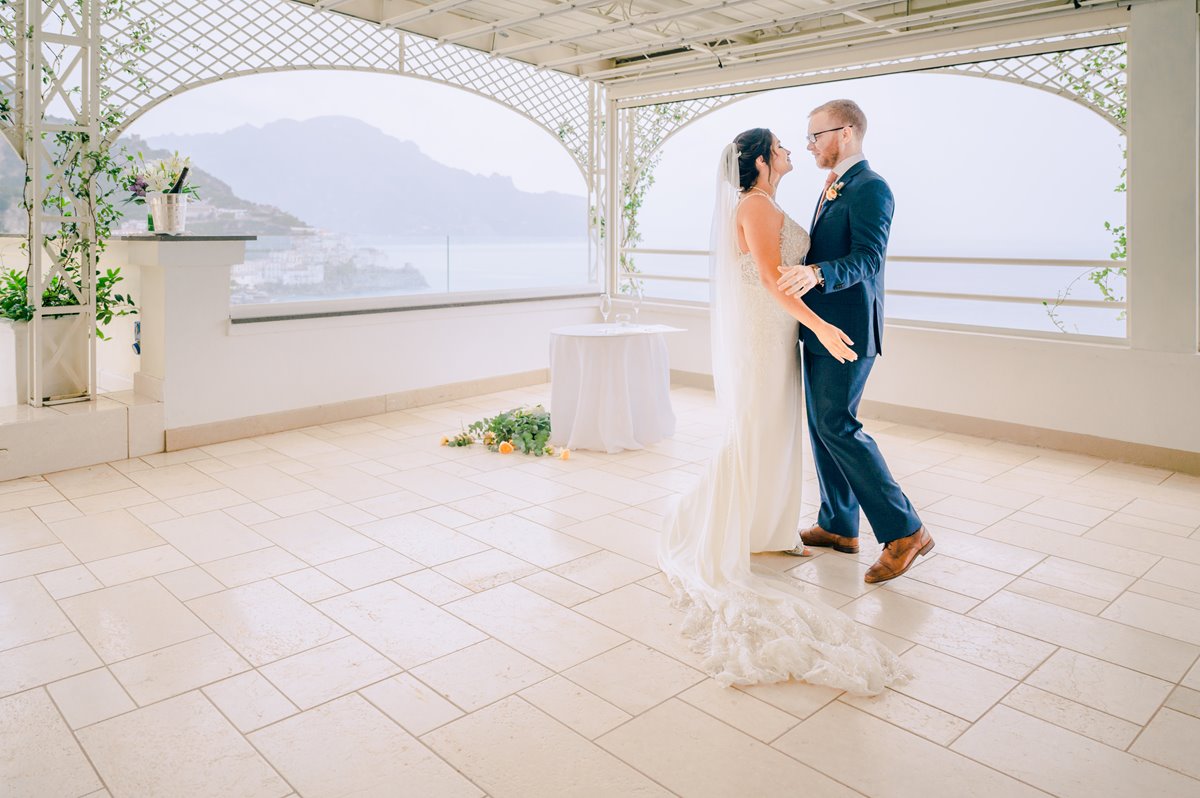
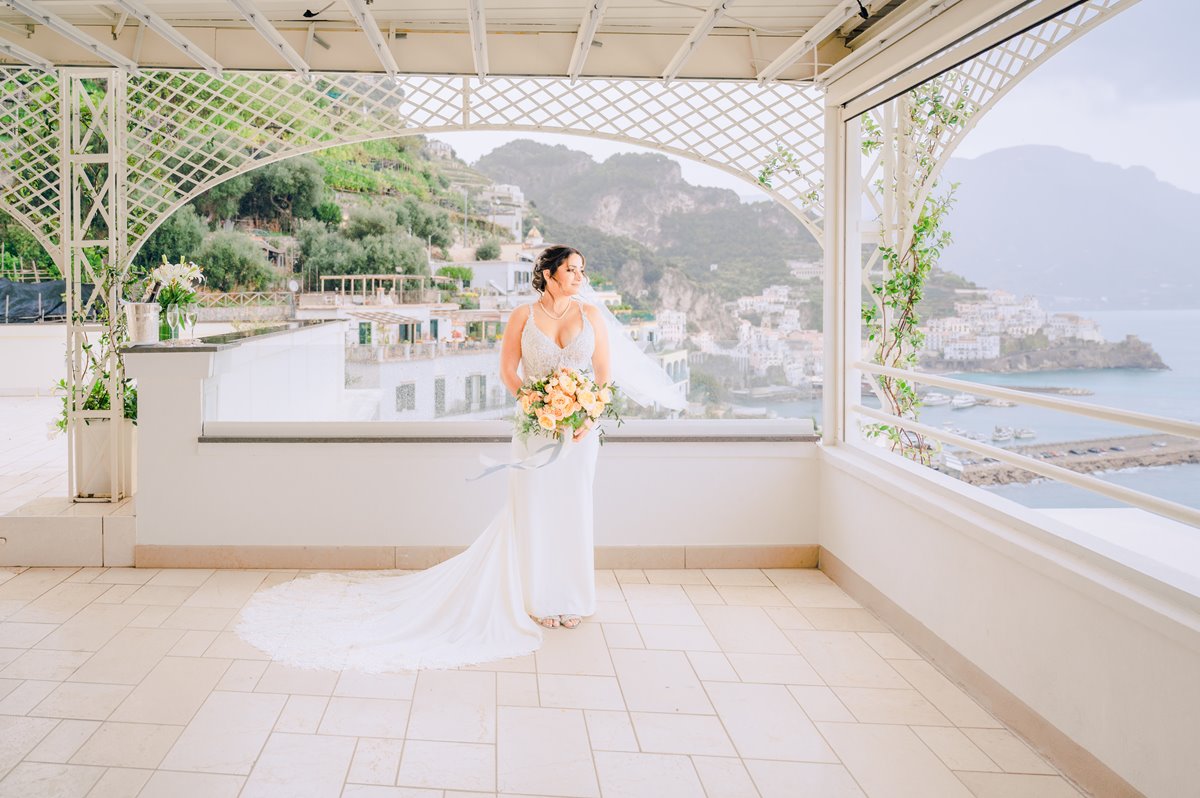
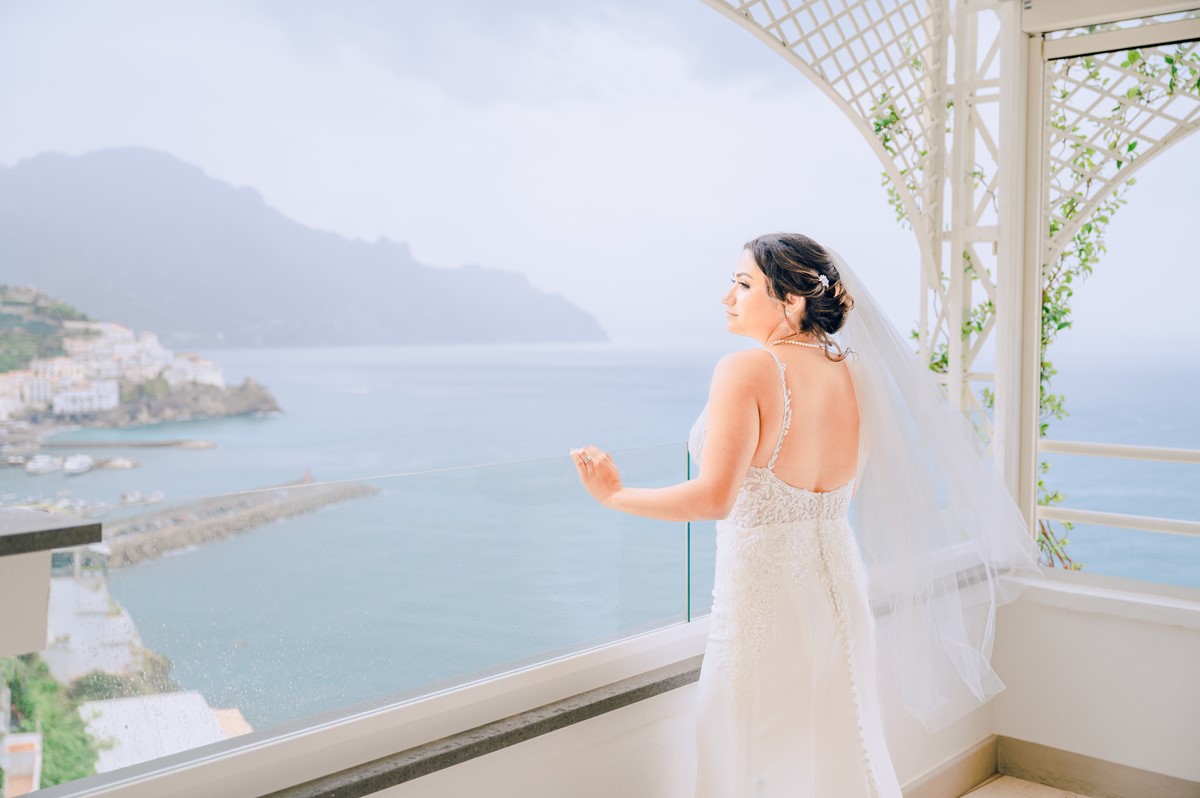
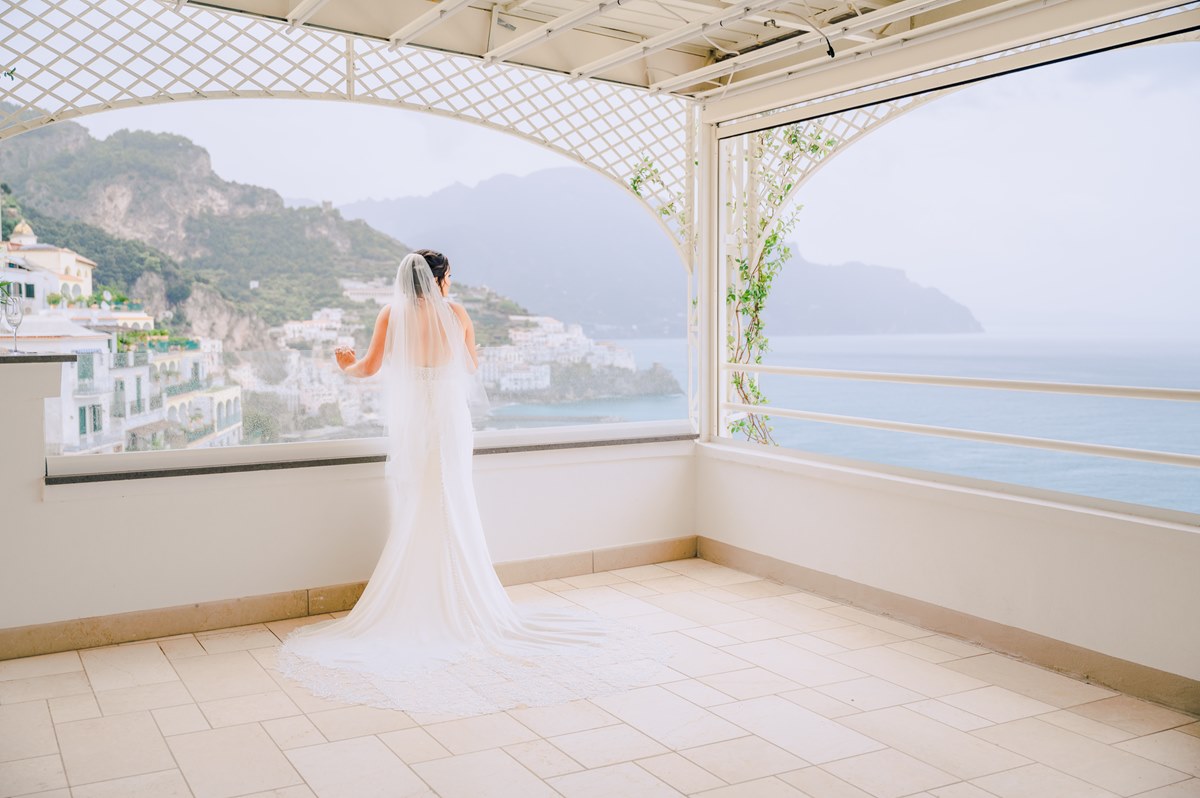
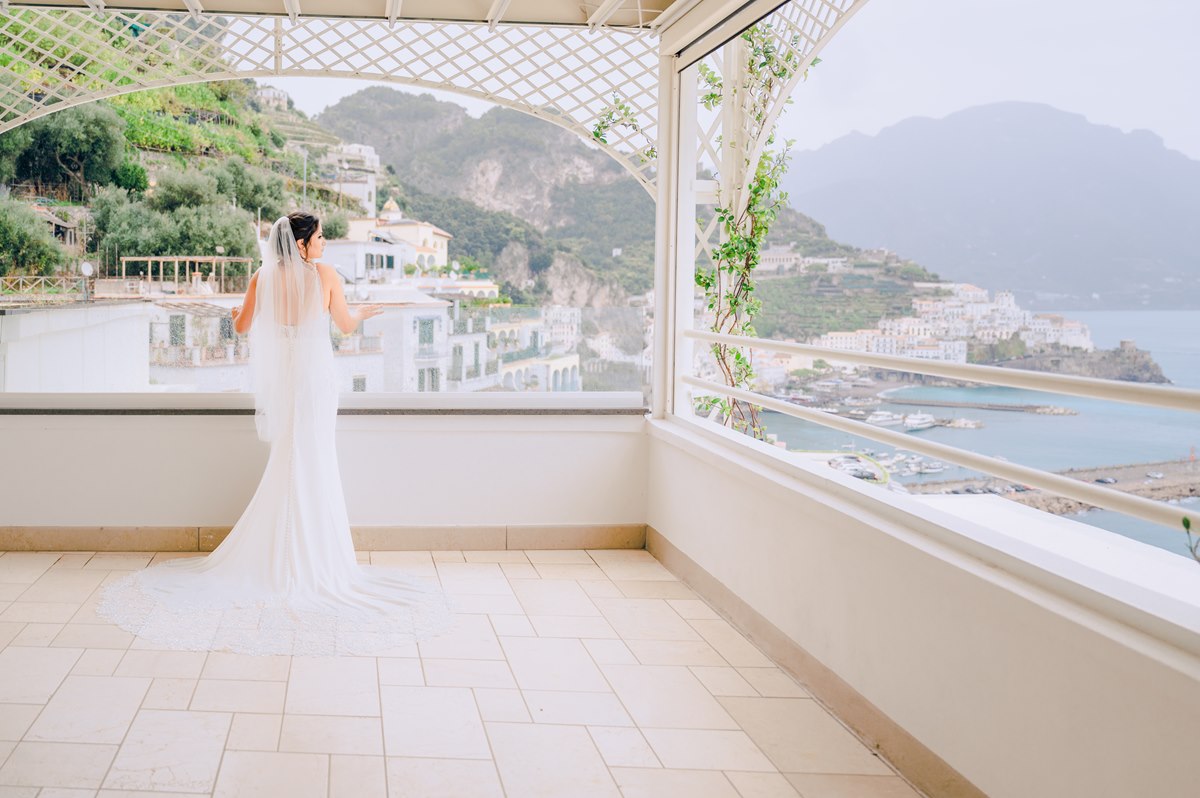
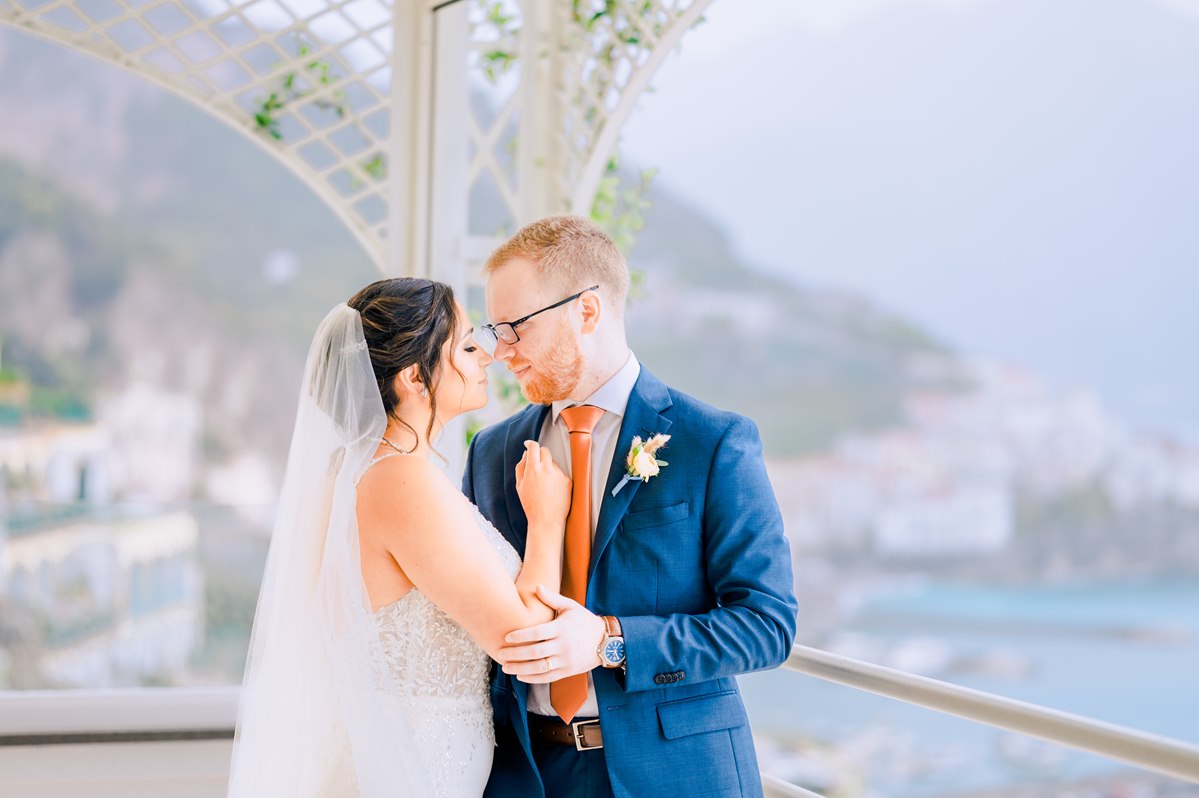
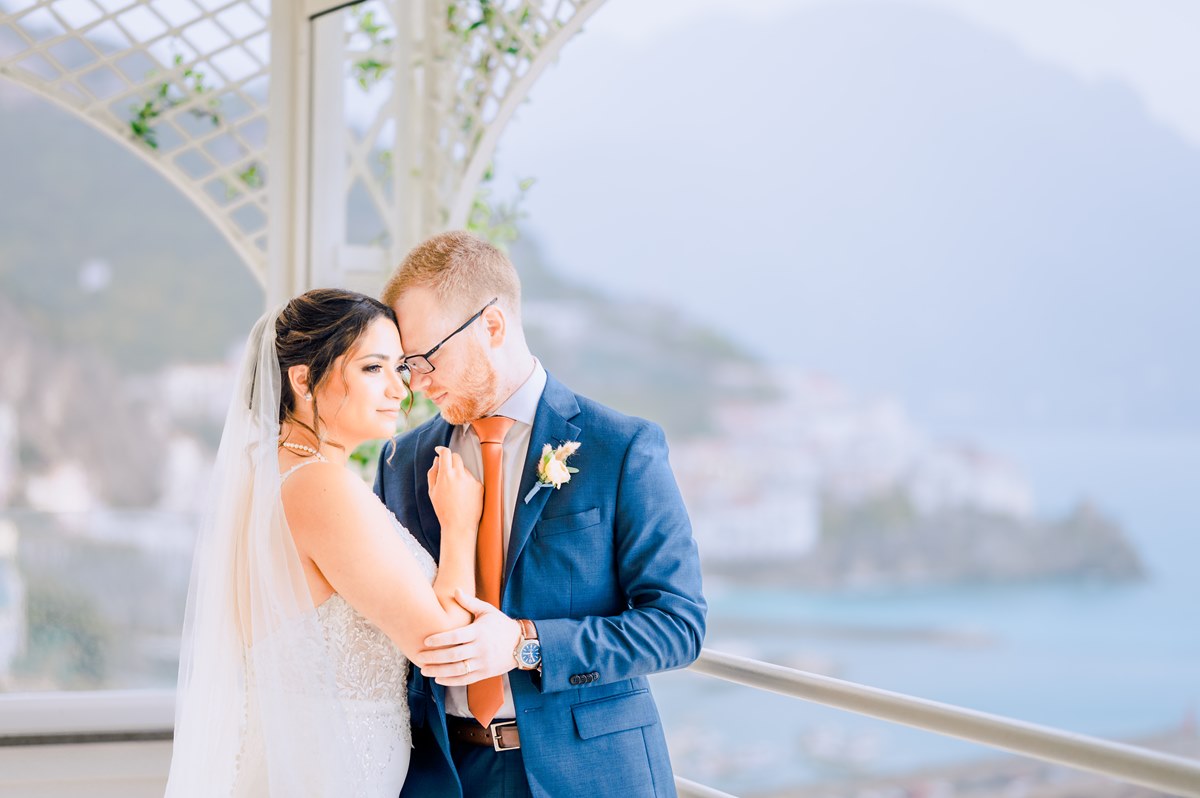
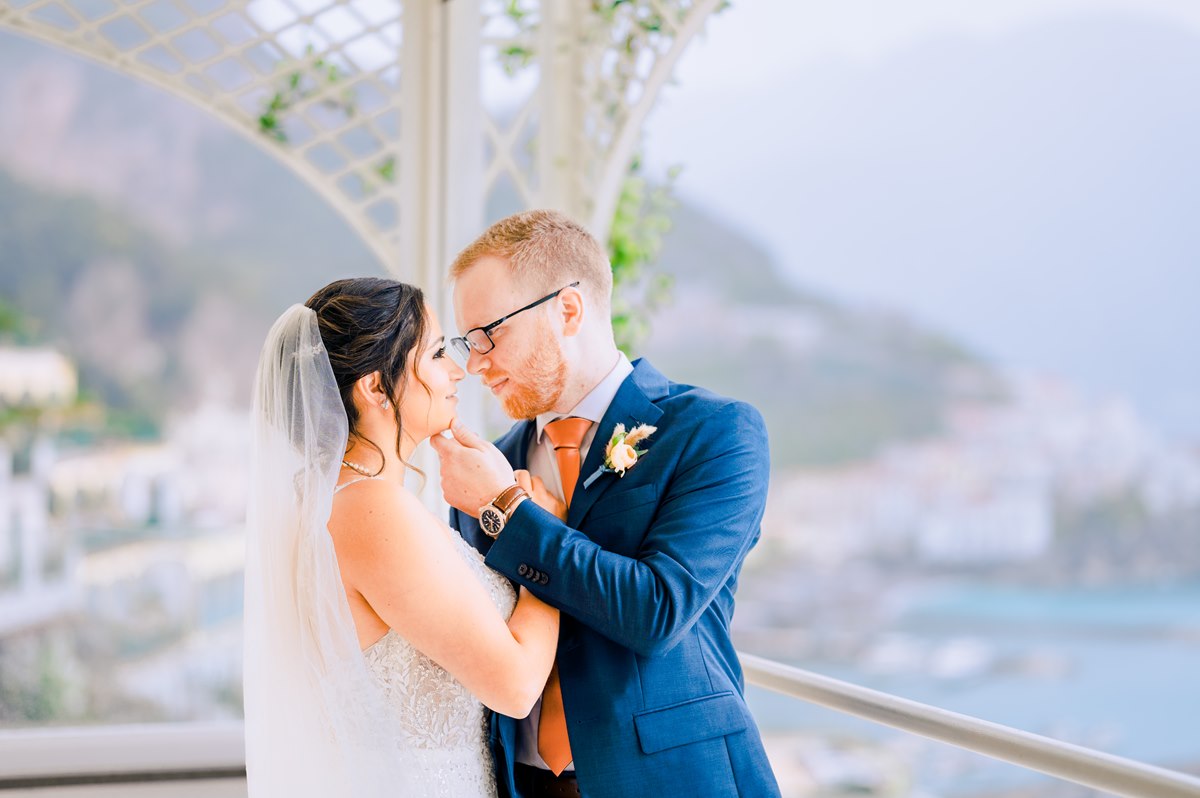
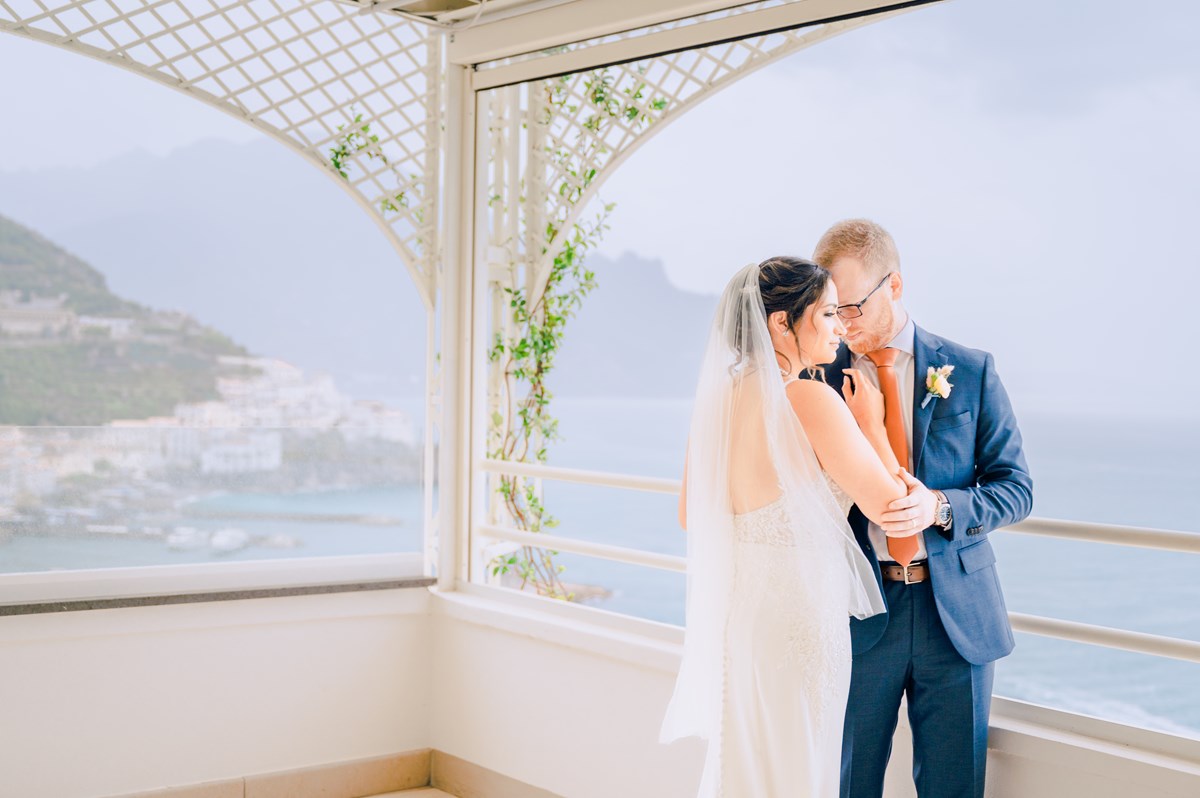
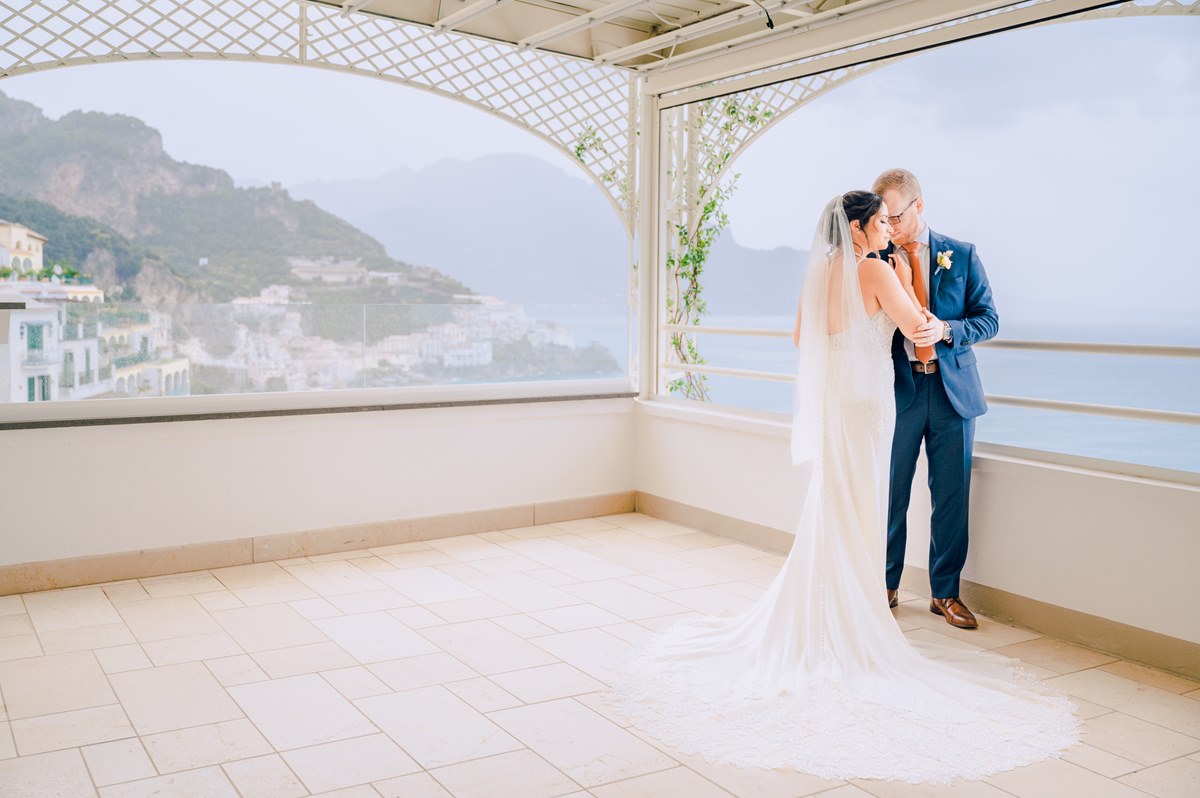
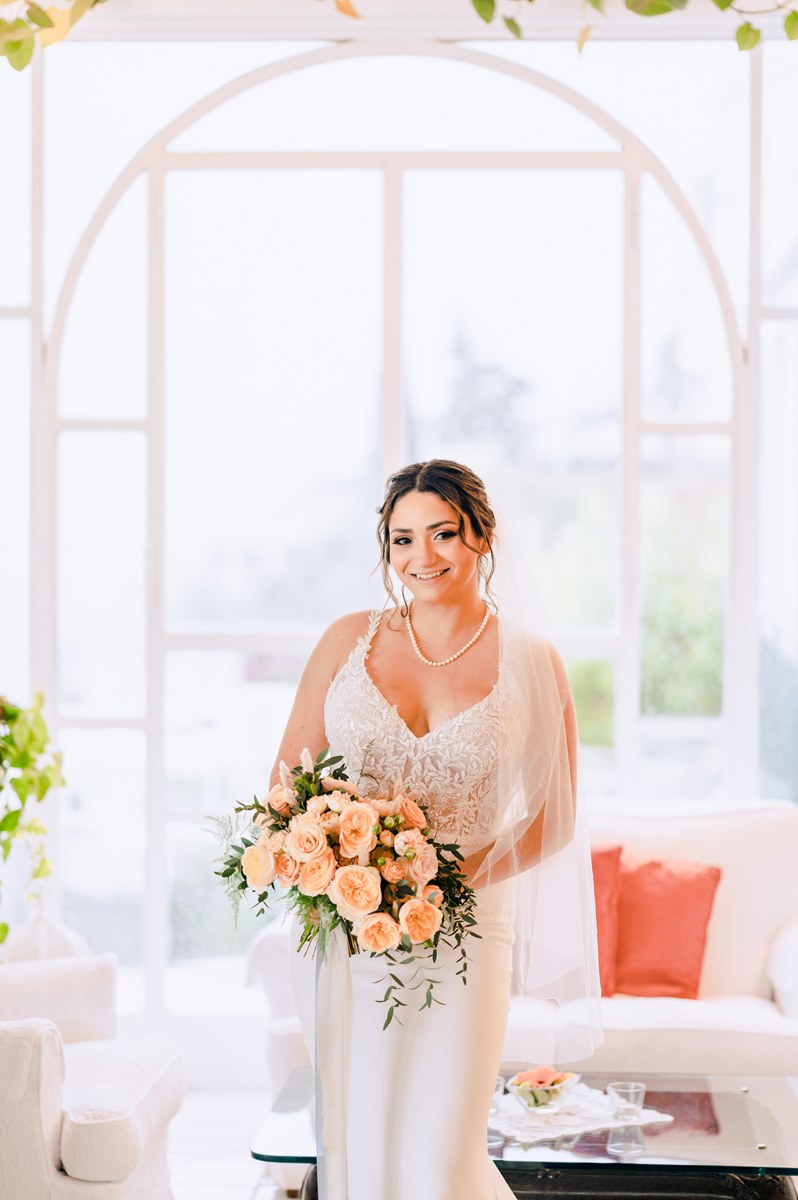
The ceremony happened in the hotel’s covered pavilion, a big white structure of lattice arches with a glazed roof and a cream stone floor, open along the sides to the sea and the mountain. It is a real room and a real view at the same time. The furniture consisted of one small round table under a white cloth, holding peach garden roses, white hydrangea, a few stems of eucalyptus, a hurricane candle and two tapers.
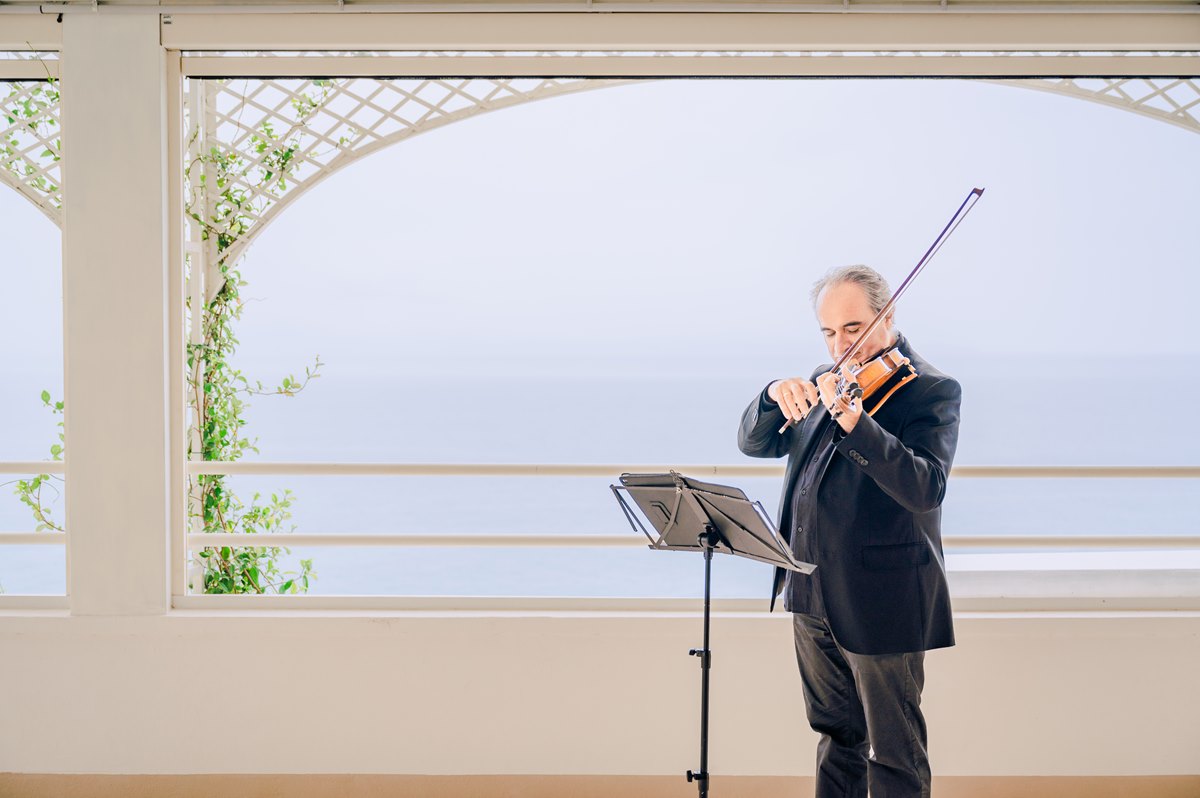
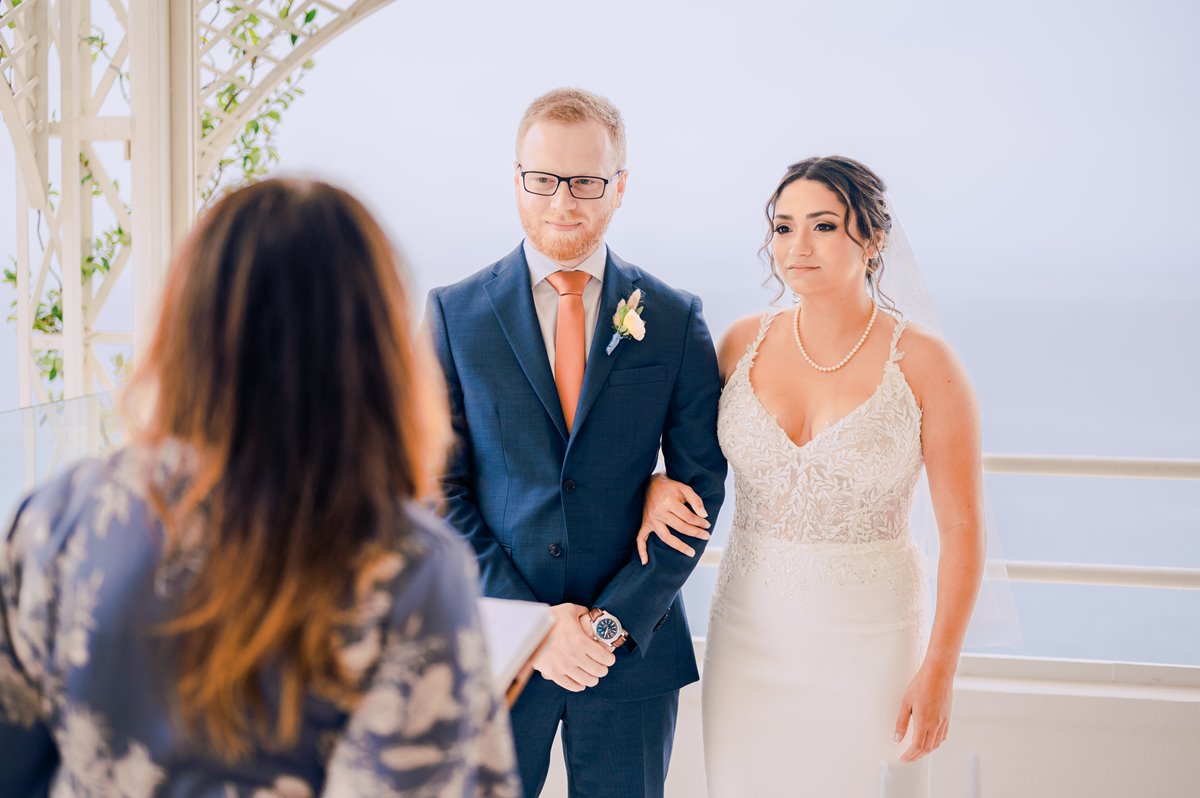
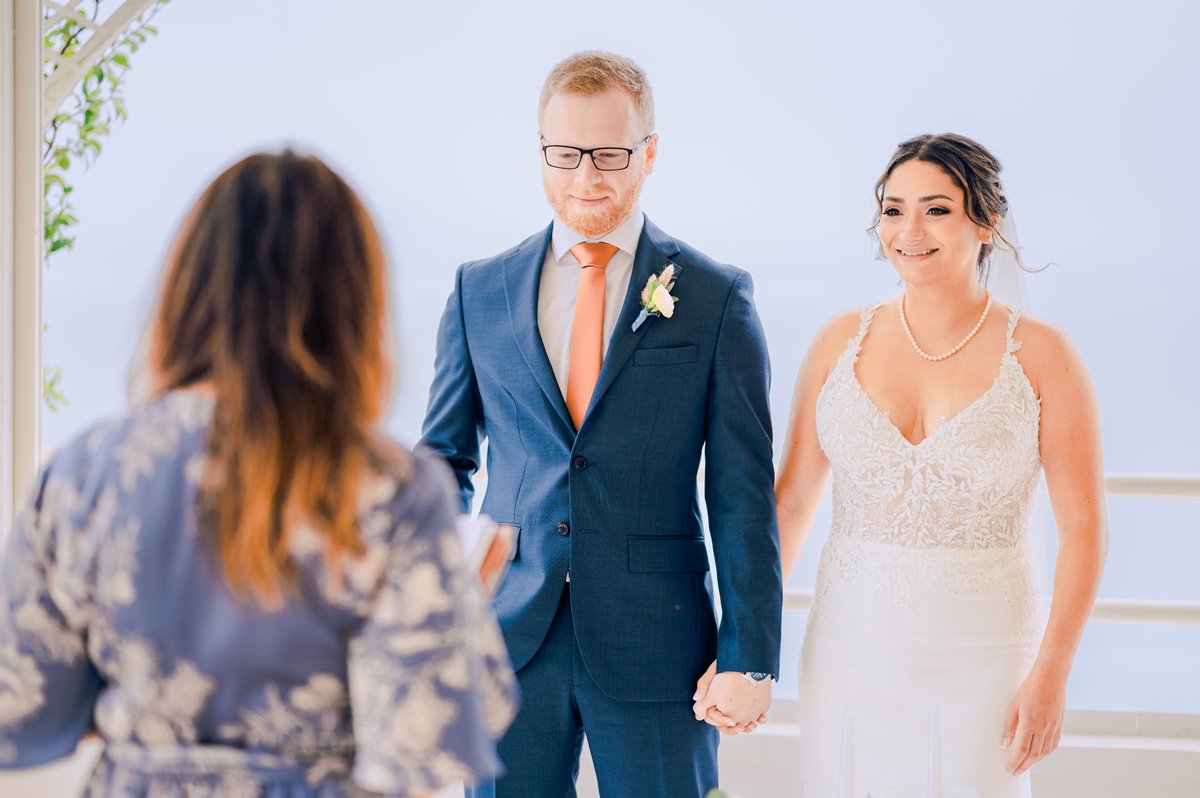
The celebrant took the ceremony, in a long blue dress printed with cream flowers, reading from a stiff folder. A violinist sat off to one side. With me, that made five people in a room that could have held a full wedding with space left over, and the acoustics were doing something I did not expect: the rain on the glass roof was loud enough that everyone had to speak up slightly, in a room where nobody was more than two meters from anybody else.
Two Vow Books, Read One at a Time
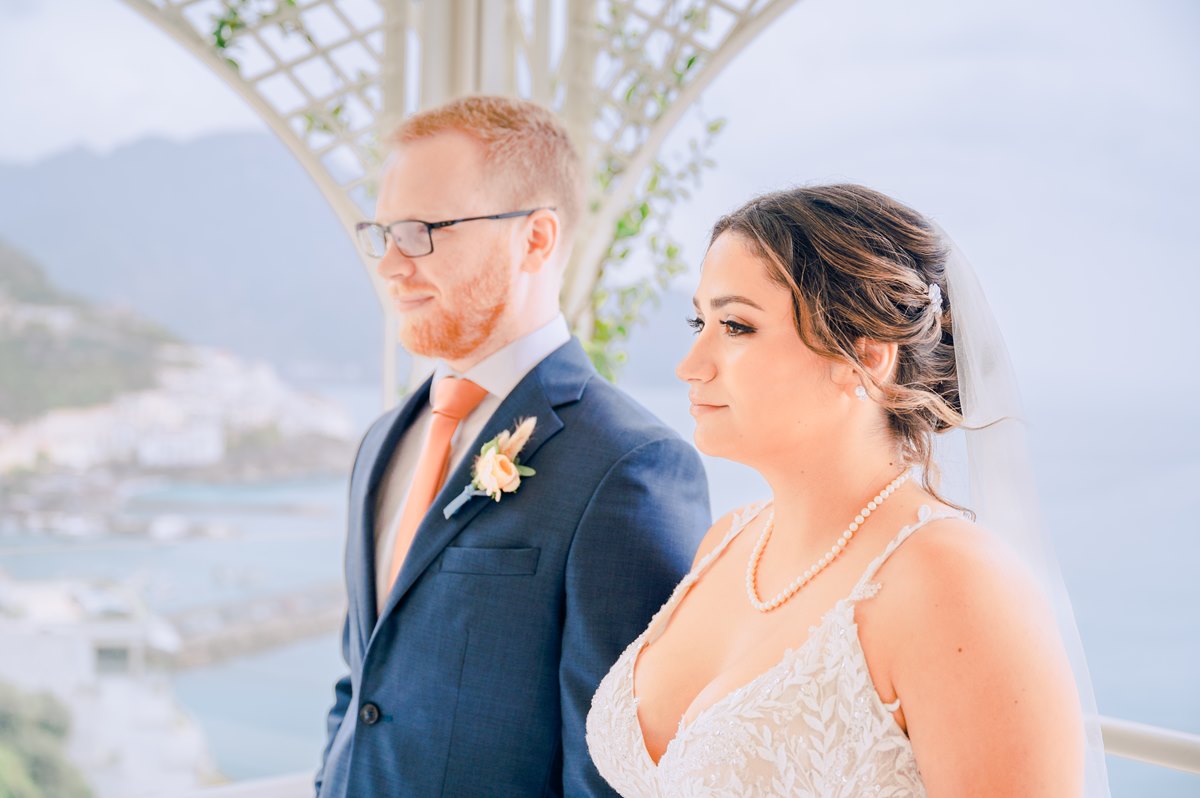
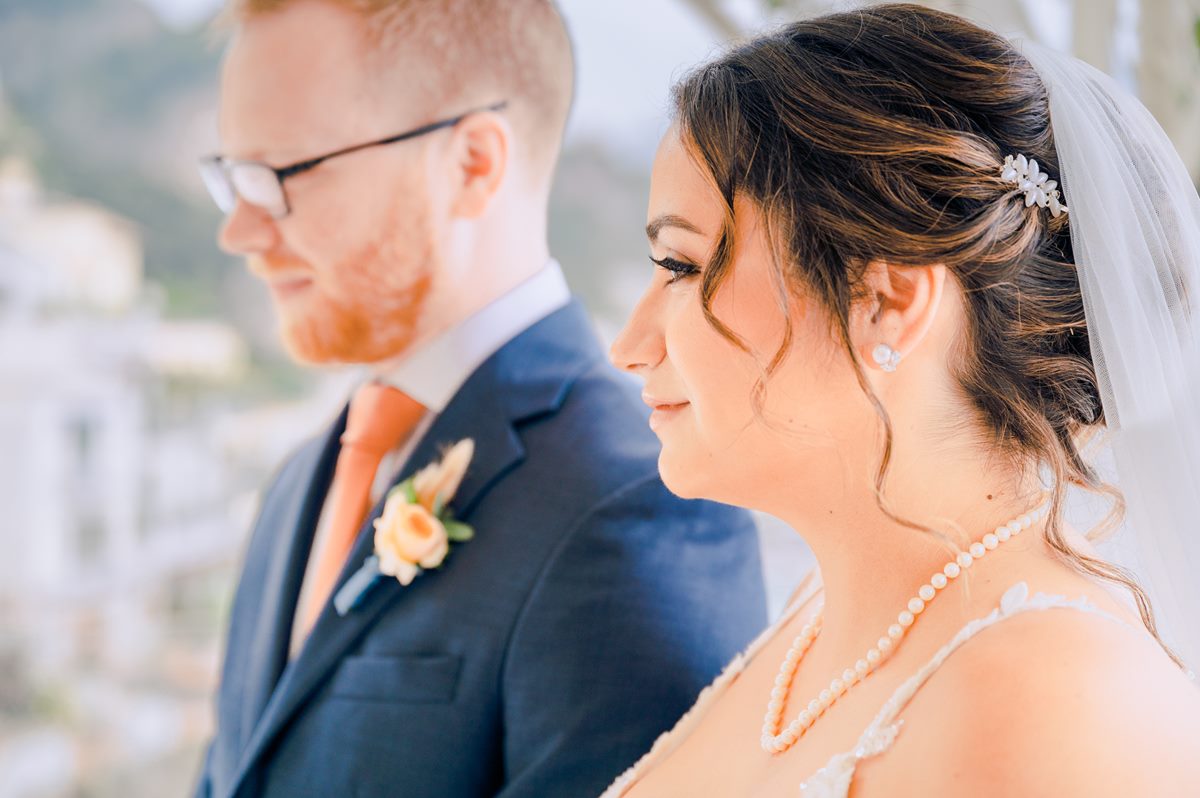
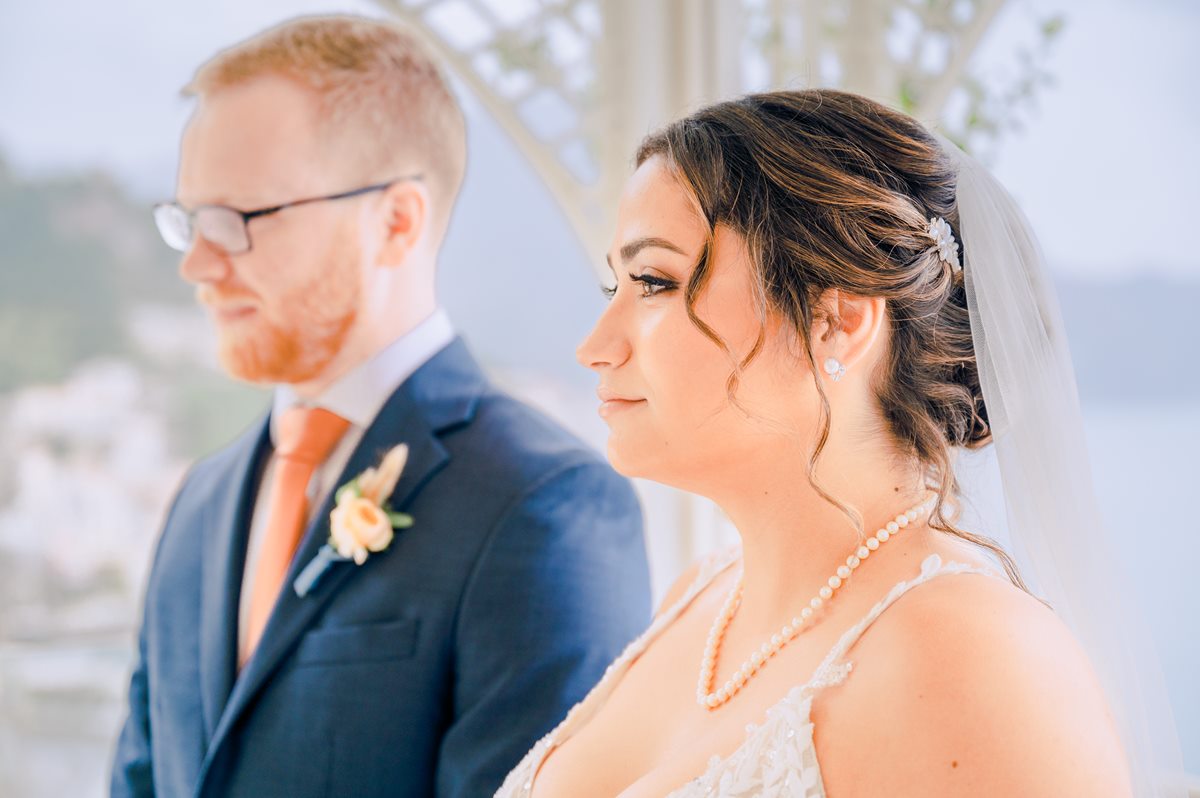
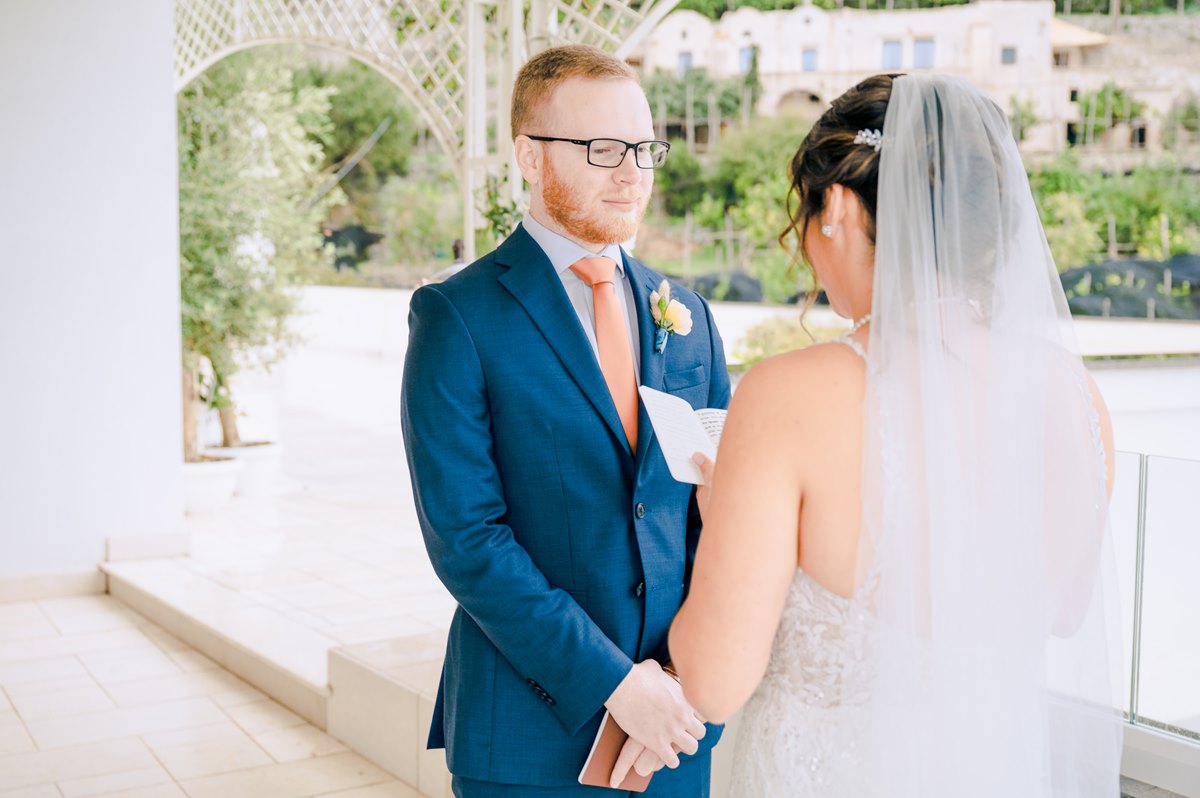
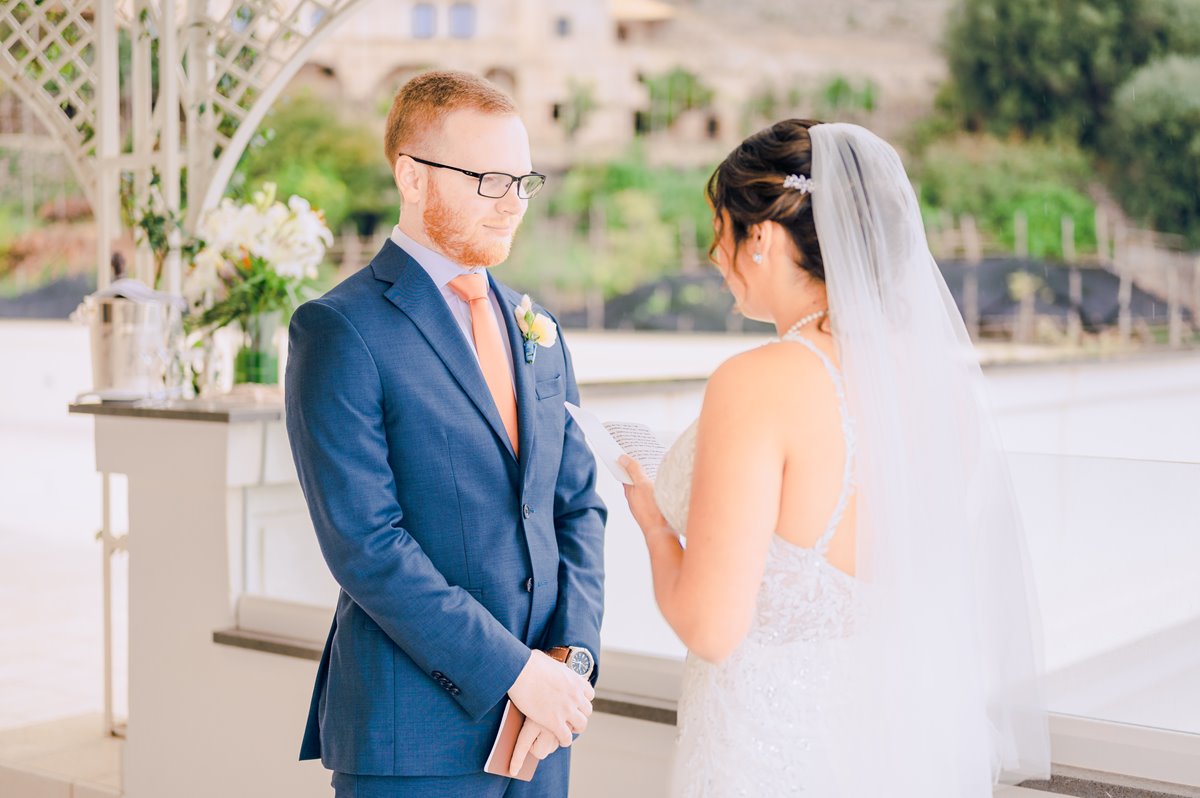
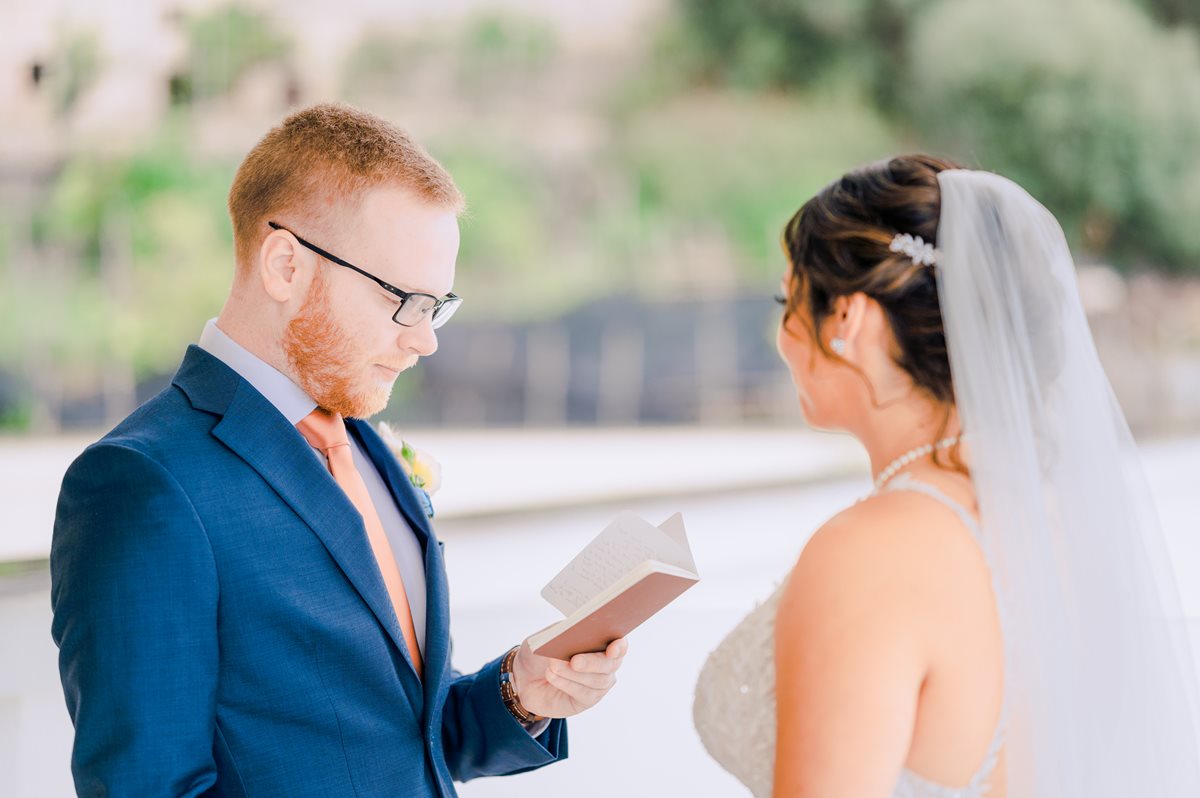
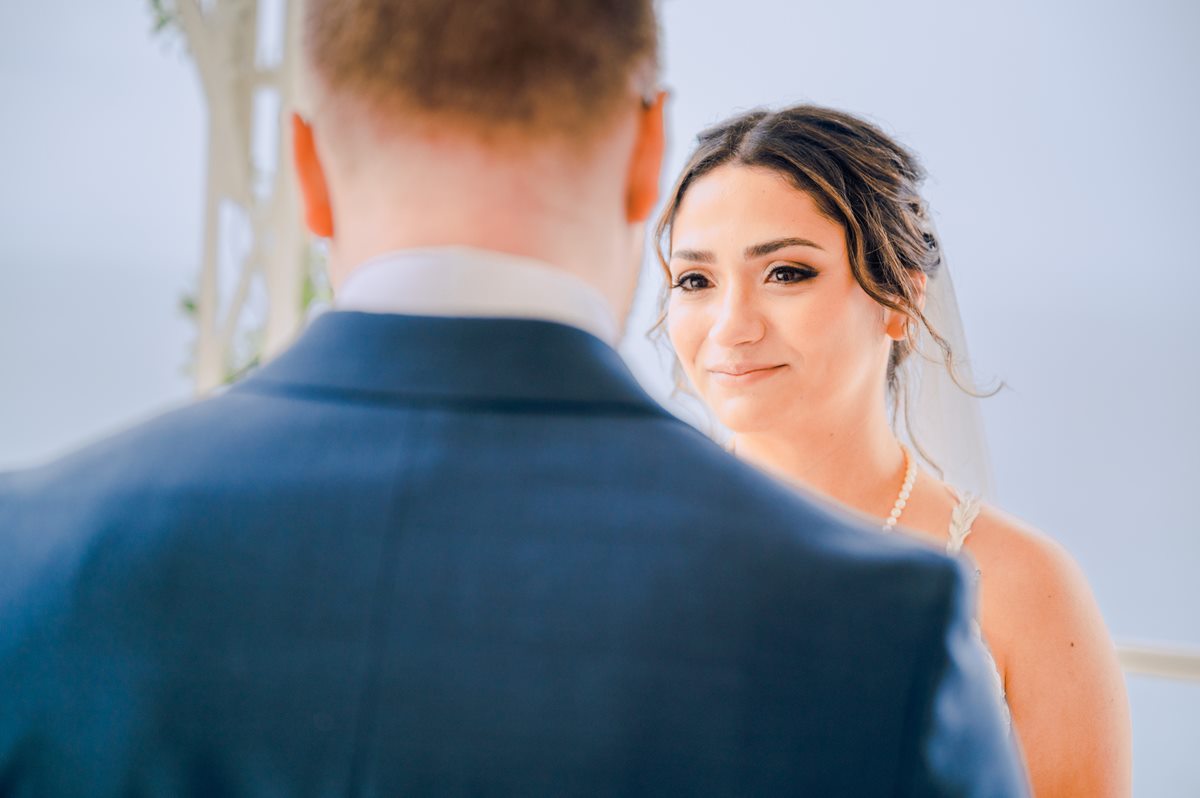
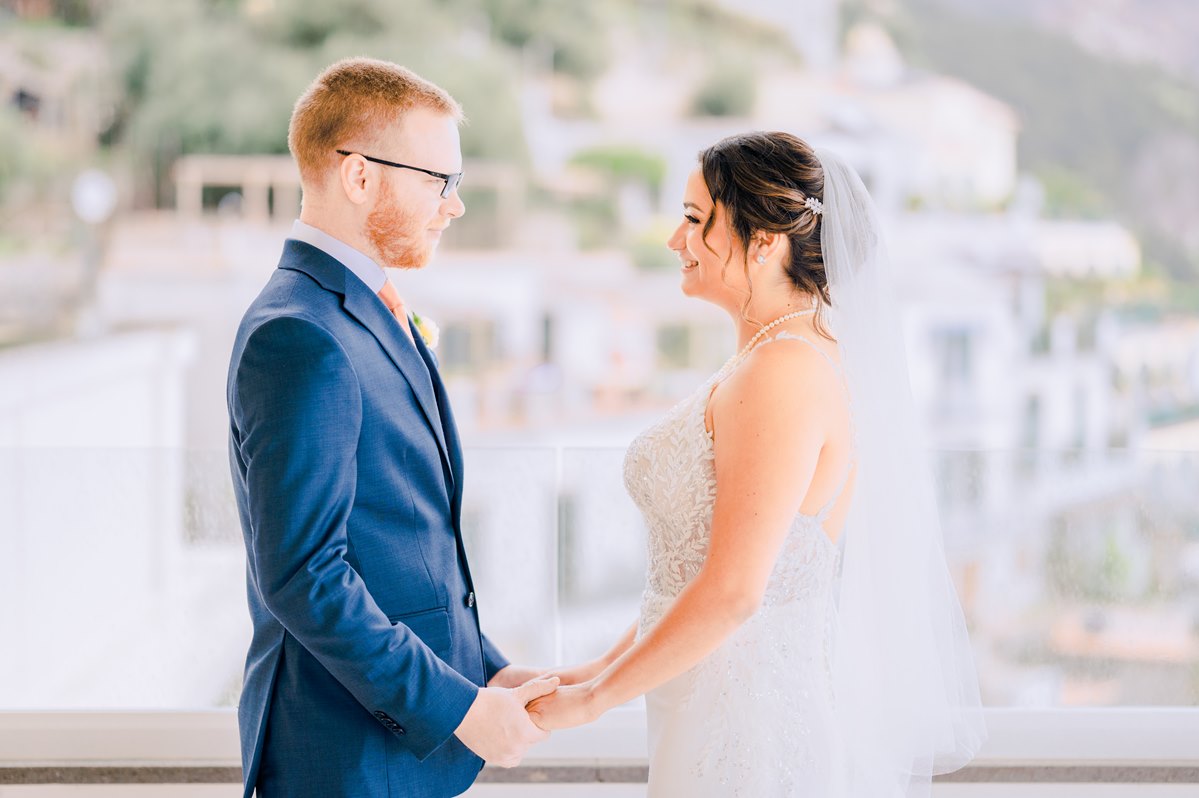
Nicole read first, from the blush book, holding it at chest height with both hands. Michael stood with his own rust-colored book down at his side, waiting, and the photograph of him listening is better than any photograph of him reading, because his face does something halfway through that he clearly had not planned. She laughed twice while she was reading. Then they swapped, and he read from his, and she went completely still.
Neither of them cried, which I mention because a lot of elopement writing implies that they will and that it is a failure if they do not. They laughed, they gripped each other’s hands too hard, and at one point he lost his place on the page.




A Rainy Day Elopement in Amalfi, Shot With No Background
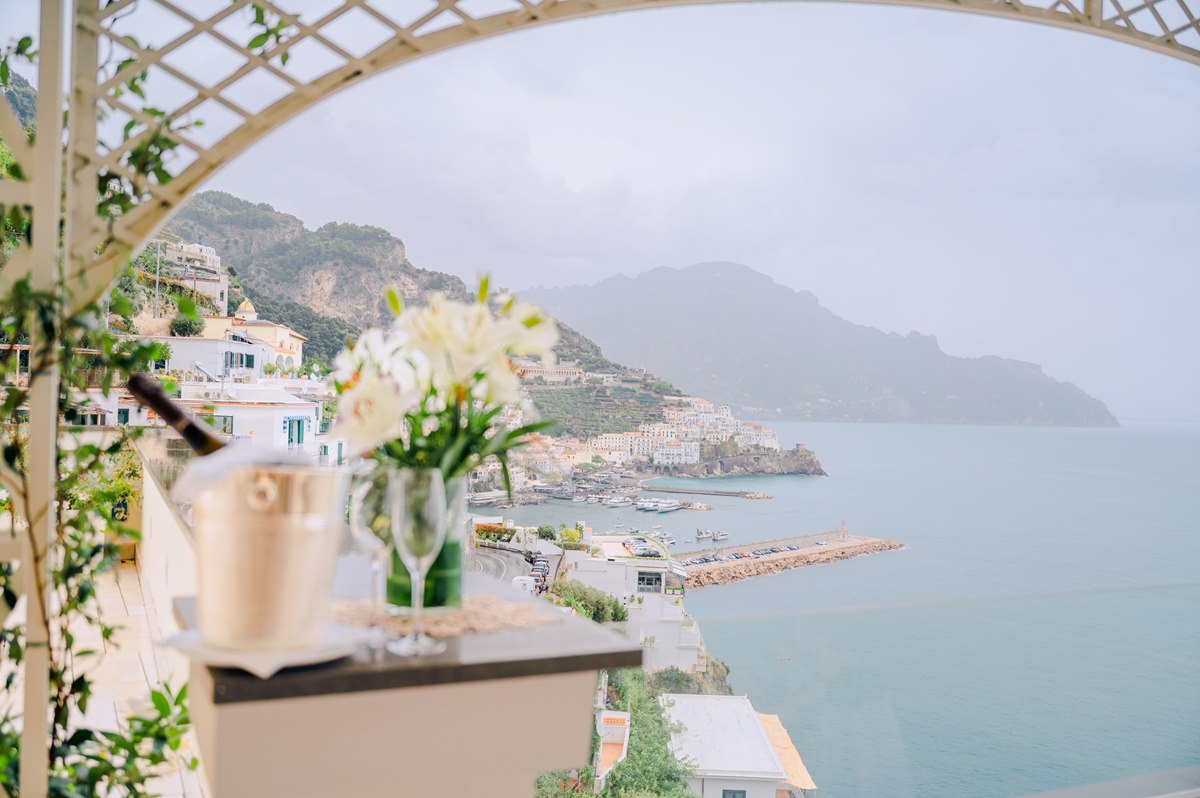
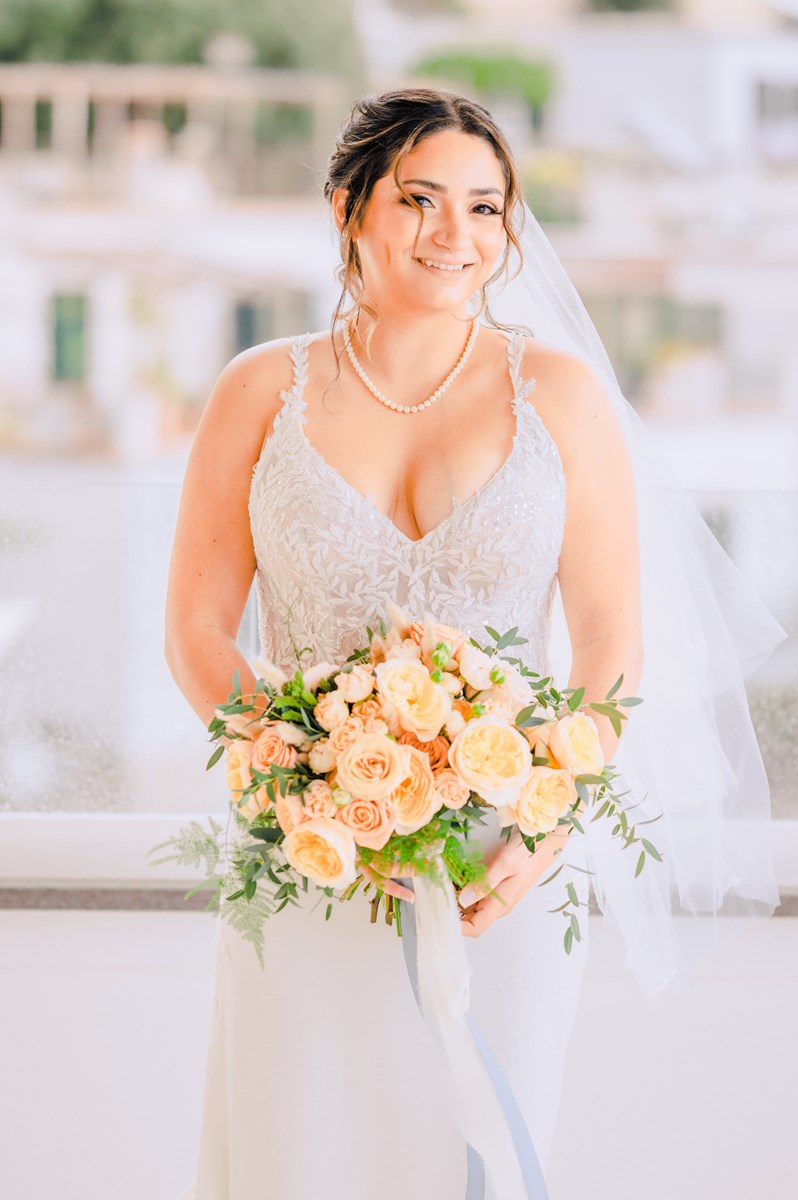
Here is the technical part, since the ceremony was shot against a wall of white. On the seaward side of that pavilion there was no tone at all to expose for, so any picture that used the open side as a backdrop was going to be a couple of silhouettes floating on paper. I made a few like that deliberately, very high key, letting the sea burn out completely and building the image entirely out of the shapes of their hands.
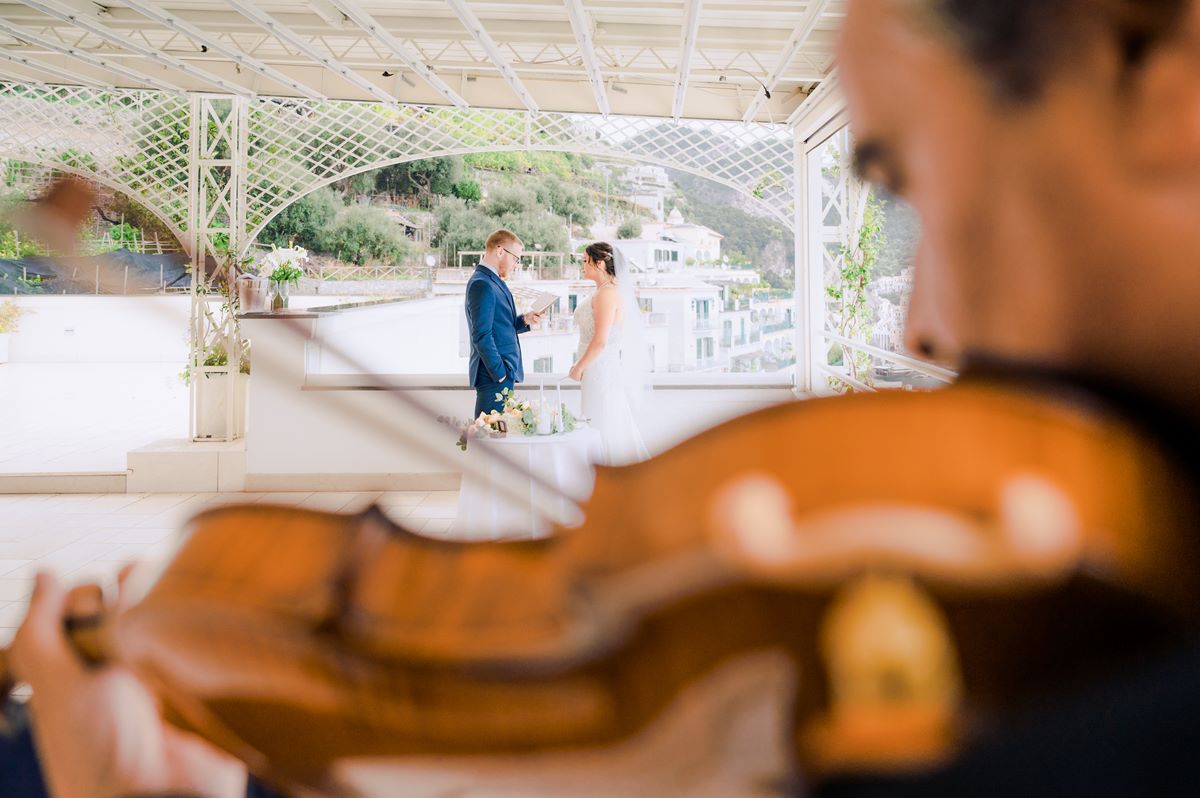
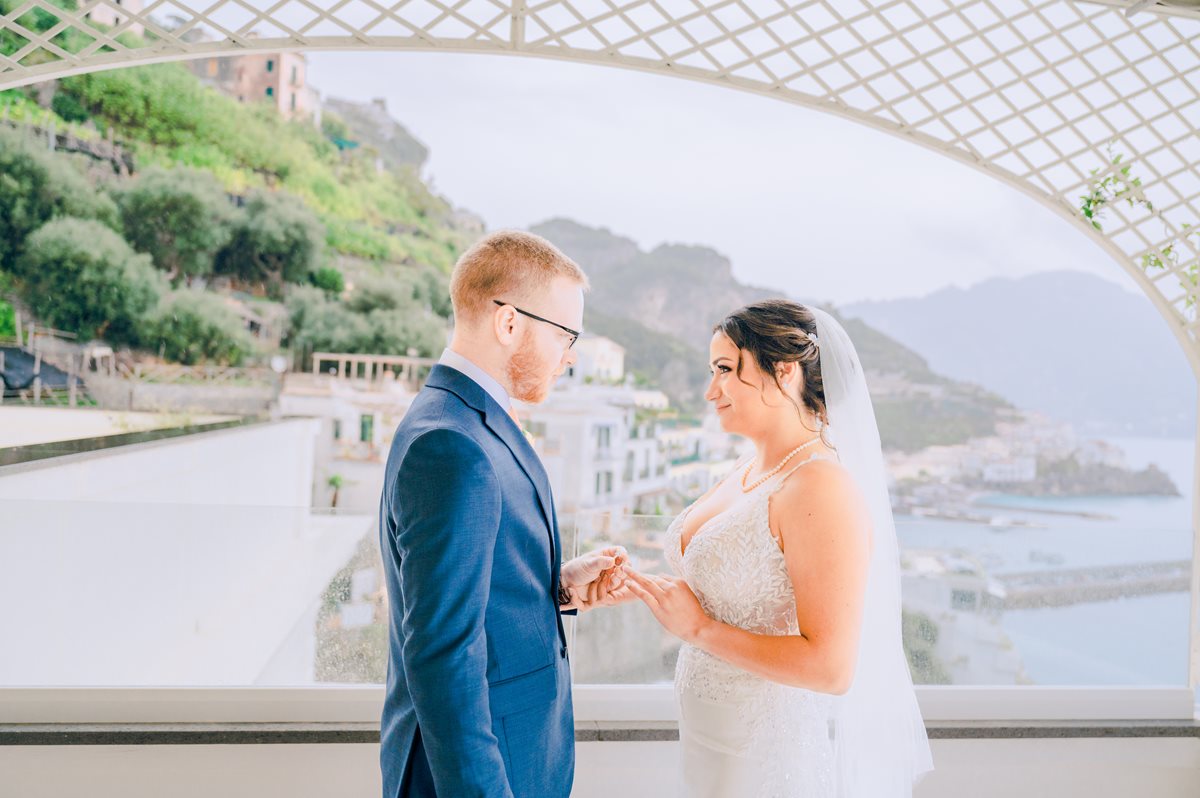
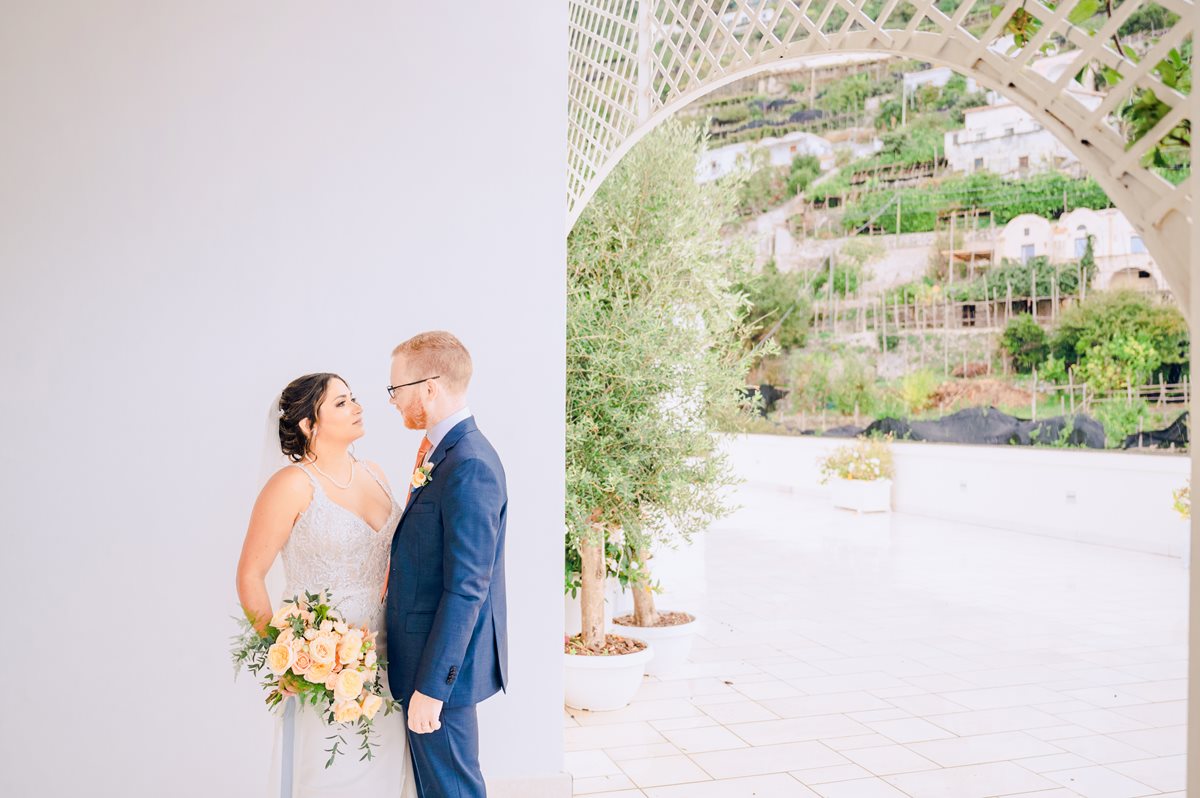
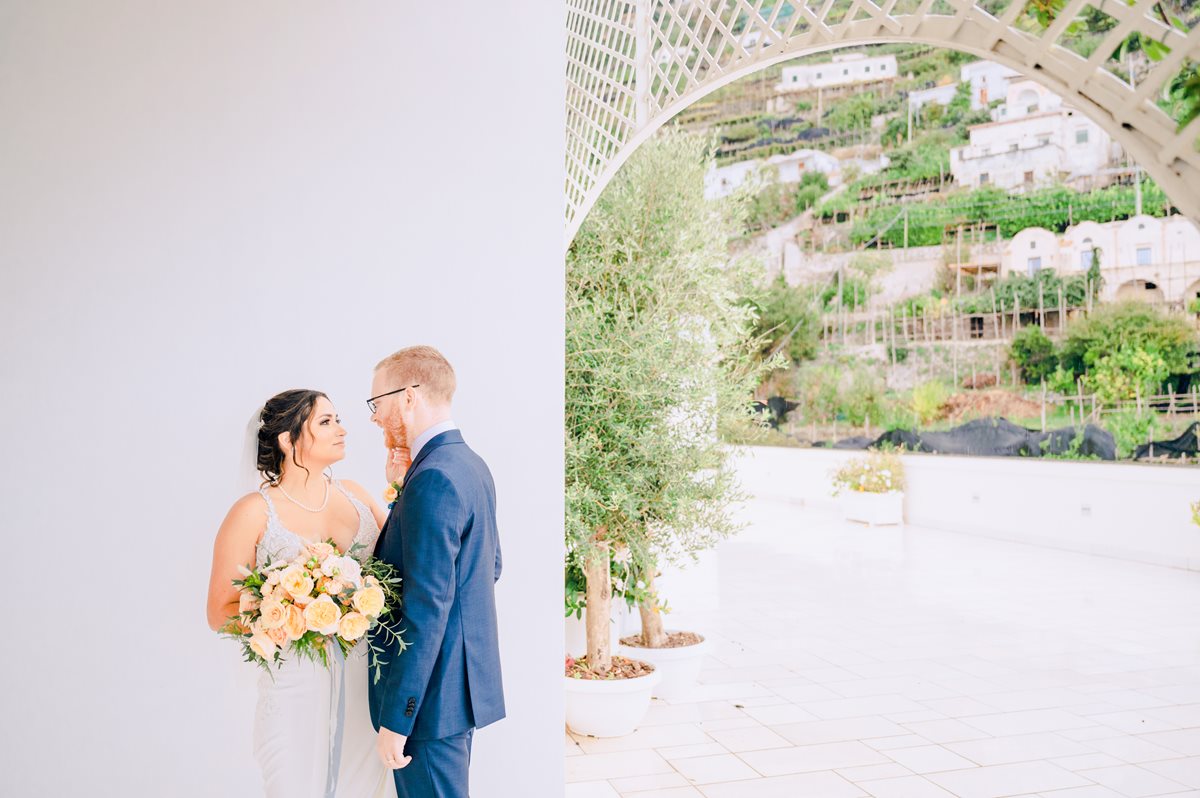
For everything else I turned ninety degrees. To the north the hillside above the hotel gives you terraced lemon groves under black shade netting, a stone building with a run of arches on the far slope, olive trees and a small yellow-tiled cupola, all of it holding tone even in rain. That side became my main axis for the ceremony, and it is why the pictures do not look like they were made in a fog bank. The violin frame, shot over the musician’s shoulder with the scroll and the bow filling the bottom of the image and the couple small and sharp beyond it, only works because that hillside was there to hold them up.

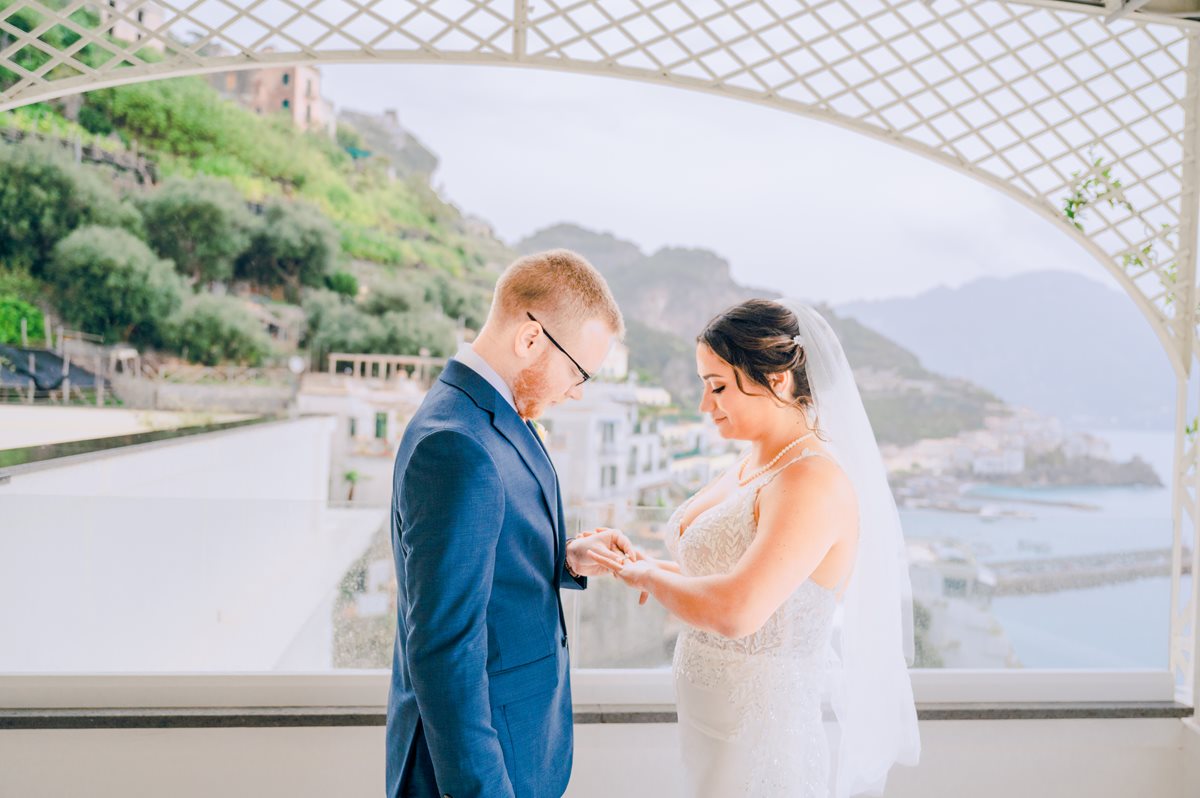
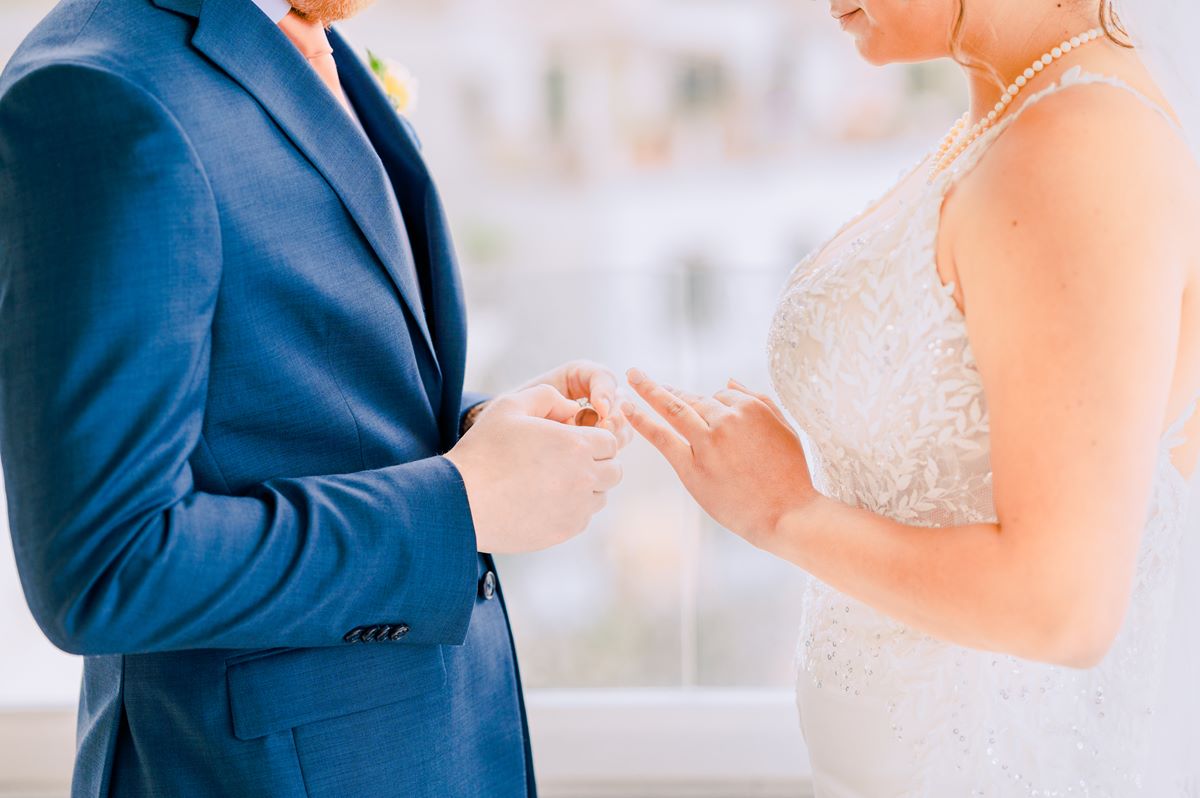
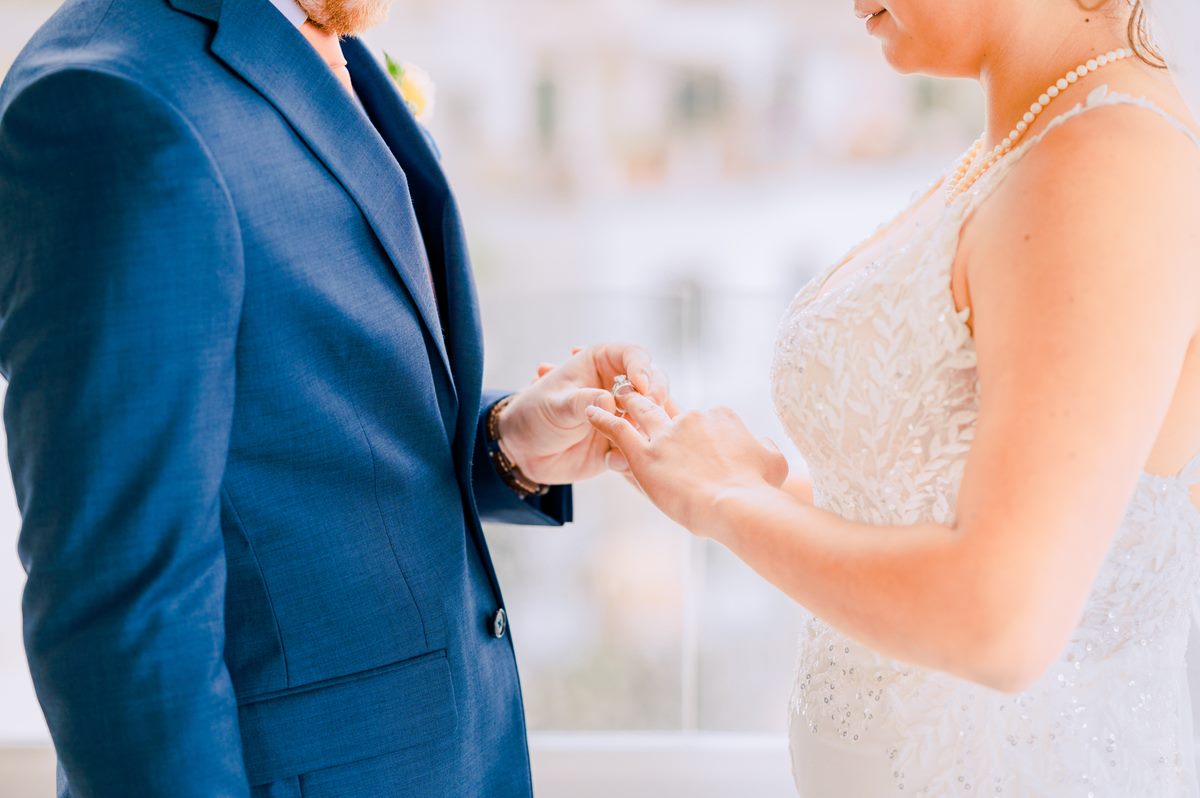
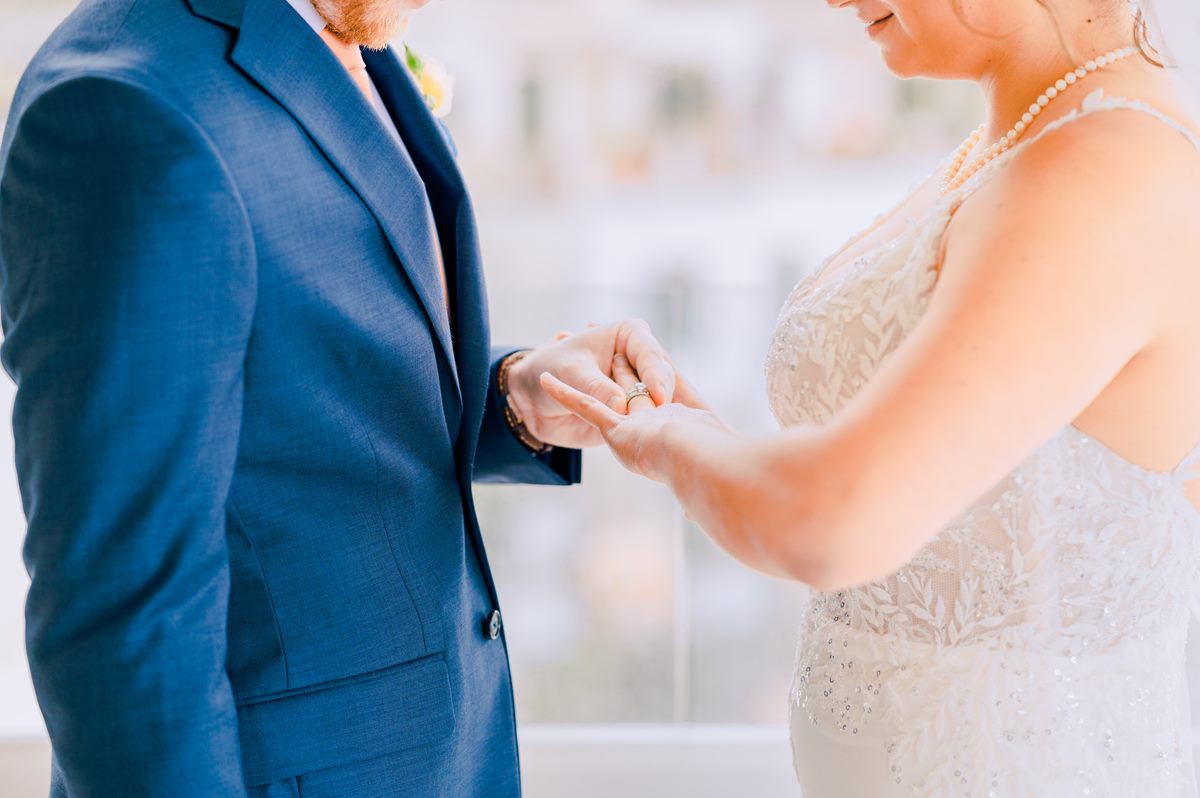
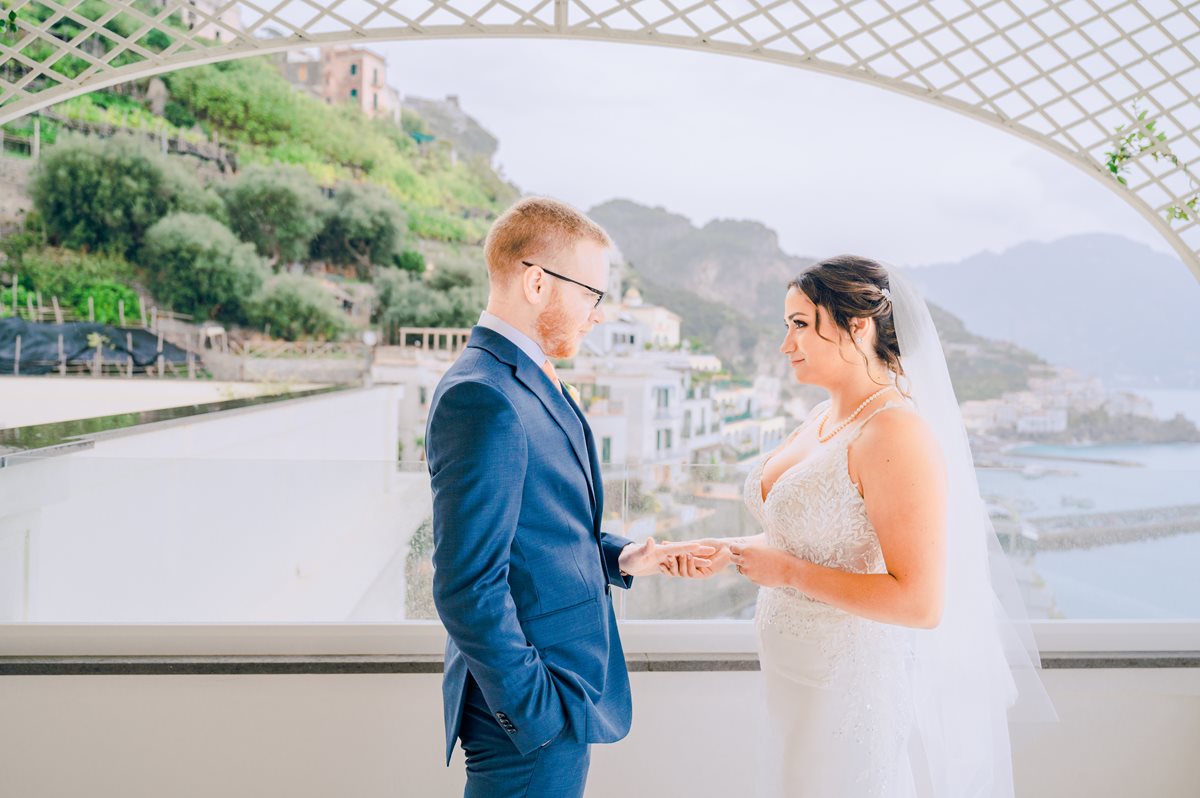
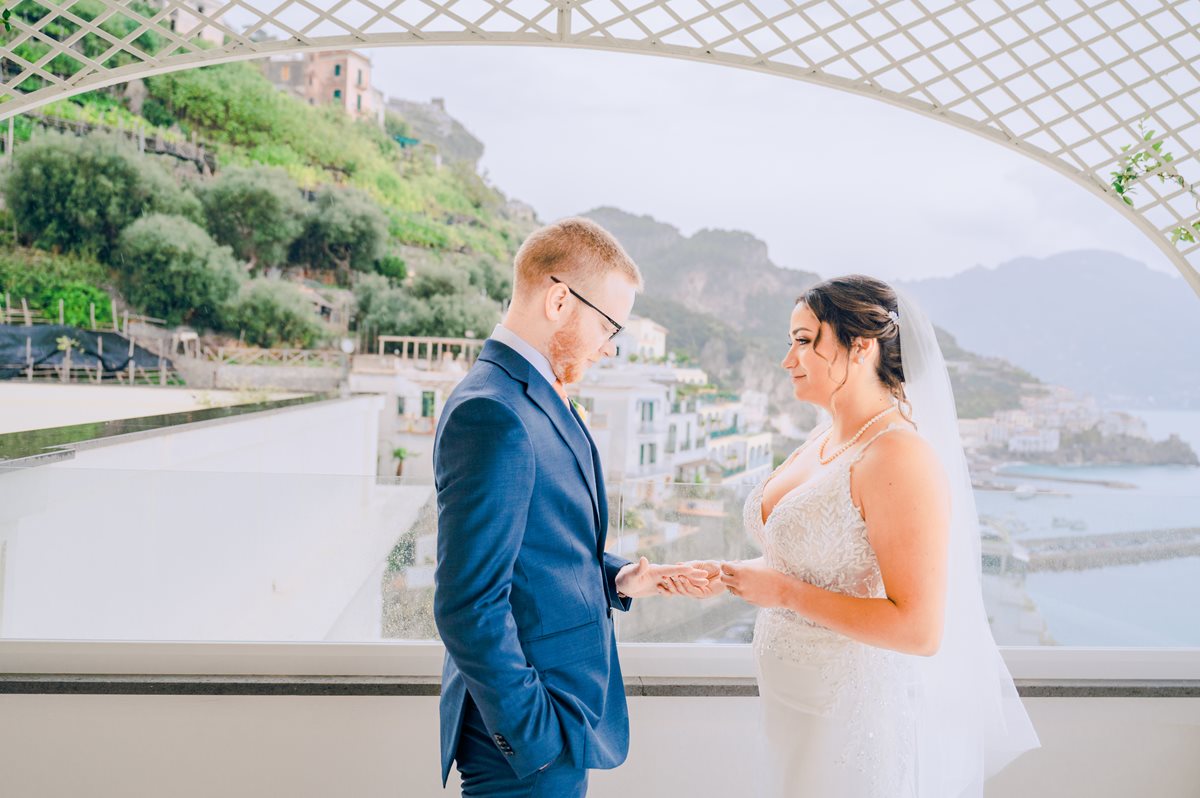
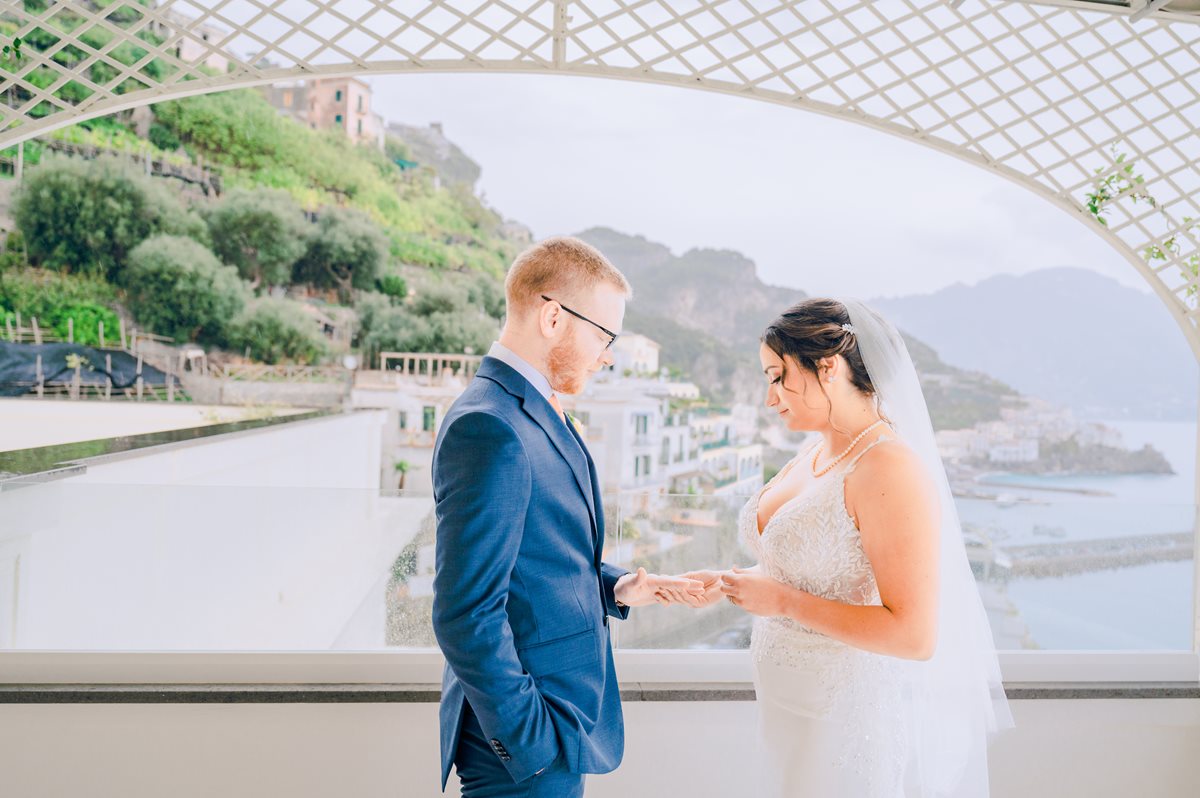
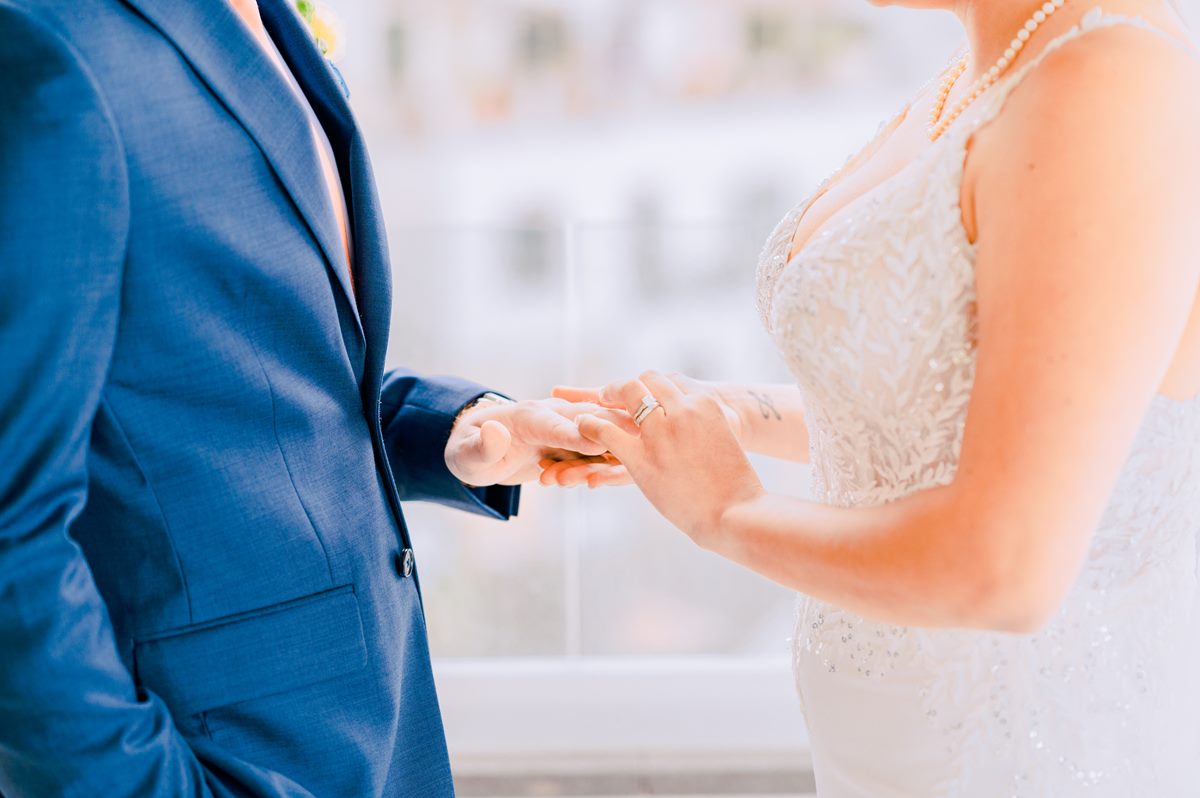
The celebrant held the two rings out on a flat palm and let them take one each, and they went on with the sea doing nothing behind them: a gold band for her, a pale band for him. Below the parapet, the water was breaking white against the rock, the only place all day where the sea had any texture in it.
Five People in a Pavilion Meant for a Crowd
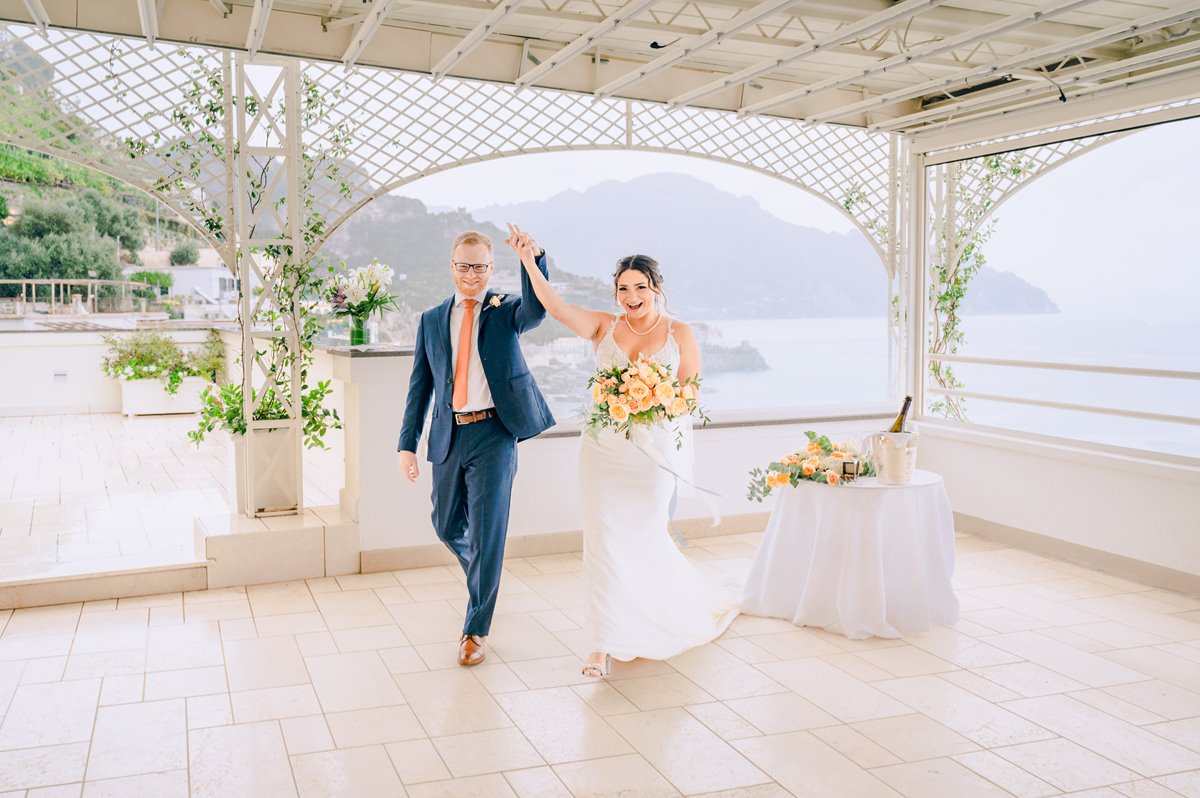
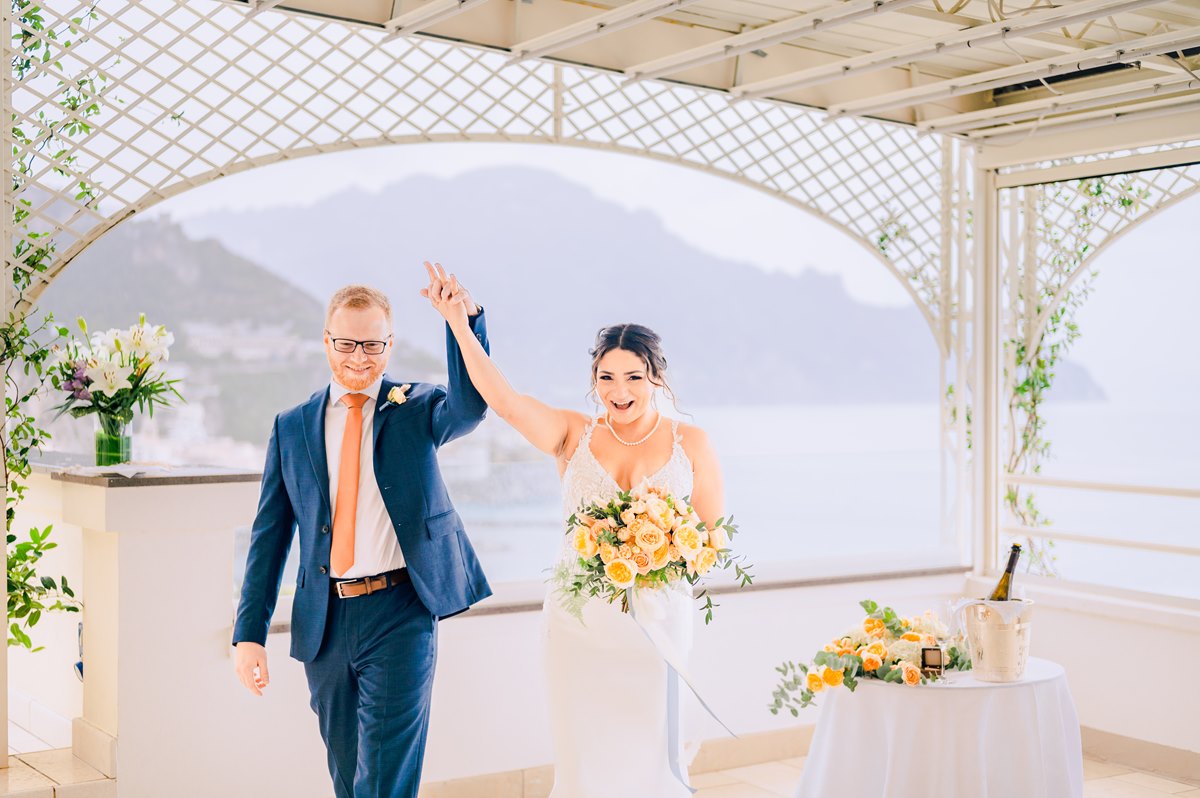
After the ring exchange, Nicole threw one arm straight up in the air and walked back down the length of that empty pavilion laughing, with Michael half a step behind her looking at his shoes. I shot it wide, deliberately, from far enough back that you can see how much unused floor there is around them. Two people, one champagne bucket on a small table, and what must have been eighty square meters of empty cream tile.

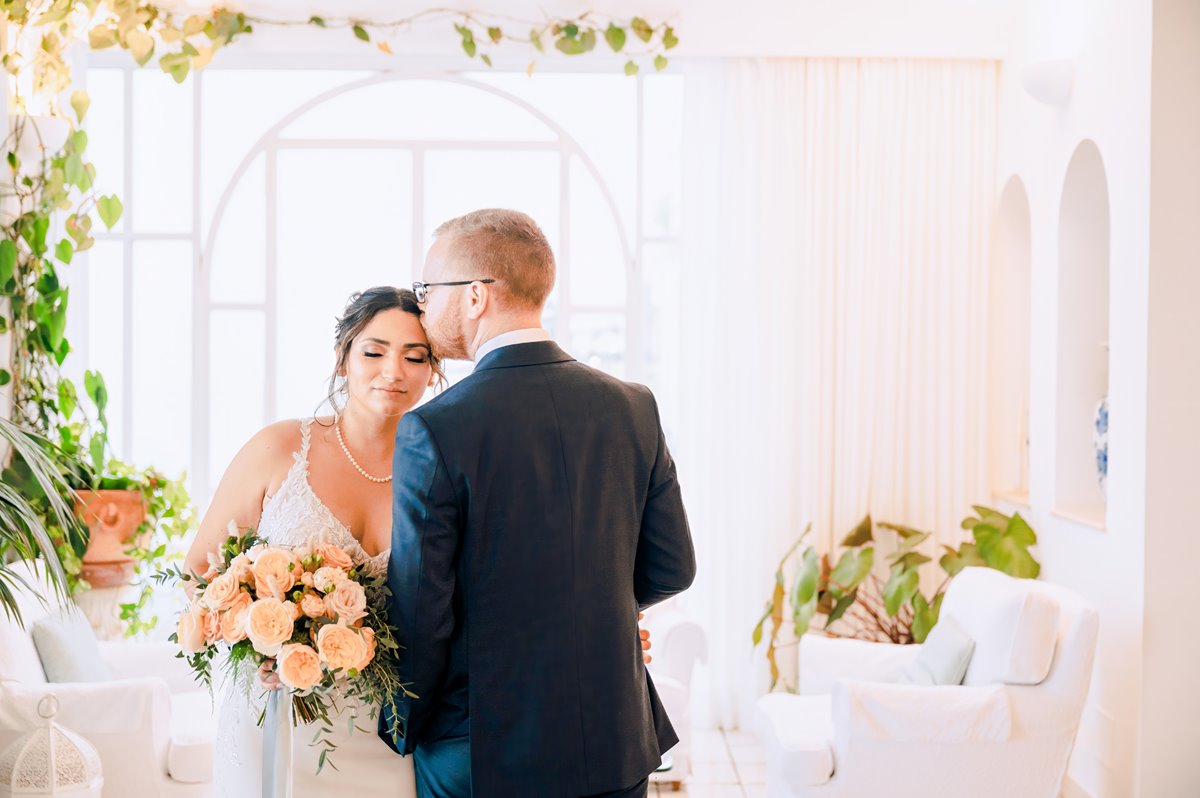
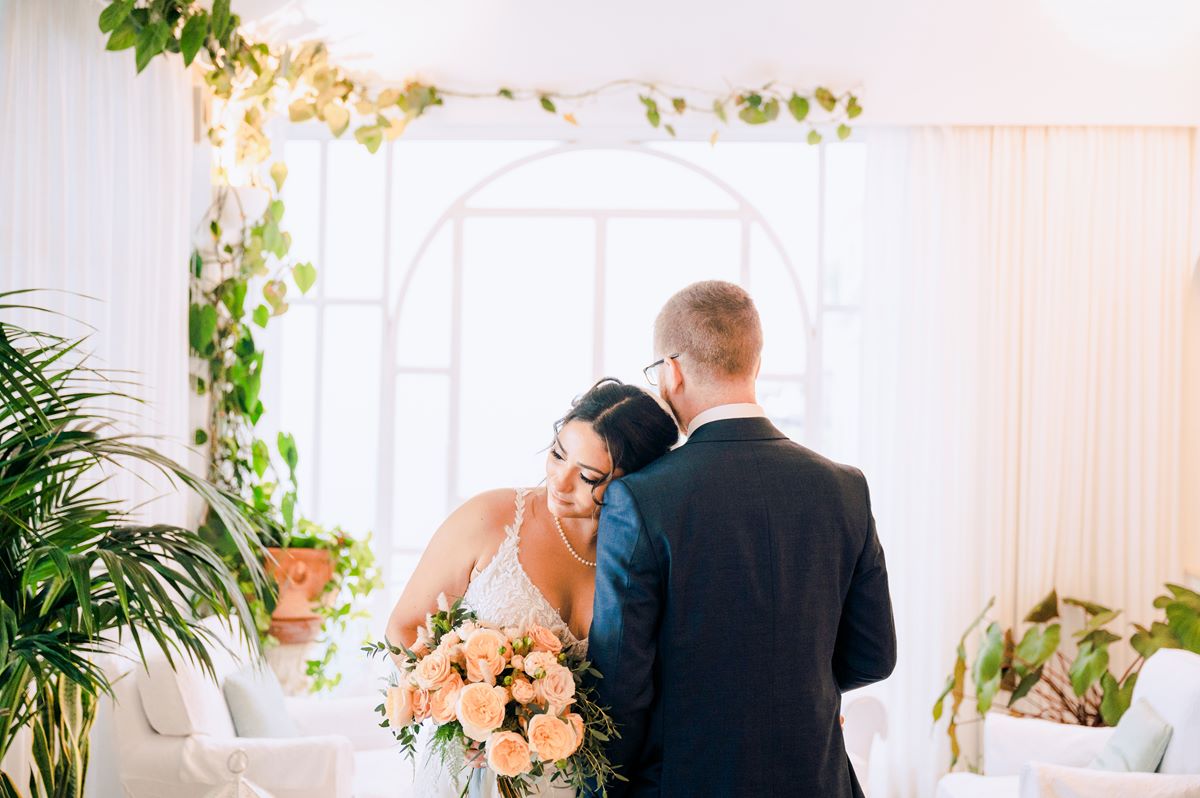
That picture says more about what an elopement is than any close-up of the two of them. A room built for a crowd goes quiet in a particular way when the crowd never comes, roomy in a way a full wedding day never gets to be, and nobody in those pictures looks lonely. If you are weighing an Amalfi Coast wedding against something smaller, that is the difference no brochure mentions.
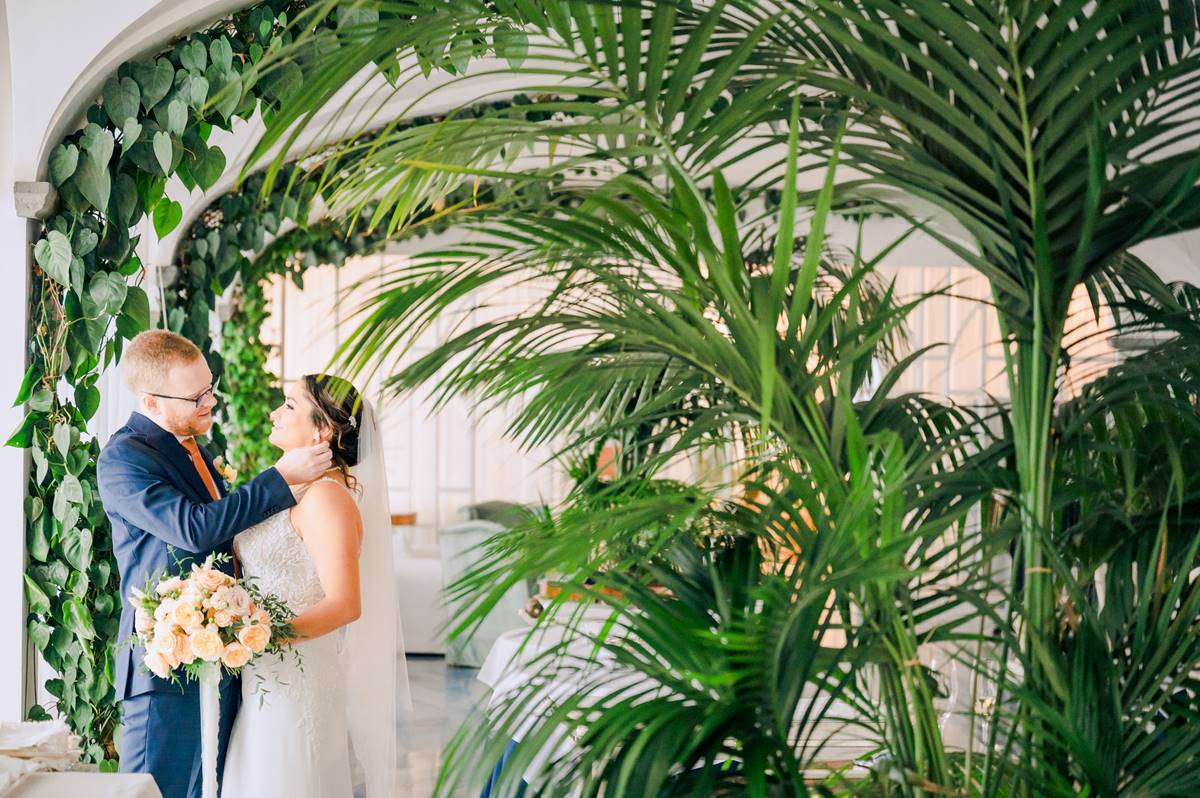
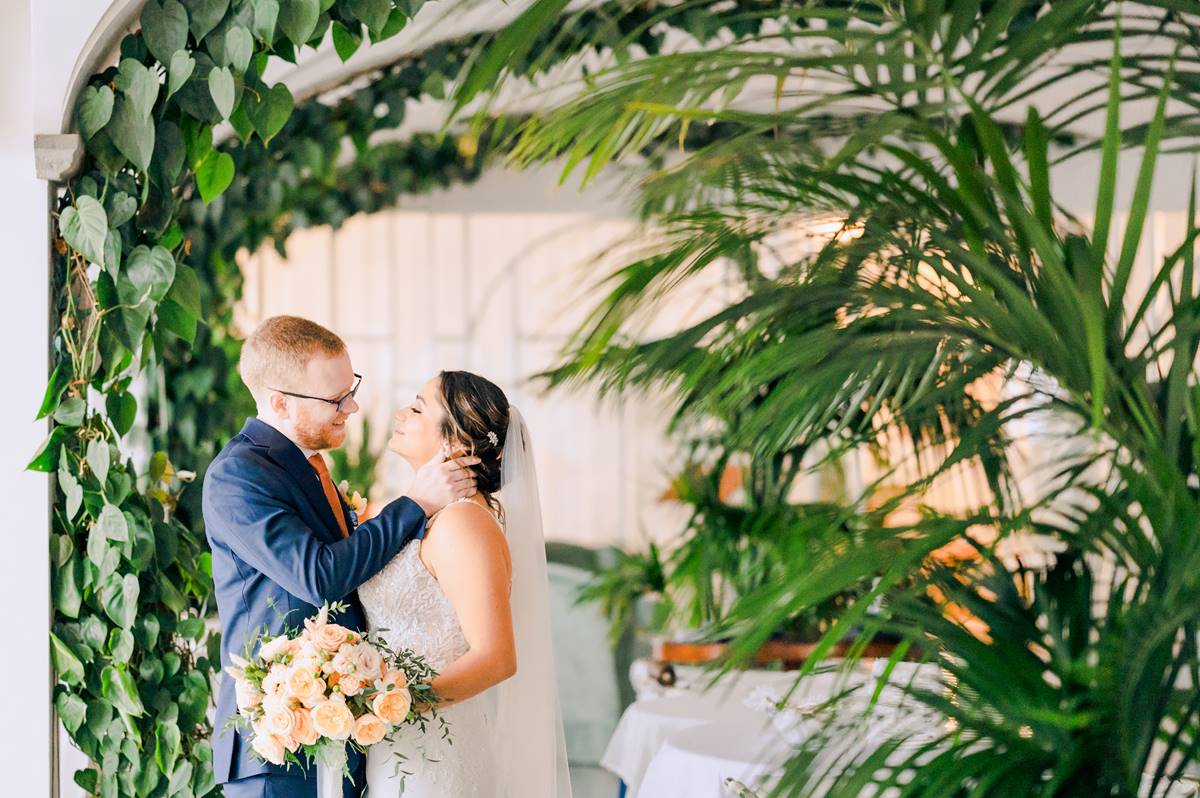
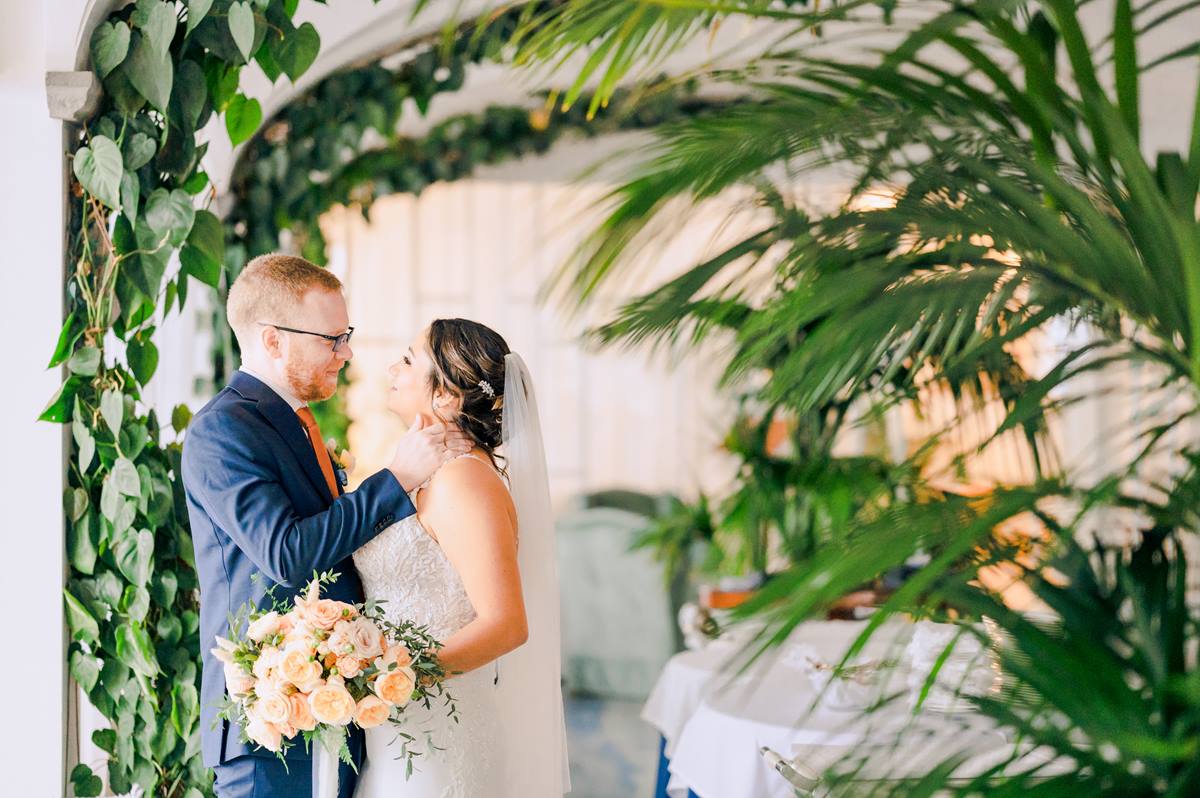
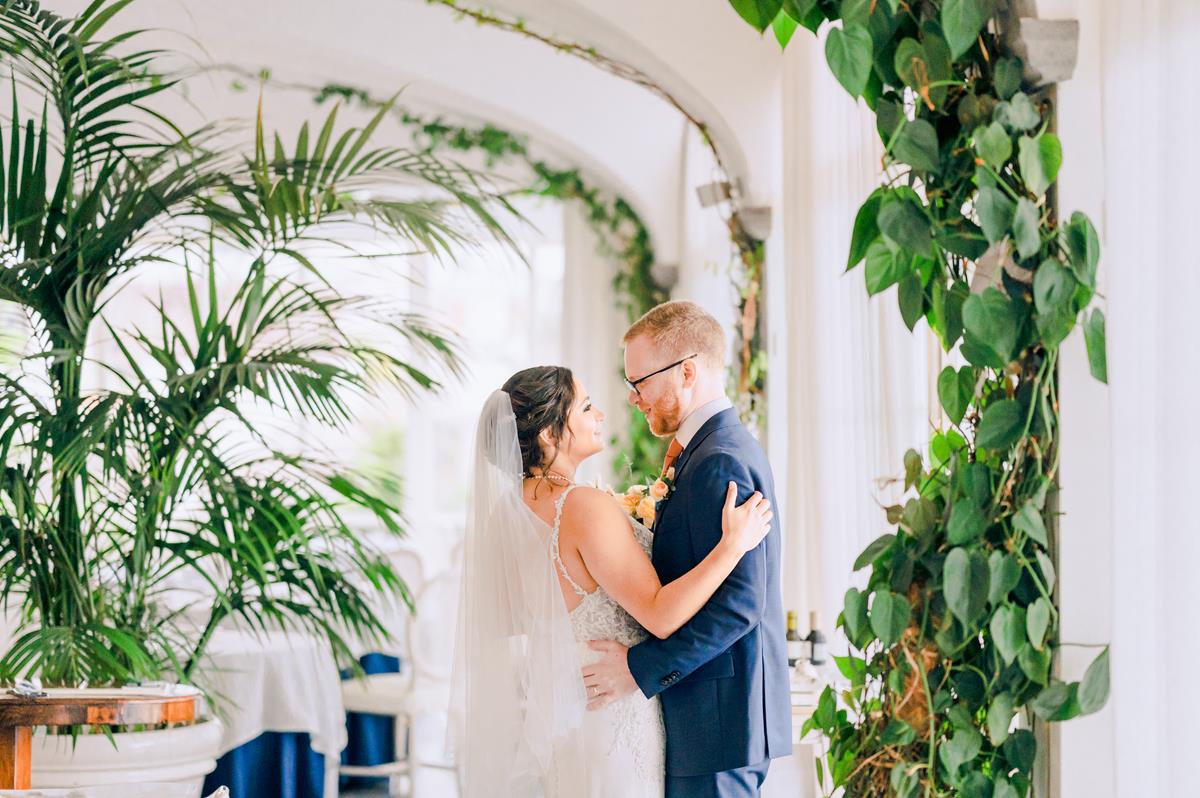
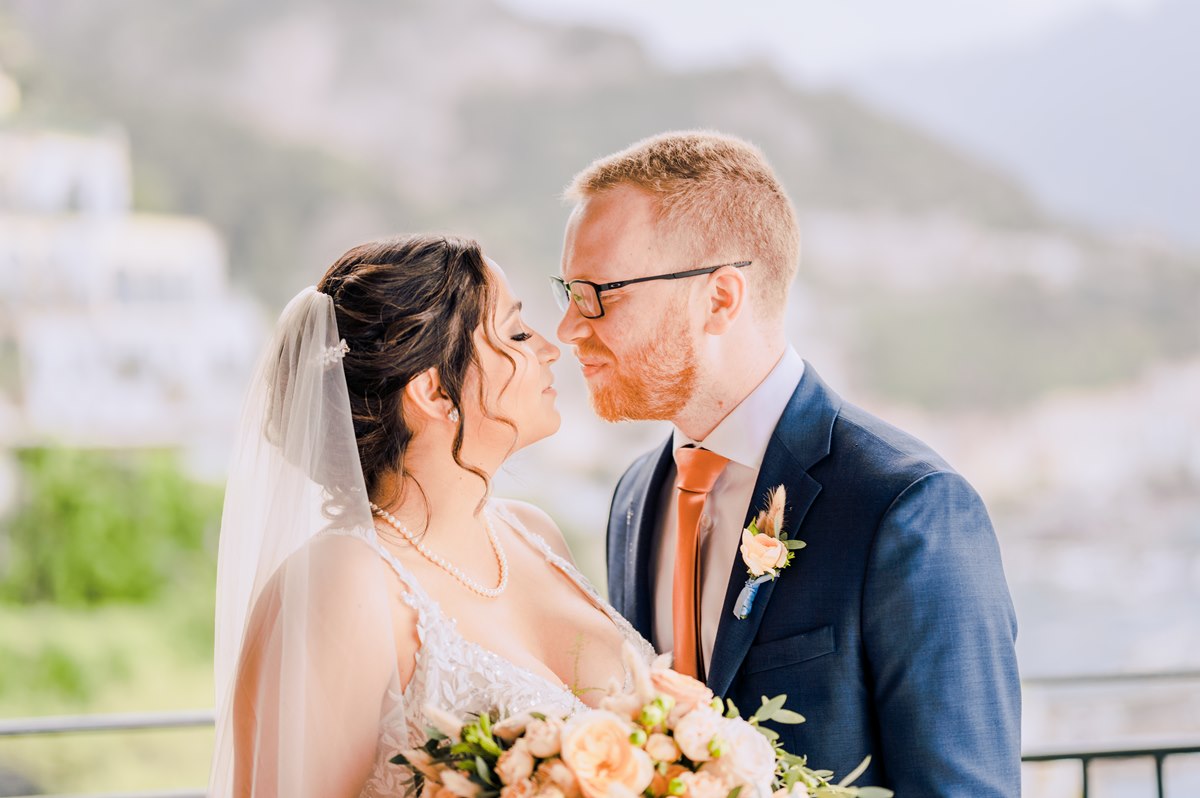
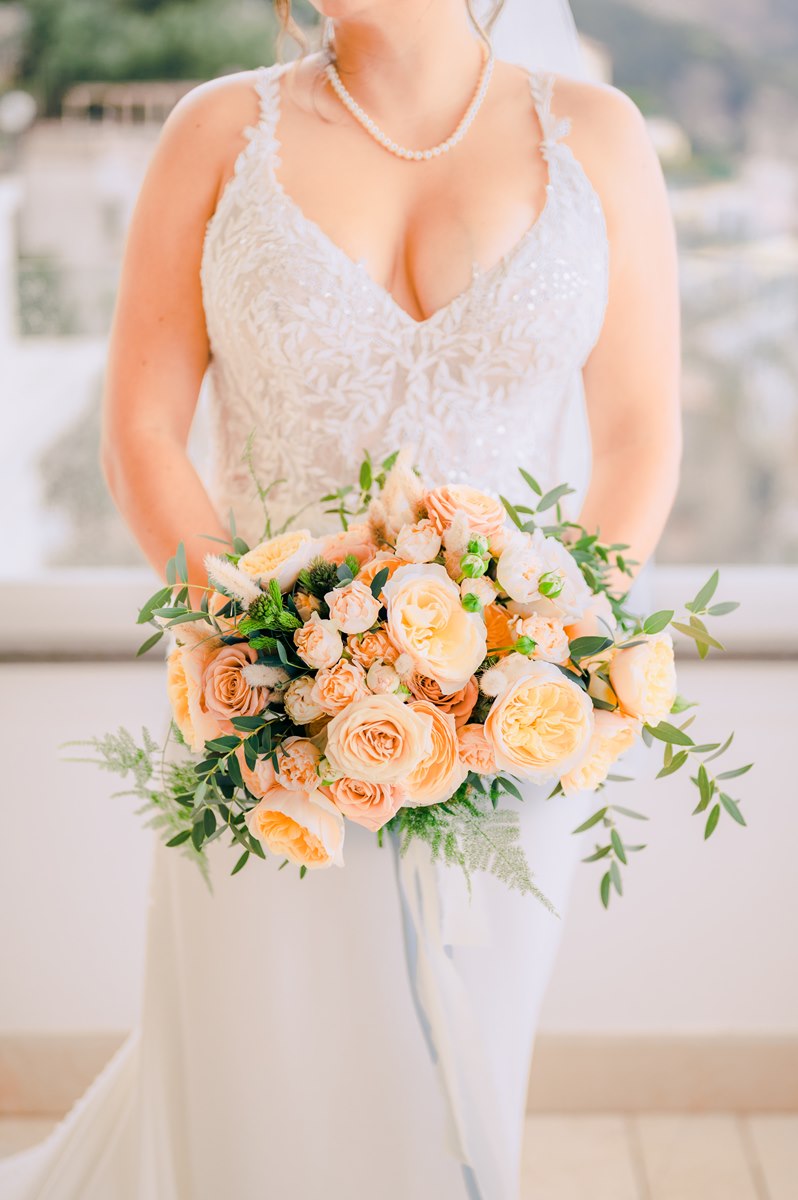
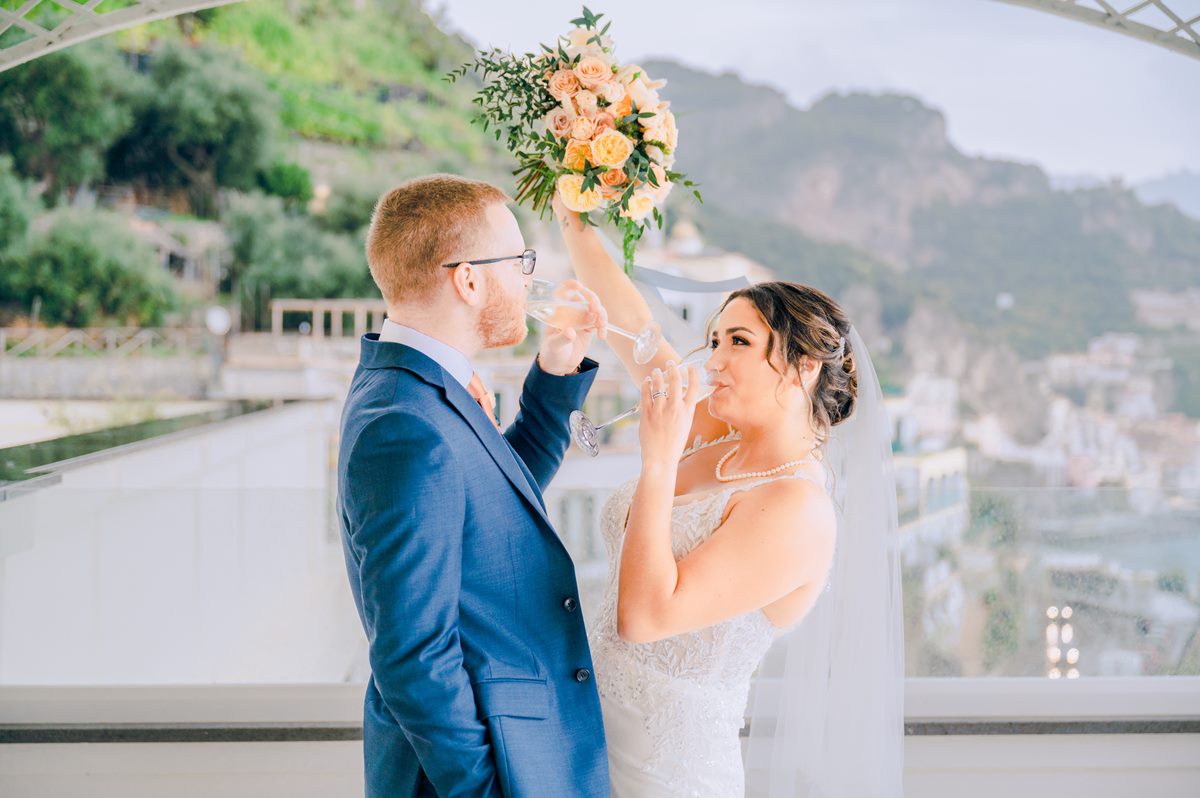
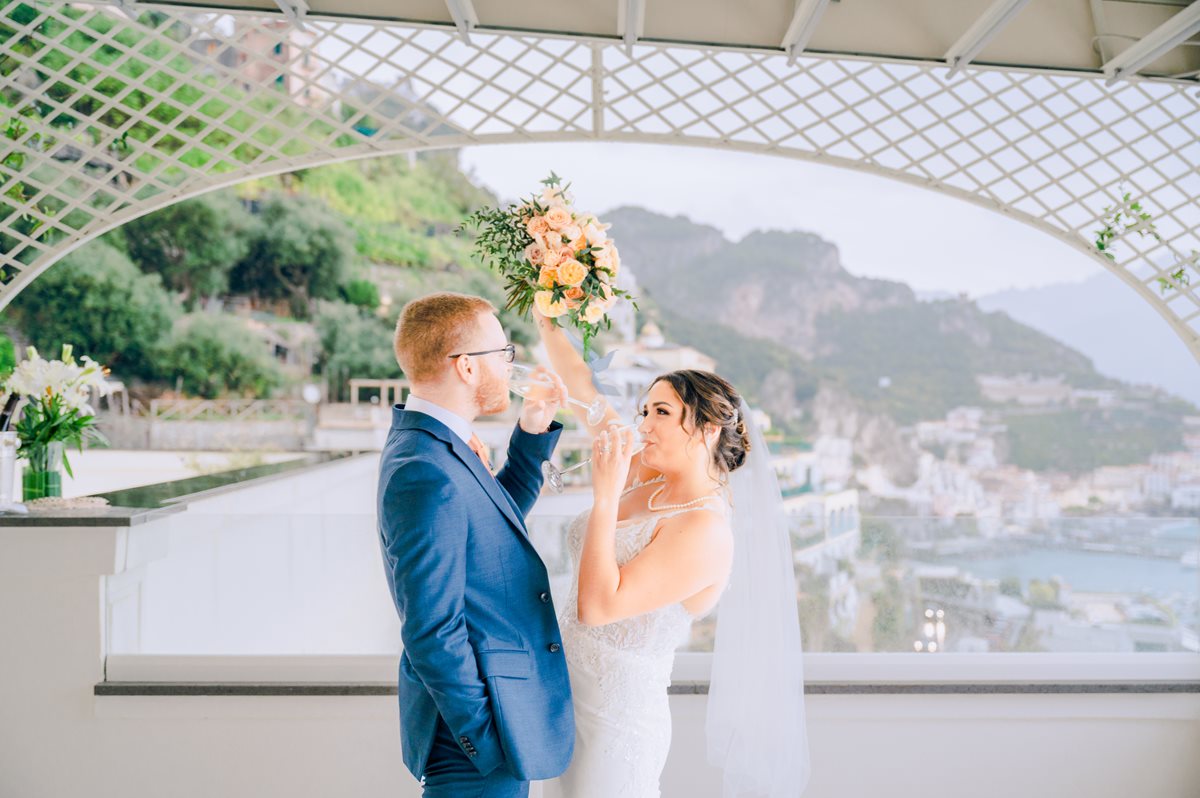
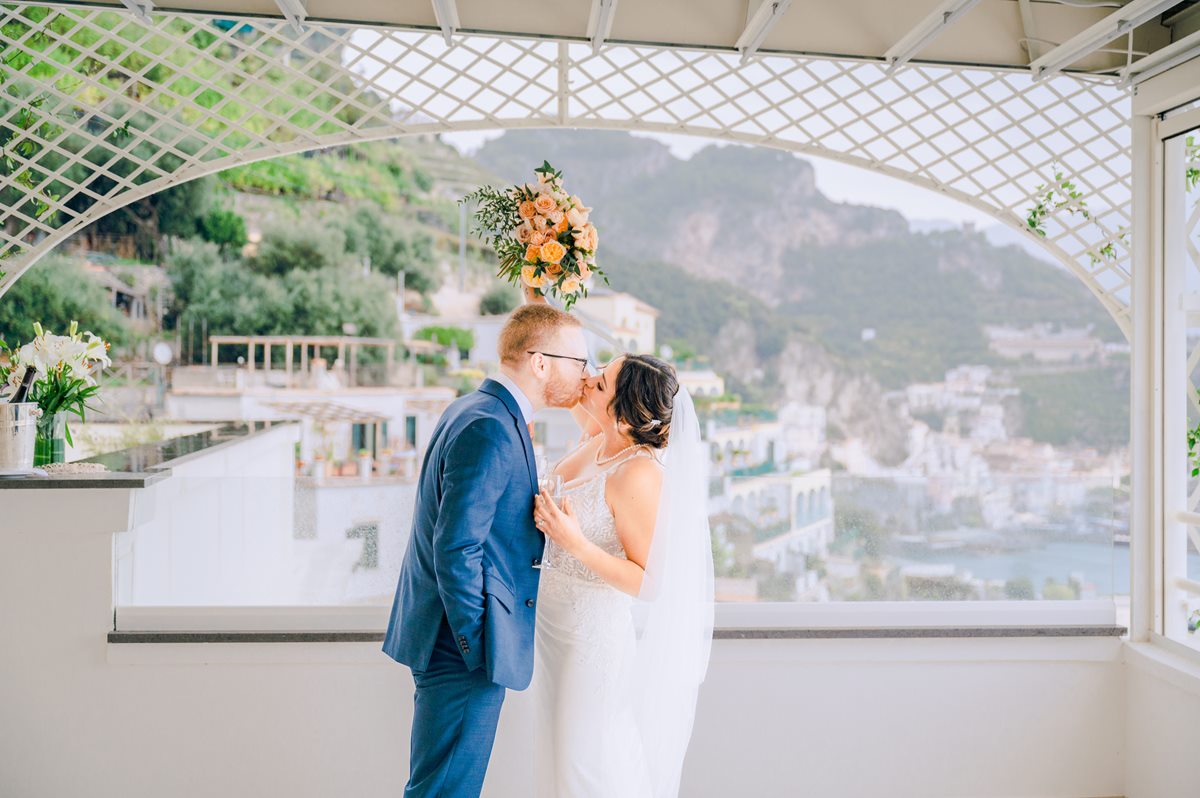
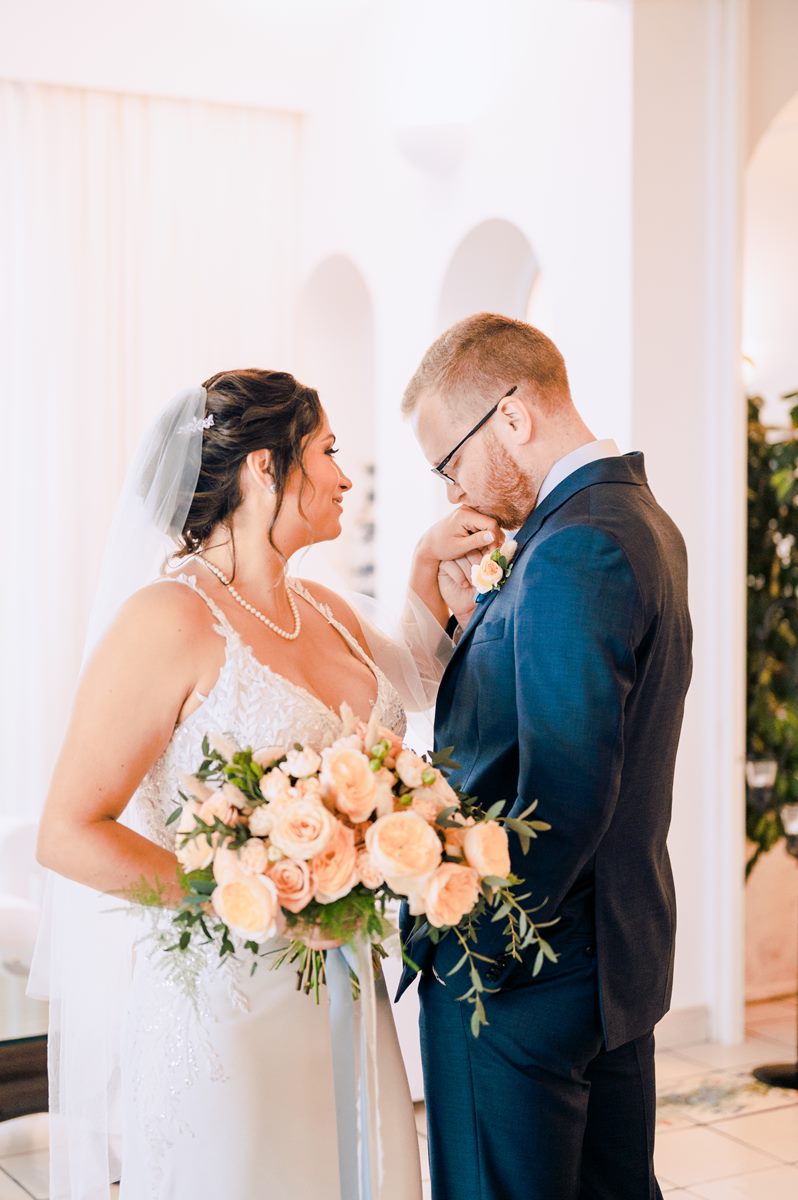
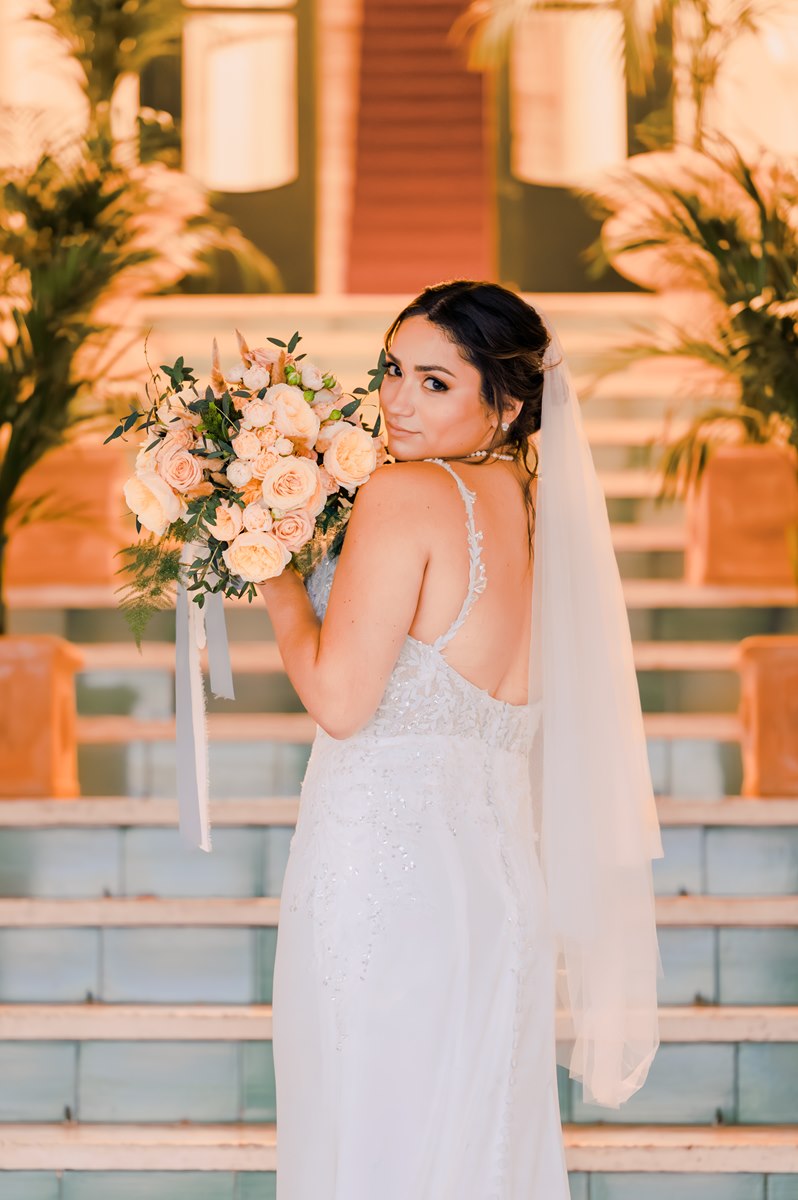
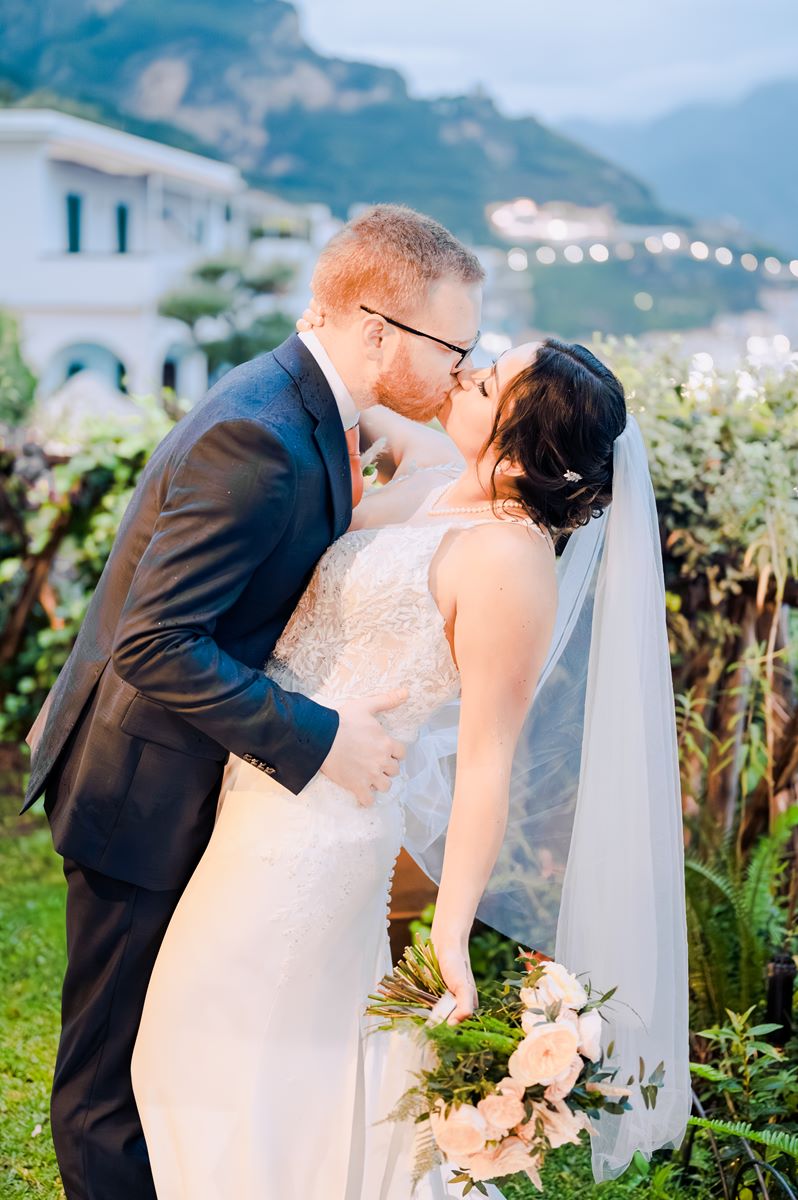
They drank the champagne. She held the bouquet up over both their heads while they kissed, which put the only saturated color in the shot against a mountain that had gone almost monochrome. Then somebody said the rain had eased slightly, and Michael asked whether we could go down into the town.

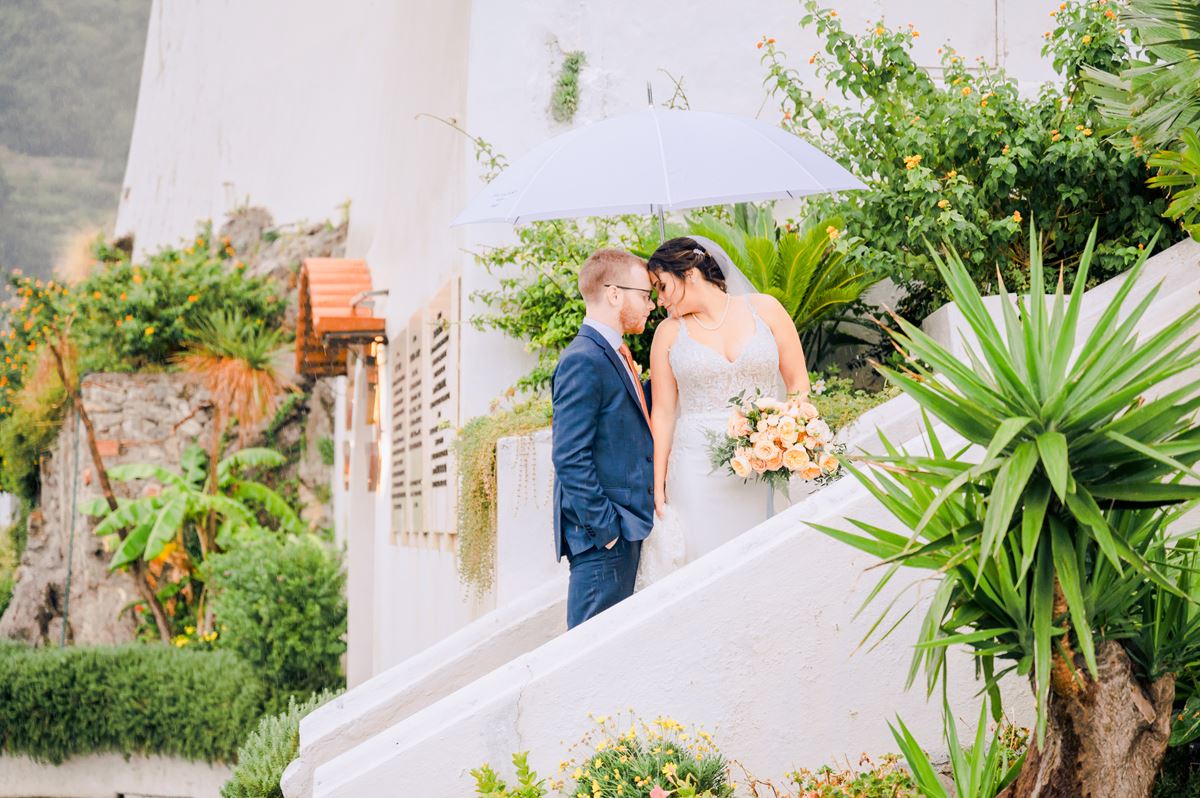
Down to the Harbor on Purpose, in the Rain
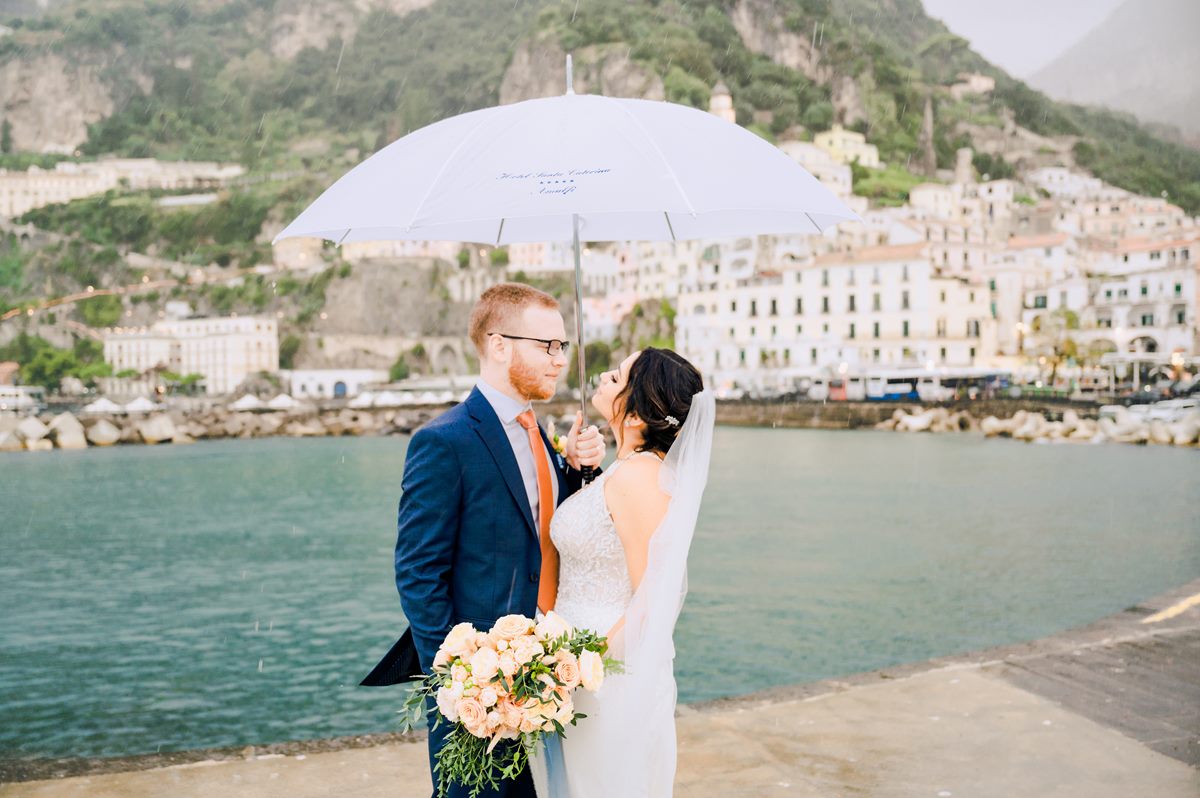
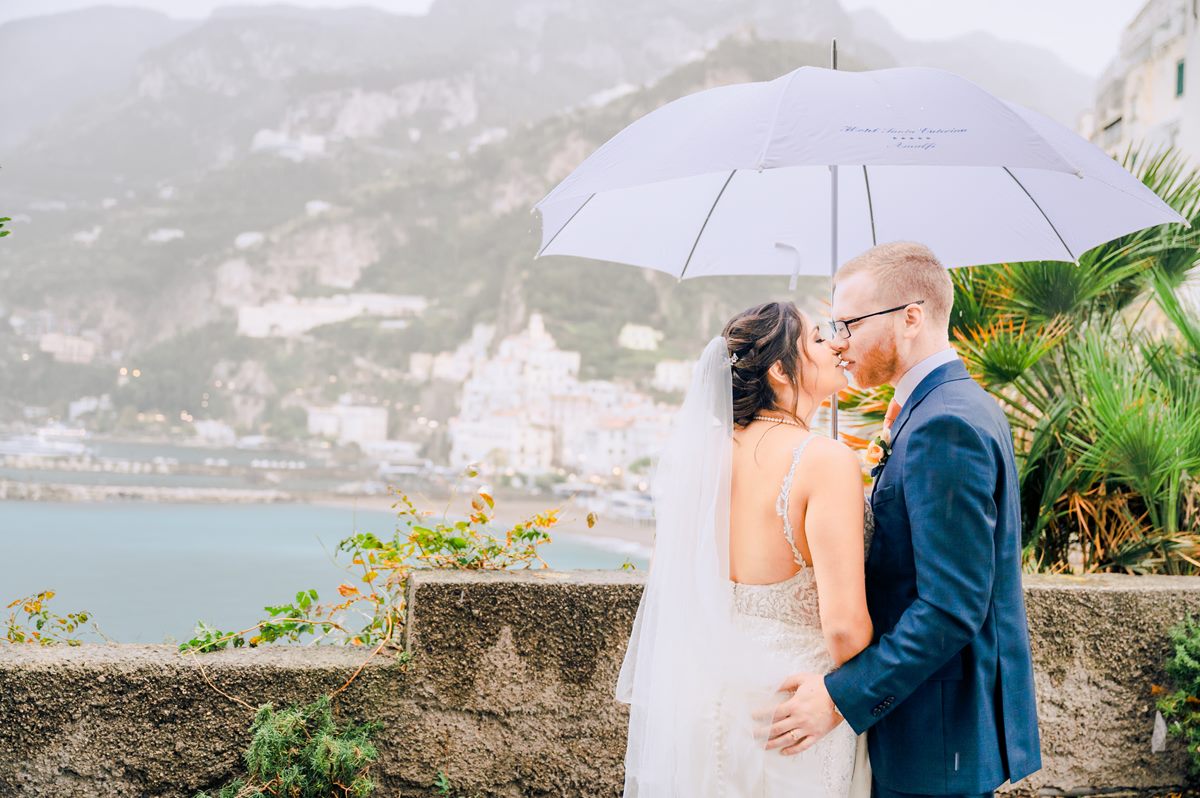
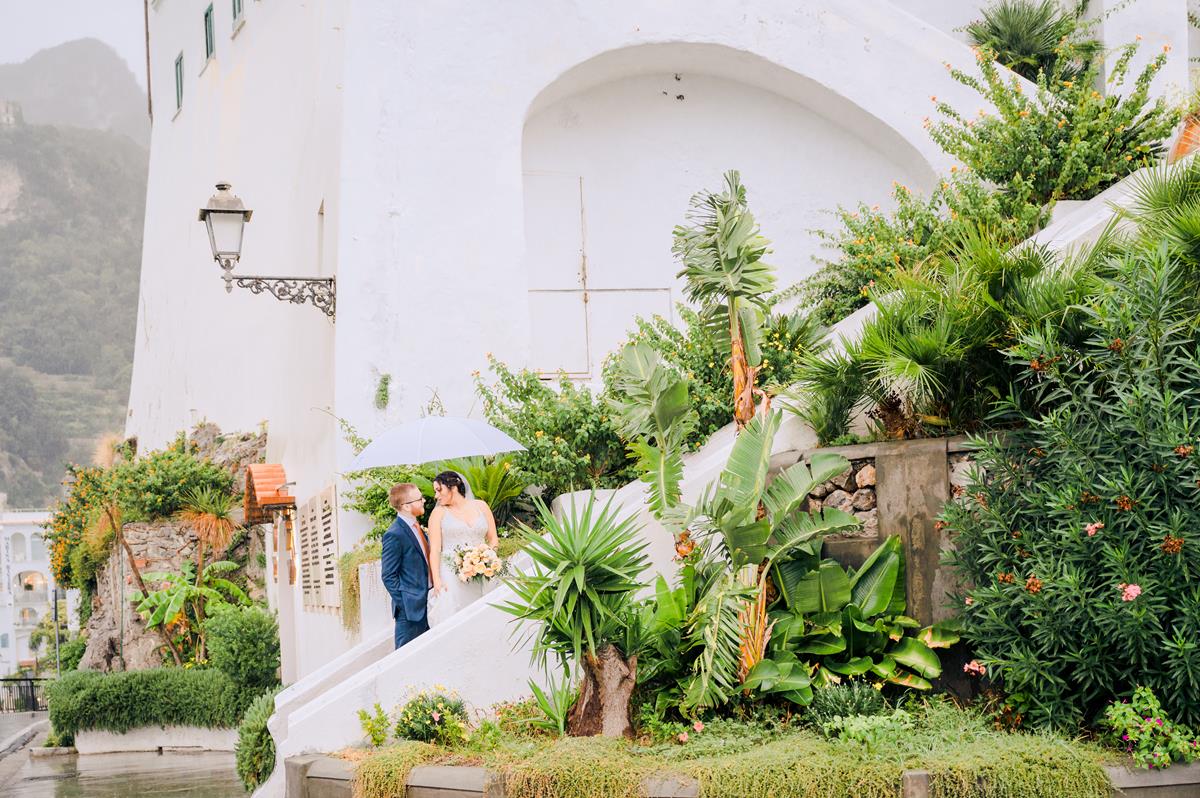
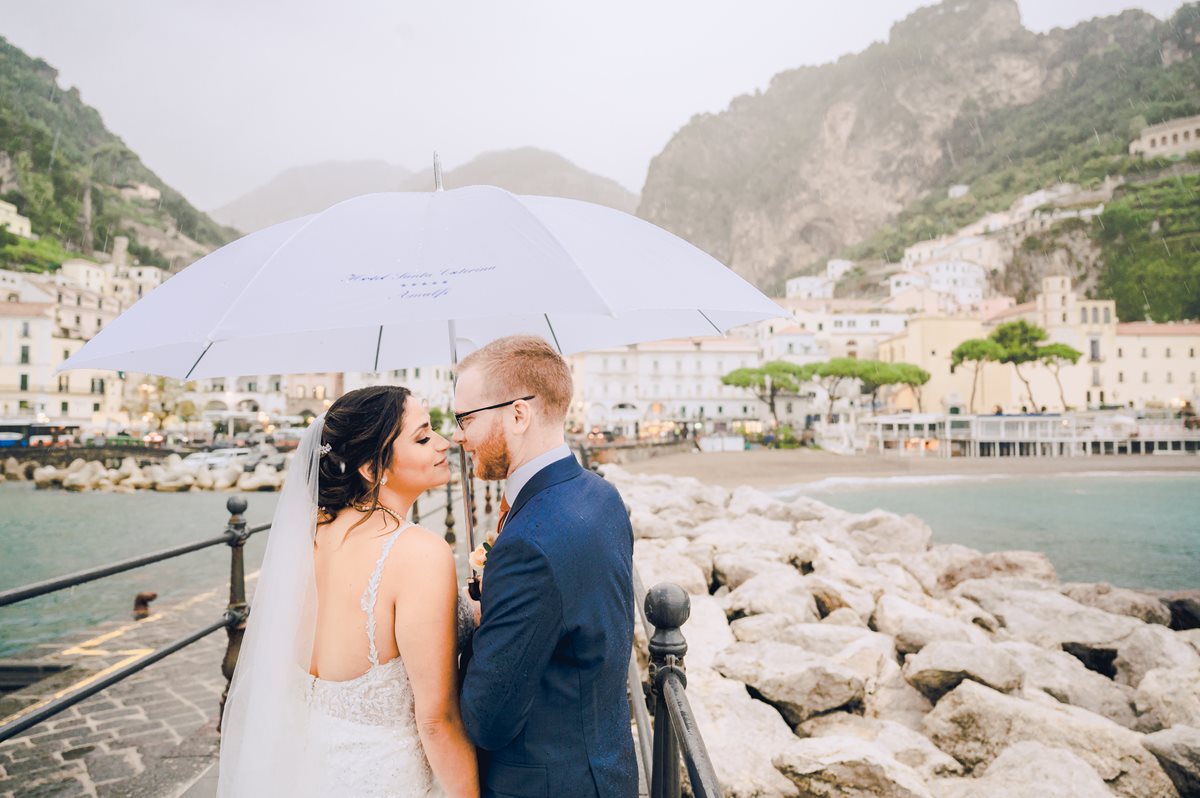
This is the part I would not have suggested and would not have refused. It had not really eased. We took two of the hotel’s umbrellas, which are plain white with Hotel Santa Caterina Amalfi printed along one panel, and drove the few minutes down to the seafront, and by the time we got out of the car the town’s street lights were on. At four in the afternoon.
She Swapped the Crystal Sandals for Turquoise Block Heels
Before we left she changed her shoes. The crystal Badgley Mischkas went back in the box and she put on a pair of turquoise block heels, and you can see them under her hem in every frame from the harbor. I want that in writing because it is the kind of practical decision that makes a sequence like this possible and that gets edited out of most wedding stories in the interest of looking effortless. Wet stone plus a stiletto plus a full-length train is how people fall over. She walked the whole pier without once looking down at her feet.

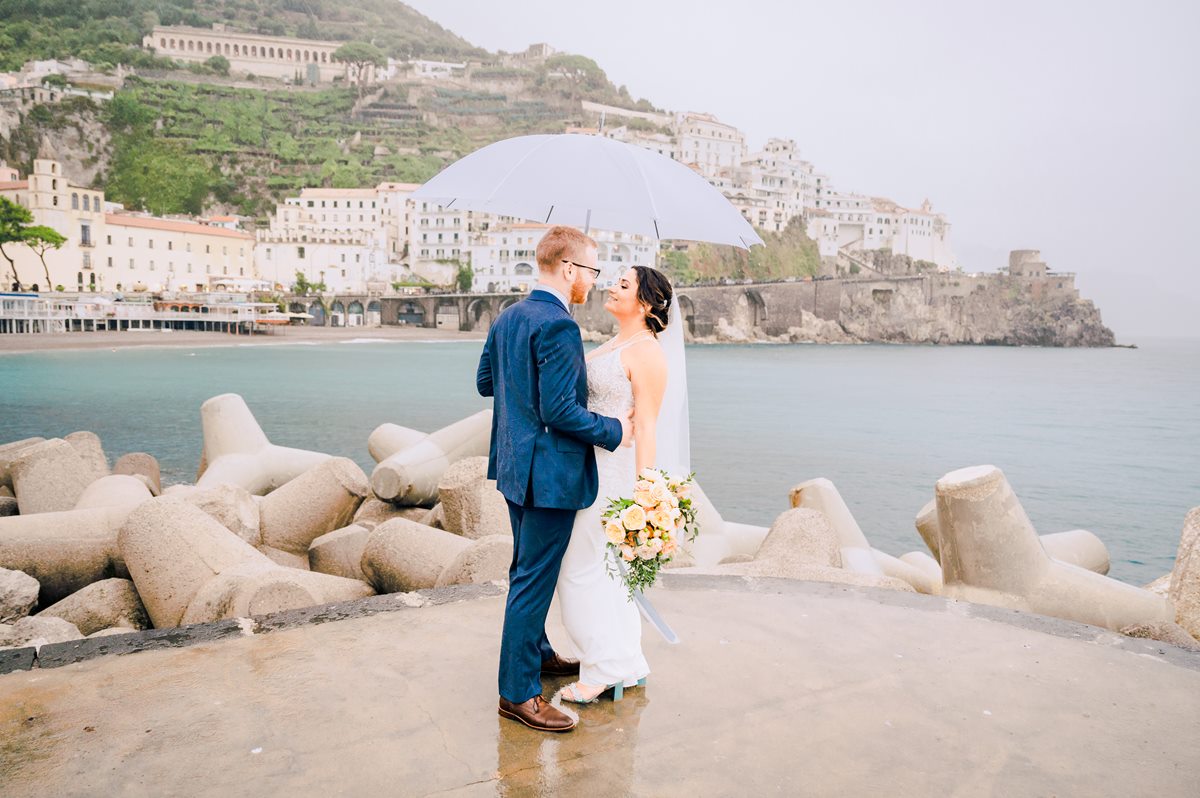
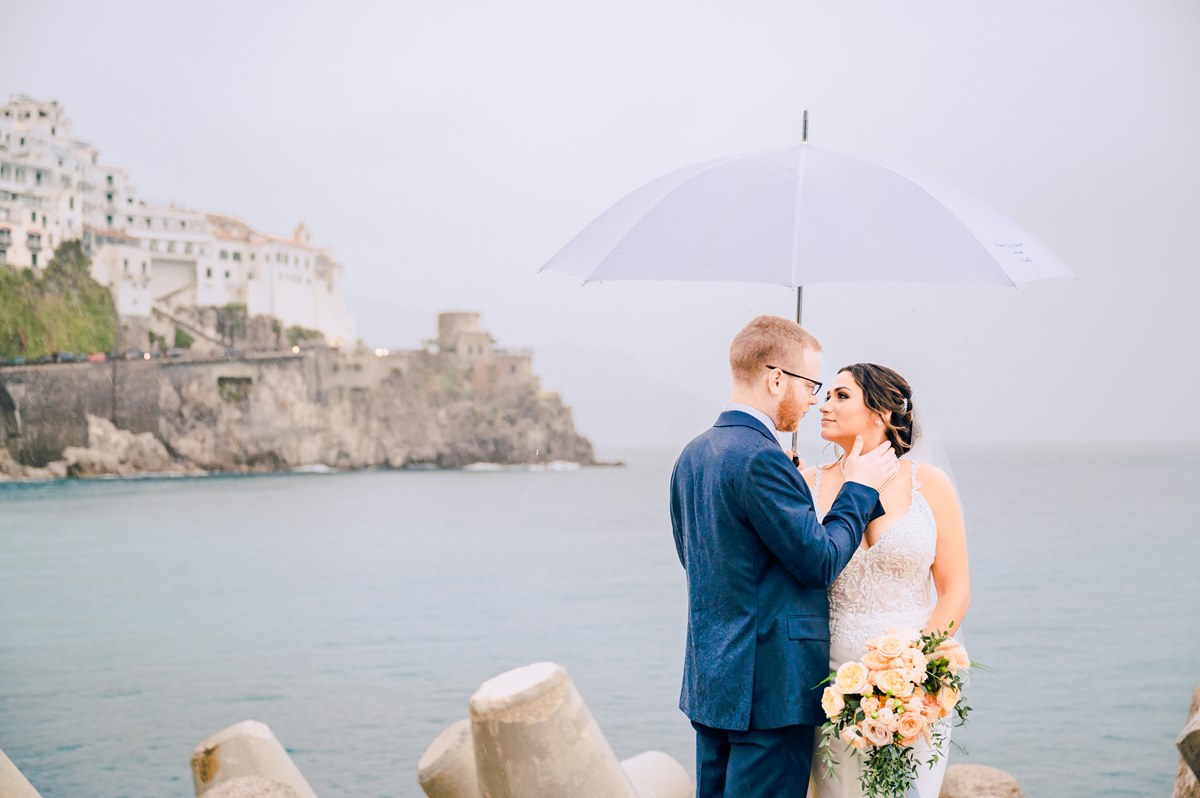
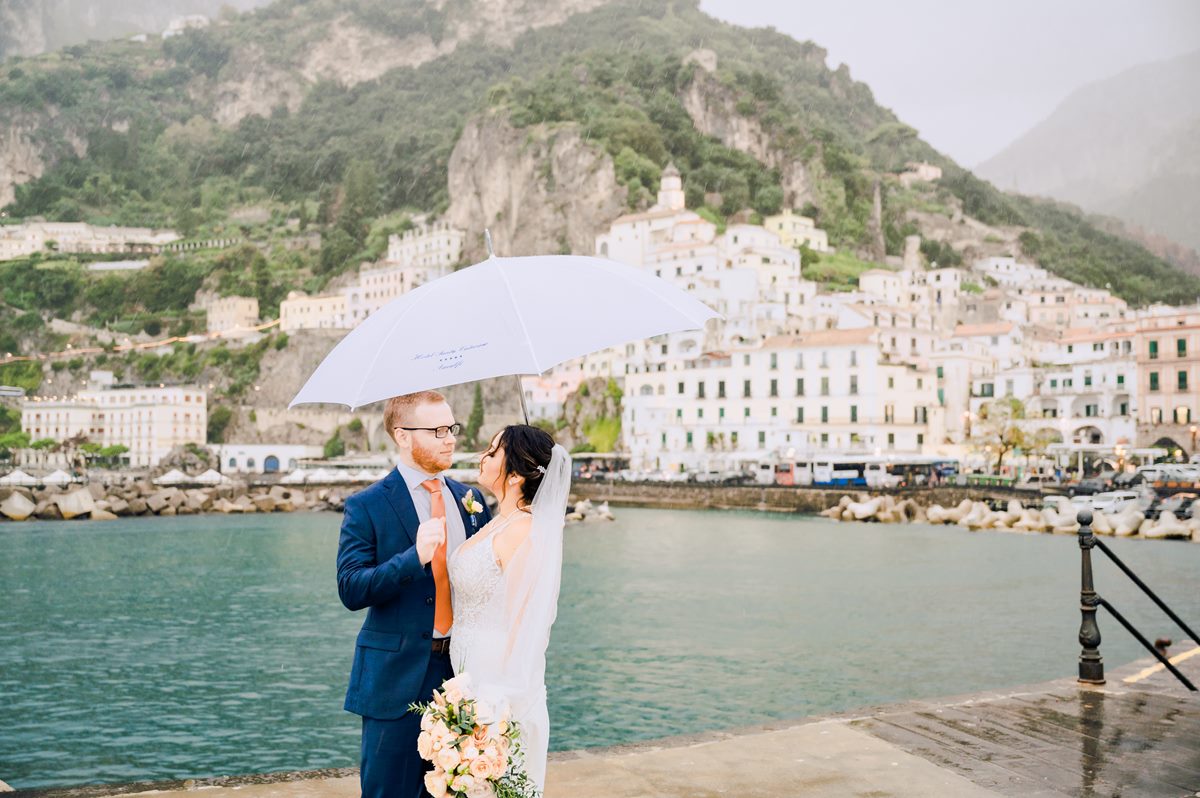
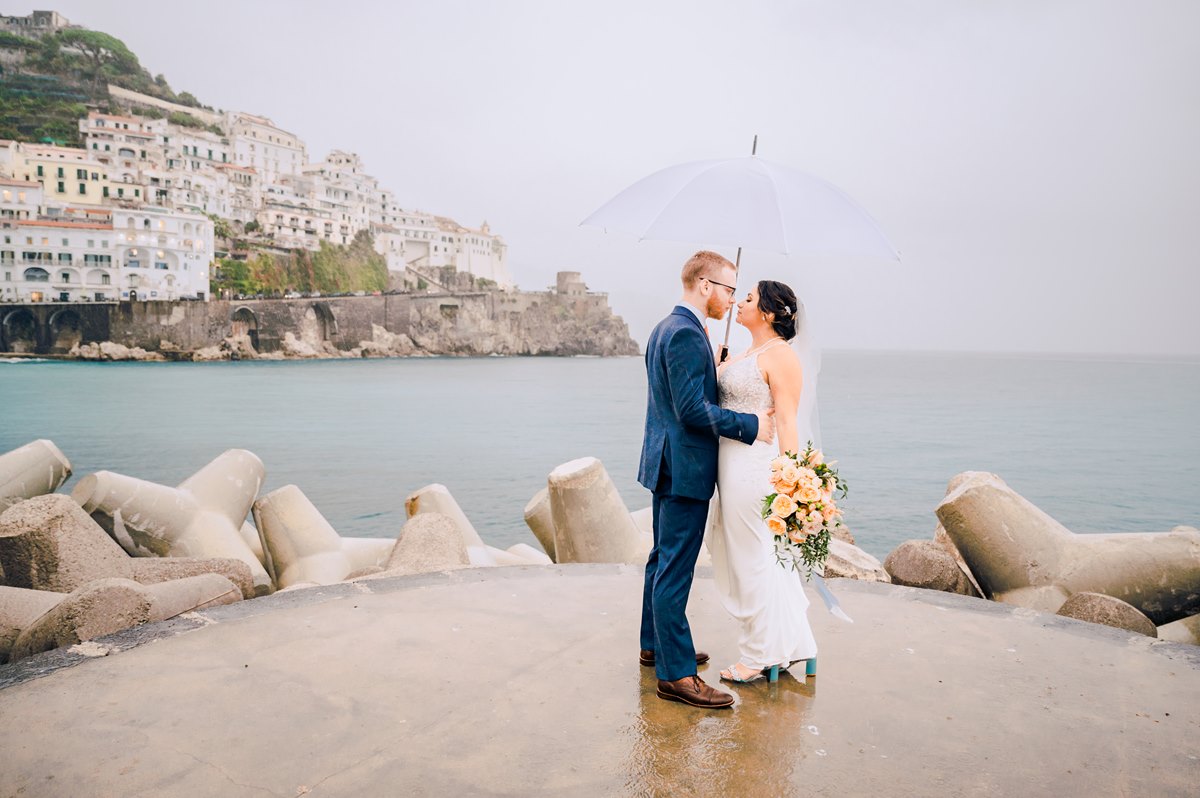
The pier itself was deserted. In August you cannot photograph on that stretch at all, because it is a queue of people waiting for the Positano ferry. That afternoon it was wet black stone with a yellow line painted down the middle, cast-iron balusters with ball finials down one side, a heap of concrete tetrapods on the other, and not one other human being on it.
Behind them, Amalfi went straight up the cleft in the mountain with the Duomo campanile sticking out of the middle of it and the umbrella pines along the front holding still in the rain.
The Only Monochrome Frame of the Day
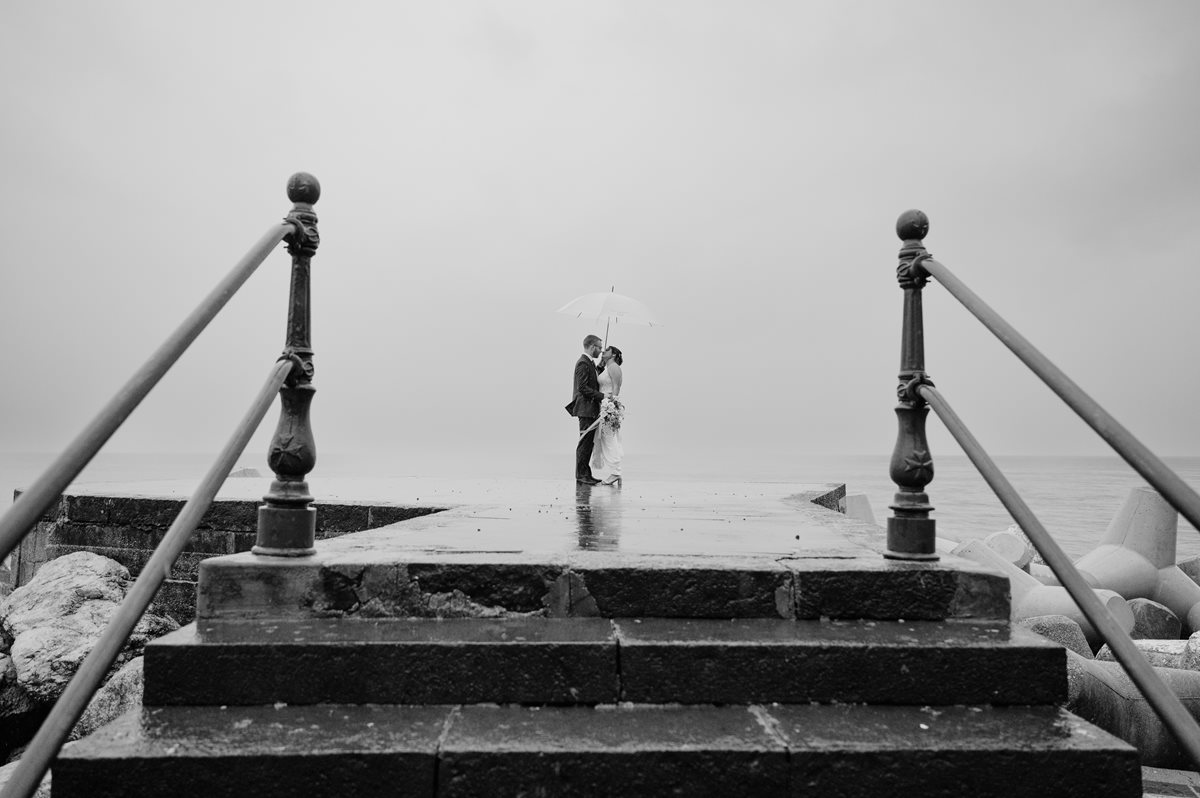
I converted exactly one photograph from that day, and it came from the pier. I dropped low at the wet steps on the landward end, so that the two iron posts frame the shot on either side and the steps fill the bottom third, and put the couple small and centered on the flat of the pier with the umbrella over them. Sea and sky are one continuous gray. No horizon in it, no color worth keeping, and the picture is essentially two figures and a circle on an empty stone rectangle.

In color that image is dull. In black and white the missing horizon stops being a problem and becomes the whole subject, and it is the single strongest frame in the gallery. It is also the only one where you can properly see the rain, sitting in beads all over the concrete.
Michael’s shoulders were soaked through by the time we walked back. He did not mention it, and neither did she, and in one photograph at the water’s edge, with an old stone watch tower over their shoulders, you can see the dark patches on his jacket quite clearly. I left them in.
RAIN ON THE CLIFF
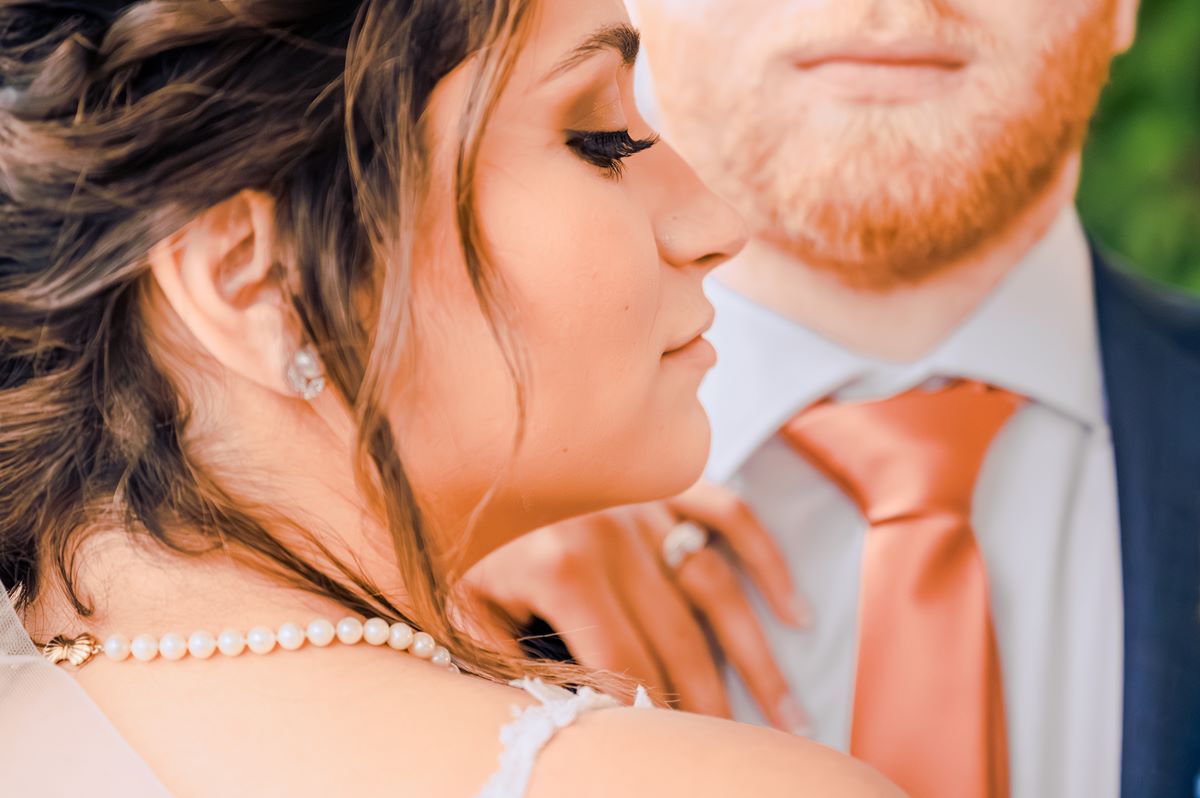
EMILIANO RUSSO
In November the harbor of Amalfi empties out, and the rain had it all to itself.

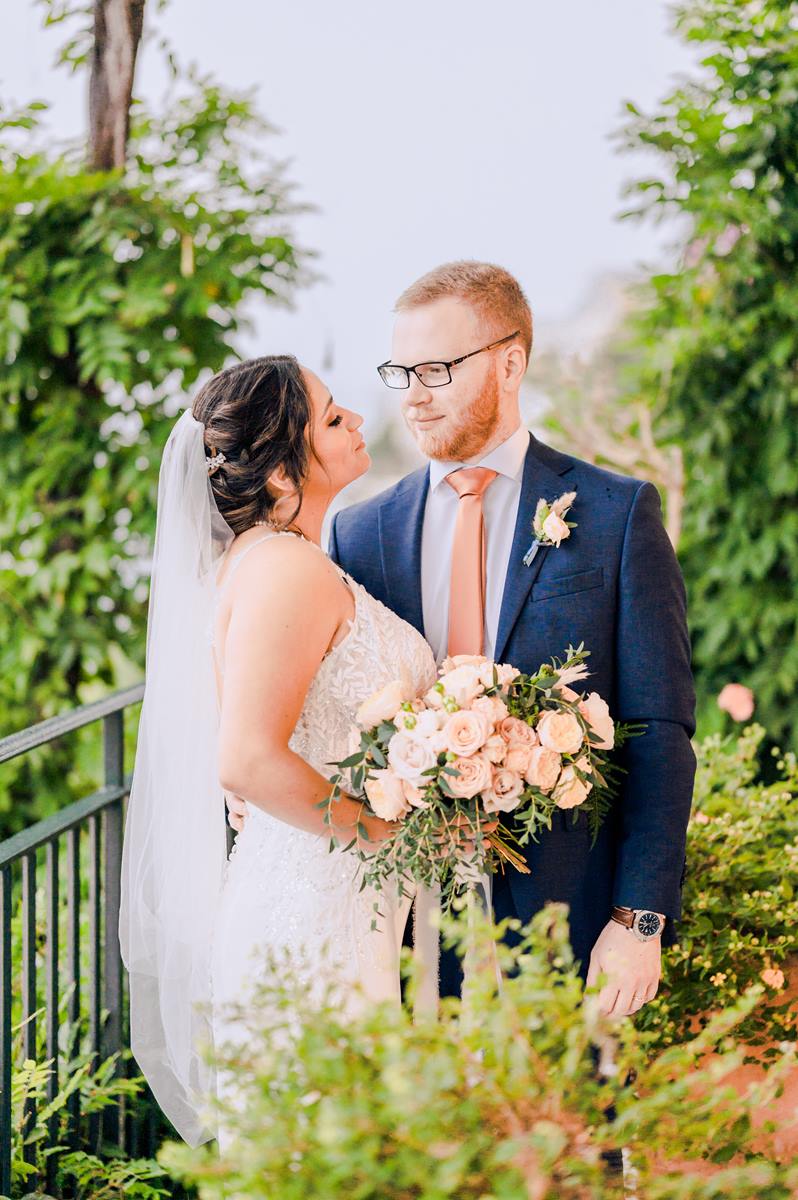
WET TERRACES
Wet stone holds every lamp in the town, and the pier stayed empty for us.
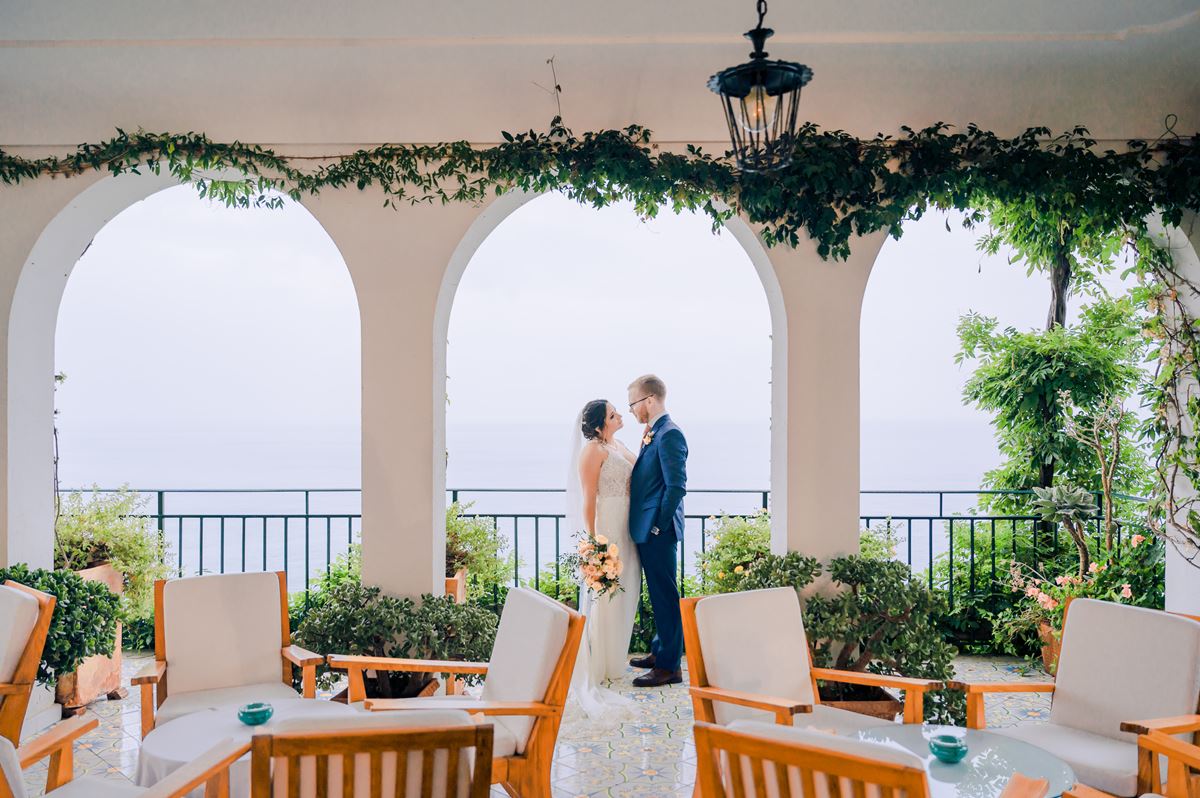
A QUIET HARBOR
An umbrella from the hotel, two people, and a pier with no one on it.


The Vine Tunnel You Never Have to Run Through
Back at the hotel we had an hour before dinner, and this is where the building earns whatever it charges. Santa Caterina is stacked vertically down a cliff and stitched together with covered walkways, which means you can spend a whole afternoon apparently outside without ever standing in the open. A couple planning an Amalfi Coast elopement instead of a full wedding day should weigh that quite seriously, because the smaller your day is, the more of it happens on foot between spaces.
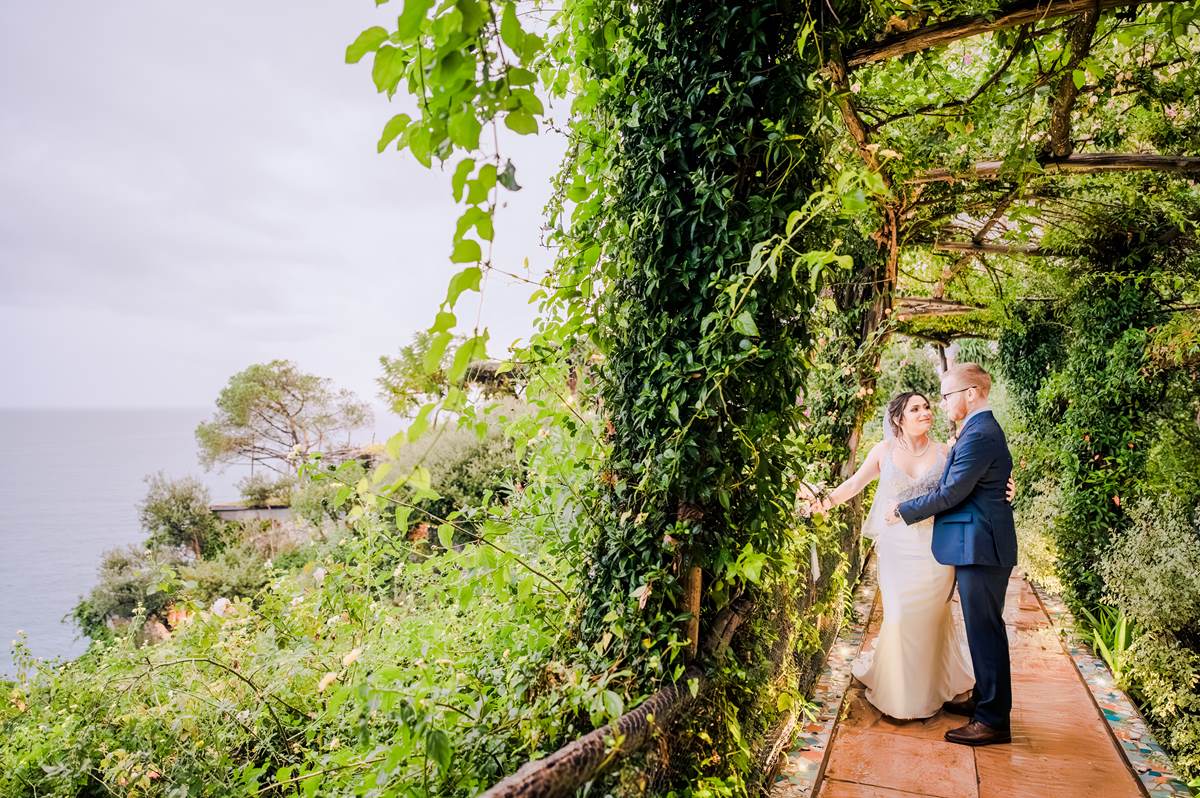
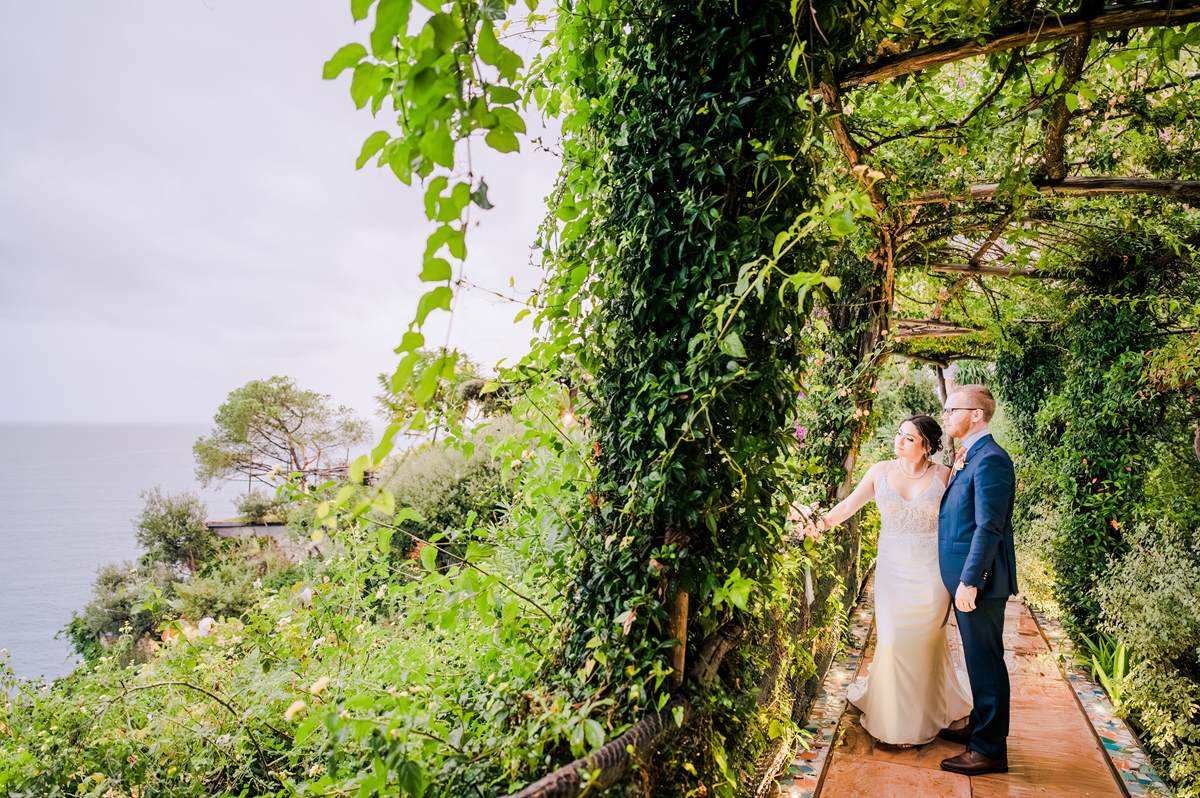
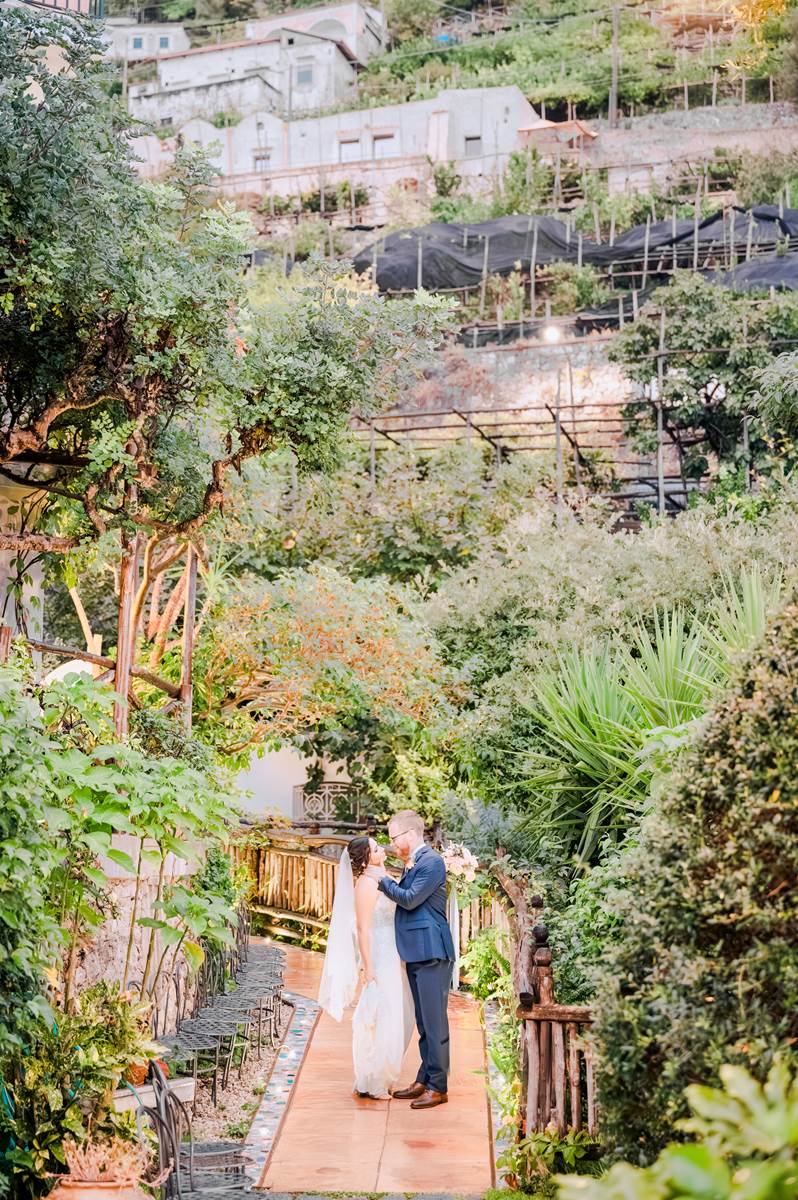
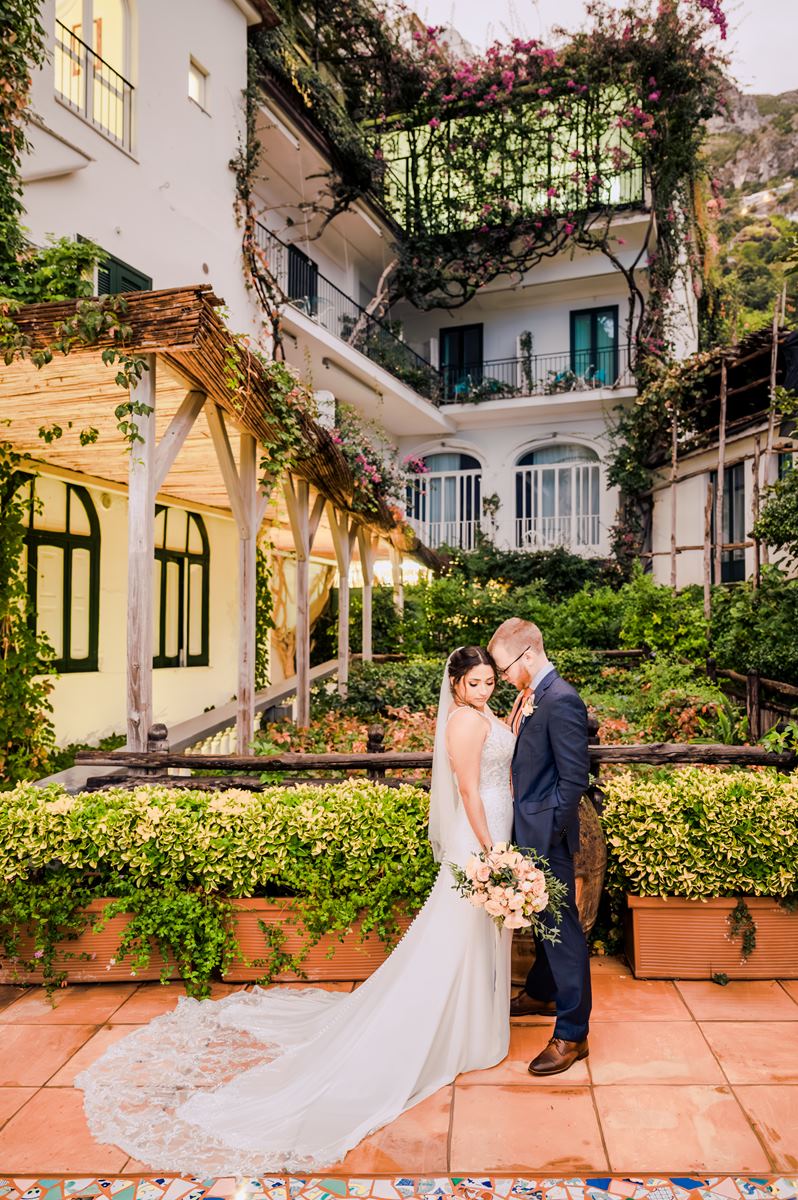
The long pergola walk runs along the cliff on chestnut poles, roofed in old vine and climbing rose and passionflower so densely that almost nothing comes through it. The path underneath is terracotta with a border of hand-painted majolica tiles down each edge. I shot along it with the couple at the far end, using the tunnel of green as a frame and letting the sea show as a flat pale band through the gaps on the left.
Every one of those pictures is dry, and every one of them looks like a garden portrait. The vines were dripping. They were not.
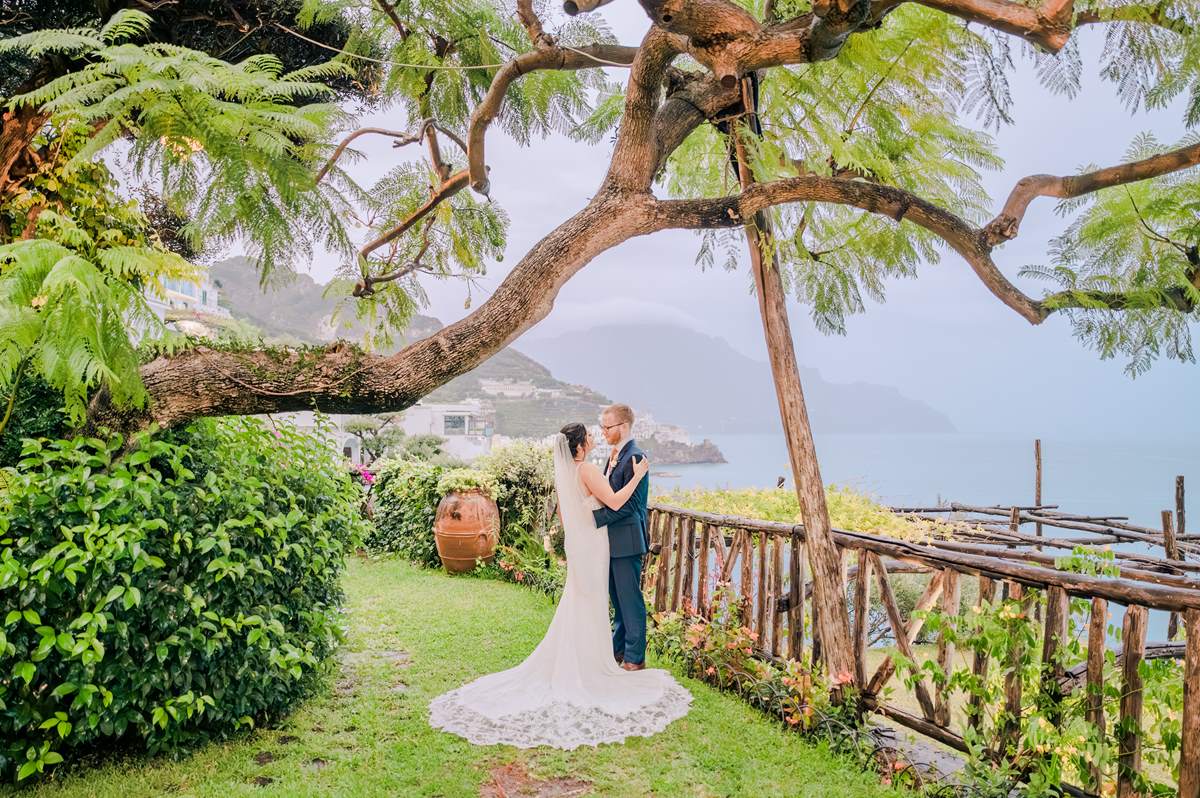
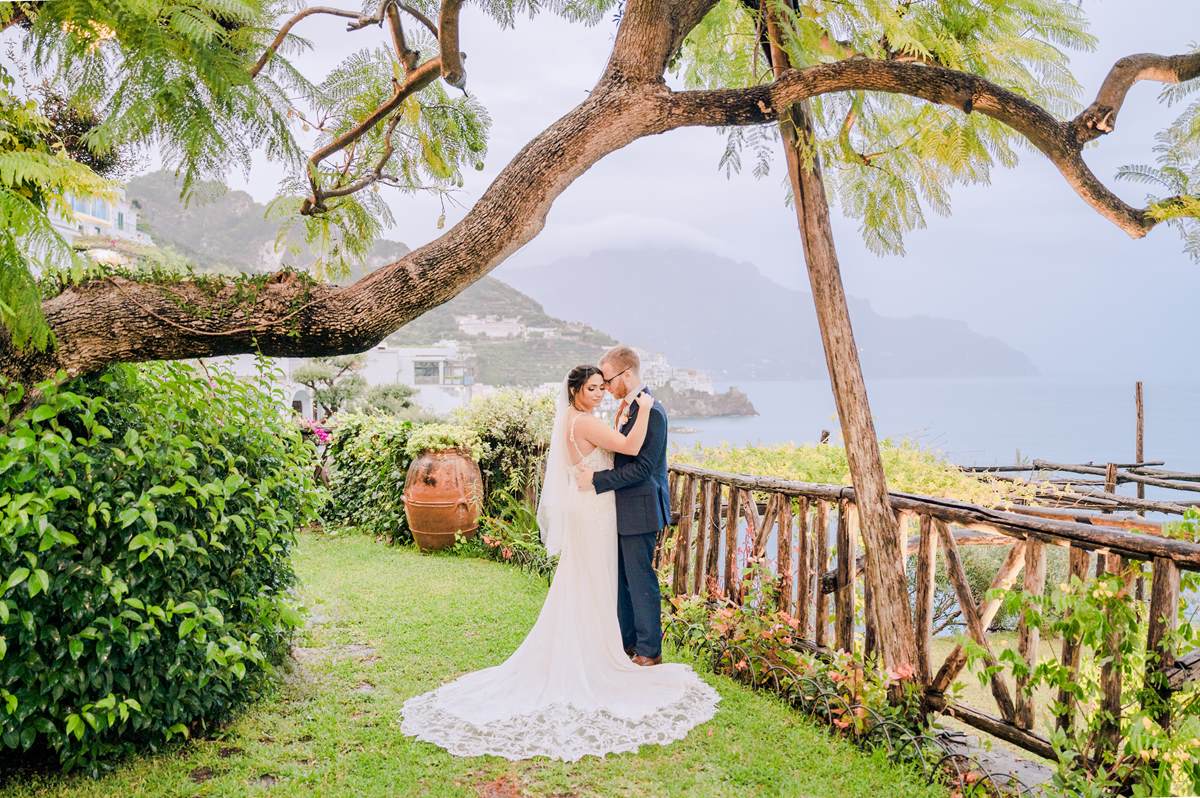

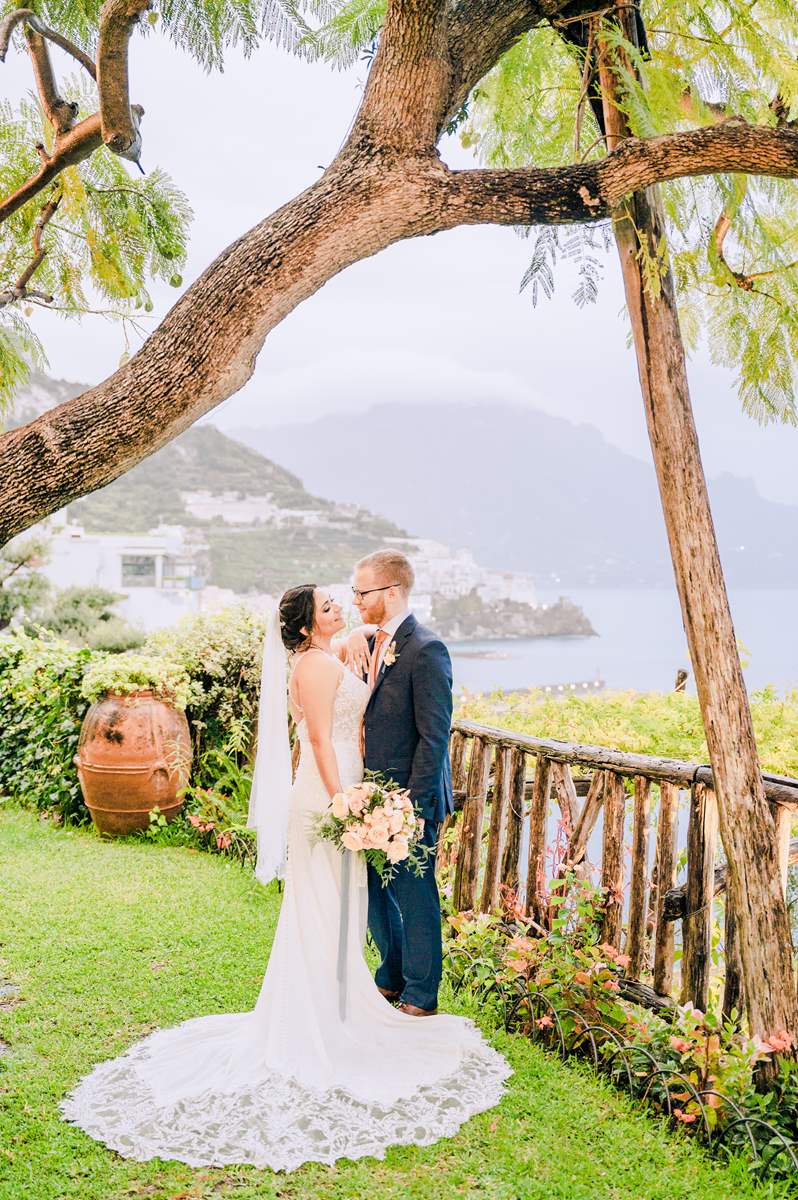
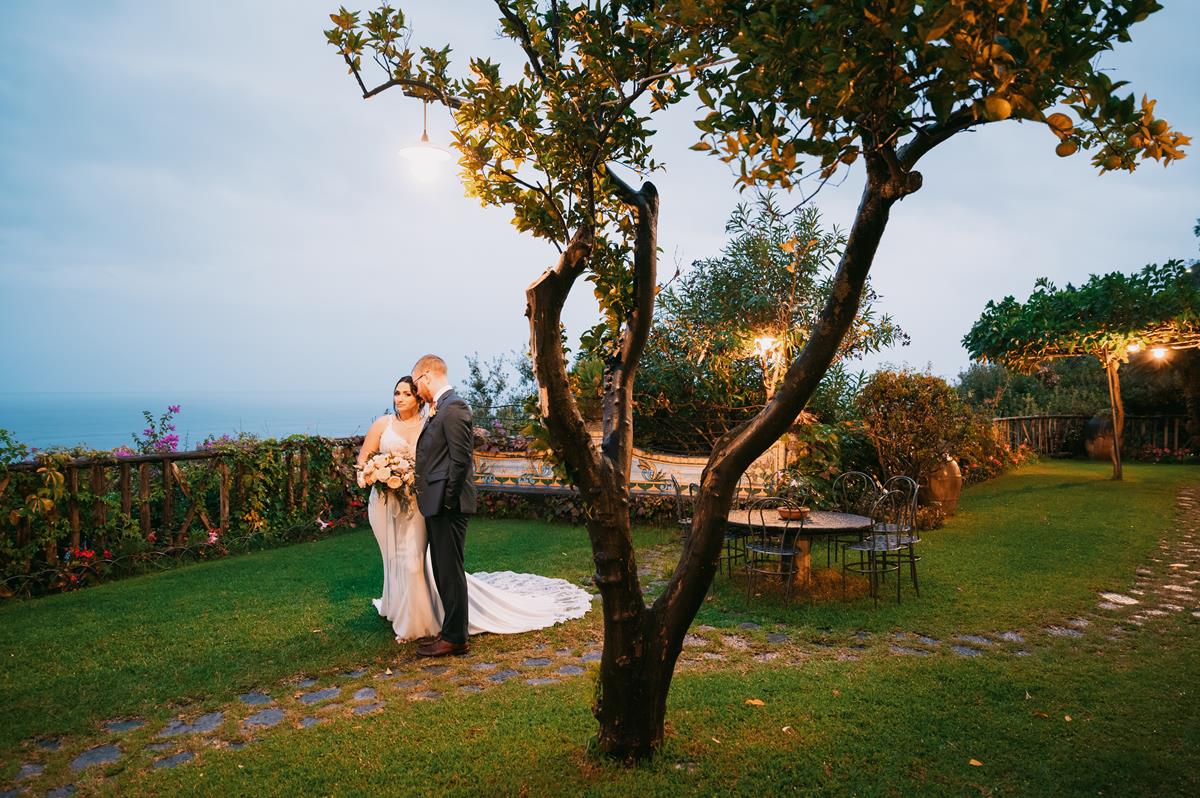
Below the walk sits a lawn terrace with a rustic chestnut-pole fence along the drop and a single big tree that leans right out over the grass at an angle you would not believe if it were drawn. I put them under the trunk with the fence running out to the right and Amalfi behind, half dissolved. The grass was soaked and vivid, greener than it ever is in June, and Nicole’s train and the lace edge of her veil arranged themselves in a wide arc on the wet lawn without anybody touching them.
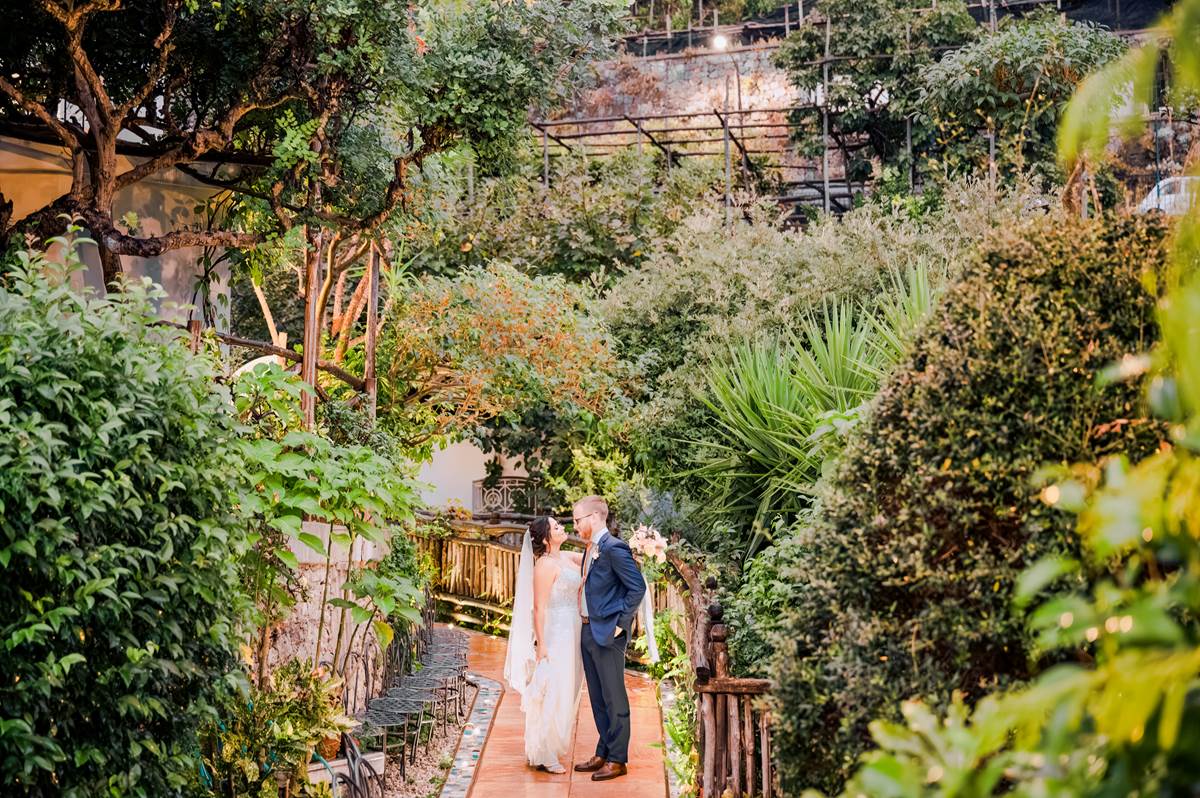
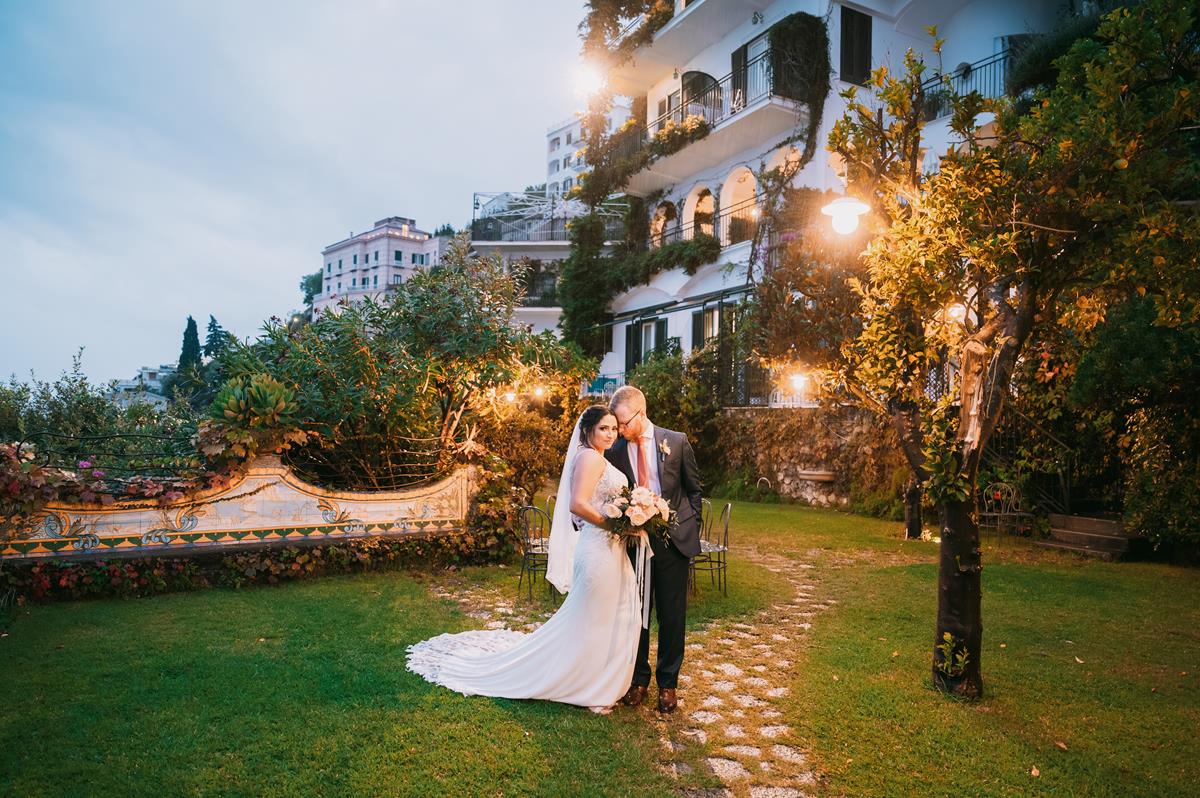
By the time the light went blue, the garden lamps had come on and a lemon tree near the path was lit from below, and a curved majolica bench runs along one edge of that lawn, painted in yellow and green and blue. I had never once photographed it in daylight, because in daylight nobody looks at it. At dusk, with warm lamps at the back of it and the hotel’s arched loggias glowing above, it is the best object in the garden. Their last outdoor pictures were made standing on a line of stepping stones with that bench in the corner and the whole facade lit up behind them.


The Lancet Windows and the Rain Running Down Them
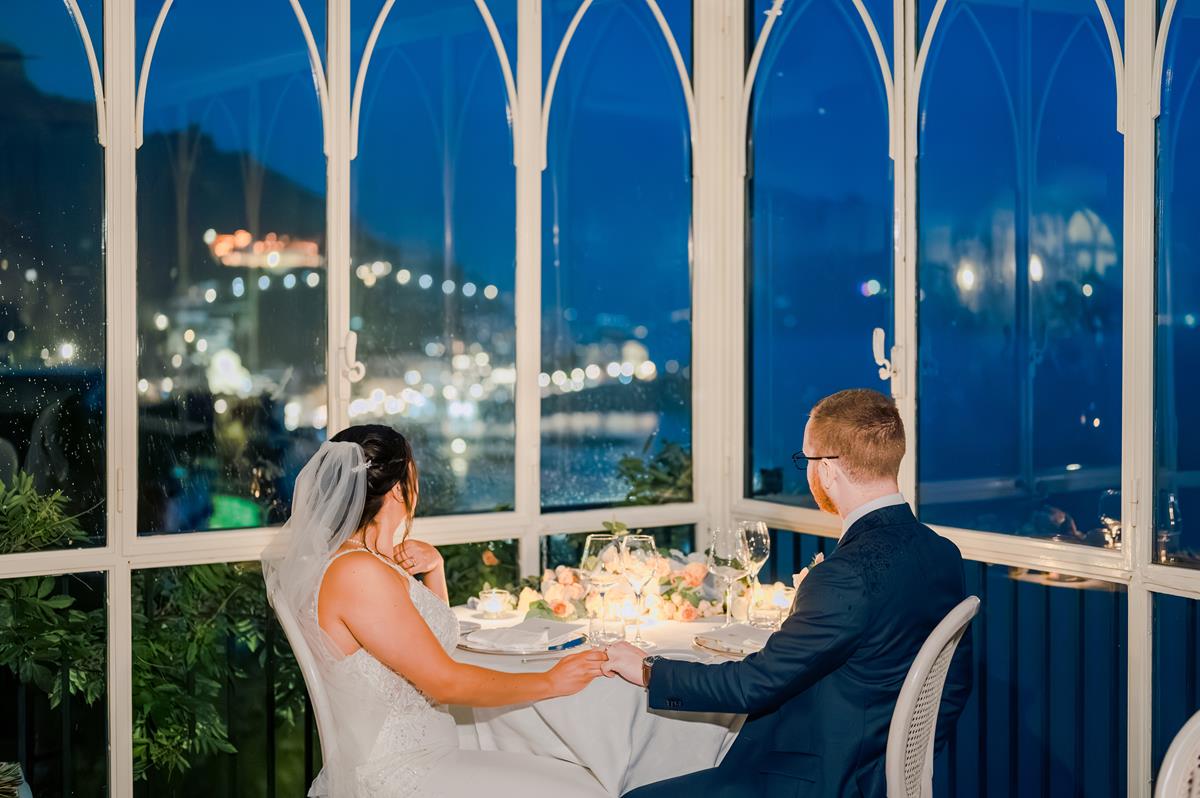
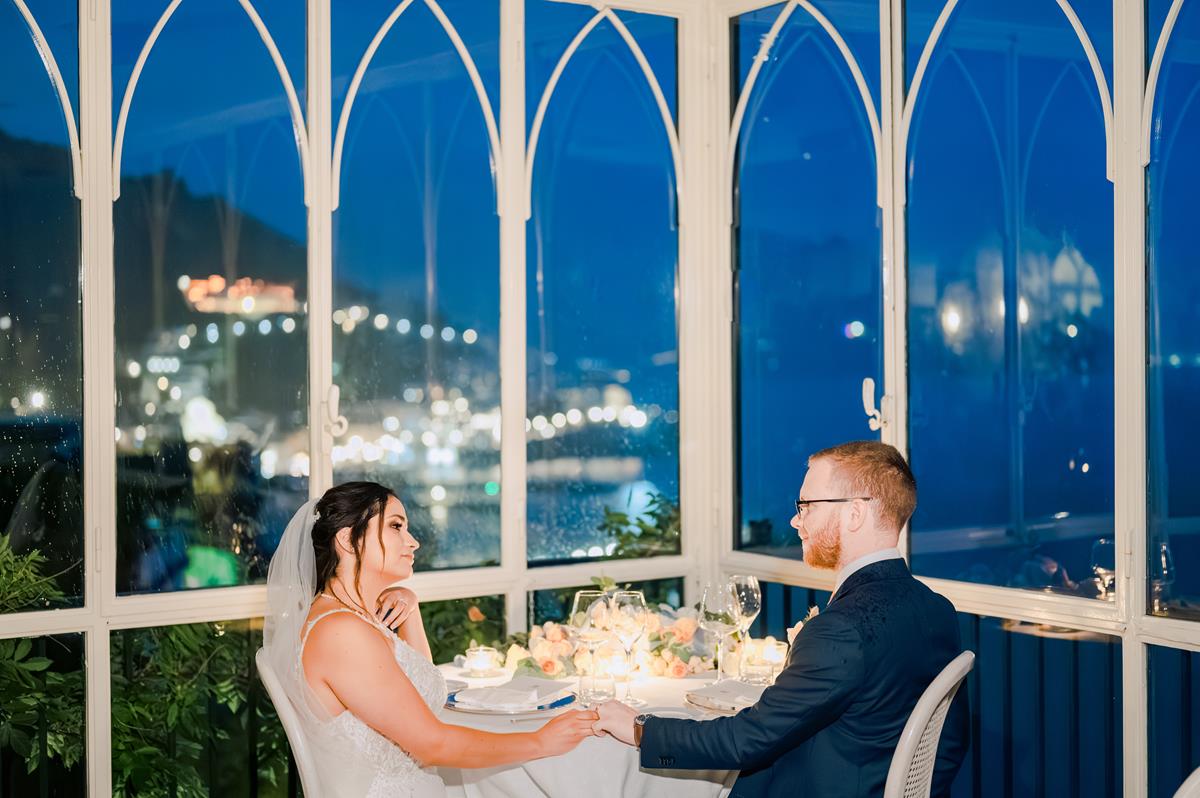
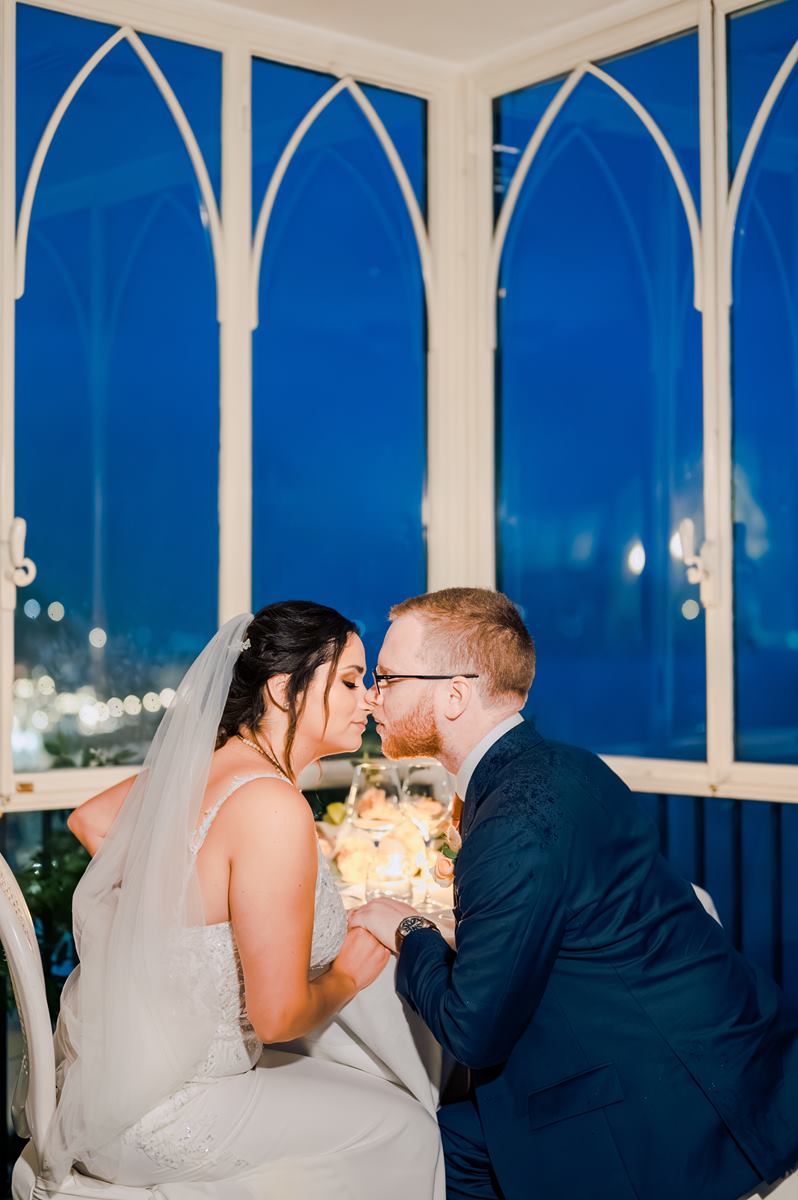
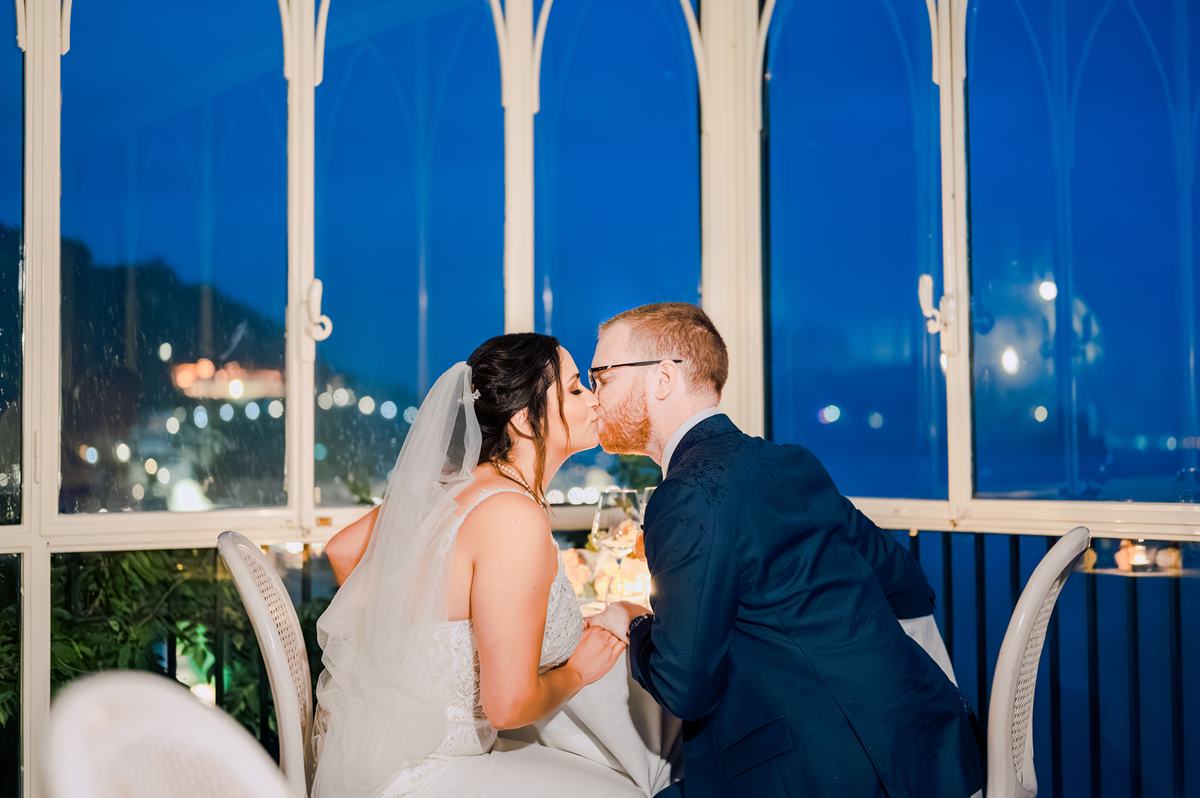
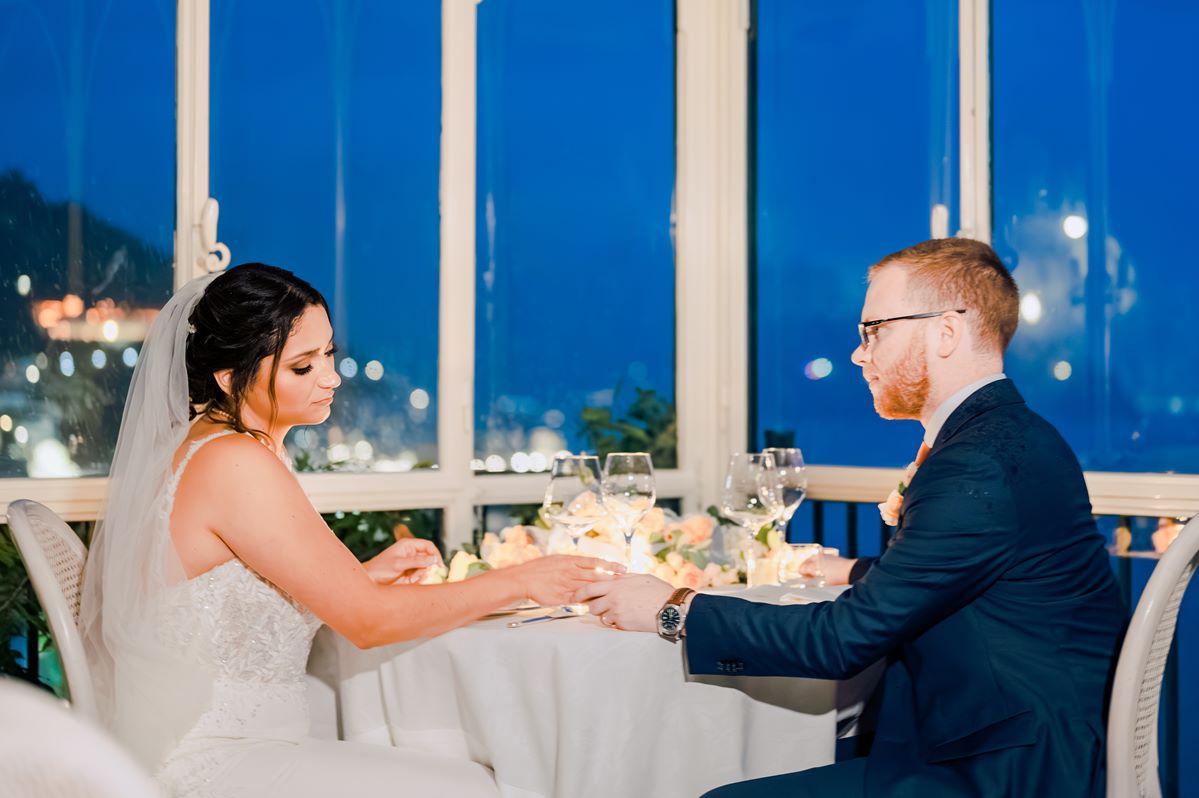
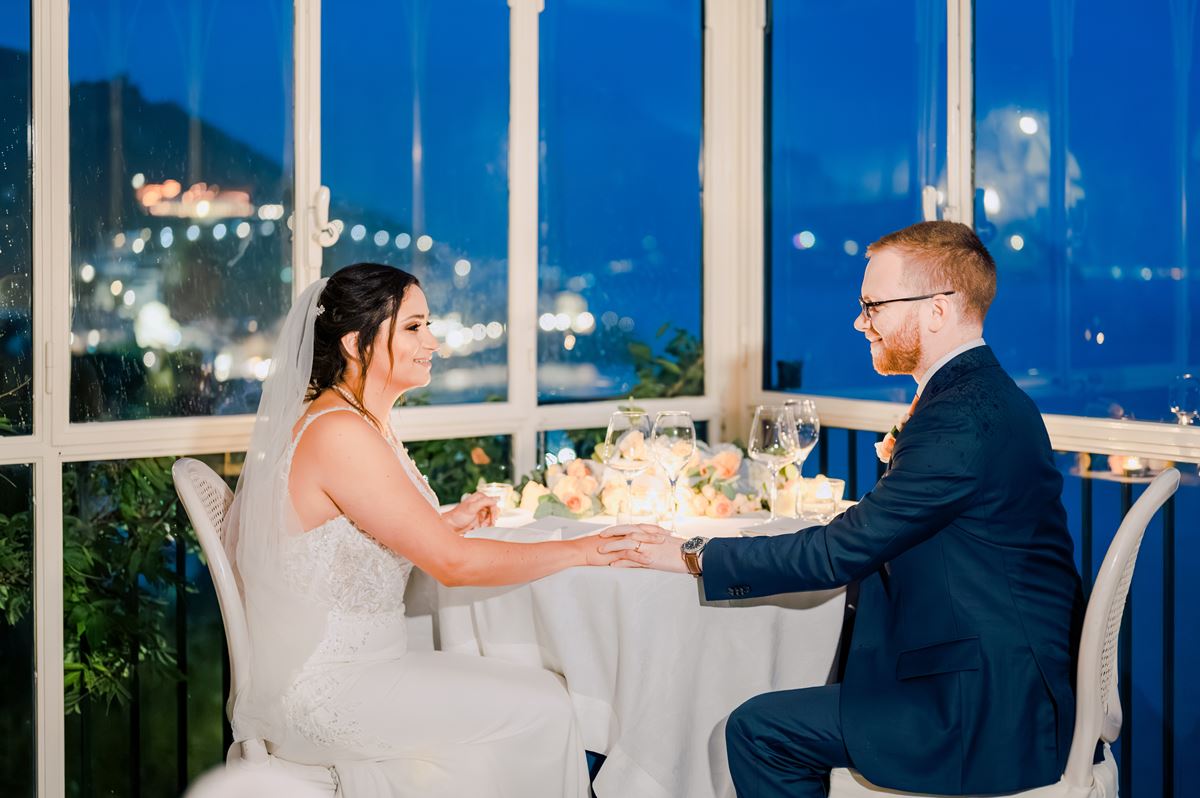
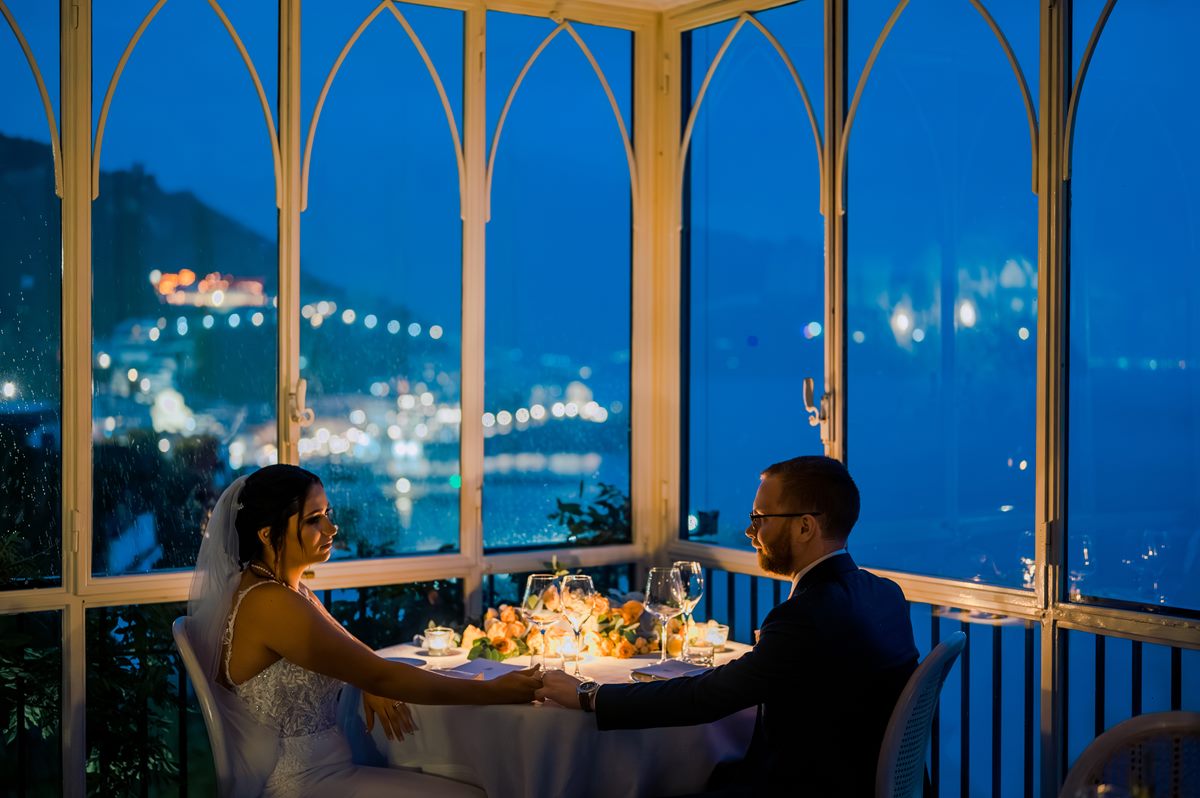
Dinner was for two, at a round table in the hotel’s glazed veranda. The window frames there are white and pointed, a run of tall lancet arches down two walls, and outside them by that hour the sky had gone deep cobalt. Amalfi’s lights were scattered along the shore below, and because the glass was streaming with water, every one of those lights had turned into a soft round bead. The town read as a spill of bokeh through a wet window.
Their table was low and simple: peach and cream roses running along the middle of the cloth, candles in glass, wine glasses, two white cane-backed chairs. I photographed most of it from over their shoulders and slightly to one side, so that you see the backs of their heads, their hands meeting across the linen, and the lit town beyond. It is the calmest set of pictures from the day and the most conventionally beautiful, and it required the rain to work. Dry glass would have given me a clean view of Amalfi at night, which I already have from twenty other evenings.
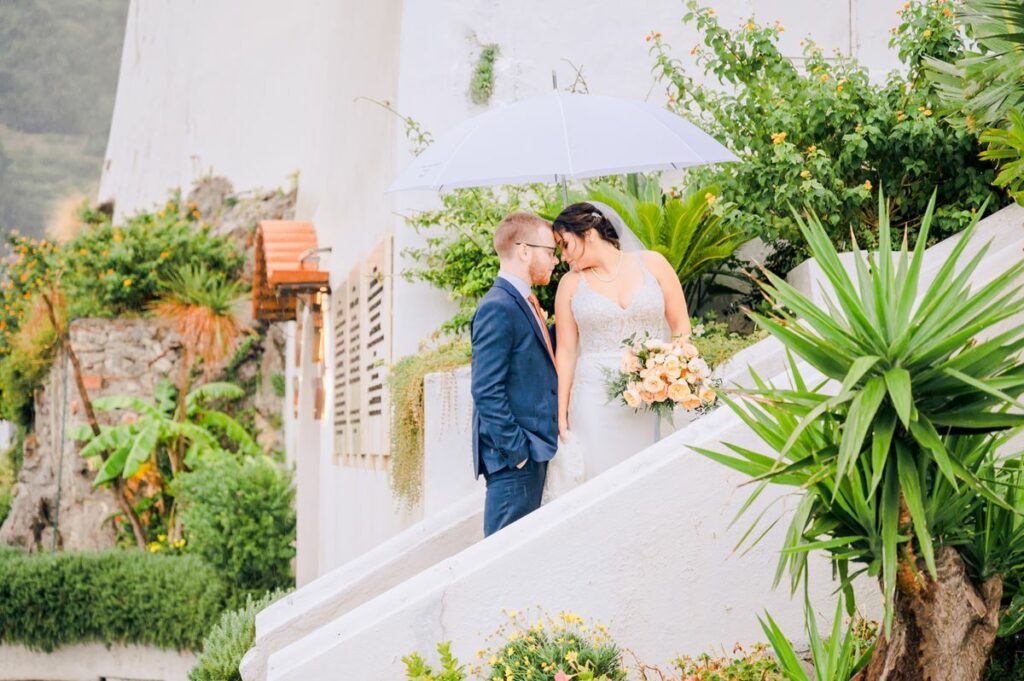
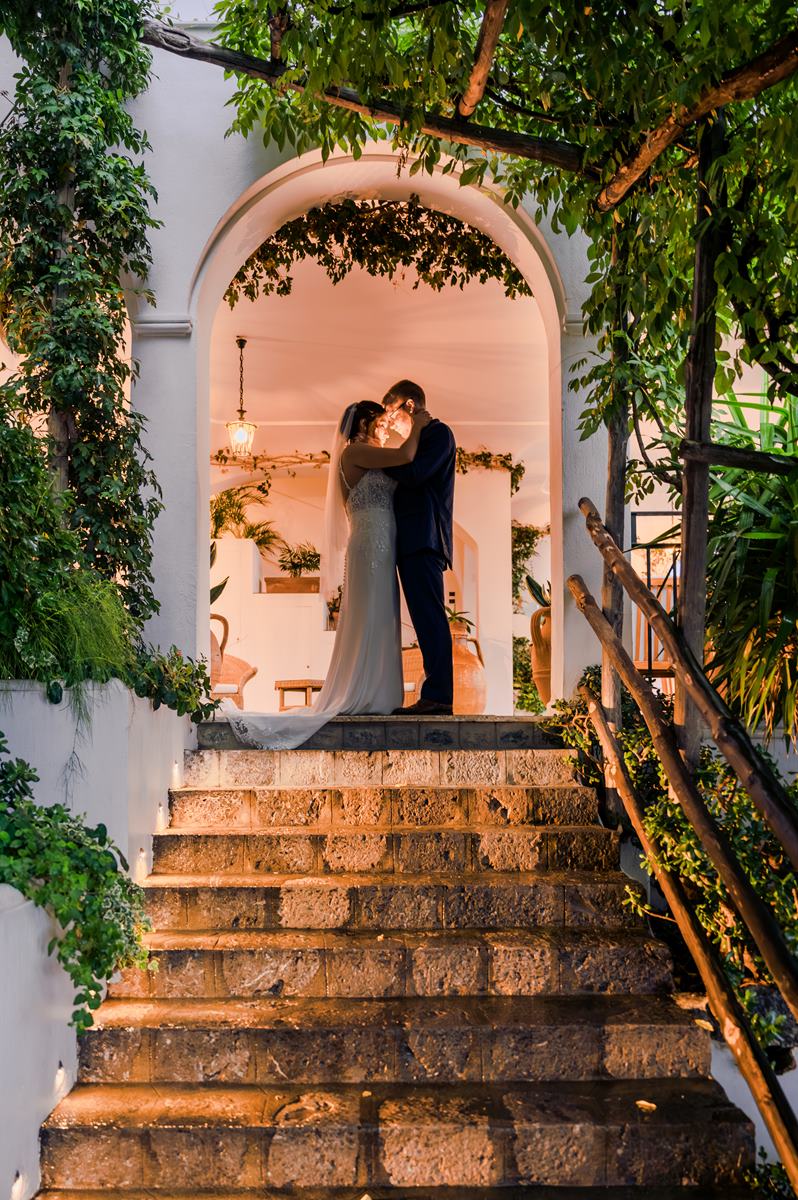
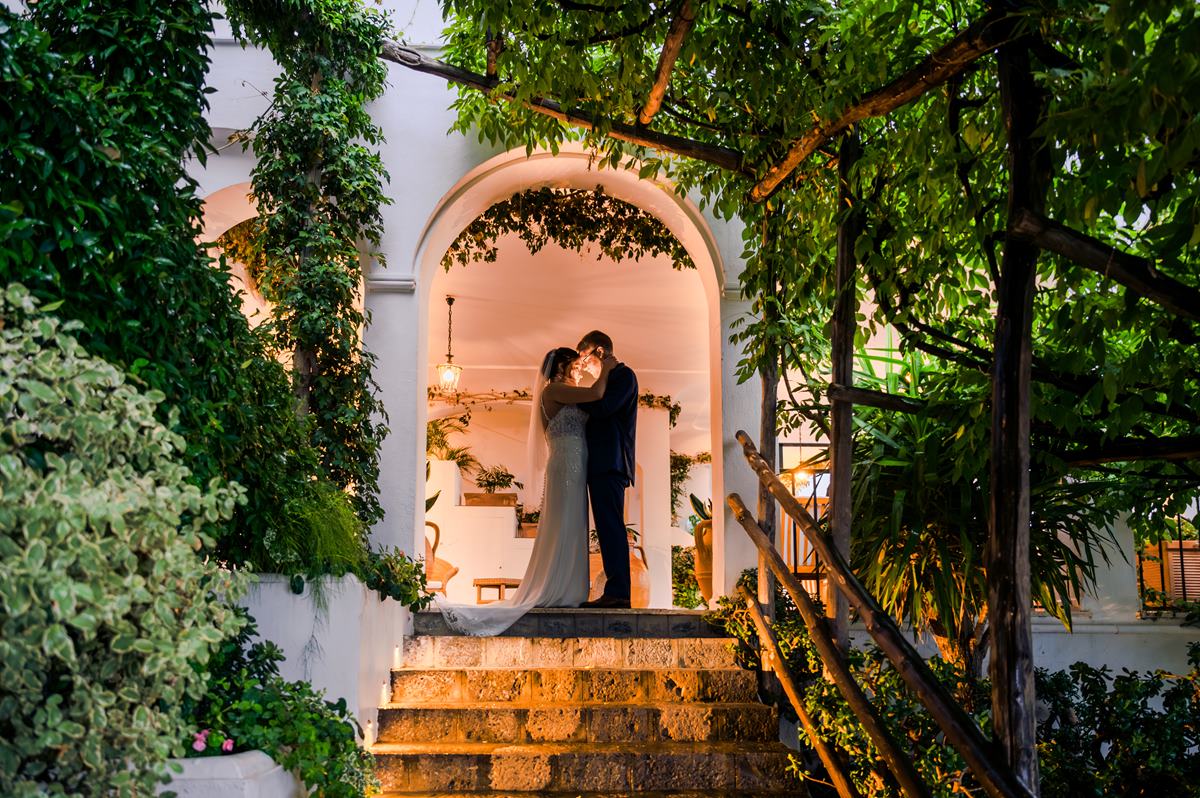
They stayed at that table a long time. There was no cake to cut, no speeches, nobody waiting to dance with anybody. Around nine they walked back up through the property and I made one last frame of them at the top of a rough stone staircase, silhouetted under a lit archway with a lantern hanging in it and a chestnut handrail going up beside them.


Four Things the Rain Took Away
I would rather be straight about this than pretend it is all upside, so here is what a rainy day elopement in Amalfi genuinely takes away from you. All four of these are real, and all four happened to Nicole and Michael.
- The view you booked. On a day like this it disappears rather than softening. No horizon, no blue water, no Amalfi glowing across the bay in a wide shot. If a wide coastline frame with the two of you tiny in it is the picture you have been imagining for two years, on a day like this it does not exist.
- The golden hour. No warm light arrives before dusk, because there is no sun to lower. Your day goes straight from flat white to blue, which means the entire warm-toned section of a normal gallery is missing and has to be replaced with interiors and with lamplight.
- Hems, shoes and hair. The bottom thirty centimeters of a train picks up gray water from stone in about four minutes, hair that has been set will lift within an hour, and any outdoor sequence has to be planned around footwear you can actually walk in.
- Spontaneity in town. Half the small businesses along the seafront shut in late autumn, and the places that are open are not expecting you. The empty streets are a gift for photographs and a nuisance for anything else.
What you get in exchange is a coast with nobody on it, a hotel with far fewer guests in November and staff who have time for you, and a set of photographs that do not look like the other four thousand sets made at this address. This is exactly the conversation I would want you to have early with the Amalfi Coast wedding planner you hire, because the decision about when to come is made a year out and cannot be revisited.


The Pictures That Survived Have No View in Them
When I sat down to edit this gallery, I did what I always do and pulled the twenty pictures I would show first. Going back through that shortlist afterward, I noticed that seventeen of the twenty have either no background at all or a background that is entirely interior: the painted floor panel, the vine arch and the clock, the coral cushions, the pier in black and white, the wet lancet windows with the town reduced to points of light.
Three have the coastline in them, and in all three it is so low in contrast that it functions as a pale wash rather than a subject. The famous view, the reason this hotel exists and the reason people fly a very long way to get married on this particular cliff, is not doing any work in the pictures Nicole and Michael actually kept.
I would not push that into a tidy conclusion about rain being secretly better, because it is not, and I would have liked a horizon. What I take from it is narrower and more useful: on this coast the view is a bonus and the building, the tile, the plants, the clothes and the two faces are the material. On a clear day the view is loud enough that you never find out. That afternoon it was switched off from start to finish, and everything still worked, which is a thing worth knowing before you look at a forecast and start panicking.
If you are holding a date on this coast between October and March and wondering what a rainy day elopement in Amalfi looks like through a camera, send me the date you are holding, and I will come back with availability and the price.
 Written By Emiliano Russo