A Borgo Santandrea Wedding Day With Nothing Scheduled: Jessica and Bill
Jessica and Bill had already signed the paperwork at home in the States. What they had not had yet was a day with the dress on and nobody expecting them anywhere, so they spent one at Borgo Santandrea and I photographed it from the rock passage to the terrace above the beach.
A WEDDING DAY AT BORGO SANTANDREA, NO CLOCK
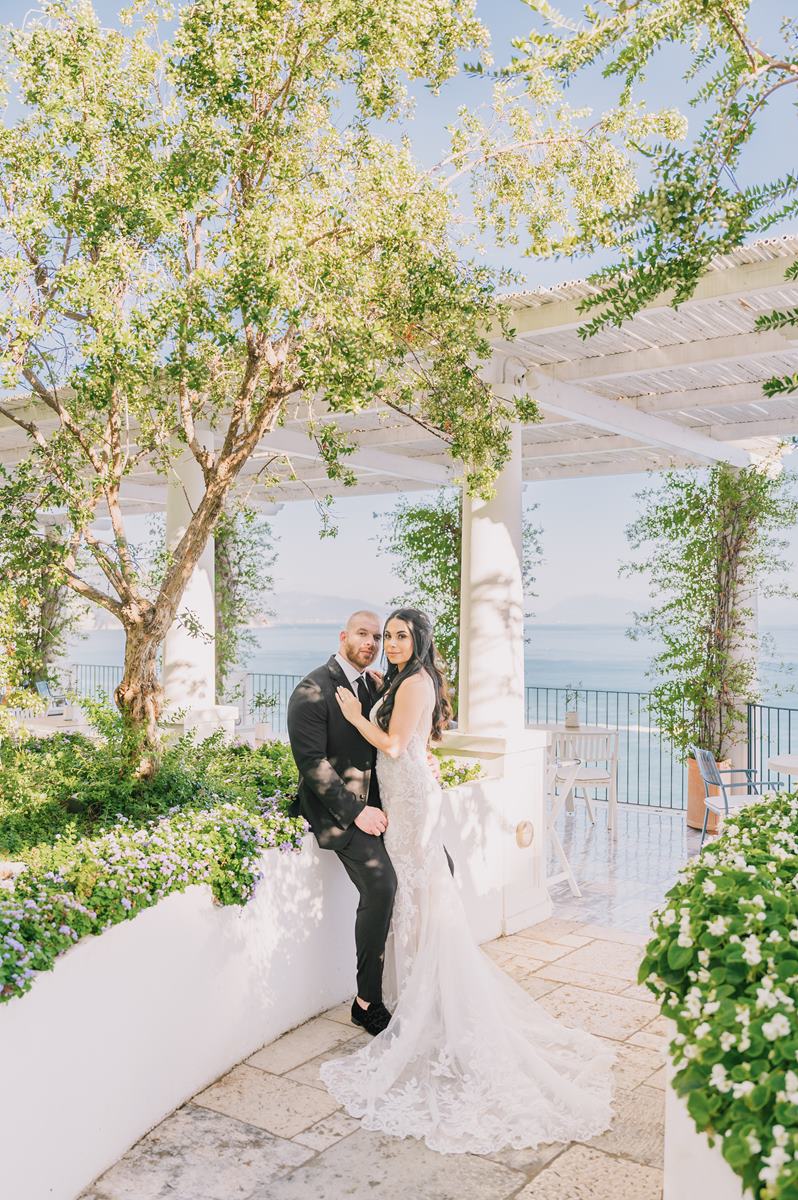
The strangest thing about this Borgo Santandrea wedding day was how quiet it was. There was no hairdresser running late, no mother of the bride asking about the cars, no coordinator with a printed sheet. Jessica and Bill were already married. They had done that part at home in the States, in front of the people who had to be there, and they had arrived on this coast with the one thing a wedding day never gives you: hours that belonged to nobody but them.
I have photographed a lot of weddings at hotels along this stretch of water. This was the first time I walked into one knowing that nothing was going to happen at a fixed hour. There was no ceremony, no celebrant, no guests and not even a bouquet: Jessica put on her wedding dress again, Bill put on a black suit and a black tie, and the two of them spent the day walking a property that sits on the cliff at Via Giovanni Augustariccio 33, in Amalfi.
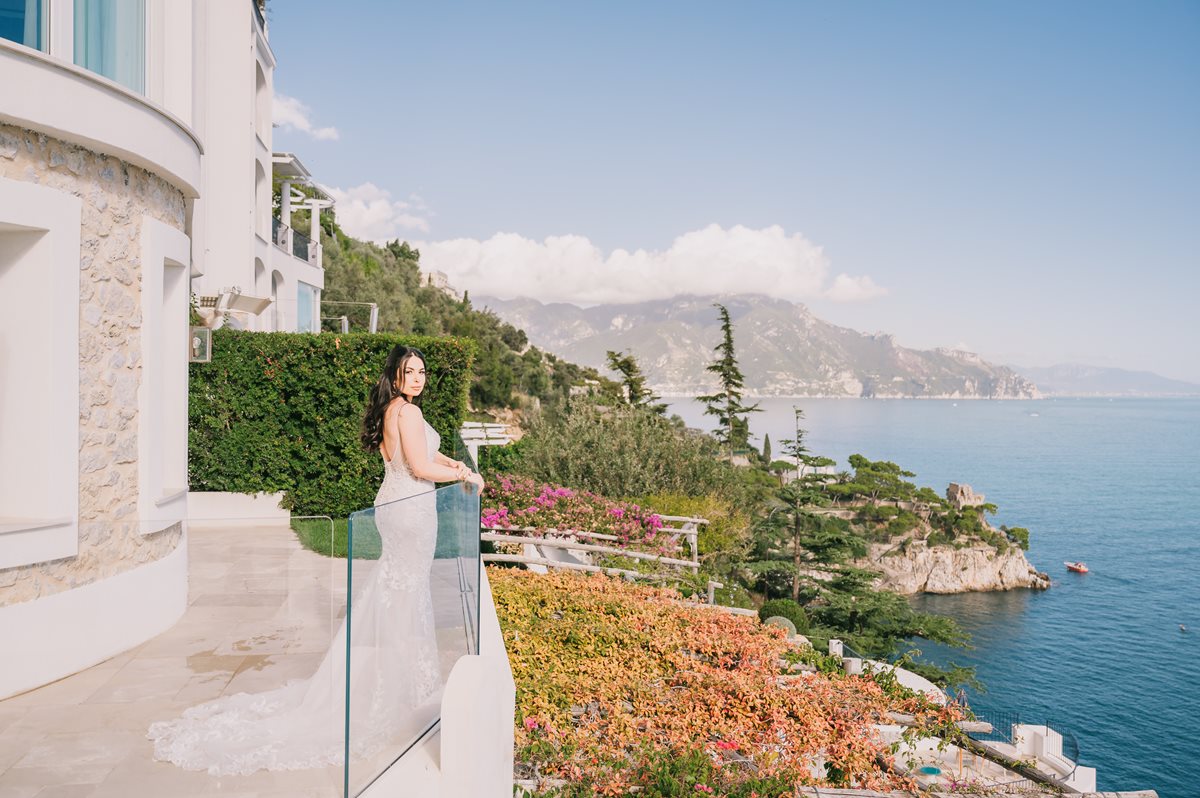

She Had the Glass Rail to Herself
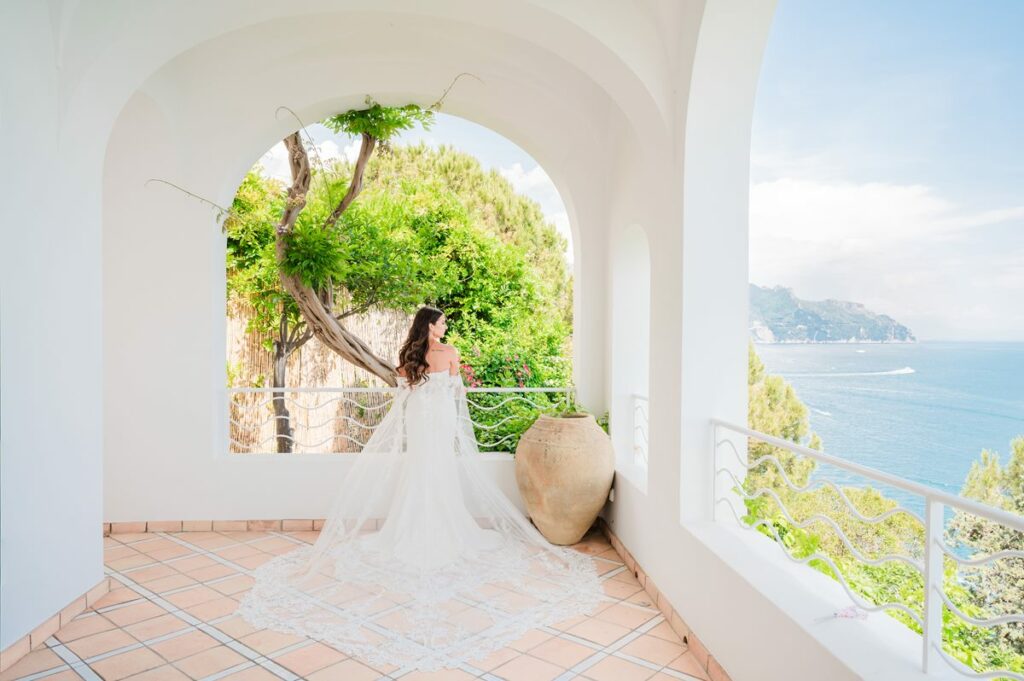
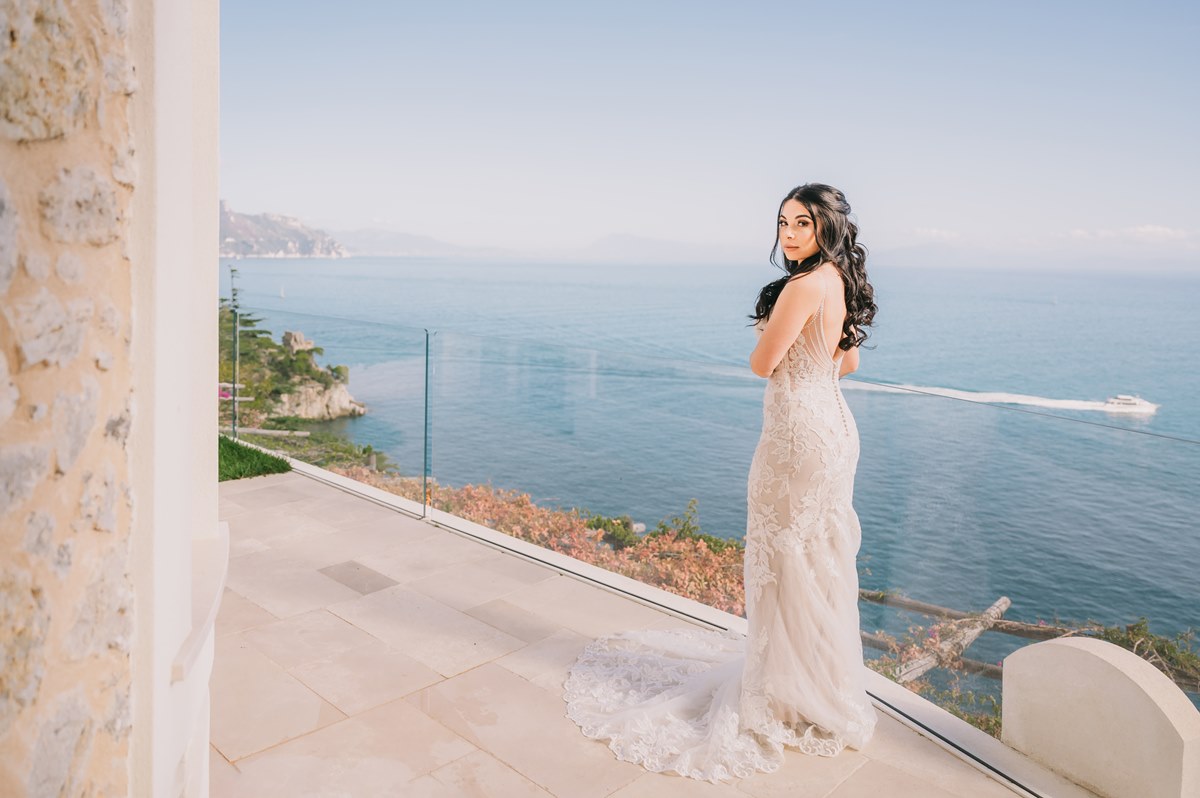
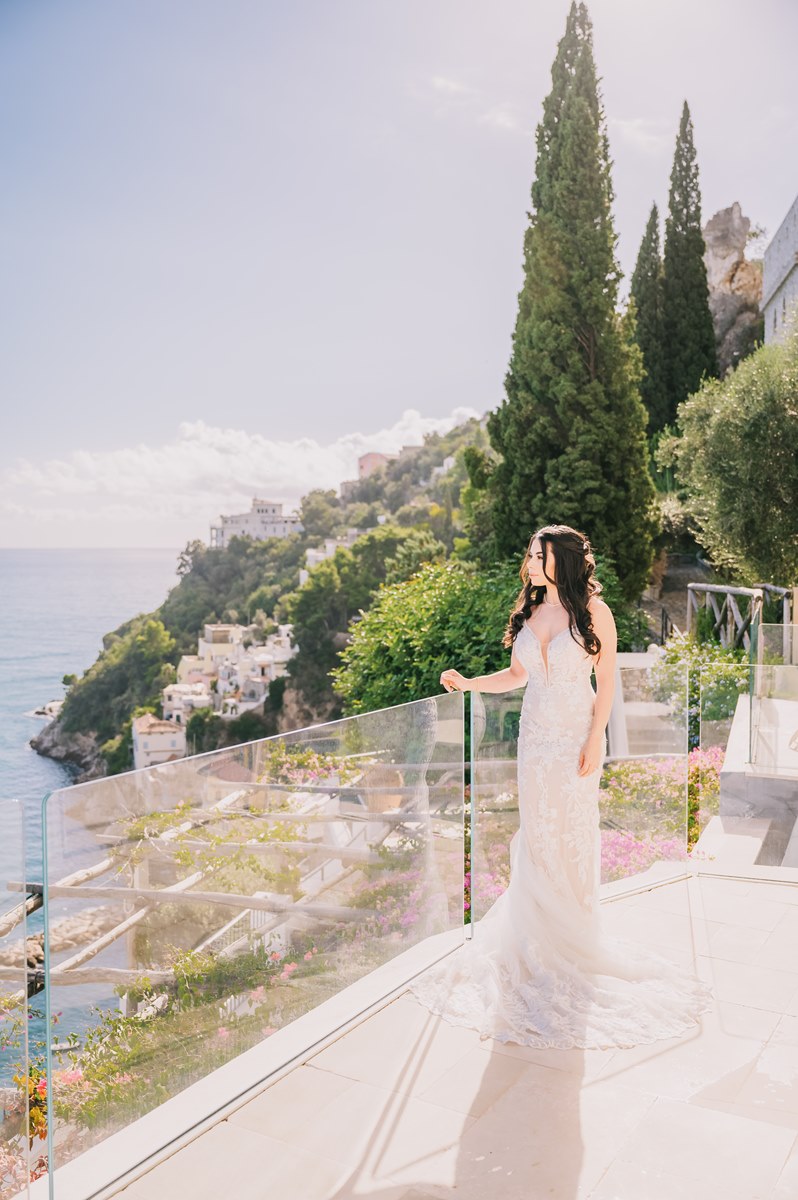
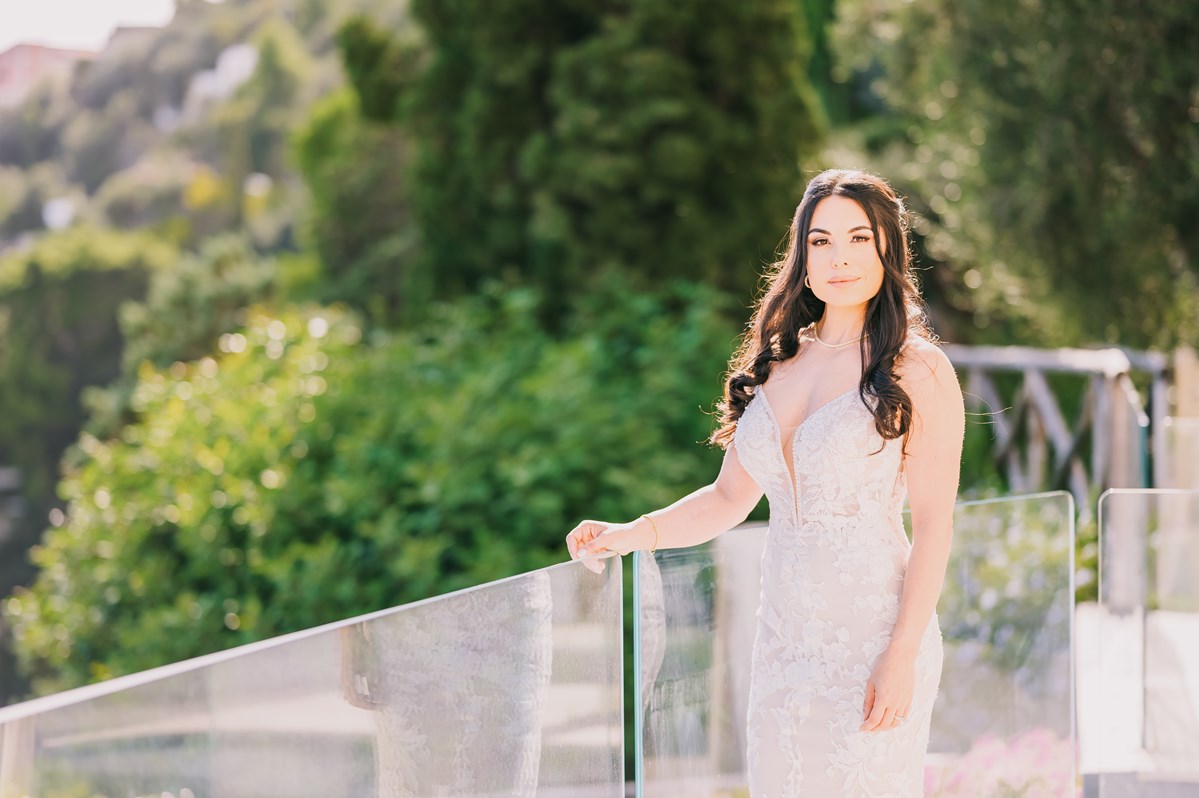
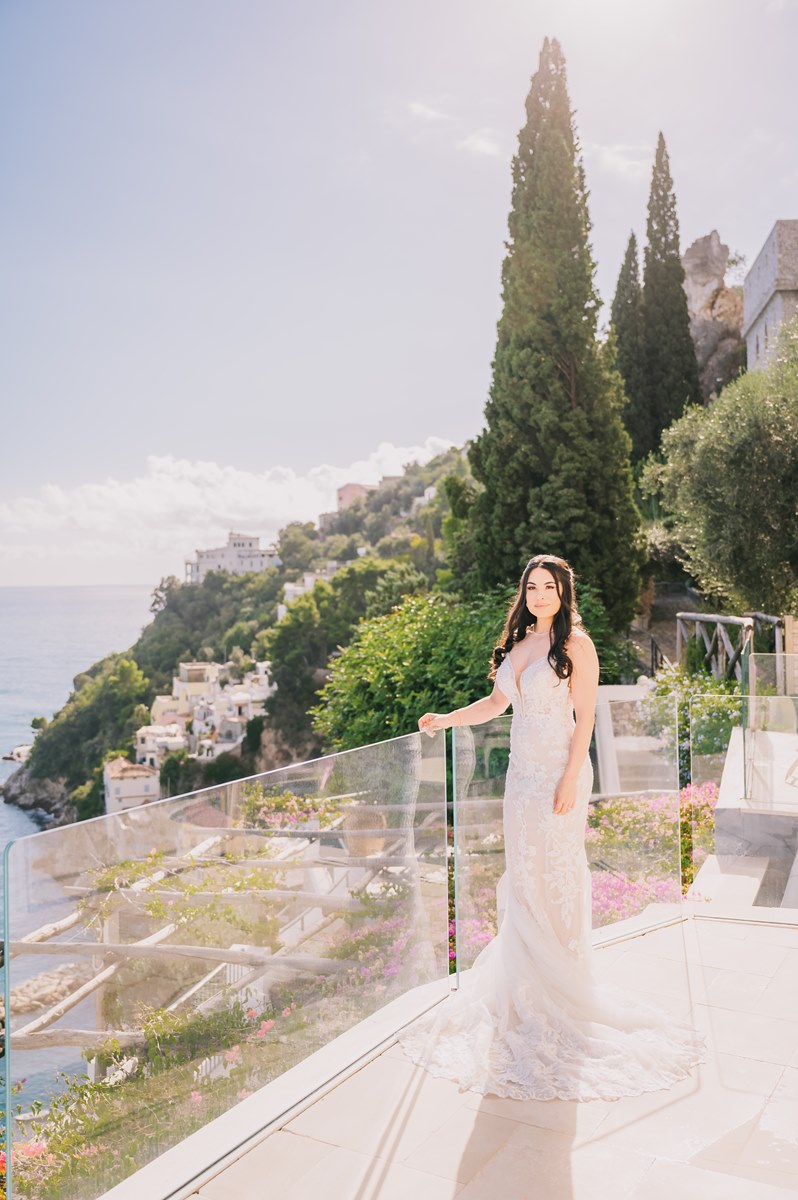
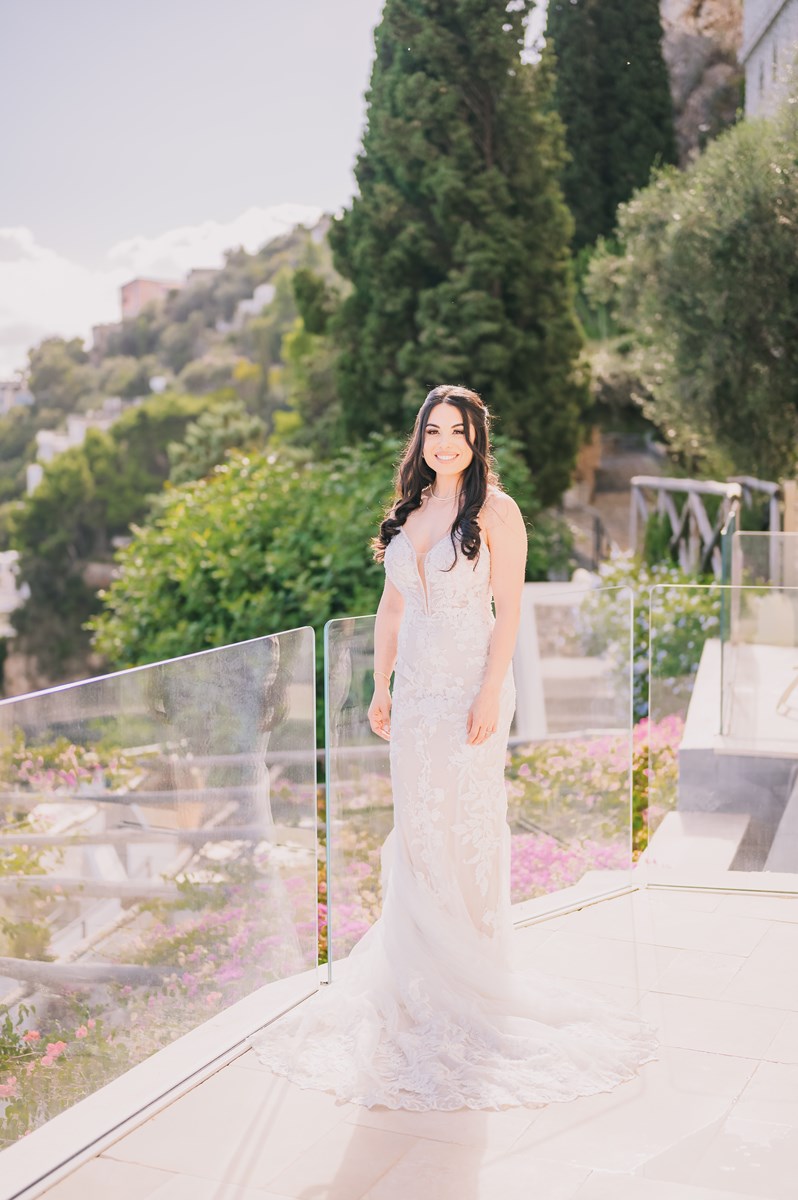
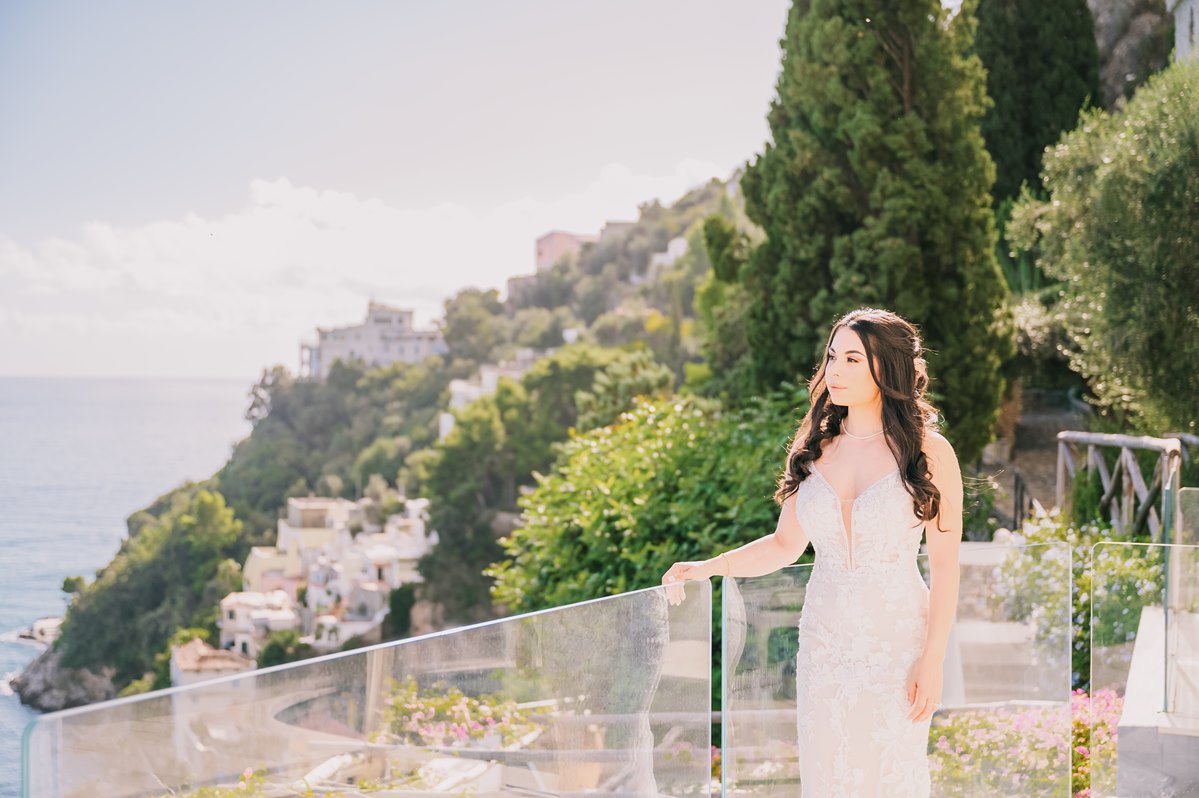
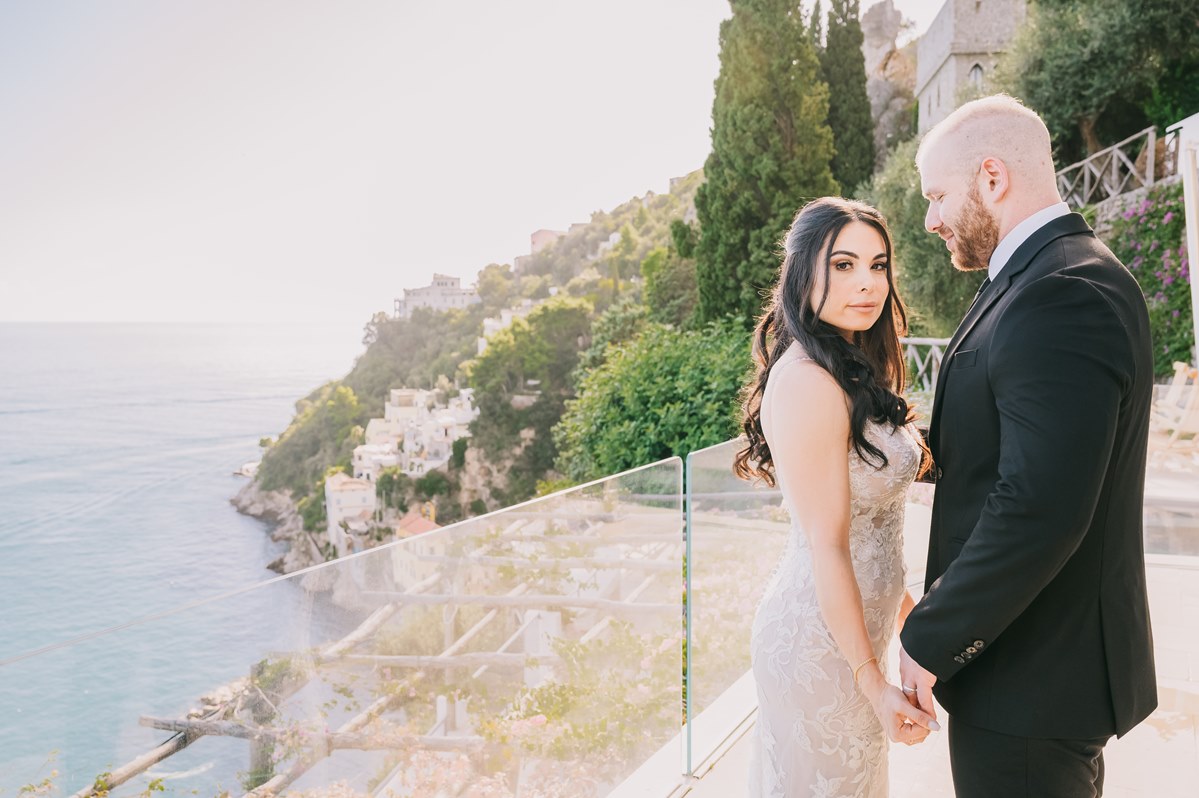
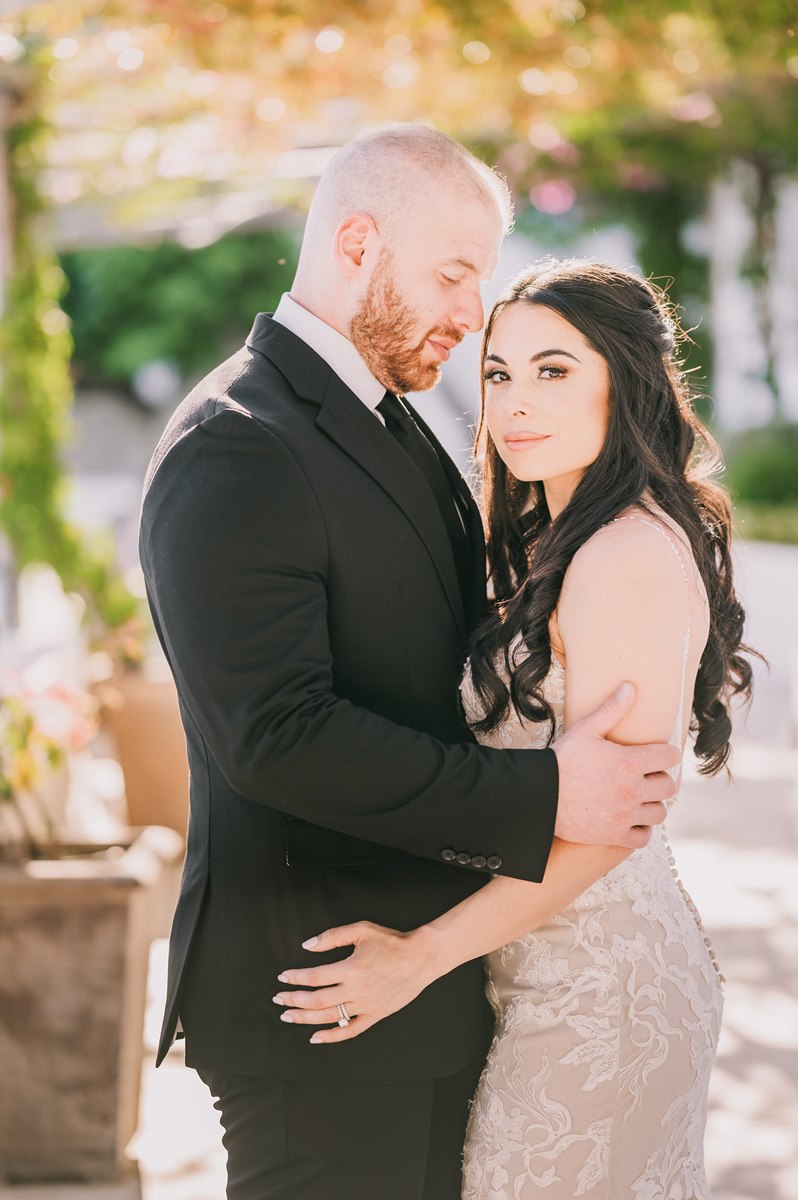
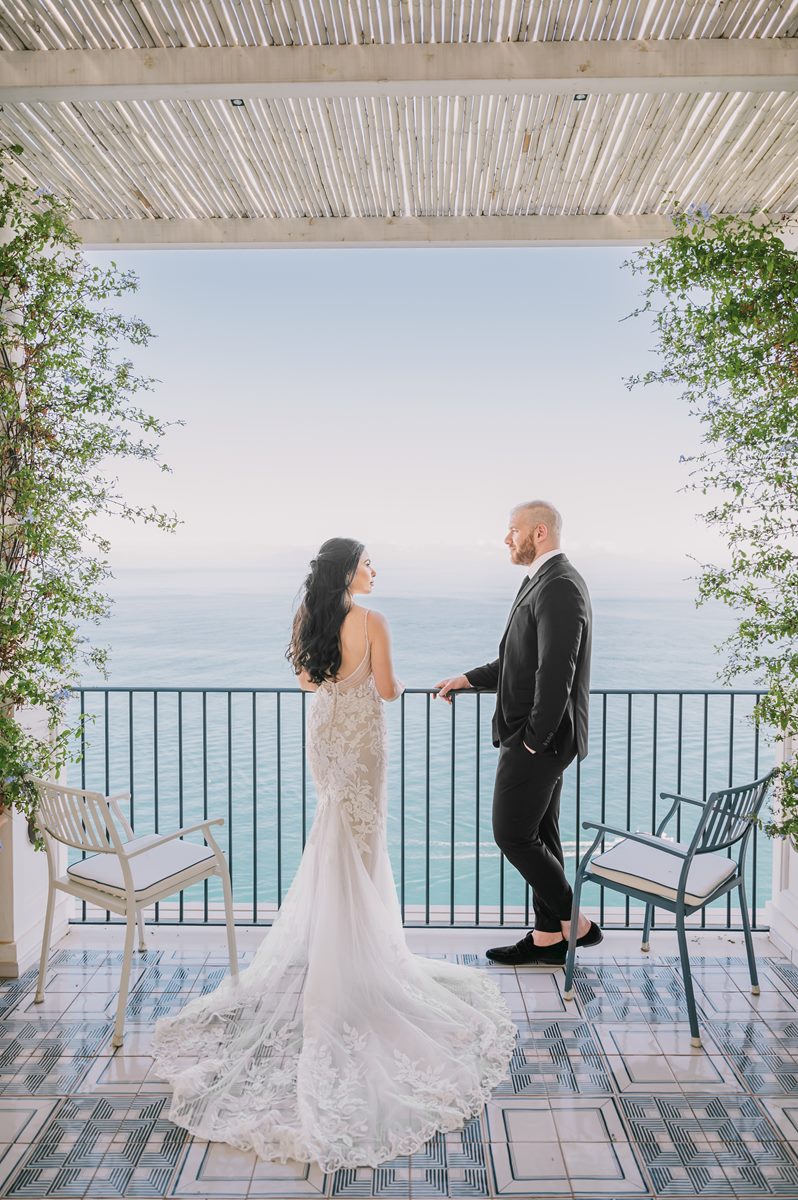
Before Bill came out, I had Jessica alone on the upper terrace for a while. The dress is fitted lace with a plunging front and a long train, the kind of shape that photographs best in profile and from slightly below, and she wore her dark hair long and loose past her shoulders.
Cypress trees stand behind that terrace and give you vertical lines to place a body against. The stone paving is pale, almost white in full sun, and it acts as a giant reflector under the chin. In a few frames she is small in the corner of a wide shot with the whole gulf open beside her, and I like those better than the close portraits, because the scale of the place is the point.
There is a version of this coast that only exists when you photograph a woman in a wedding dress standing completely alone, with no one else in the frame and nothing about to happen. That picture needs a whole day around it, and days built this way are rare.

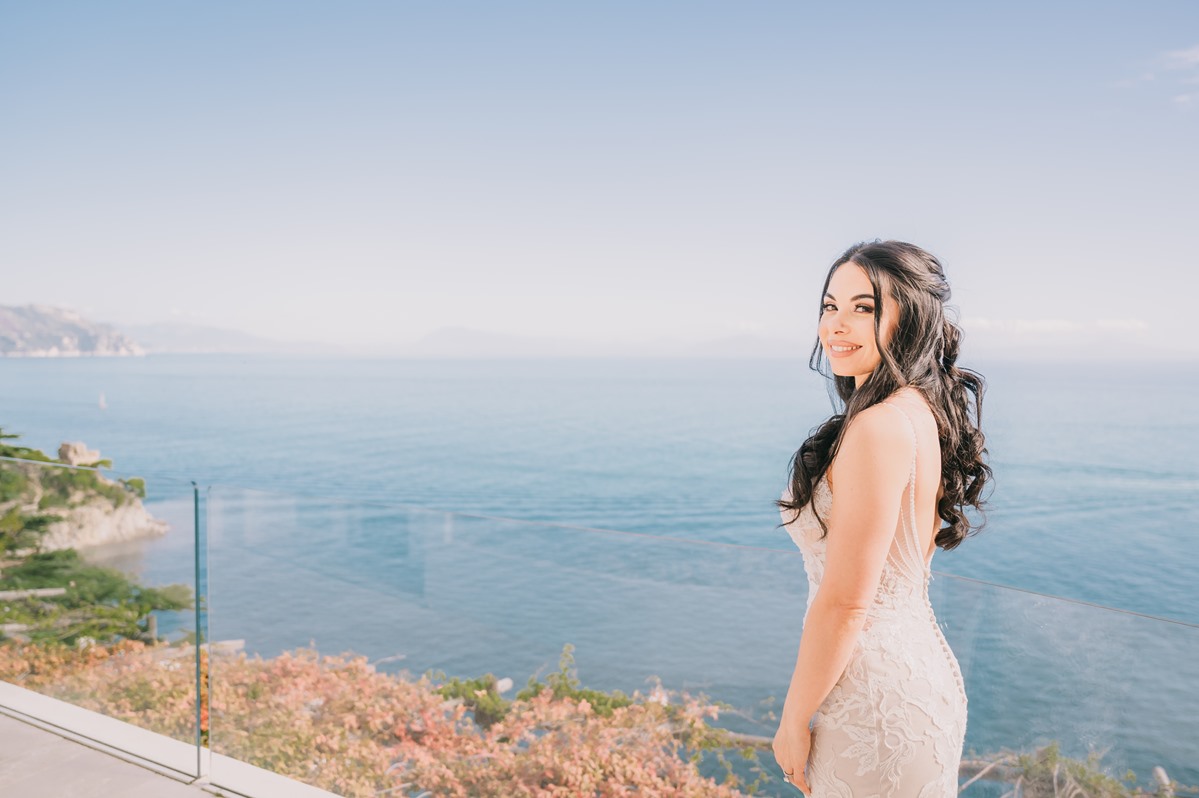
He Walked Up While She Faced the Water
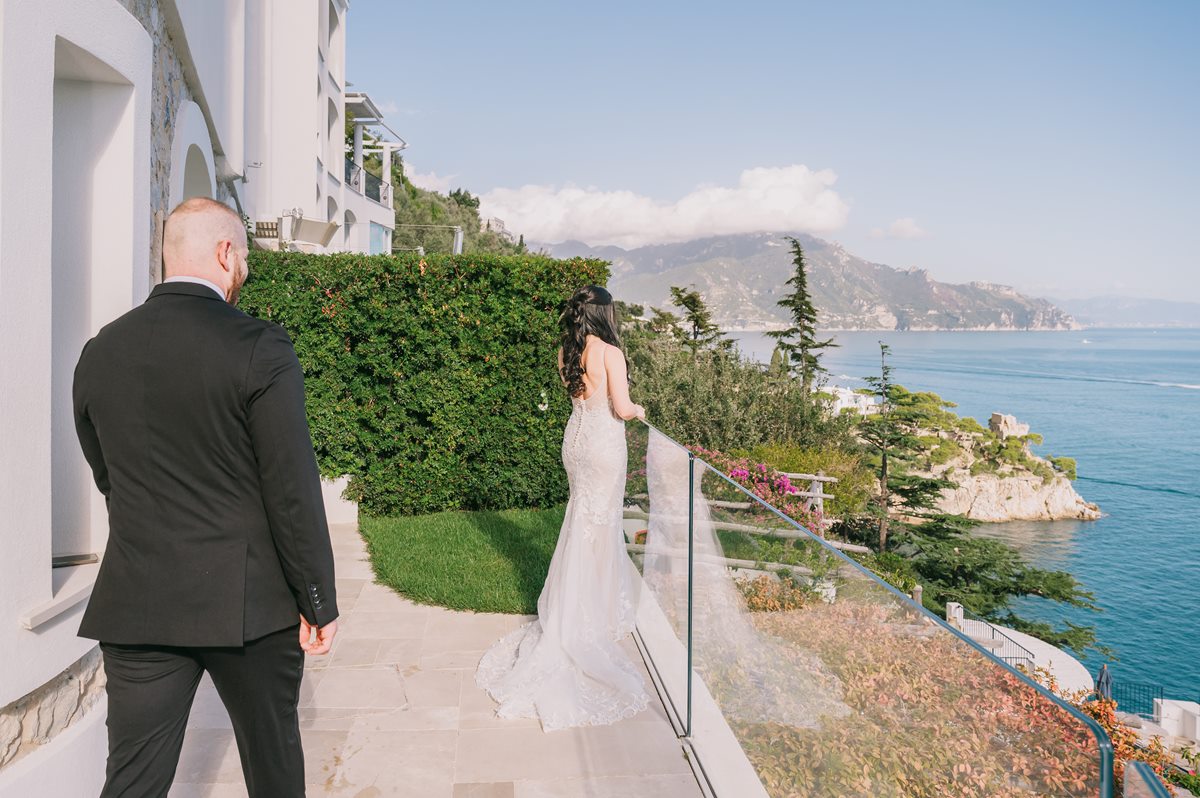
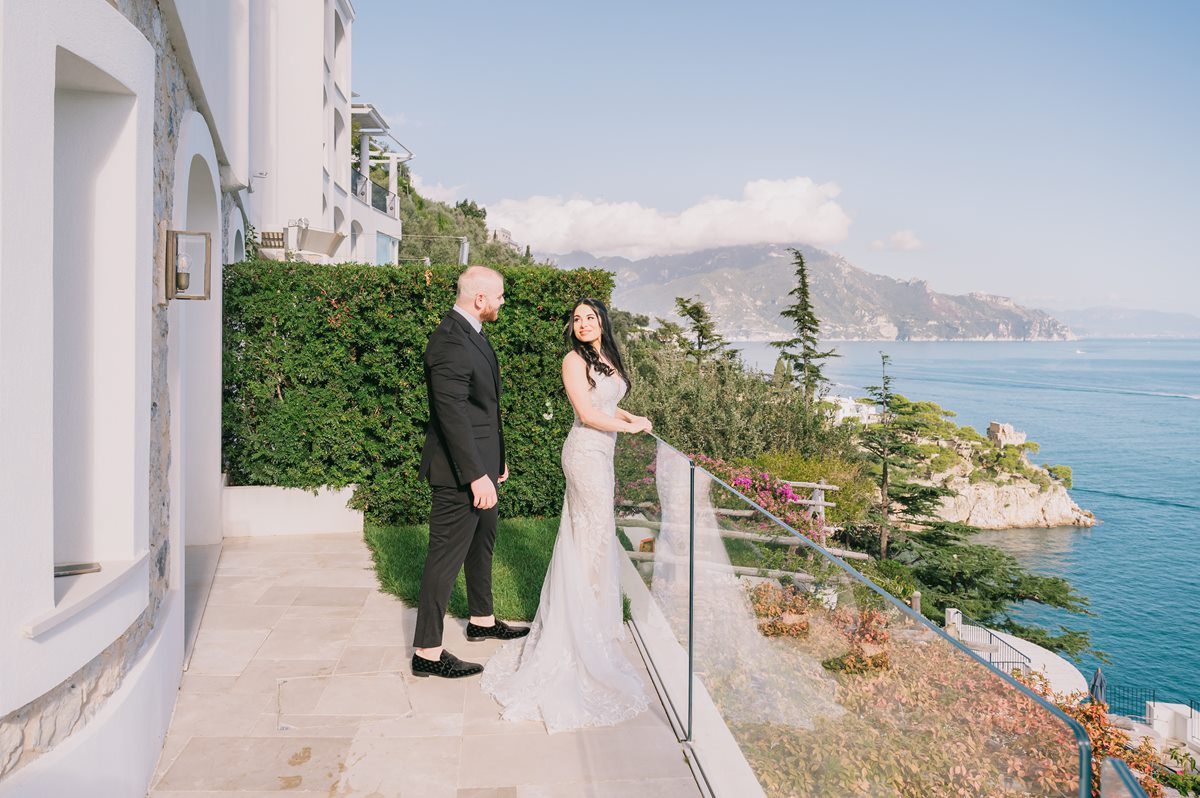
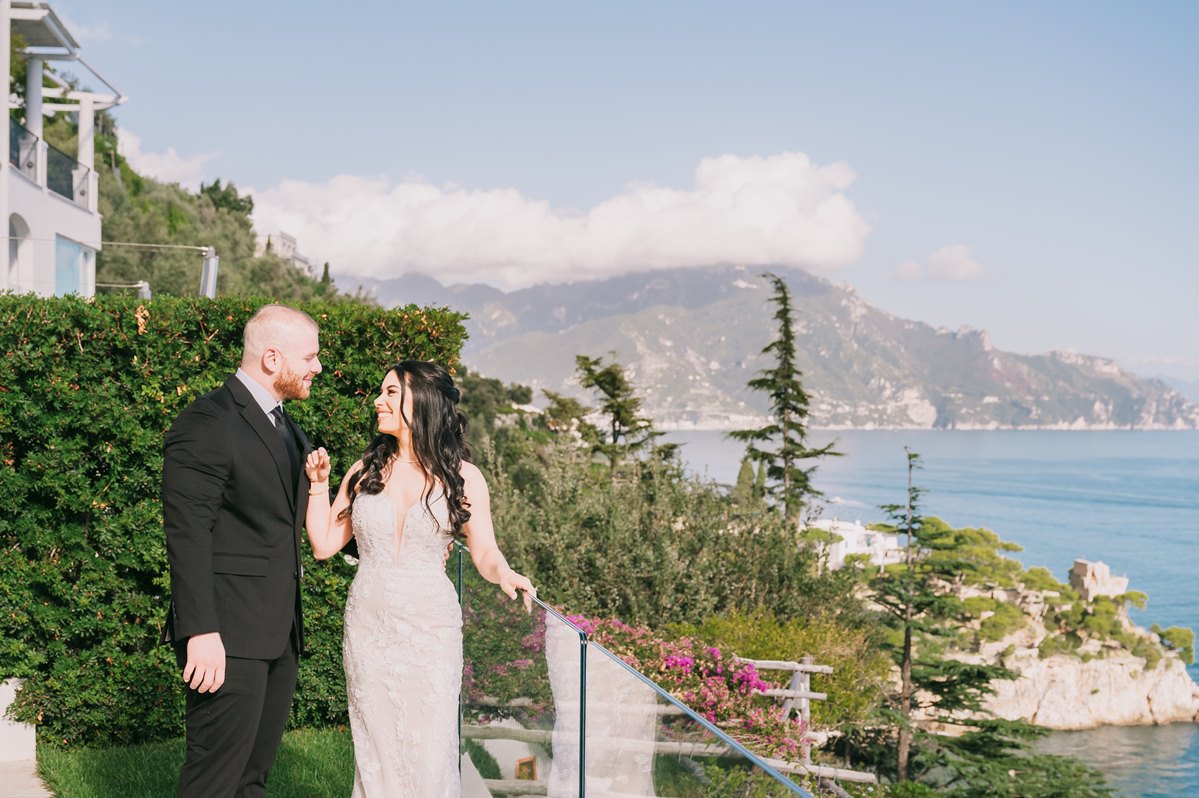
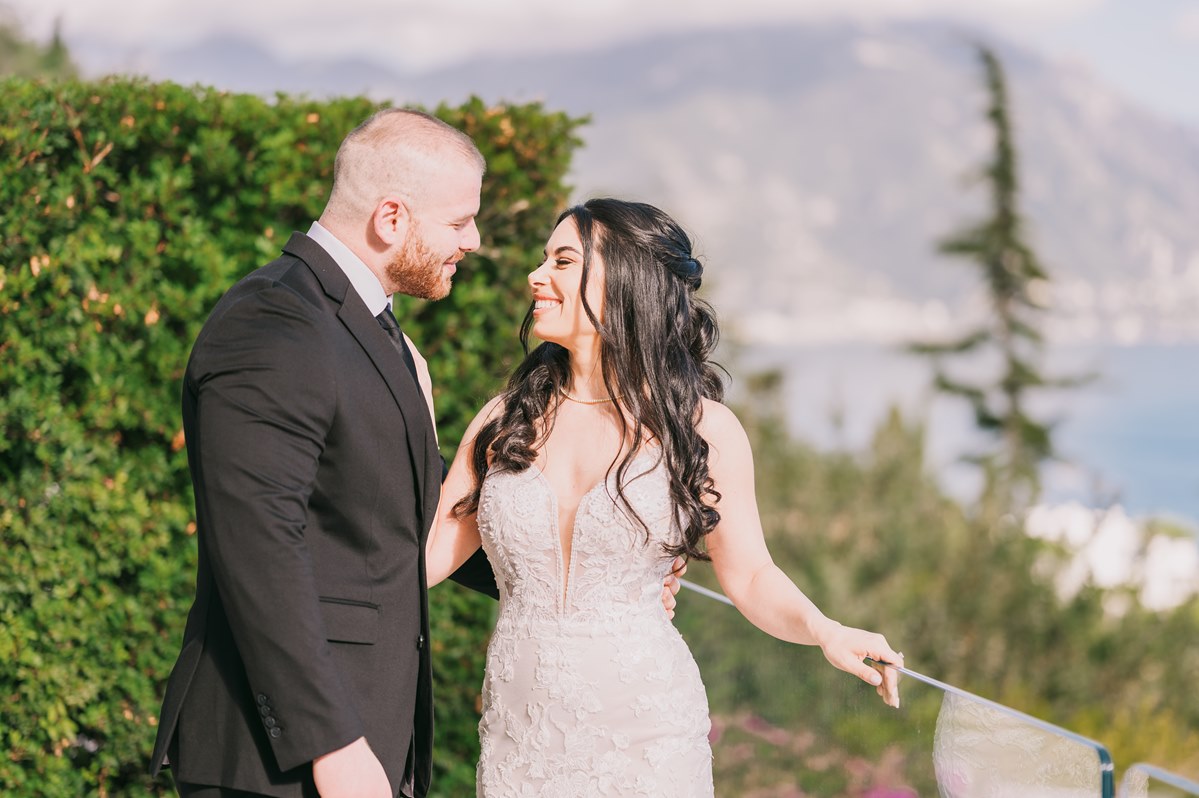
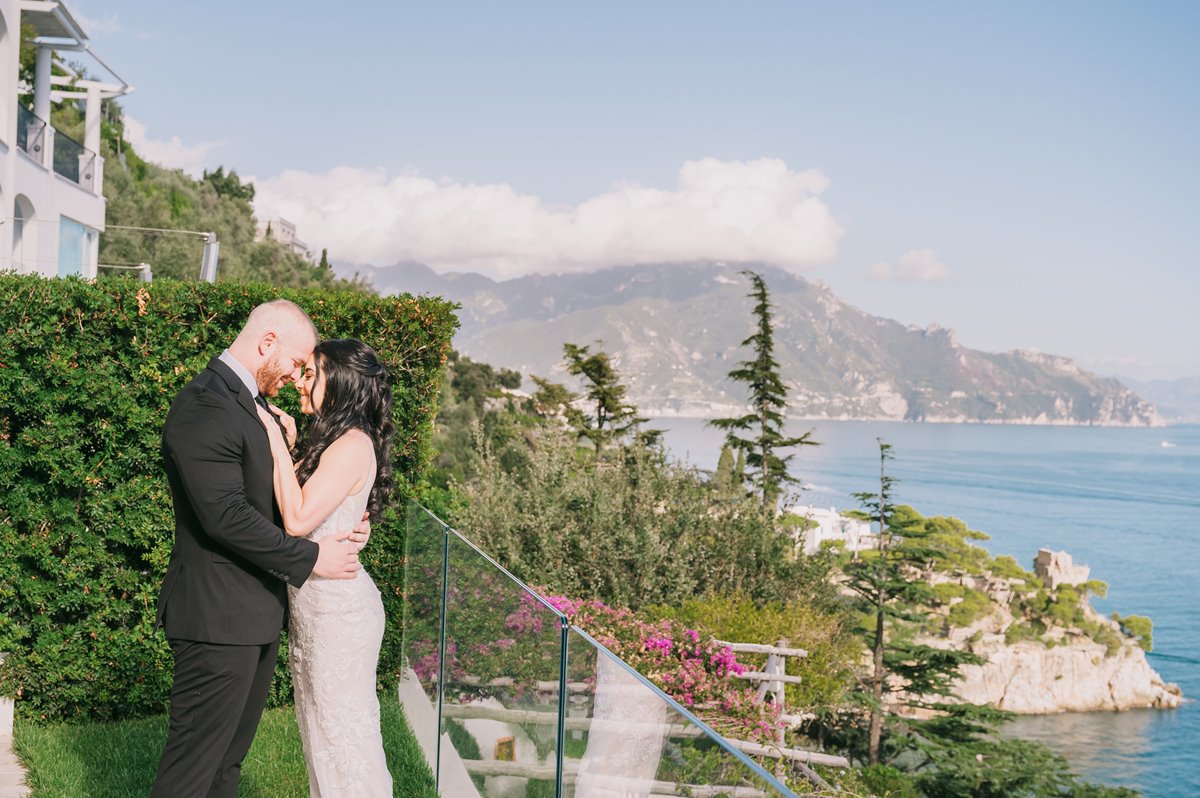
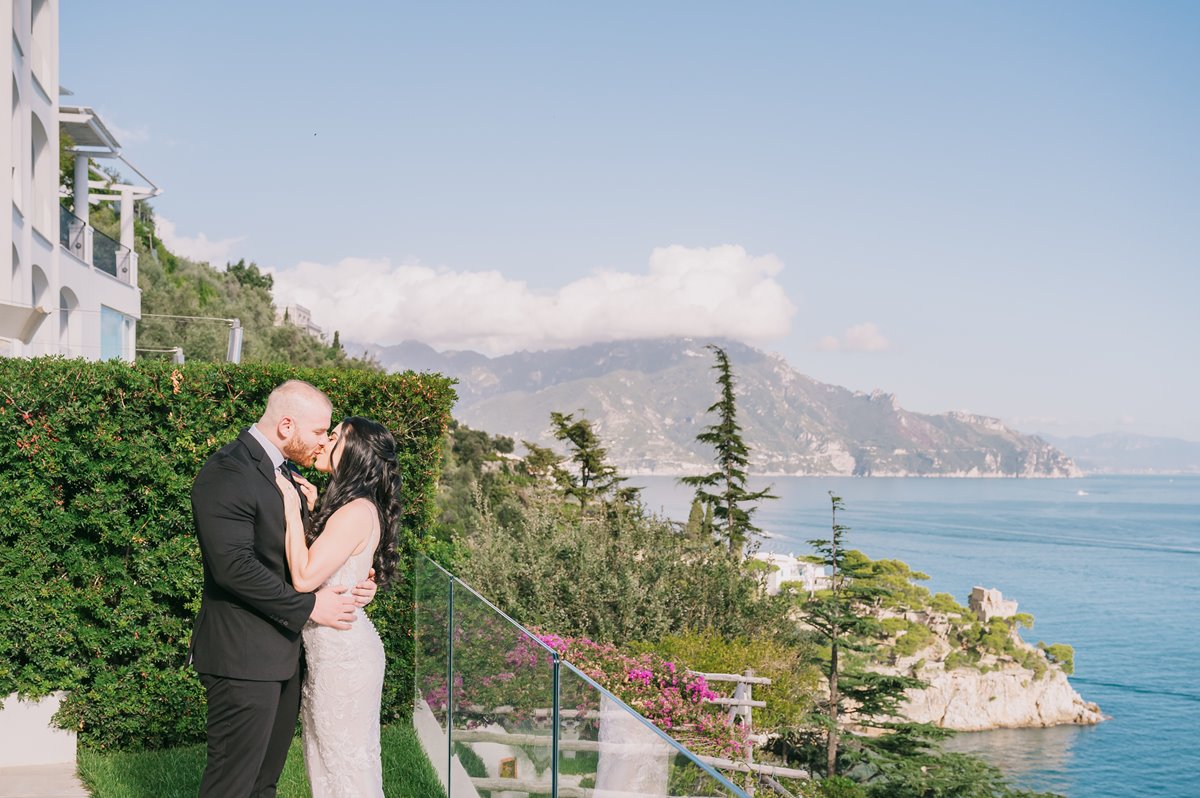
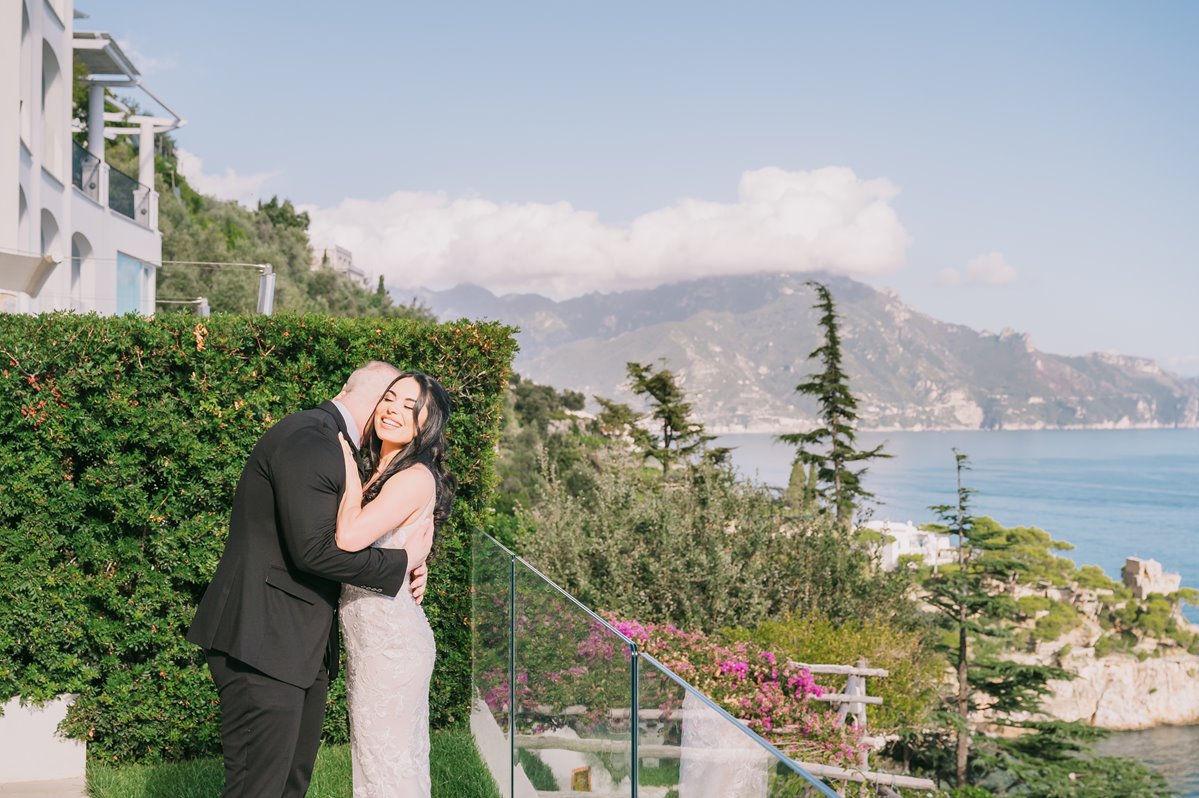
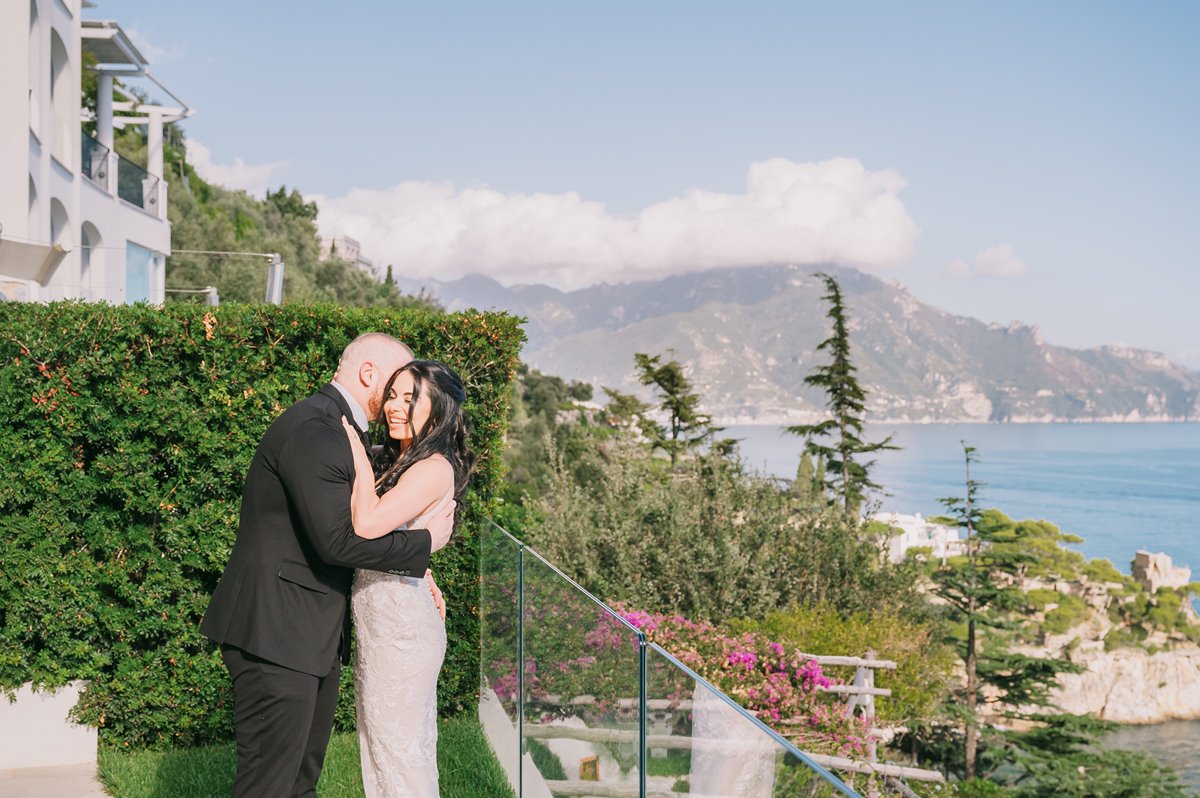
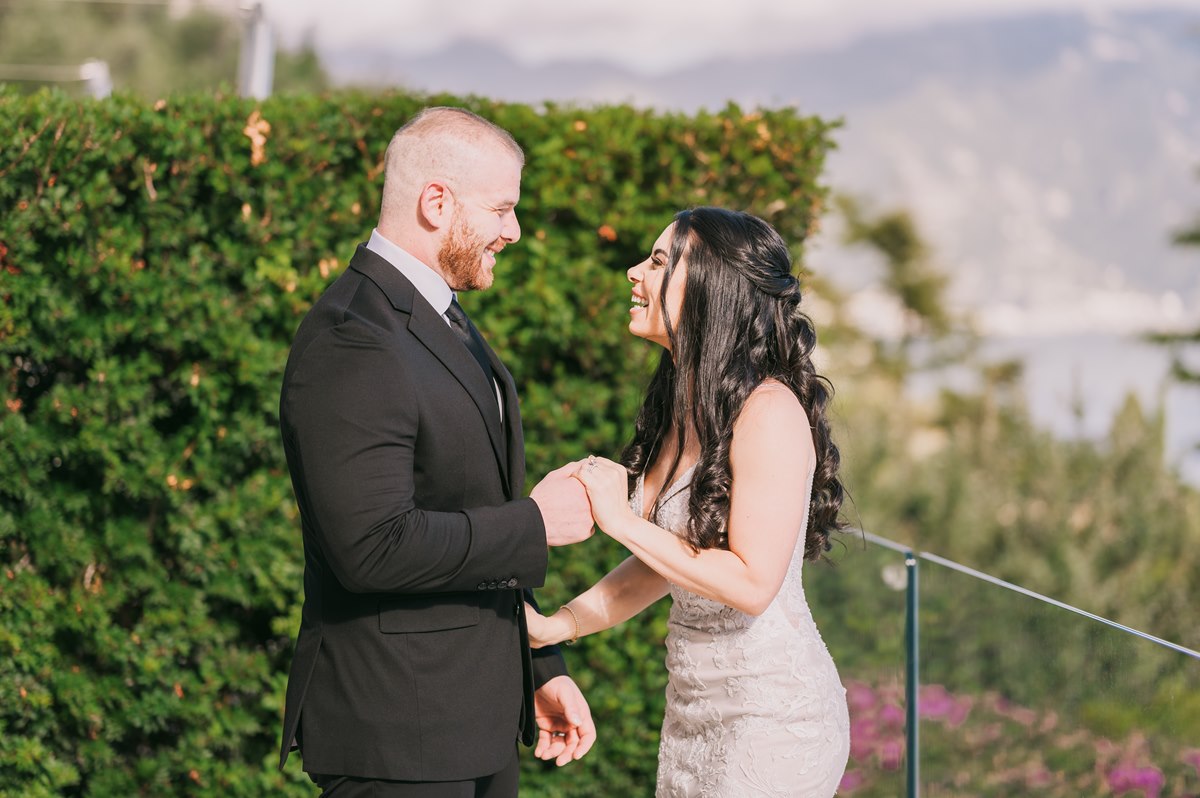
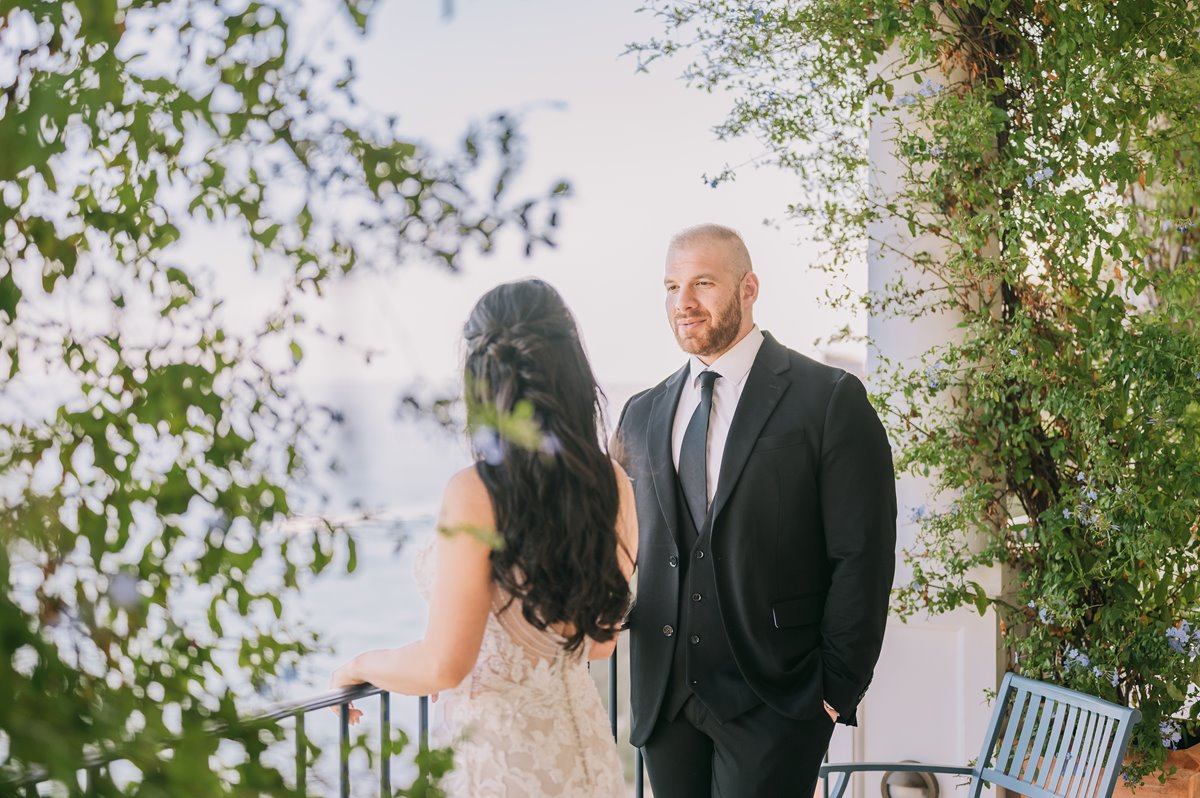
They wanted a first look anyway. They had not had one at home, and they decided they wanted it here, so I set it up on a walkway on the upper level, with a tall clipped hedge running along one side and the glass rail and the sea along the other.
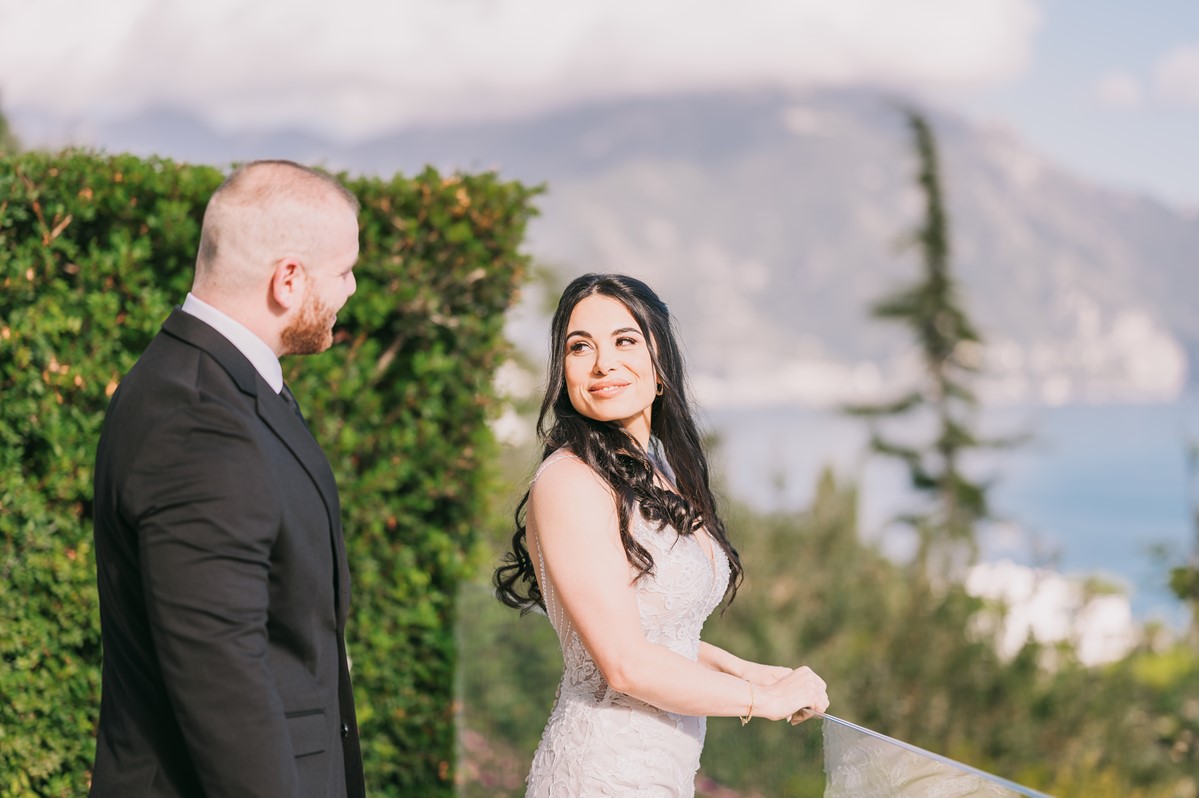
Jessica stood at the rail with her back to the path. Bill came up behind her, stopped a step short, and put a hand on her shoulder. She turned around. That is the entire event, and it was over almost before it started.
A Path Two People Wide
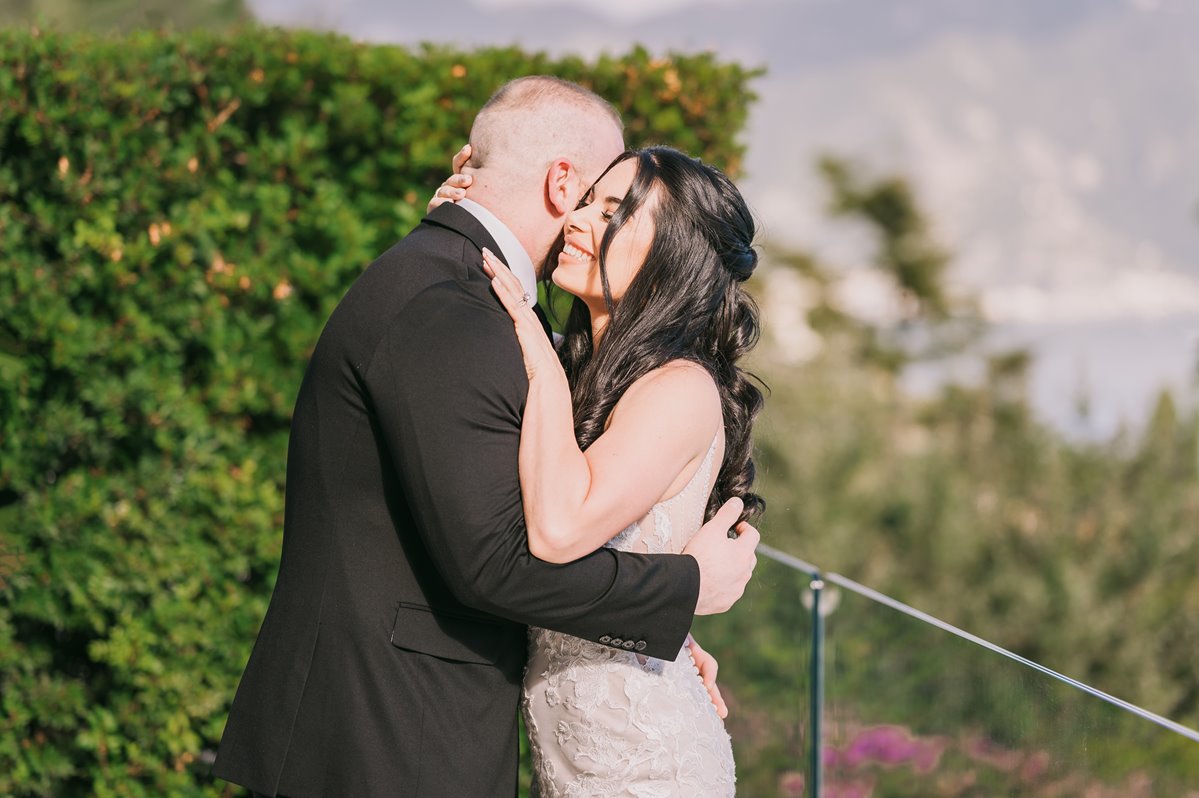
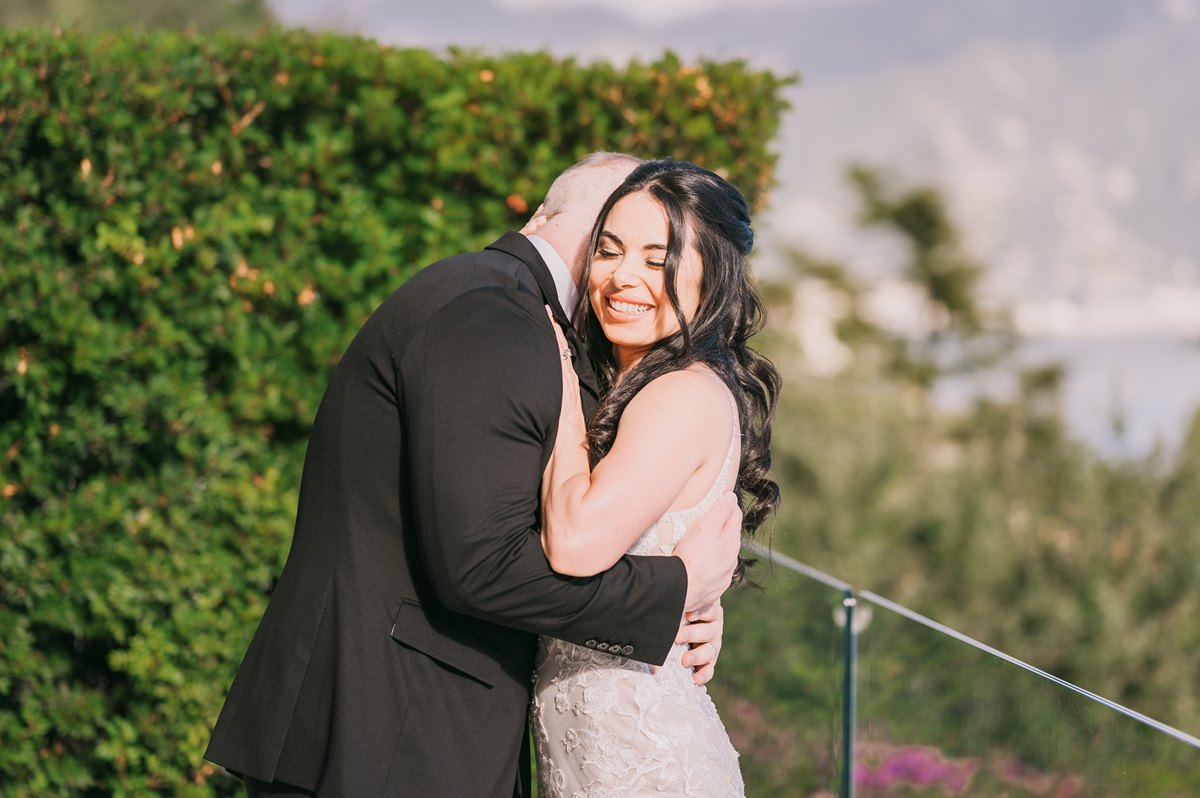
The walkway is narrow, which is usually a complaint and here was a gift. There is nowhere for a subject to drift. The hedge is dark and green and eats the light instead of returning it, the pale paving throws a soft bounce back up onto the faces, and the result is a natural contrast that I did not have to build. Behind them the coast opens out, the water goes from turquoise close in to a flat hazy blue at the horizon, and a rocky headland sits in the frame at exactly the right distance to give the background some architecture.
Shooting a first look in a tight passage means committing early to one of two positions: behind him, so you get her face over his shoulder, or past her, so you catch his. I took his side first, because Bill is the one who was walking, and a man walking toward something is a better opening frame than a woman standing still.


What Changes When the Turn Is Not on a Clock
On a wedding day the first look is a compressed thing. Everyone is aware that the ceremony is coming. The couple hold each other for a moment, somebody says something kind, and then the machine starts moving again.
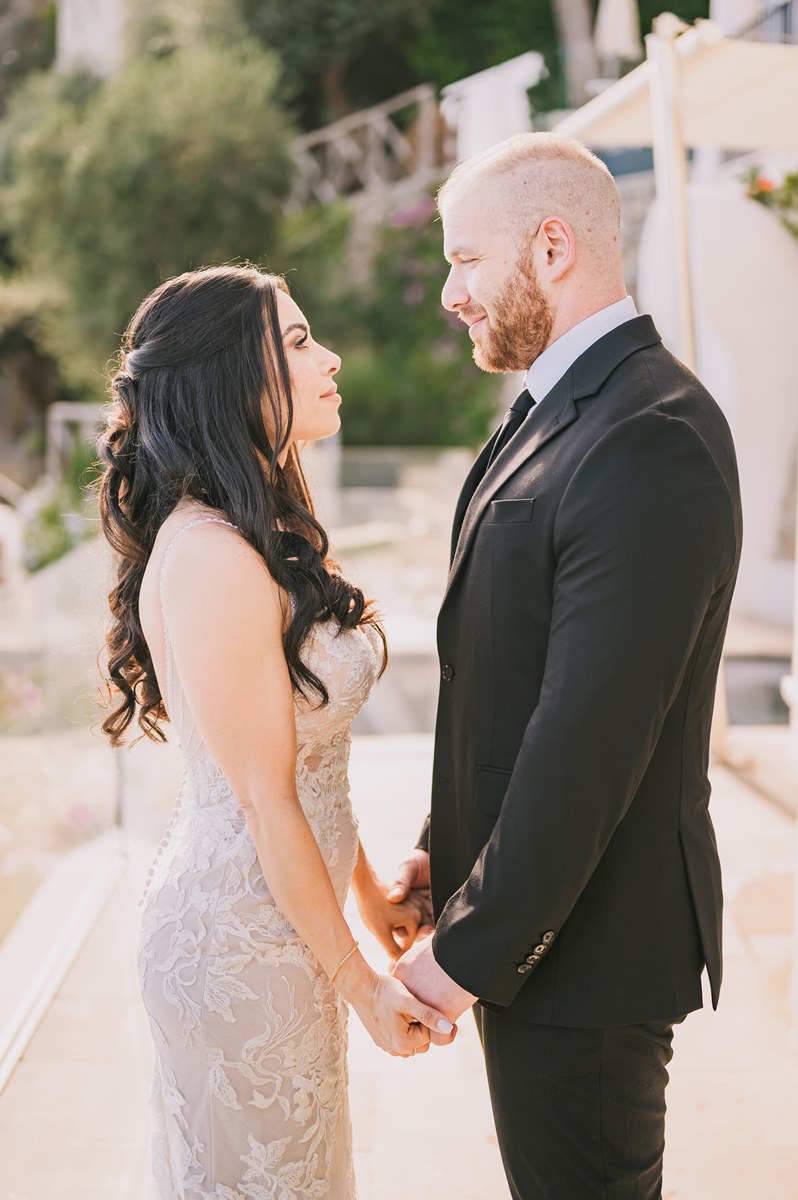
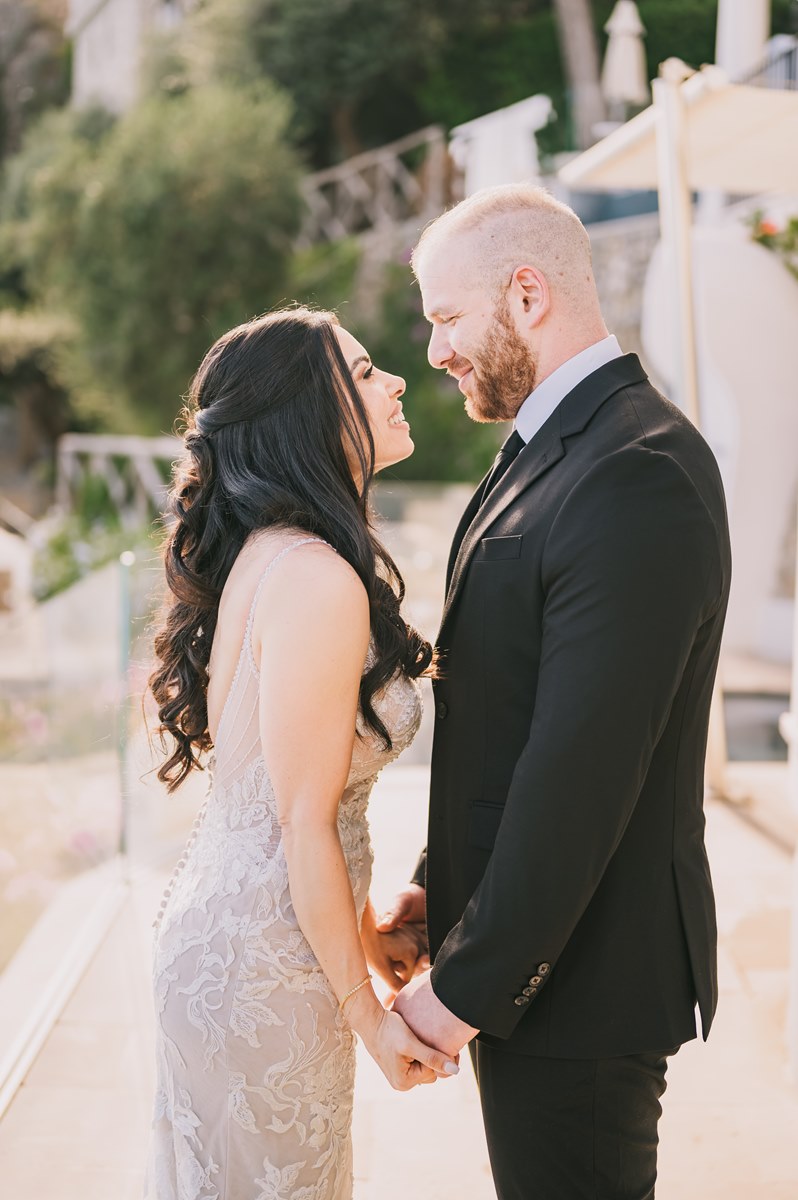
Theirs went on for a while. They talked. She laughed at something and put a hand flat on his chest, and I got a frame there with her rings catching the sun against the black of his jacket, which is a picture I would never have had time to wait for at a real ceremony. Then they stayed out there by the glass rail doing nothing in particular, and a good share of the strongest frames in the first part of this gallery come from that stretch.

A Pool Shaped Like a Half Moon
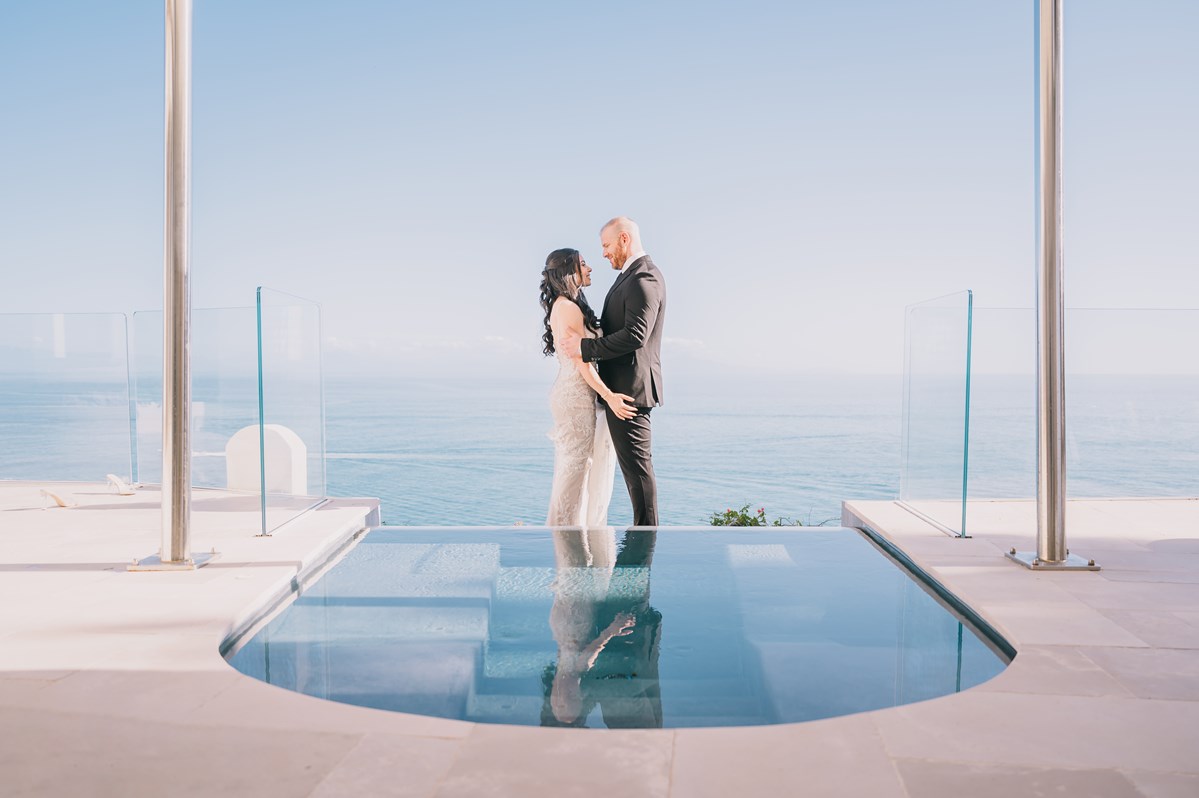
Lower down there is a pool built as a half circle, cut into a pale stone deck that runs right to the edge, with slim steel poles standing beside it. By the time I brought them down, the surface had gone completely still, and it stayed that way long enough to work.
I put them at the far edge, standing close, facing each other, and then framed mostly on the water. In the finished frame the two of them stand at the top of the picture and the pool holds their reflection upside down, sharp enough to read the shape of the dress. The sea beyond is the same flat blue as the pool and the seam between them almost disappears.
The trick with a reflection like that is holding still yourself. Any breath of wind ruins it and you cannot see the ripple through the viewfinder until it has already happened. On a wedding day I would have had a couple of minutes there and taken whatever the water gave me. Here I could wait for it.
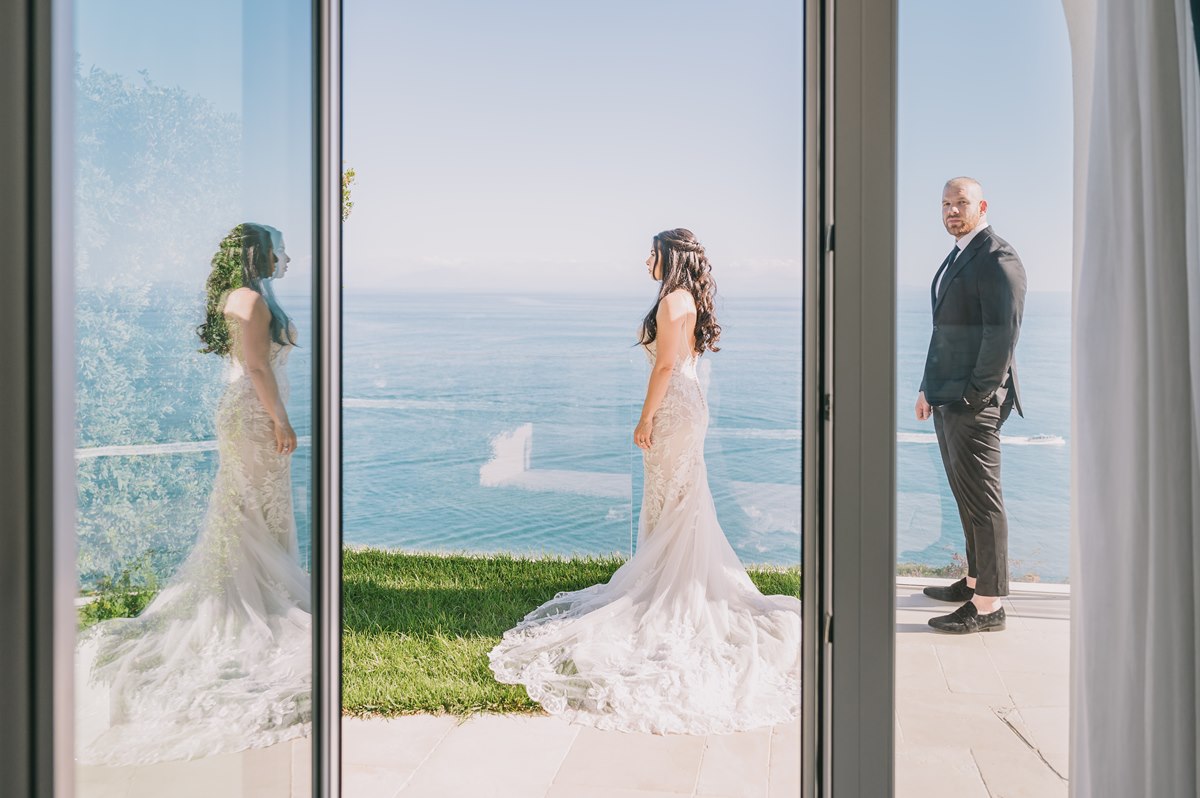
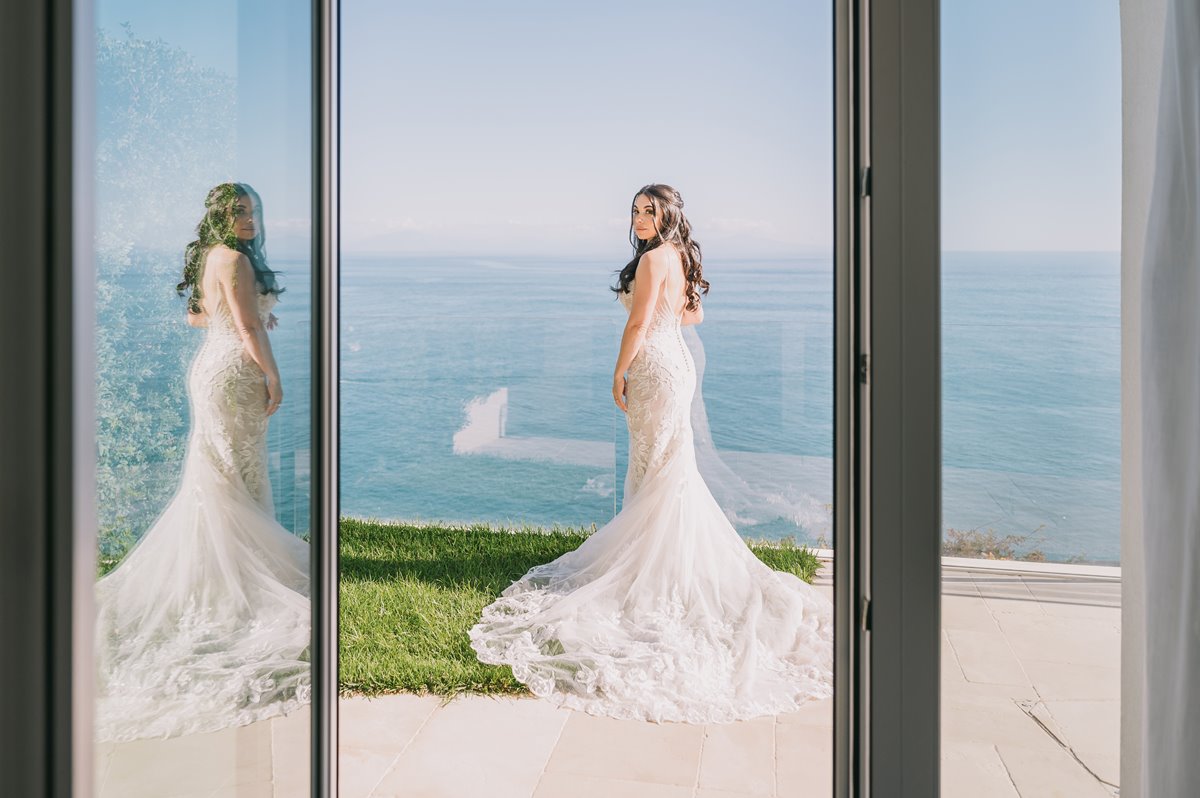
There is another version of the same idea shot through a set of glass doors nearby, where Jessica appears twice, once as herself and once as a reflection in the pane, with Bill standing apart behind the next panel. It is a colder picture than the pool one, with straight lines everywhere and the sea cut into vertical strips by the frames of the doors, and I kept it for exactly that reason.

Under the Bougainvillea, Going Nowhere
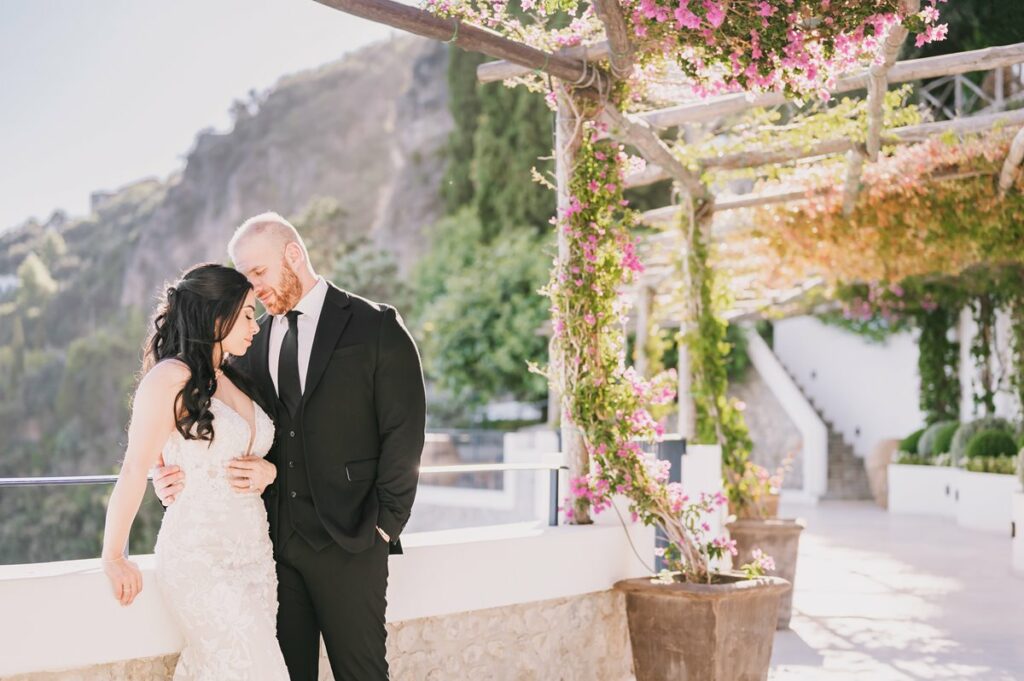
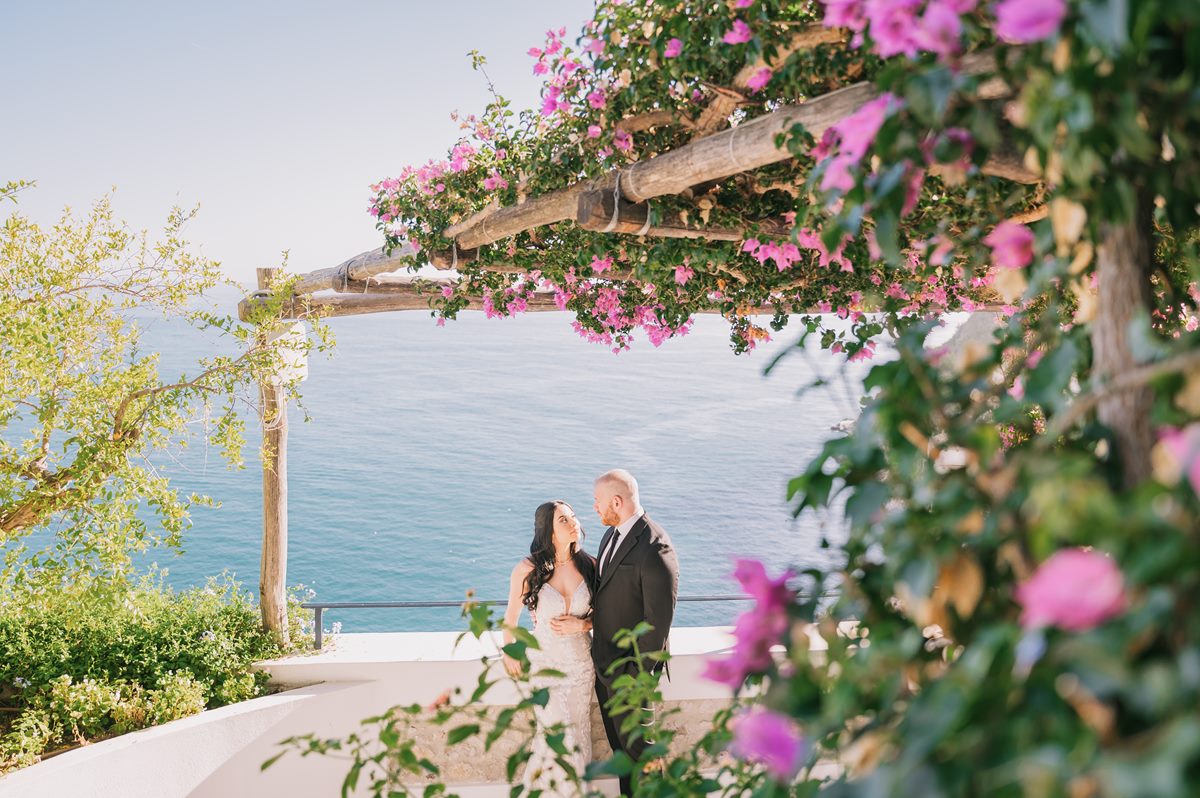
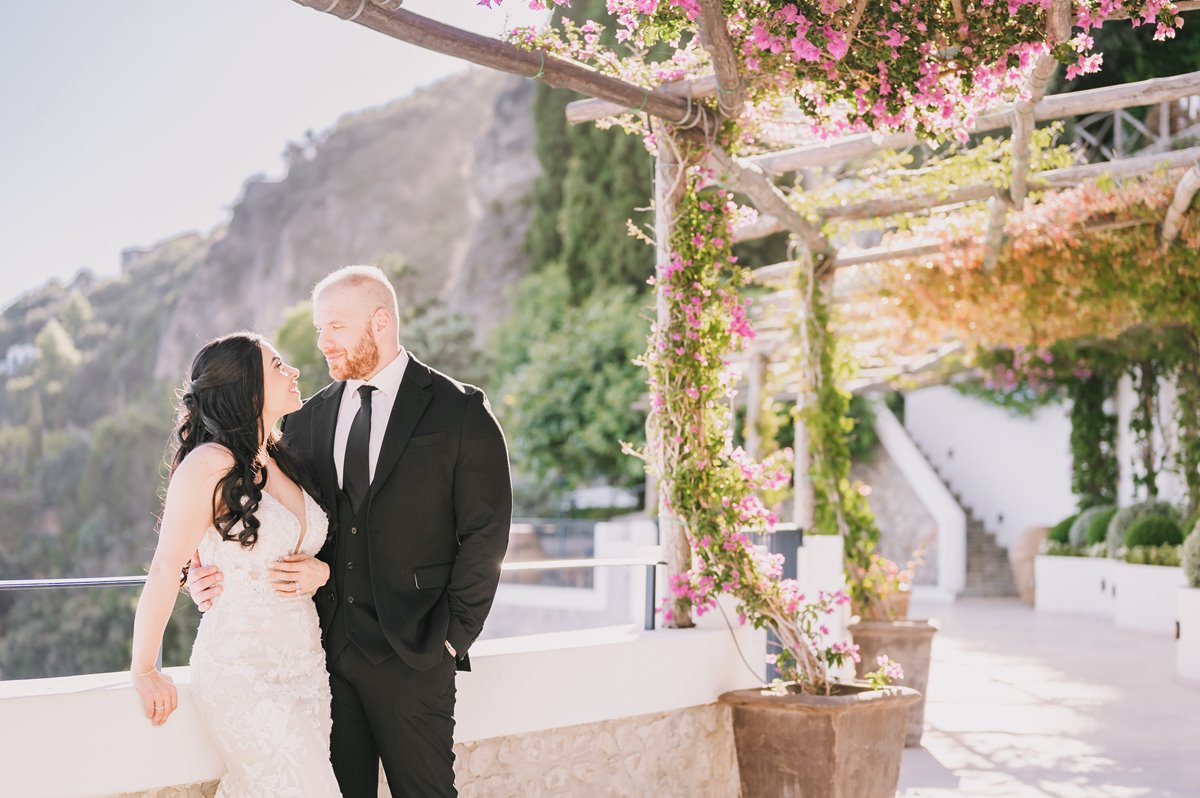
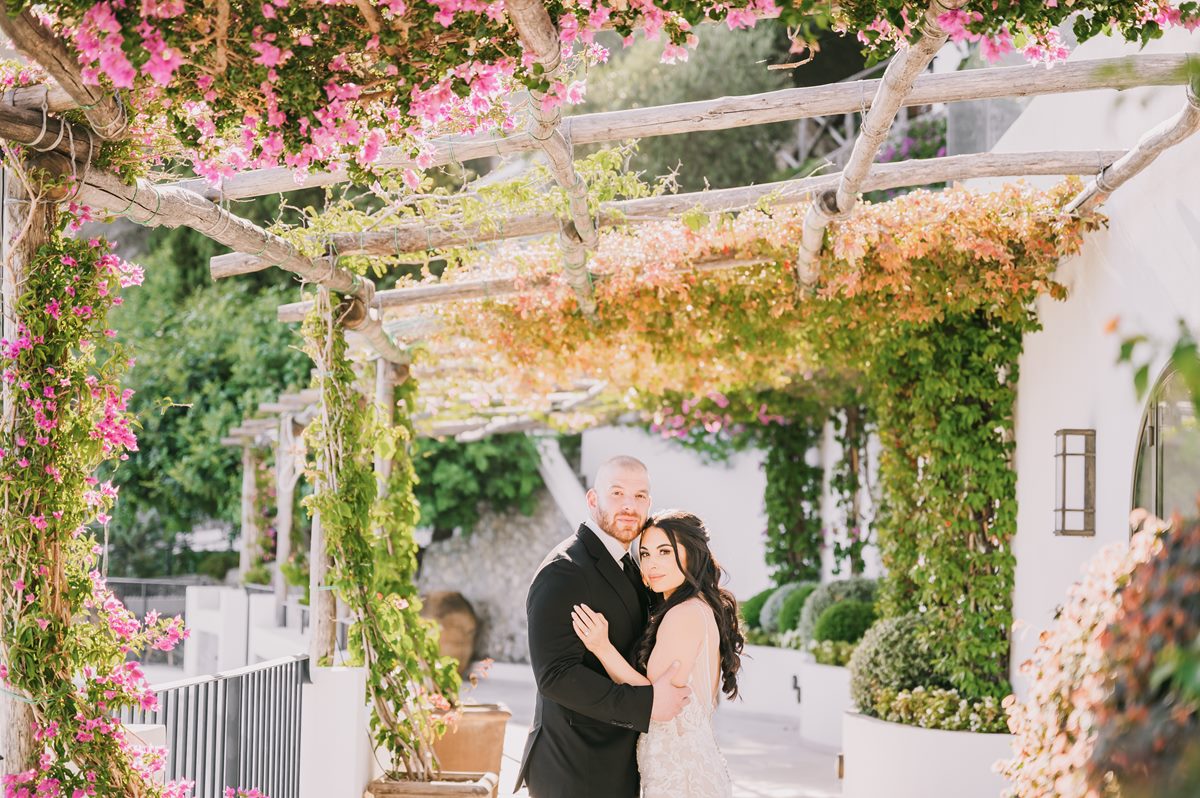
At Borgo Santandrea the upper terrace runs under a pergola of rough timber beams with bougainvillea growing over the top of it, pink and heavy in places, thin enough in others to let the sun through in patches. Terracotta pots line the edge. A white stair climbs out of the far end.
Dappled light is a problem when you have to work quickly, because it puts hard bright coins on people’s faces and there is nothing to be done about it in the time you have. With time you can simply walk the length of the pergola and find the section where the canopy is dense enough to give you clean shade, then place them there and let the sunlit part sit behind as a bright frame. That is what these frames are, and the whole method amounts to having walked the thing end to end before putting anybody in it.
This is also the stretch of the property where the hotel looks most like what people imagine when they picture a wedding in Amalfi Coast built around one hotel: white walls, flowers overhead, sea underneath, nobody else in the picture.
ALREADY WED AT HOME
Jessica and Bill signed the papers at home and kept one free day for the pictures.

COFFEE TIME
A coffee on a tiled balcony, in a wedding dress, with nowhere else to be.

A POOL, A TUNNEL
Light that moved slowly, and two people who were happy to wait.

A White Passage and a Flight of Steps
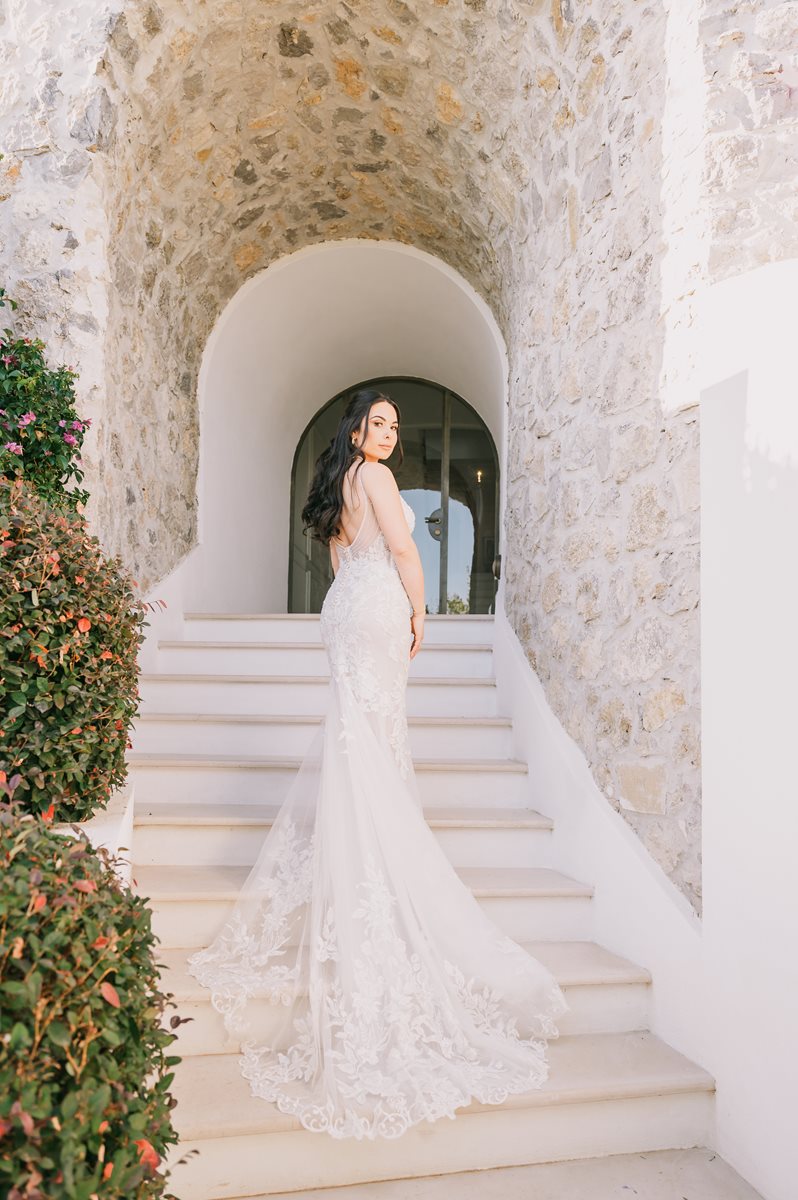
Between two levels of the property there is a short passage plastered in white, with an arched opening and a flight of white steps running up through it. I put Jessica on the steps alone with the train spread down behind her, and shot straight up the passage so that the arch frames her and the walls do the rest. Everything in that picture is white except her hair, and that is the whole idea.

They Sat Down and Ordered Coffee
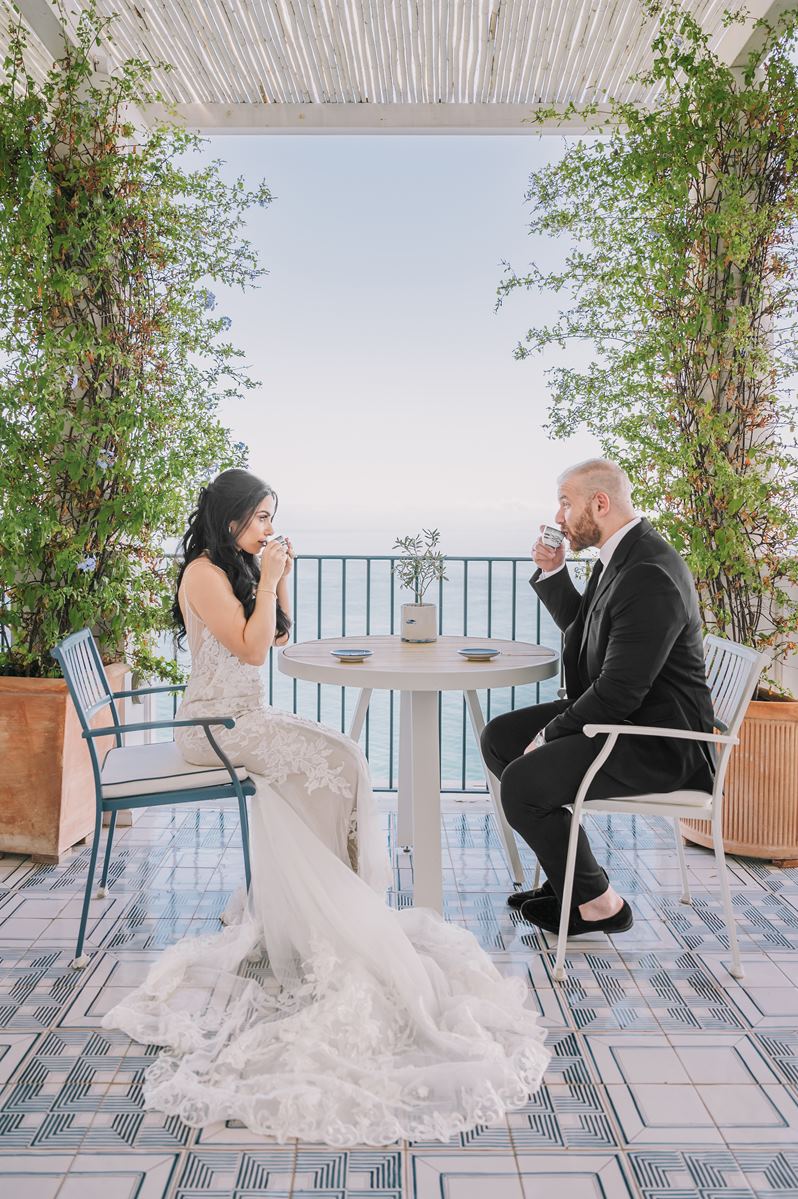
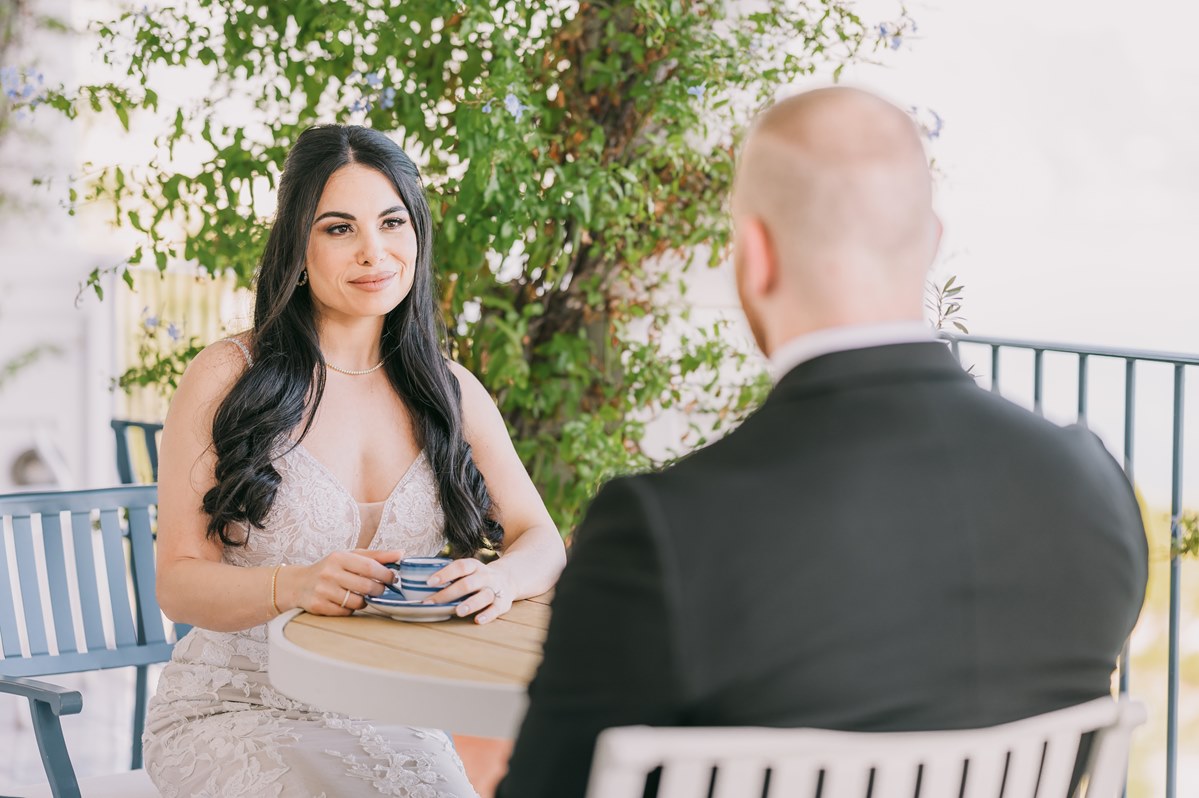
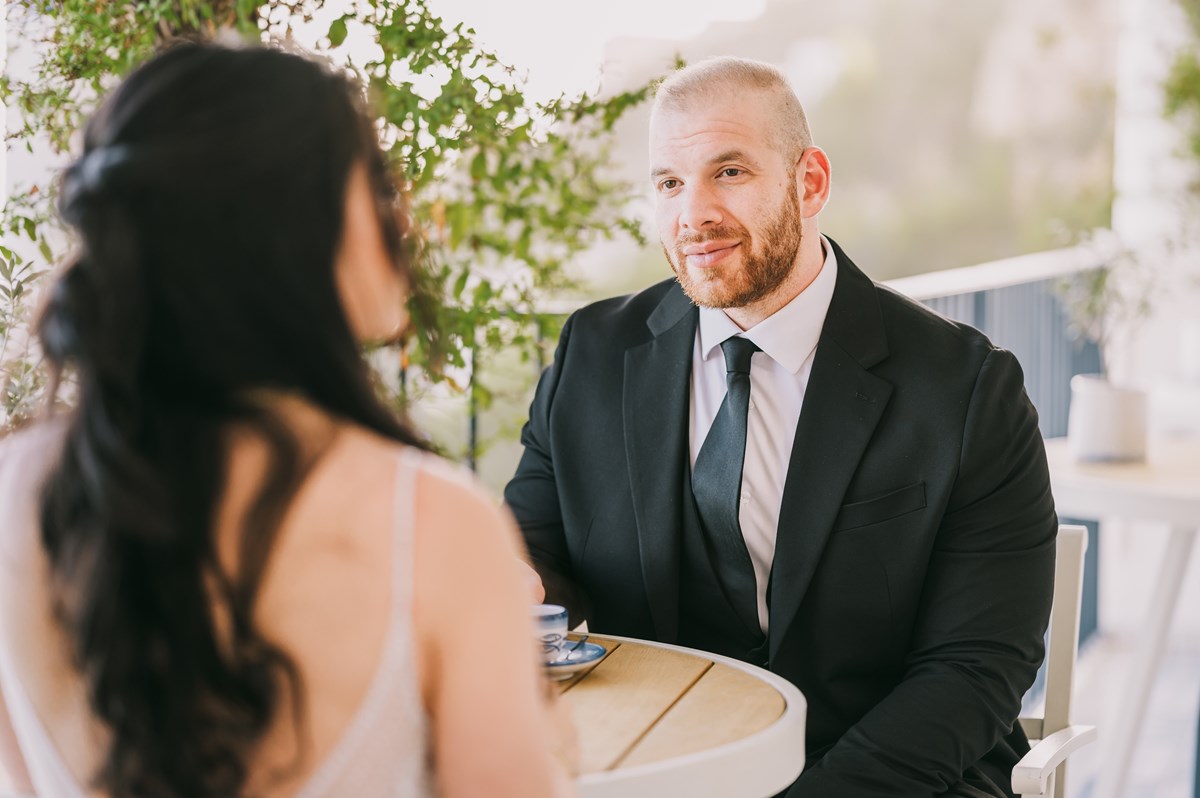
Partway through the afternoon they got tired, which is allowed, and they stopped on a small balcony with a floor of blue and white tiles and a round table with two chairs. Two coffees came out. They sat down and drank them, with the sea behind the railing.
The Frame That Holds This Whole Gallery Together
I shot it from both sides of the table, once past Bill’s shoulder onto Jessica’s face and once the other way, and those two frames are the ones I would show first if somebody asked me what this day was.
Think about what is in that picture. A woman in a wedding dress, holding a coffee cup with a saucer, sitting down in the middle of the afternoon with nowhere to be. At a wedding she would be standing, or being moved, or being spoken to, and the dress would stay a costume she performs inside all day. Here it had stopped being a costume and turned into something she was simply wearing.
Candid Frames Are Mostly Made of Time
Photographers talk a lot about candid moments as though they were a matter of technique, of standing far enough back with a long enough lens. Mostly they are a matter of time. Give people enough of it and they stop performing, because performing is exhausting and nobody can keep it up for hours with an audience of one.
That is the part I cannot buy with equipment on a normal wedding day, and the part this format hands over for free.
Plumbago Between the Olive Trunks
After the coffee I followed them down through the gardens, under olive trees on a slope of grass, along a path edged with low white walls and beds of pale blue plumbago in flower. It is the quietest corner of the property, and the frames from there are mostly the two of them small among the trunks.

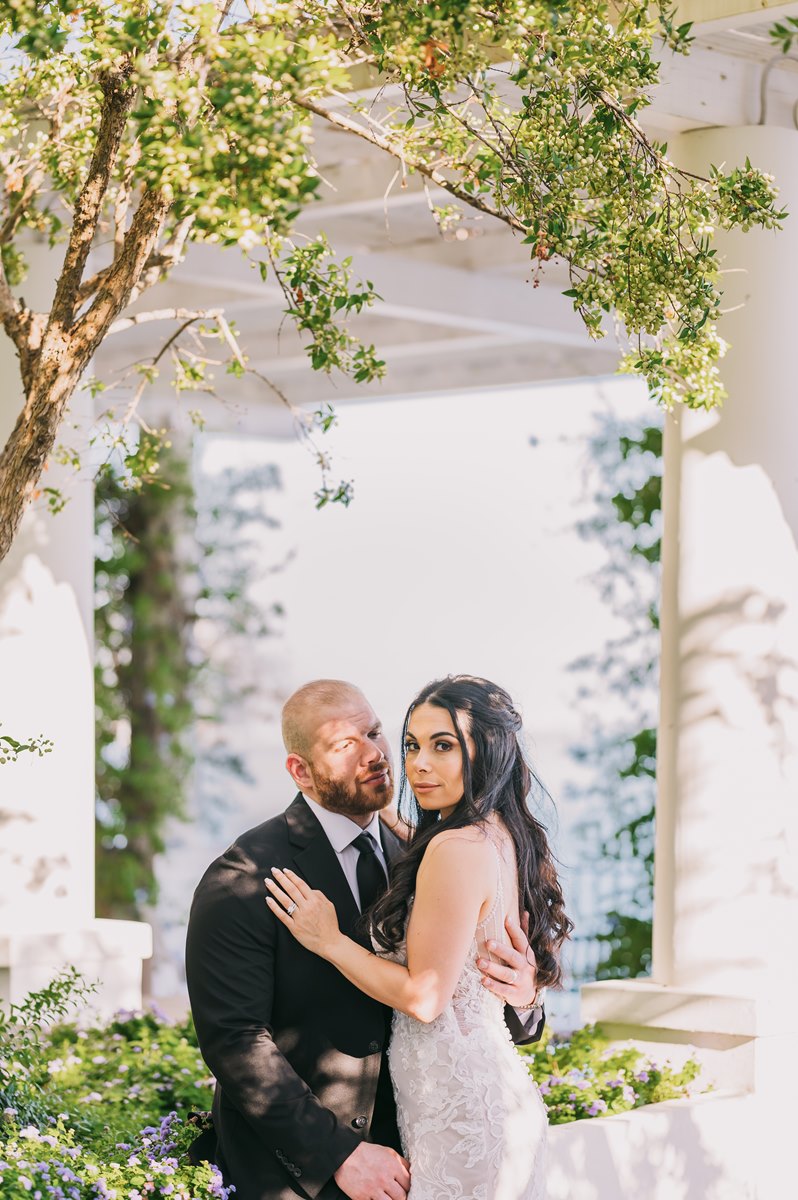
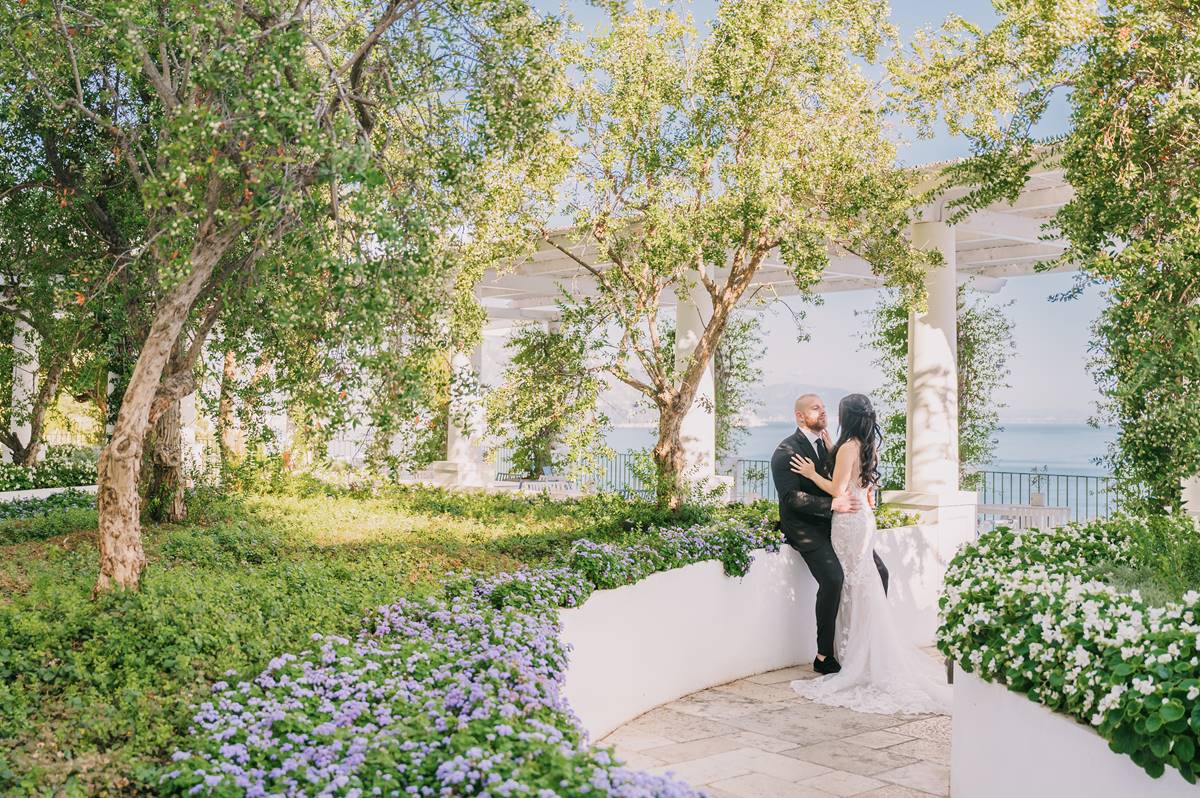

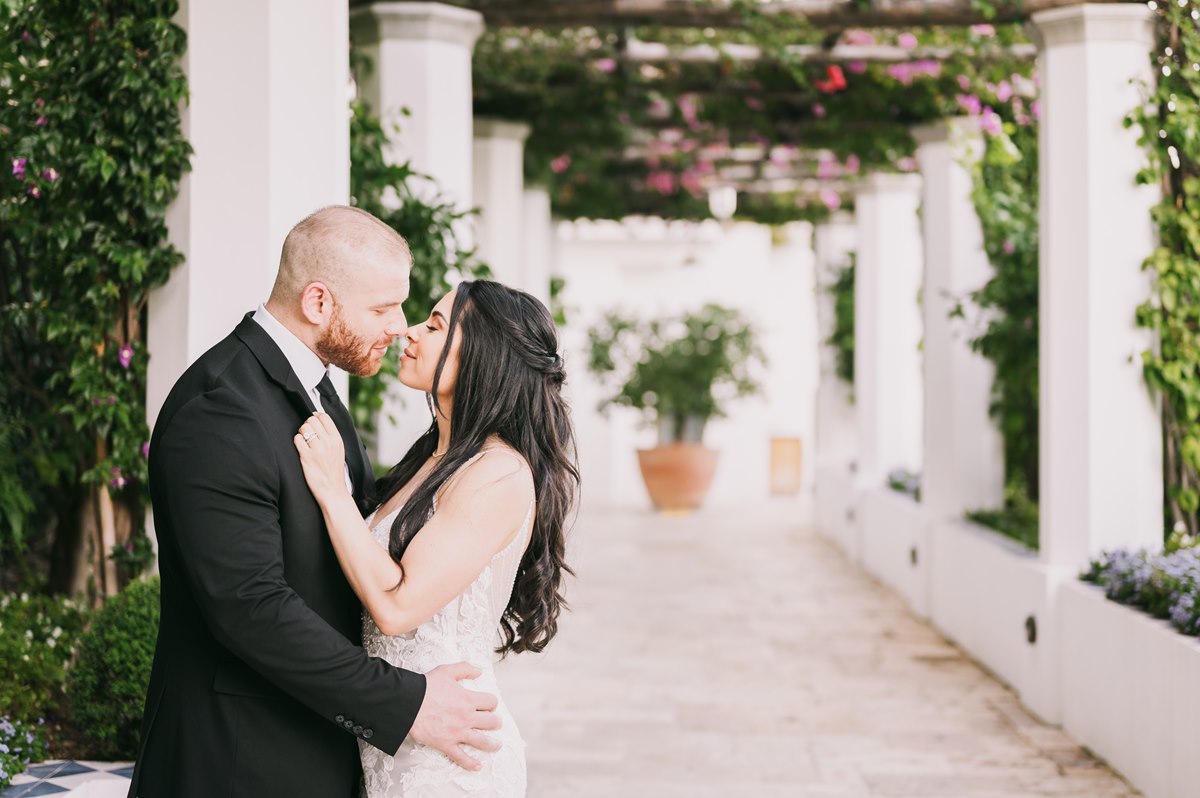
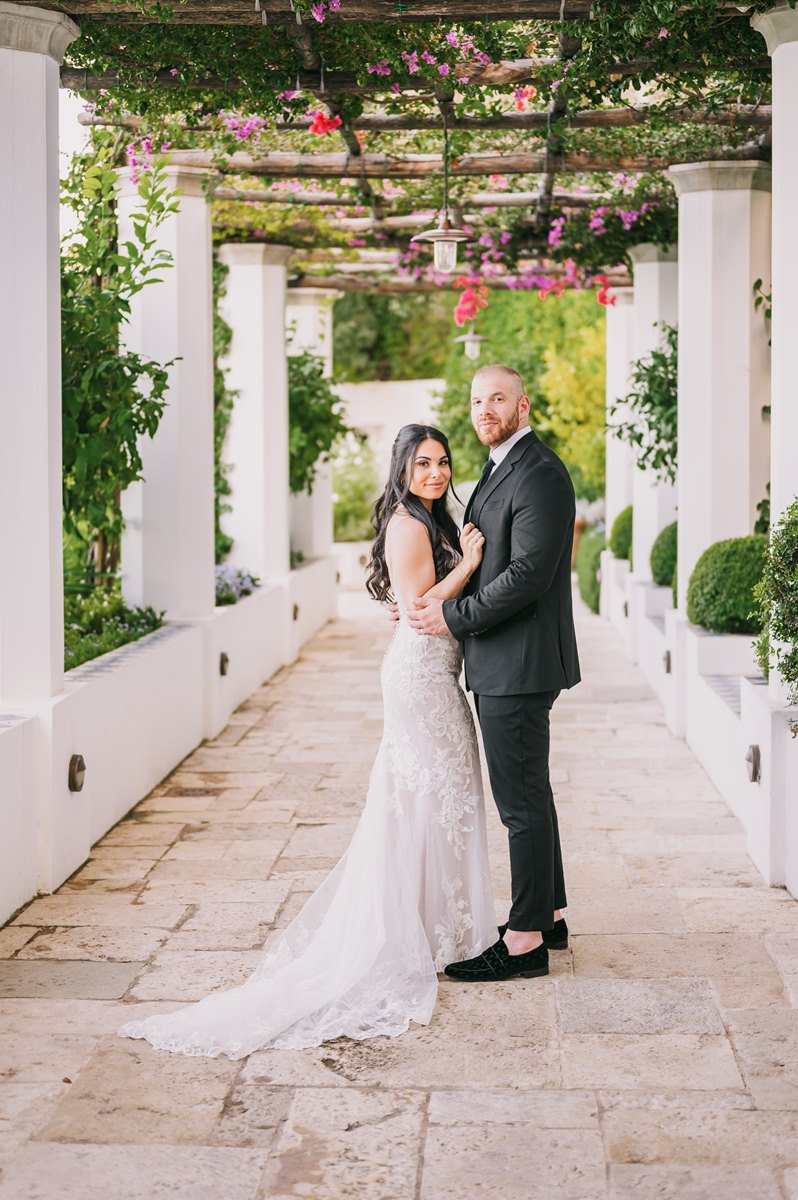
Further along, a long white colonnade carries a pergola over a straight path, with potted plants between the columns. A corridor of repeated columns is a gift for a photographer: it gives depth for free, and two people standing at the near end with the columns marching away behind them never look lost in it.
The colonnade is also the best answer on this property to midday sun. The pergola above filters it, the white columns bounce it, and faces come out soft even when the light outside is hard.
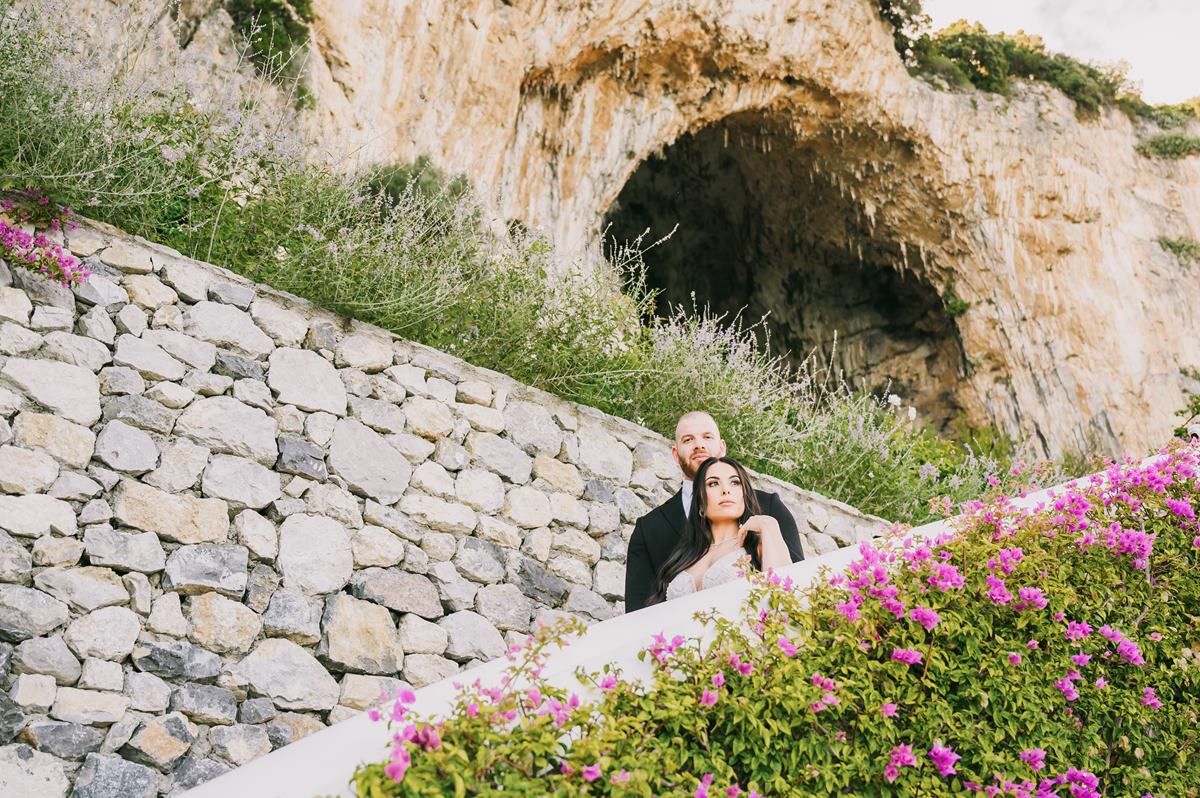
Below the colonnade the hillside is held up by terraces of dry stone, with a dark hollow in the cliff above them and pink flowers spilling over the walls. I used the stone as a texture behind them and kept the cave in the corner of the frame, a reminder that the whole place is built into a mountain.
OLIVES AND SEA
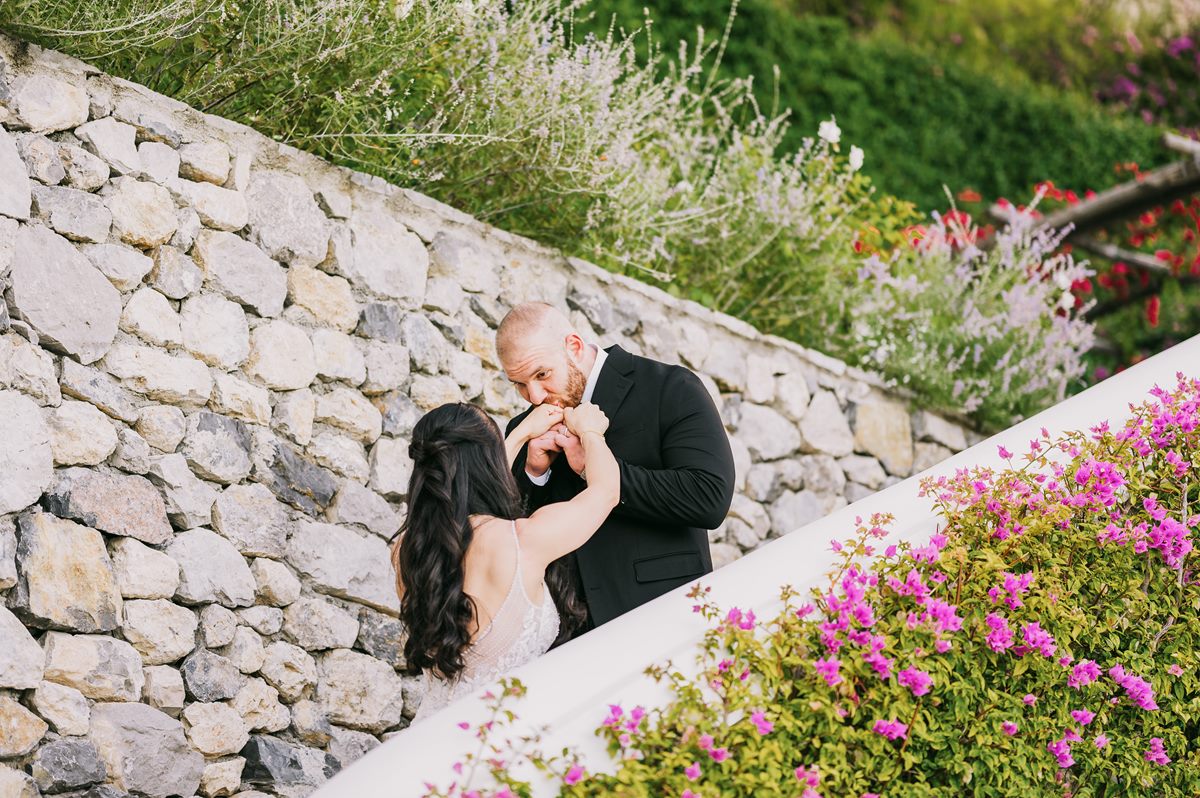
Walking a property like this one end to end before placing anybody in it is most of the job: the arches, the colonnade, the olive grove and the tunnel each have their own hour, and on a day with no clock I could wait for it.
SANTANDREA DAYS

If you are weighing up this format against a real ceremony, that is a question worth putting to an Amalfi Coast wedding planner before you book the flights, because the answer changes the shape of the whole trip.

Two Iron Gates and a Tunnel
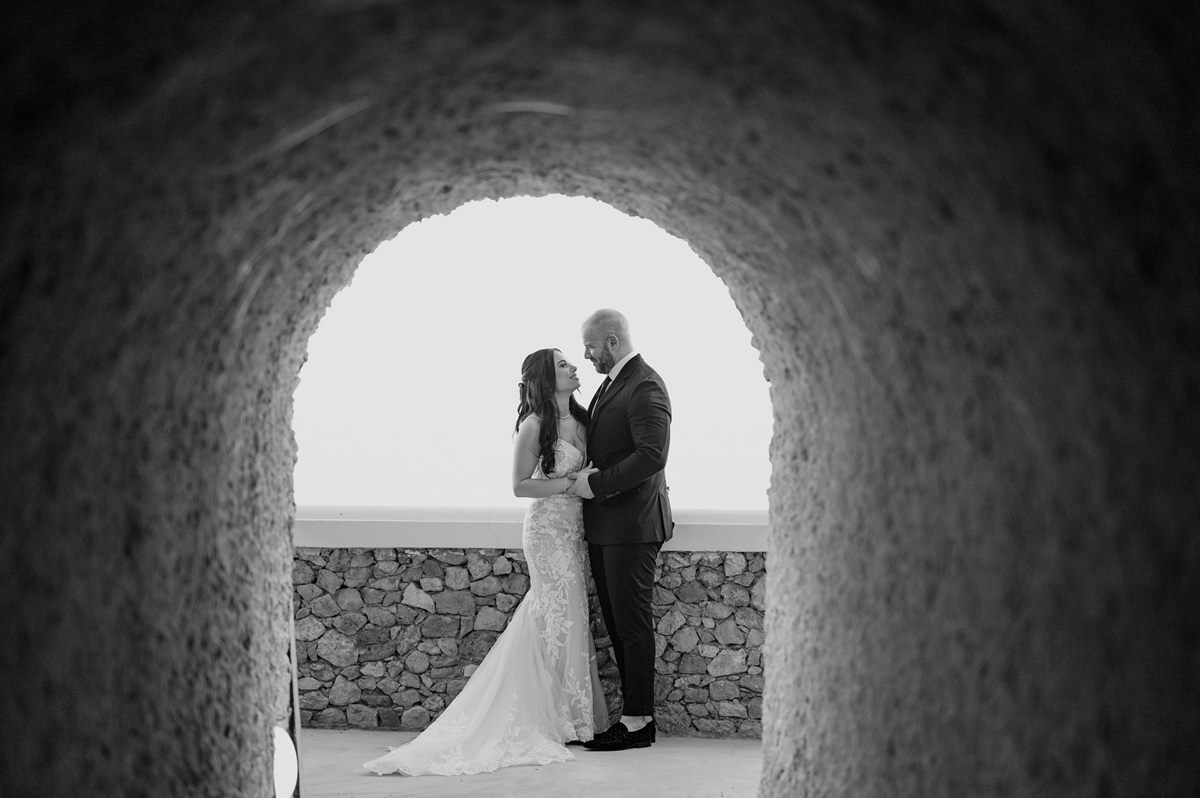
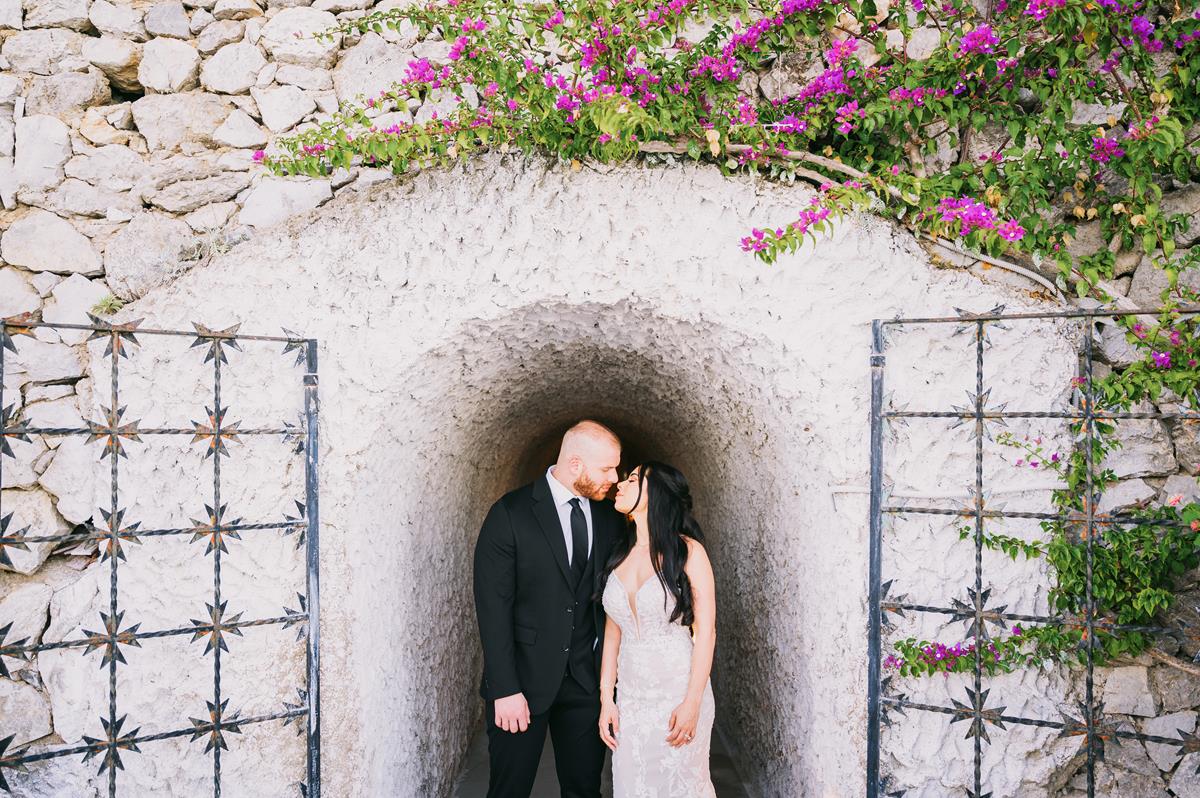
The best thing on this property, from where I stand, is a tunnel bored straight through the rock, low and rough walled, with two iron gates at the entrance worked in a pattern of eight pointed stars. It opens onto a small terrace over the water at the far end.
Why the Tunnel Went Monochrome
Inside the passage the walls are gray and brown and the light coming through the far opening is white and blown out. There is no color information in that scene worth keeping, and leaving it in would have made the frames look muddy. So I converted the whole sequence. Standing well back in the dark and shooting toward the opening, the couple become a small pale shape inside a bright arch at the end of a black corridor, with the sea behind them. Closer in, the arch fills more of the frame and you start to read the texture of the cut rock overhead.
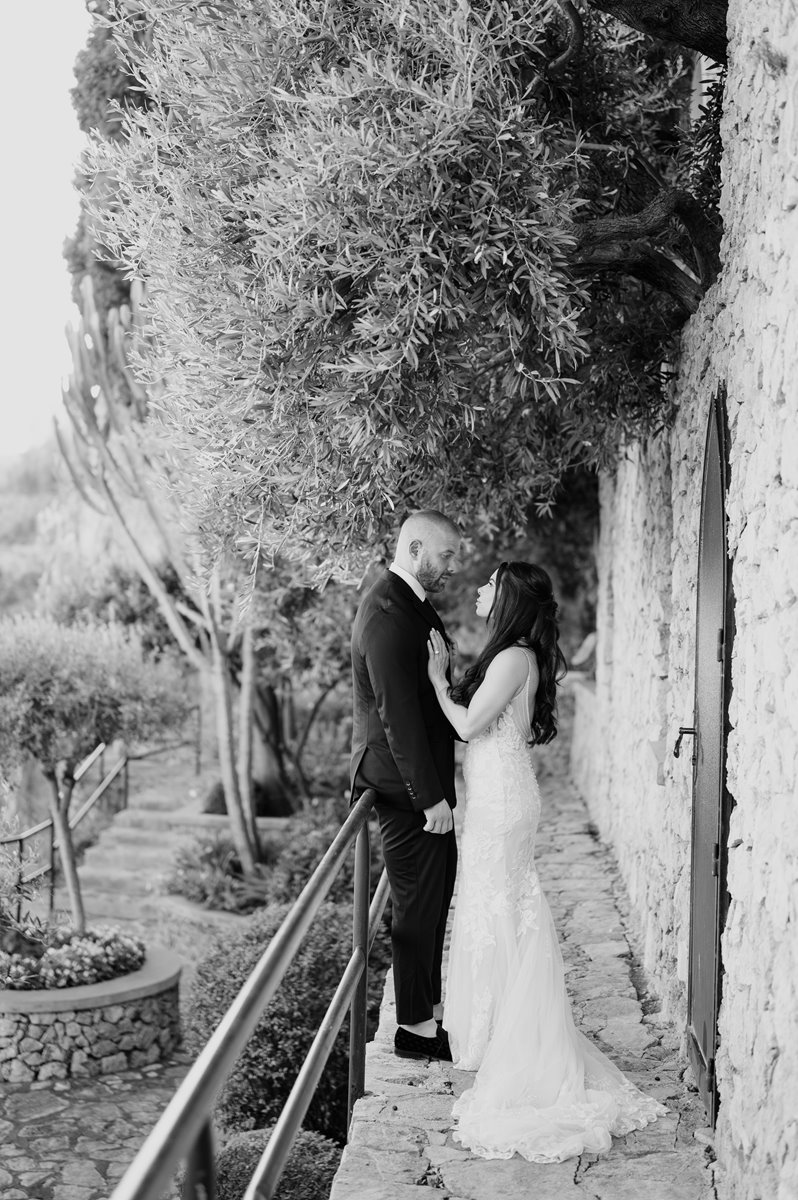
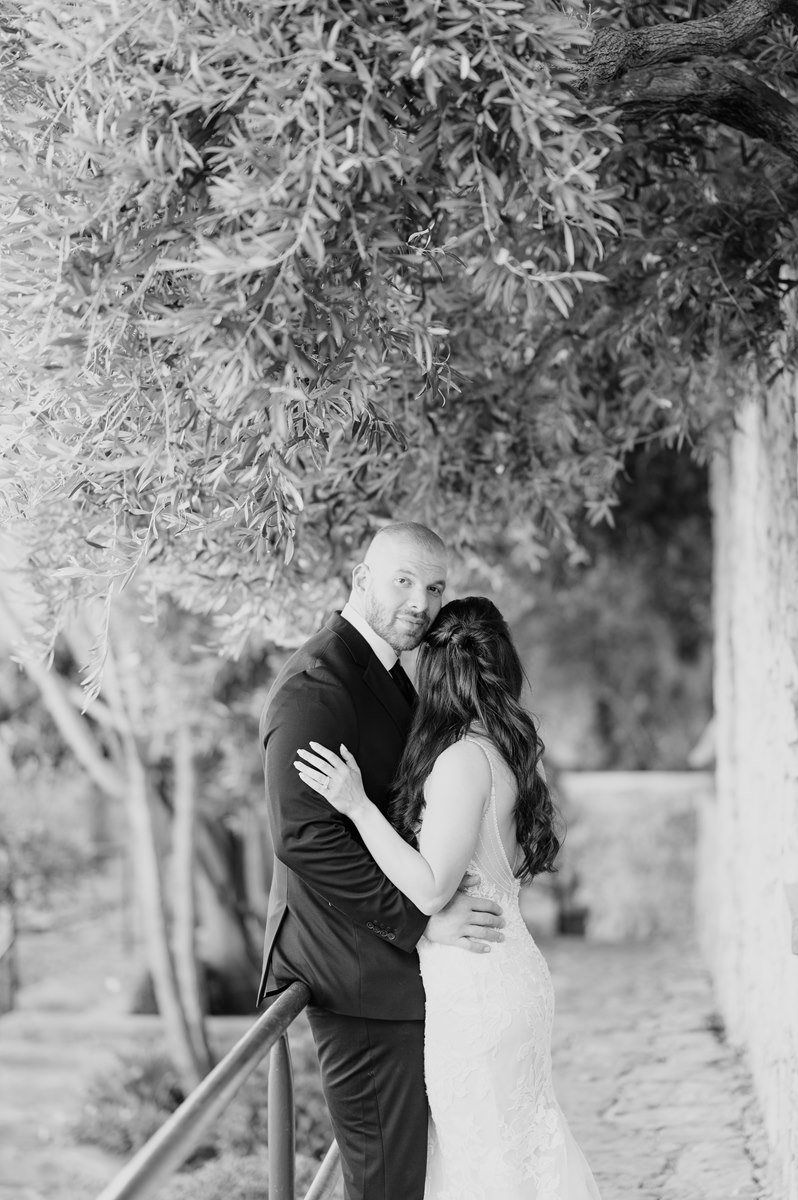
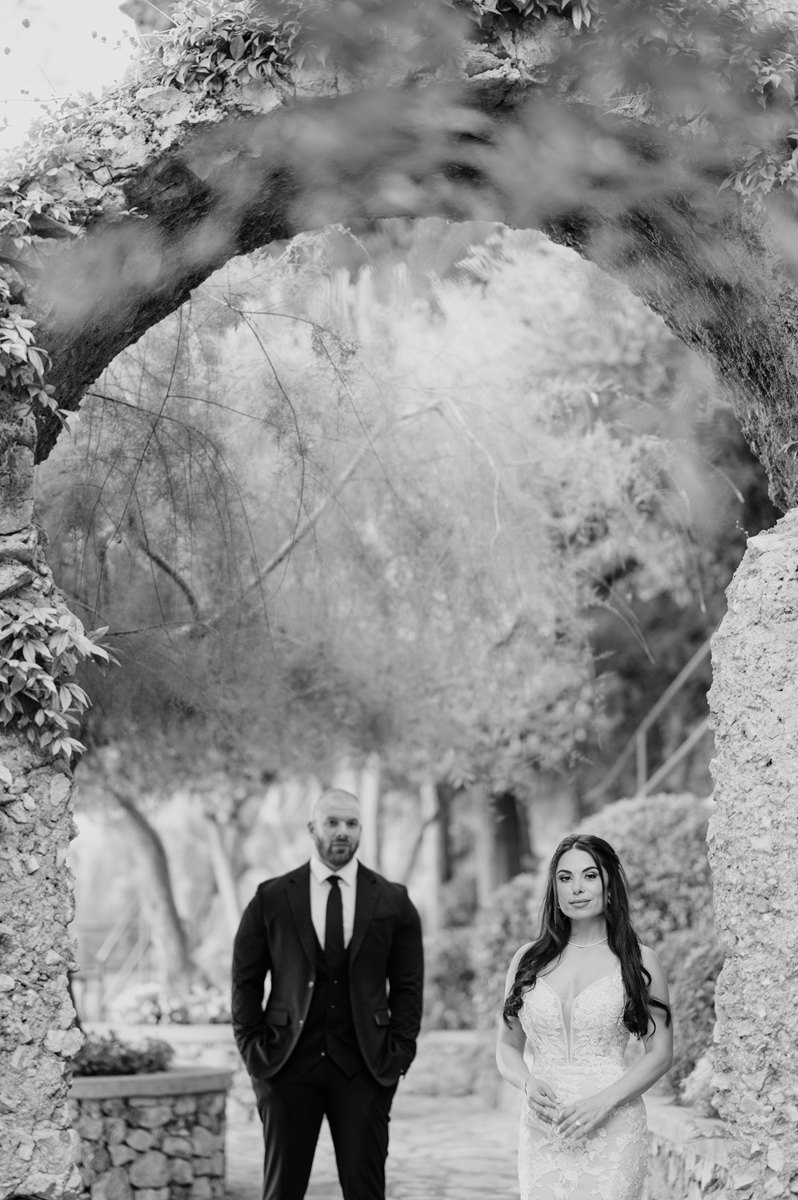
A few frames on the path outside are monochrome as well, including several under an old stone arch grown over with creeper, where the two of them stand apart from each other rather than touching. One of those is my favorite of the set, and it is the least romantic picture in the gallery, which is probably not a coincidence.



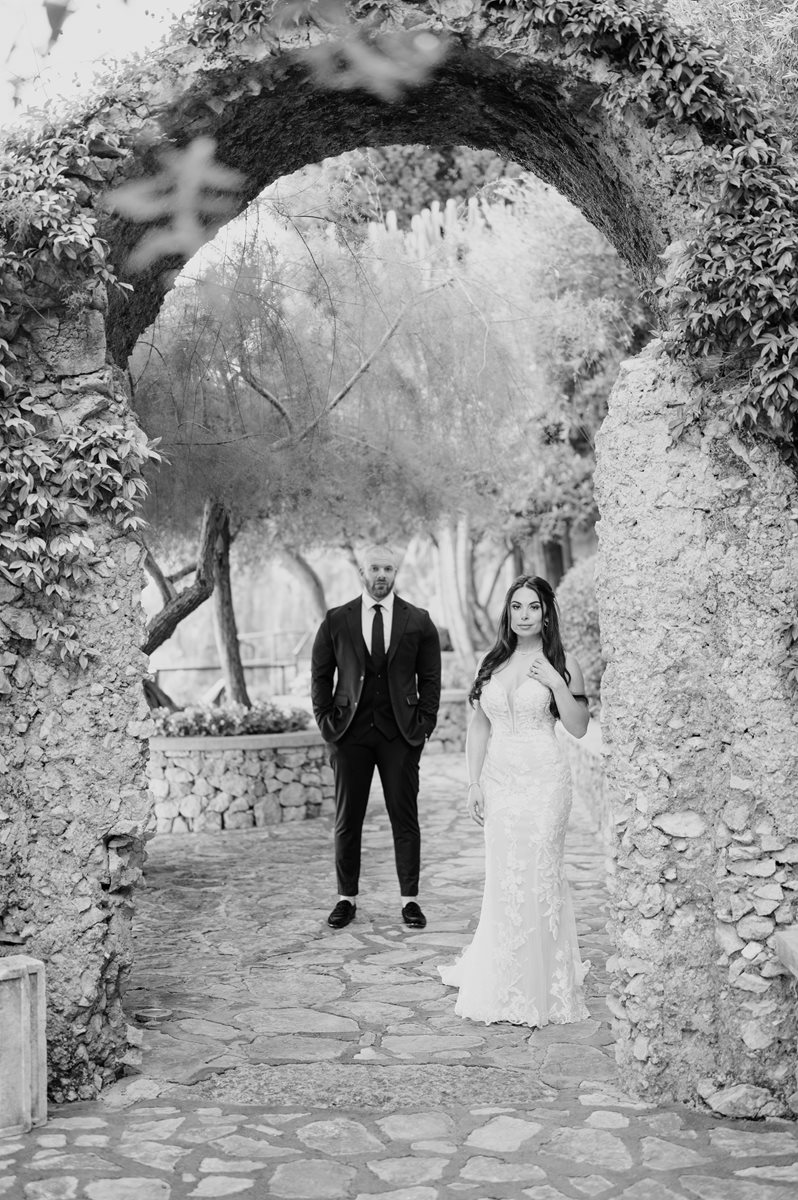
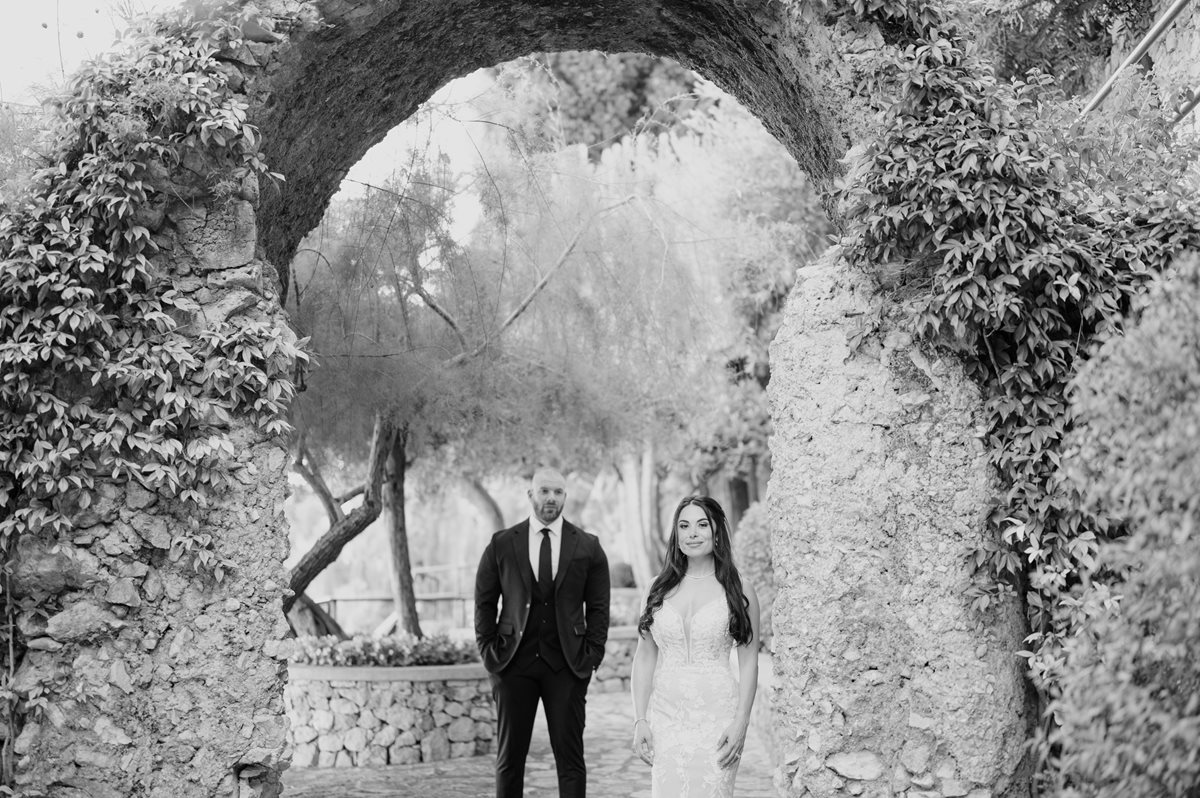

An Arch Swallowed by Green
The path that runs through the gardens passes under a rough stone arch completely covered in green, with planting on one side and a slope of trees on the other. I shot it in both directions and both treatments, black and white first and then color.
Facing the arch from below, the opening frames the sky and the trees behind it and the couple stand centered underneath. From the far side the arch becomes a dark ring around a bright garden. Jessica in a pale dress against that much foliage is a straightforward exposure problem and an easy one, as long as you meter for her and let the leaves go where they go.

Check our packages
Capture the Magic of Your Special Day with Emiliano Russo
Somewhere in this stretch I made the only real detail frame of the day: her hand resting on his, both of them against the lace at her waist, her rings and his steel watch in the same plane. With no rings being exchanged and no bouquet anywhere, that hand was the only close detail this day was going to give me, and I would have missed it at the pace of a real wedding.
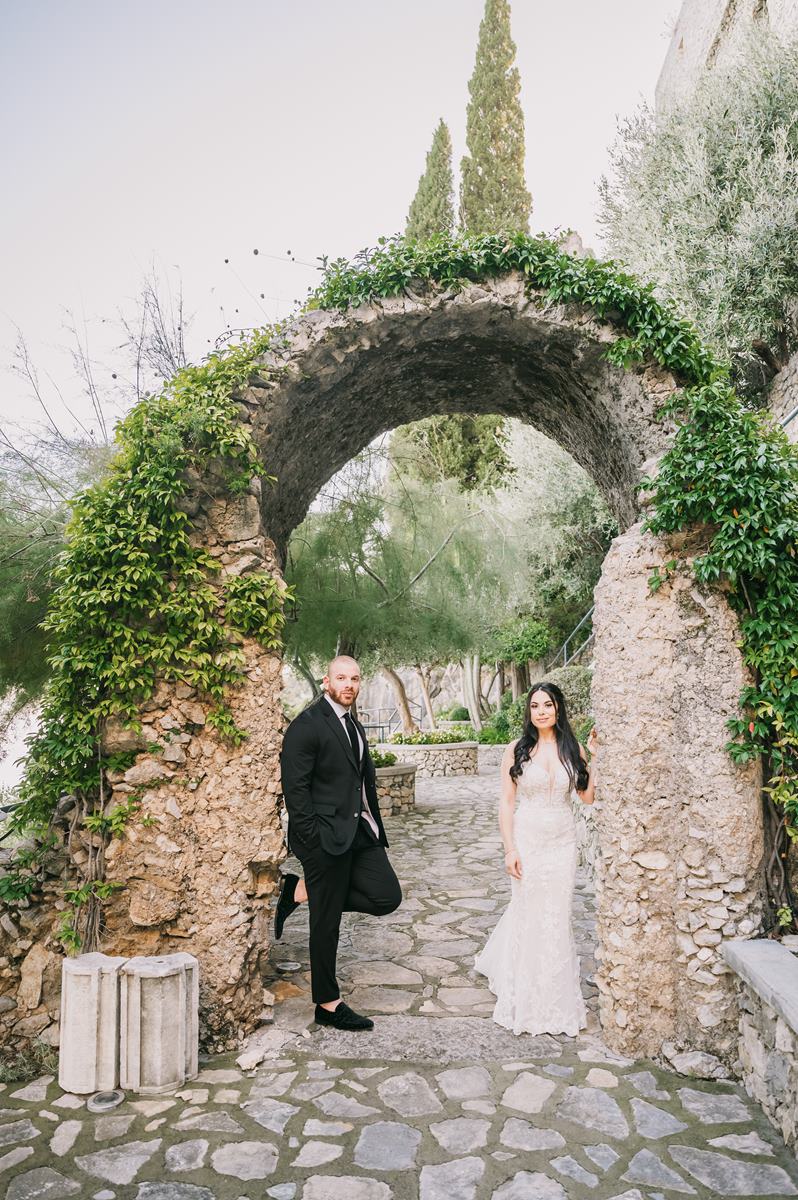

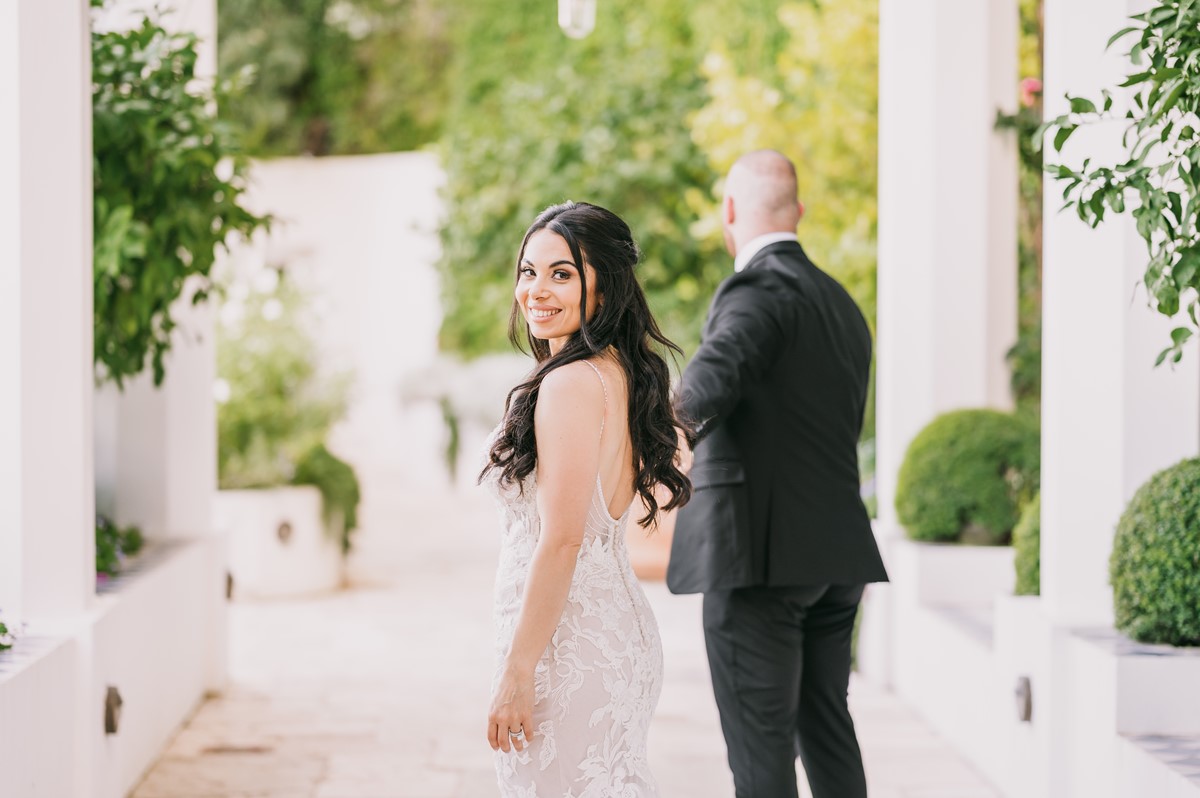
From the arch they walked on down the garden path hand in hand, and I let them go ahead and followed, which on a day like this is sometimes the whole job.

Shirtsleeves and a Vest Above the Beach
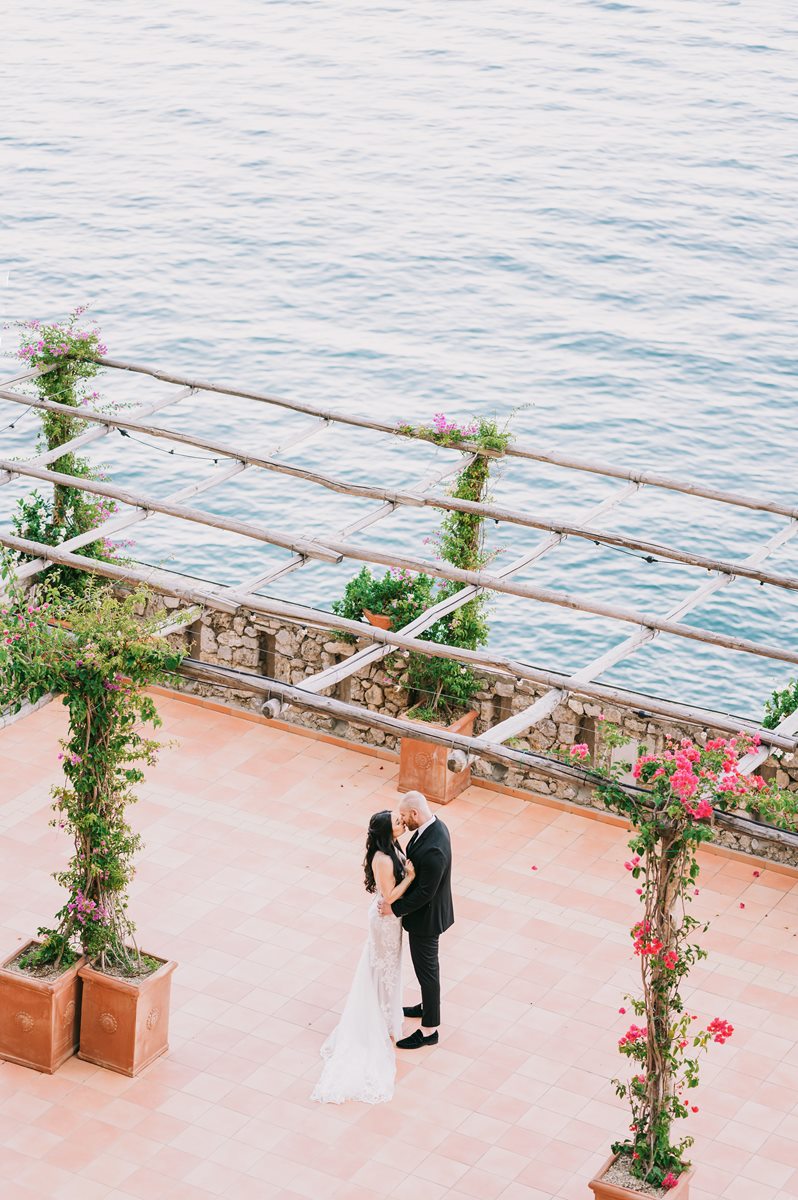
Lower down there is a terrace right above the beach, paved in terracotta and open to the sky, with a pergola of pale poles running across it carrying strings of bulbs that were not lit. Potted bougainvillea stands along the edge. Below it the pebble beach curves away, and the village sits on the headland opposite with its buildings piled up in ochre and cream.
The terrace was completely empty, which on a Borgo Santandrea wedding day with guests it never would be. No tables set, no other guests, nothing at all.
I climbed to the level above and shot down on it, and those are among the best frames of the gallery. From up there the pergola becomes a grid of pale lines across a field of terracotta, the pots punctuate the edges, and Jessica and Bill are two small figures near the center, standing close together with her train fanned out on the floor. You can see the whole shape of the space, how much of it there is, and how little of it they needed.
Bill had taken his jacket off by then and was in the vest and shirt. In the black jacket he is a shape. In the vest you can see his shoulders and the line of his arm around her, and in one frame they are barely holding still and it reads as a slow dance, although there was no music playing and nobody had suggested it.
ABOVE THE PRIVATE BEACH
Already married at home, they came for the pictures, with an Italian wedding photographer for the day.

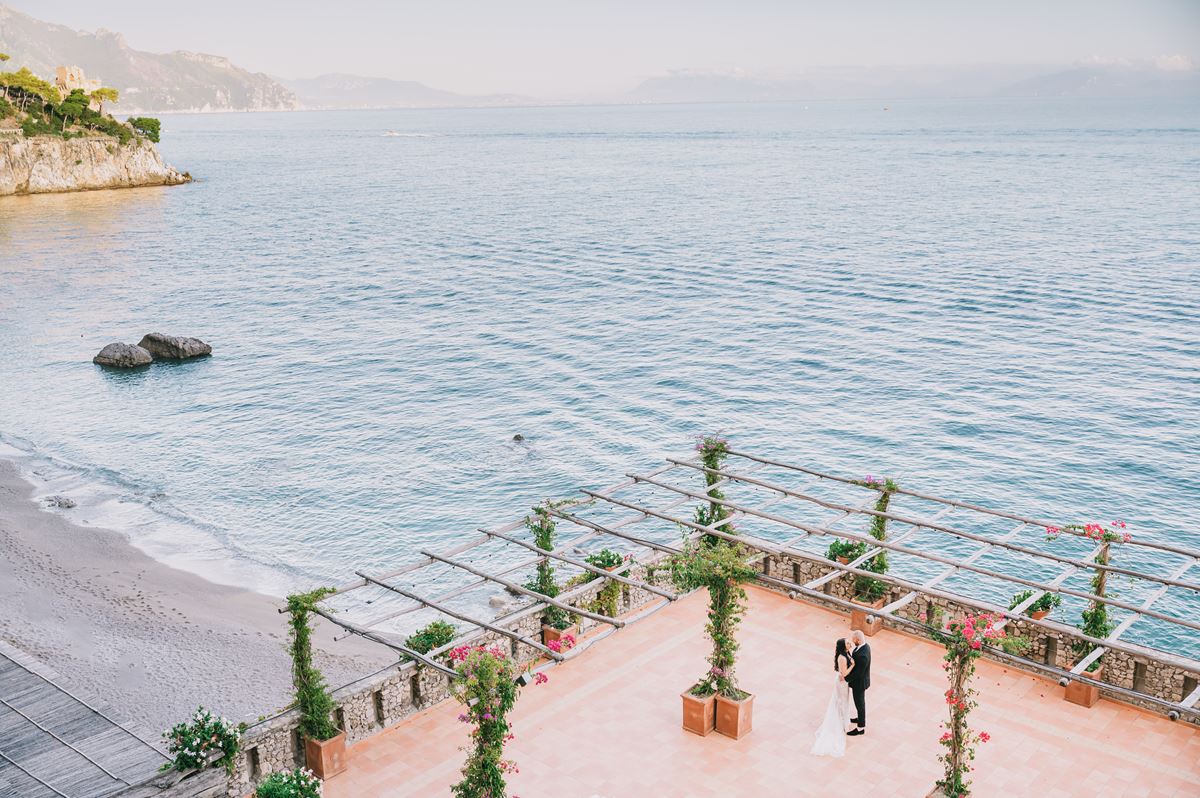
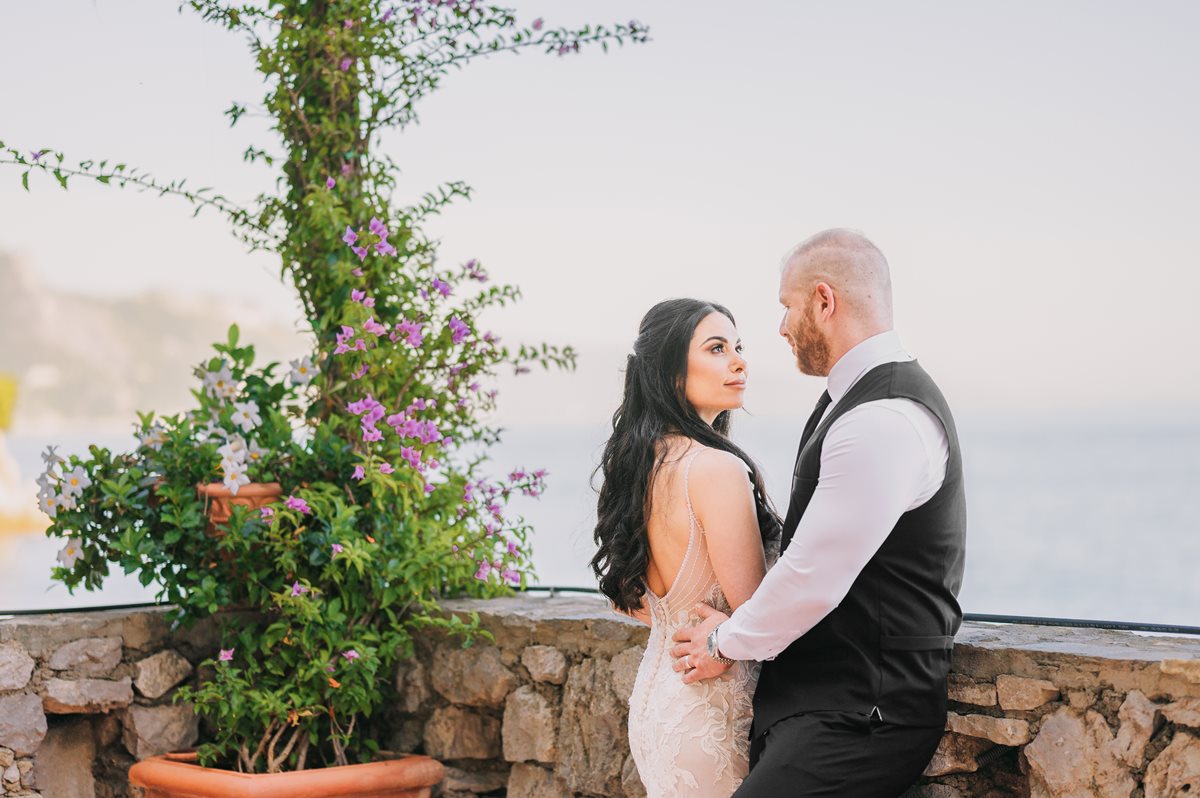
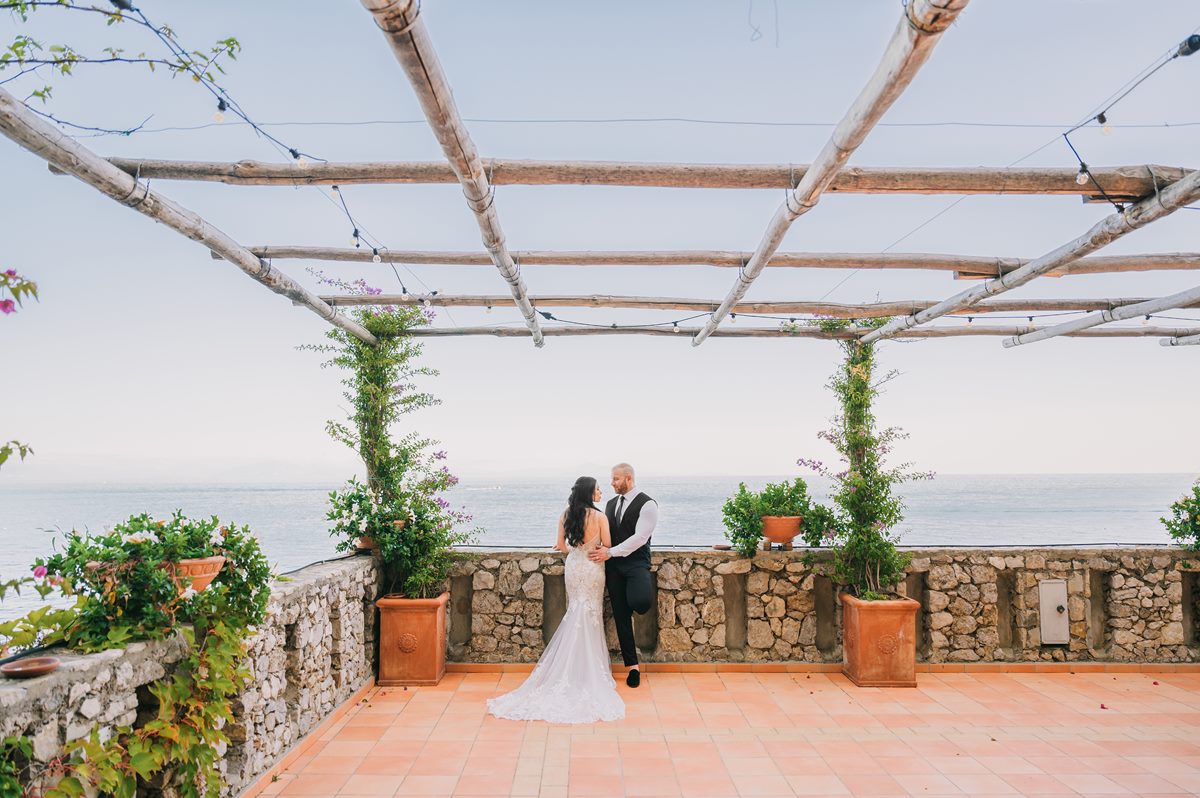
TERRACOTTA GRID
From the edge of that terrace you look across the bay to the village opposite, the houses stacked up the cliff and an old round stone structure sitting on the rocks at the water. I took two frames of it with no people at all.


A Gothic Doorway Over White Steps
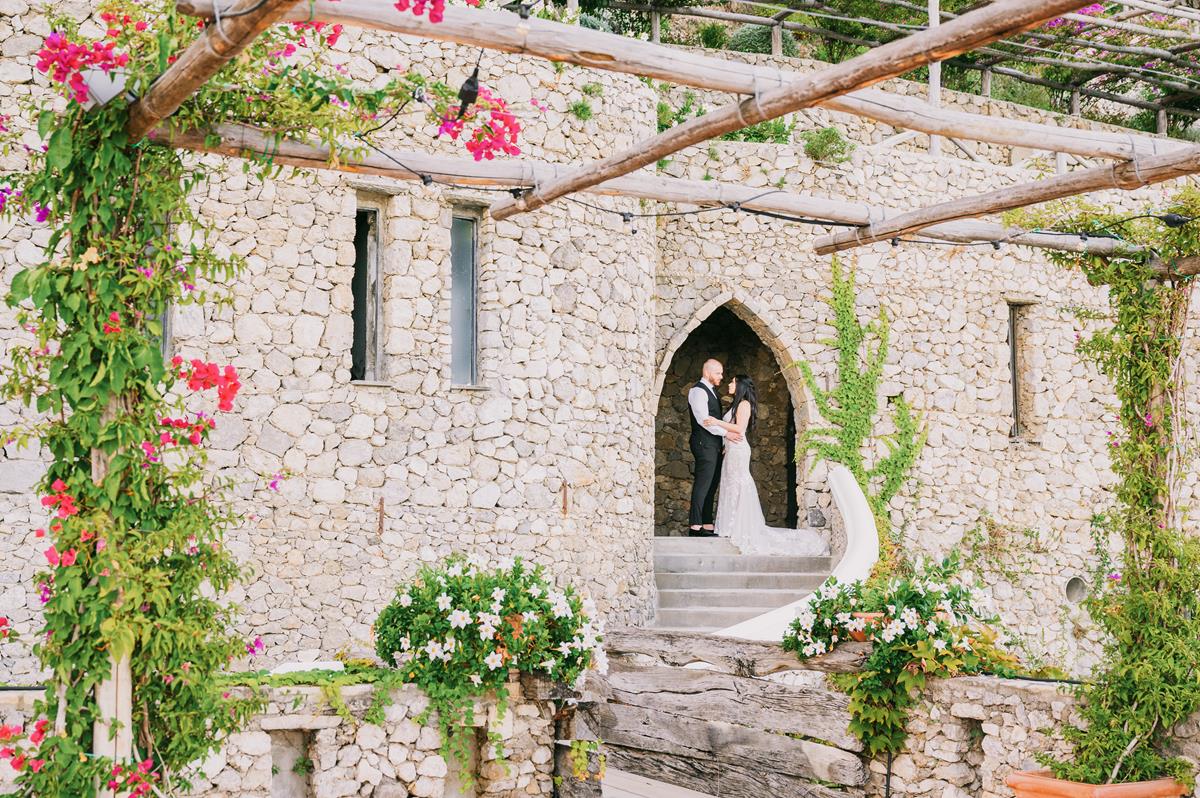
One of the buildings has a doorway shaped as a pointed arch, the narrow kind you see in the older architecture along this coast, set into a wall of rough pale stone. A white stair curves down from it and spills onto the level below, with white flowers growing at the foot of it and bougainvillea on the pergola overhead.
I framed the couple standing inside the arch, small, with the stone filling everything around them. Shot straight on, the arch reads as a frame within the frame and the eye has no choice about where to go. Jessica’s train falls down the first steps and the curve of the stair carries the line of it out of the bottom of the picture.
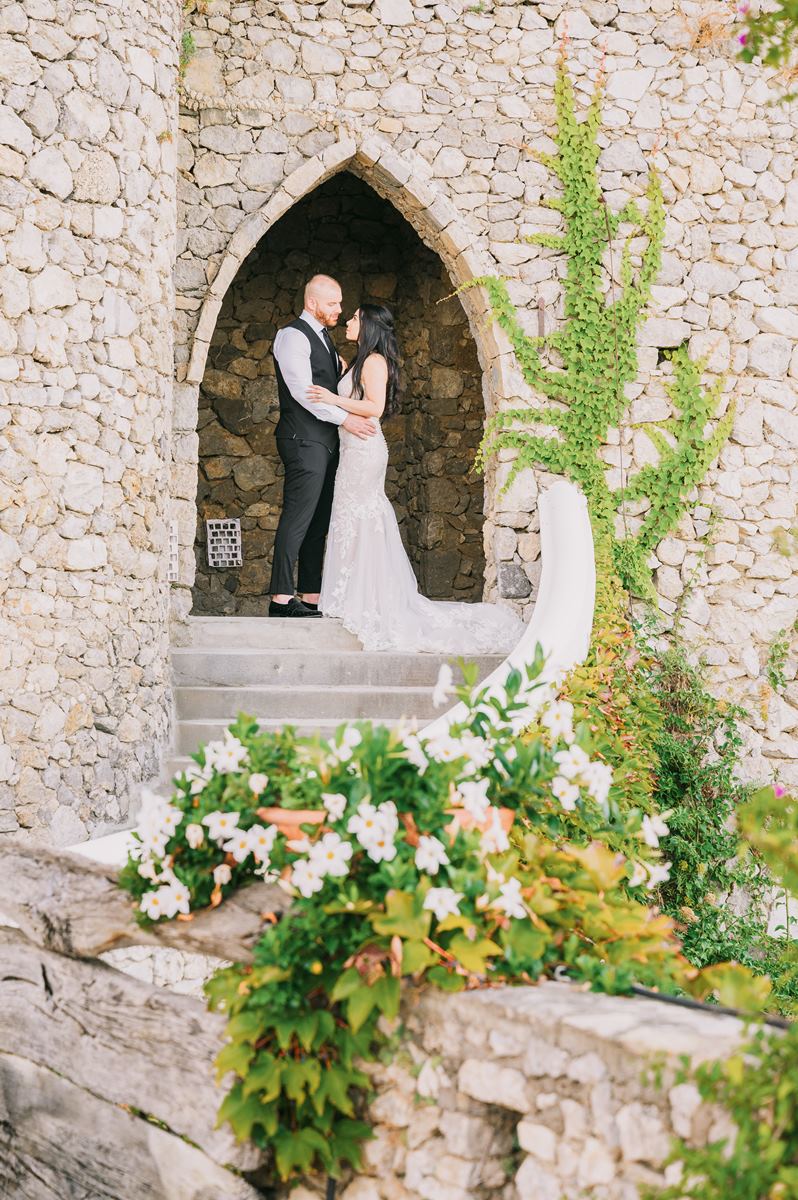

That arch is also the clearest example of how differently these hotels behave as the sun moves. It is worth reading how Borgo Santandrea compares with the Santa Caterina and the Convento before committing to any of the three, because the choice comes down mostly to light and levels.

Two Garden Walls, One Gray and One Magenta
Farther along there is a lawn on the seaward side, edged with a fence of chestnut poles, with a pergola of the same rough timber running above a path of stepping stones. The wall that holds the slope back is dry stone, and set into it, flat against the face, are round millstones, the old kind with a hole through the middle. I have photographed a lot of stone walls on this coast and I had never seen that.
The fence matters photographically because it gives a diagonal that runs from the bottom corner of the frame out toward the village on the far headland. Put a couple on the grass behind it and the eye travels along the rail, hits them, and then carries on to the buildings stacked up the cliff beyond. Without that line the same picture is just two people on a lawn.
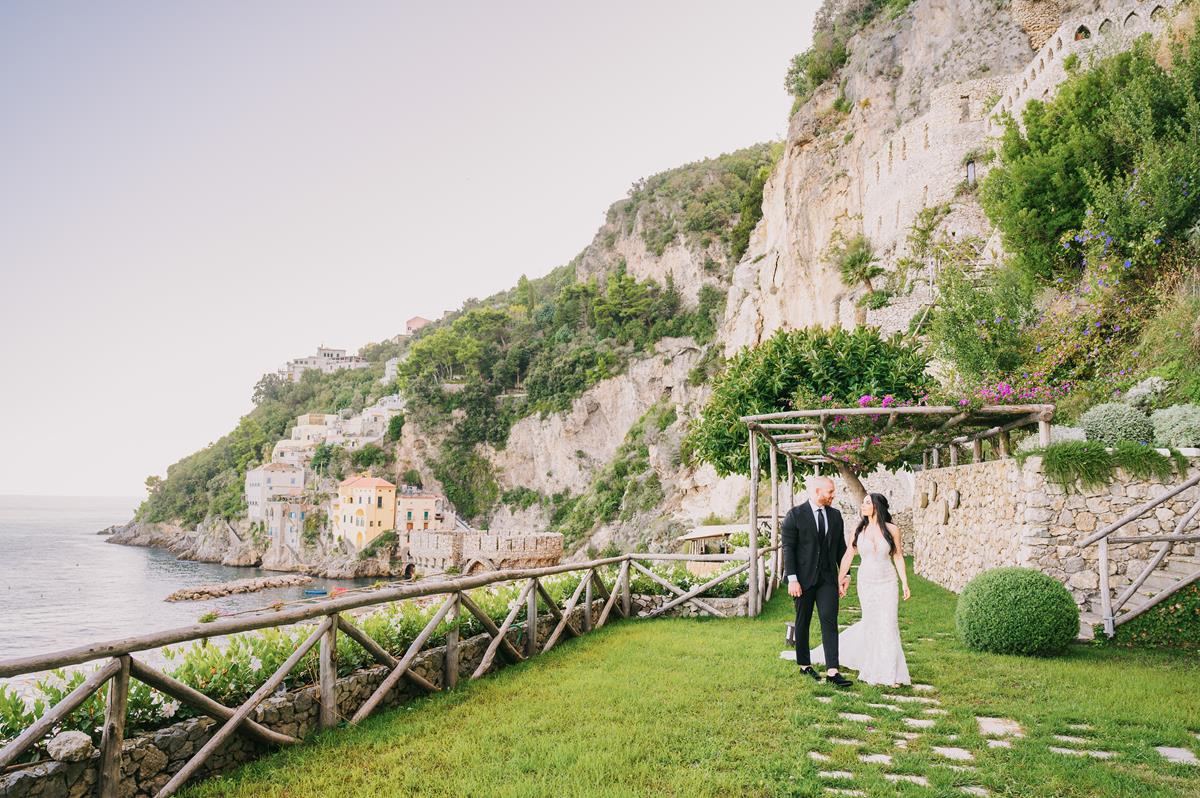
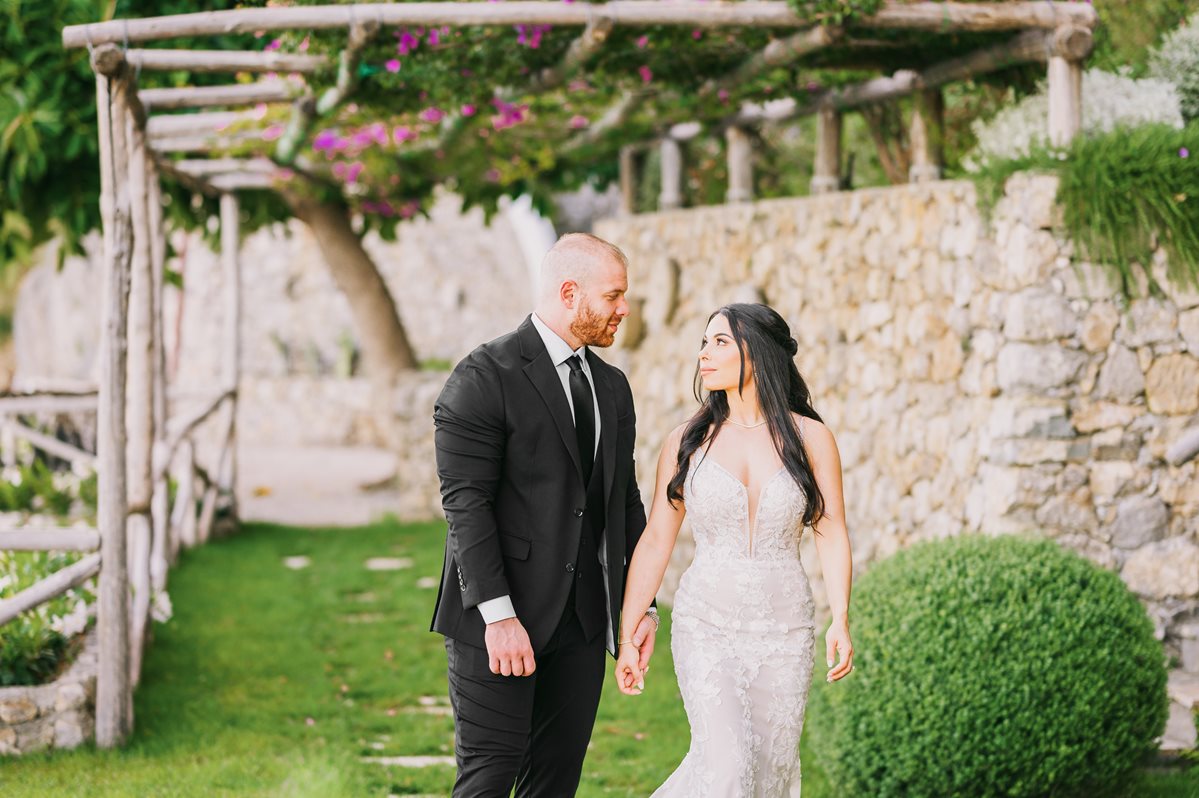
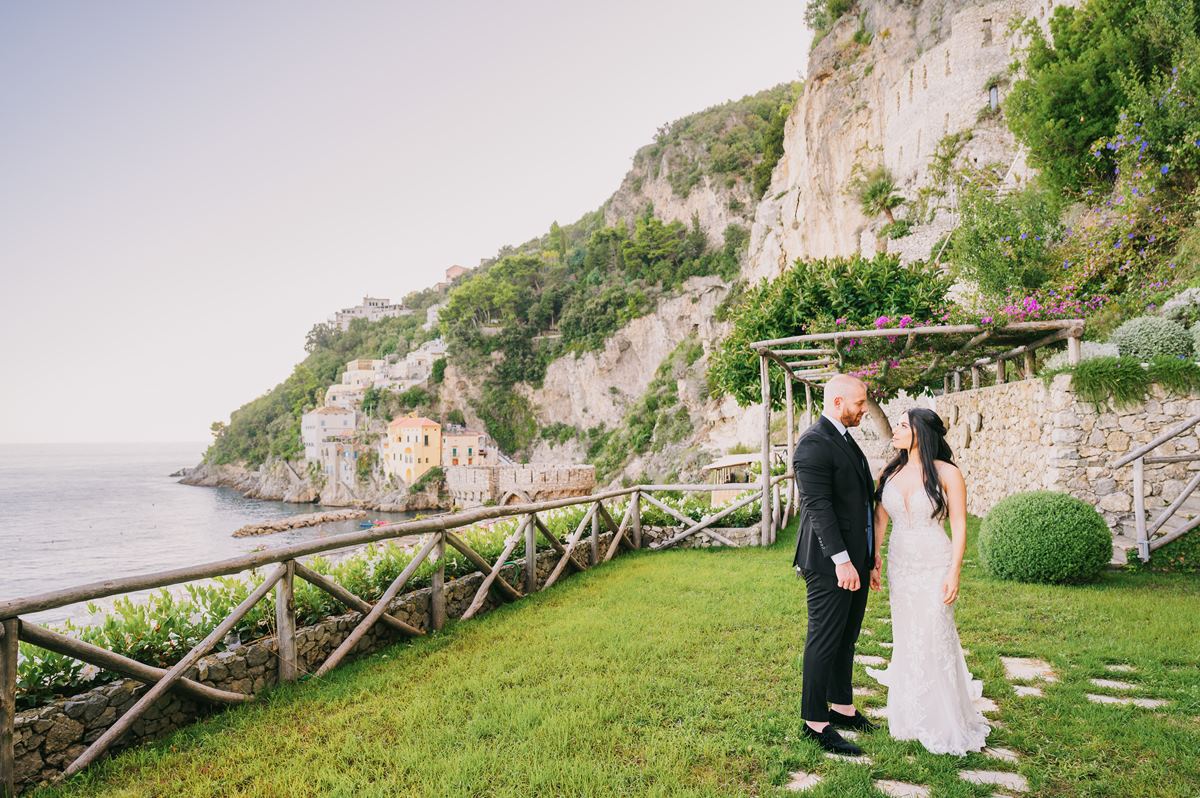

Under the pergola the light comes in low and slanting, and the grass turns a green that looks slightly artificial in the files. I have not corrected it much. That is genuinely what it did.

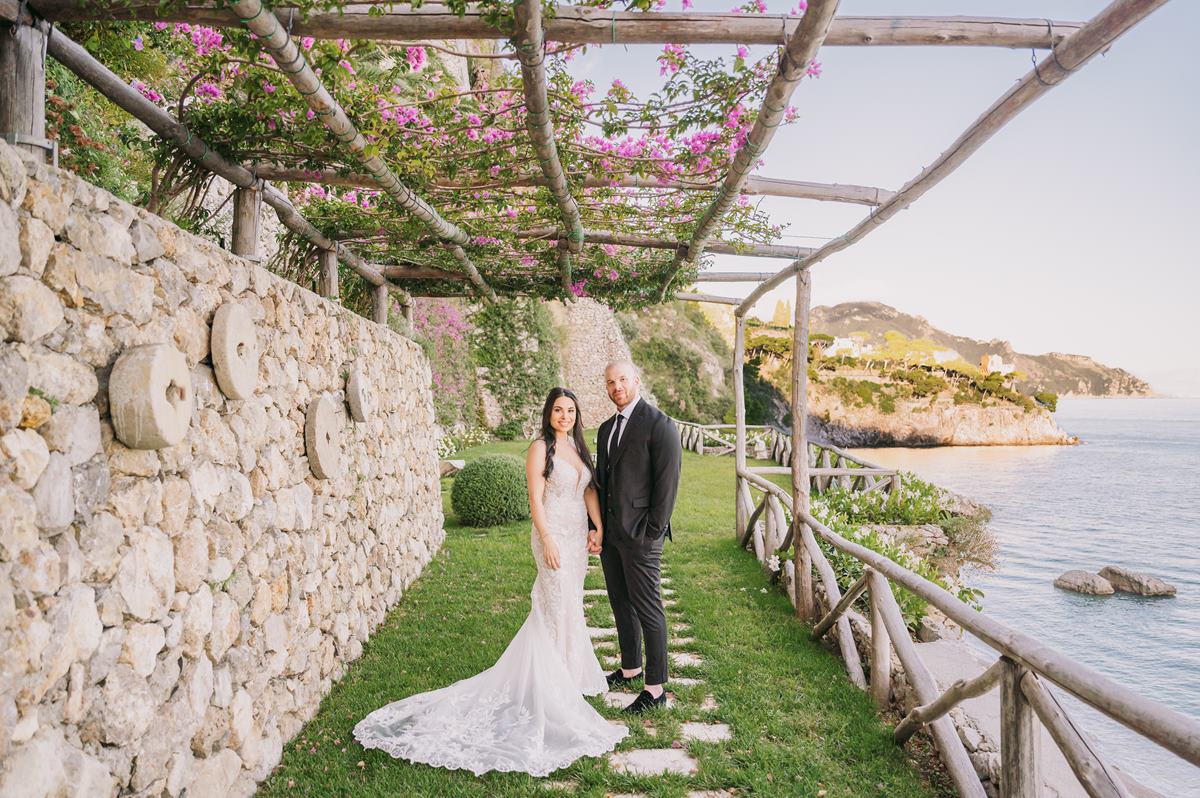
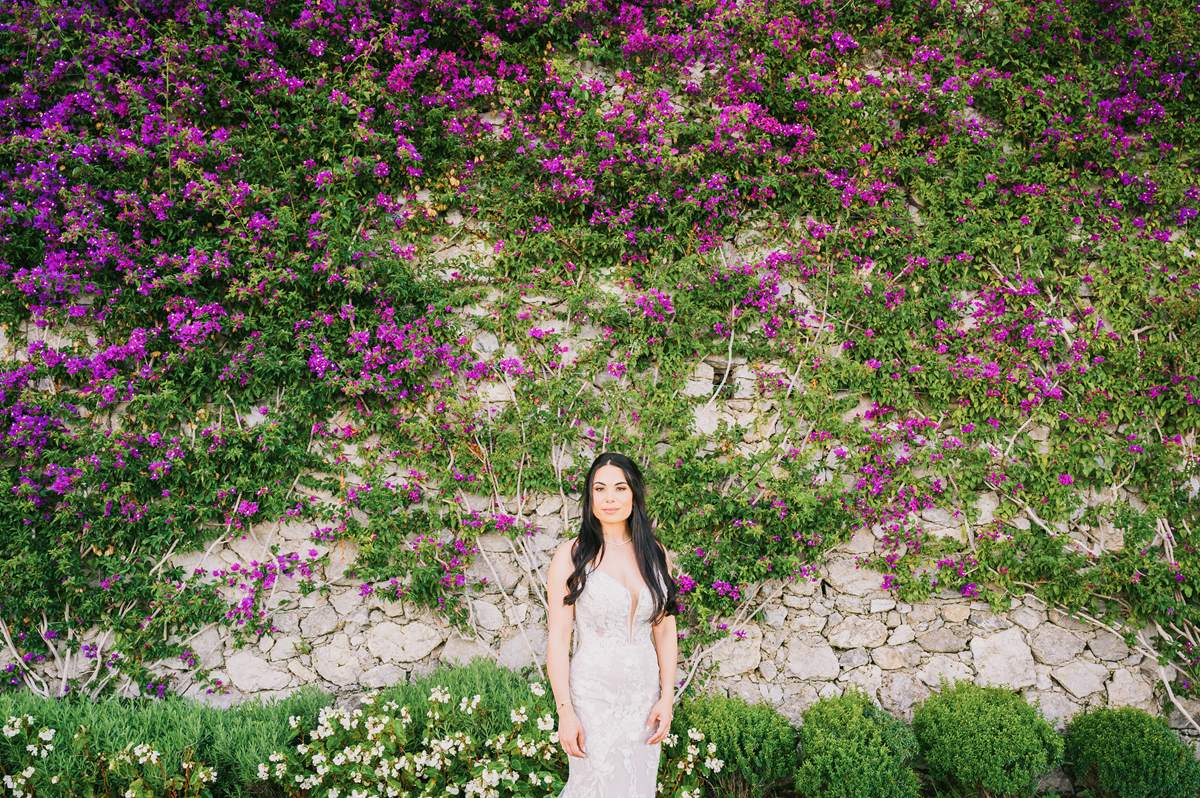
Behind the lawn a second wall climbs high, and a mass of magenta bougainvillea covers most of it, with palms standing above the top and a white fence along the edge. It is the single strongest color on the whole property.
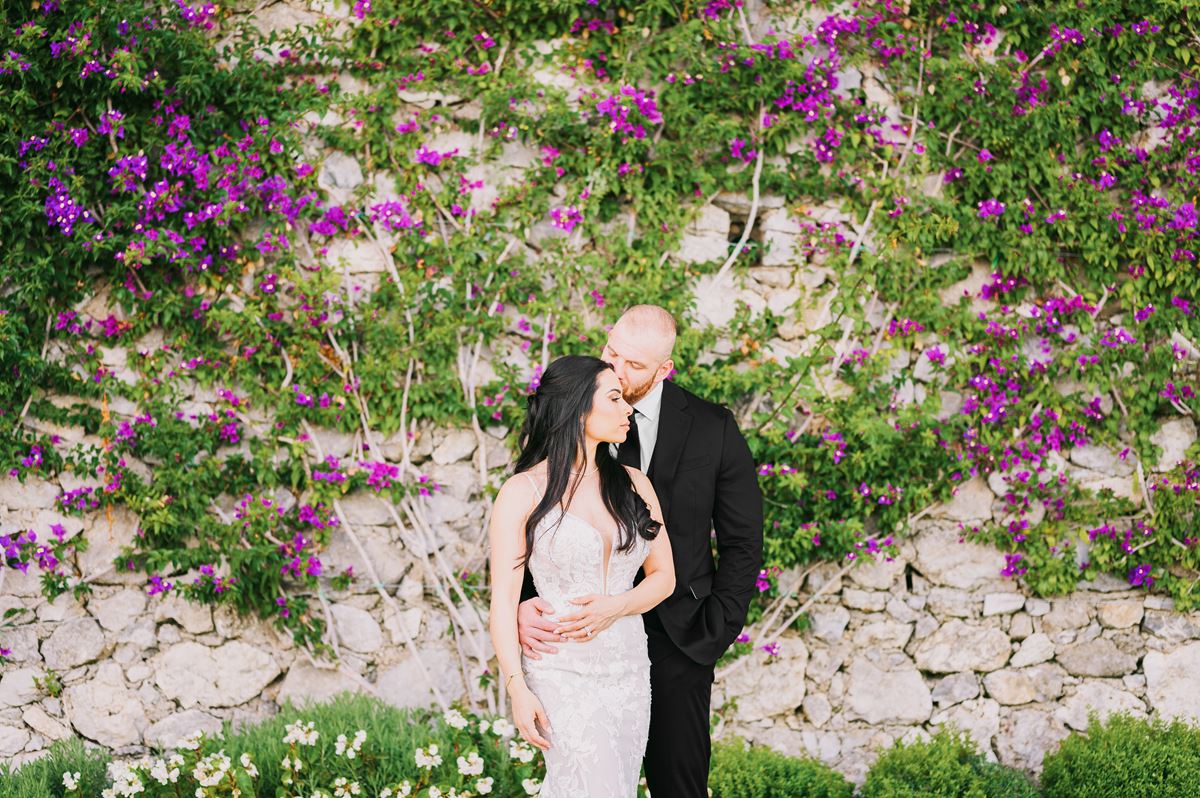

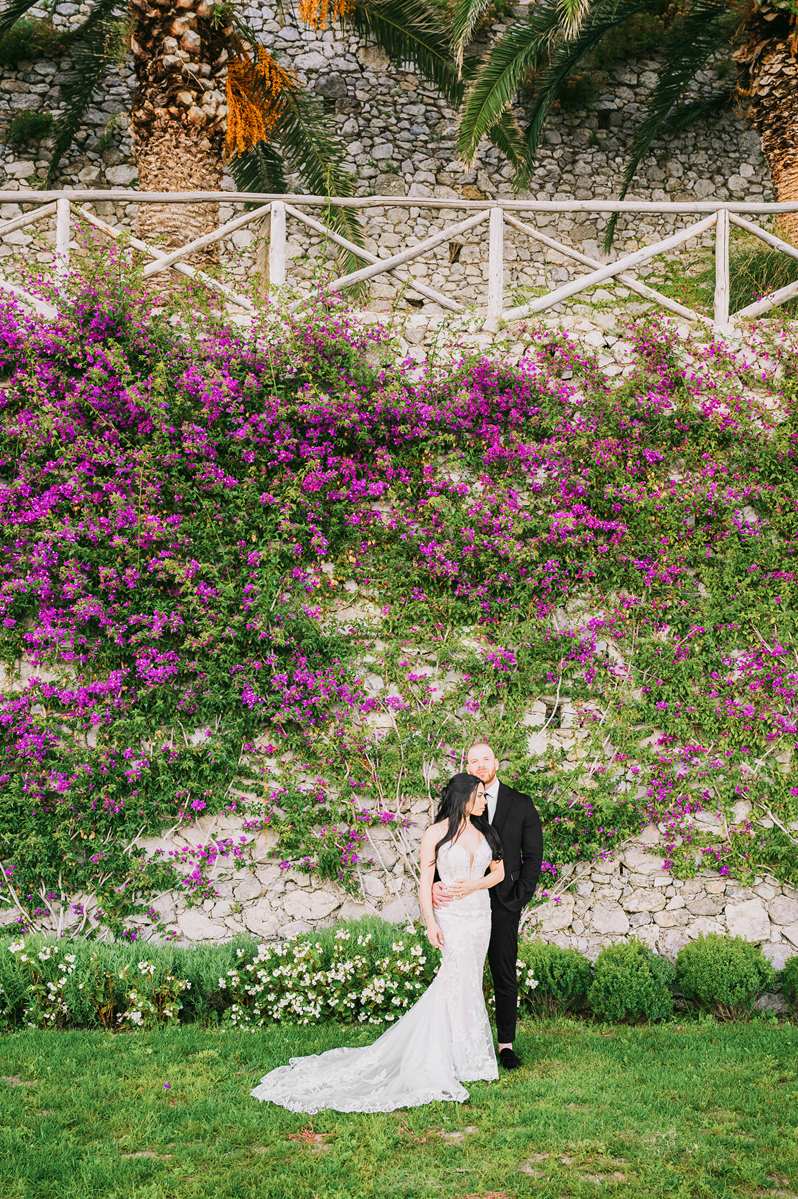

The instinct with a background like that is to move in close and let the flowers sit behind the couple’s heads. I did that, and those frames are fine. The better ones are the opposite: the two of them placed small and low in the corner of a frame that is otherwise entirely wall, so the scale of the thing registers.
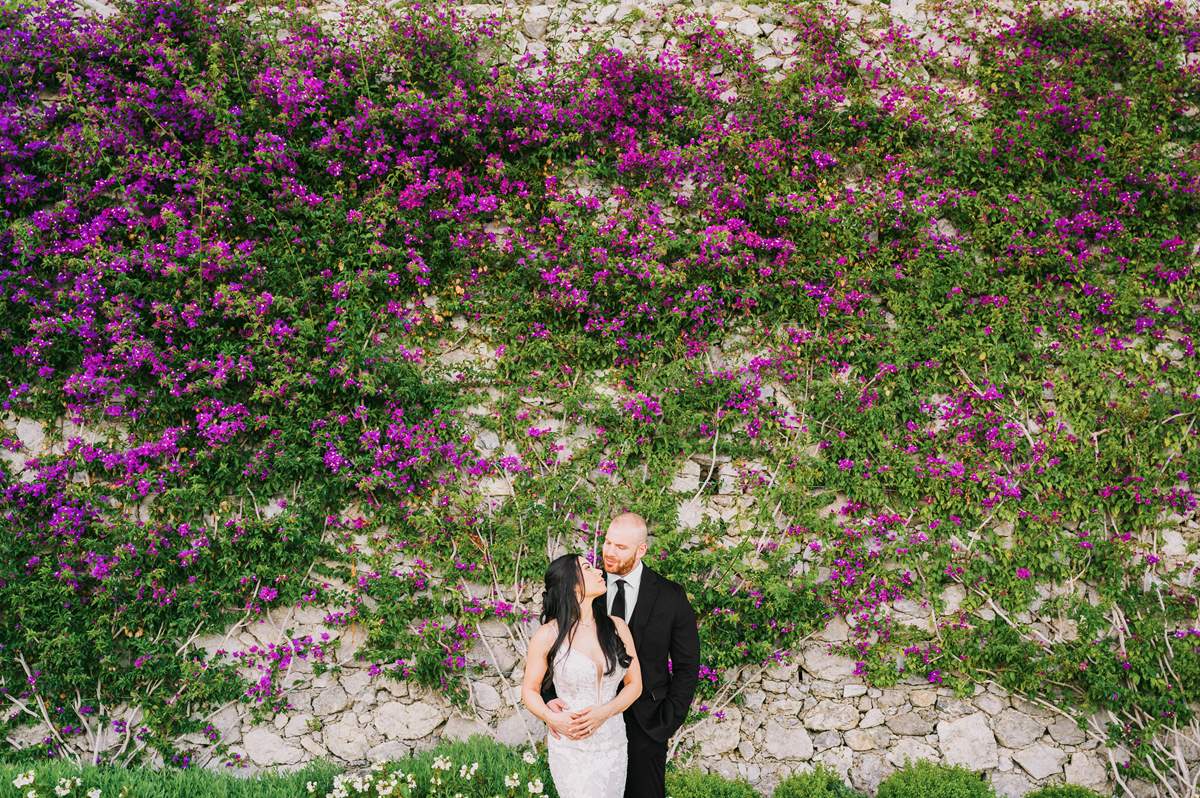
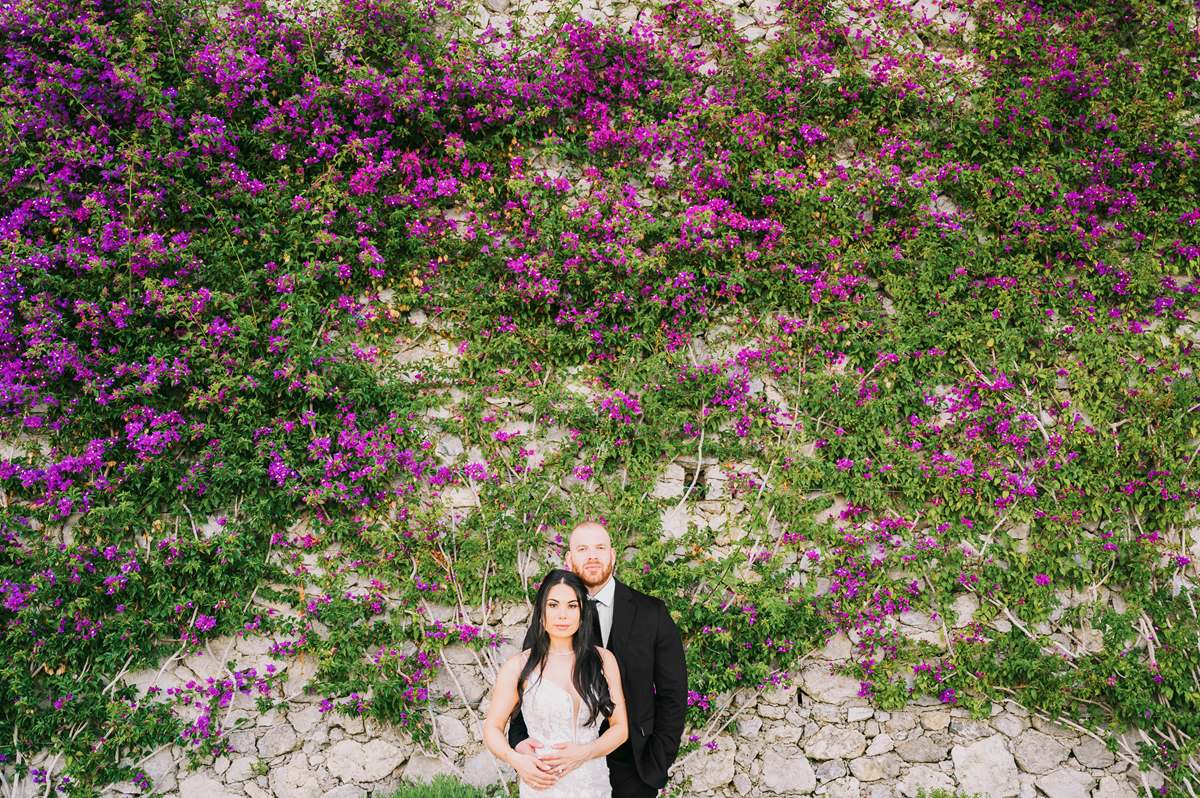
In one of them Jessica stands alone in front of it, at the bottom of the picture, and the flowers take up nearly all of it. Backing up far enough to make your subjects small takes nerve on a wedding day, because it looks from the outside like you are idle, and because if it fails you have burned minutes you did not have. Most of the year I work as an Amalfi Coast wedding photographer with no minutes to spare, which quietly rules that frame out.

The last frame on the page goes back to the gates of the rock passage, this time in color: the white plaster around the mouth of the tunnel, the iron stars, the bougainvillea hanging over the top, and the two of them inside the dark opening, kissing.
What a Borgo Santandrea Wedding Shoot Needs When the Wedding Already Happened
If you are thinking about doing what Jessica and Bill did, a few things are worth knowing before you book anything.
Give it real time, not a quick session. The whole value of this format is the time, and if you compress it back down to an hour you have paid for a hotel day and bought yourself a normal portrait shoot.
Understand that the property is vertical and that walking it in a fitted dress with a train is real physical work. Jessica went up and down stone stairs again and again. Flat shoes for the walks between spots and heels only when the camera is up is the standard answer and it is the right one.
Expect the light to move a long way across a day like this. Walk the property first, note which terraces lose the sun early, and save the lowest terraces above the water for when the light softens.
And decide honestly if you want any ceremony element at all. Some couples in this position ask for a small private exchange of words anyway, which is easy to arrange and needs no celebrant once the legal part is done at home. These two wanted none of it, and the day lost nothing by it.
What I Took Away From a Day With No Timetable
Most of what I know about photographing weddings is knowledge about compression: how to get something true out of a few minutes between the ceremony and the first course. It is a real skill and I am not dismissing it. But it shapes what you produce far more than you notice while you are producing it.
Given a day with no timetable, I made different pictures. Slower ones, wider ones, more frames where the people are small and the place is large, more frames of nothing happening. The coffee on the tiled balcony is the clearest example. It is a photograph of two people sitting down, and it says more about their marriage than any posed embrace in the gallery.
They got married in front of their families at home, which was the right way to do that part. Then they came here and gave themselves the day the wedding could not contain. Both things were the wedding; they just happened an ocean apart.
If you have already done the legal part and you are trying to work out whether a Borgo Santandrea wedding shoot is still worth flying for, tell me which day of your trip is still open and I will tell you honestly what I could do with it.
 Written By Emiliano Russo