
A Ravello-Atrani Wedding Day
A civil ceremony in a hillside garden above Ravello, a bride photographed against a white wall in Atrani, and a wedding dinner at Palazzo Ferraioli that ended with four musicians in straw hats playing into the night.
Elisha and Luke came from London for a Ravello-Atrani wedding at the beginning of September: a civil ceremony in a garden above Ravello at three in the afternoon, and dinner by the sea in Atrani that night. I covered six hours of the day with Felice, and it started at sea level, in Atrani, where they were both getting ready.
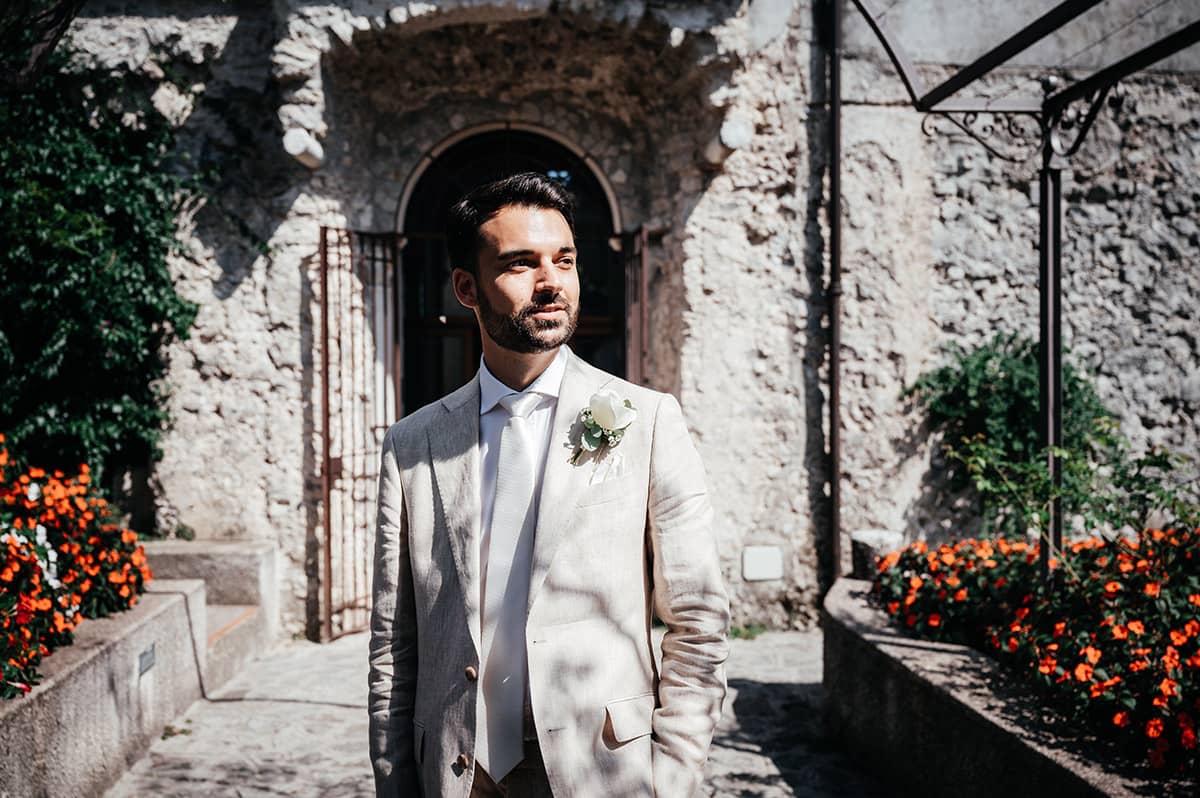
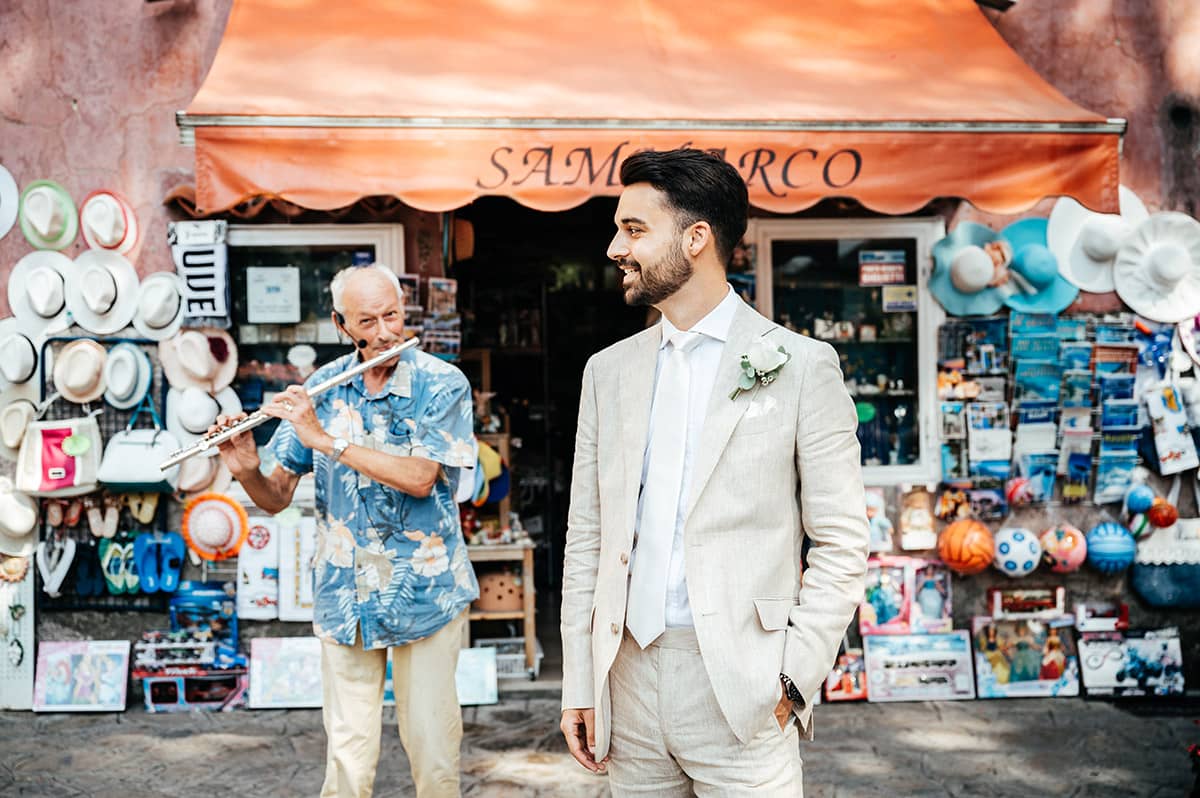
Luke was dressed first, in a cream linen suit, and I found him in the square at the foot of the white staircase under the clock, then in a stone doorway, and then in front of a souvenir shop full of straw hats, where an old man in a flowered shirt was playing the flute for passersby. He kept playing while I photographed them side by side, and Luke could not stop grinning.
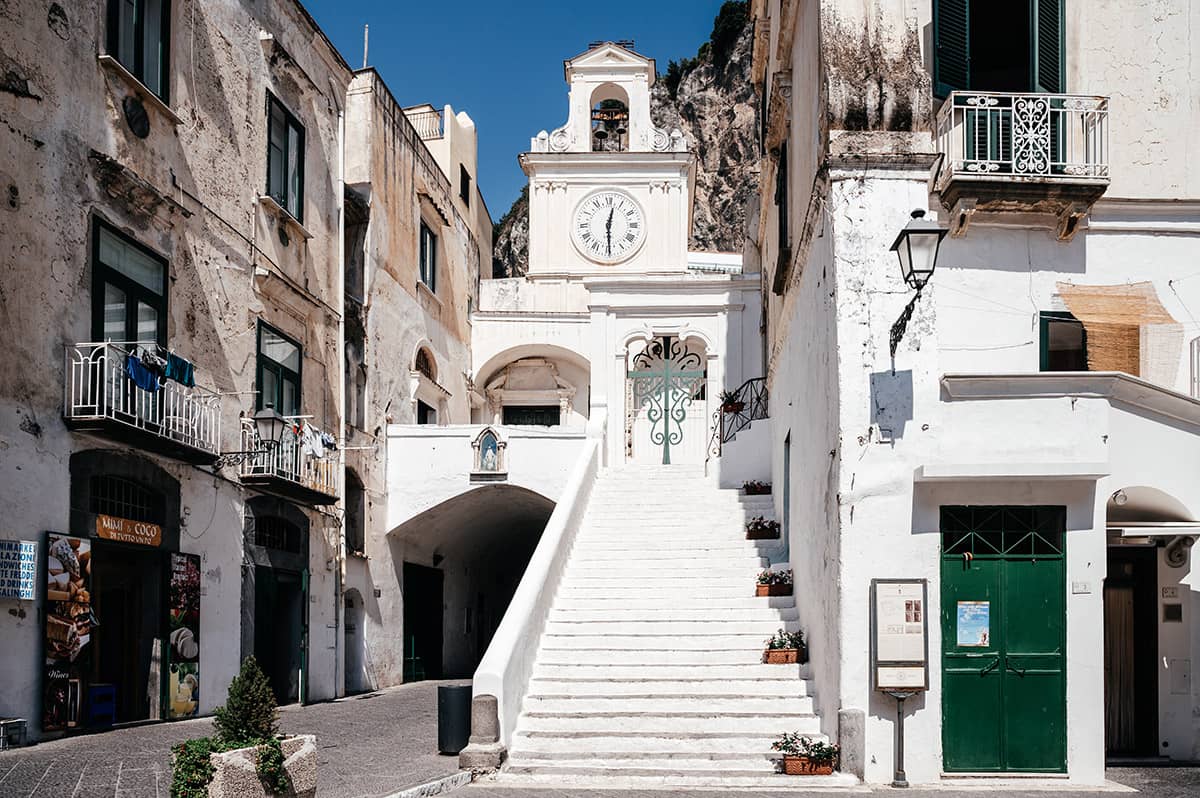
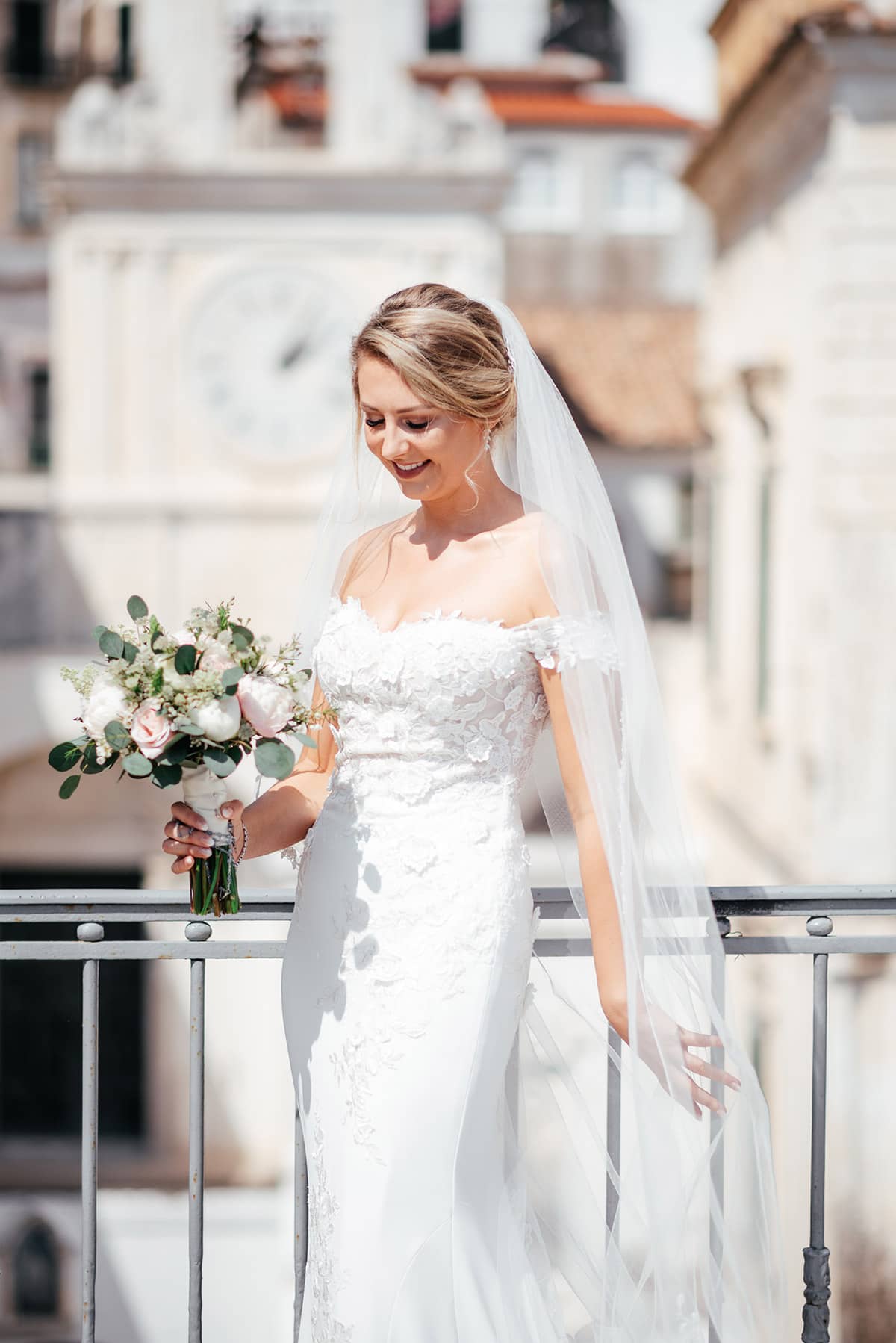
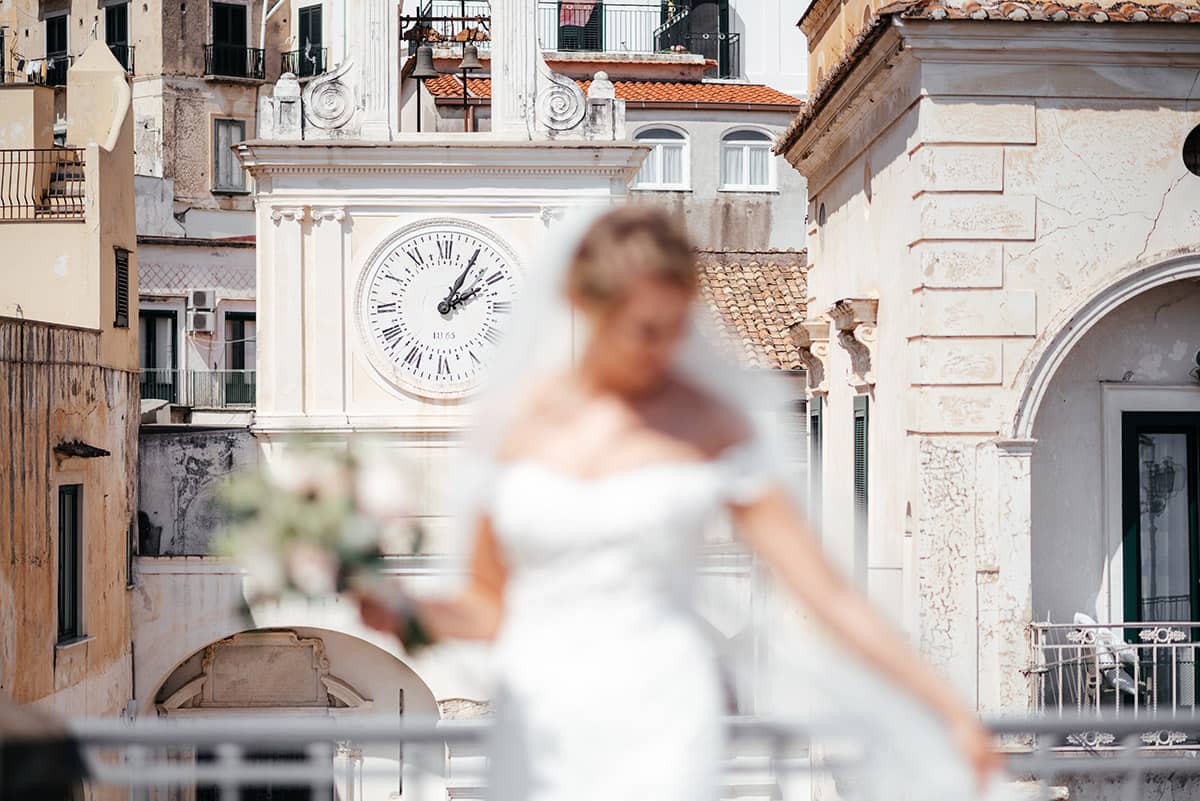
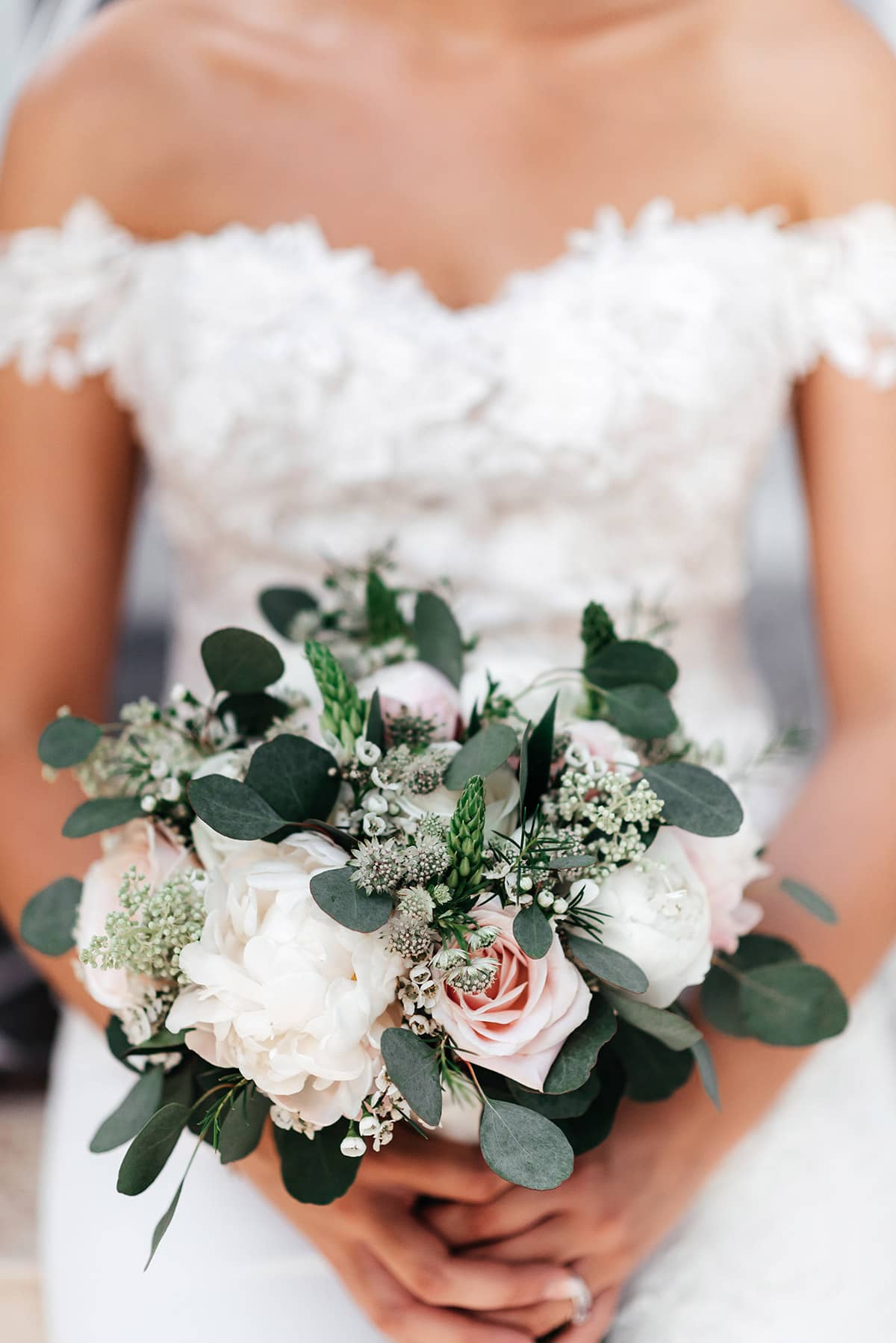
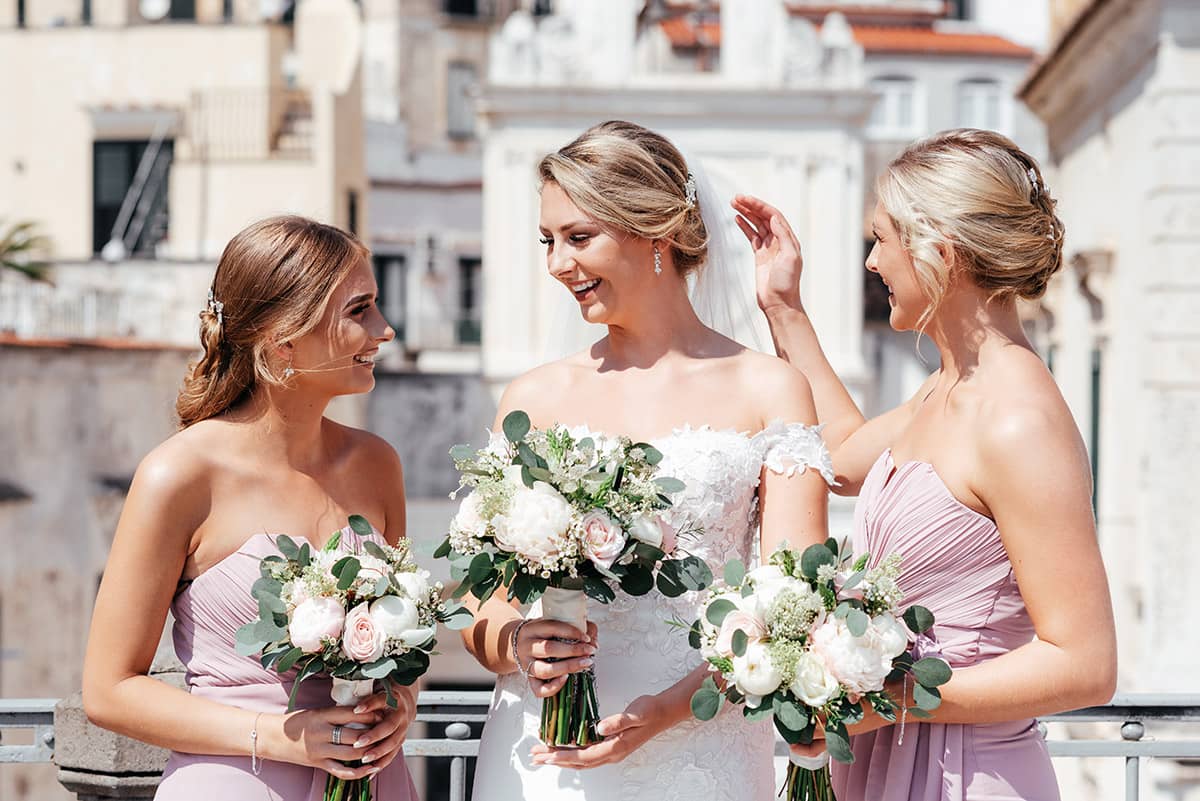
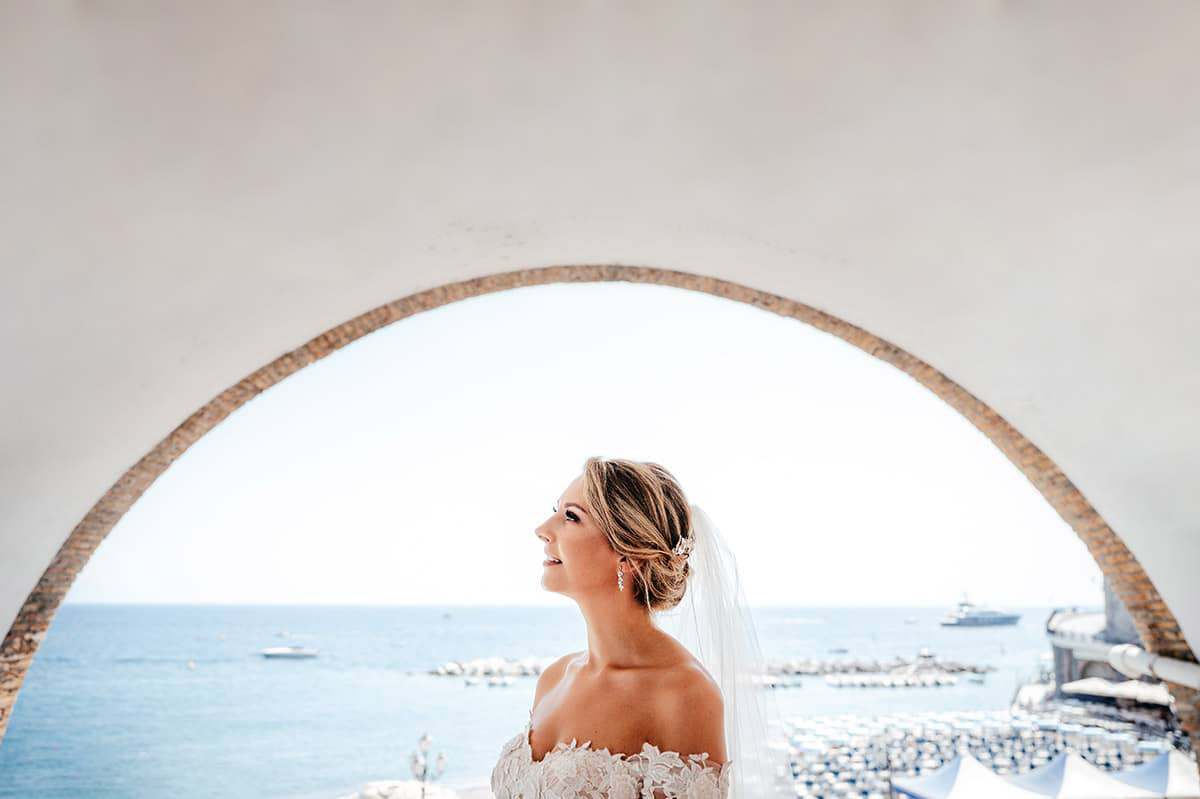
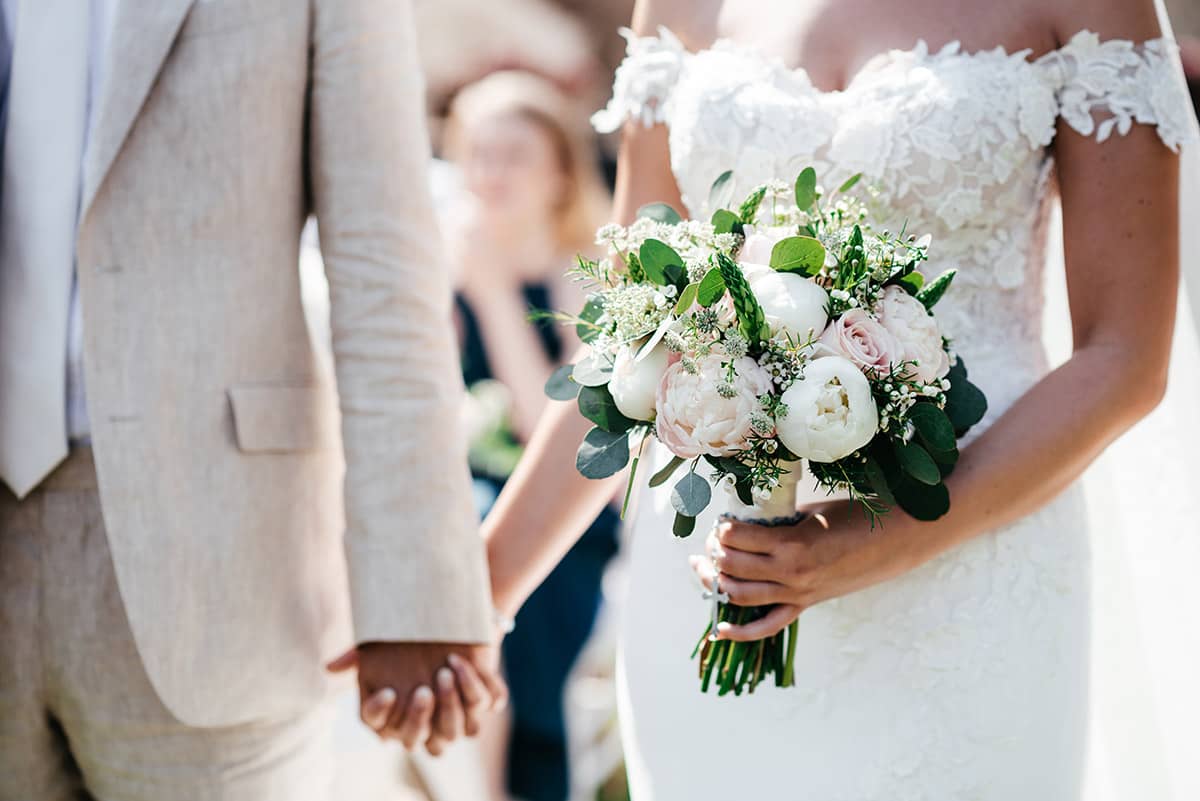
Elisha got ready a few streets away. Her two bridesmaids, both in blush pink, joined her on a terrace with the clock tower of the square behind them, and her bouquet of white roses and eucalyptus was the only green in a white town. Her dress had a fitted lace bodice with off-shoulder sleeves, which photographs well anywhere there is green behind it. The last frame before leaving was Elisha alone under a white arch, looking out at the harbor.
Getting ready in Atrani and marrying in Ravello is an easy plan to photograph: the village gives you white walls and the harbor in the early afternoon, and the drive up brings the couple to the ceremony with time to spare.

A Civil Ceremony Above Ravello
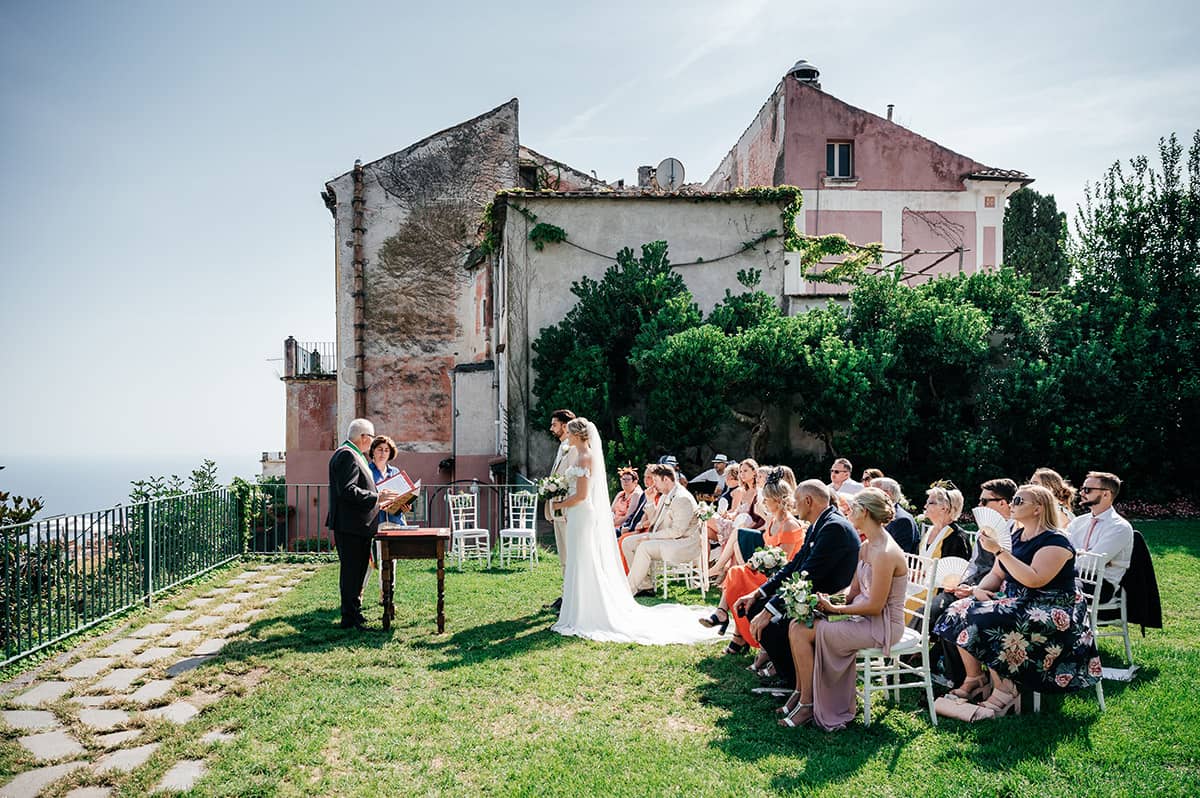
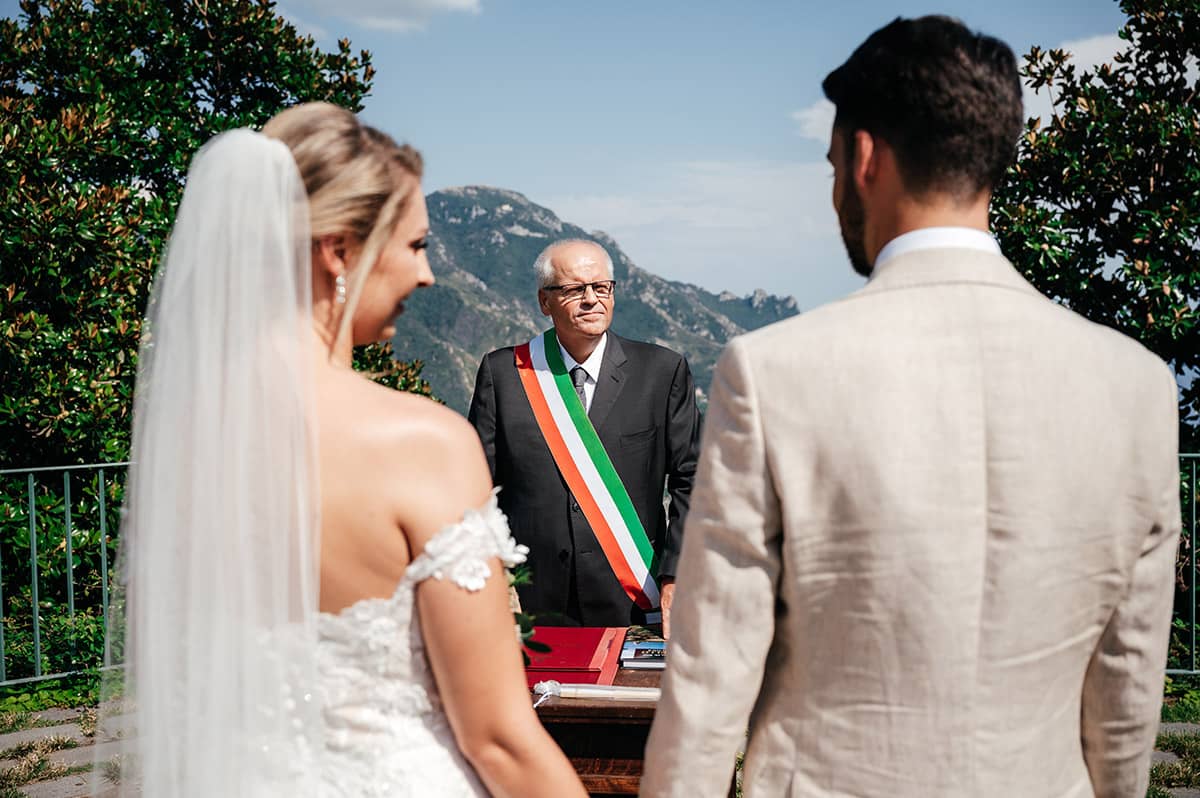
For the ceremony itself they chose a Ravello Town Hall wedding: a legal civil service, arranged through the comune, held outdoors in a garden that the town uses for this. The registrar wore the mayor’s tricolor sash and read from a leather folder at a plain wooden table set against a low iron railing, mountains behind her, the sea somewhere further down and out of frame. About thirty guests sat in white chairs on the cut grass, the women in fascinators among the linen suits, which told me most of this group had flown in from somewhere used to a different kind of wedding weather.
Behind the table stood an old building the color of dried rose, its plaster cracked down to the stone in patches, a satellite dish bolted to a wall that has probably seen four centuries of Ravello weather. A backdrop like that tells the truth about the town, lived in and patched for a very long time.
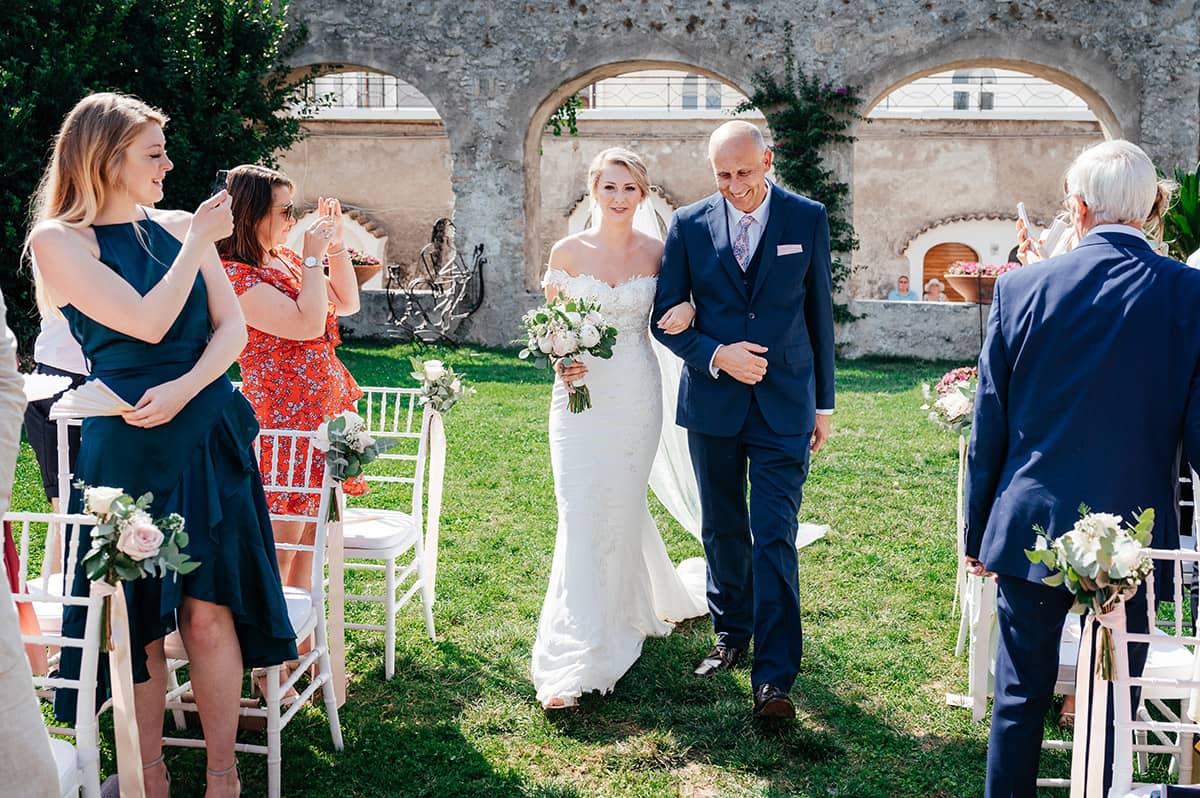
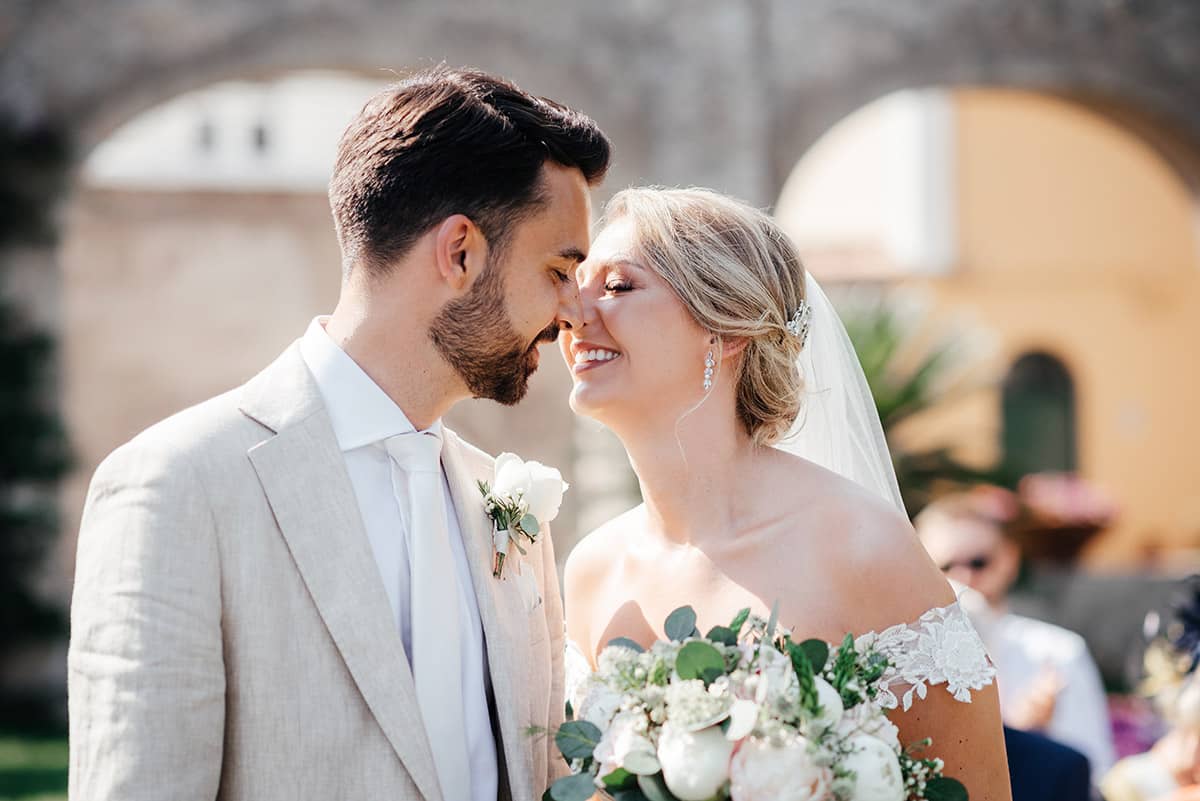
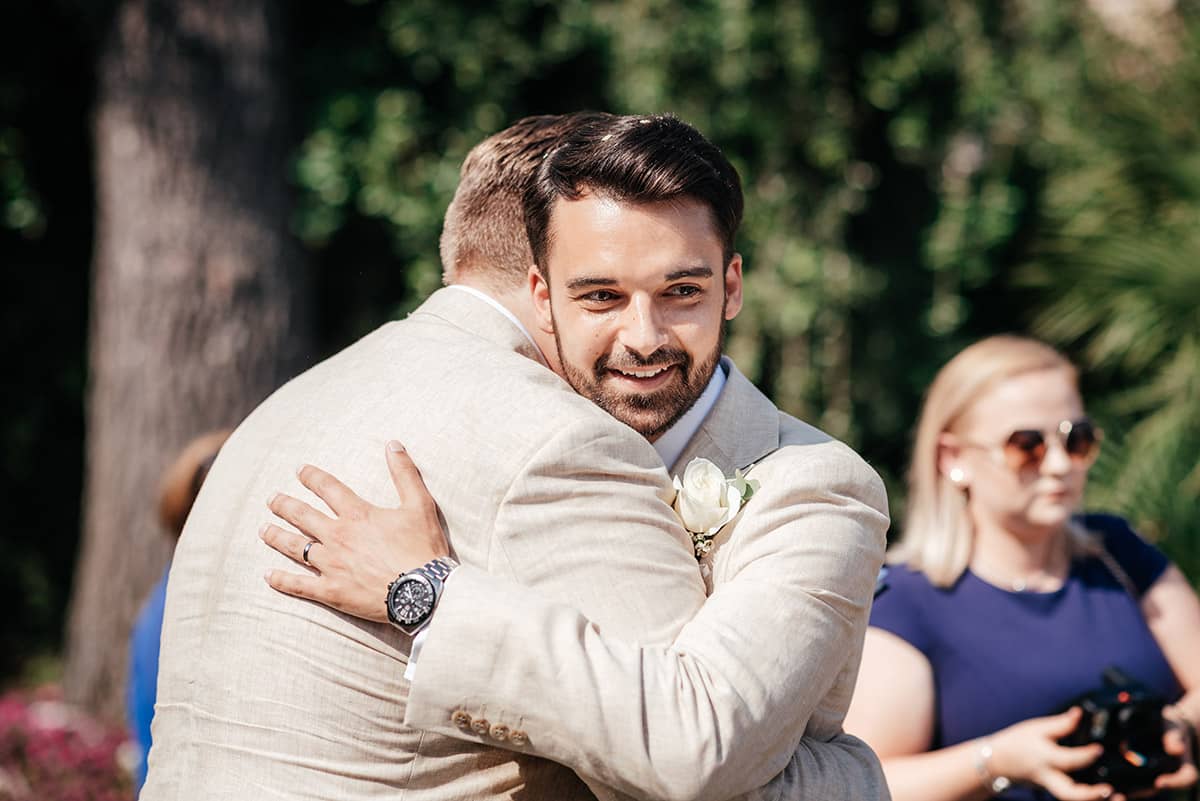
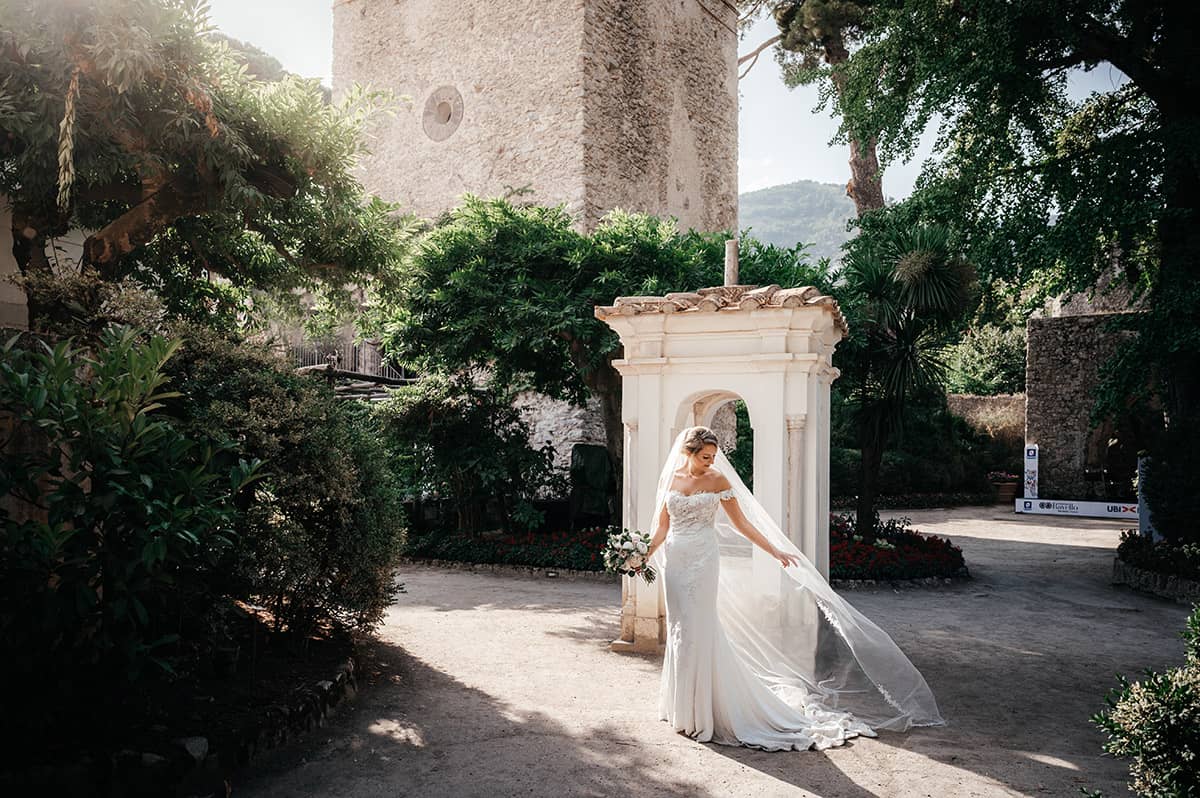
Elisha walked in on her father’s arm through a garden path lined with old stone arches. I positioned myself ahead of them, shooting wide to keep both the arches and the guests turning to watch in the same frame. When she reached Luke, I moved to the side of the aisle rather than the back, close enough to catch the moment his face changed before either of them said a word.
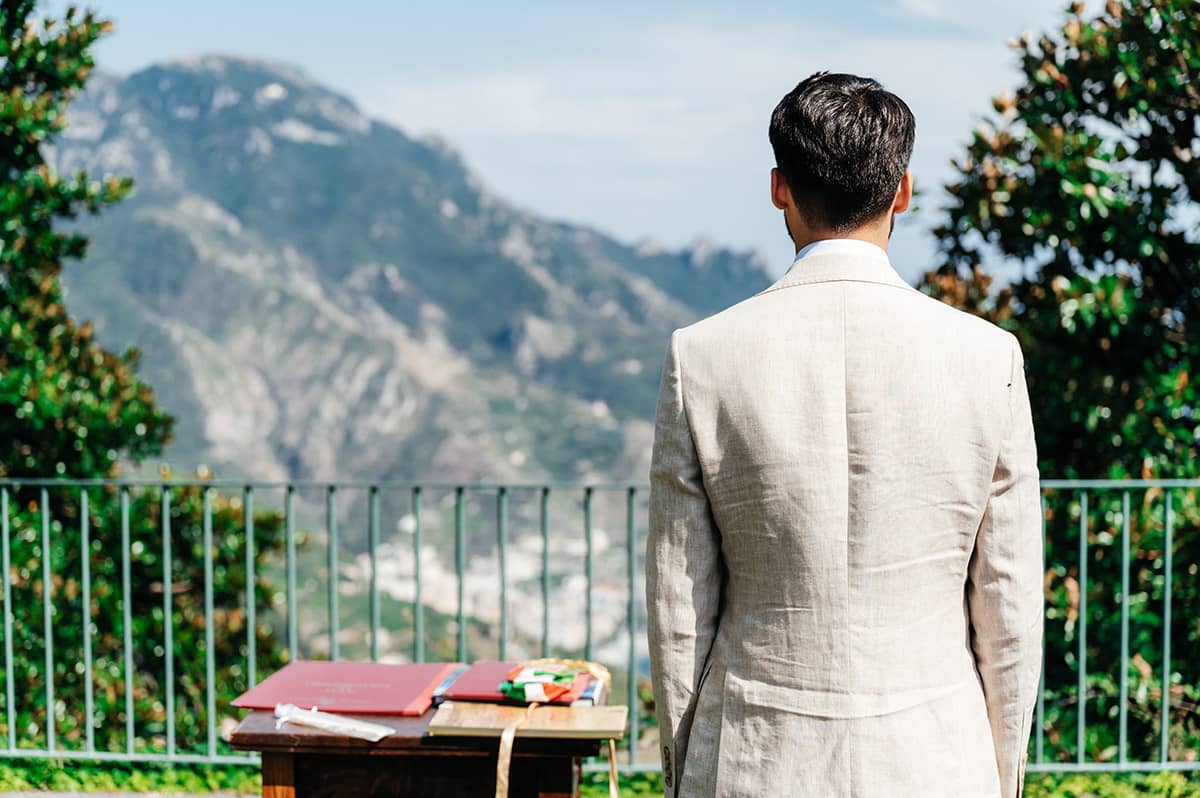
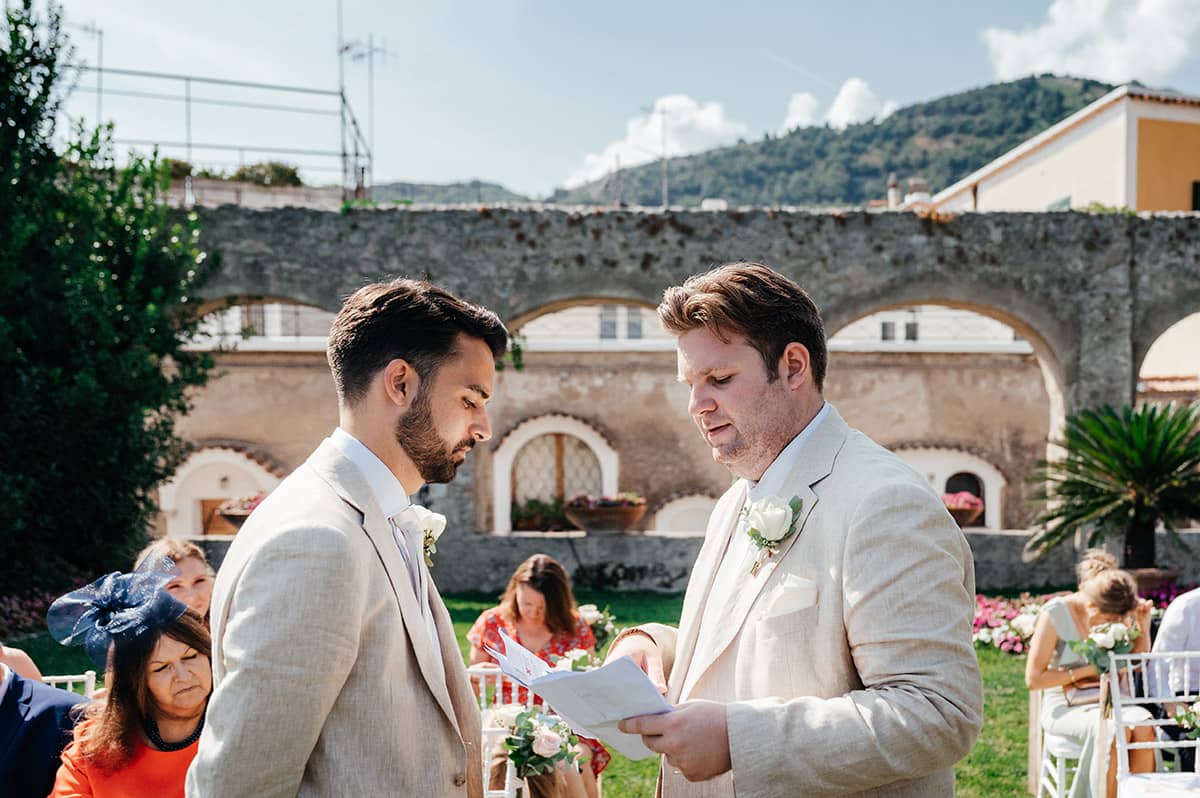

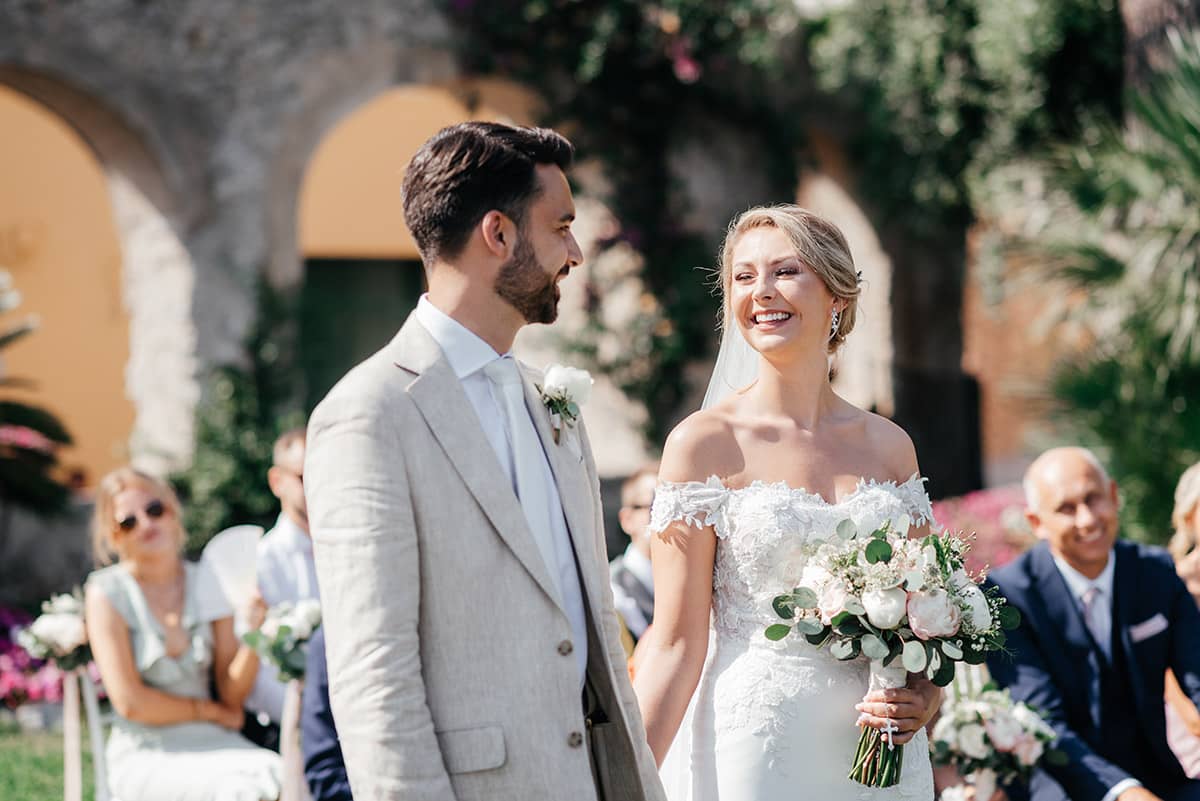
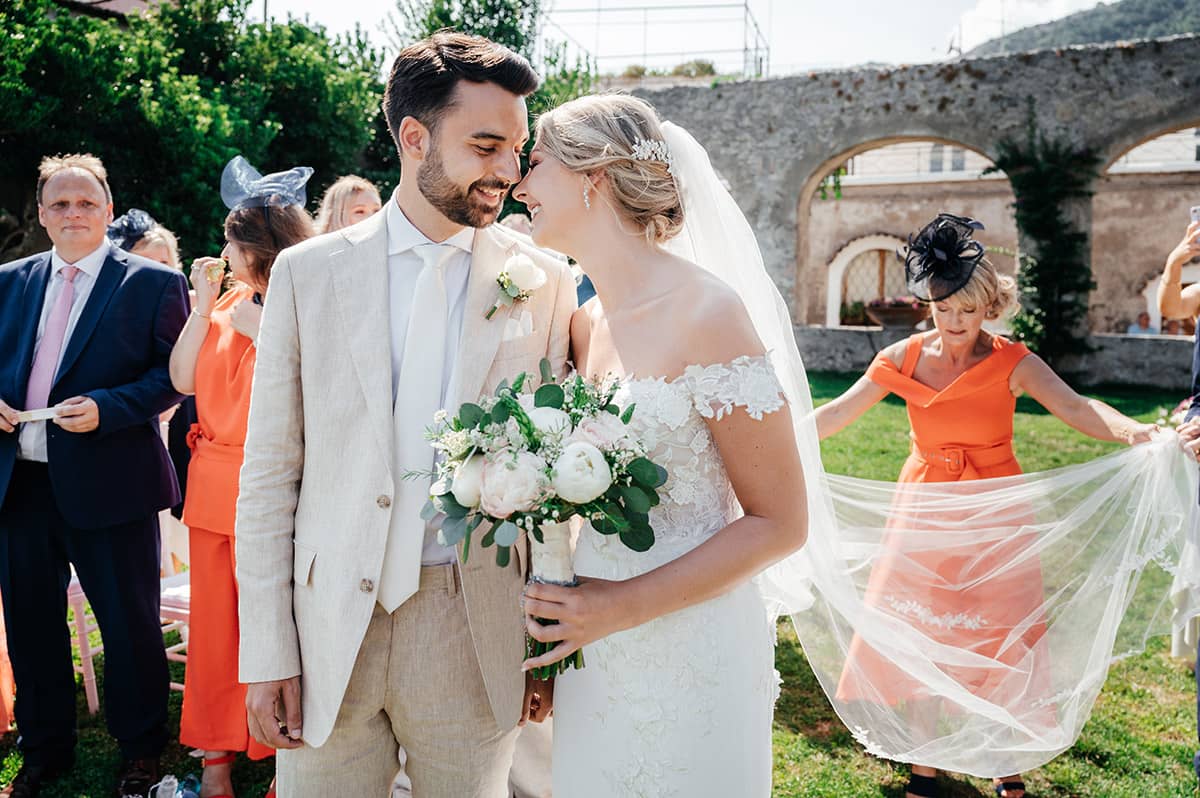
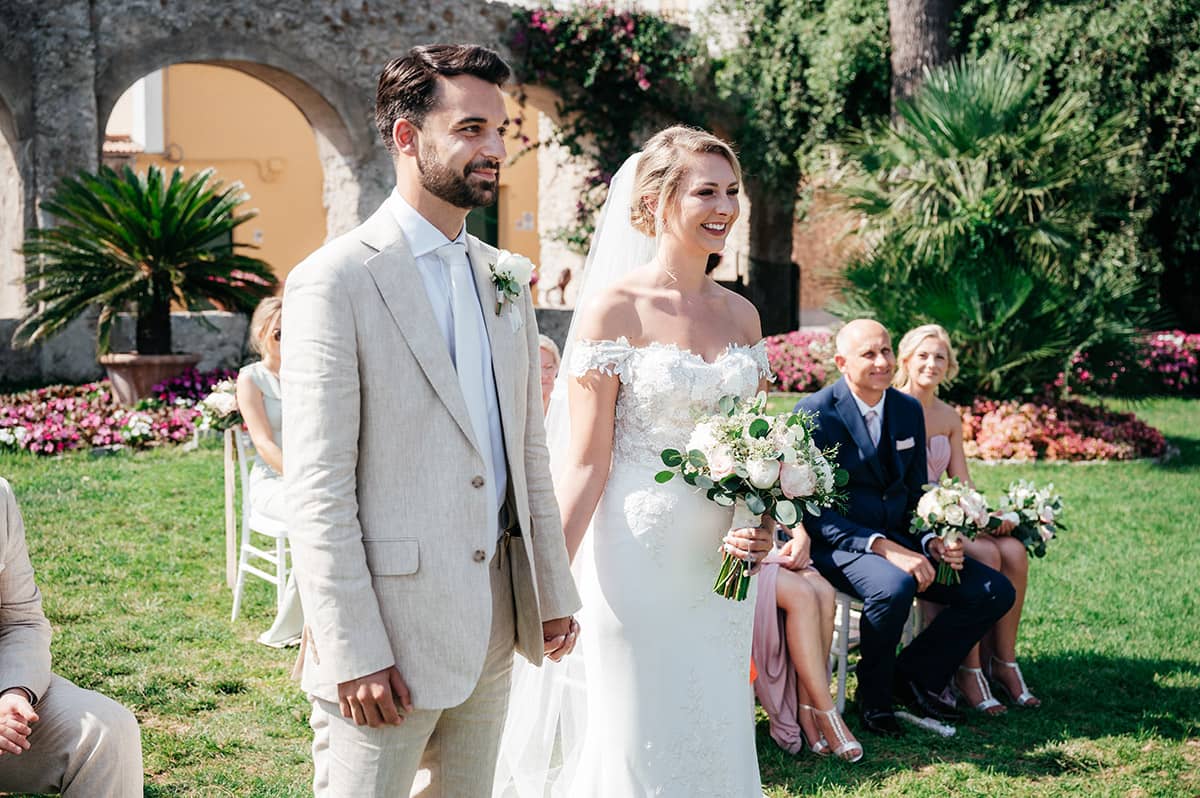
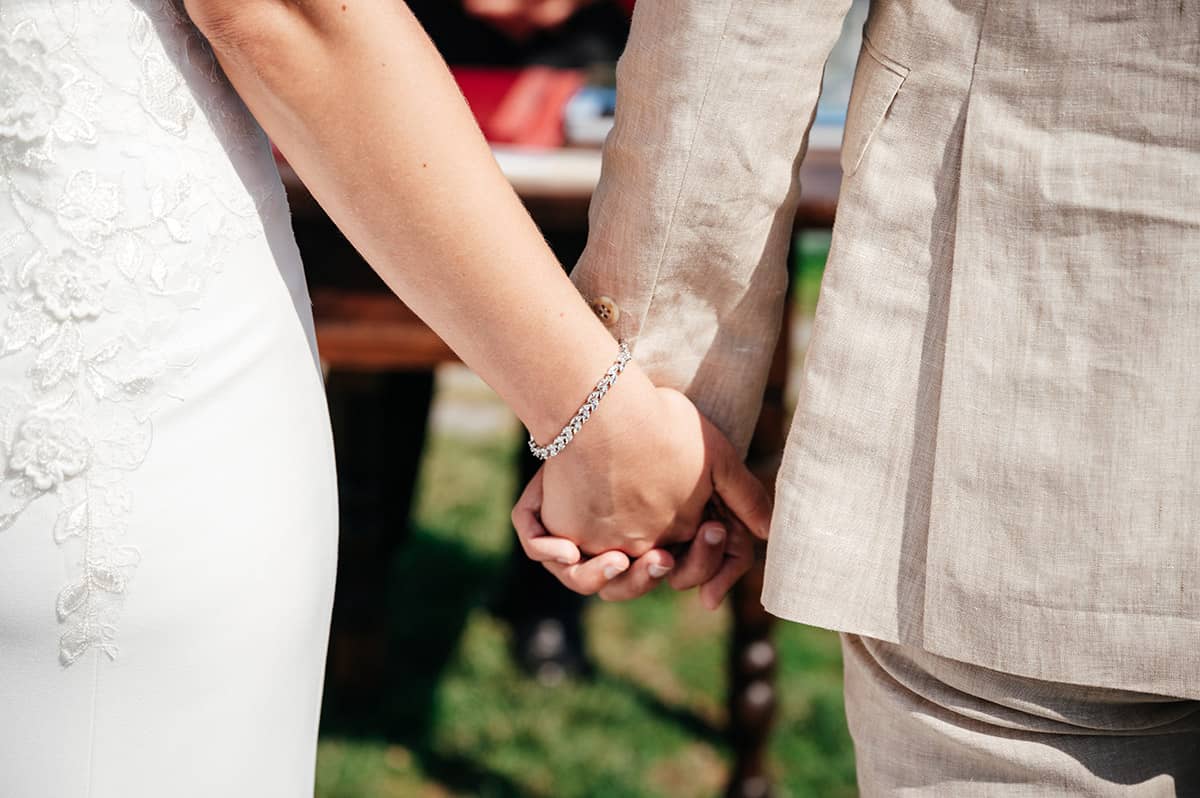
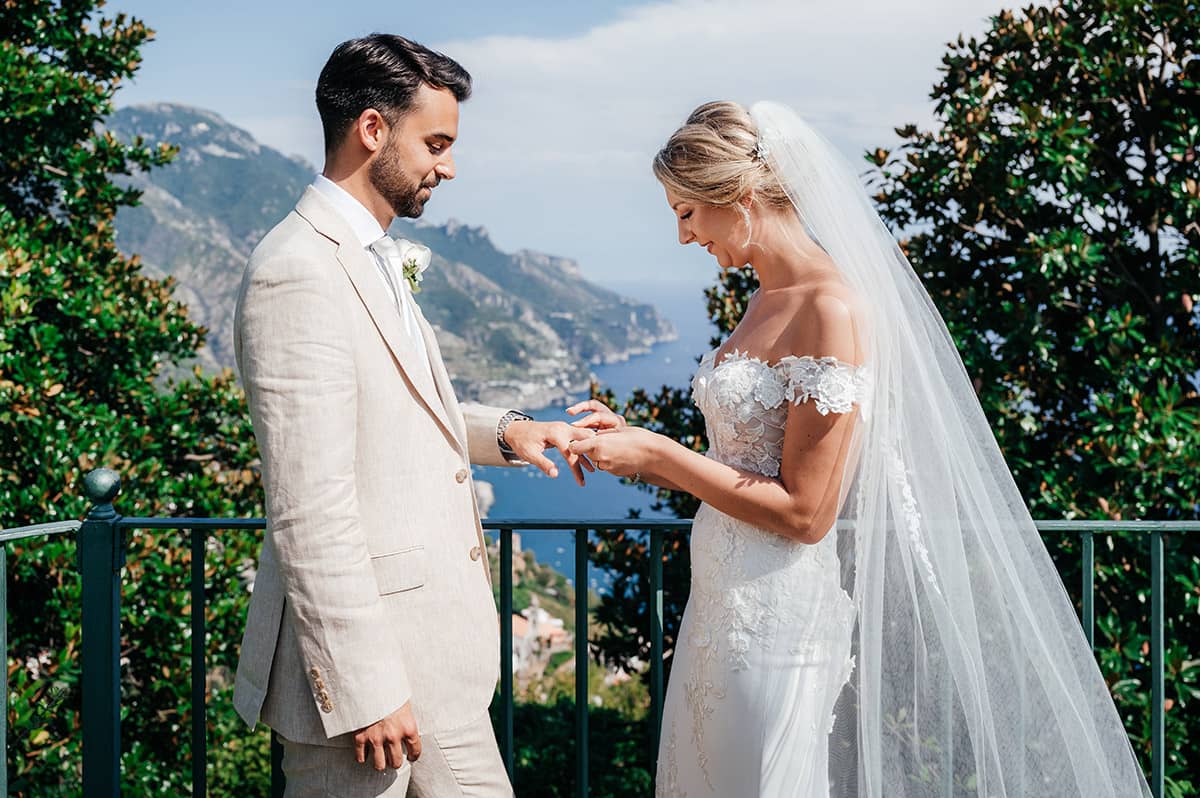
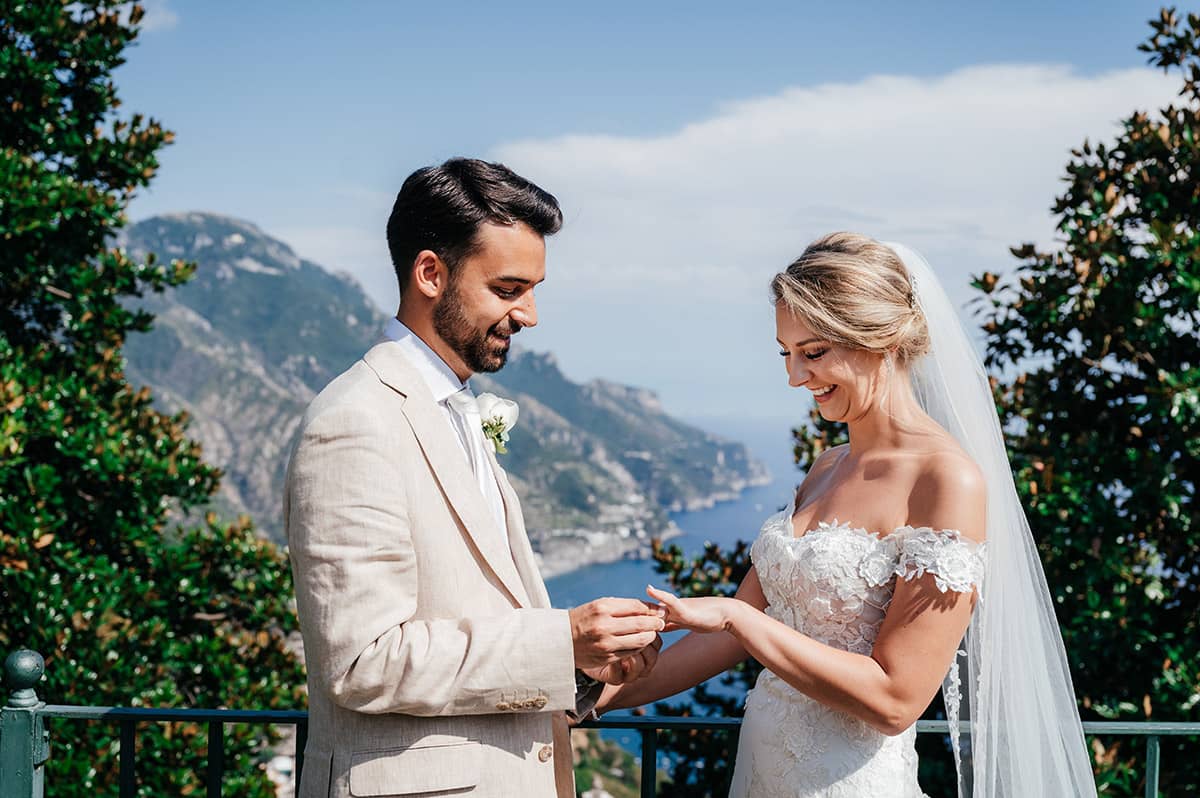
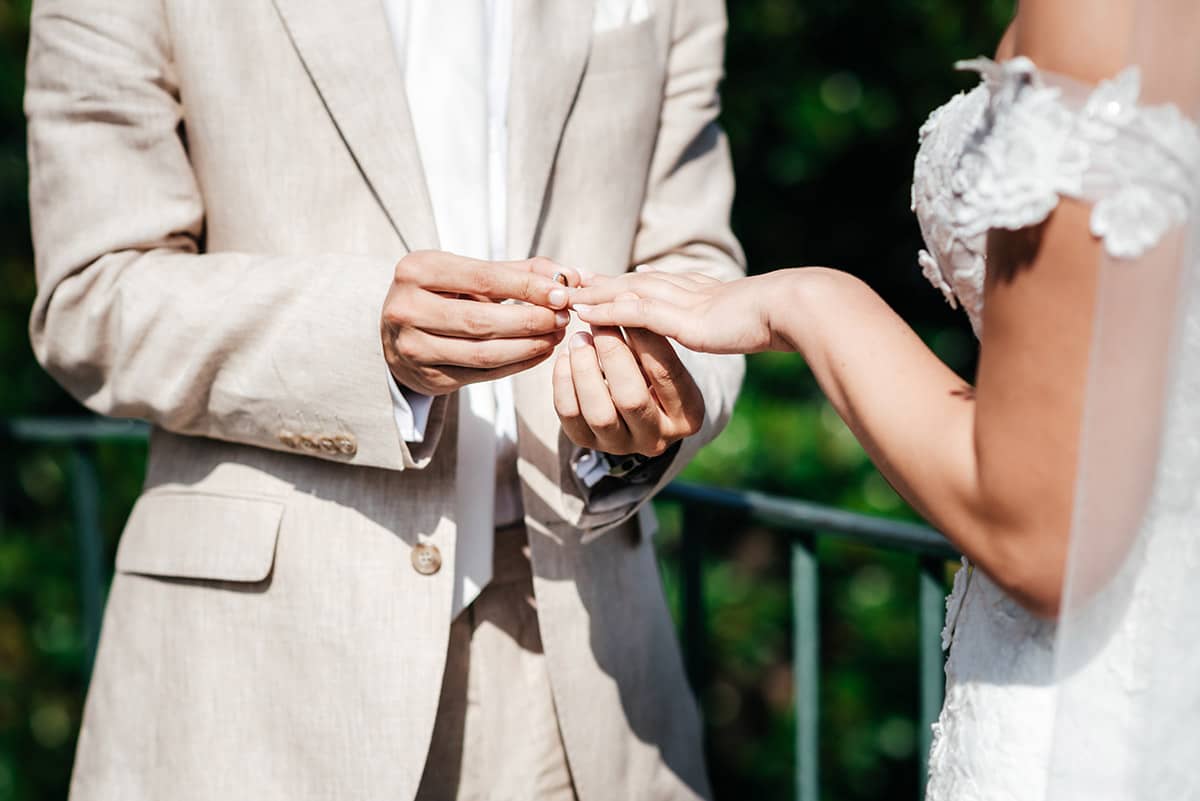
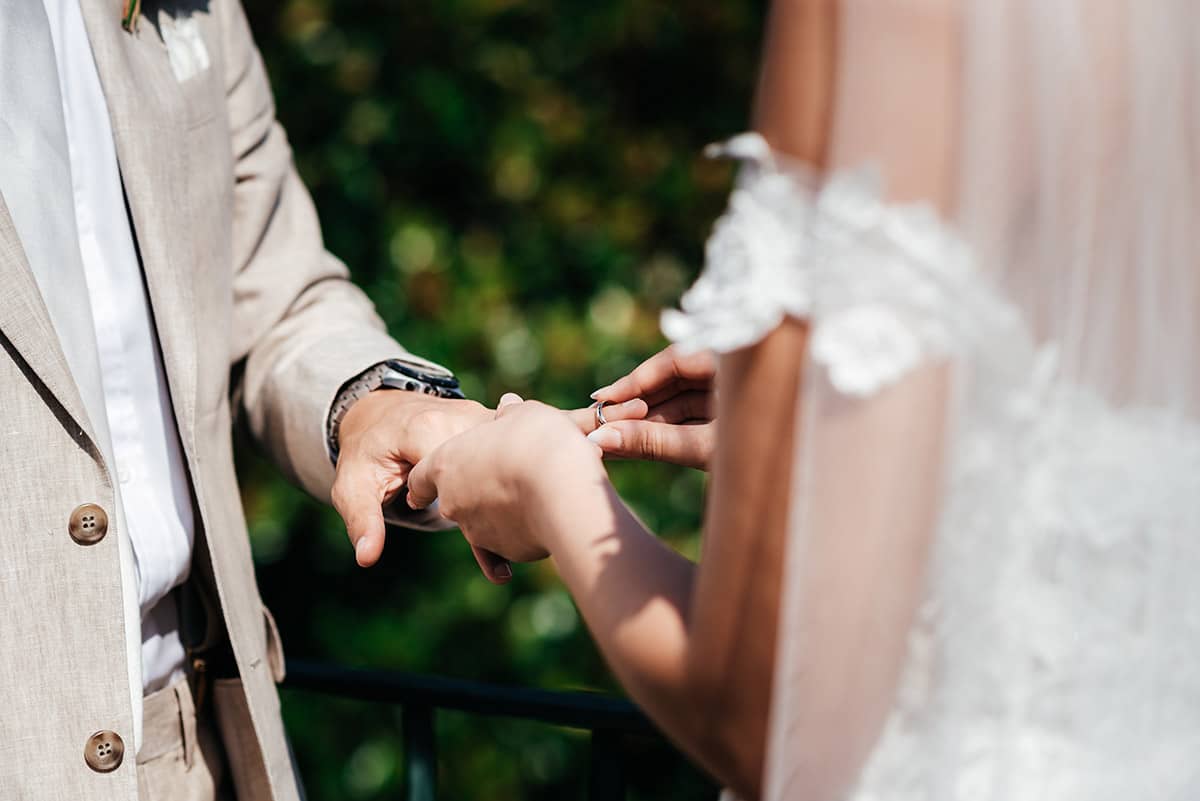
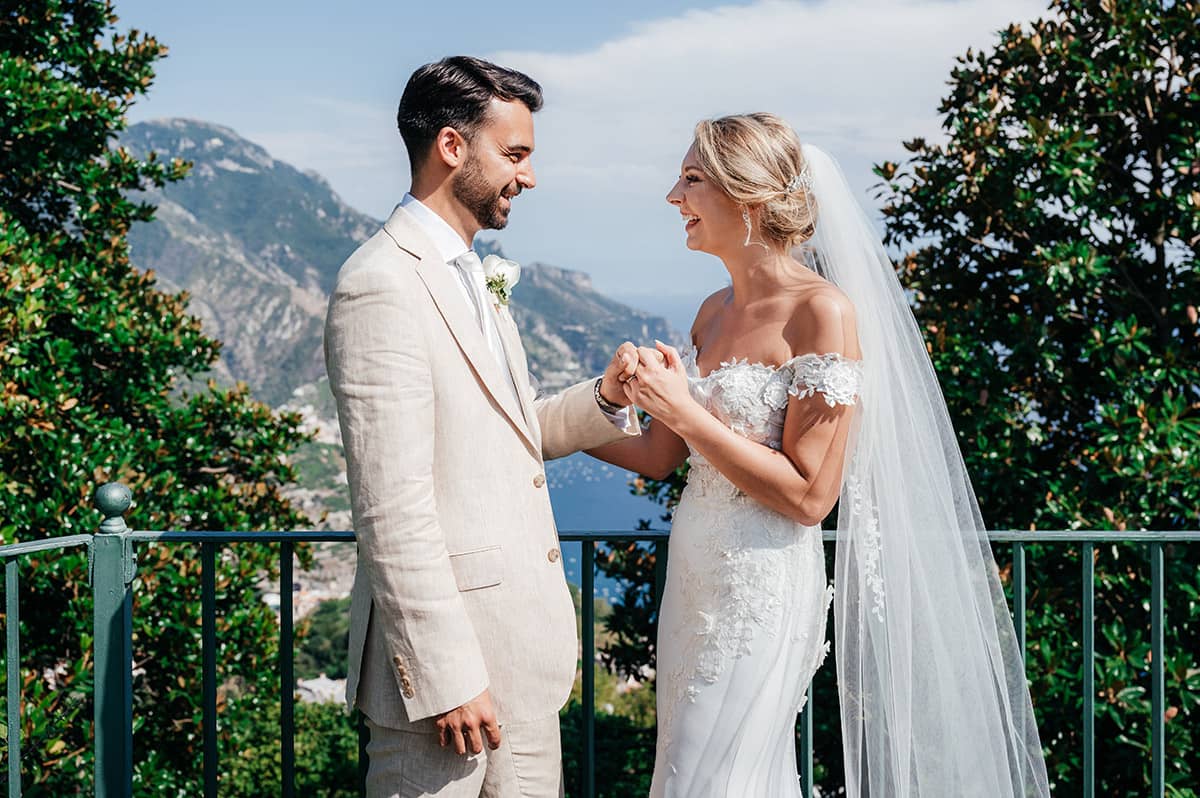
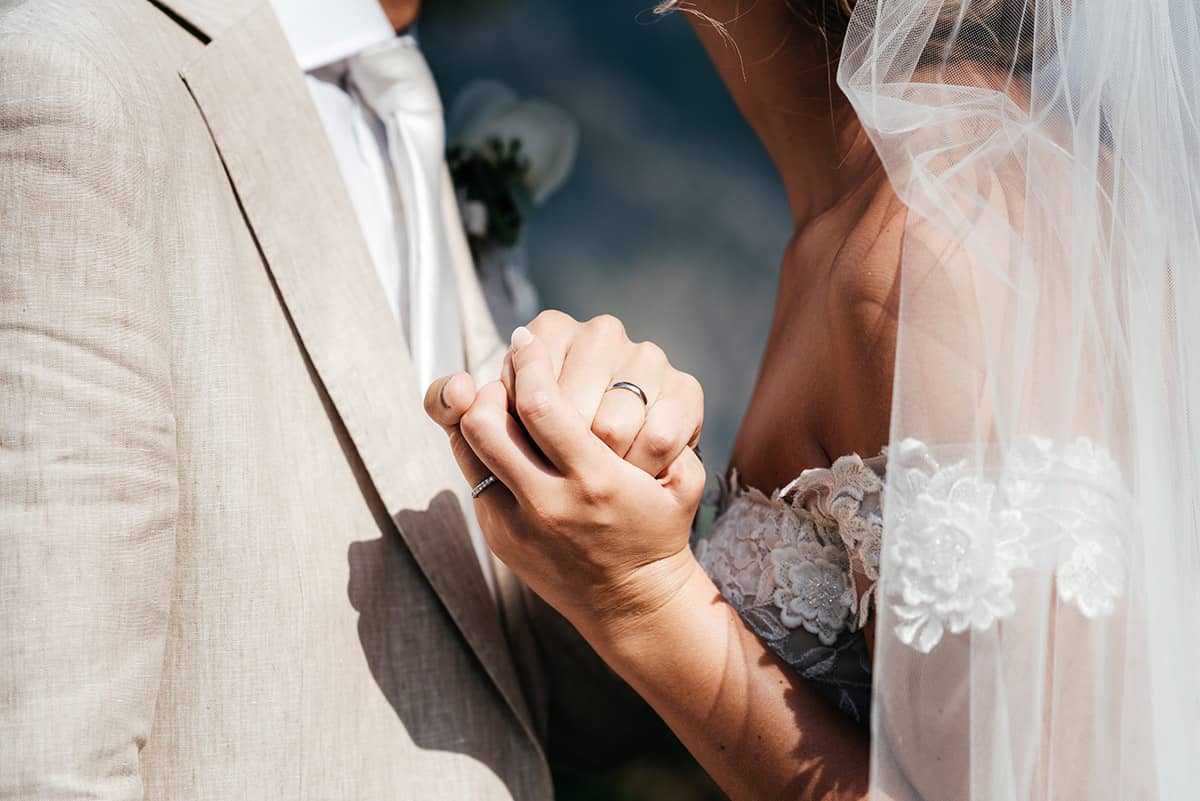
I shot the ring exchange from behind the officiant’s table, low enough that the mountain behind Elisha and Luke filled the top third of the frame and the coast ran flat and pale blue along the bottom edge. Neither of them was looking at the camera. Luke was watching his own hands work the ring onto Elisha’s finger, and she was watching him do it. That is the photograph I keep coming back to when people ask what a Ravello-Atrani wedding looks like: a civil ceremony in a garden with the whole coast behind you, followed, hours later, by dinner in a different town.
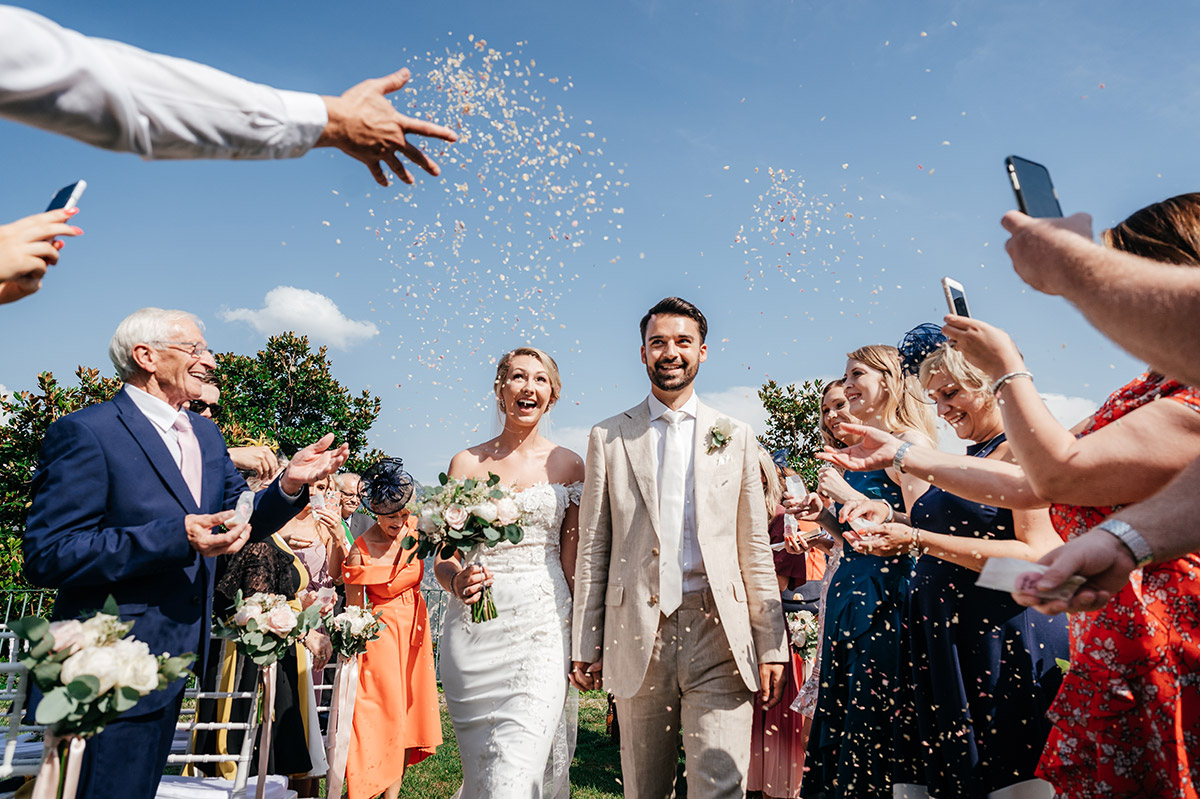
After the vows, the group threw rice and dried petals, and I shot it from ground level so the confetti reads against open sky rather than against the guests’ clothing. Confetti shot against a crowd disappears into the pattern of everyone’s outfits, while confetti shot against sky becomes its own subject for half a second before gravity takes it back.
The Whole Group, One Street
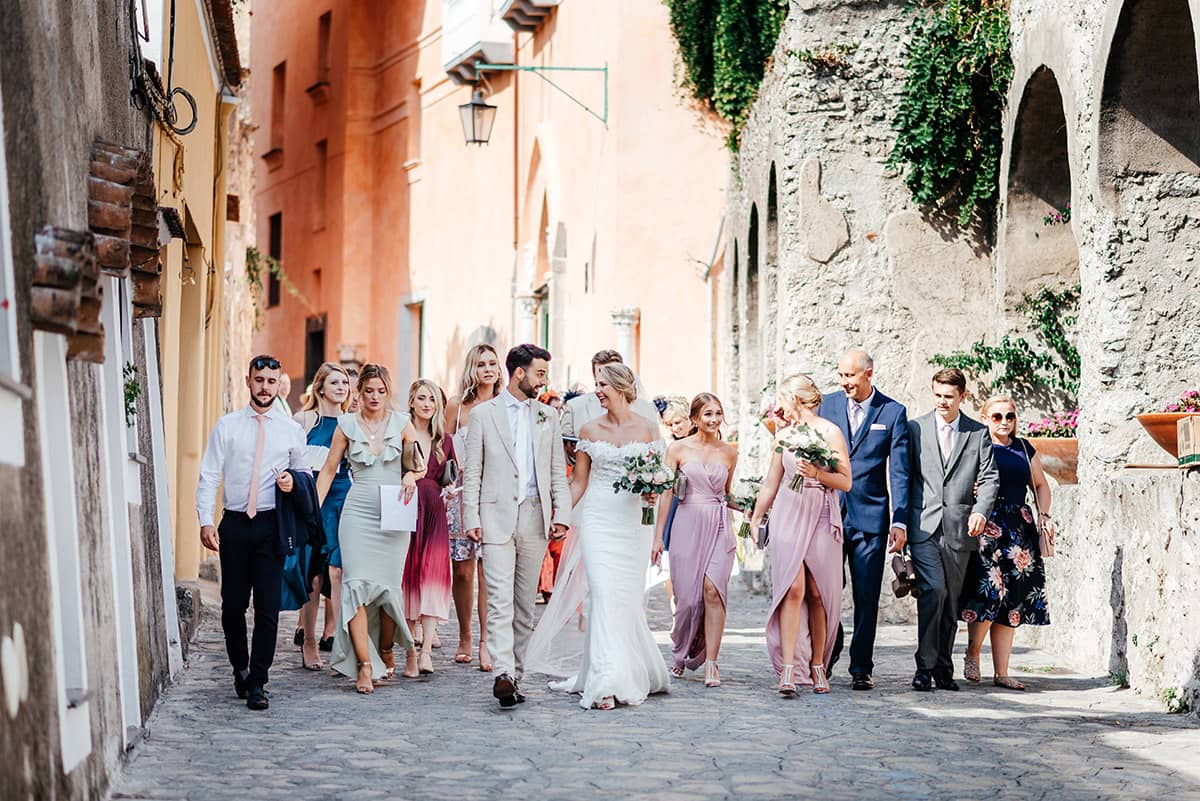
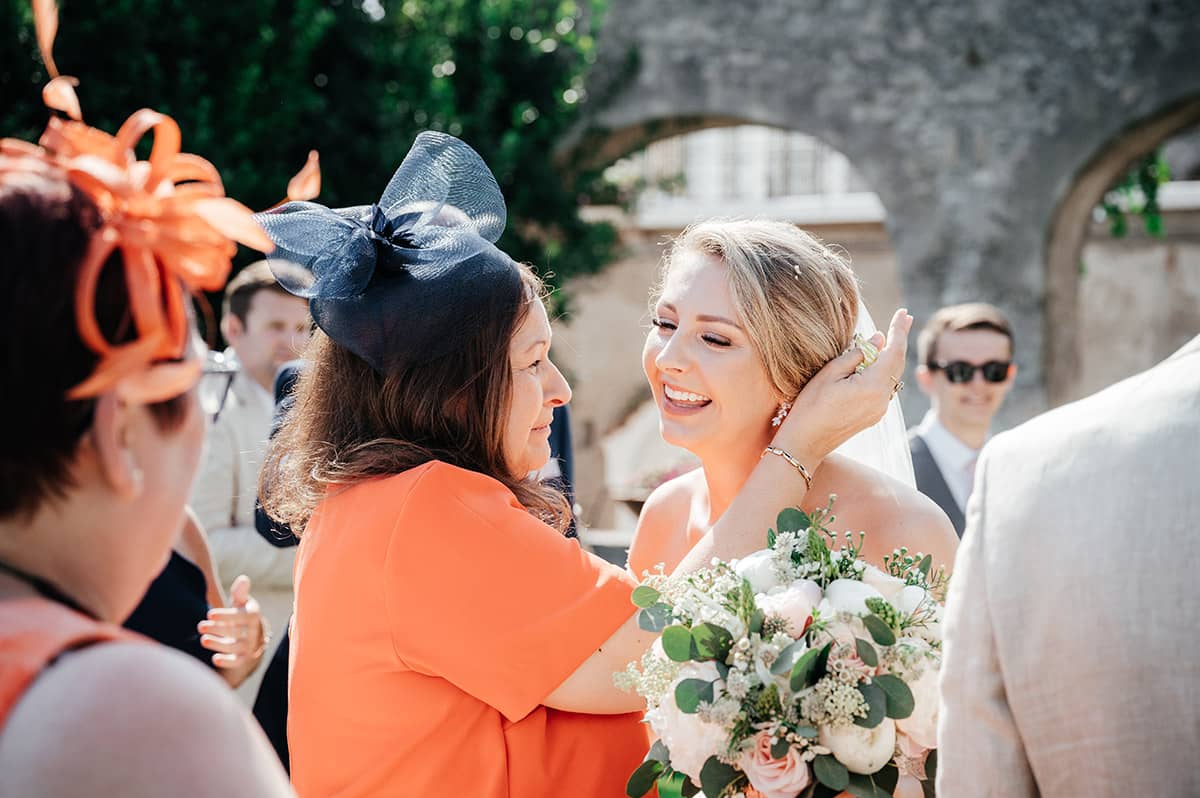
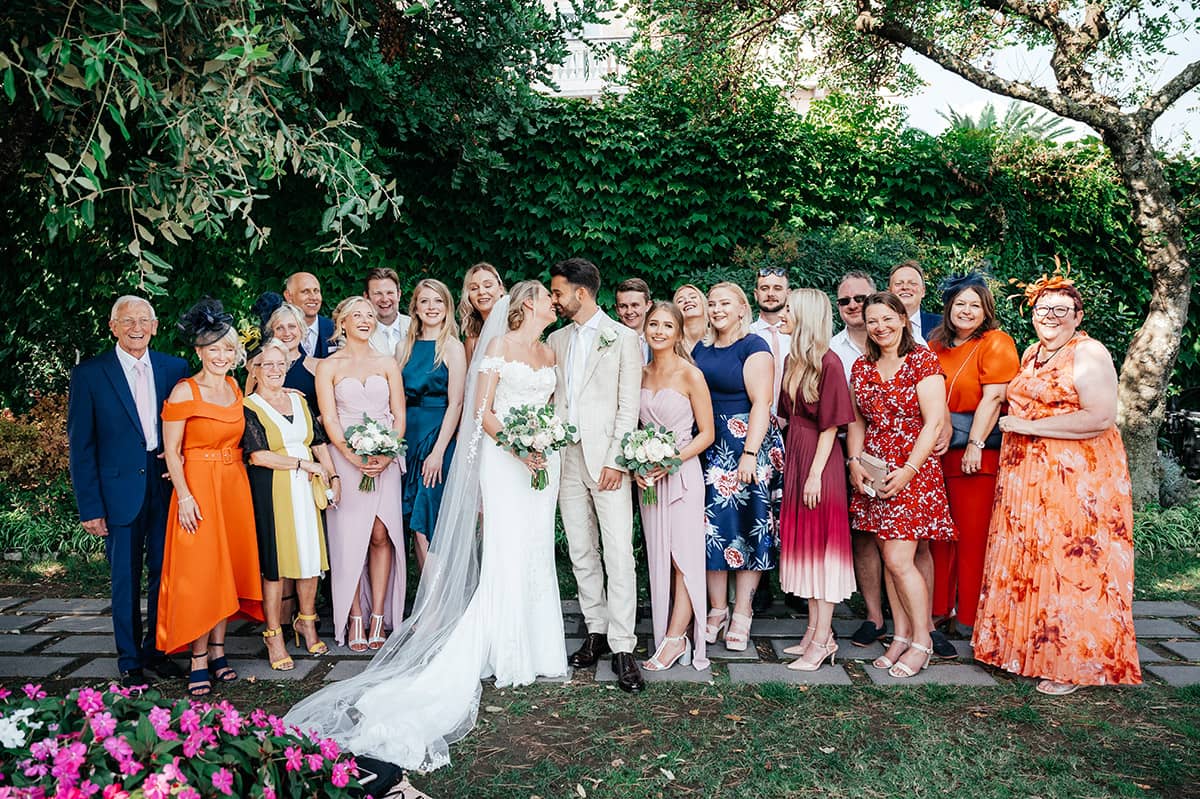
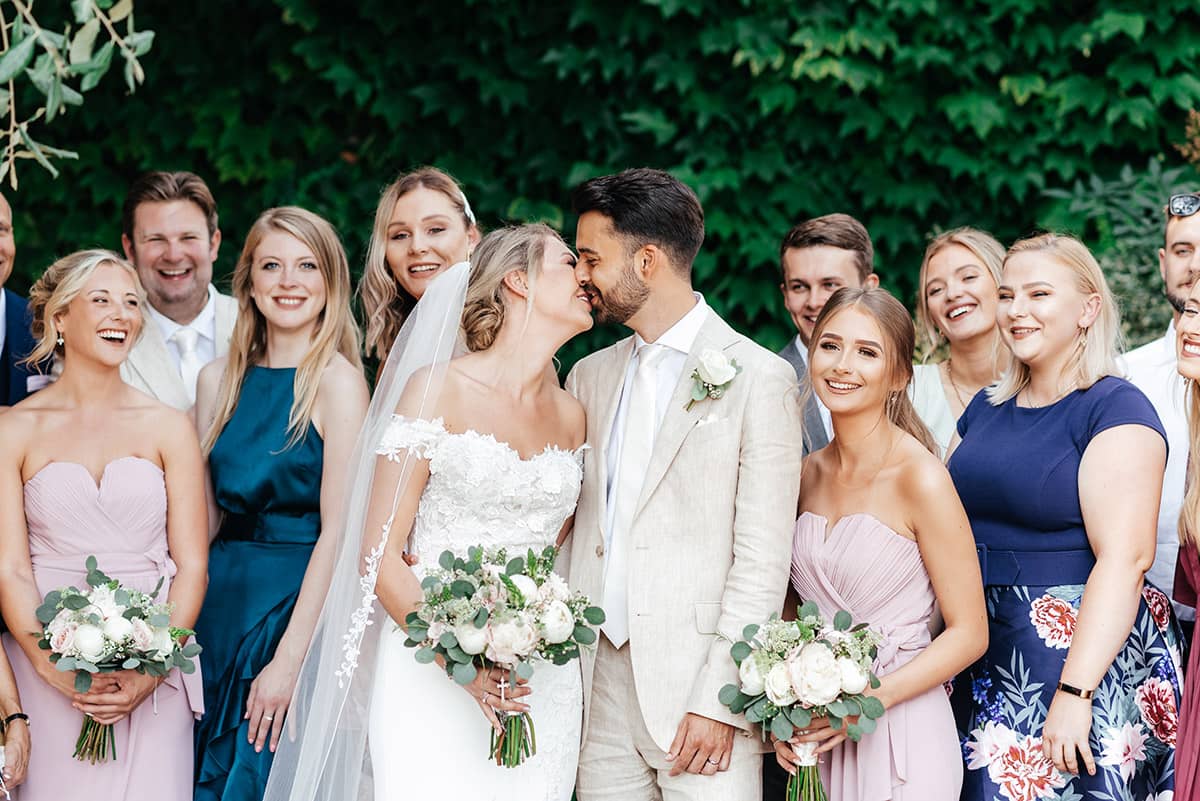
Before anyone scattered for drinks, I lined up the full group against a wall of ivy for the kind of photograph every couple says they don’t need and every couple asks to see first once the gallery arrives. Elisha’s two bridesmaids wore the same blush pink, and around them the guests brought every other color there is, teal, navy florals, red, a bright orange fascinator, which is exactly how a group of real friends looks on a September afternoon.

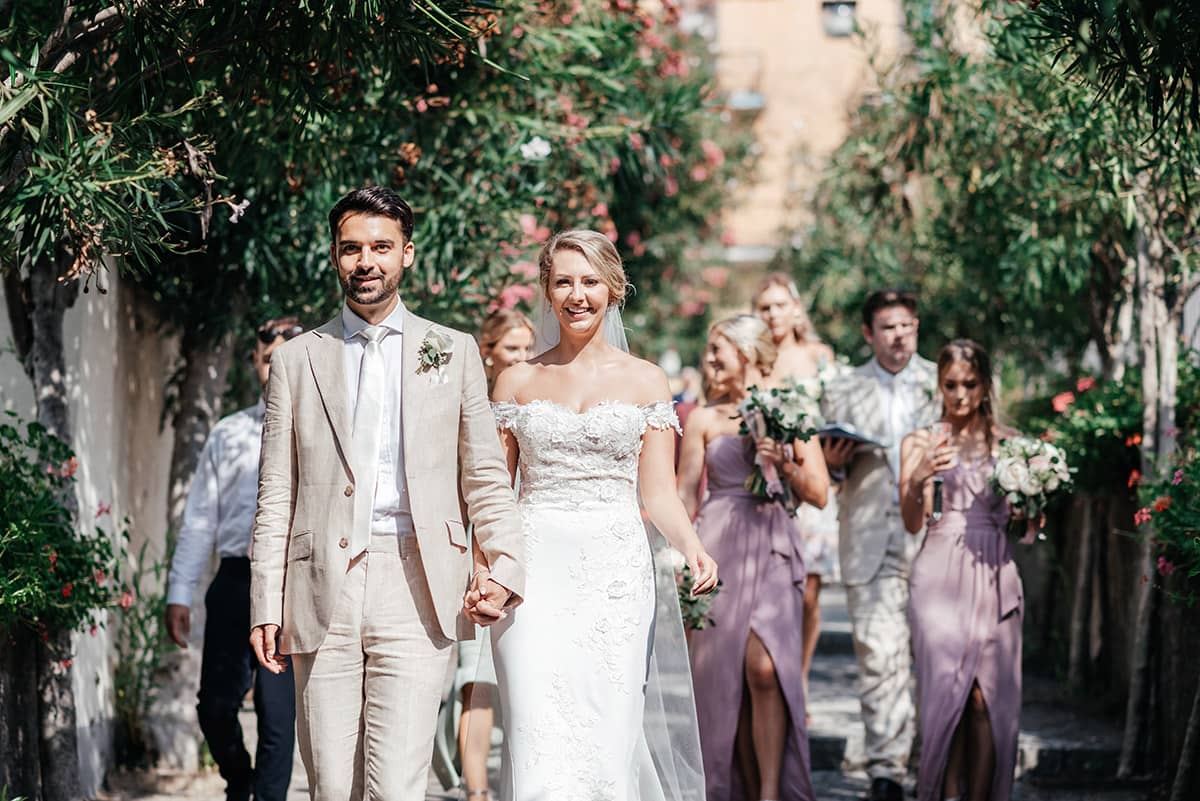
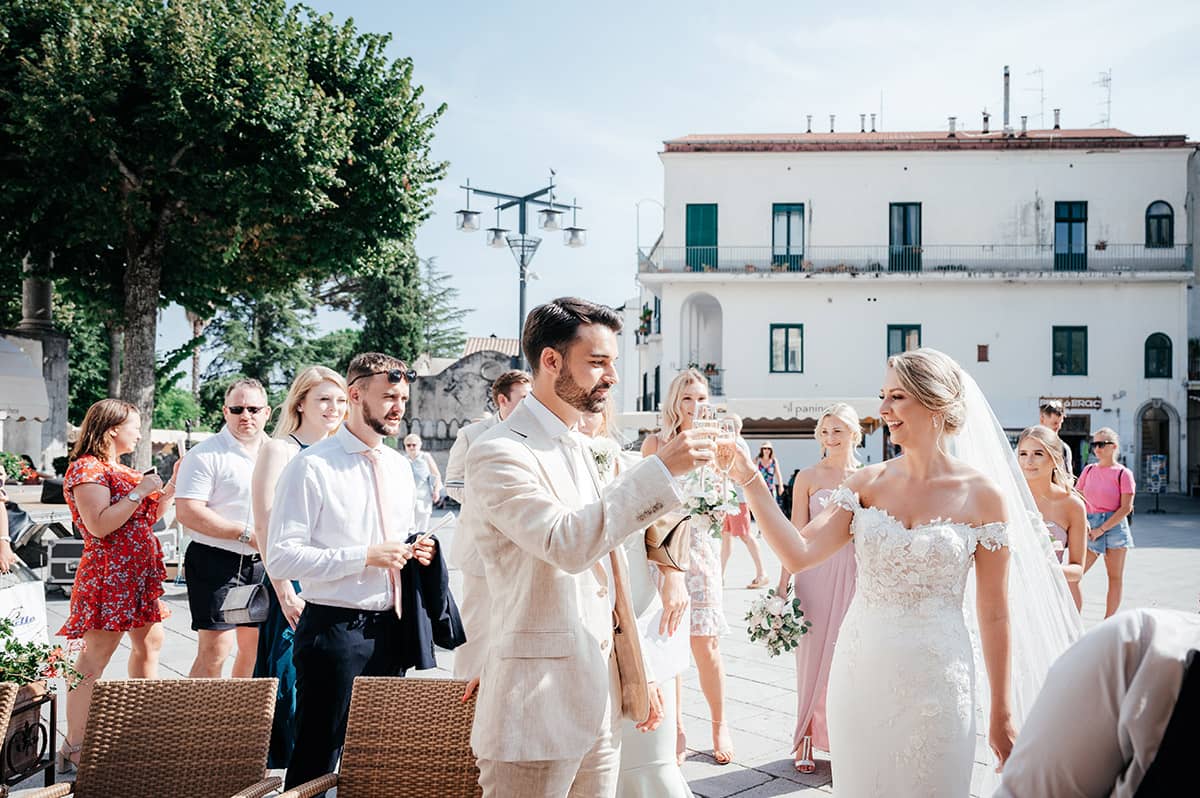
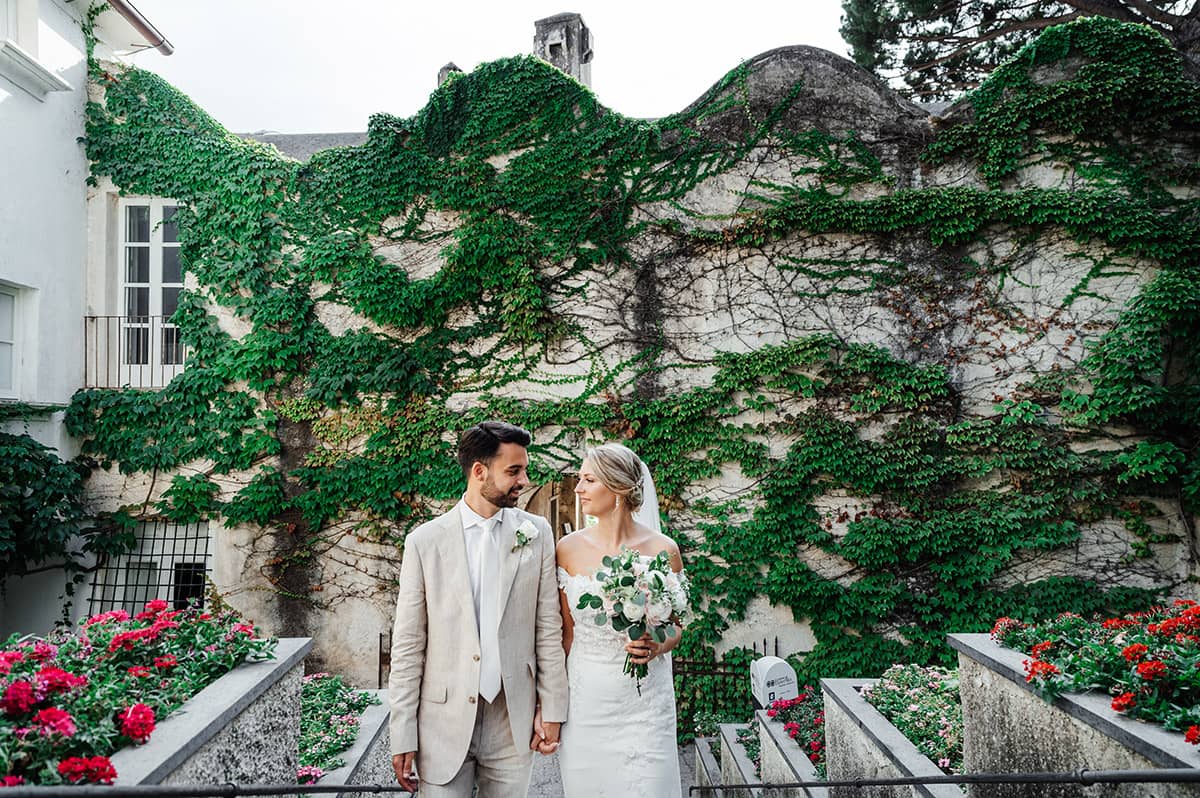
From there the whole group walked through Ravello’s own back streets, the narrower lanes behind the postcard piazza, orange and peach plaster on one side and a stretch of ancient stone wall on the other, arched openings cut into it and ivy hanging down where the mortar had given way. Thirty people in wedding clothes moving through a lane built for two, bouquets swinging, someone’s jacket already off and over a shoulder. The walk ended in Ravello’s main piazza, where I had Elisha and Luke raise a toast in the open square while a handful of tourists in shorts and sunhats looked on, with no idea what they had just walked into on an ordinary weekday afternoon.
A Terrace Above the Water
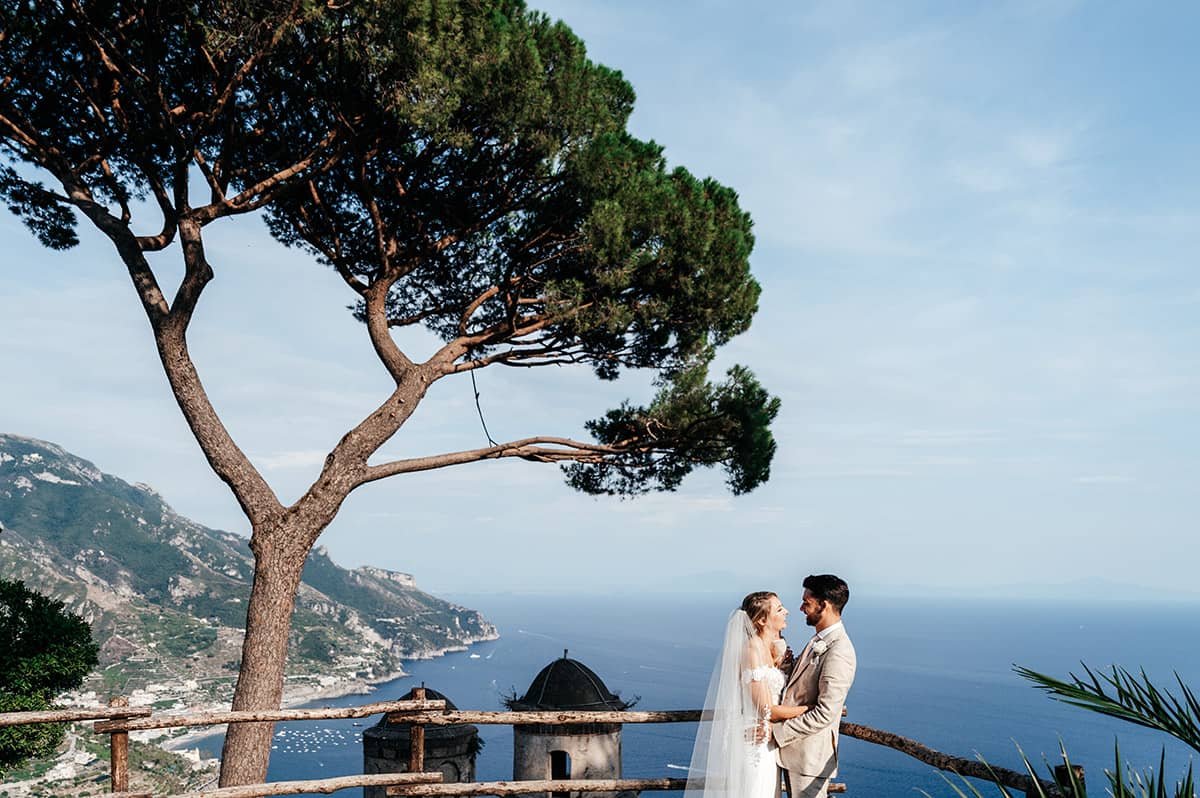
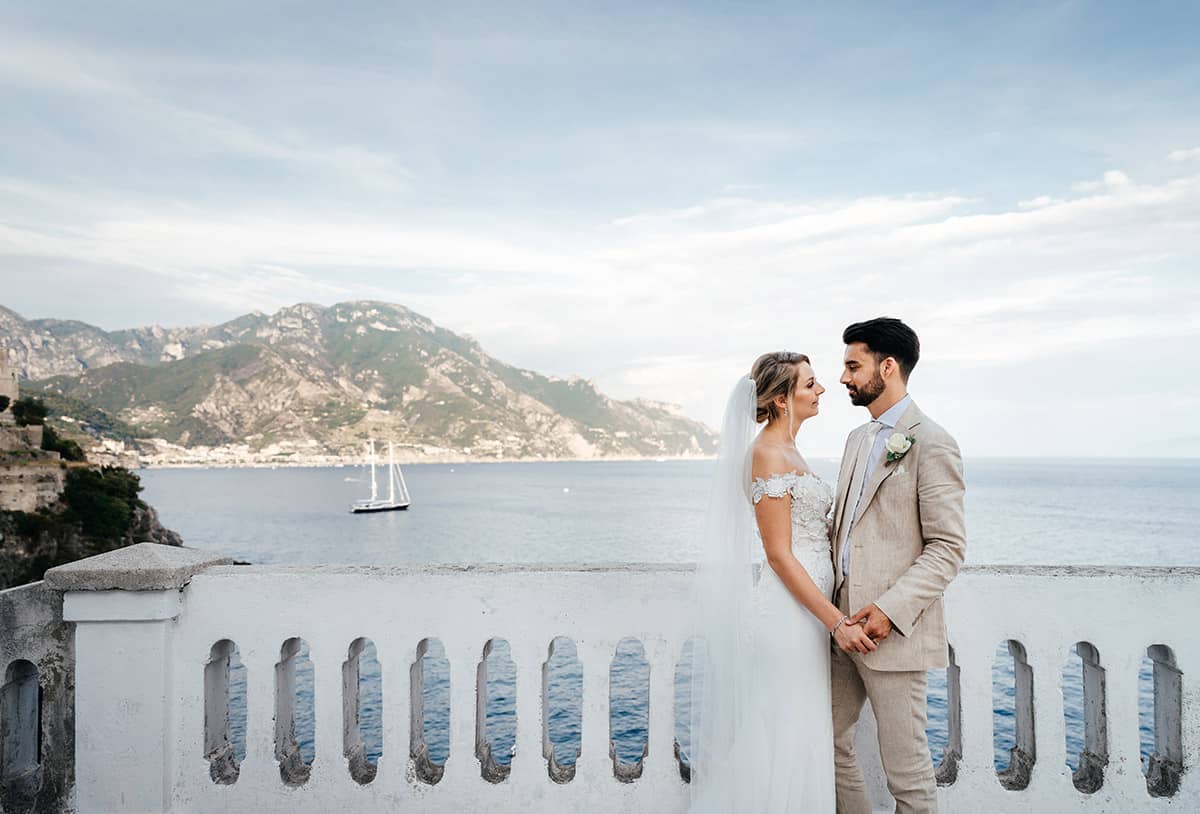
Once the group had moved on, I took Elisha and Luke to one of Ravello’s stone balustrades, the kind with turned balusters and a wide ledge built for this view: the coastline curving away to the south, a sailboat anchored close enough to read its rigging, the water doing that particular flat silver thing it does in the hour before real sunset. I shot them small in the frame here, the architecture and the sea doing most of the work. A couple portrait on this coast should tell you where you are as much as who they are.

FRIENDS IN EVERY COLOR
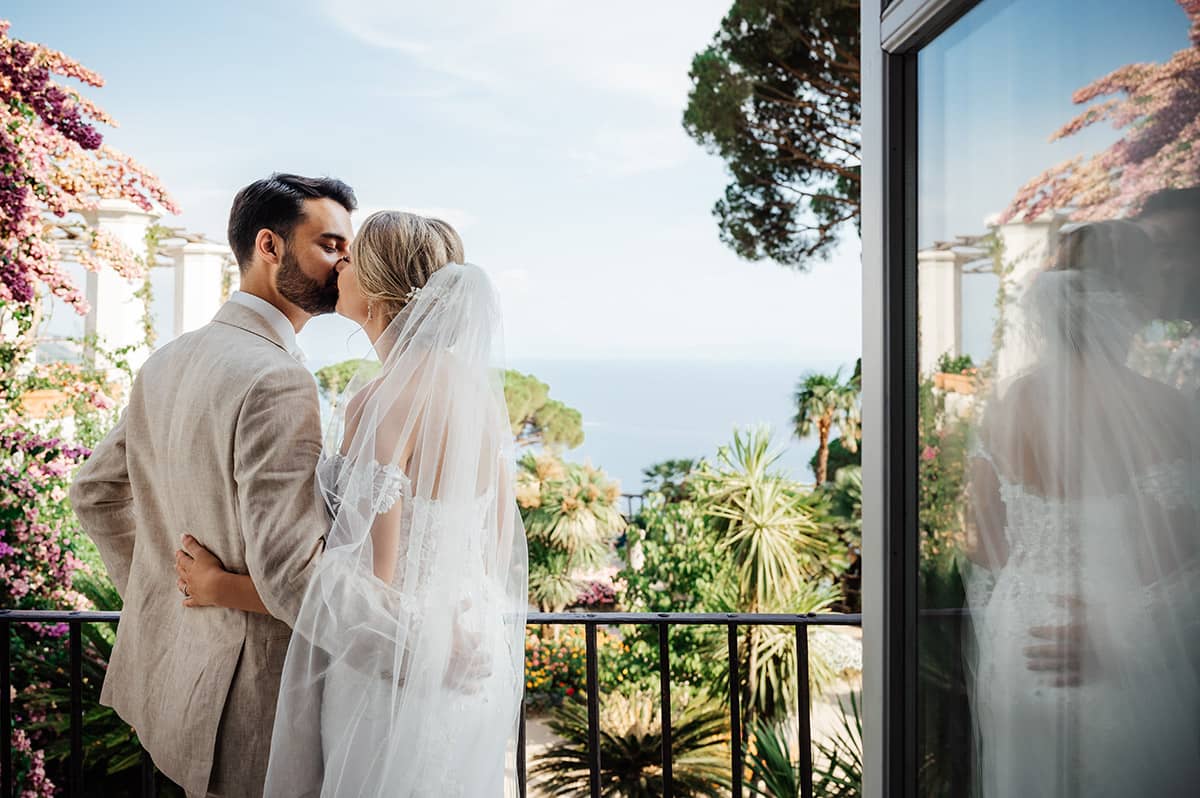
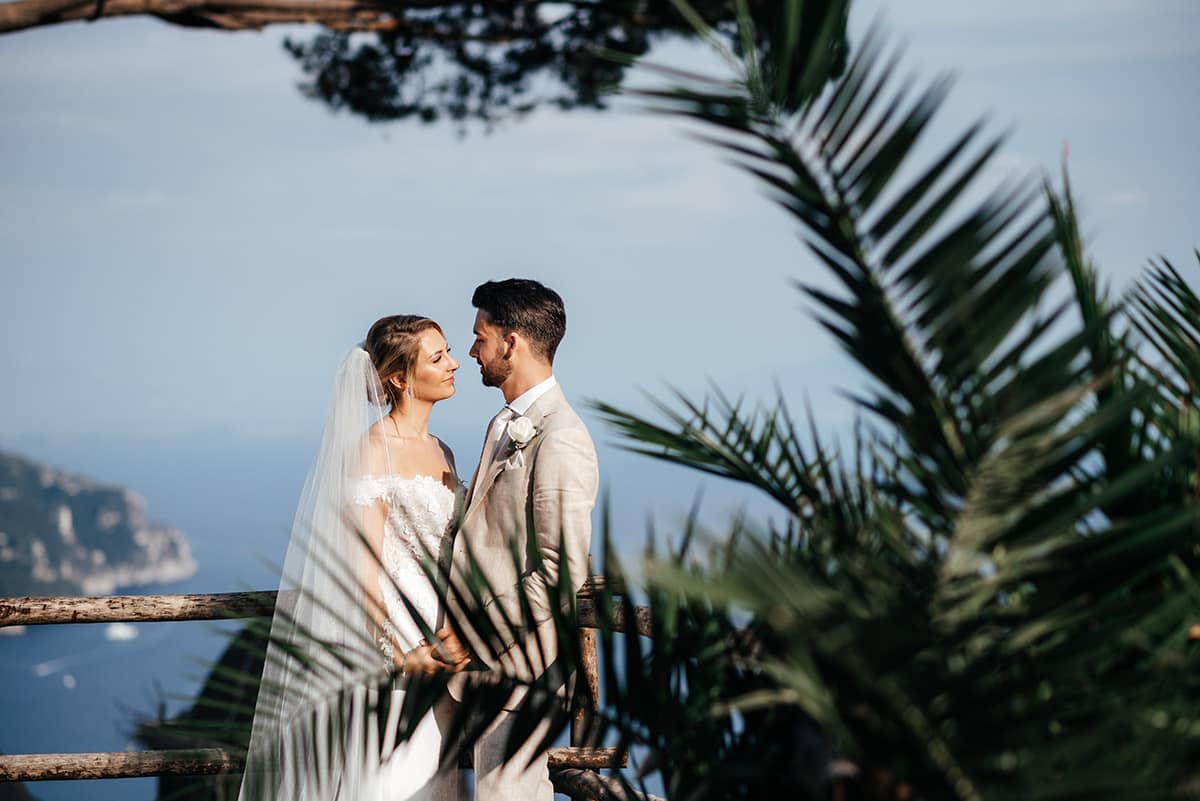
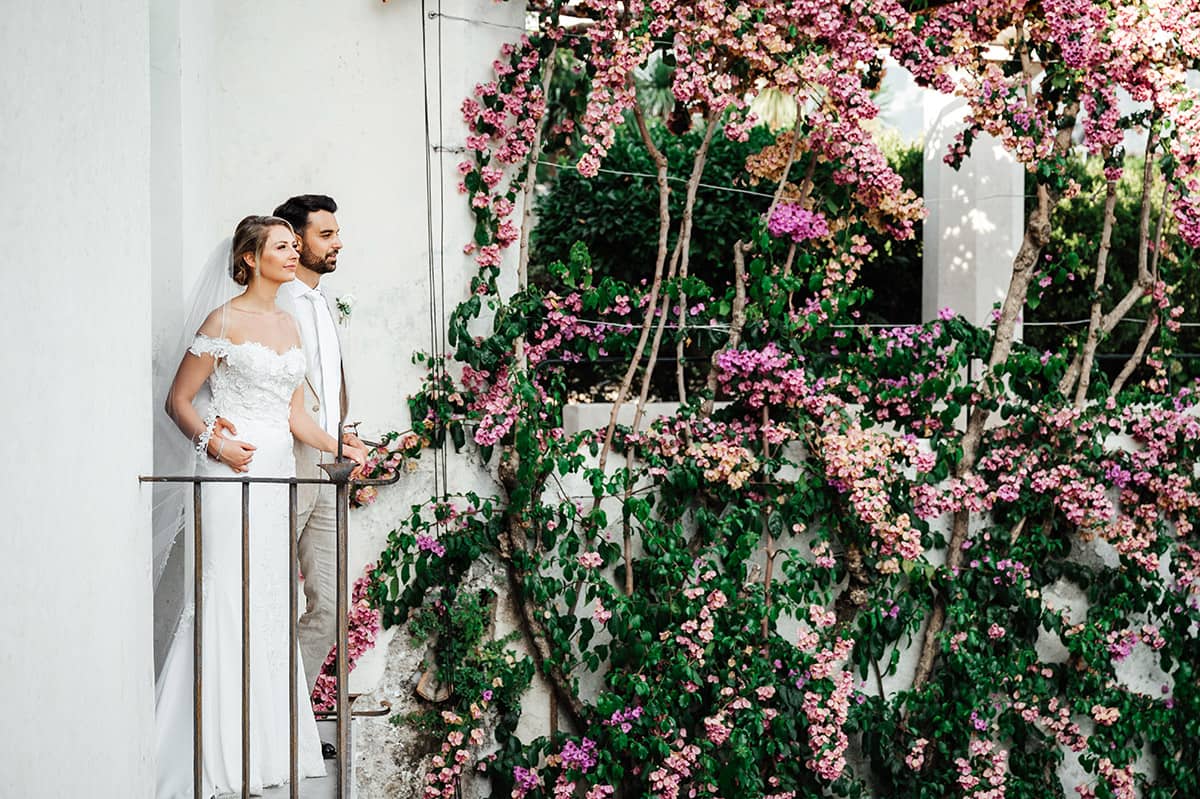
A second setup, on a balcony framed by bougainvillea and a low pergola, gave me something tighter: their faces close, the sea reduced to a pale strip behind them, a glass door at the edge of the frame throwing back a second, softer version of the same kiss. I favor pairing one wide environmental shot with one tight, intimate one from the same general spot. Together they read as a single moment seen twice, once for the place and once for the two people in it.
I like these balustrades in the late afternoon, when the sun comes in from the side and the white stone throws light back up onto faces, the closest thing to a reflector a town can give you.
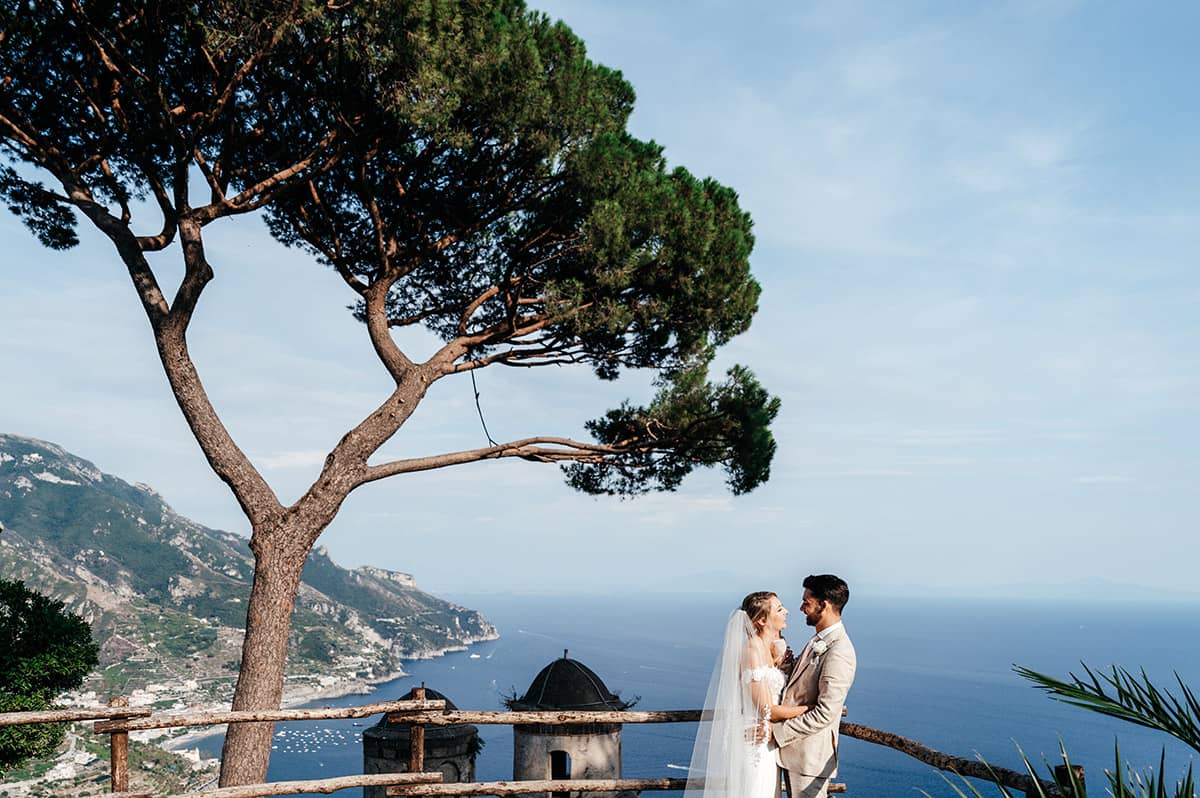
One of the best known views in Ravello is an umbrella pine leaning over the drop with the coast behind it, and I gave it one frame, the two of them small under the branches.
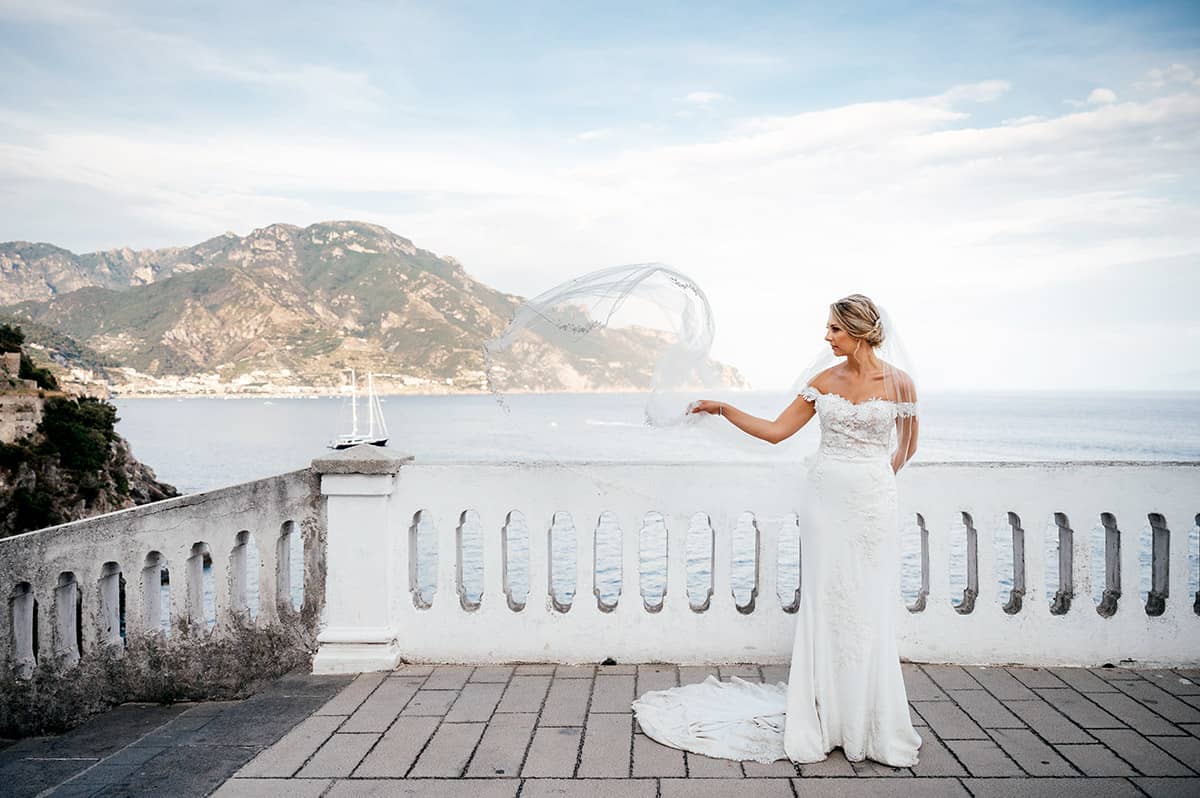
A last walk across a terrace with old iron lamp posts, the veil lifted by the wind, and then it was time to drive back down to the sea, where the evening was waiting.
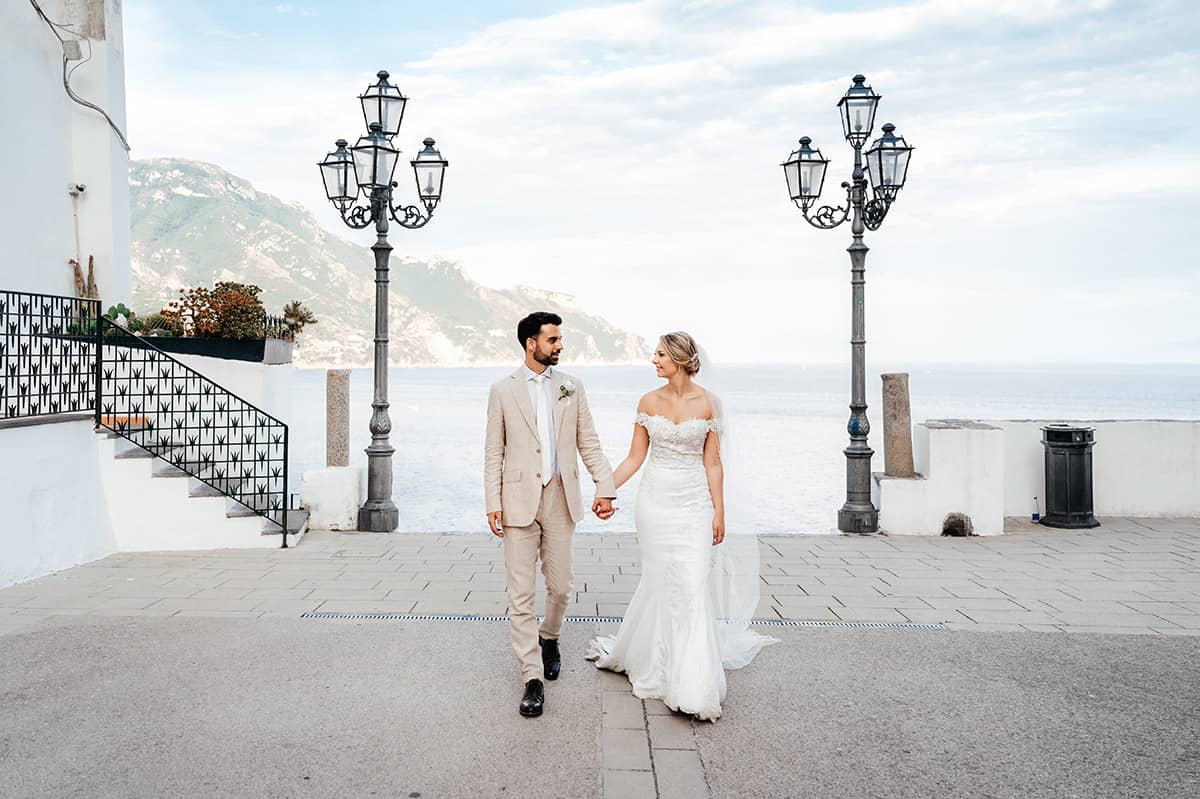
BACK STREETS OF RAVELLO
A Quiet Corridor
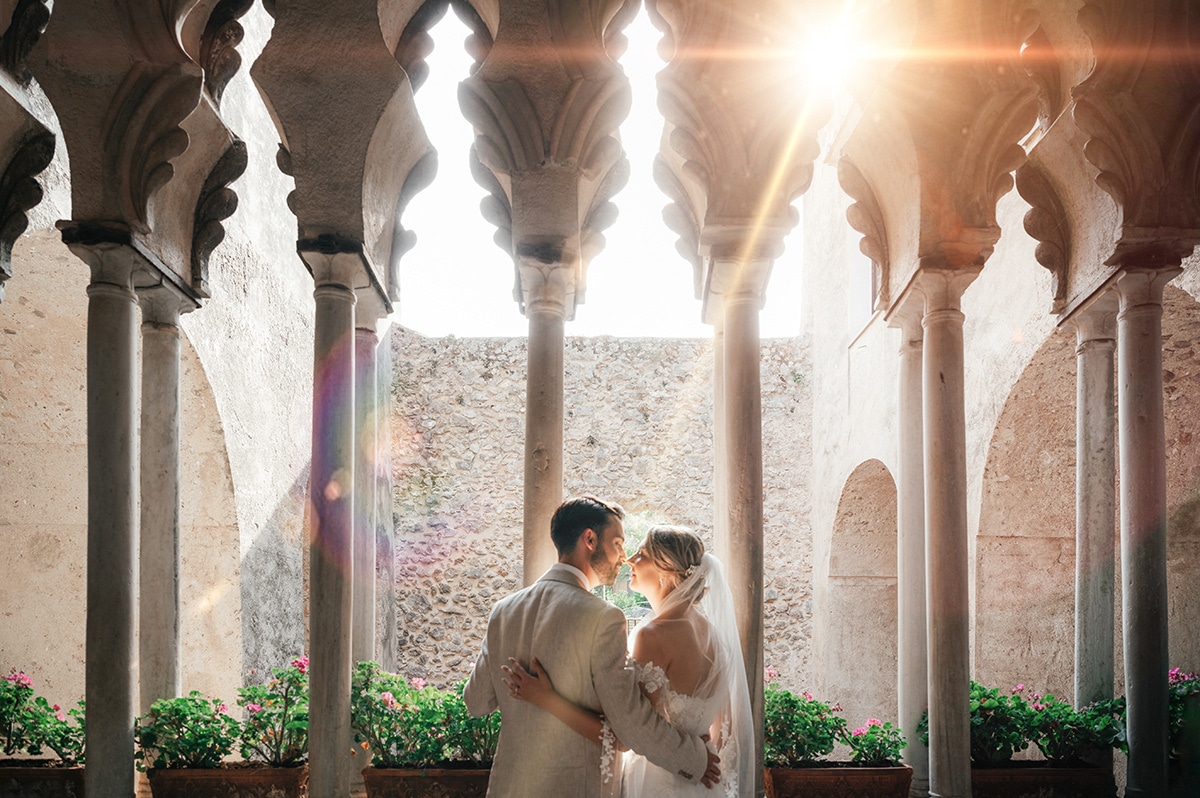
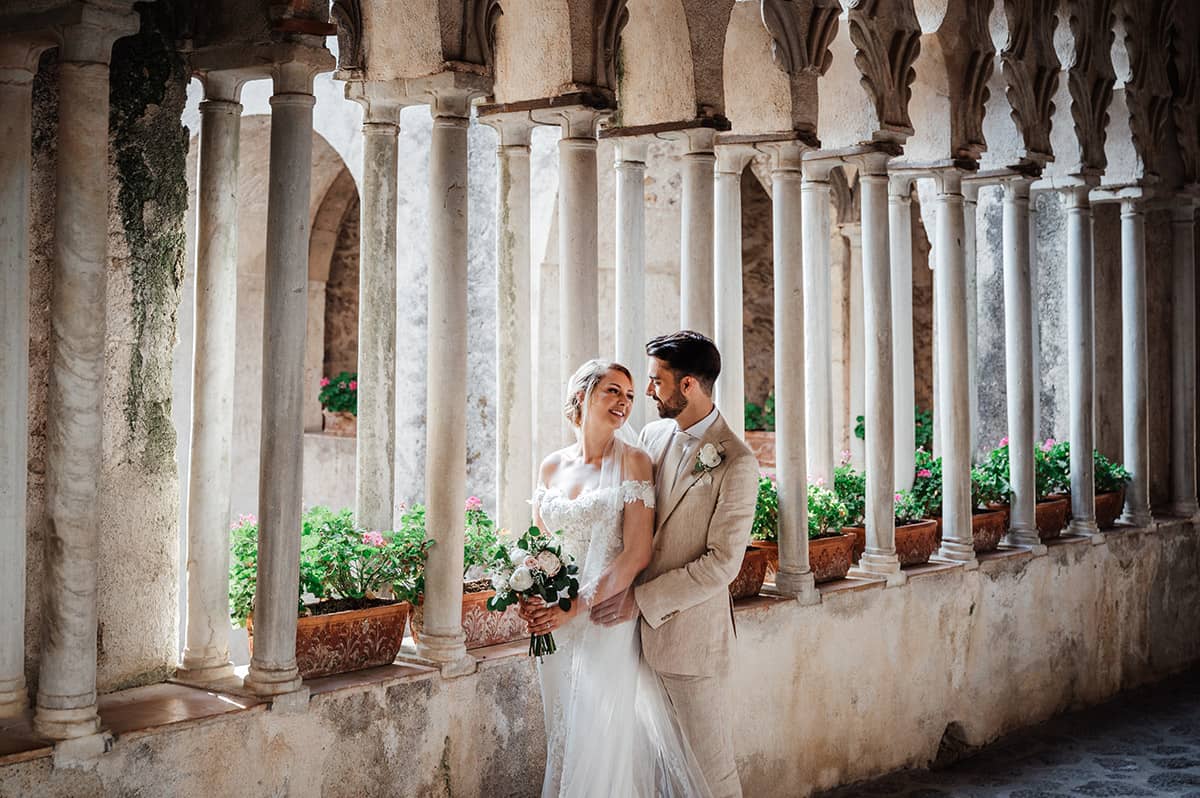
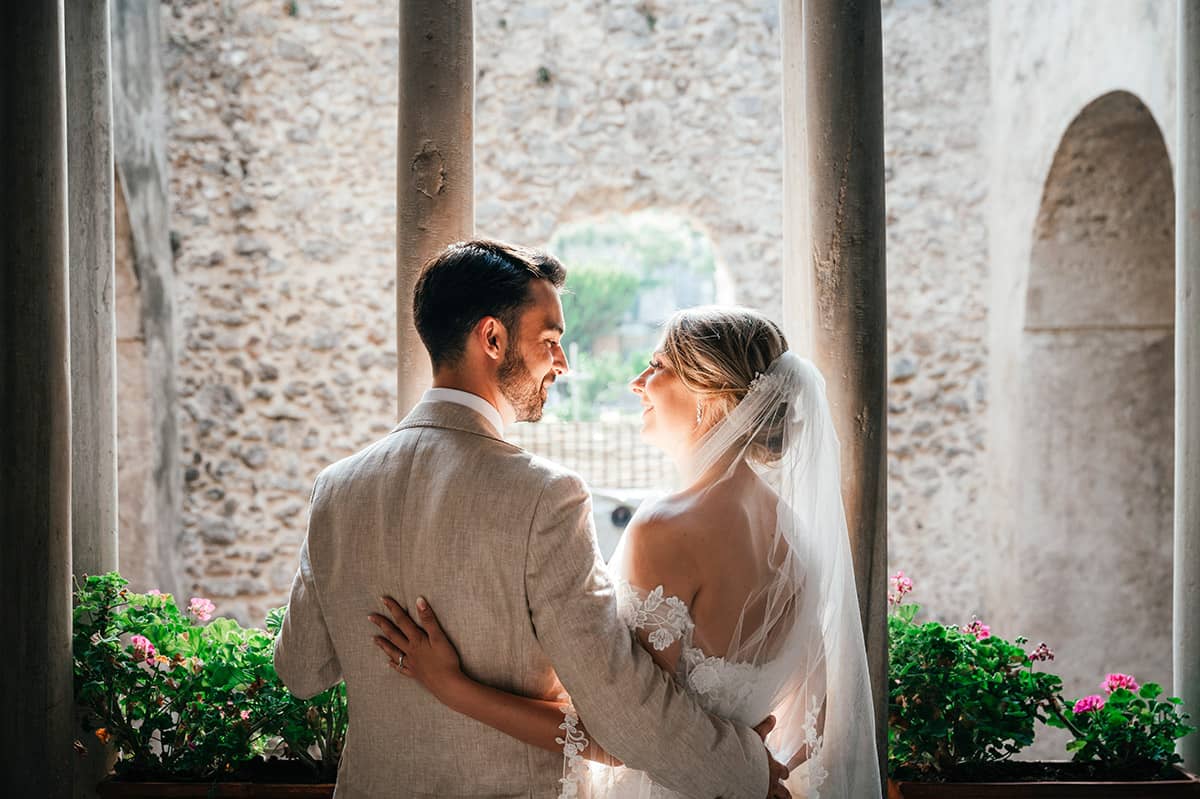
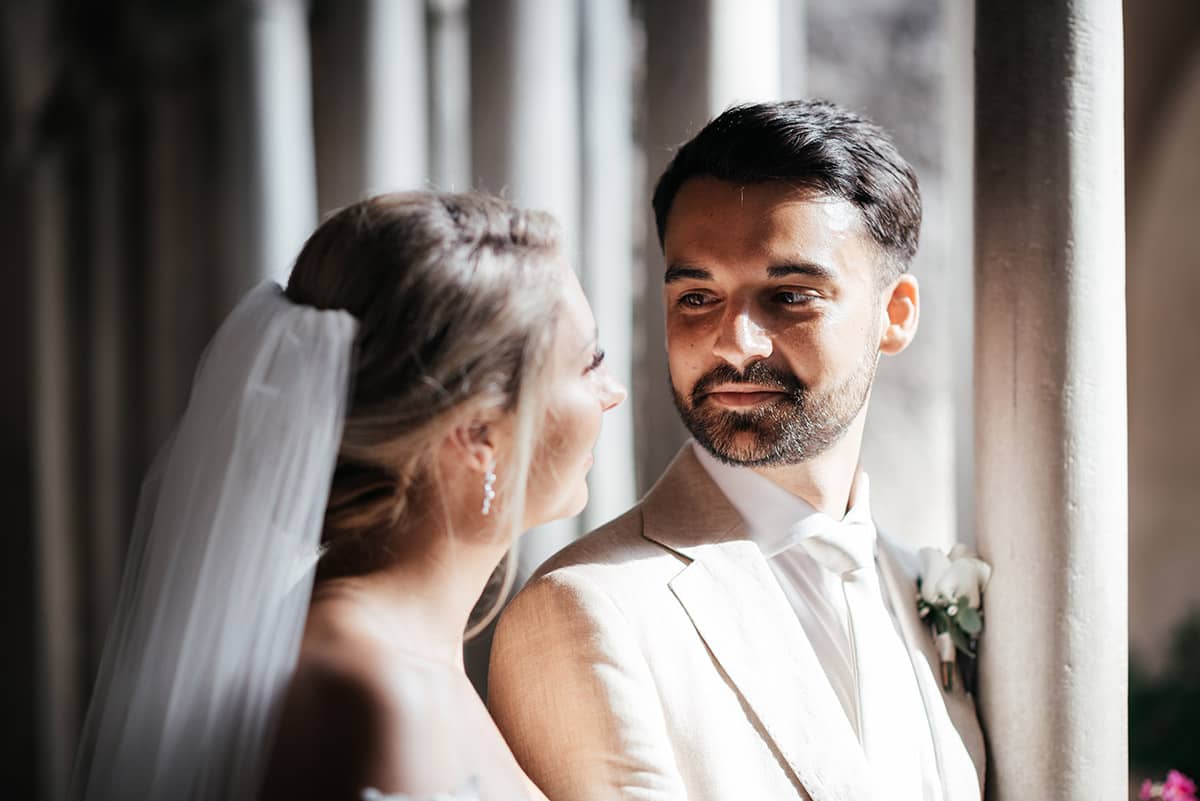
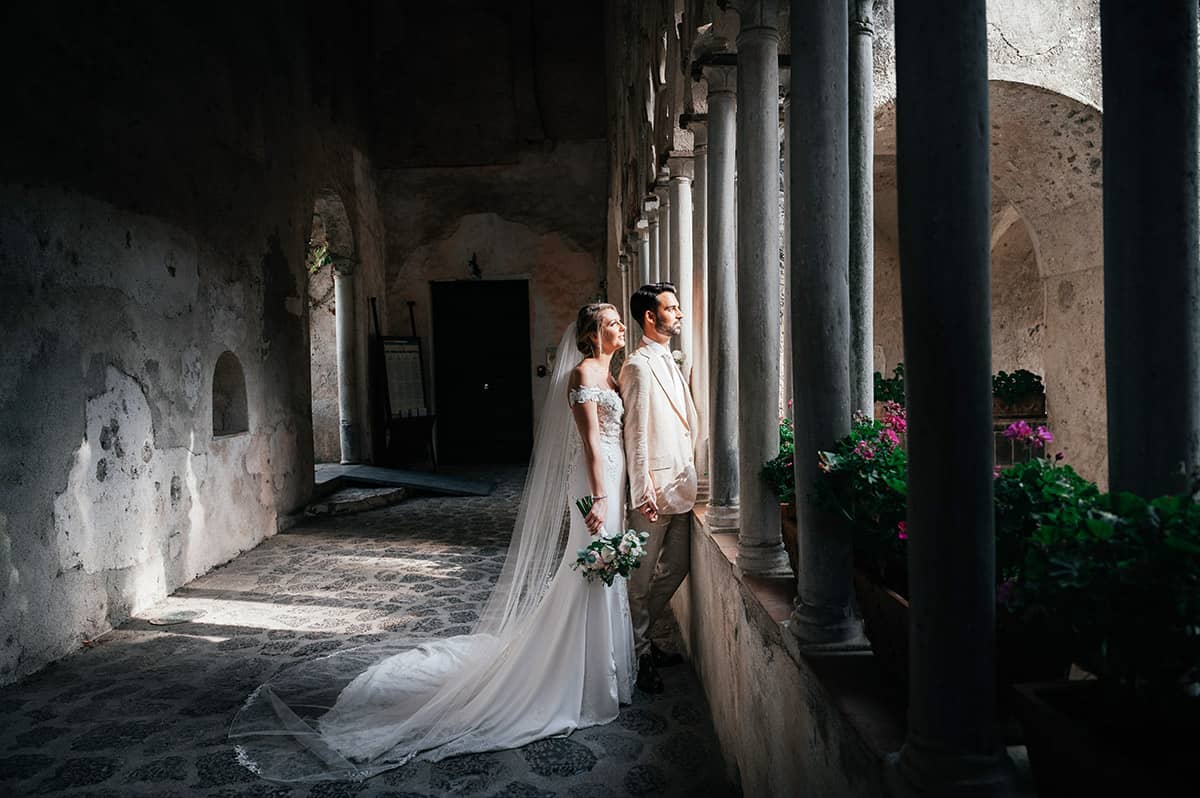
Before leaving the ceremony grounds, I took Elisha and Luke through a covered stone corridor on the same property, a narrow loggia with a row of thin columns on one side and deep shadow on the other. The light there does something I look for specifically: it comes through the arches in hard, separate shafts, so a couple standing at the right point in the walkway gets lit in stripes rather than evenly. I kept them nearly still and used the columns as a repeating frame that leads the eye down the corridor toward the open flower boxes at the far end. It is one of my favorite kinds of Ravello portrait because it depends entirely on the specific building. You cannot fake that light in a studio, and you cannot get it anywhere else on the coast that I have found.
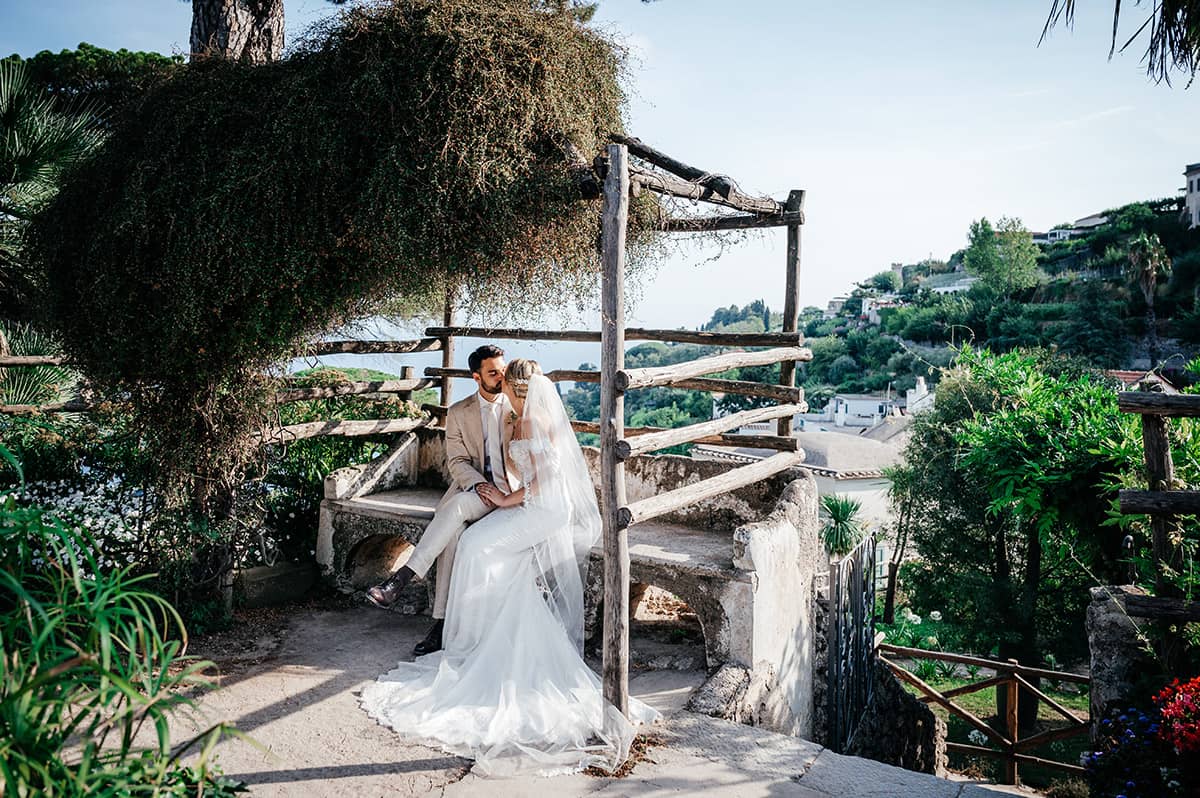
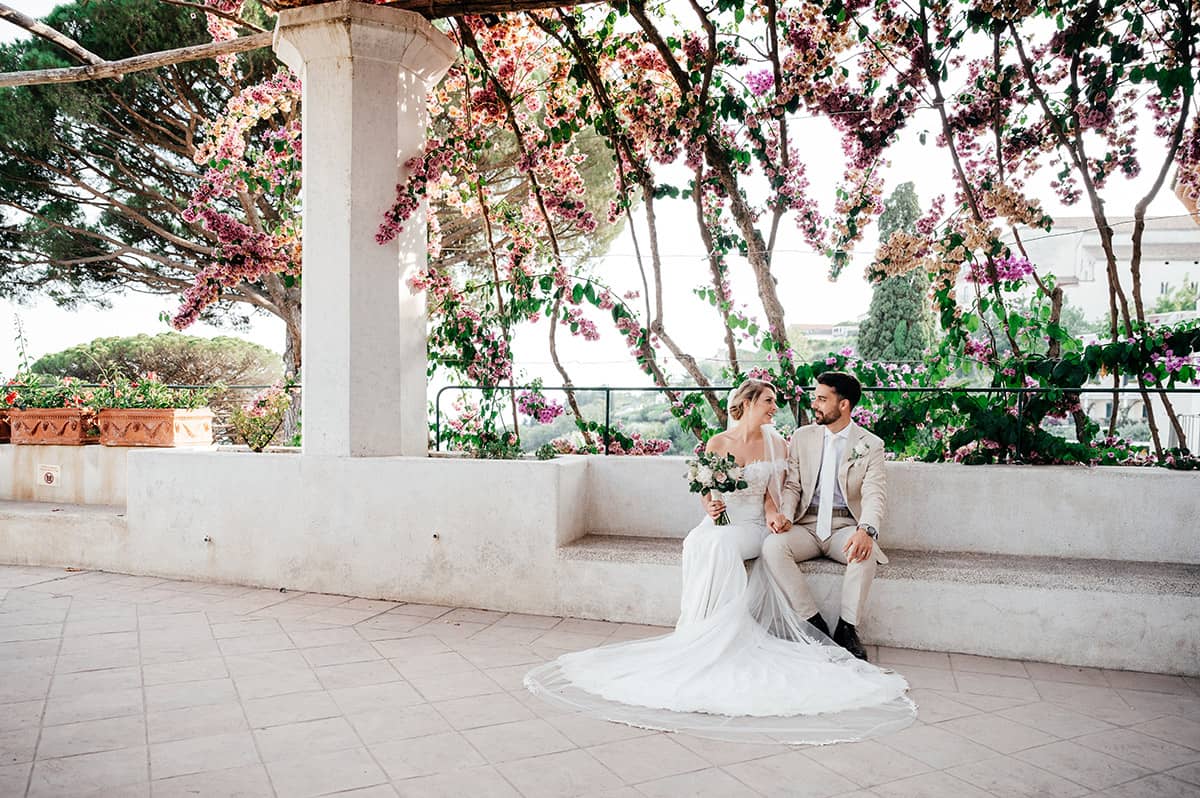
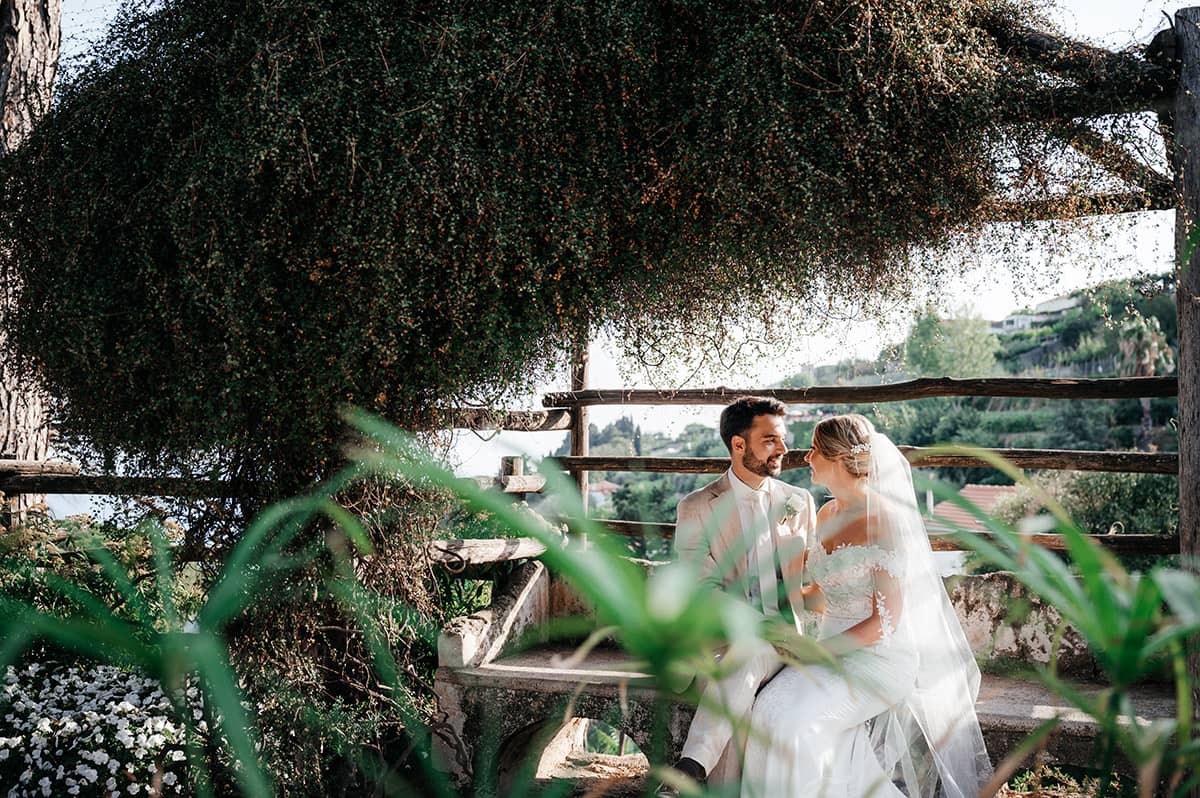
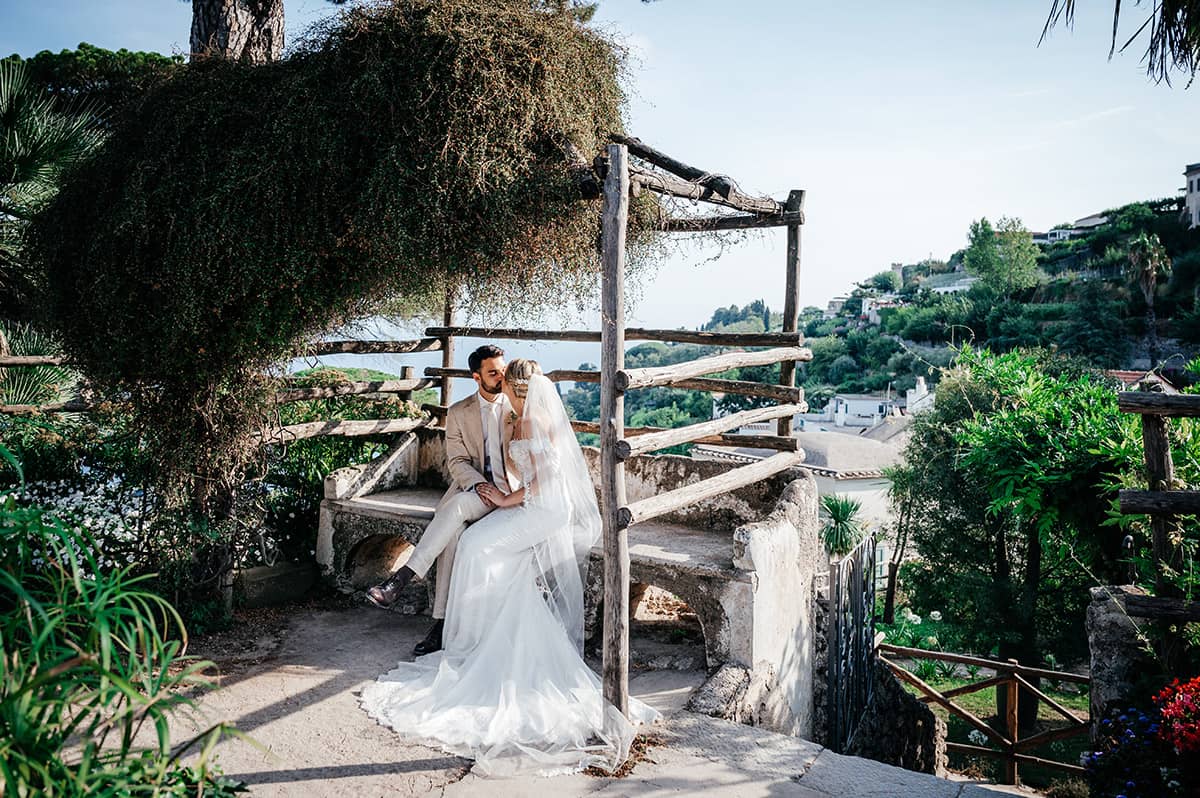
A few steps further along the same property, an old wooden pergola strung with dried ivy shaded a stone bench built into the hillside, with the green terraces below dropping away toward the coast road. I sat them there for a minute, close together, veil catching on the rough wood, and shot wide enough to hold the whole structure in frame. It is a quieter picture than the ceremony ones, and I place it deliberately right after the noise of the group toast, because a couple needs at least one photograph from the day where nobody else is watching.



The Drive Down to Atrani
The two of them had already decided, months before the wedding, that the reception would happen somewhere else entirely: Atrani, the fishing village at sea level where they had started the day, about twenty minutes down the coastal road from Ravello. The logic was simple once they explained it to me. A Ravello ceremony gives you altitude, distance, a sense of occasion. Atrani gives you intimacy, the sound of water, streets too narrow for anything but foot traffic. Doing both in one day means the wedding album covers two different registers of the Amalfi Coast rather than one, which is part of why I recommend the combination on my Ravello wedding photographer page to couples who ask about it.
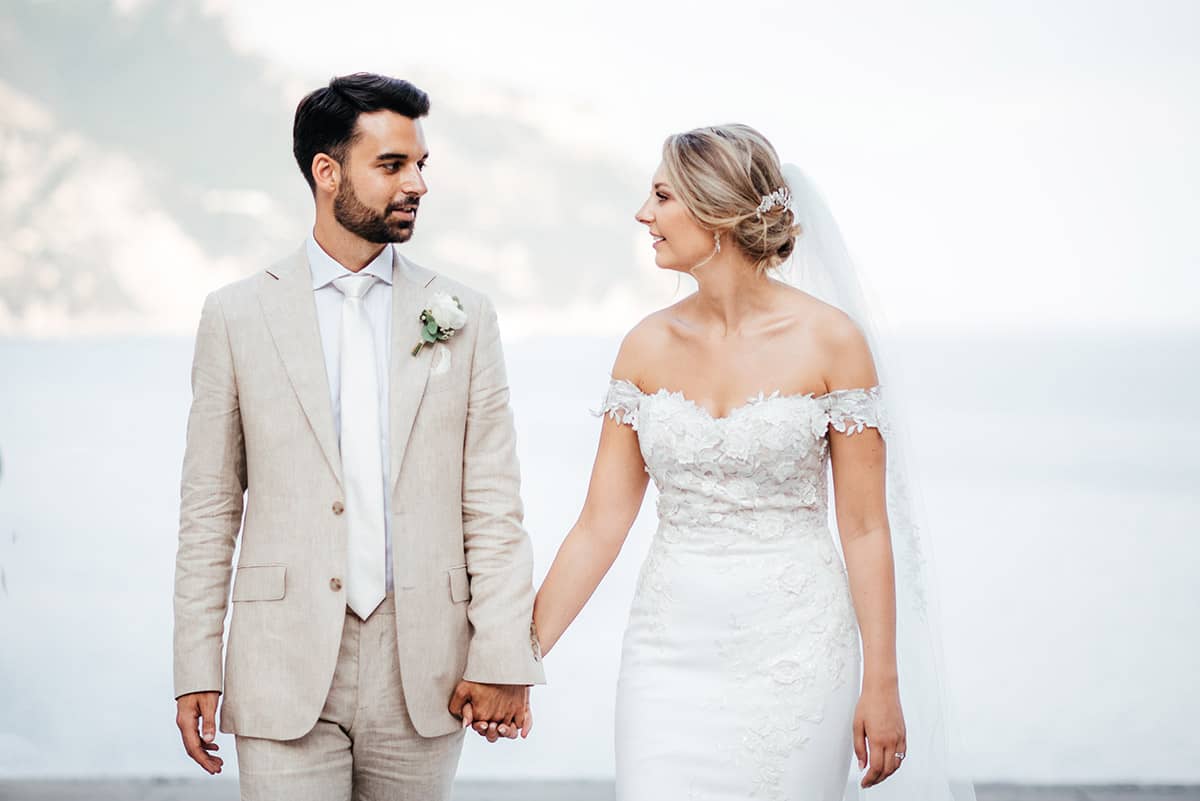
Back in Atrani, I photographed Elisha and Luke alone, without the wedding party, which had gone ahead to Palazzo Ferraioli to settle in before dinner. The first shot that matters from this stretch is a plain one: the two of them standing against a blank white house wall, two dark green shutters the only other elements in frame, one window open and one closed. I shot it from far enough back that the wall dominates the picture and the couple becomes small and precise within it, a technique I use often in Atrani because the village gives you these enormous, unbroken planes of whitewash that most of the coast does not.

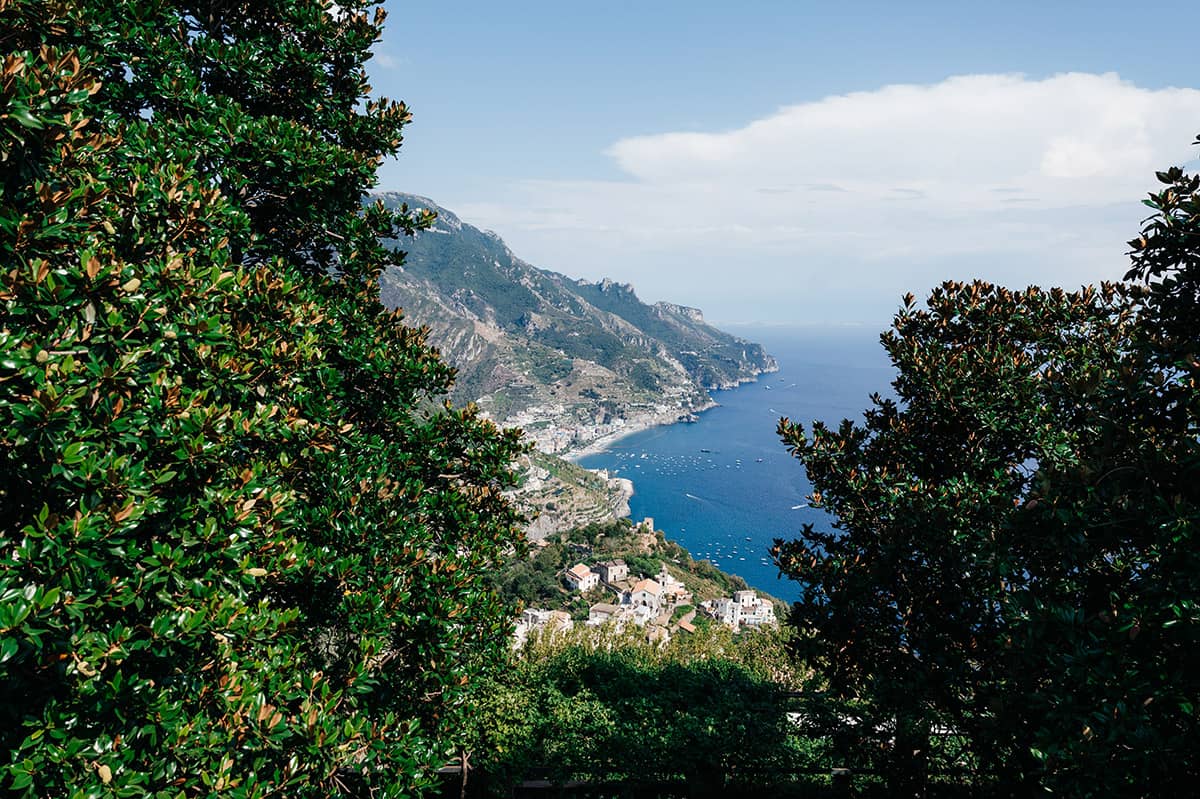
From the road above, Atrani is one white mass of houses stacked against the cliff, with the bell tower in the middle and the sea at its feet, which is the view the guests had in front of them all through dinner.
Atrani is often called the smallest town in southern Italy by area, a single square and a tangle of lanes and stairs, and walking it at dusk with a bride in white turns heads at every corner.
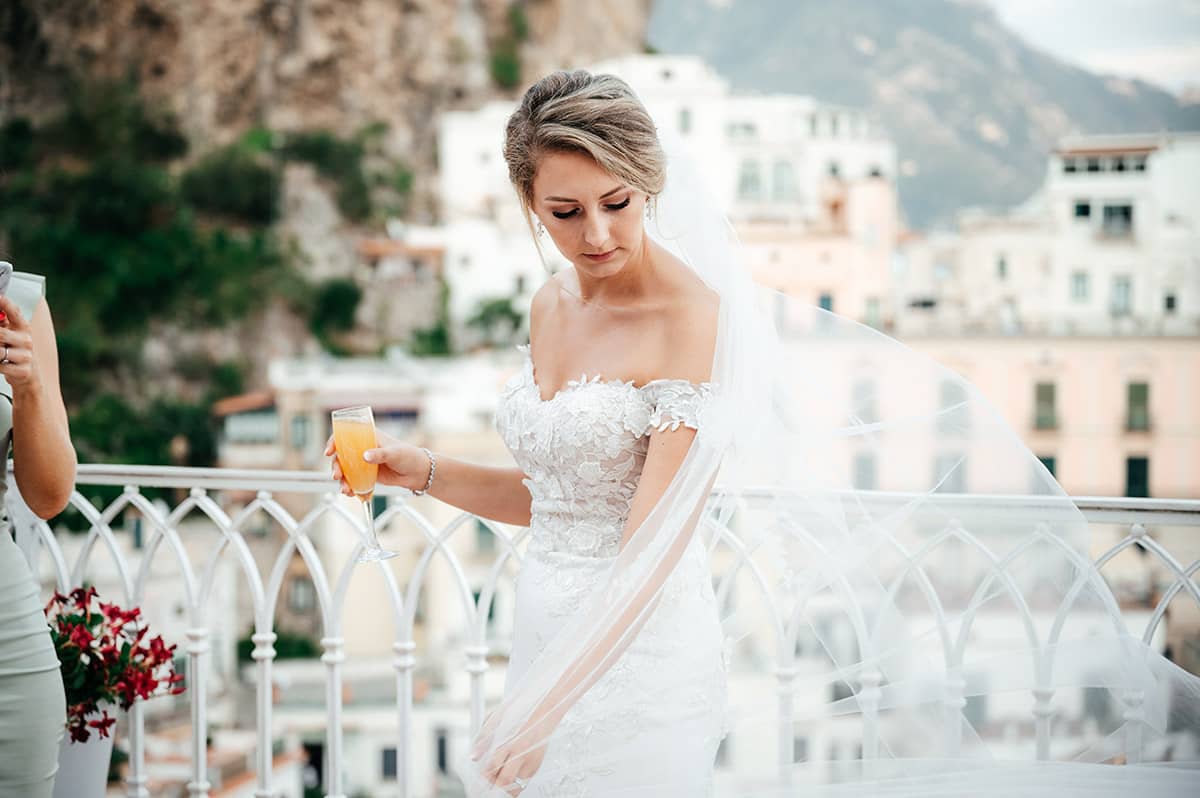
Later, on a wrought iron balcony with a lattice railing, Elisha held a glass of something the color of a sunset and looked down rather than at the lens, the whole climbing white mass of Atrani stacked up behind her against the hillside. That building, seen from below, looks almost vertical, houses stacked on houses with no logic a visitor can follow. From above, on that balcony, it reads differently: still dense, but calm, sorted by the eye into a pattern instead of a puzzle. I shot her in profile so the village stays legible behind her rather than turning into a blur of white noise.

Dinner at Palazzo Ferraioli
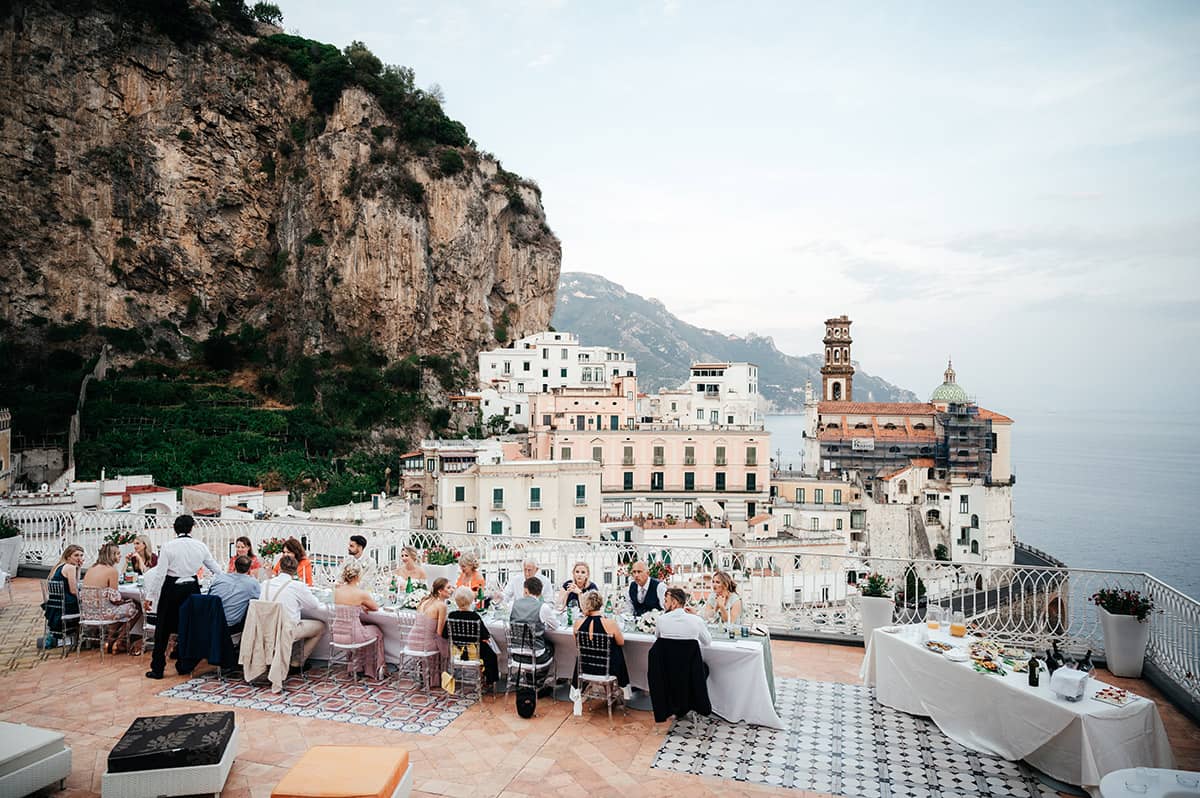
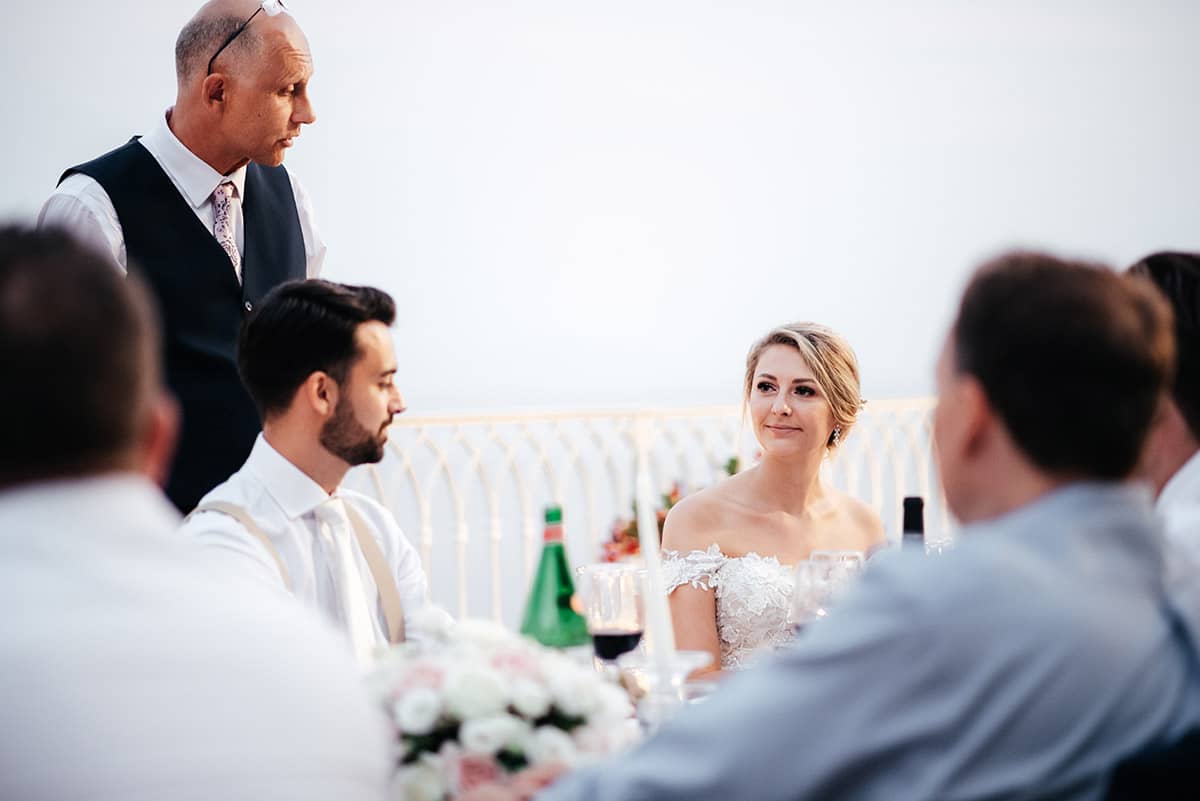
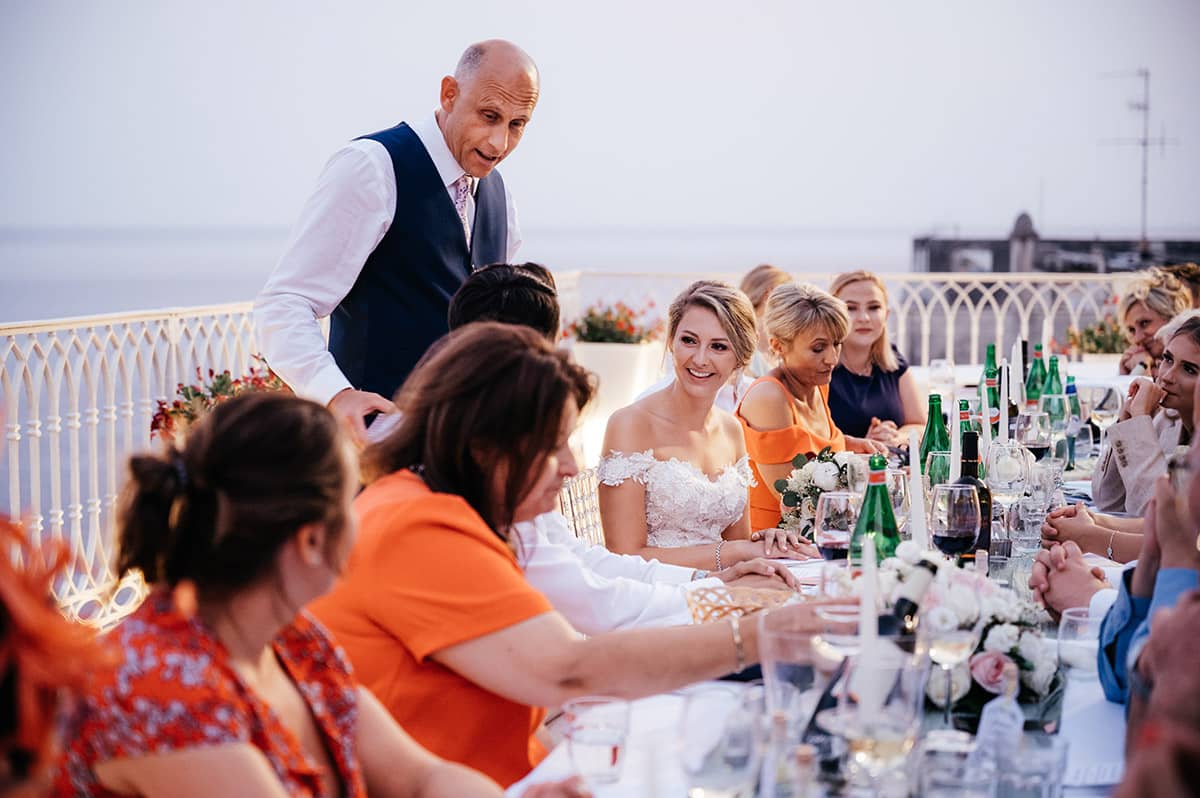
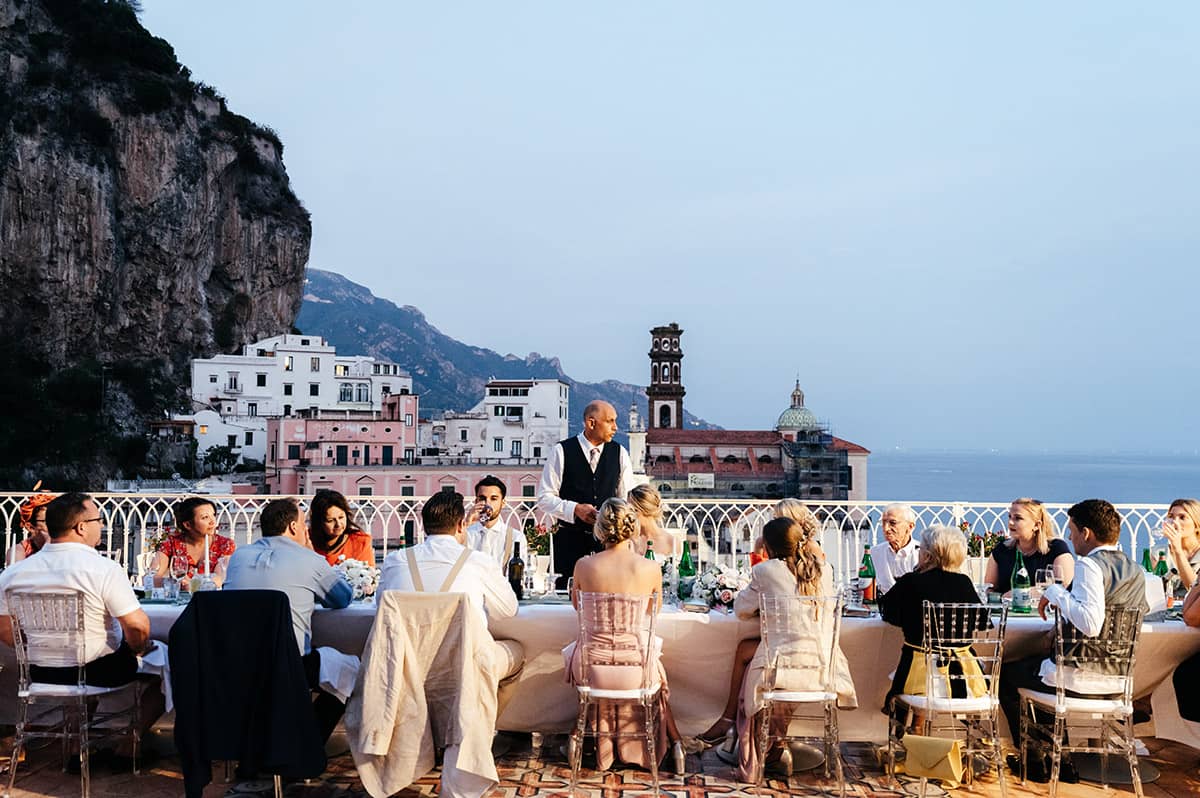
The reception took place at Palazzo Ferraioli, a historic hotel on a cliff above Atrani that has hosted enough weddings on this coast that I know its terrace by heart. Dinner started while there was still light in the sky, the whole group at long tables along the balustrade, Atrani spread out below in the last of the dusk, its bell tower and the green maiolica dome of the Collegiata visible over the guests’ shoulders. Elisha’s father stood halfway through the meal to give a toast, one hand on the back of her chair, and I shot it from the far end of the table so the entire row of faces turning toward him would be in frame alongside the newlyweds.
The terrace sits high enough above Atrani that the whole village is in the frame behind the table, and as the light went, the windows below came on one by one.
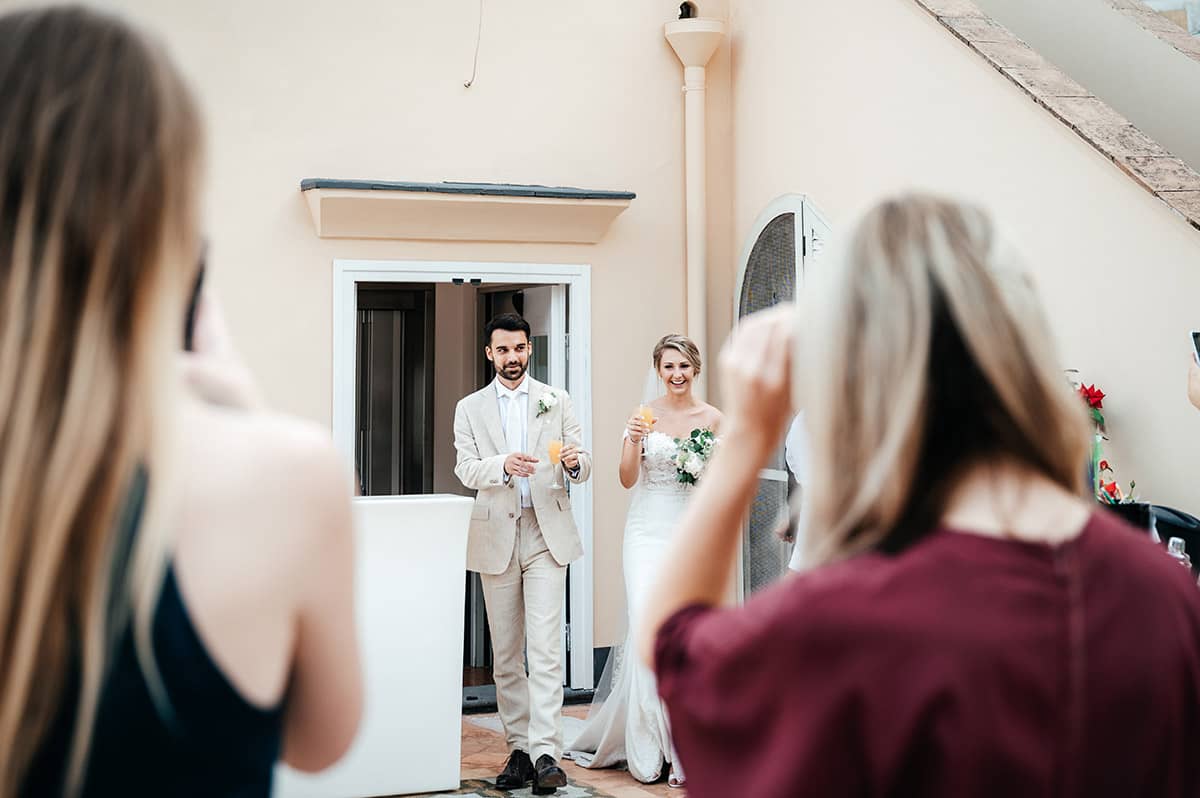
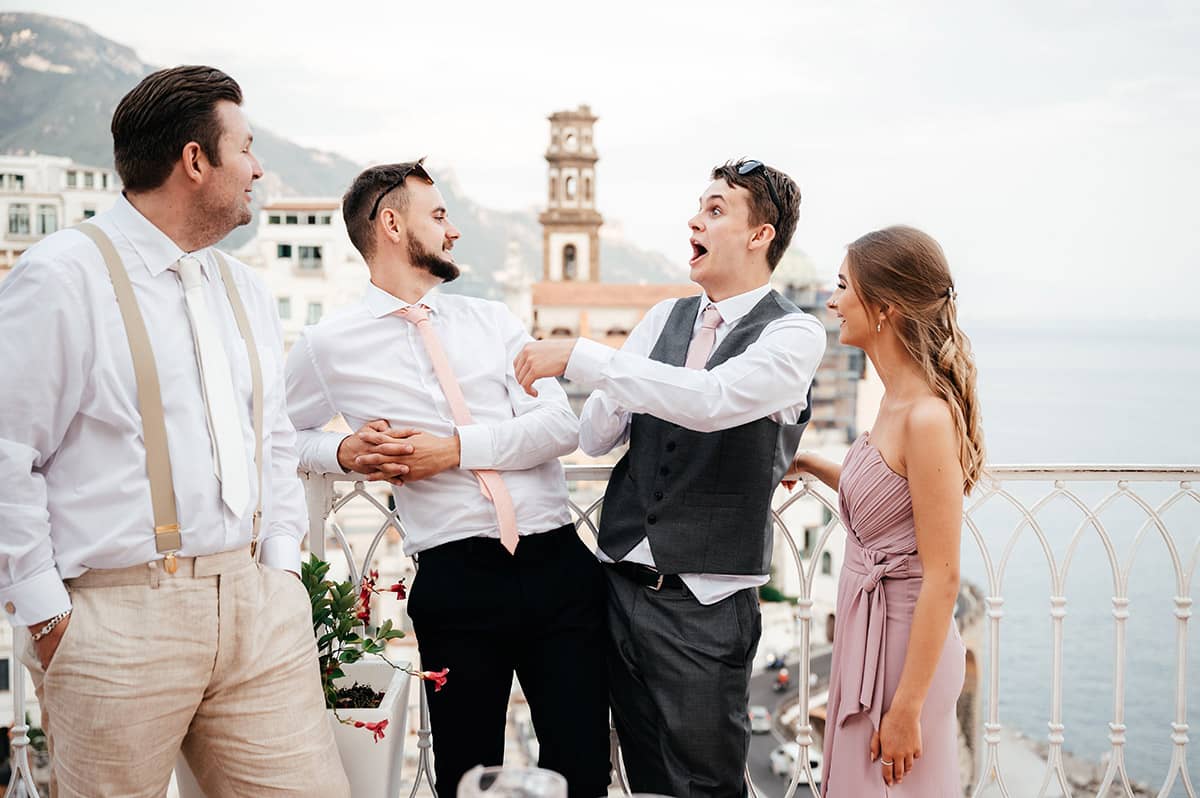


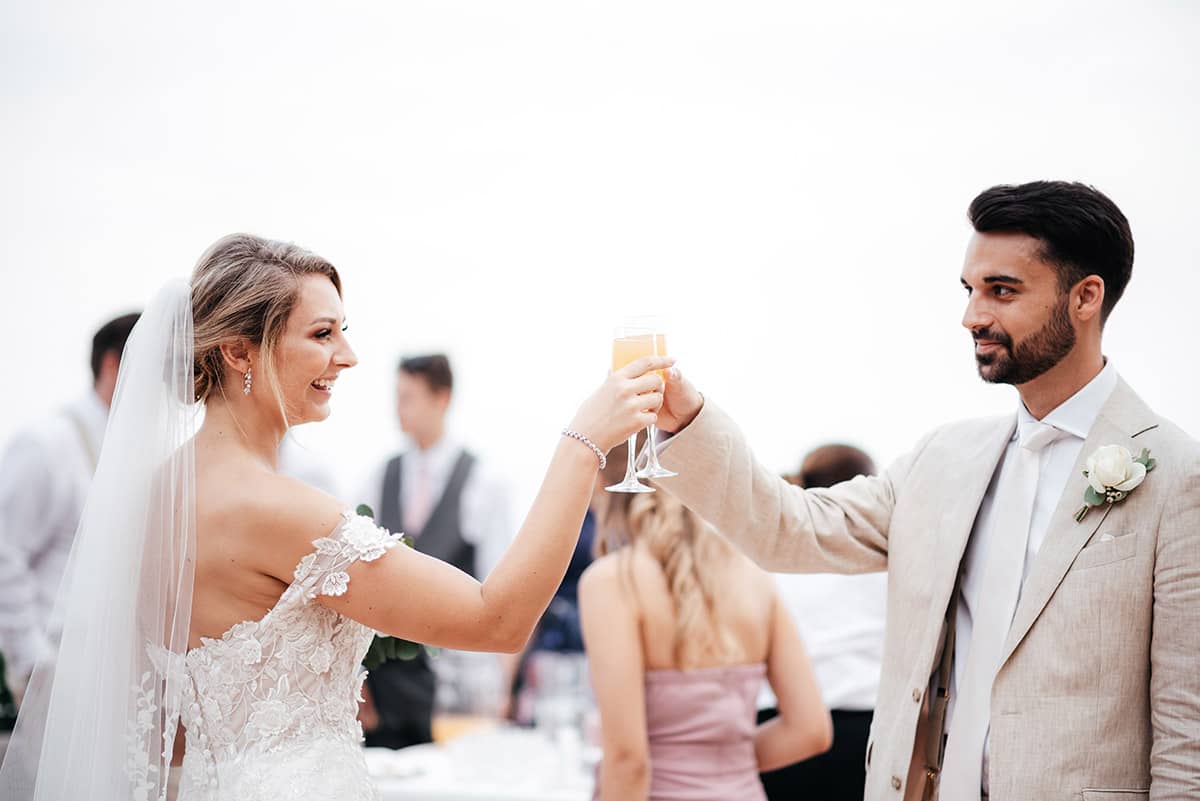
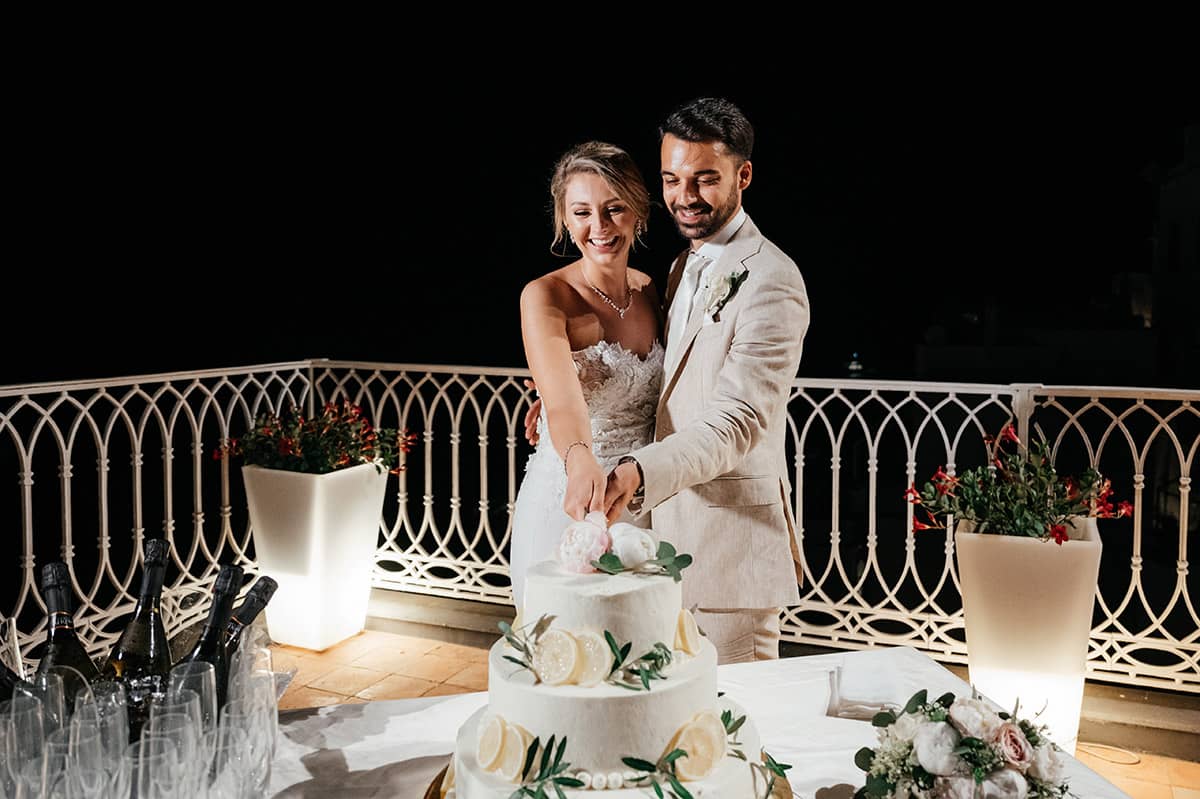
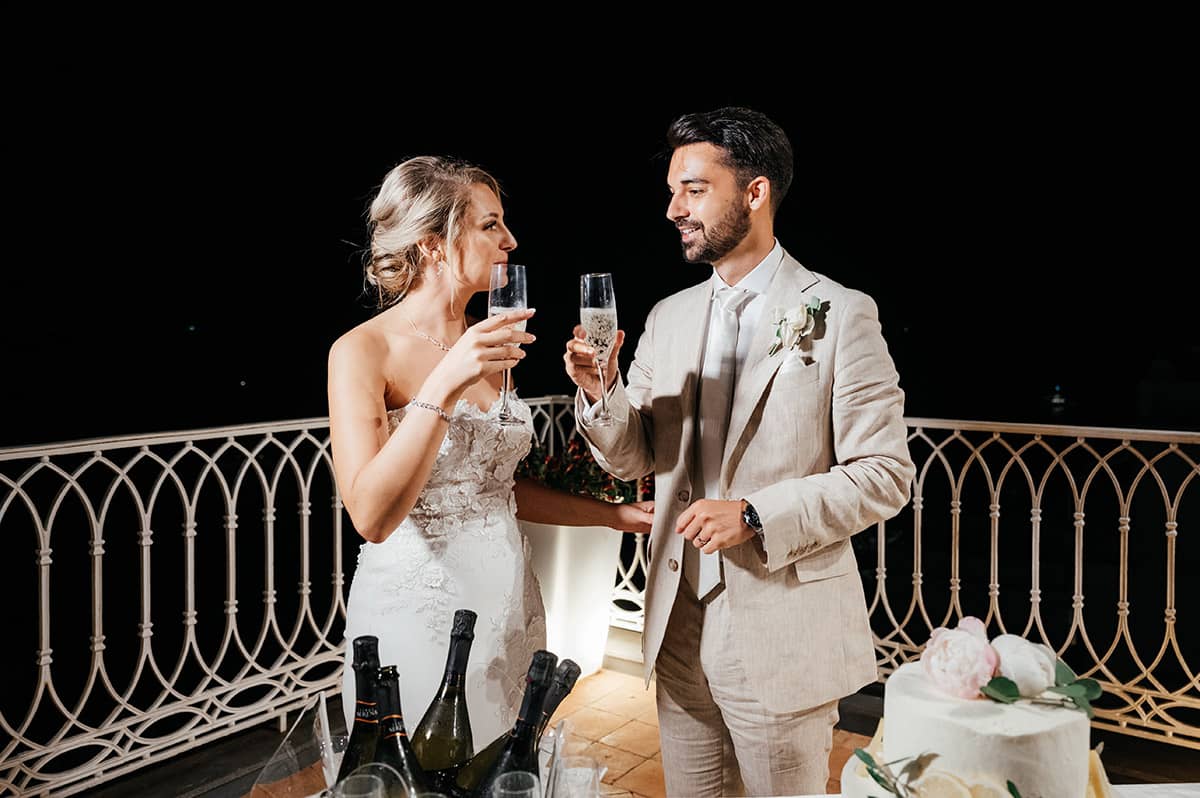
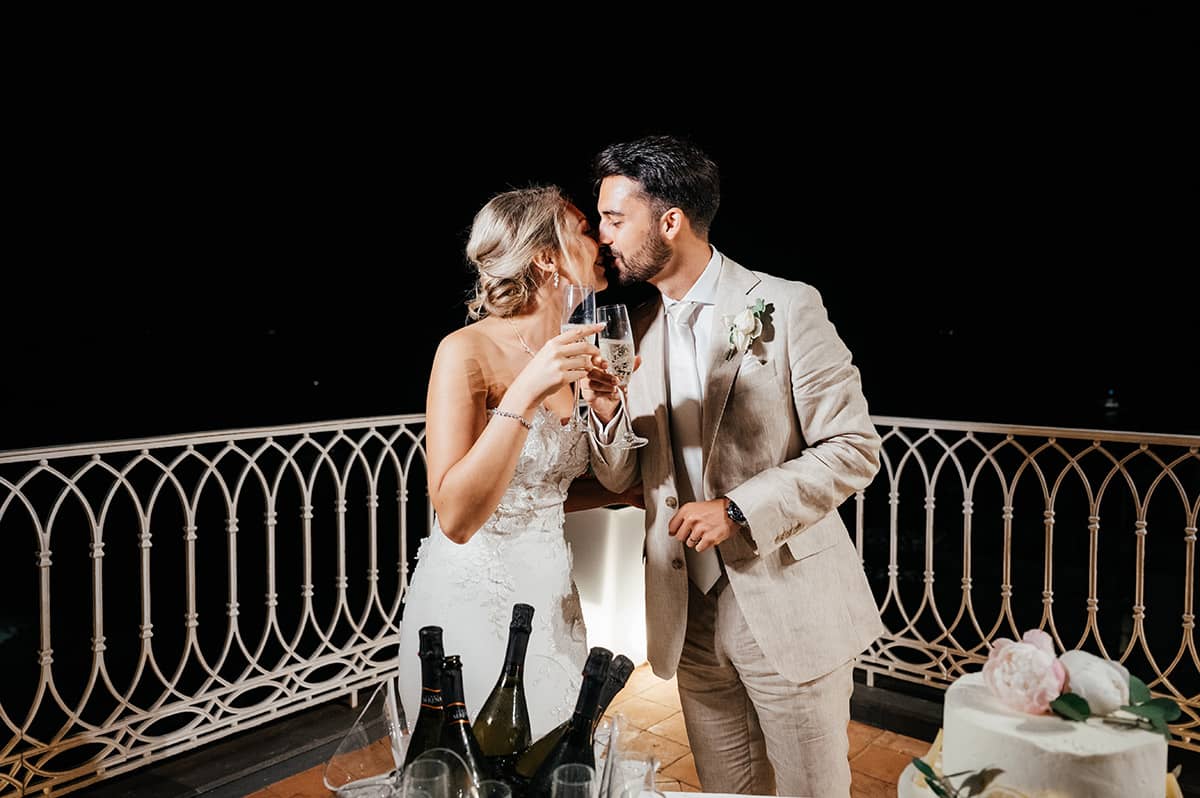
By the time the plates were cleared, the sun was gone and the whole terrace ran on candlelight and the string of warm bulbs along the balustrade. A four-piece band, all of them in straw fedoras, set up at the corner with a guitar, a double bass, a mandolin, and a second guitar, and played through most of the rest of the night with no amplification needed. I shot the cake cutting and the final toasts with only the light that was already there, the candles and the bulbs, and let the background go black. The best frame of the night is a simple one: Elisha and Luke’s faces almost touching over two glasses of prosecco, the black night behind them doing all the work a sunset backdrop usually does during the day. Some of my favorite portfolio photographs come from this kind of low, uneven light. It forces a kind of intimacy that a bright, evenly lit reception never quite produces.
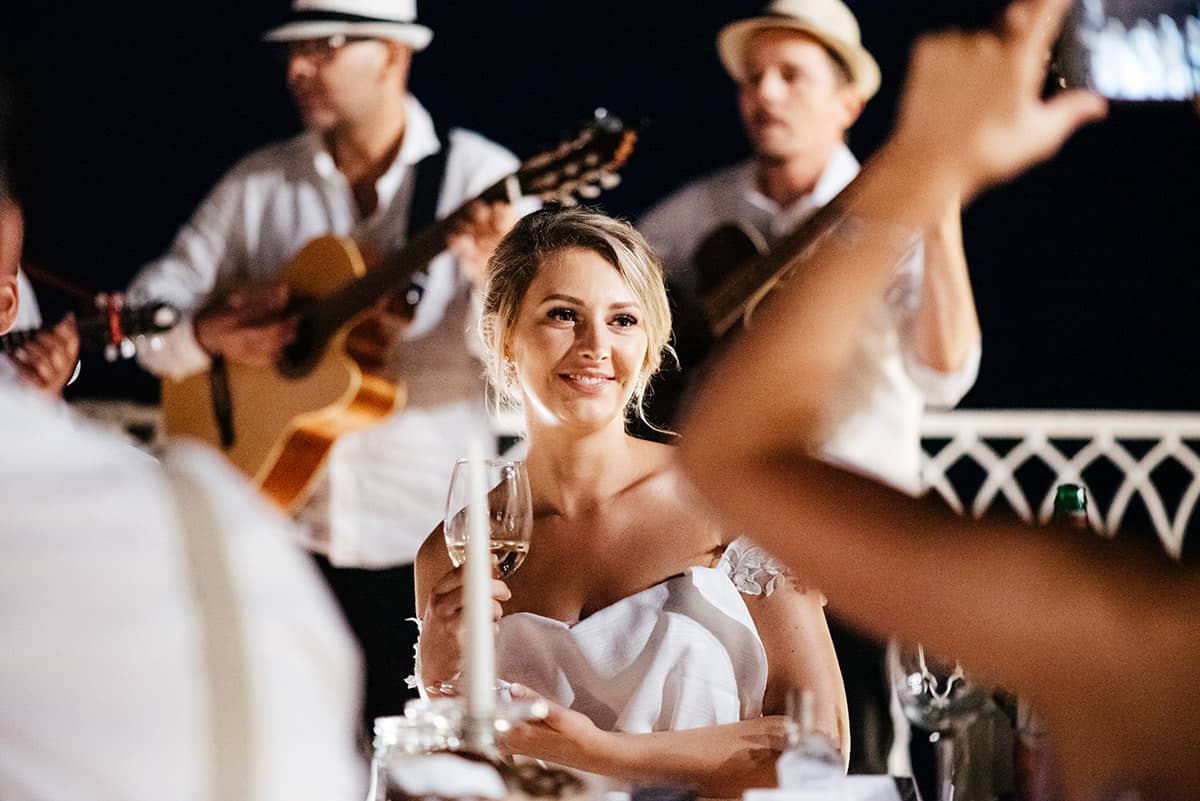
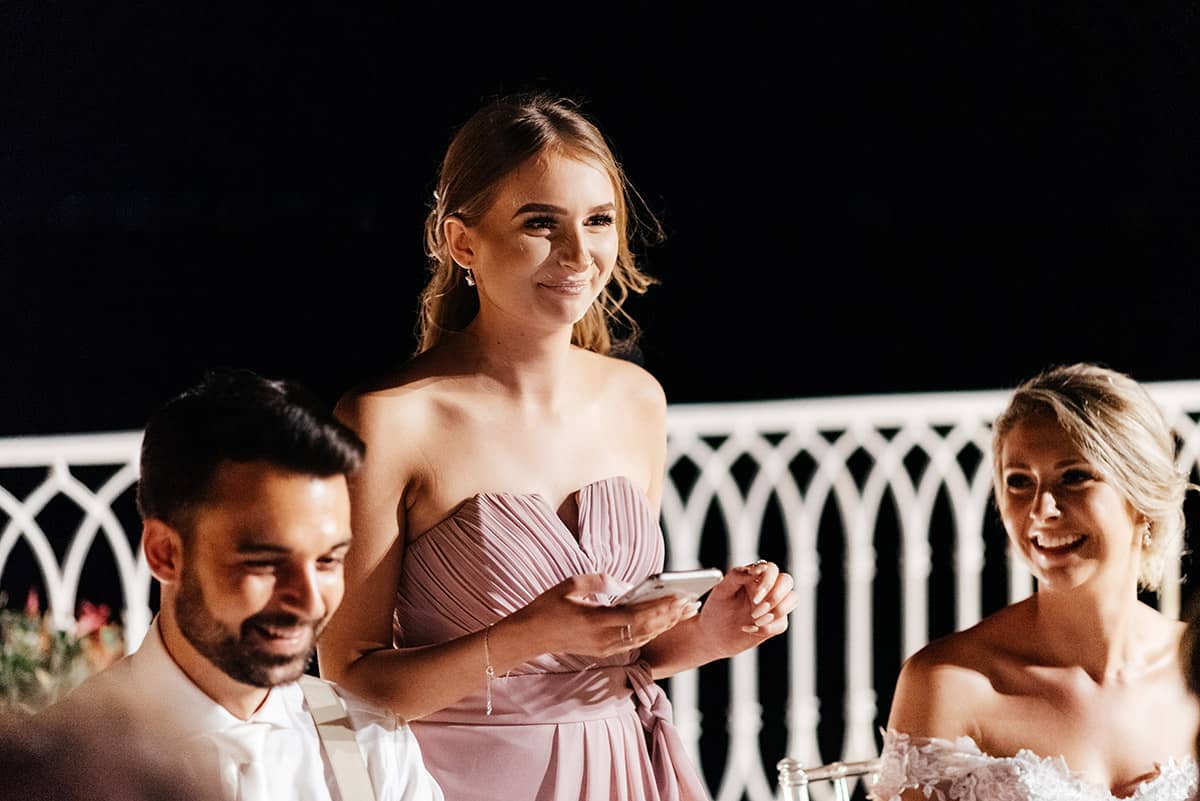


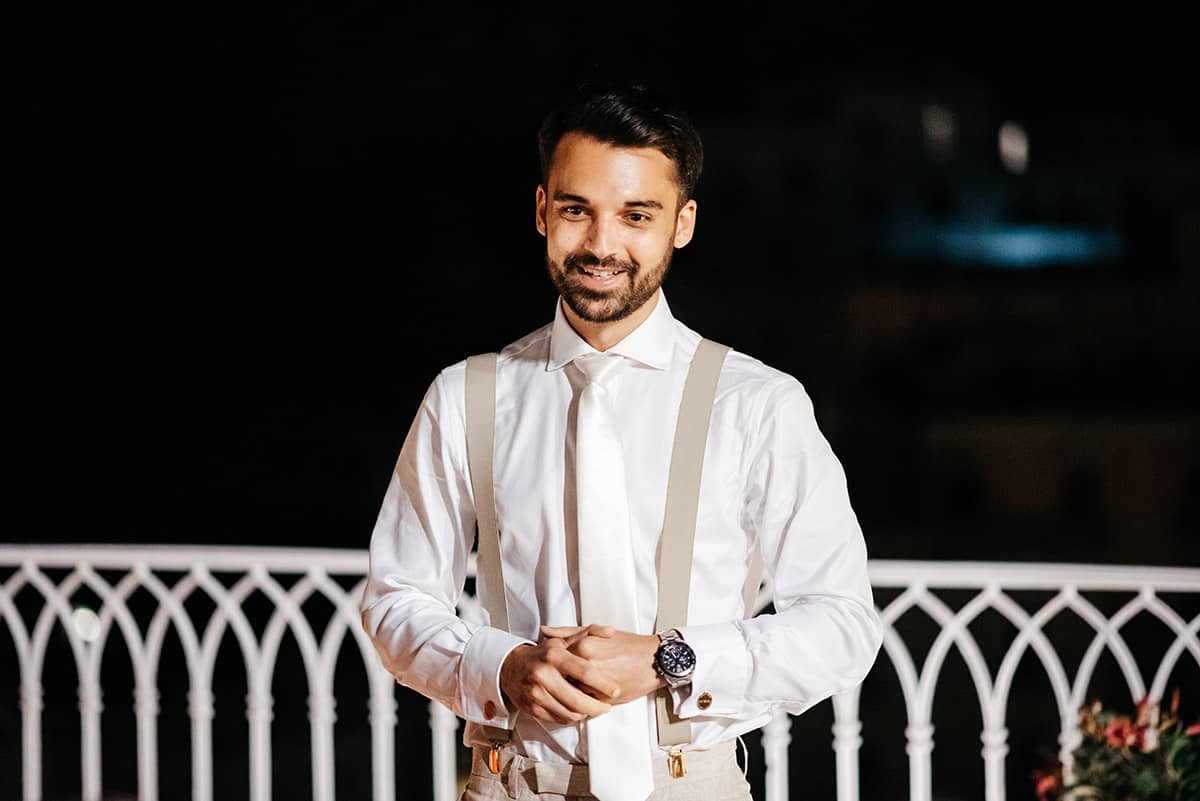

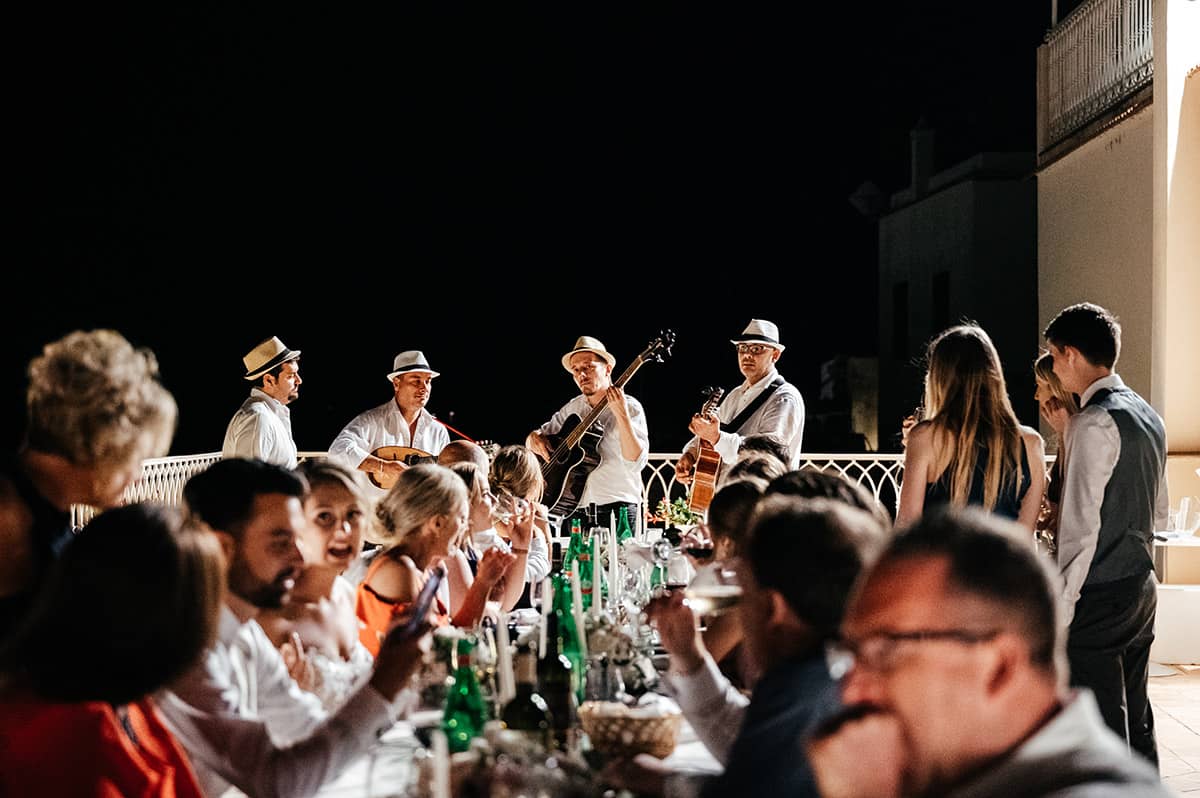
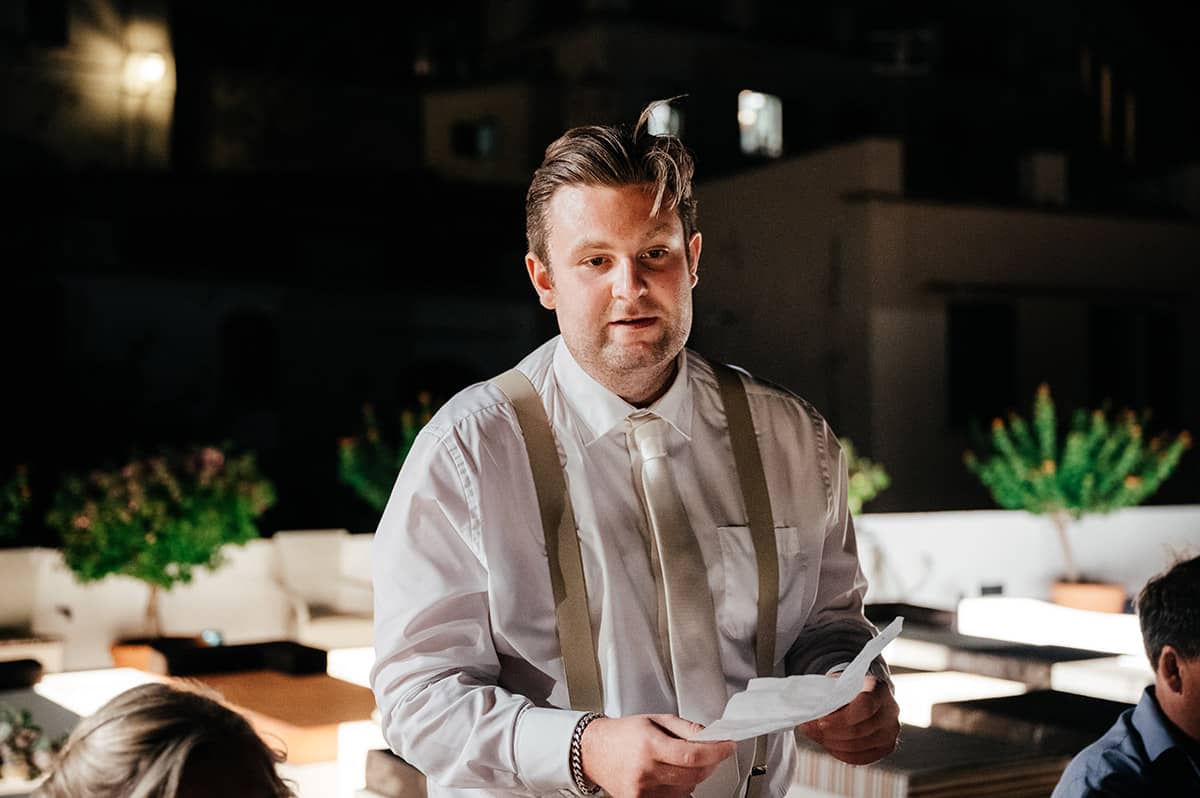
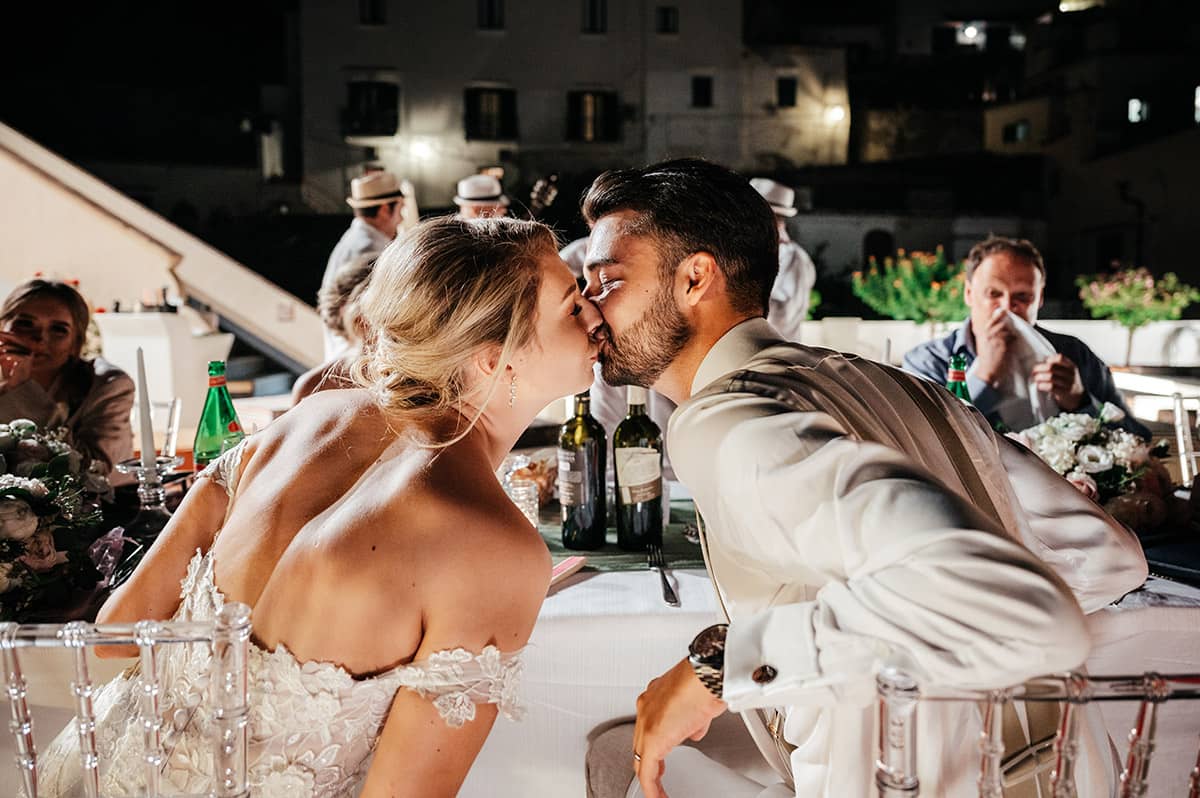
The musicians moved around the tables instead of staying in one corner, which is the best thing that can happen to a dinner photographer: every table gets its moment with the music, and every face turns toward it.
The cake came out late, under the bulbs on the balustrade, and Elisha and Luke cut it with the black sea behind them, then raised their glasses one more time to the whole table, the musicians still playing behind them.
Planning a Ravello-Atrani Wedding
If you are weighing a Ravello-Atrani wedding of your own, a few things are worth knowing before you book anything. For couples who want the legal ceremony in Italy, the civil route through the Ravello comune is a good one, and the gardens it uses for the outdoor version photograph well. Atrani, by contrast, has almost no flat ground for a large venue, and its handful of reception spaces sit on private terraces cut into the cliff, Palazzo Ferraioli among them.
Groups of up to about thirty guests, like Elisha and Luke’s, work well for this format. Much larger and the transfer between towns starts eating into the light you have left for portraits. A group that size still fits in Atrani’s narrow streets and on one terrace for dinner, and walking through the village together becomes part of the evening.
A Ravello-Atrani wedding, ceremony above and reception below, works for couples who want the ceremony to feel formal and the celebration to feel loose. Write to me with your guest count and I will tell you whether this two-town format, or a single venue, fits your day better.
If you want both towns, tell your photographer early. The drive, the walk down into Atrani and the light at the end of the day are what the whole timeline is built around, more than any single venue.
OTHER WEDDINGS ABOVE AND BELOW RAVELLO

Alida and Michael at Belmond Hotel Caruso

Hotel Caruso – Anastasia and Joe
Shiva and Michael – Palazzo Confalone

Wedding at Palazzo Avino – Fabiano and Oliver

Palazzo Avino – Austin and Emily
Palazzo Confalone – Holly and Ben
EMILIANO RUSSO STUDIO
 Written By Emiliano Russo