

Summer Honeymoon in Ravello and Atrani – Sarah and Christian
A summer honeymoon in Ravello and Atrani: Sarah and Christian brought their wedding clothes from Michigan in September, and two photographers spent six hours with them between the gardens of Ravello and the sea.


Sarah and Christian flew in from Lansing, Michigan, in mid-September with her lace gown, a long veil and his black tuxedo. It was not their wedding day but a honeymoon session in their wedding clothes: six hours with Felice and me, starting at noon in Ravello and ending at sea level in Atrani, the village directly below it.
Ravello and Atrani are close on the map and very different on the ground: one high on a ridge among gardens and villas, the other at sea level, squeezed into the mouth of a valley. A session that uses both gives you two honeymoons in a single day.
Through the Arches of Villa Rufolo
The session began at Villa Rufolo, the thirteenth-century residence of the Rufolo family, merchants who grew rich on the trade of medieval Ravello. The first frames were made through the pointed arches near the entrance, where the dark stone frames the bright garden beyond like a doorway into another century. For you, that age is the backdrop: arches no modern venue can build, already old when the first travelers reached Ravello.


The gardens owe their look to a nineteenth-century Scotsman, Francis Neville Reid, who restored the villa and filled its terraces with exotic plants. In September the beds are still full of color, rows of pink and magenta flowers below the paths, and I used them as a foreground to keep the couple small against the garden.

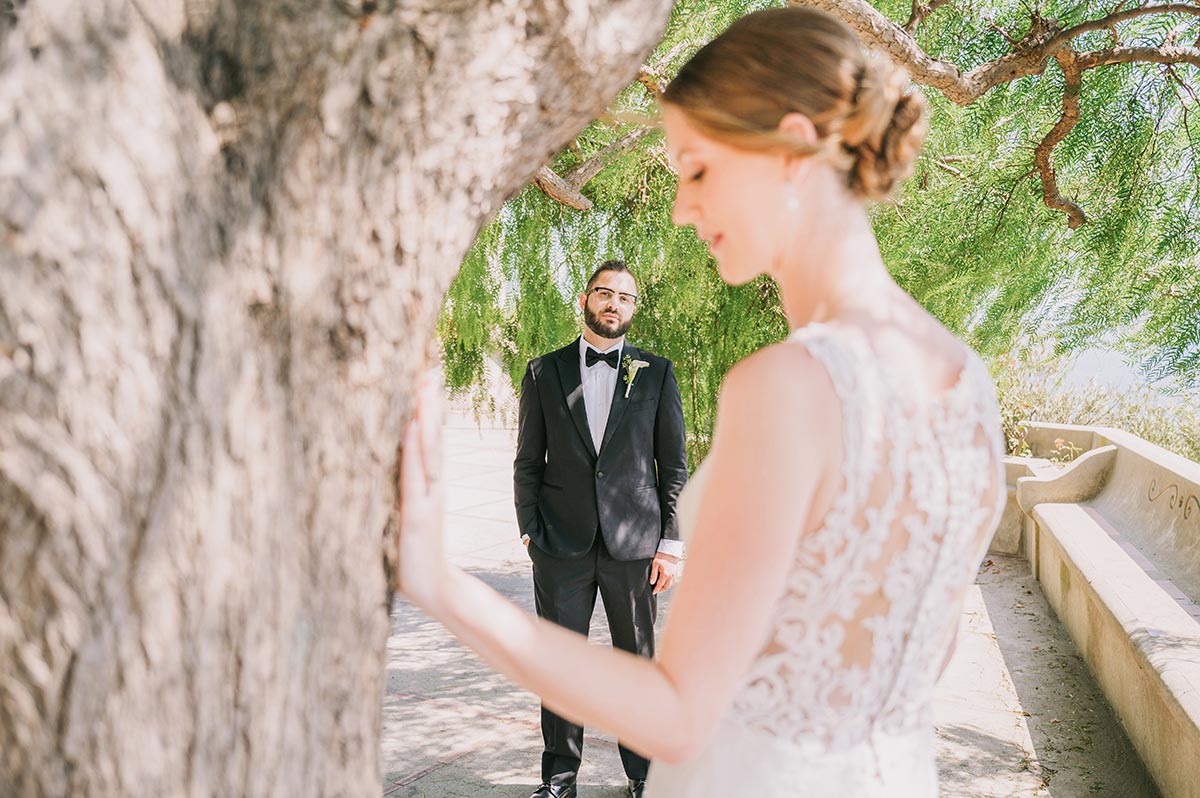
At noon in September the sun is still high and hard on this coast, so I worked the shade first: the paths under the trees, a column wrapped in ivy, then the curved stone bench on the upper terrace, where the light bounces back off the pale stone instead of falling straight onto faces.
You may wonder whether noon is a bad time for photographs. Out in the open, yes. In a garden with trees, arches and a cloister it works, because the place gives you the shade the sky does not.


The Moorish Cloister
The Moorish cloister is the heart of the villa: slender columns below and a band of interlaced arches above, carved in a style that recalls the Arab world the merchants of Ravello traded with. The light inside is soft at almost any hour, because the walls hold off the direct sun and the pale stone fills every shadow.


Sarah’s train filled the floor of the gallery, and I let it spread across the stones rather than gather it. A long veil in a narrow space is worth the extra minute of arranging, because the pattern of the arches repeats behind it in every frame.
I keep the compositions symmetrical in the cloister: the arches are so regular that a crooked frame looks like a mistake rather than a choice.


A First Look by the Ivy Wall
It was not their wedding day, and a first look still worked. Christian waited with his back to her by a wall covered in ivy, between flowering plants and an old stone well, and turned when she reached him. The laugh in those frames is real, and so is the way he looks at the dress.


Further on, a small pond under a pergola reflects the plants around it, and with the couple at the far end the water doubles the frame. It is one of the quietest corners of the villa.


I shoot these from low, almost at the level of the flowers, so the color fills the bottom of the frame and the two of them stand in the middle distance.
Water slows a frame down. A pond, a fountain or a wet stone gives the eye somewhere to rest, and on a day full of strong color that rest matters.

Palms and Old Stone
The lower part of the garden is full of palms against old stone walls, the remains of rooms that lost their roofs centuries ago. It looks more like a garden in North Africa than one in southern Italy, and that mix of the exotic and the ruined is what Reid’s garden is known for. For your photographs, it means a garden that changes character every few steps.


A white gateway with two columns gave me a frame inside the frame: the couple walking through it toward me, hand in hand, then stopping under the arch. In full sun, white architecture needs careful exposure, or the lace of a gown disappears into the wall behind it.


Wagner came here in May 1880 and, so the story goes, found in these gardens the magic garden of Klingsor for the second act of Parsifal. Every summer the Ravello Festival still builds its stage in the lower garden, above the sea, and a concert of Wagner’s music remains part of it.


A Pergola of White Columns Above the Sea
From the gardens I took them to a long pergola of white columns, its beams covered in climbing plants and its floor laid with old tiles, with nothing beyond the railing but the sea. Under a pergola like this the canopy breaks the overhead sun while the background stays bright, so faces are soft and the coast stays visible behind them.
COOL STONE UNDER VILLA RUFOLO

A single beam of light between 13th-century columns, and no flash.


PINK POTS ALONG THE COLONNADE
Shade from the vines, and the coast bright through the columns.

DOWN THE SWITCHBACKS TO ATRANI
A short drive down the mountain, from the gardens to the sea below.


This is the controluce approach I use whenever the sun is too high for open portraits: I put something between the sun and the couple, shoot toward the light, and let a rim of light on hair and shoulders separate them from the background.
The old tiles on the floor also reflect a little light back up into faces, which is why the portraits under this pergola needed almost no correction afterward.


I kept them at the far end of the pergola for a few frames, the columns lined up on both sides like a corridor, then brought them closer to the camera step by step.


Walking a couple slowly toward the camera under a structure like this gives a sequence rather than a single photograph: the same frame four or five times, with the two of them a little larger and a little more relaxed in each.


Shooting Through the Flowers
Pink flowers hung from the beams and spilled from terracotta pots along the colonnade. I used them as a foreground, shooting through them so the pink became a soft wash of color at the edge of the frame: white lace, pink blur, green leaves and the blue of the coast, a palette that came entirely from what was already there.


From the end of the pergola Ravello itself appears, houses and gardens along the ridge, and a wide frame there puts the whole session on the map.


The Terrace With the Pines
Back at Villa Rufolo, the terrace above the lower garden has the view everyone comes for: two umbrella pines leaning over the railing, the domes of the church of the Annunziata below, and the coast running away toward Maiori.
Sarah walked out alone to the railing for a few frames with her back to me, arms open, the veil moving in the breeze. A solo frame like this gives a honeymoon gallery a pause between the couple portraits, and it is one I always ask for.


In the garden beside it, tall stems with pale round flower heads swayed in the breeze, and they made a soft, moving foreground for a few closer portraits.


Into the Dark Halls Below
Below the garden level Villa Rufolo keeps a series of vaulted rooms, dark and cool, where the light enters in a single shaft through an opening. I placed the couple at the edge of that beam and let the rest of the room fall into shadow, with no flash: the stone around them goes black, and the lace catches every bit of light.
A dark room in the middle of a bright day is also a rest for the couple: a few minutes out of the sun, in cool air, before going back out into the heat of the garden.


Coming back out into the garden after that, the contrast is the point. A gallery that moves from bright flowers to a black vault and back again feels like more than one place, even when every frame was made inside the same villa.


White Benches and a Bell Tower
Another pergola, this one lined with white benches and with a bell tower rising behind the leaves, gave the session its brightest frames: white stone, white lace, a black tuxedo and green overhead. Christian sat on a bench for a few portraits on his own, and Sarah’s hands, crossed over the lace of her gown, made one of my favorite details of the day.


Two photographers make the difference in places like this. Felice worked the wide frames from the far end while I stayed close, so the gallery has both the scale of the pergola and the faces in it from the same few minutes.


A Lawn on the Edge of Ravello
The last stop in Ravello was a lawn on the edge of town, with an iron railing and the whole coast below it: the bay, the mountains folding away toward Maiori, the sea turning silver in the haze.
That haze is typical of the end of summer on this coast. It flattens the far mountains into soft layers of gray and blue, and behind a couple it works like a painted backdrop.
With the light starting to soften, the close portraits there are some of the warmest of the day: foreheads together, a hand on a cheek, the view blurred behind them.


On the way down, a white arcade with a green door and pots of plants along the wall was worth two quick frames.


Down to Atrani
Atrani lies directly below Ravello, at the mouth of the valley that runs down from it, and it is the smallest town in Italy by area, about twelve hectares of houses stacked between the cliffs and a small beach. Where Ravello is high and open, Atrani is close, white and tight against the sea.
Christian got a few solo frames against a white wall with green shutters, the kind of wall you find all over Atrani, and he played along with every one of them.
The road from Ravello drops down the mountain in tight bends to the coast road, and Atrani is right at the bottom. The drive gave the two of them a break in the cool of the car, with water and a few minutes without a camera pointed at them.


Sarah’s turn came against a wall of faded blue paint peeling over the stone. Old walls like this beat any studio backdrop: the color is soft, the texture is real, and nobody painted it for a photograph.
I photographed Sarah alone there on purpose. After hours of couple portraits, a few frames of the bride on her own change the rhythm of a gallery and give her a set of images that are only hers.


The Terrace of Santa Maria Maddalena
Above the beach, the churchyard of Santa Maria Maddalena opens onto a terrace with a white balustrade and old iron lamps, hanging directly over the water. The church was built on the cliff in the thirteenth century and is known for its majolica dome, and from its terrace the coast opens up on both sides. For you, it is the one spot in Atrani where you stand above the sea instead of beside it.
From the far corner of the terrace the couple are two small figures against open water; a few steps closer along the balustrade, they become the subject again. The same few minutes give both.


By then the light had turned soft and even, the end of a long day in the sun, and the close portraits against the balustrade have the gentlest light of the whole gallery.


The Steps of San Salvatore de’ Birecto
The last setting was the great staircase of San Salvatore de’ Birecto, the church where the doges of the Republic of Amalfi were invested with their ducal cap, the birecto that gives it its name. Its façade with the clock and the staircase took their present form in the Baroque period, and the steps make a natural set: Sarah sitting with her train spread over them, Christian leaning against an old column at the side.
After six hours together the stiffness is long gone, and these frames needed almost no direction from me.
The staircase is a public one in the middle of town, so people walk up and down it all evening. I wait for the gaps instead of asking anyone to move, and the few seconds of empty steps are always enough.


Below the steps lies Piazza Umberto I, a small square enclosed by houses a few steps from the beach, with café tables under the arches and people having an evening drink. I photographed the two of them crossing it from the far side, the clock of San Salvatore above them and the life of the square around them.


The last frames were on the white steps under the iron gate of the church: the two of them sitting close, a kiss, and the evening coming down over the square.
Ending in a piazza rather than at a viewpoint is a choice I like for a honeymoon: the day closes with ordinary life around you, not with one more postcard.


Planning a Summer Honeymoon in Ravello and Atrani
A summer honeymoon in Ravello and Atrani works best as a descent: the gardens and terraces of Ravello in the middle of the day, when the shade of the pergolas and the cloister protects you, and Atrani at the end, when the light softens down at sea level. Sarah and Christian’s six hours covered both without hurry, with the drive down the mountain as a break in the middle.
Villa Rufolo is a museum with an entrance ticket and opening hours, so check them for your date, and plan around the heat: in mid-September the midday sun is still strong, and water and a short rest in the car make a real difference. Their package promised a minimum of 400 edited photographs, delivered within 70 days.
If you have fewer hours, keep Villa Rufolo and the steps of Atrani and drop the rest: the two ends of the day are the ones that tell the story.
Planning the wedding day itself in Ravello? Start from the wedding in Ravello guide, which walks through the venues, then the Ravello wedding photographer page, where I describe coverage with two photographers. For an afternoon like theirs, send me your dates and your preferred towns and I will plan the route with you.
MORE SUMMER HONEYMOONS ON THE COAST

Honeymoon in Praiano – Billy and Jessica
Meghan and Ilkin in Positano

Honeymoon in Ravello – Robb and Holly

Honeymoon in Villa Rufolo, Ravello – Ada e Chon

Honeymoon in Ravello – Nico and Priya

Engagement pictures in Cortona
EMILIANO RUSSO
 Written By Emiliano Russo