Church Wedding Without Guests: Hiroshi and Aiko in the Basilica of Minori
ONE BASILICA, TWO PEOPLE, ONE PRIEST
Two people, a priest, and a basilica with every single pew empty behind them. Hiroshi and Aiko came from Japan to marry alone in Minori, with a red lacquered box carrying the rings and a getting ready morning at Hotel Santa Caterina in Amalfi.
Tell me the church you have in mind and the date you want.
Hiroshi and Aiko flew in from Japan for a church wedding without guests: a basilica that seats several hundred people, with nobody in it but the two of them and the priest. There was no wedding party, nobody in the front row and no reception afterward. Their Japanese wedding on the Amalfi Coast filled a whole day, from a hotel balcony in the morning to the breakwater at dusk, and for most of it the only voices in my pictures are theirs.
Small weddings are most of what I shoot on this coast, and nearly all of them are small in the way an elopement is small, meaning private, intimate, deliberately stripped down. This one was different, because everything about it was formal: a tiara, a long tulle veil, a full ball gown and a basilica with a bishop’s history behind it, with all of the ceremony and none of the audience.


Bougainvillea Ropes and a Gold Watch
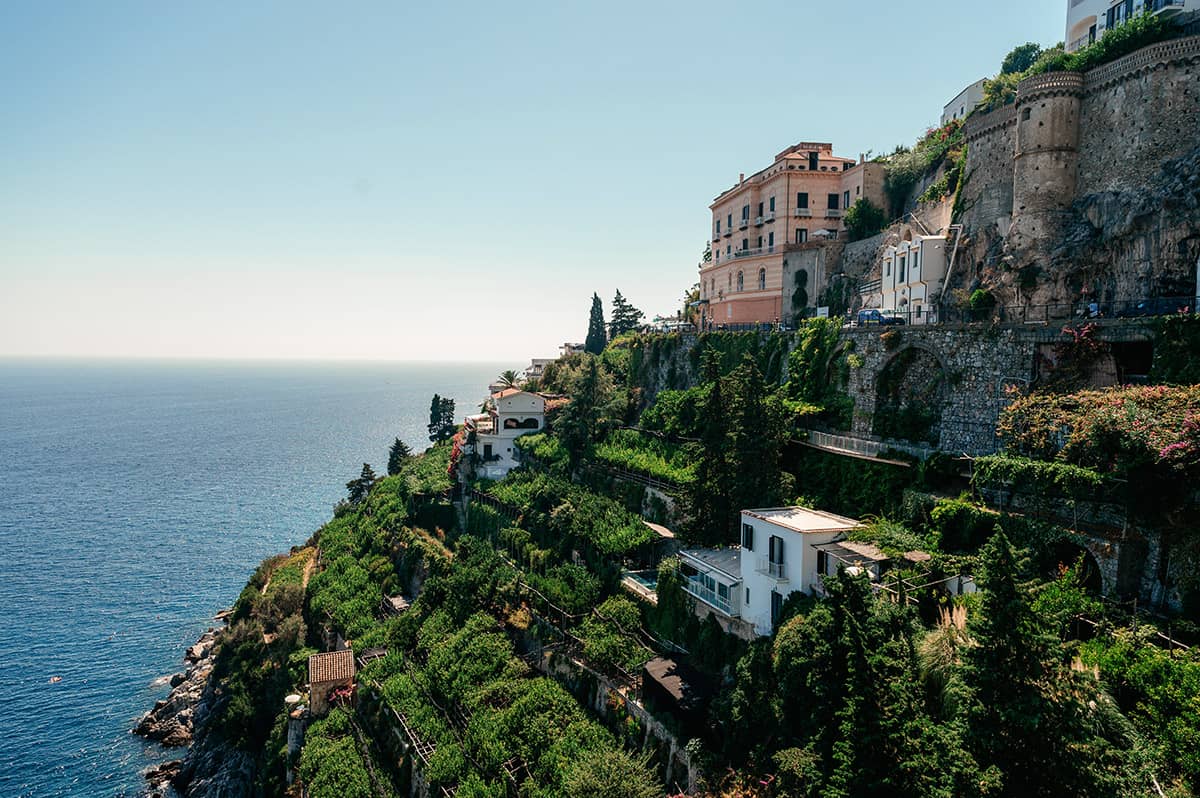
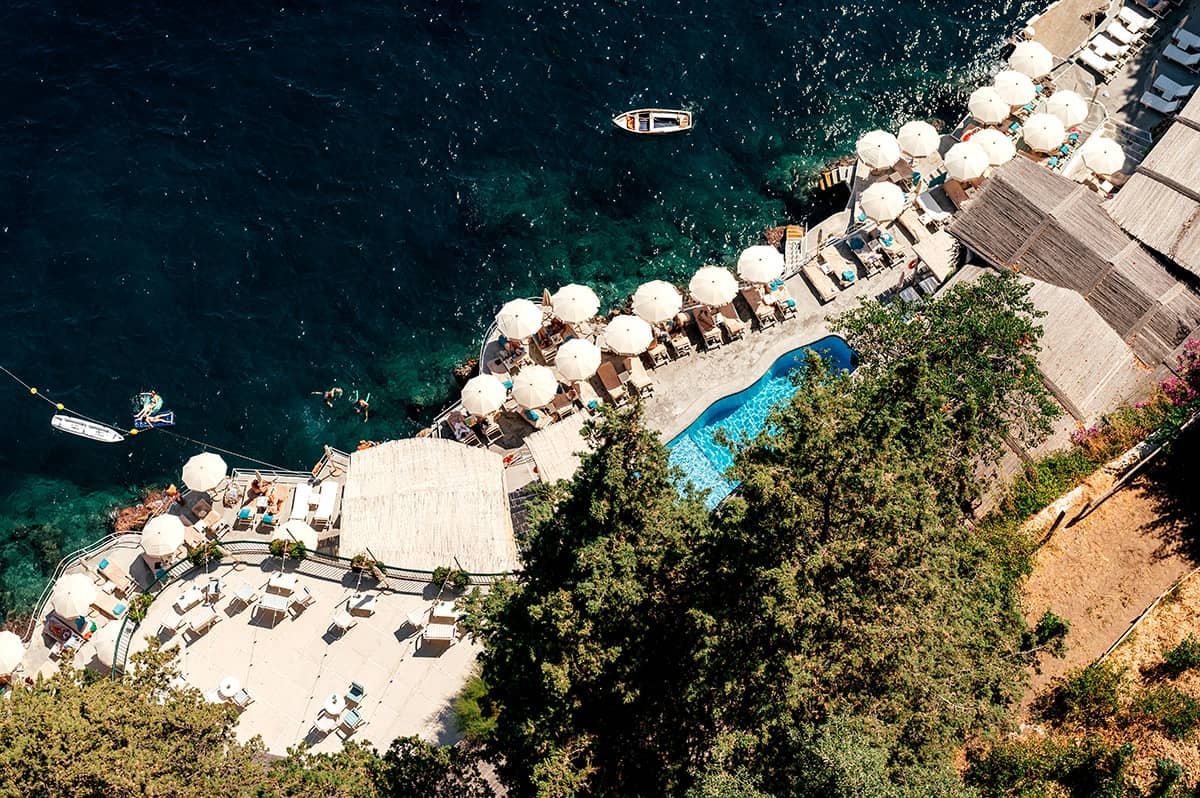
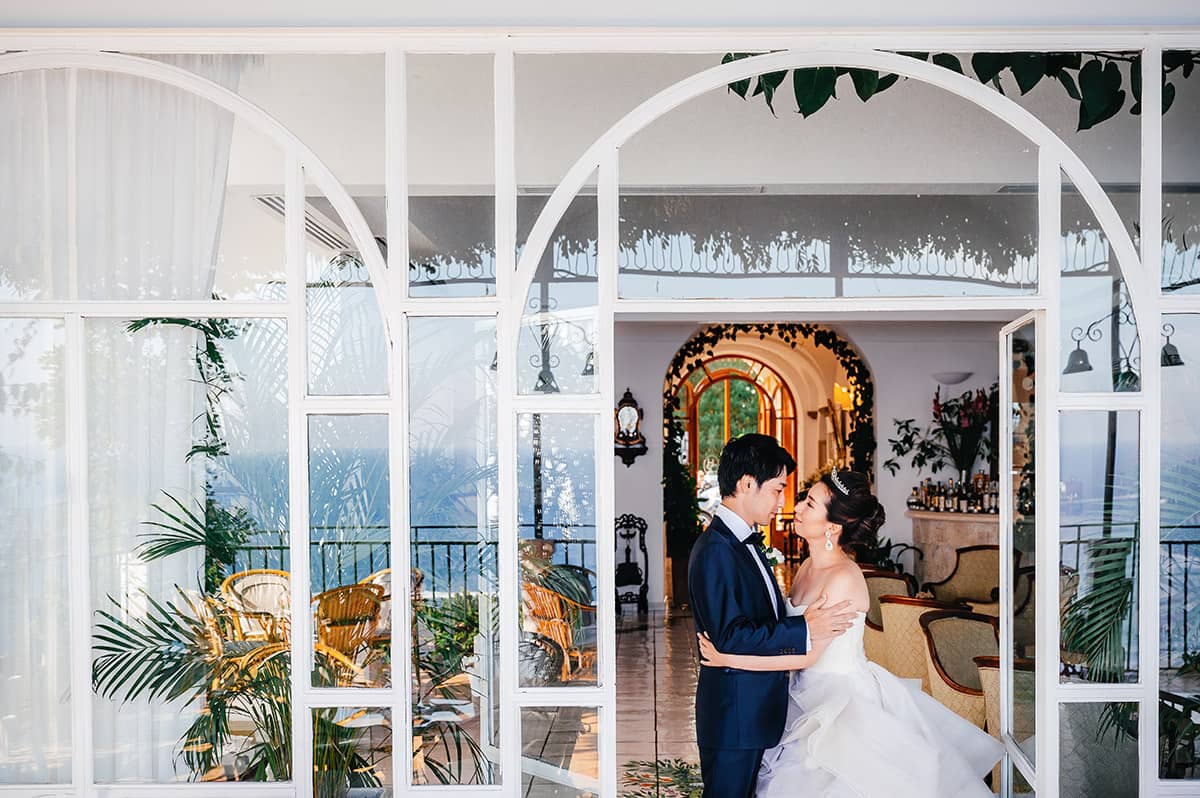
They based themselves at Hotel Santa Caterina, which sits on the cliff just outside Amalfi, and the morning ran at a pace I almost never get to shoot. When there are ninety guests waiting, the getting ready hours are a countdown. Somebody is always checking a phone. Here there was nobody to keep waiting, so the morning simply took the time it took.
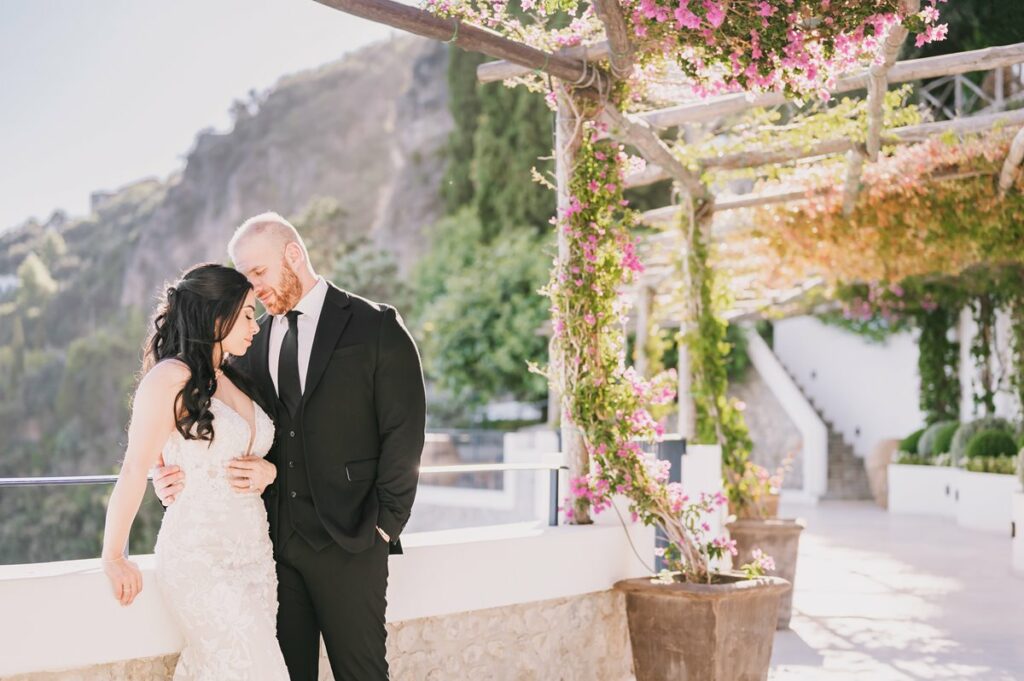
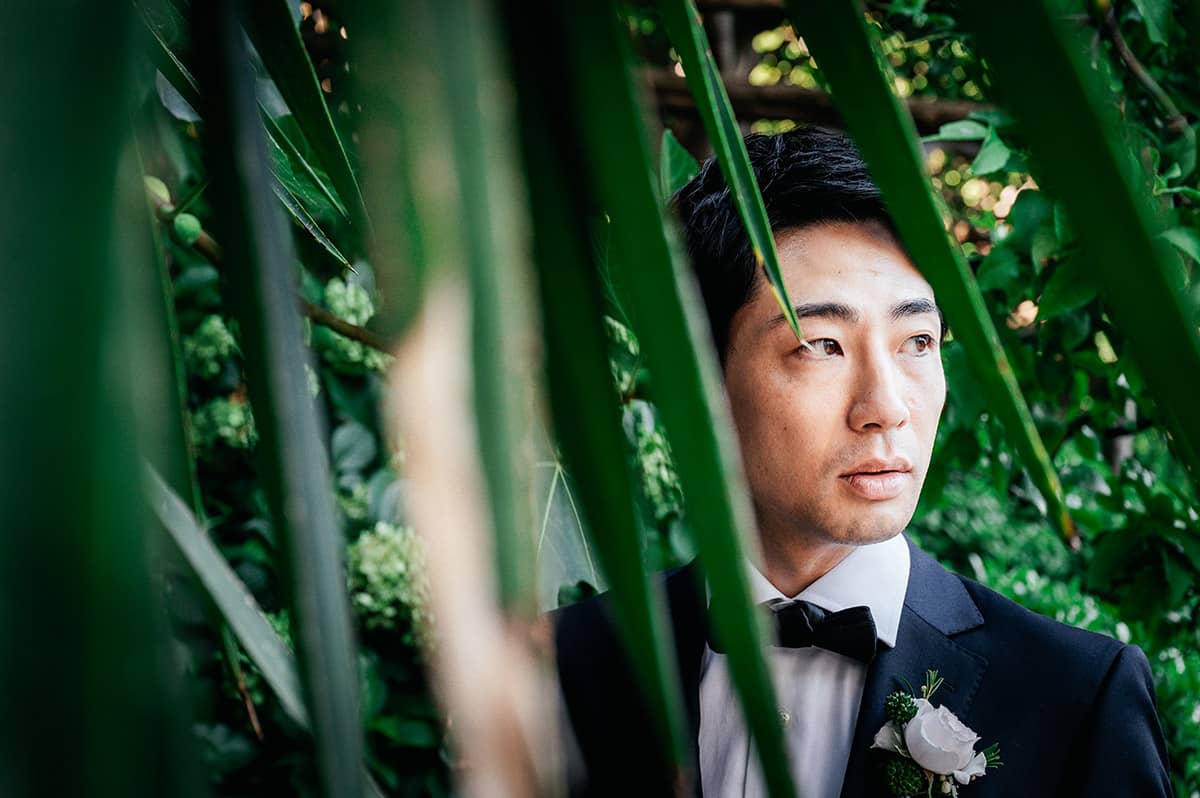
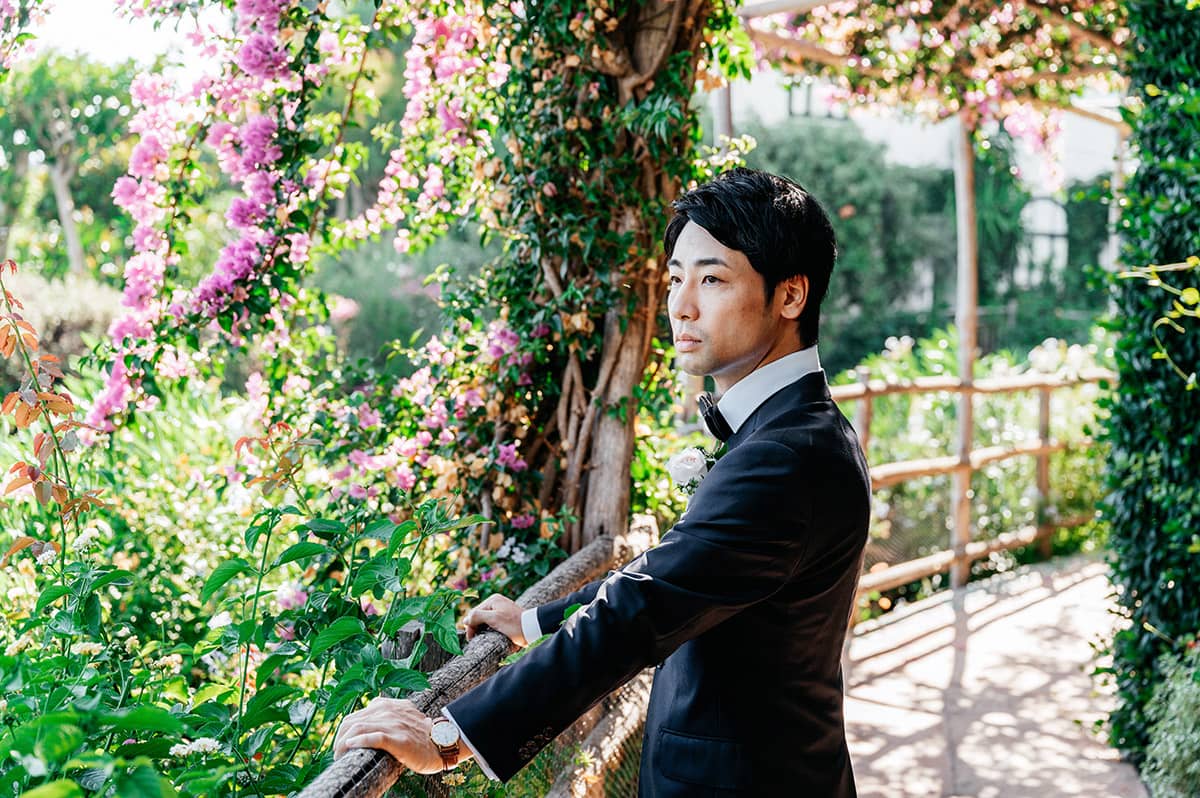
I photographed Hiroshi first, on the wooden walkway that runs through the hotel’s upper garden, leaning on the rustic railing with bougainvillea coming down in heavy pink ropes behind him. Dark navy tuxedo, black bow tie, a single white rose in the lapel, a gold watch he kept adjusting. He was not nervous in the way grooms are nervous when a room full of relatives is about to watch them. He looked like a man on a very good holiday who happened to be getting married that afternoon.
The Rings on Broken Vietri Tile
One frame from that morning has stayed with me more than the rest, and it is the ring shot, which I did not set up.
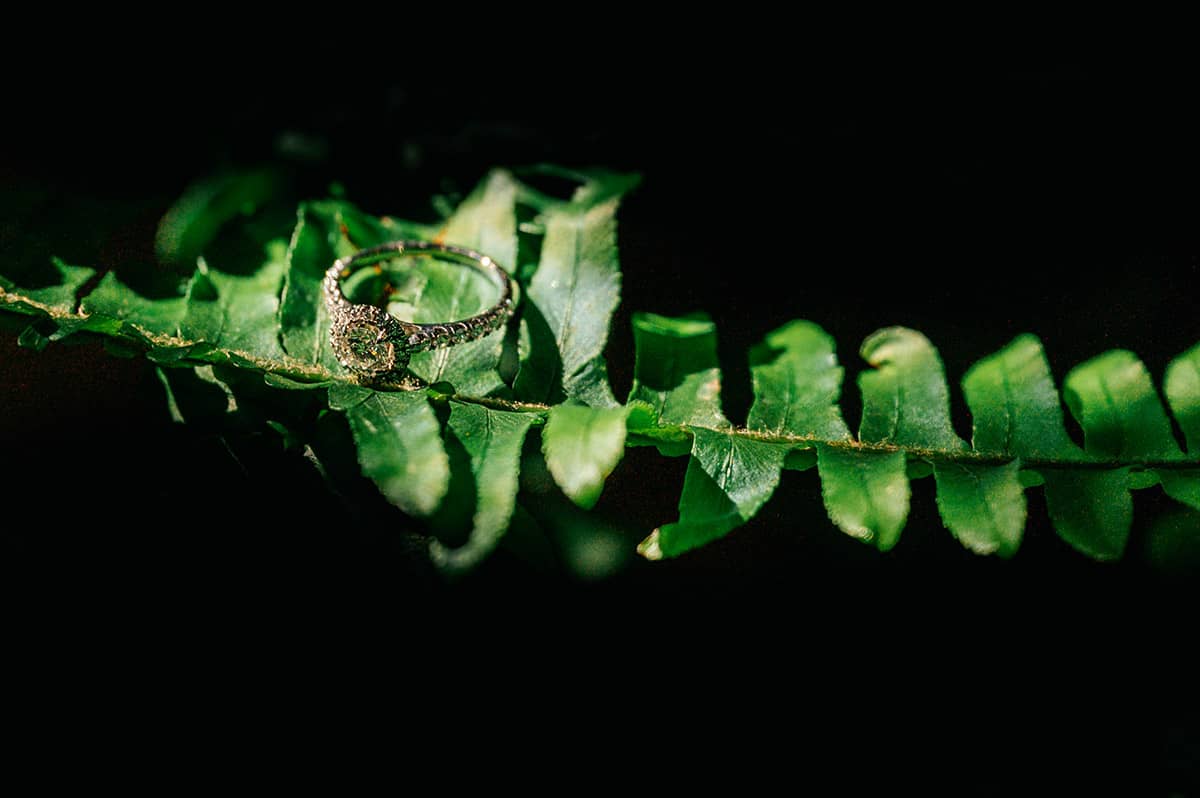
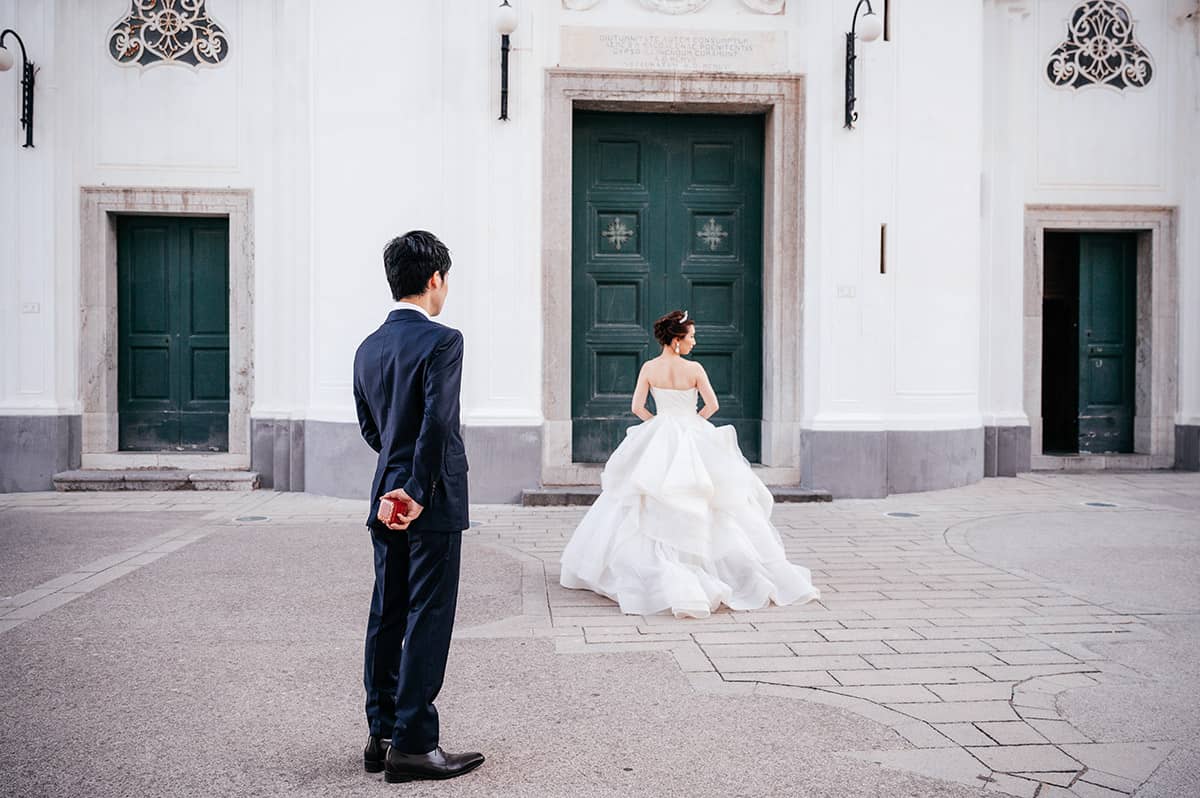
The rings had traveled from Japan in a small lacquered box, deep red with a gold border, the kind of object that has no equivalent in an Italian wedding. Somewhere on the property there was a patch of ground where broken majolica had been set into concrete: fragments of old Vietri tile in green, ochre, red and white, flower patterns and geometric ones, all of it smashed and reassembled at random. I put the two bands down on two separate shards, the box beside them, and shot straight down in hard midday sun.
It is the only photograph in the whole set where both countries are in the frame at the same time, and neither one is explaining itself.
A Balcony Wrapped in Green
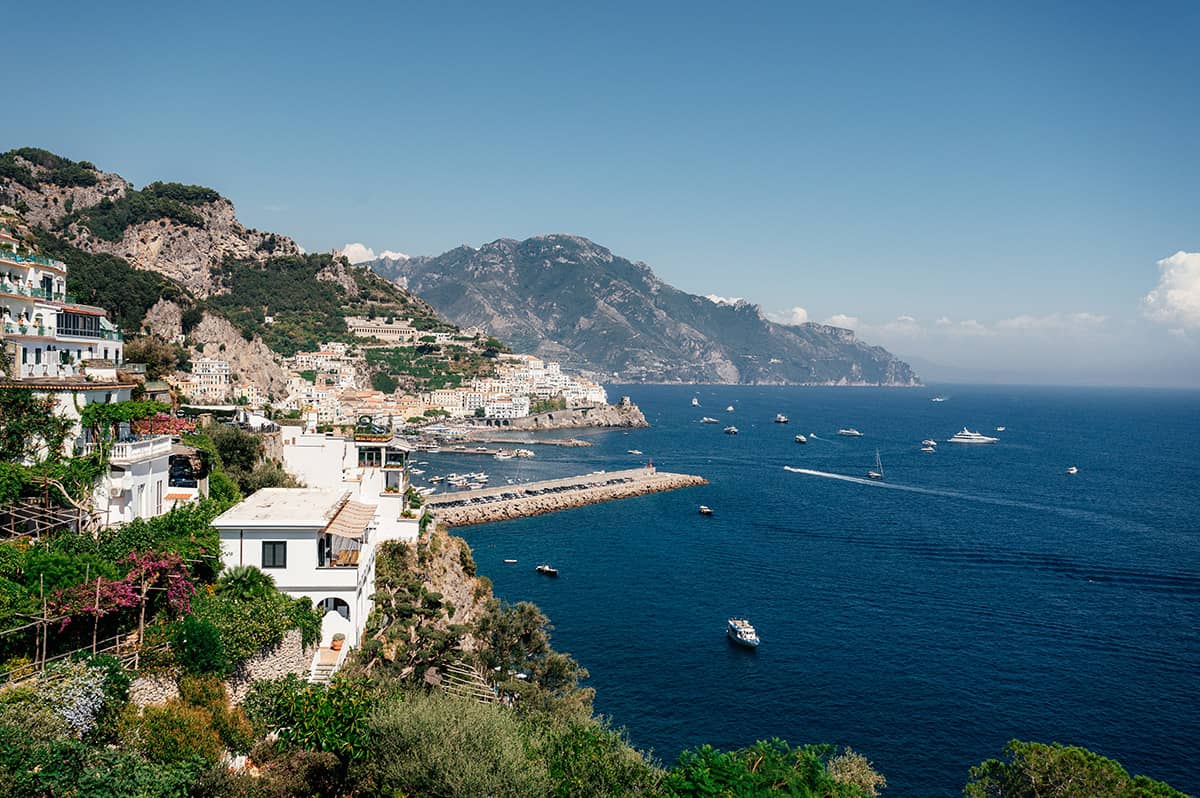
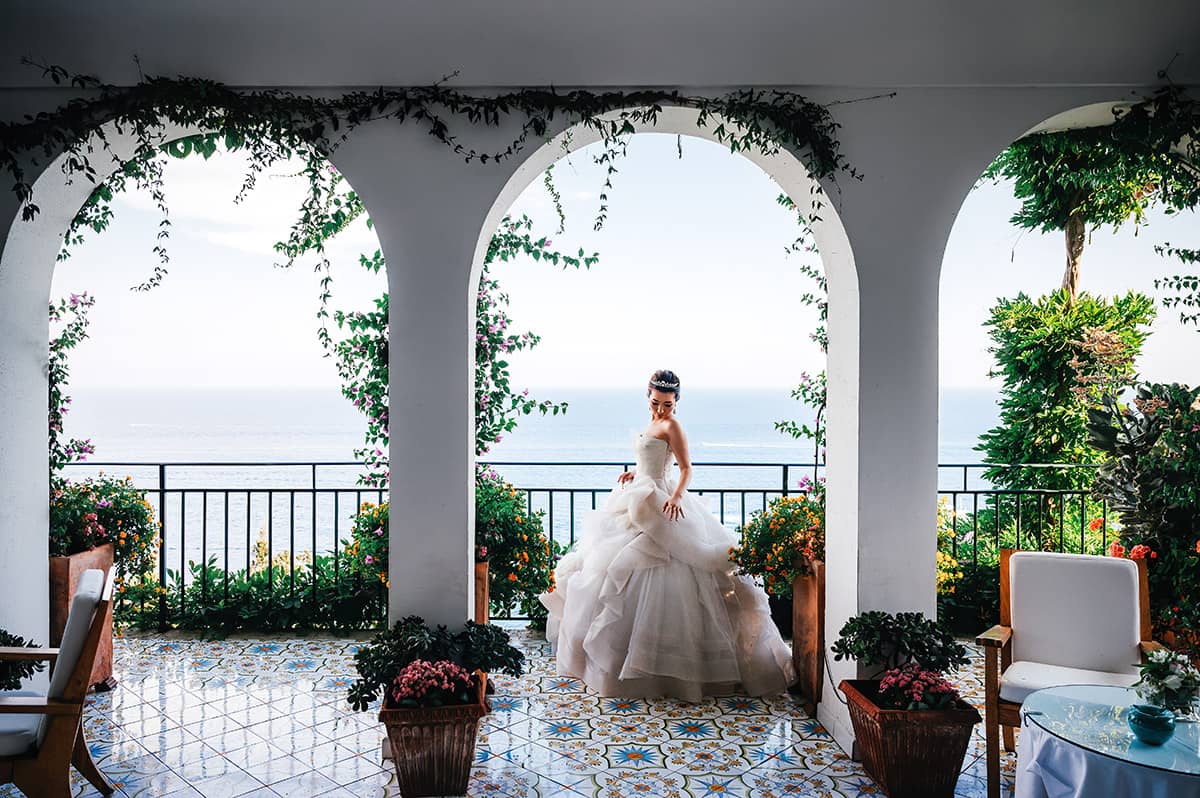
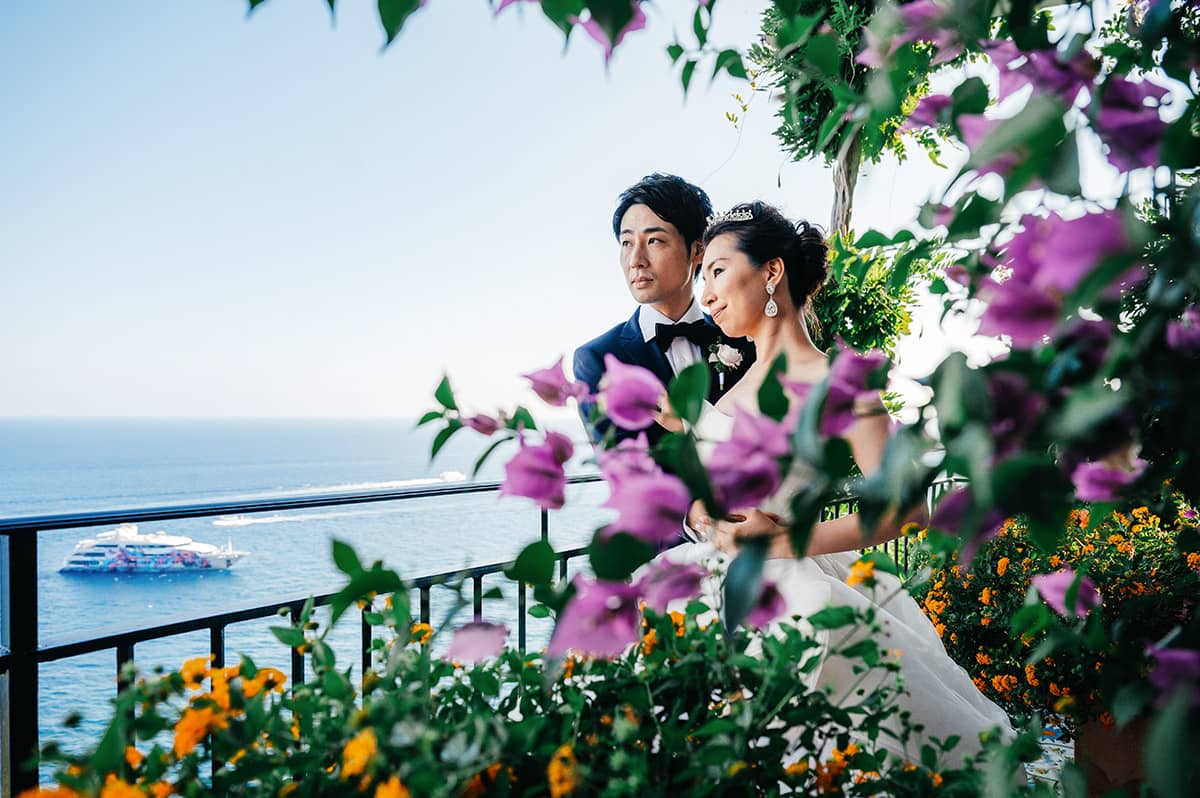
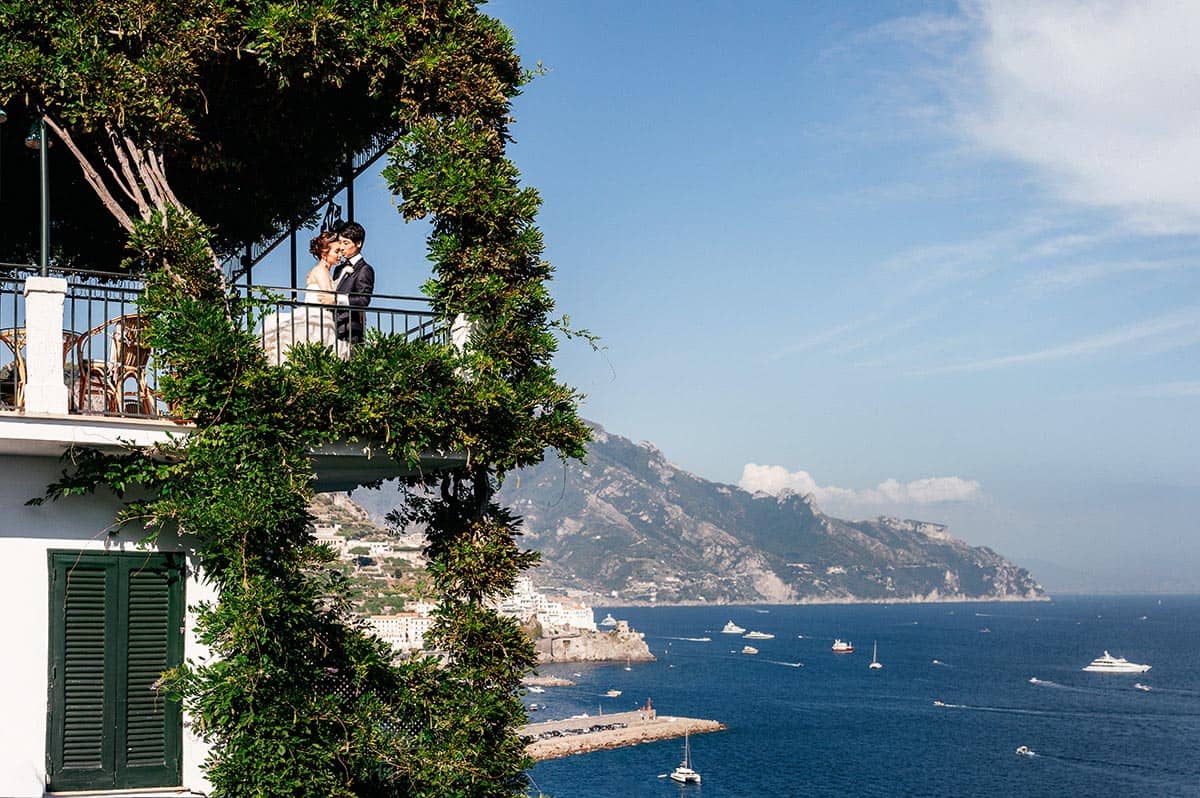
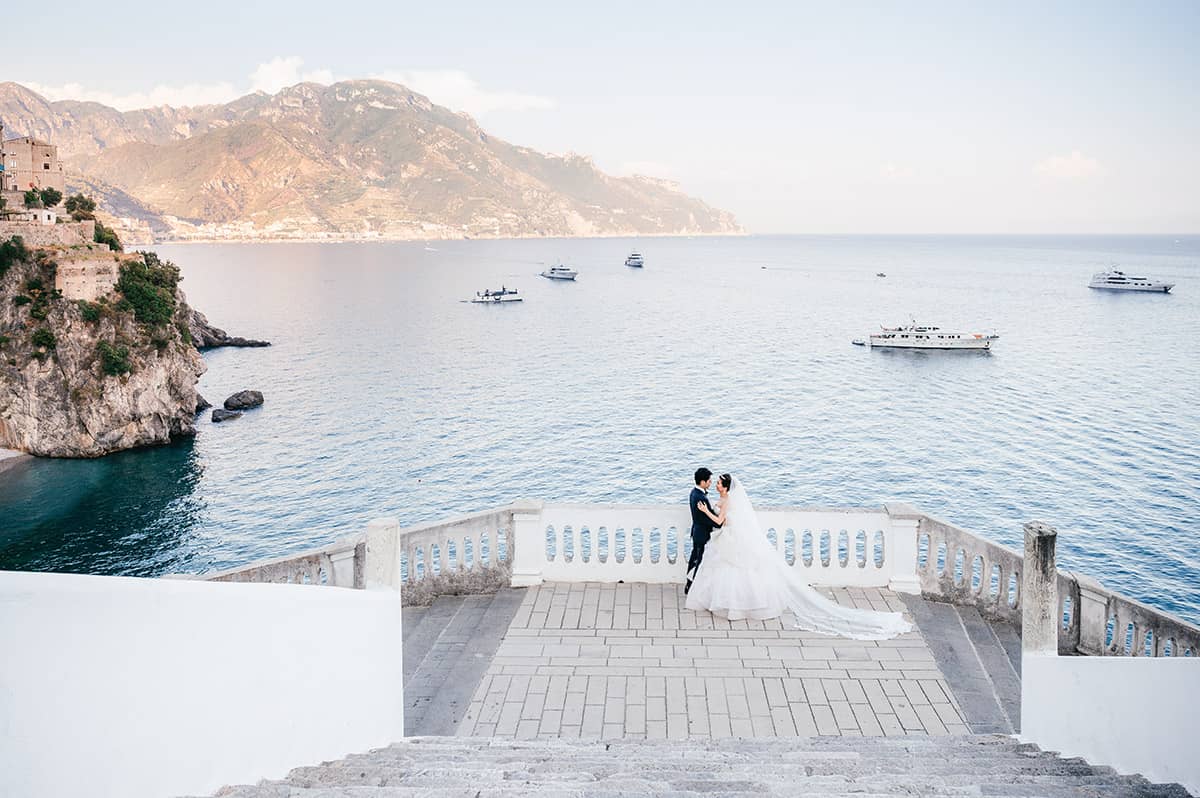
Before we left for the church I took them out onto one of the small balconies on the seaward side, the kind that has a creeper growing straight over the railing and across the underside of the floor above. From a terrace further along I could shoot back at them through the leaves, the two of them small in the corner of the frame, Amalfi stacked white against its own cliff in the distance and the sea going out flat and blue behind everything.
AN EMPTY BASILICA IN MINORI, AND DUSK BACK IN AMALFI
IF YOUR CEREMONY NEEDS NO AUDIENCE, IT STILL DESERVES A WHOLE DAY OF PHOTOGRAPHS, START TO END.

That is a frame worth planning for at this hotel. It only works from a specific spot, at a specific time, with the couple standing exactly where a couple has no natural reason to stand, and it takes about ninety seconds to make once you know where to put everybody.
The Drive to Minori and Why It Was Booked Long
Then we drove. The ceremony was not at the hotel and not in Amalfi: it was in Minori, the next town along the coast heading east, and getting there means the SS163, which is the road every photograph of this coastline is taken from and the road every timeline underestimates.
Yumi Tazekawa, their planner, had built the transfer with a buffer that looked excessive on paper and turned out to be exactly right. On a clear day out of season you make that drive in a quarter of an hour. In summer, behind a bus that has to reverse to let another bus round a bend, it can take three times that, and there is no alternative route. There is one road. If it is blocked, you sit in it wearing a ball gown.
We also had a driver, and on this coast a driver is equipment, not luxury. A local NCC driver knows which passing points a large car can actually use and, more importantly, knows where he is allowed to stop for the ninety seconds it takes a bride to get out without climbing over a guardrail.
A Church Wedding Without Guests, in a Basilica Built for Hundreds
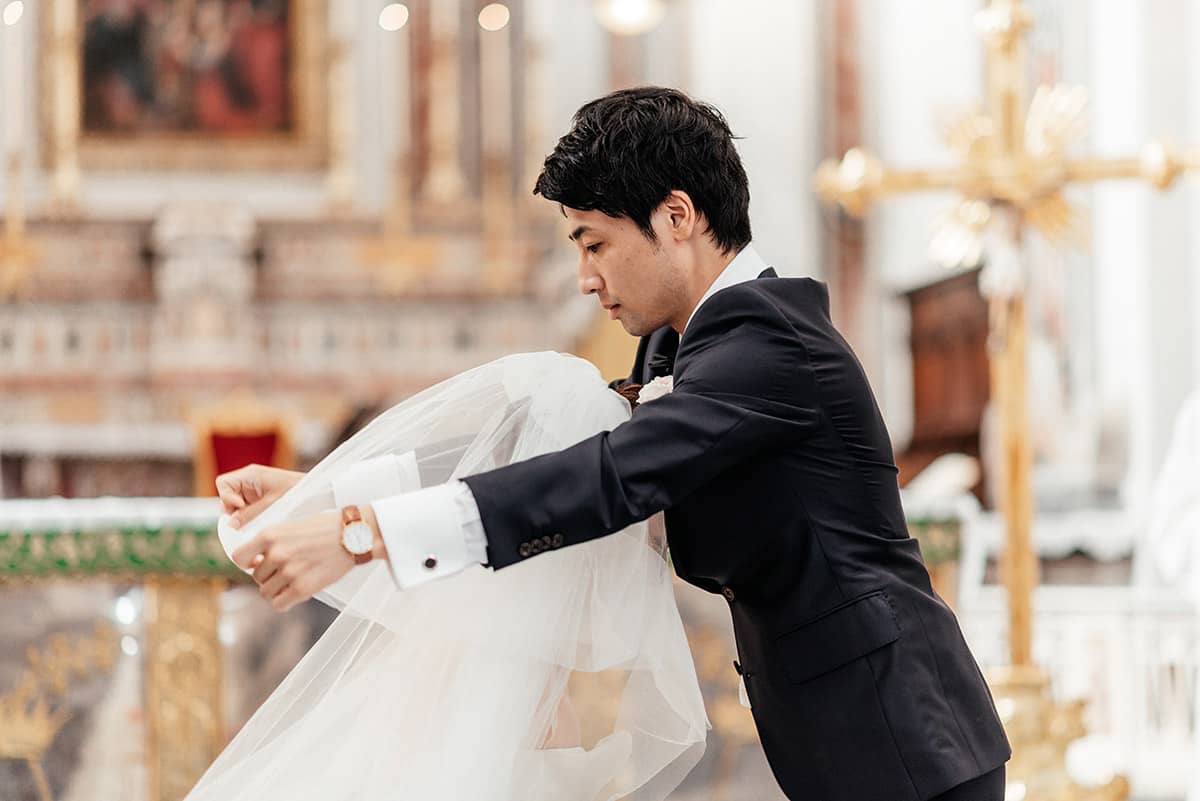
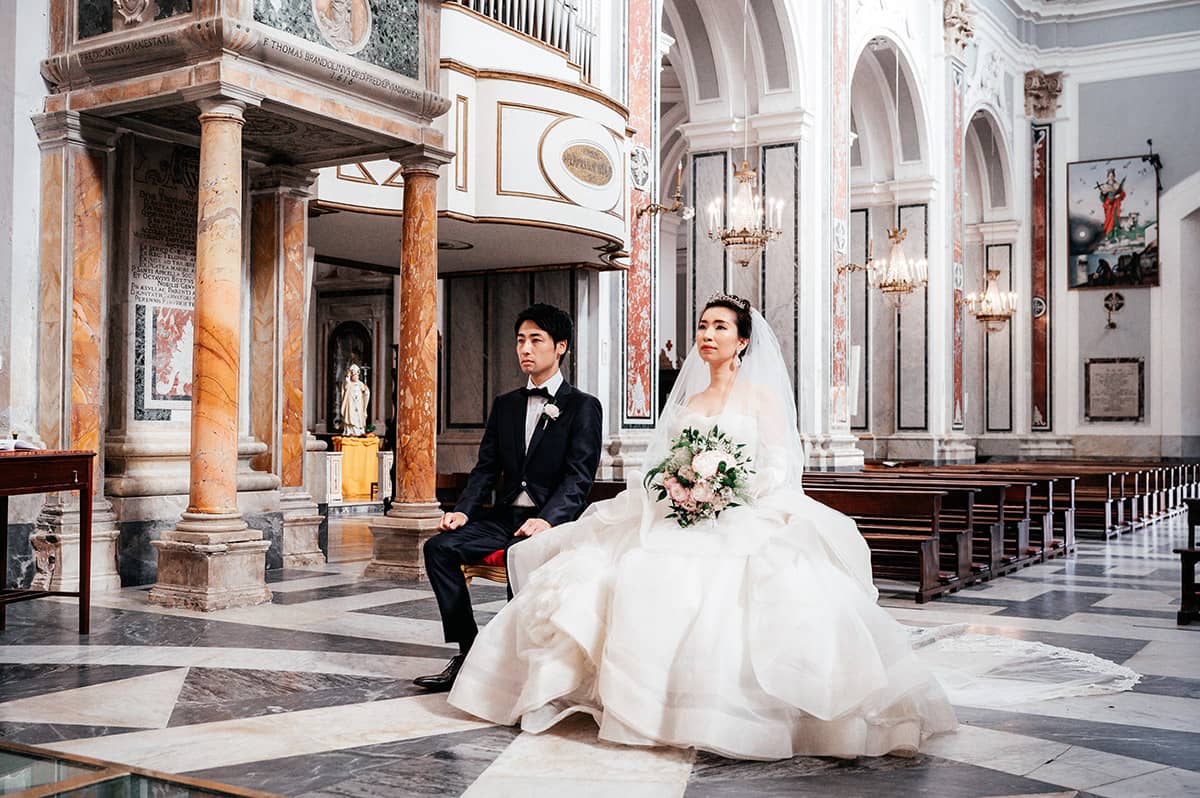
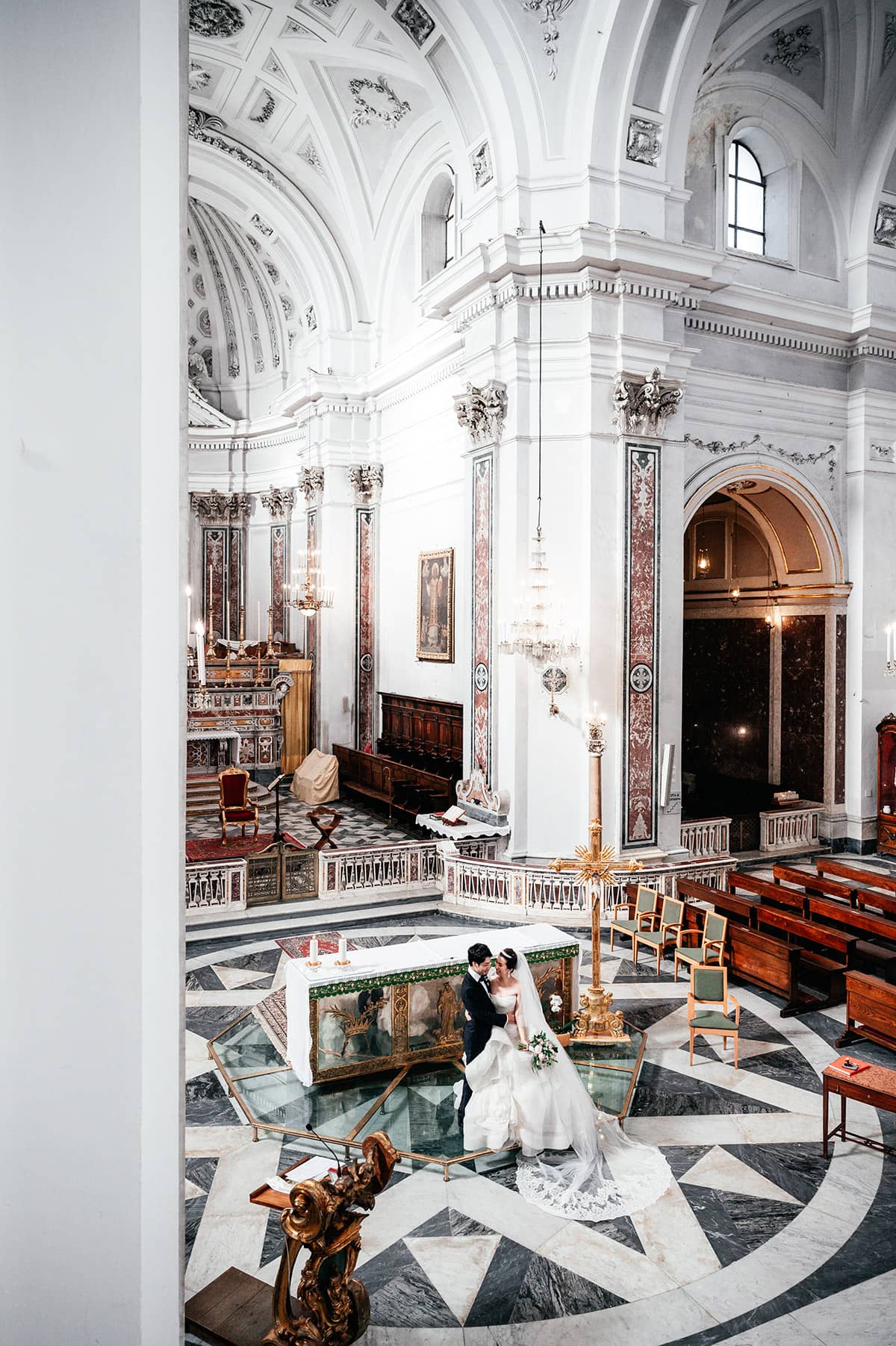
The Basilica of Santa Trofimena stands in the middle of Minori with its main facade turned toward the sea, and that is deliberate: the relics of the saint were found on the shore near here, sealed in a marble urn, somewhere in the seventh or eighth century. When Minori became a bishop’s seat around the year 1000 they were carried up into a cathedral built in the center of town, and when that building fell into disrepair in the seventeenth century the townspeople pulled it down and built the one standing today. Three naves, piers faced in colored marble, a checkerboard floor, chandeliers. Under the high altar, in the crypt, the relics still sit in an alabaster urn carved in 1722.


Into all of that walked two people from Japan, and nobody else at all.
They Walked In Together
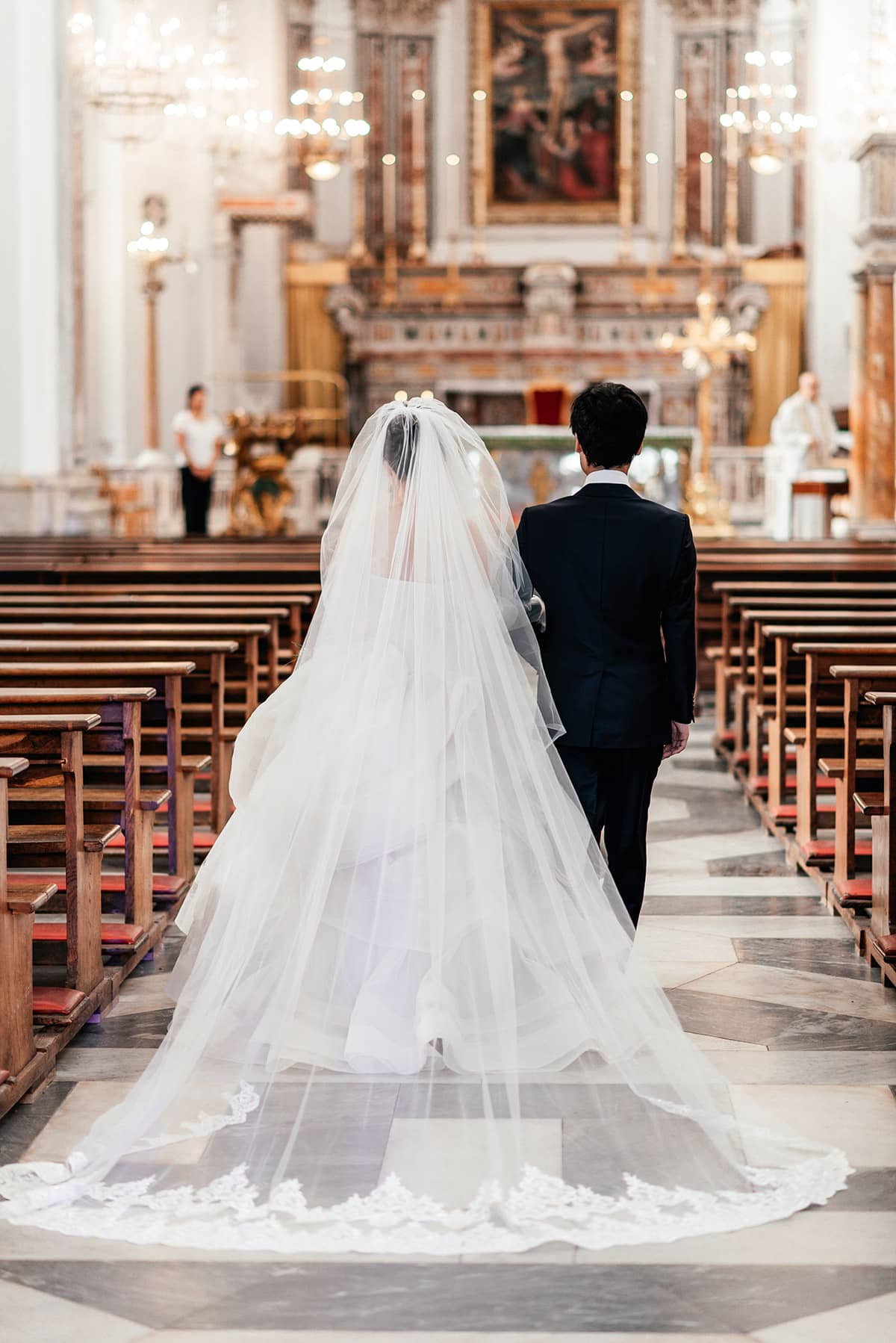
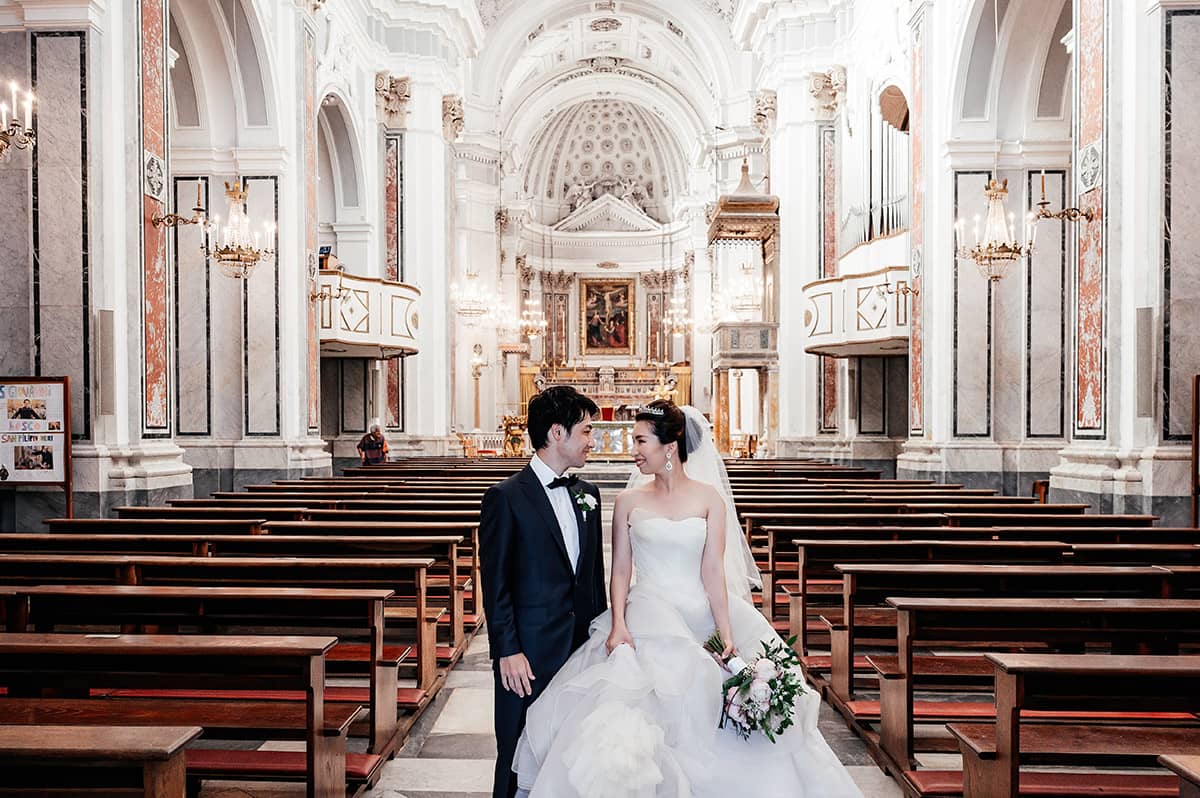
There was nobody to give anybody away, so they came up the nave side by side, her arm through his, from the open doors all the way to the altar. I shot it from directly behind: the veil trailing several meters across the marble, the tiered skirt filling the aisle, and on either side of them row after row of empty pews with red cushions on the seats.
Two other people are in that photograph, both of them at the far end. The priest in white, waiting at the altar rail. And a woman standing quietly against the left wall, watching them come. That is the entire congregation.
What Changes When the Pews Are Empty
A wedding photographer spends most of a church ceremony solving problems created by other people. Where to stand so the groom’s uncle is not in the frame. How to get down the side aisle without crossing a videographer. When to move, because moving during a silence in a packed church is a small violent act and everybody turns around.
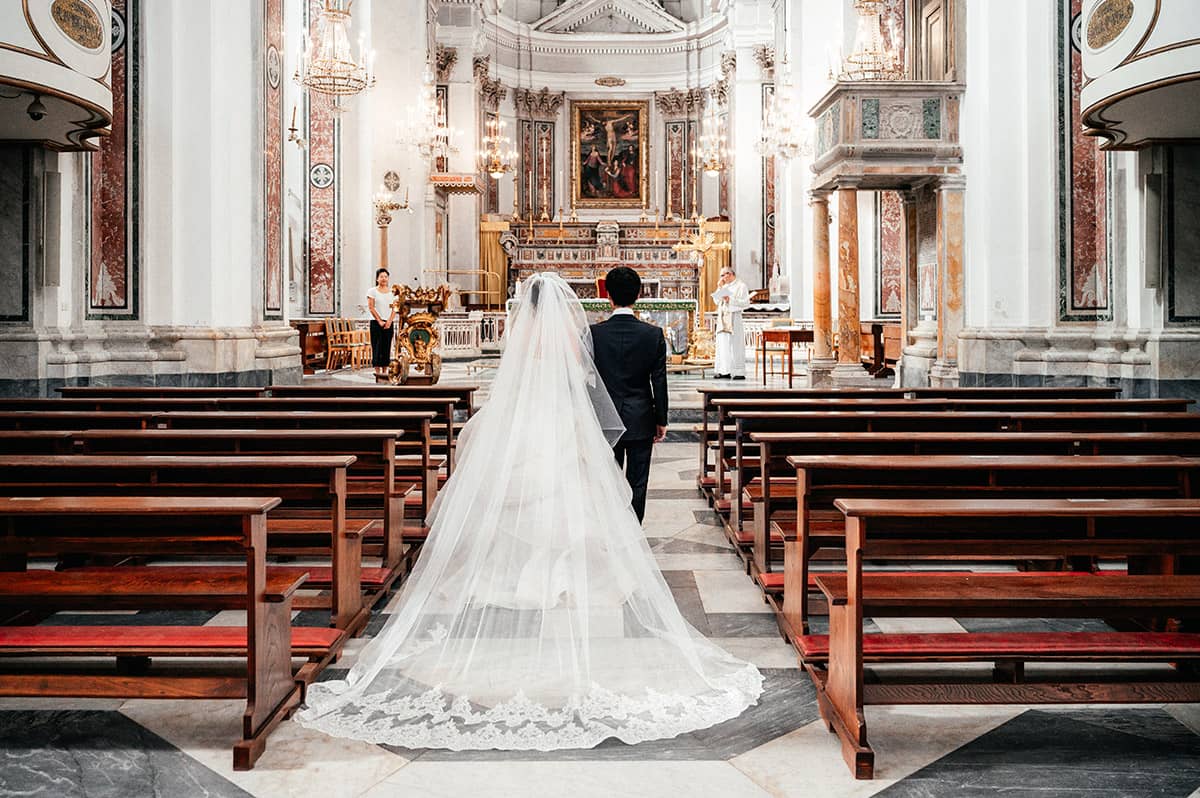
None of that existed here. I could stand in the center of the aisle. I could walk the full length of the nave during the rite and the only sound was my own footsteps on marble. And the empty pews, which I expected to be a problem to hide, turned out to be the strongest element in the frame: two people at the center of a very large room built for hundreds, with row after row of empty wood receding behind them toward an open door and the white daylight of the piazza outside.
Shooting Wide When Instinct Says Go Close
My instinct in a church is to work long and stay back. Here I did the opposite for about a third of the ceremony, because going tight on their faces threw away the entire point of the pictures. If you crop to two people and a priest, this looks like any small ceremony anywhere. Pull back until the marble piers and the empty rows are in the frame, and the photograph starts telling you something true about how they chose to do this.
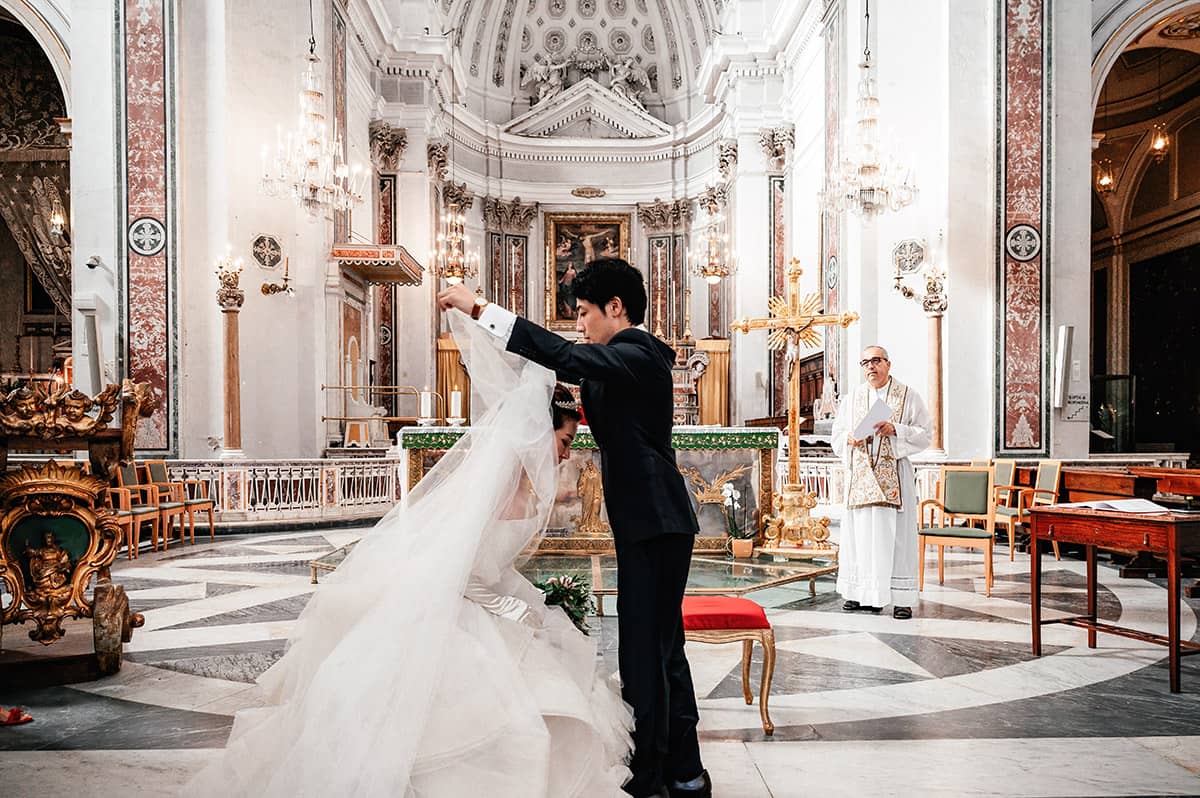
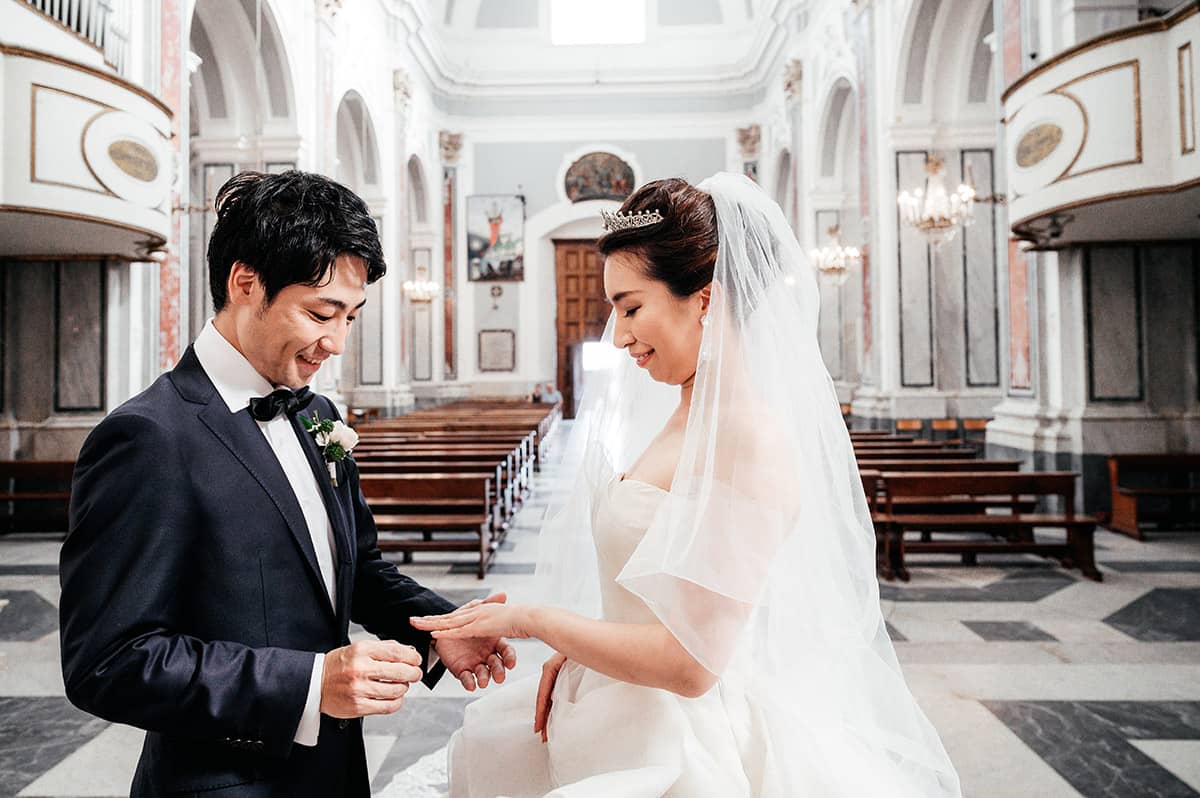
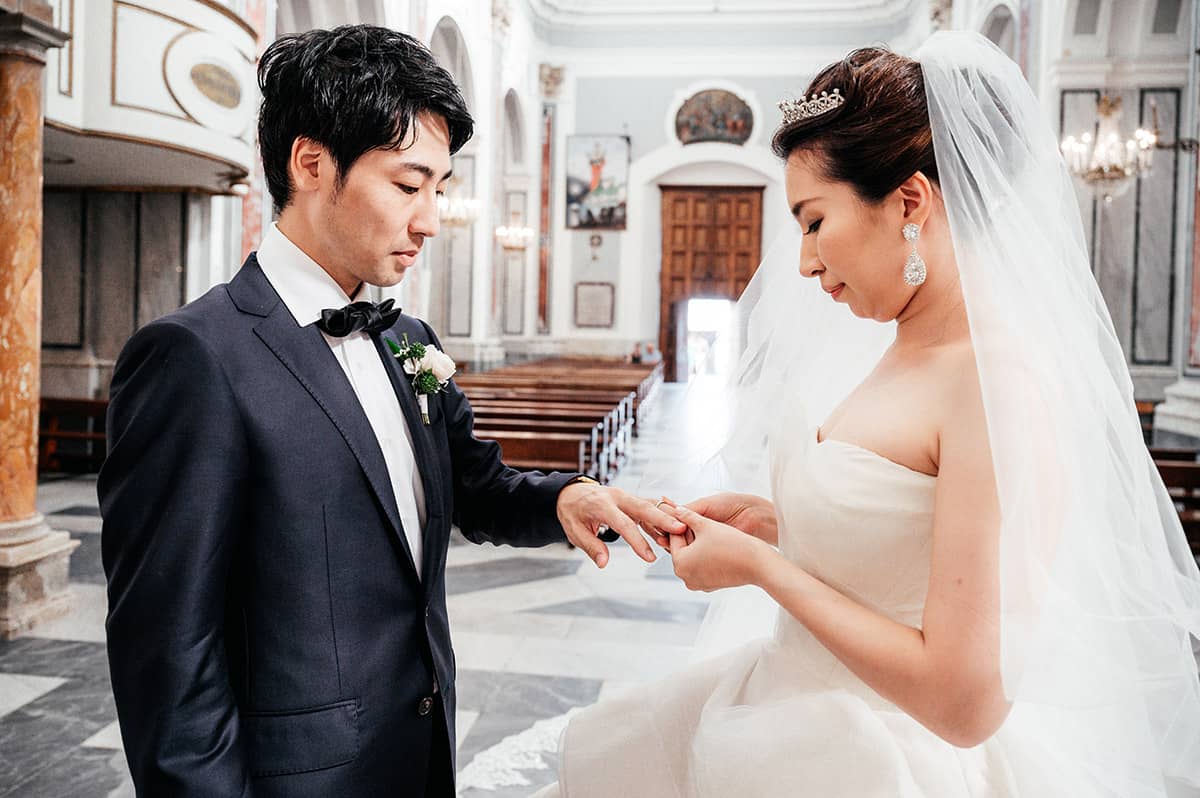
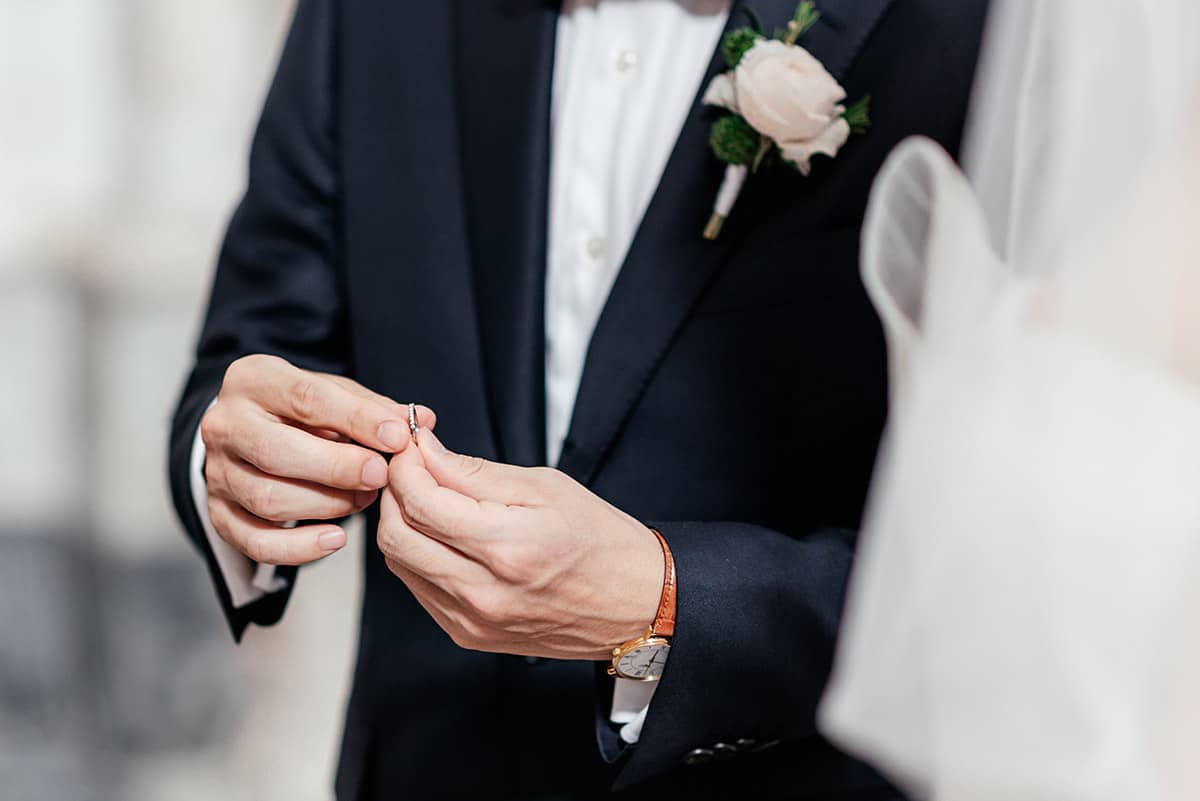
The exchange of rings I did shoot close, standing, in the middle of the aisle, Aiko’s veil falling forward over her shoulder and the open door of the basilica burning white behind them both. That frame and the wide one from the back of the nave are, to me, the two halves of the same wedding.
Why Minori Instead of the Duomo in Amalfi
Almost every couple who tells me they want a church on this coast is picturing the same one: the Duomo di Amalfi, at the top of that enormous flight of steps, with the striped facade and the bronze doors from Constantinople. It is the most photographed church between Sorrento and Salerno and there is a good reason for that.




There are also reasons to look one town further along, and Hiroshi and Aiko’s day is a decent argument for all of them.
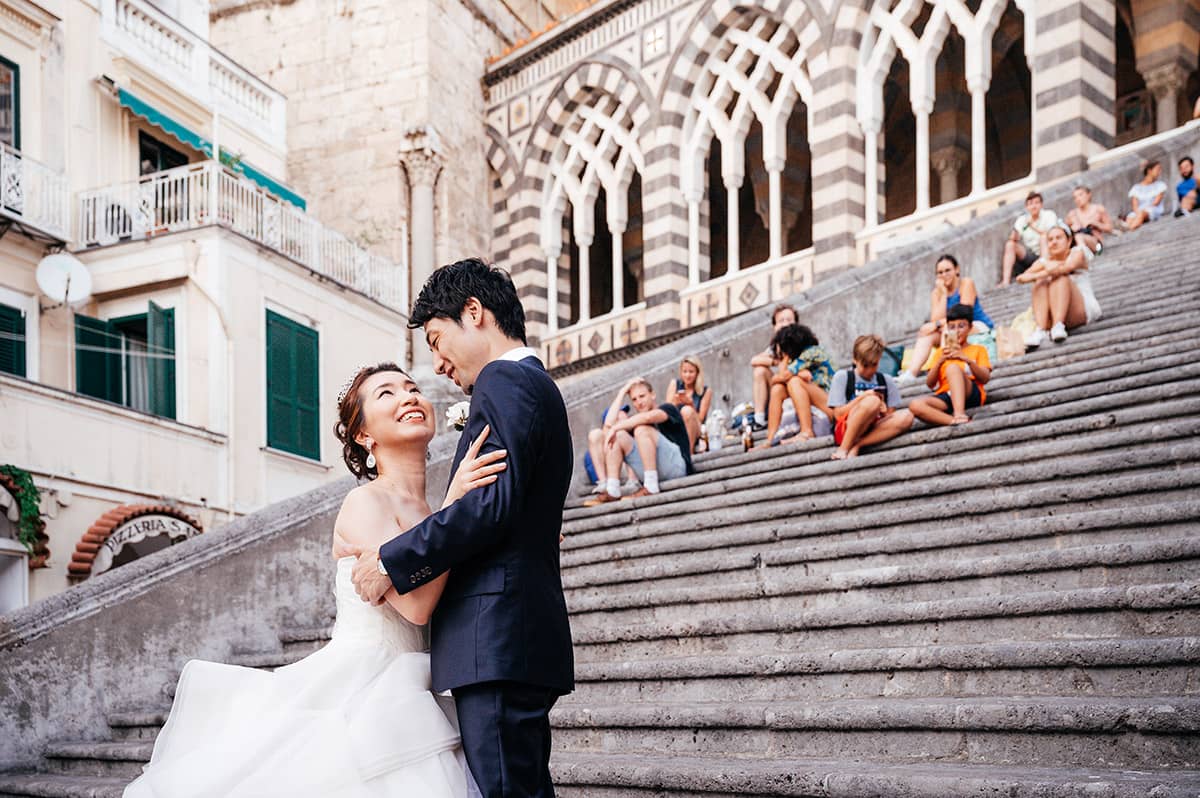
The steps in Amalfi are the first problem. Sixty-two of them, in full sun, and they are the only way in. A bride in a structured gown climbs them slowly and in public, with the piazza below full of people eating gelato and filming her on their phones. Some couples enjoy that. A couple who has flown from Japan specifically to be alone does not.
The second is scheduling. The Duomo is a working cathedral in a town that receives cruise passengers by the thousand, and it is also a paid museum route for part of the day. Minori gets a fraction of that traffic. Holding a mid-week hour there is a conversation, not a negotiation.
The third is the one nobody thinks about until they see the pictures. The Duomo’s interior is dark, ornate and gold-heavy, which is beautiful and demands a lot of a photographer. Santa Trofimena is the opposite: pale marble, a checkerboard floor, tall clear windows and white walls that bounce daylight back onto faces. On a bright afternoon it lights people almost by itself. I used no flash inside that basilica at any point, and after years working as a photographer on the Amalfi Coast I can count on one hand the churches here where that is true.
RED LACQUER, BROKEN VIETRI TILE AND A BRONZE CHURCH DOOR
WRITE TO ME IF YOU ARE FLYING IN FROM FAR AWAY FOR A DAY WITH ROOM FOR NOTHING BUT THE TWO OF YOU.

Minori is the quieter choice rather than the better one, and for a ceremony with no guests to impress it was the correct room. For anyone weighing up churches while planning a wedding on the Amalfi Coast, that is the trade worth understanding early: fame and steps on one side, light and privacy on the other.
The Bronze Doors and the Palm of the Martyr
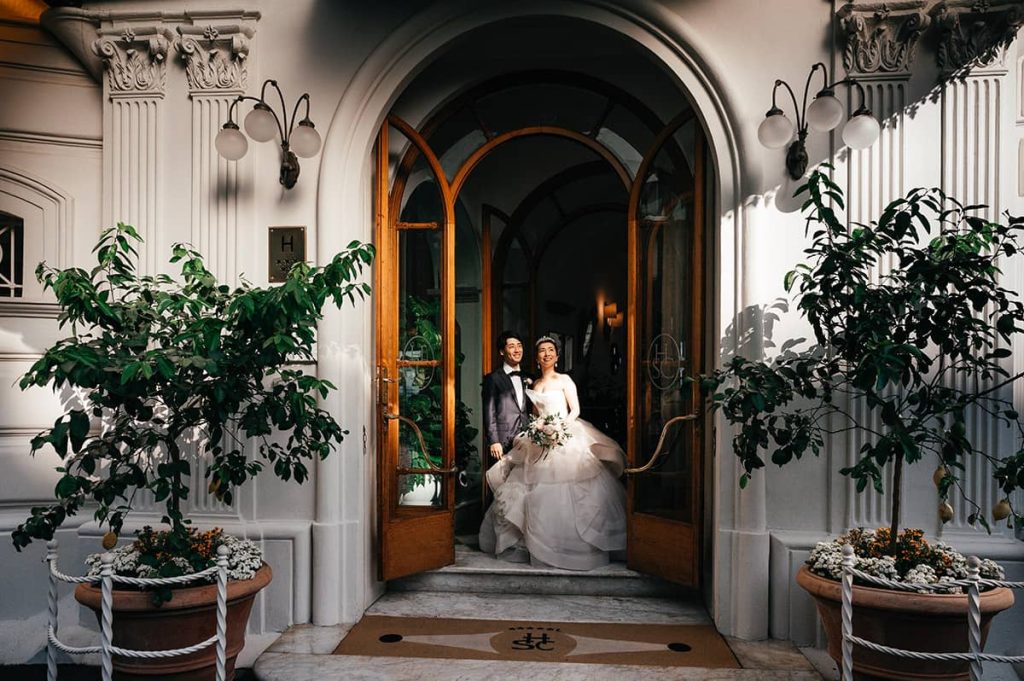
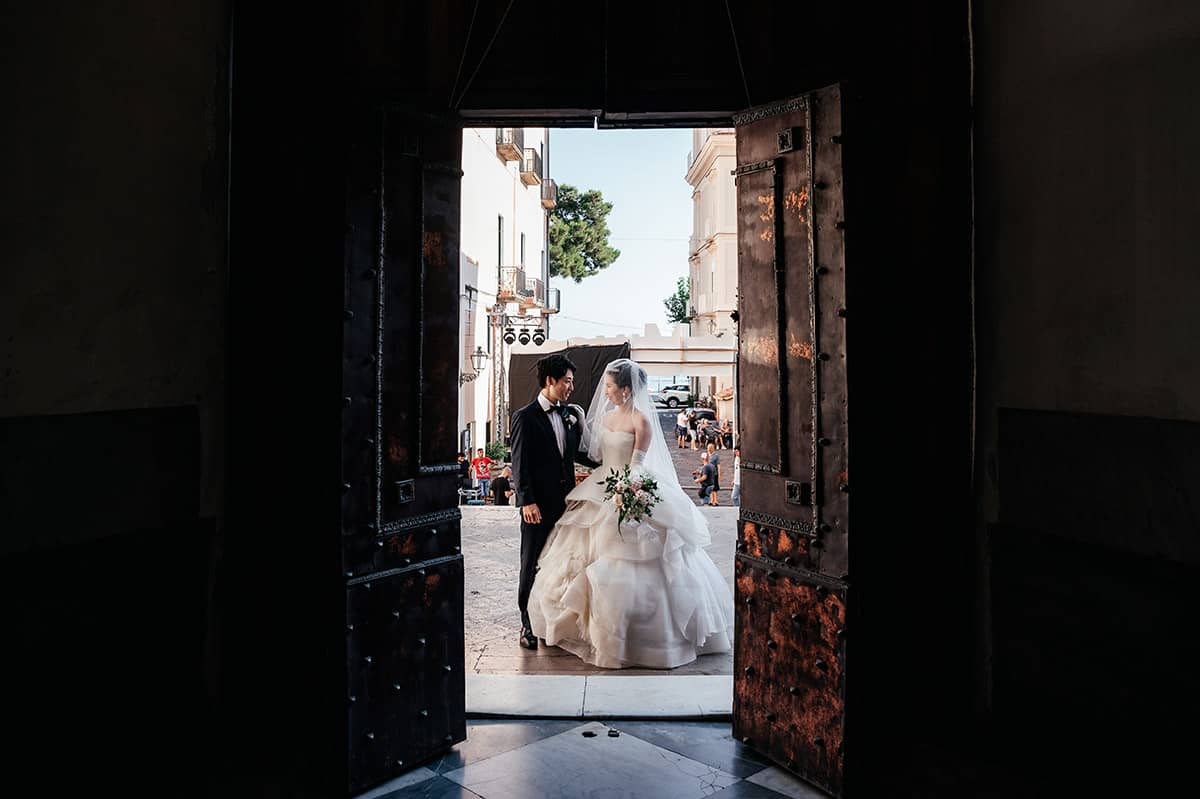
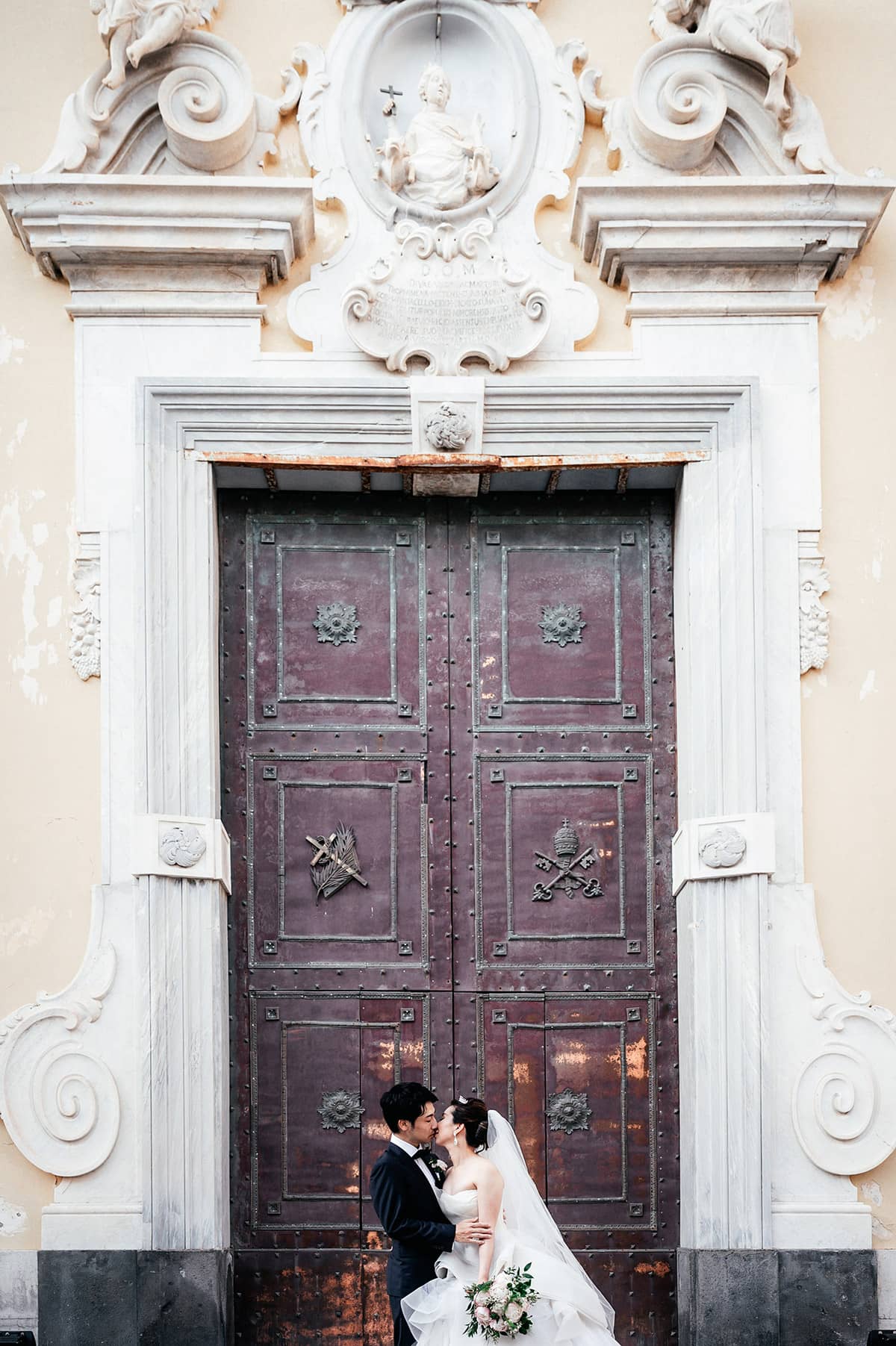
Coming out is where this church gives you its best single background, and it is worth waiting for. The main doors are enormous, dark bronze gone purple with age, set into a white baroque frame with a carved oval above the lintel and a Latin inscription under it. On the panels there are papal keys crossed under a tiara, and a palm branch beside a cross.
That palm marks Trofimena as a martyr, and in the older images inside the basilica she is shown holding a palm branch and a small model of Minori itself. I did not know that when I made the photograph. I found it afterward, checking what I had actually pointed a camera at, which happens more often than photographers admit.
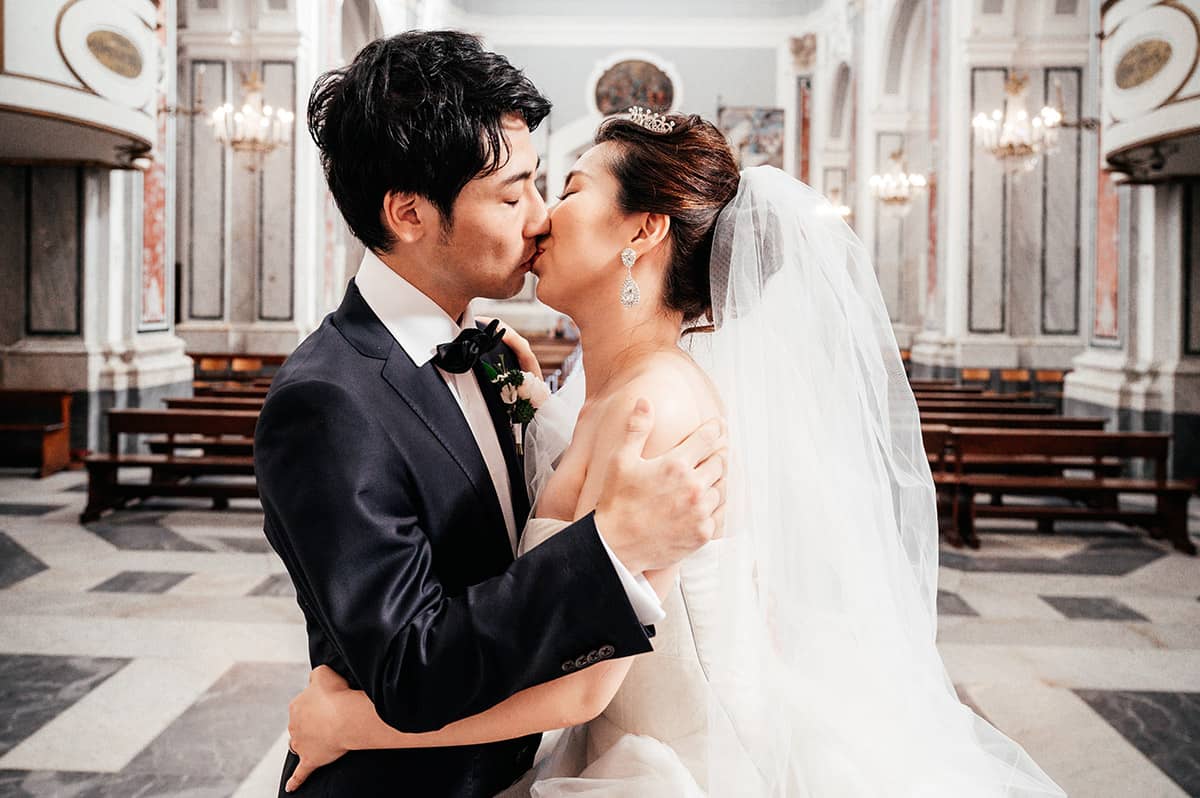
I put them small in the bottom of the frame, kissing, with the entire doorway rising above them. Two people the height of a doorknob, under three centuries of stonework, on a day when the building belonged to nobody but them.
Two Walls and a Tiled Dome
Between the church and the drive back we spent maybe half an hour in the streets, and it produced the two most stripped down photographs of the day.
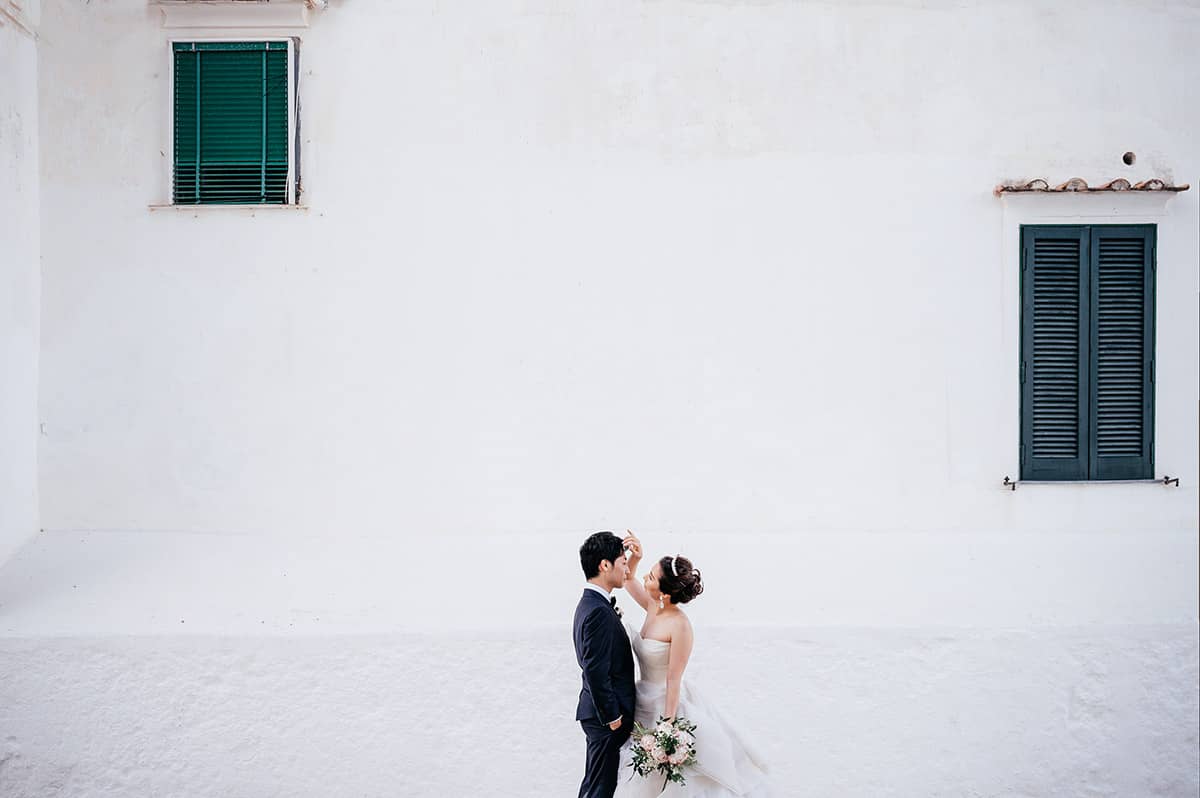
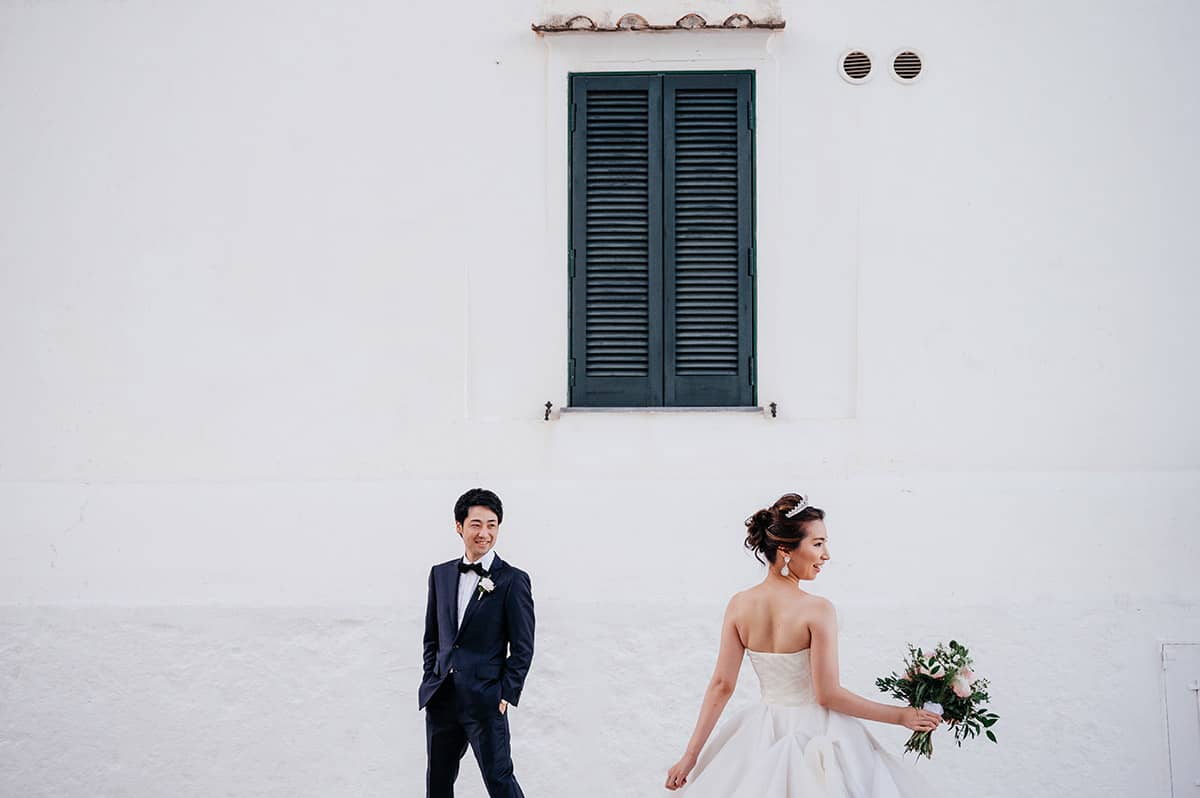
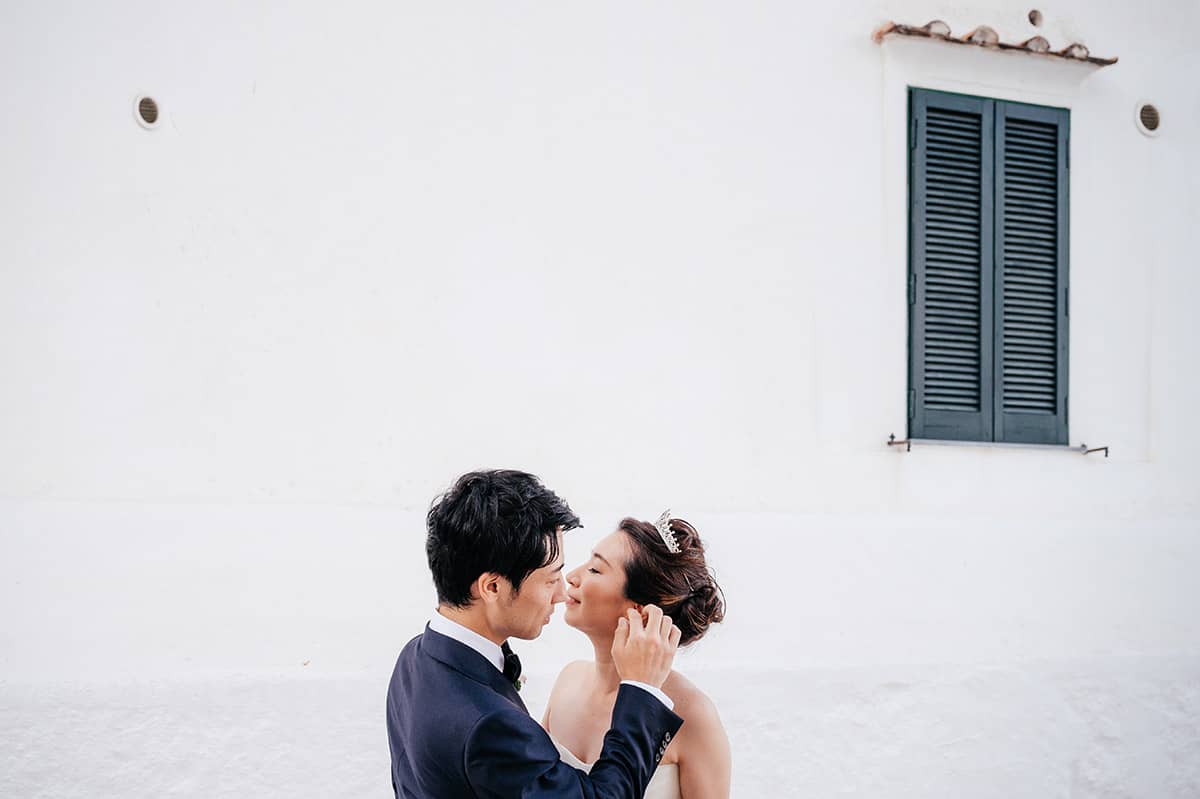
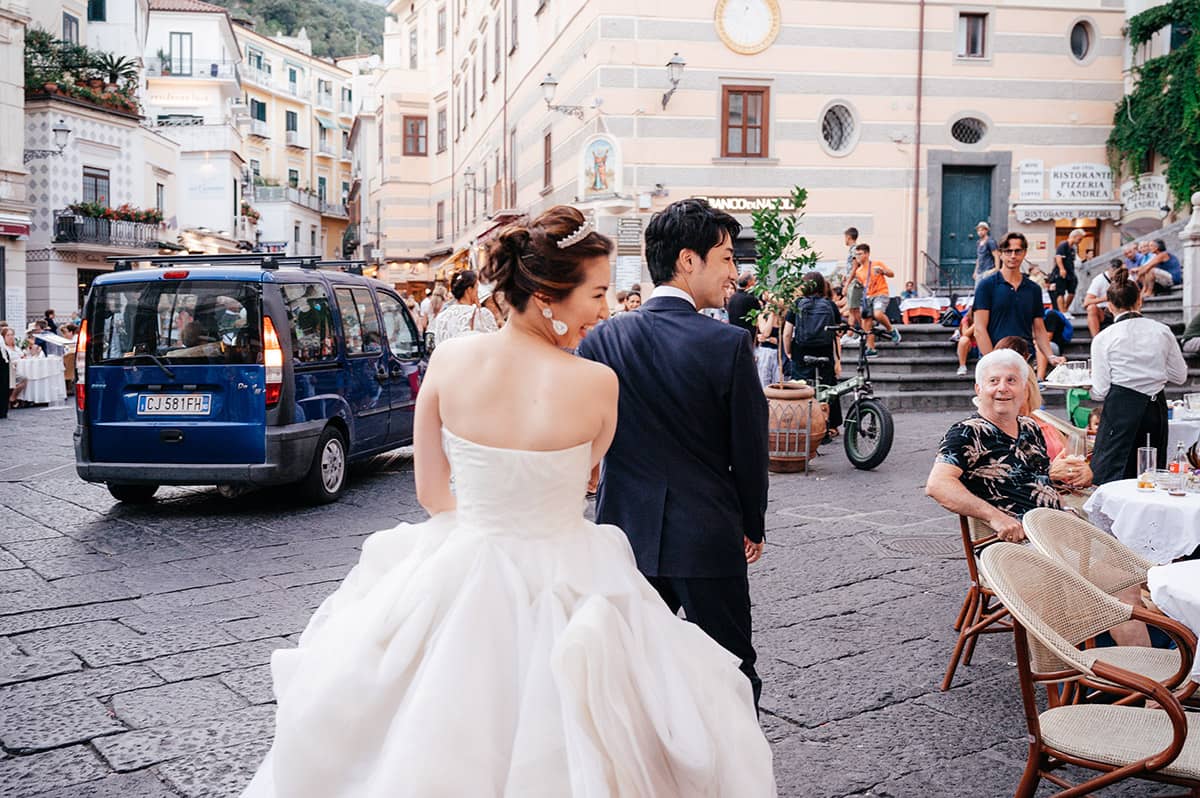
The first is a wall. Just that: a tall lime washed wall, blinding white in afternoon sun, with two shuttered windows in dark green and a line of old roof tiles over one of them. I put them small in the bottom third of the frame, facing each other, his hand up at her hair, and left the rest of the picture empty. Four fifths of that photograph is a white wall. It is the frame from this wedding I would enlarge and hang.
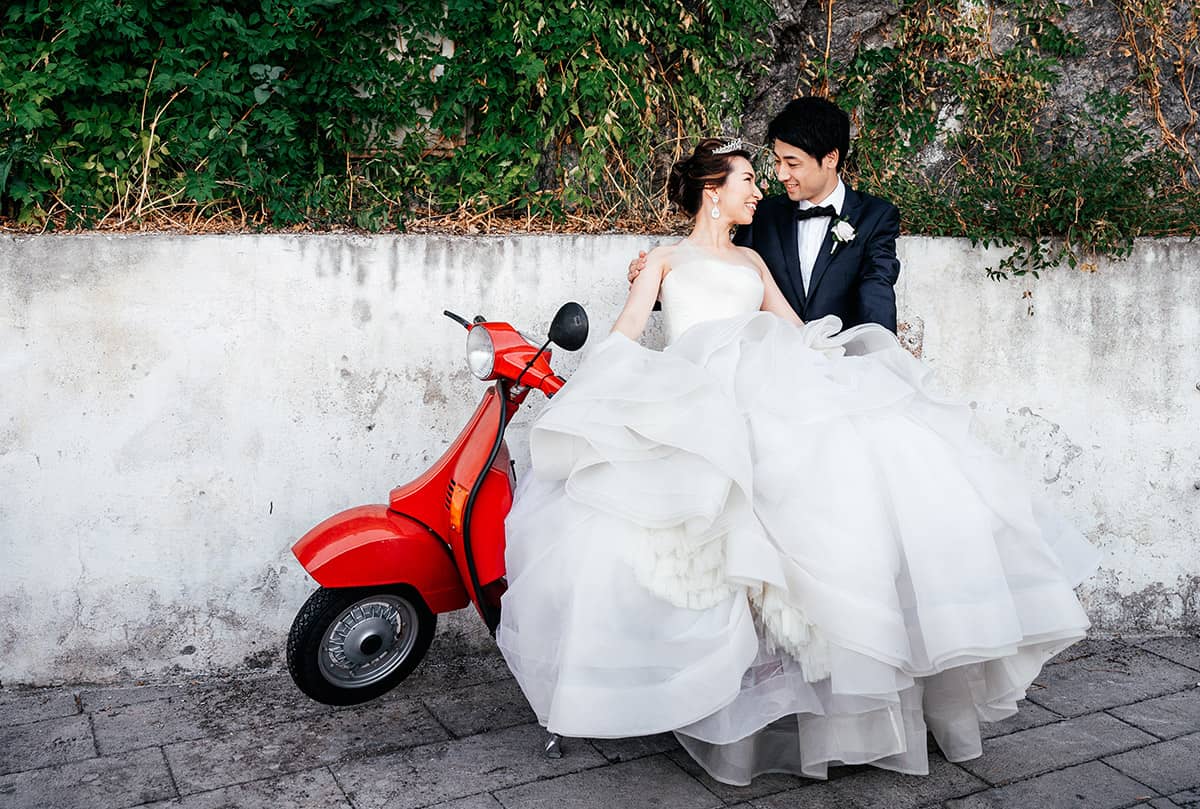

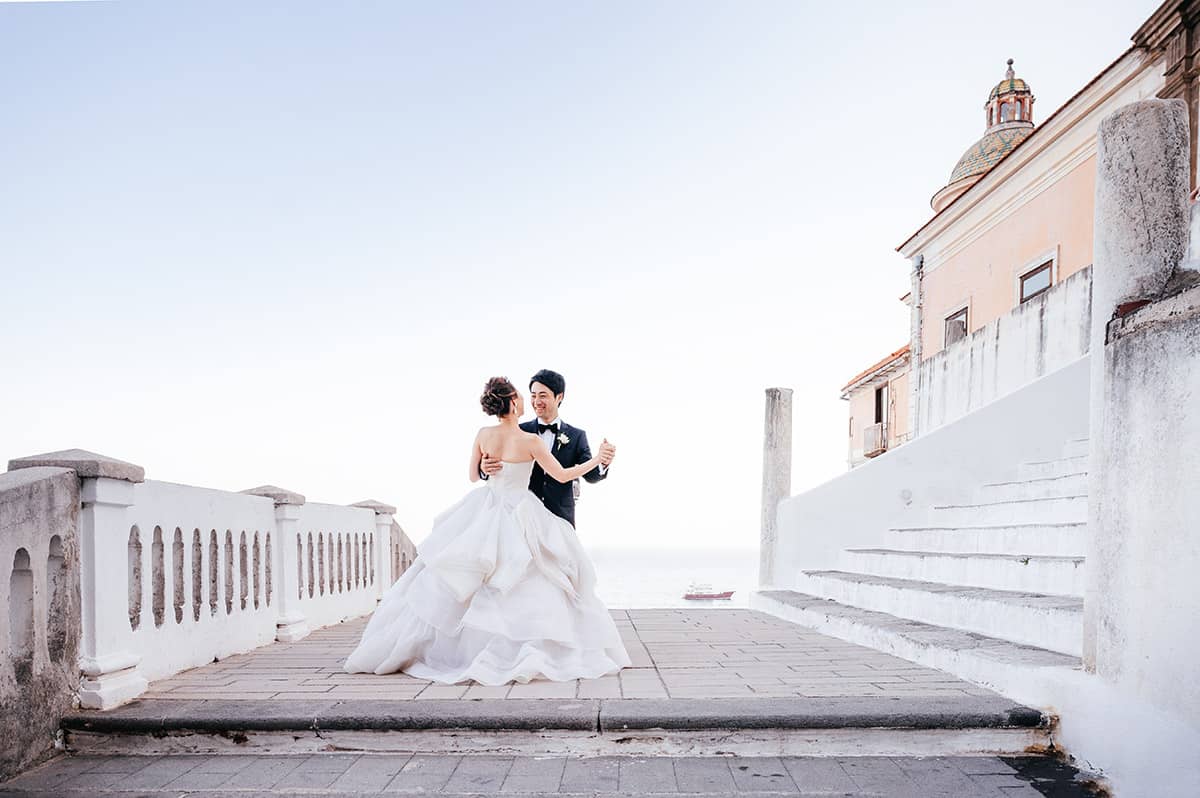
The second is a small terrace above the water, reached up a flight of whitewashed steps, with a stone balustrade along one side and a squat dome of glazed tiles rising behind a pale pink building. They danced on the paving, badly and without music, while I stood back where the pavement met the road. It took four minutes and needed nothing but a corner and some light.
A Tiara, a Ball Gown, and No Audience
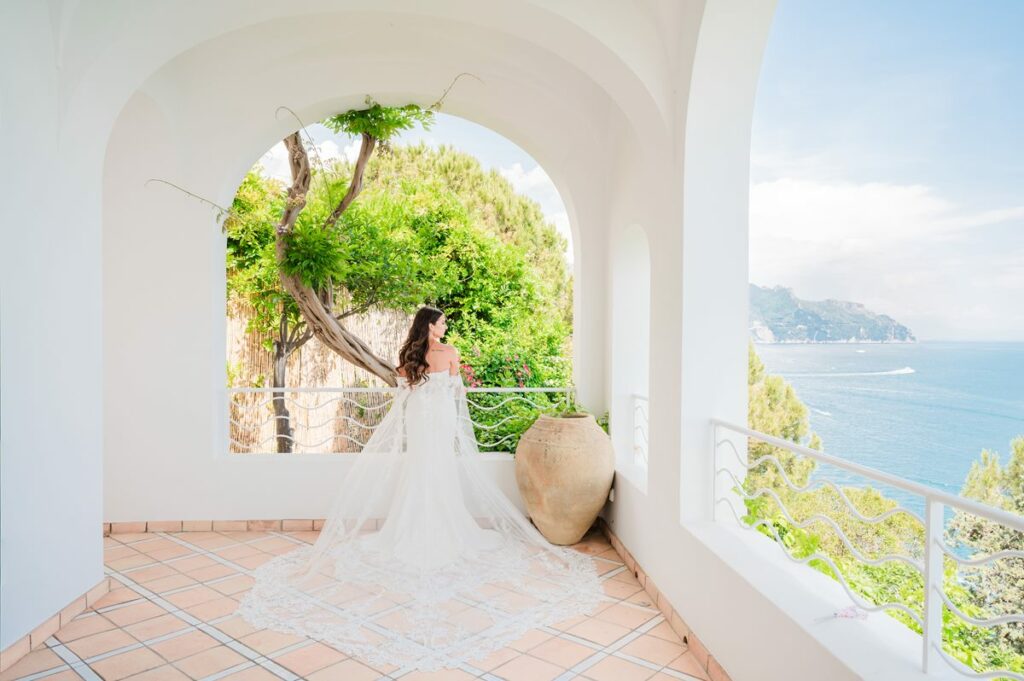
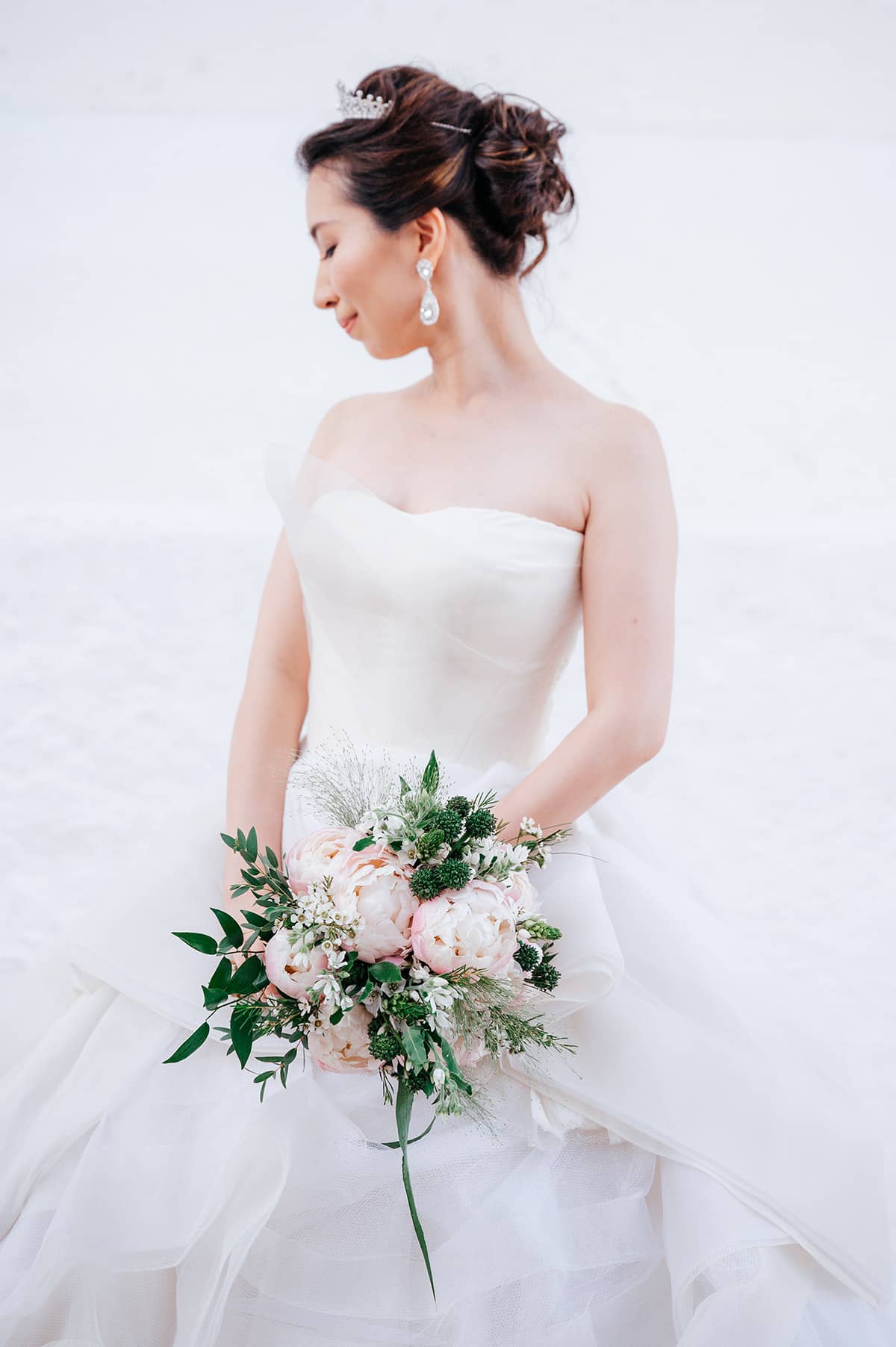
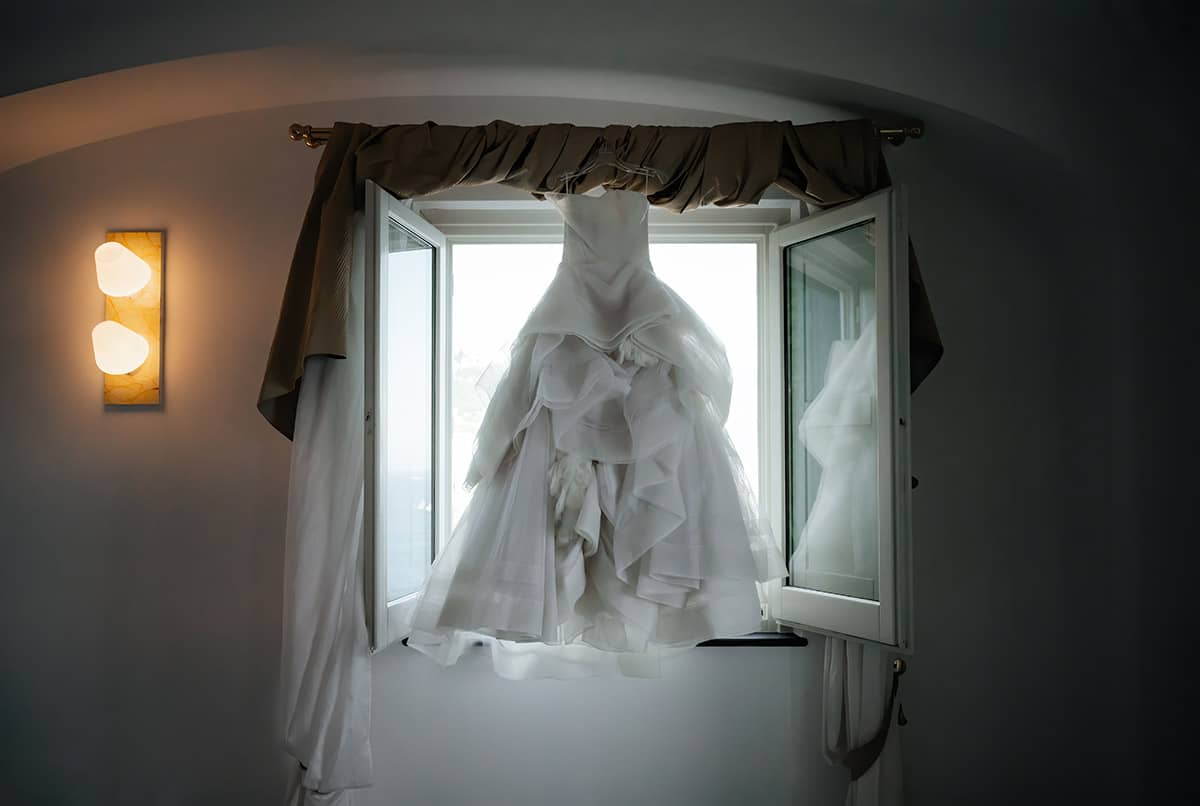
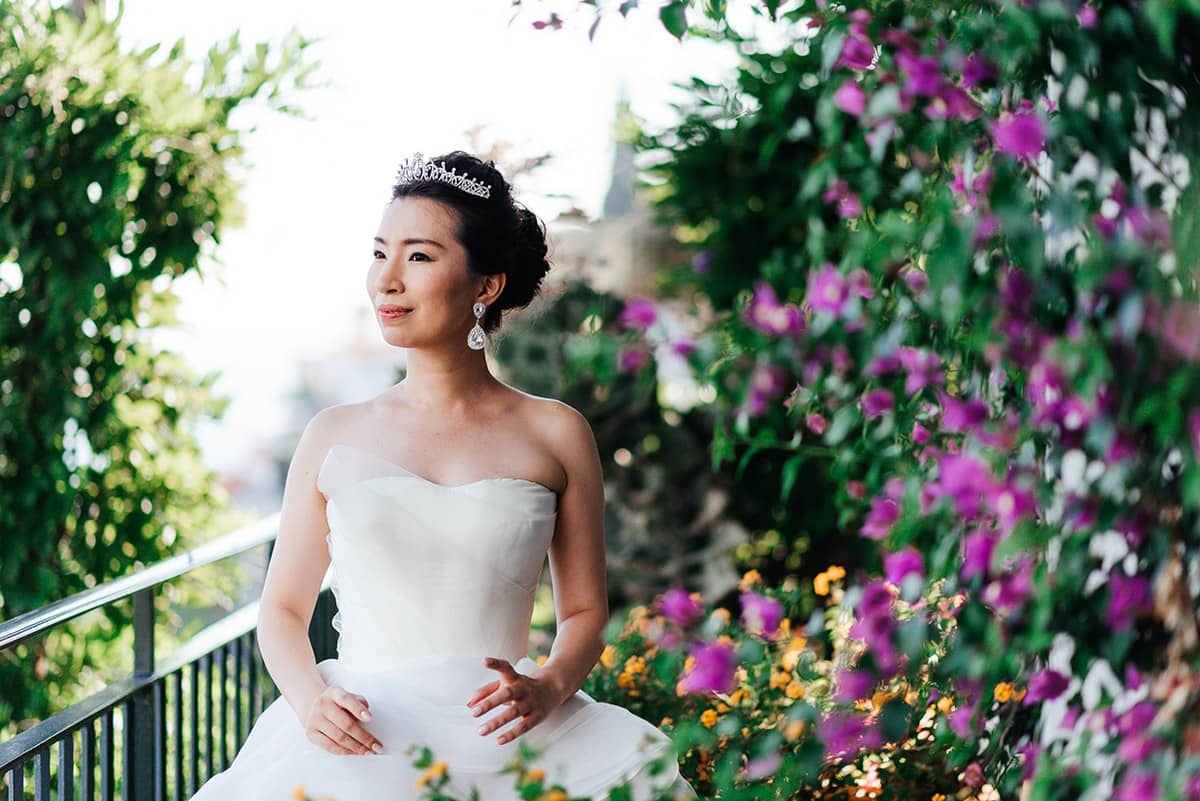
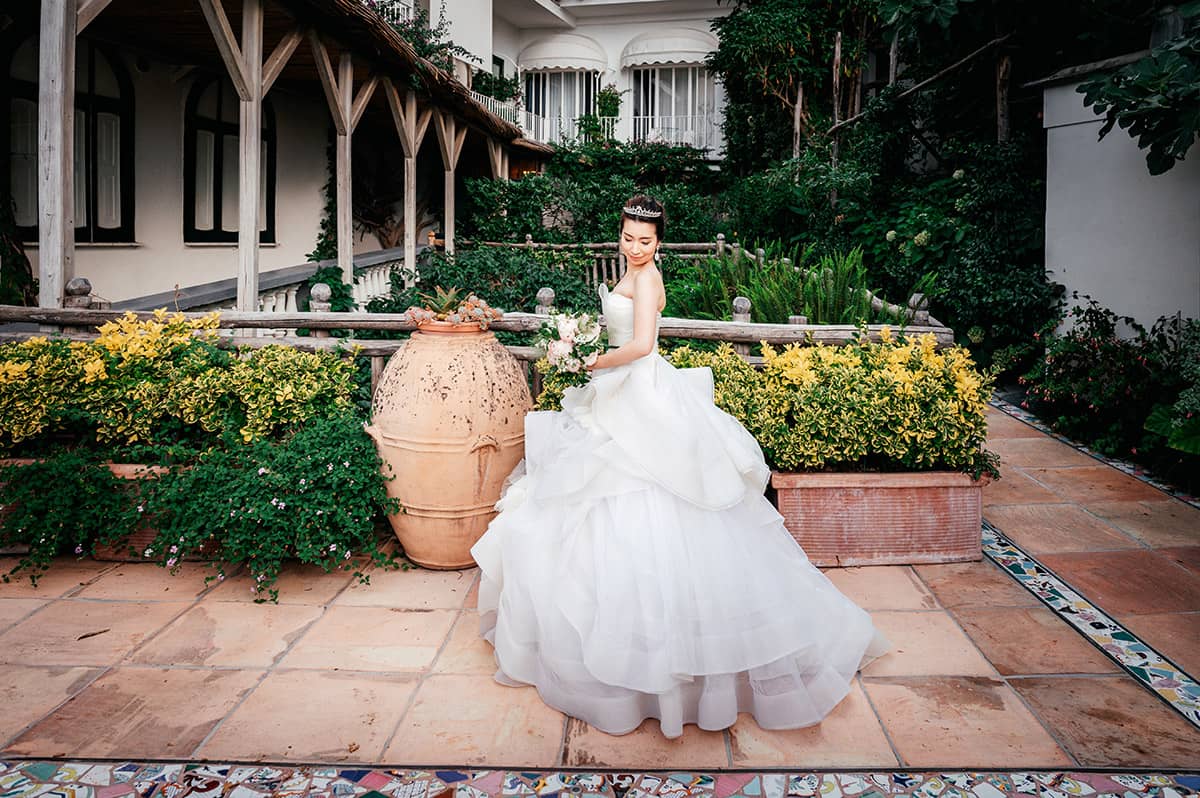
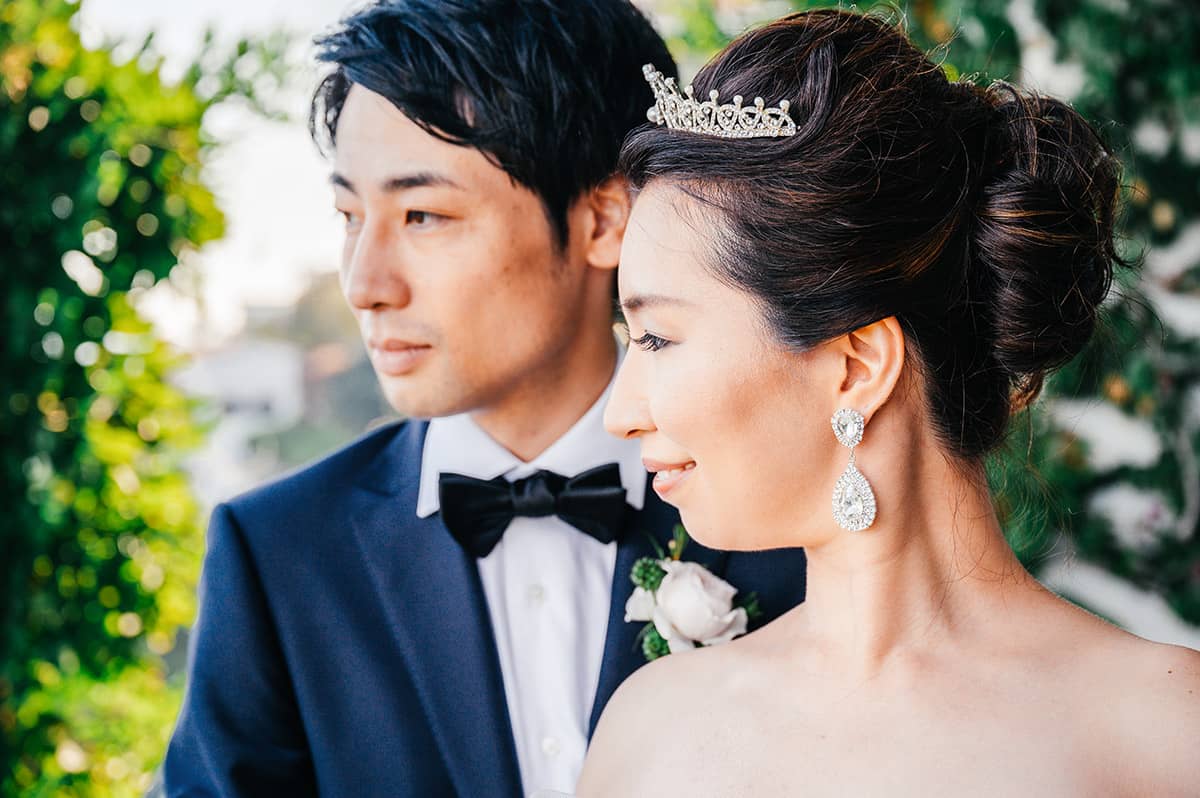
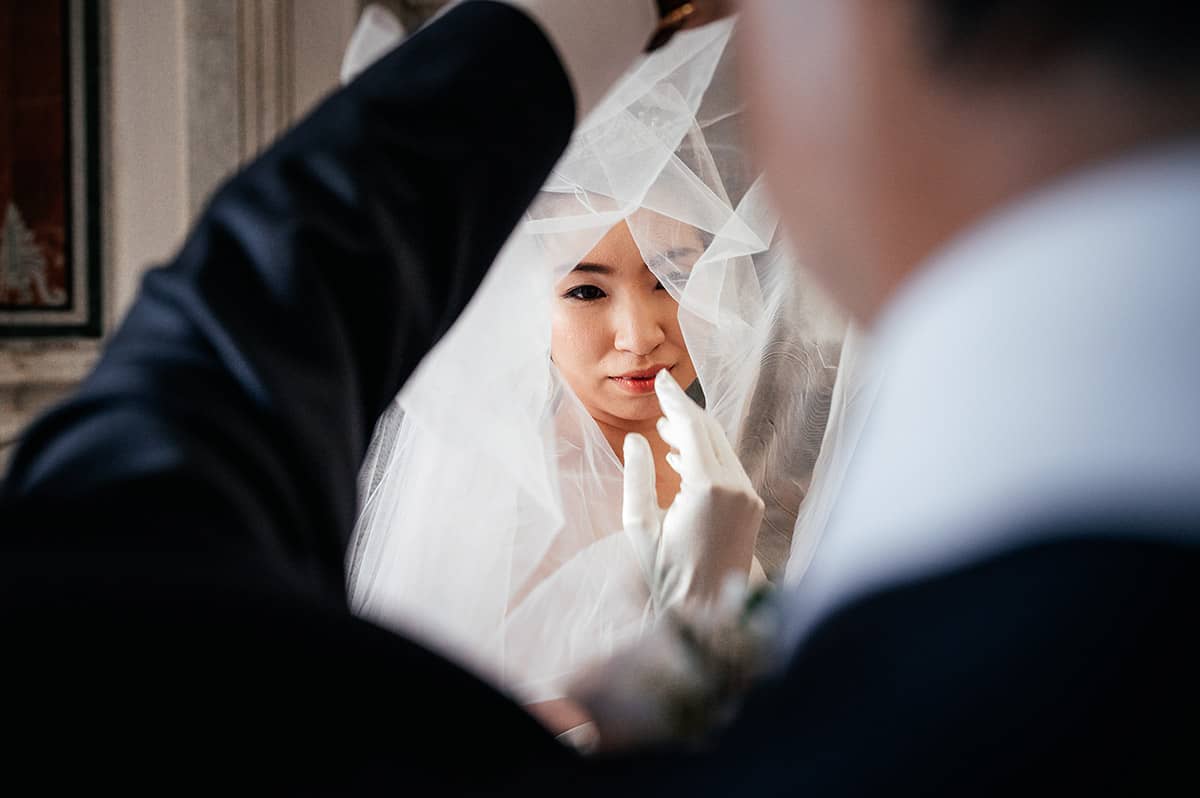
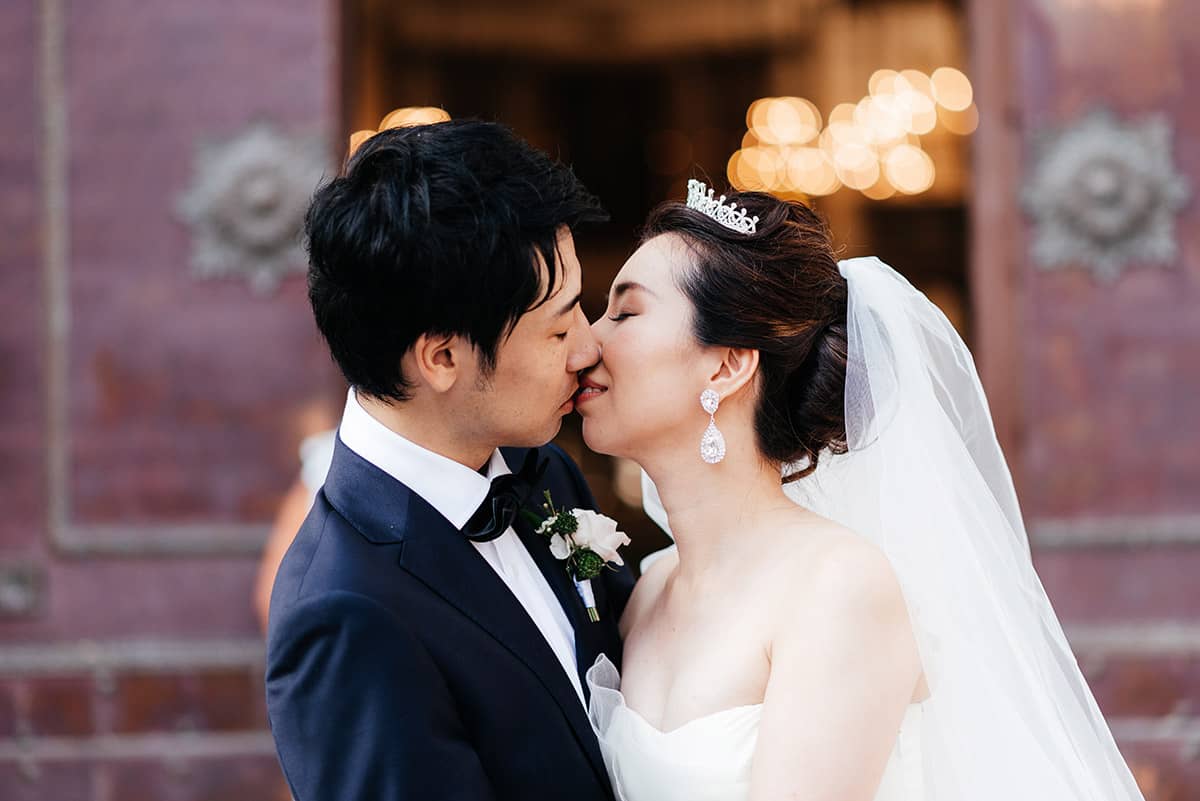
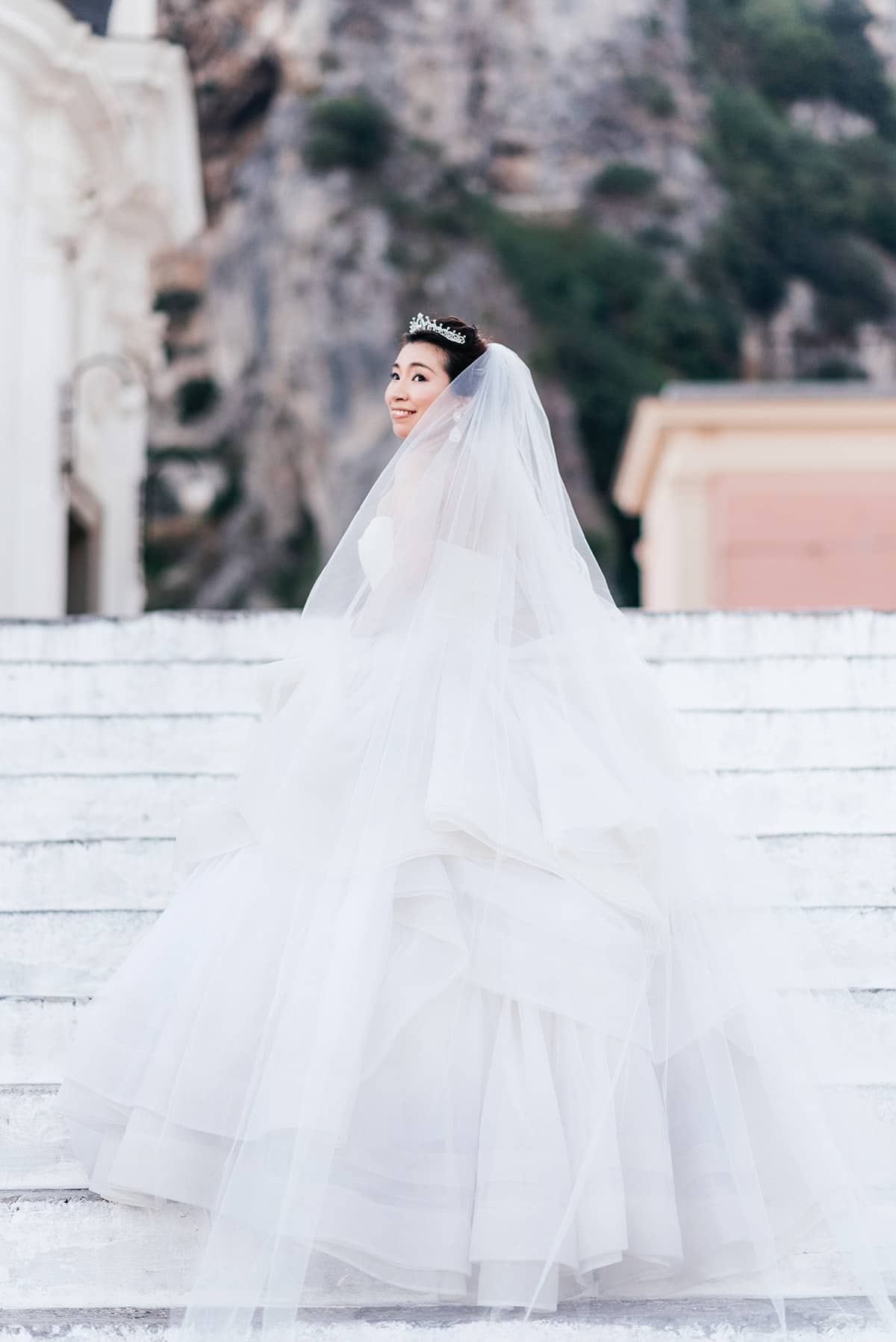
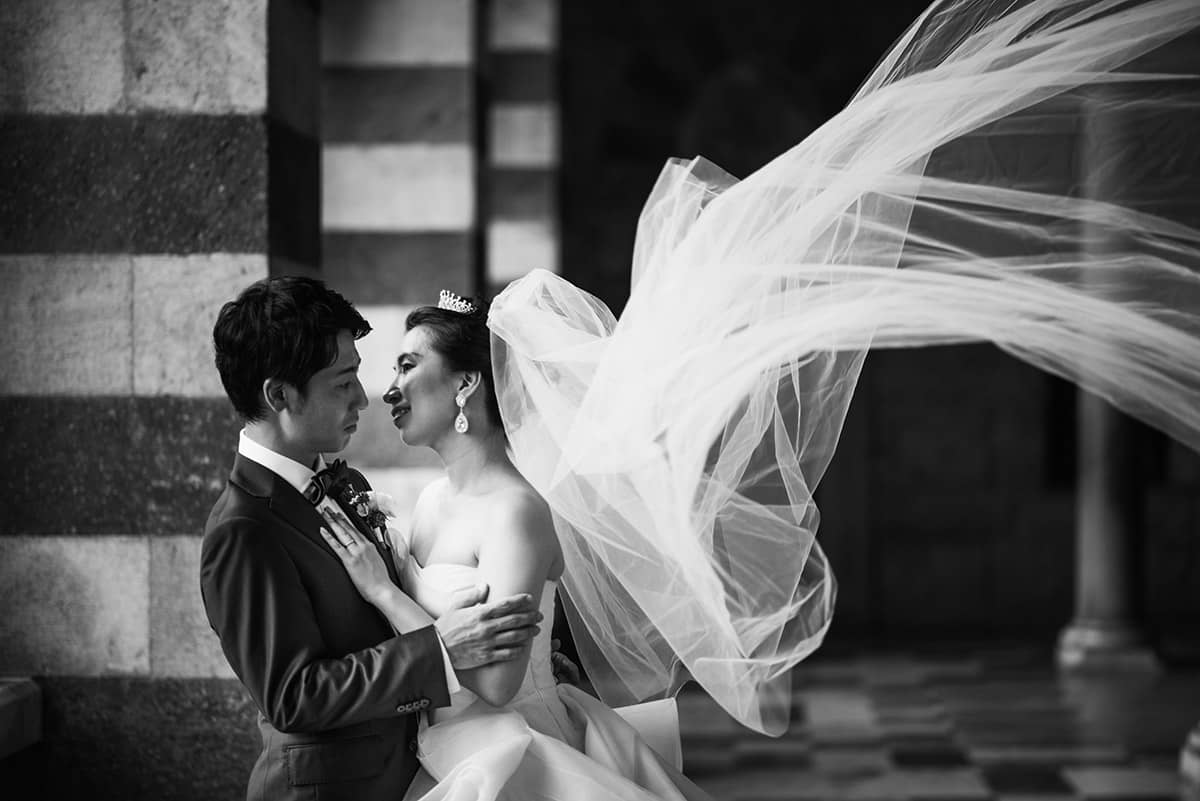
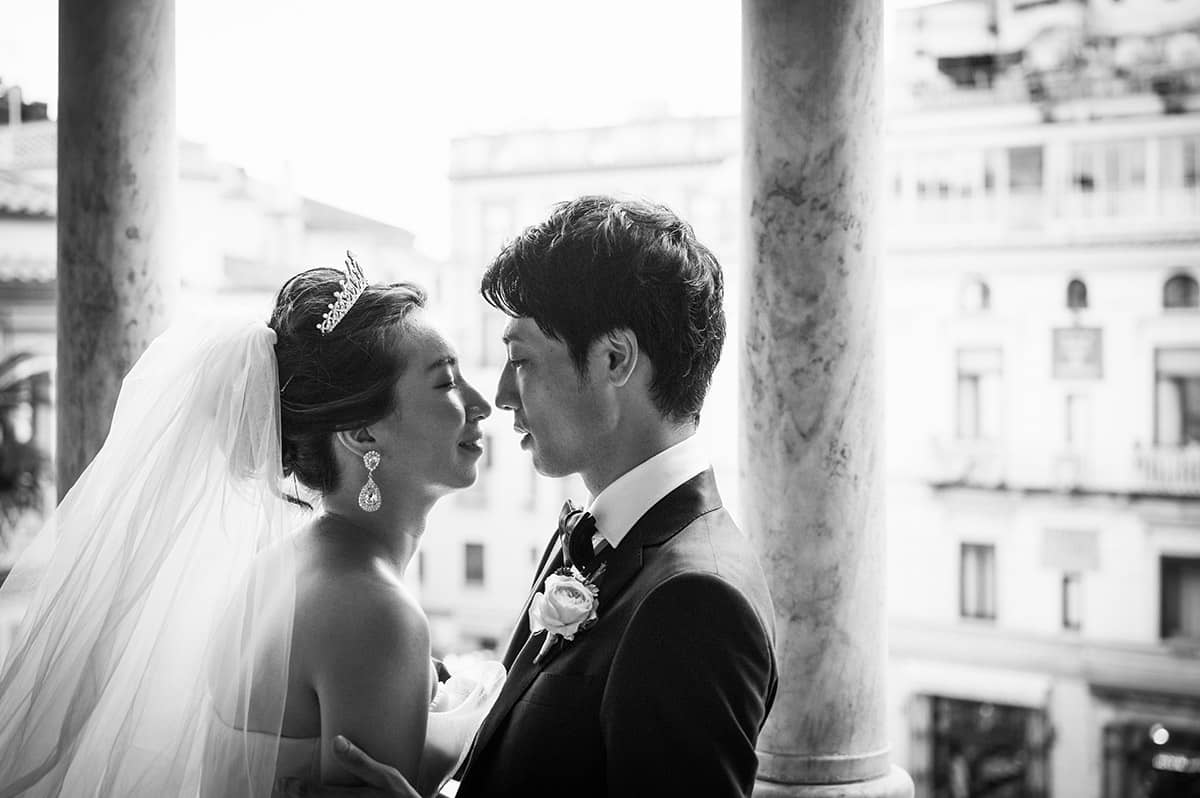
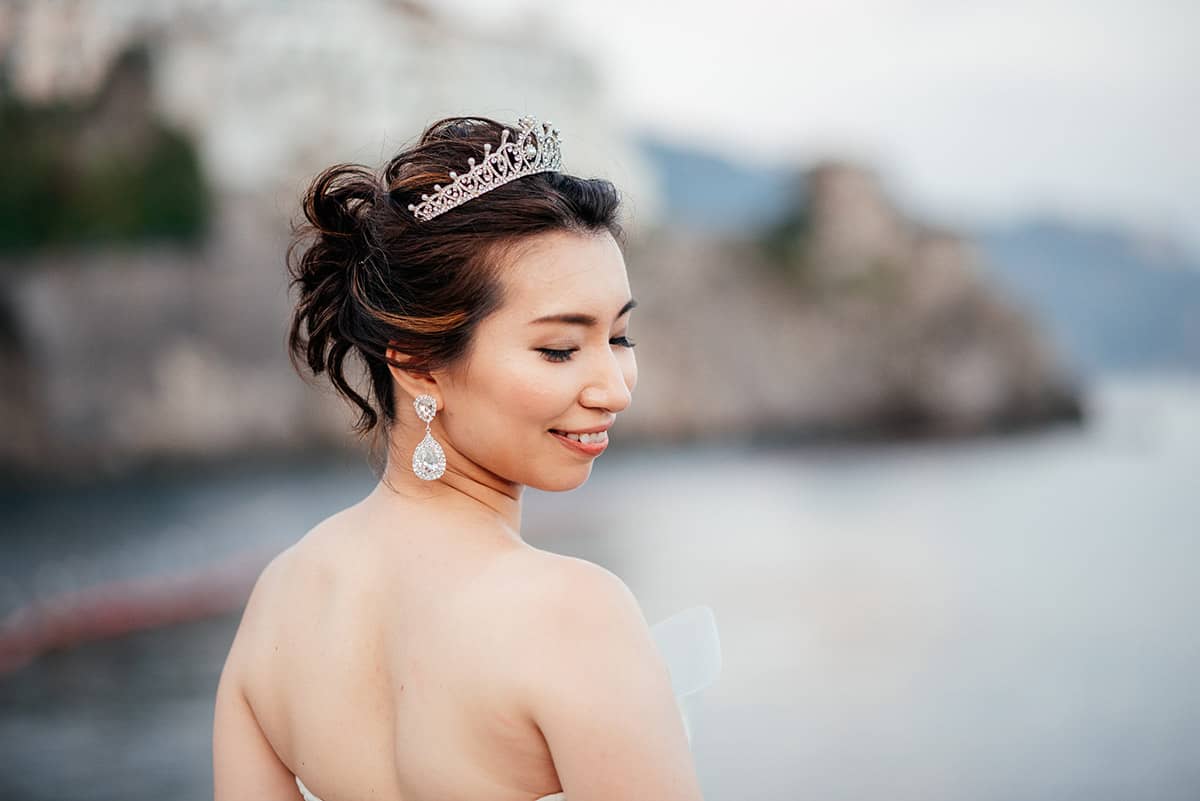
Aiko’s dress was a strapless ball gown with a draped bodice and a skirt built in wide tiers of organza, the sort of dress that is engineered rather than sewn. No lace anywhere. With it she wore a crystal tiara set into an updo, a long tulle veil and drop earrings that caught every light source in the building.
There is a version of this outfit that would look staged at a wedding with no guests. It did not, and I have thought about why. I think it is because nothing about the day was performed for anyone. The dress was not there to be seen by a room. She wore a tiara in an empty church for the same reason people dress for dinner alone in a good hotel, which is that the occasion is real whether or not it has spectators.
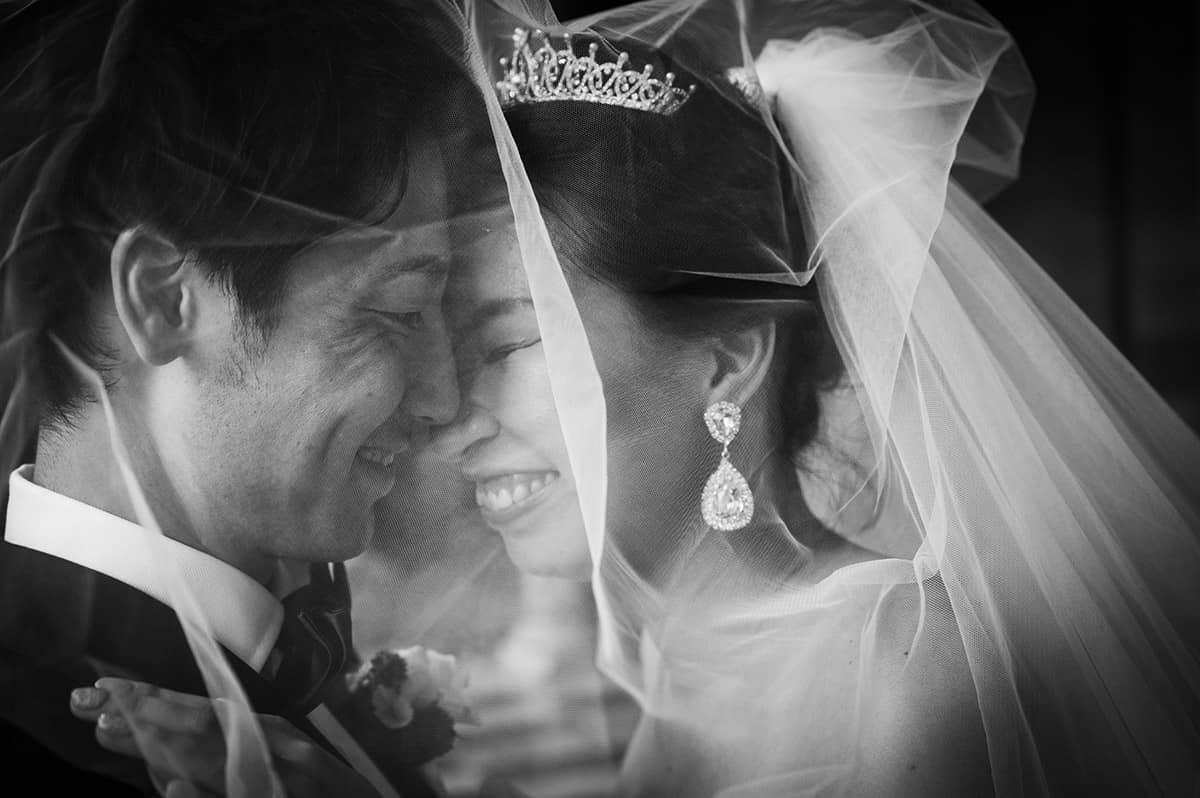
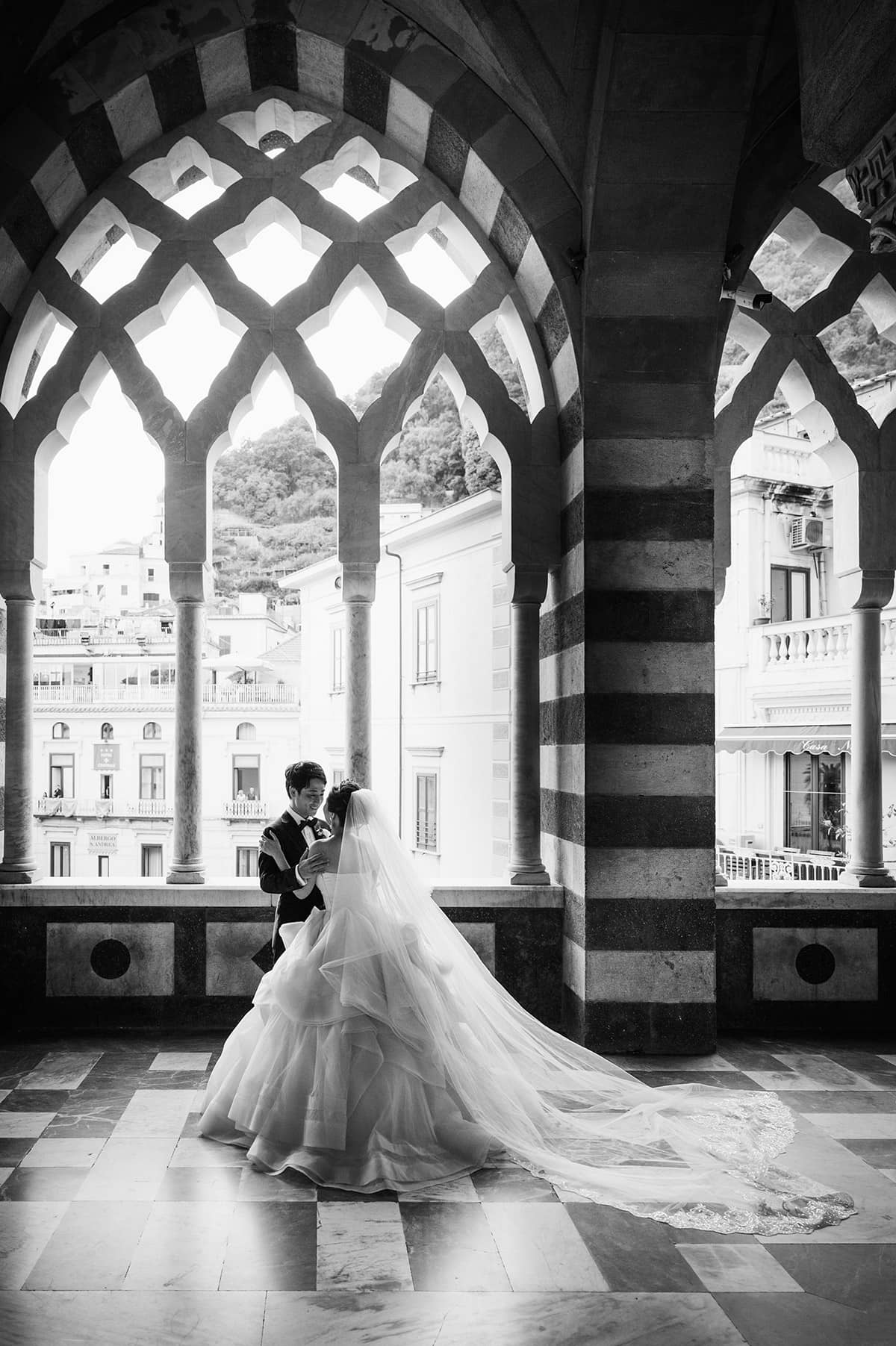
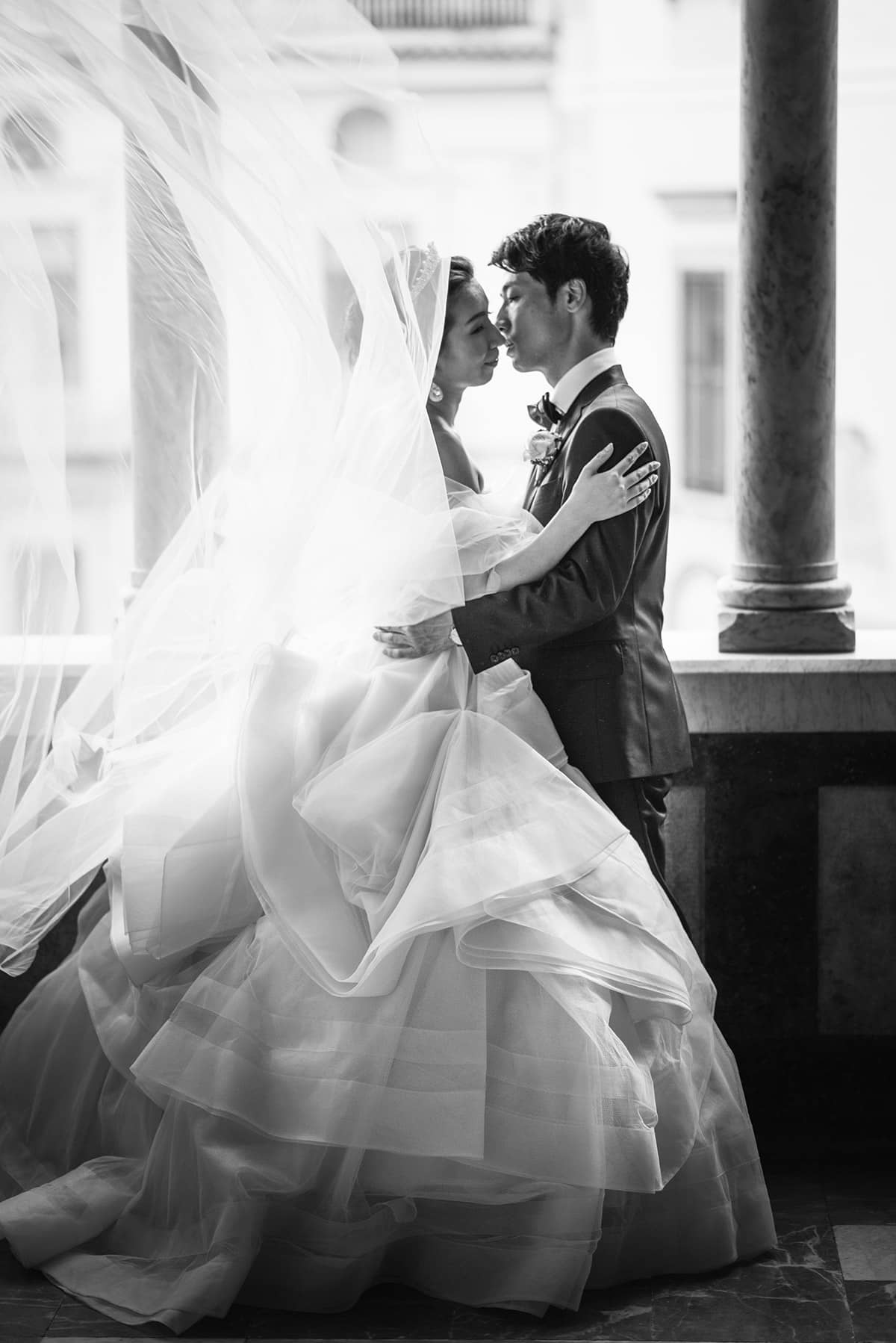
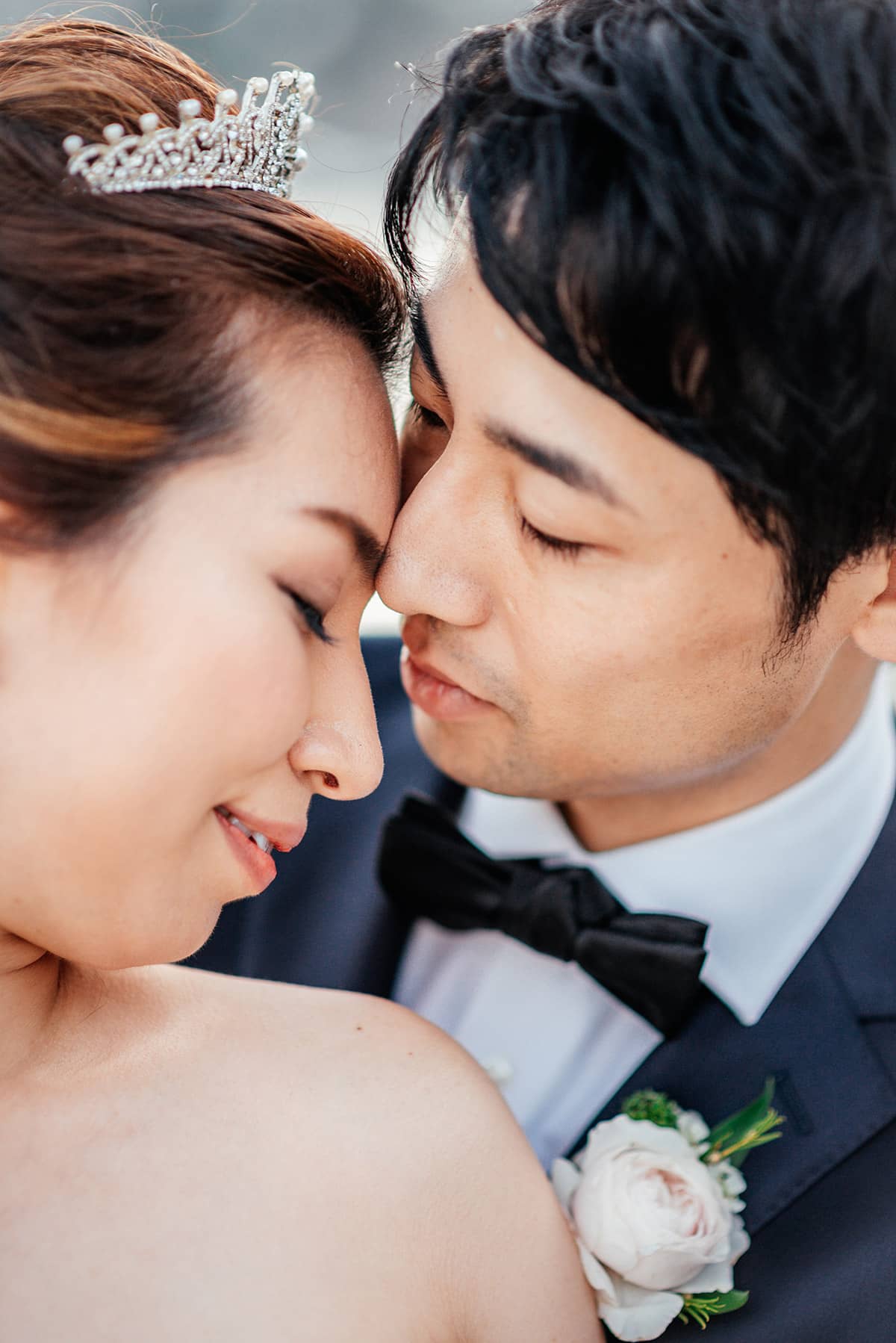
The best portrait I made of the two of them is in black and white, under the veil, foreheads nearly touching, both of them laughing at something neither of them explained to me. There is a stone floor and a column behind them and no information at all about where they are or who is watching. Nobody was.

Back to Amalfi for the Last Hour of Light
We went back toward Amalfi for the last hour of light, and this is where a wedding without a reception gives you something a normal timeline cannot. There was no dinner to be at. Nobody was holding a room of guests while the couple was off having portraits taken. We simply had the evening.
Three Lanterns to a Post
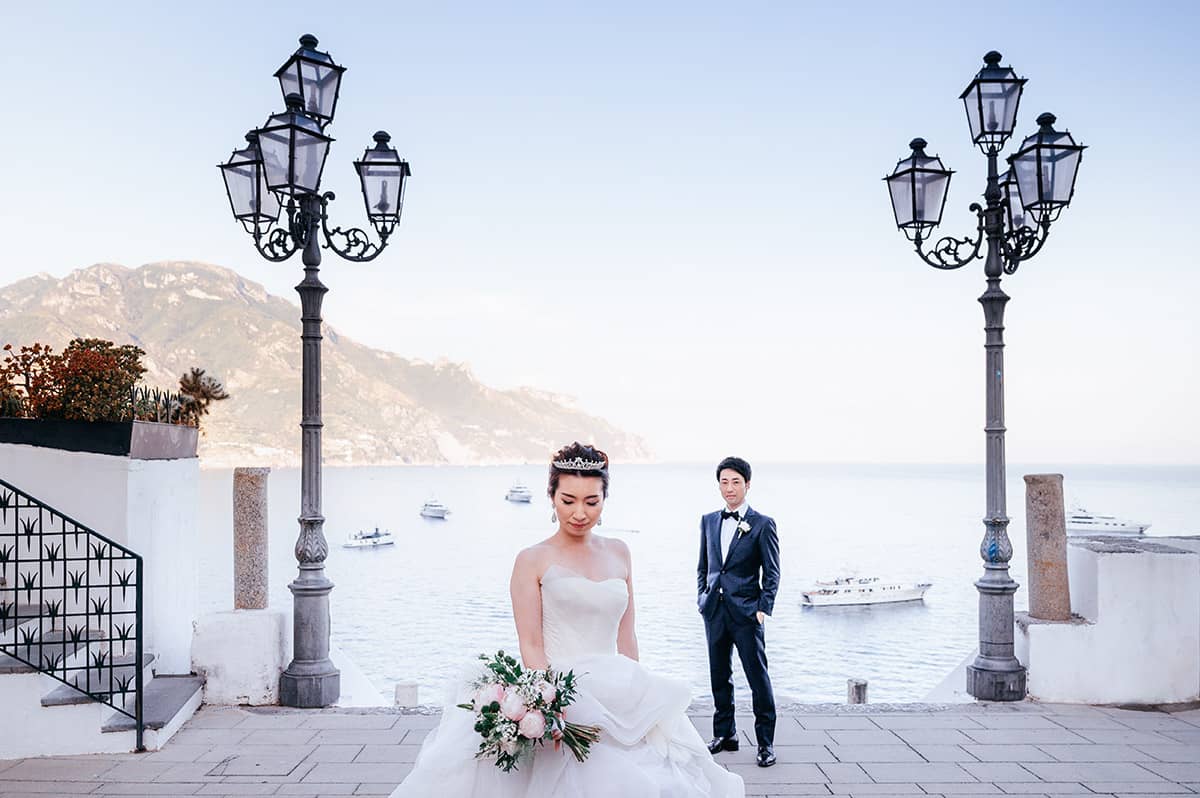
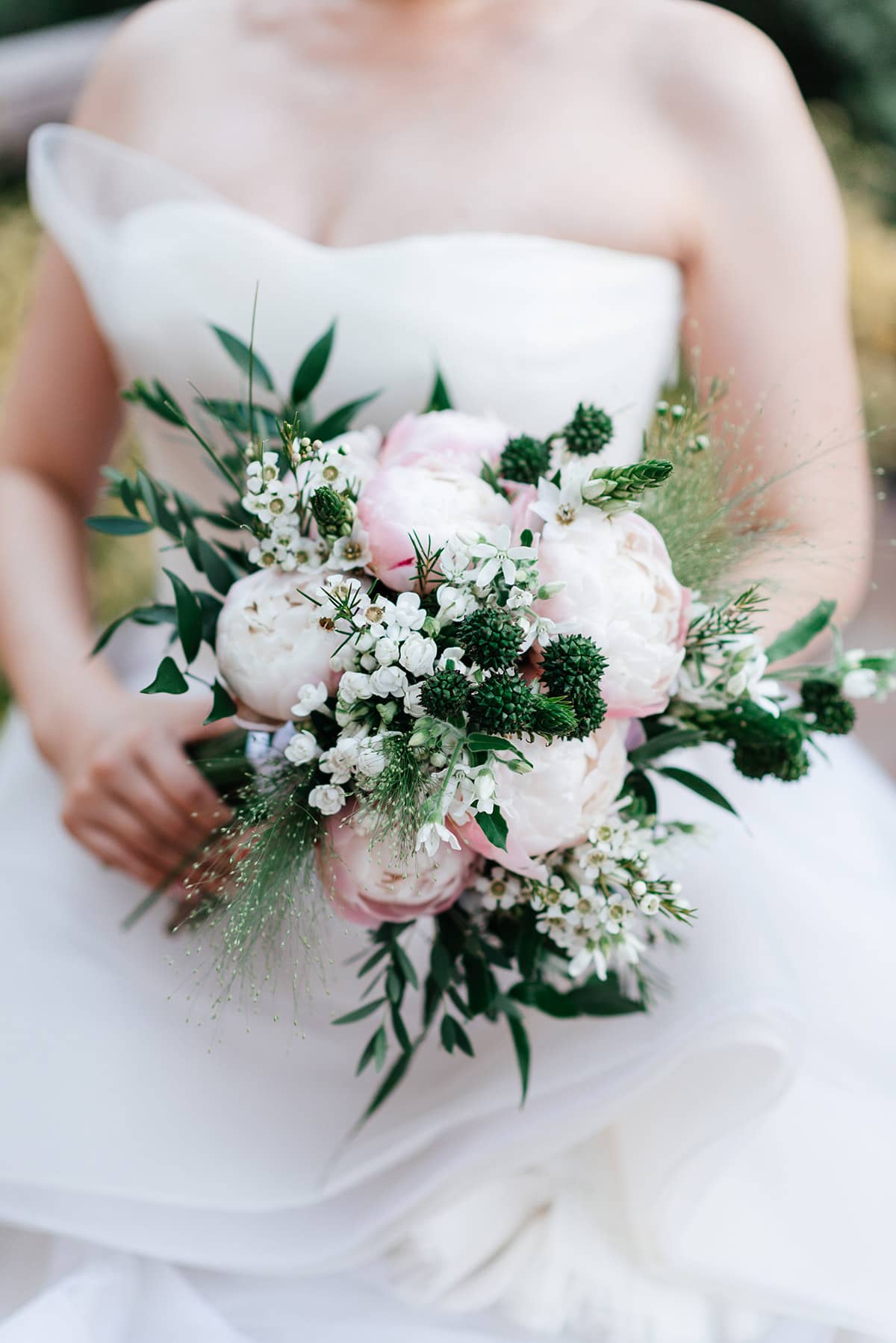
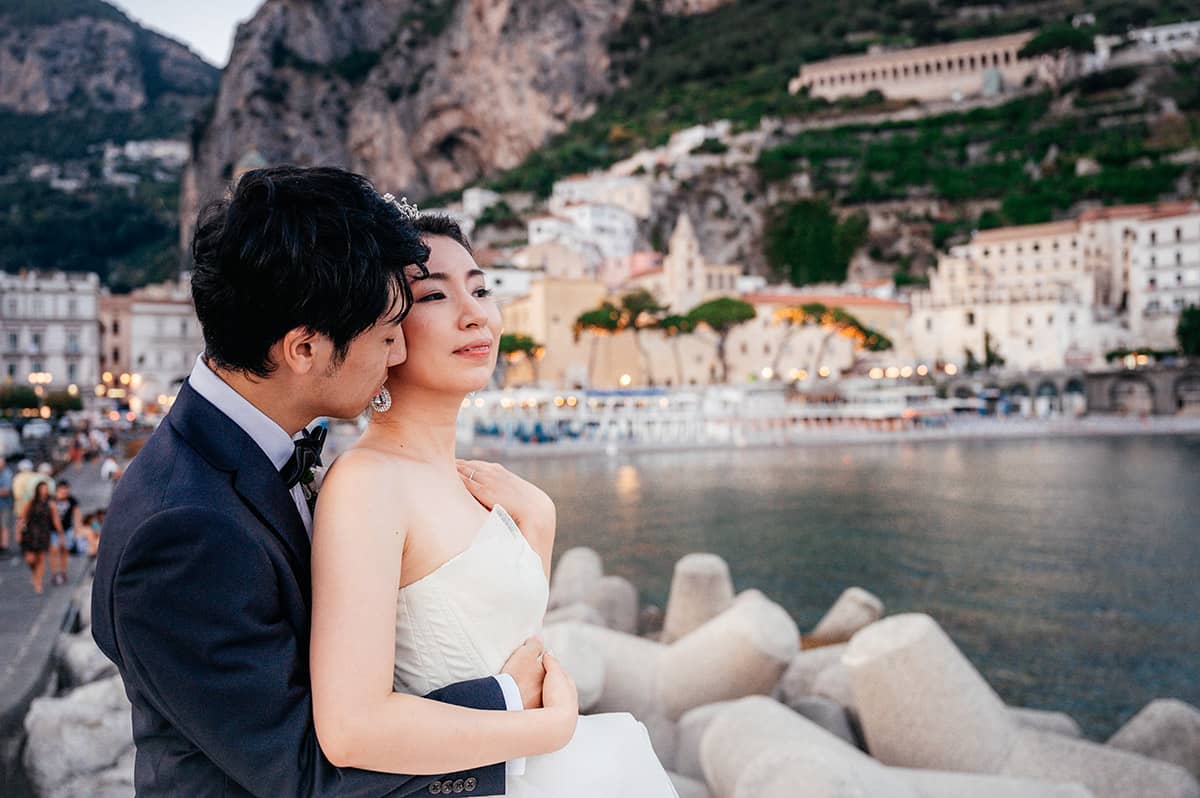
On the promenade there are cast iron lamp posts with three and four lanterns each, spaced along the waterfront with the harbor behind them. I placed Aiko in the foreground with her bouquet, looking down, and left Hiroshi standing between the two lamp posts about eight meters behind her, hands in his pockets, in focus but small. The mountains behind Amalfi were going pale in the haze and the boats had all come in.
It is a composition I have used before on that stretch, and it works precisely because it puts distance between two people who have spent the entire day within arm’s reach of each other.
Tetrapods and a Flat Gray Sea
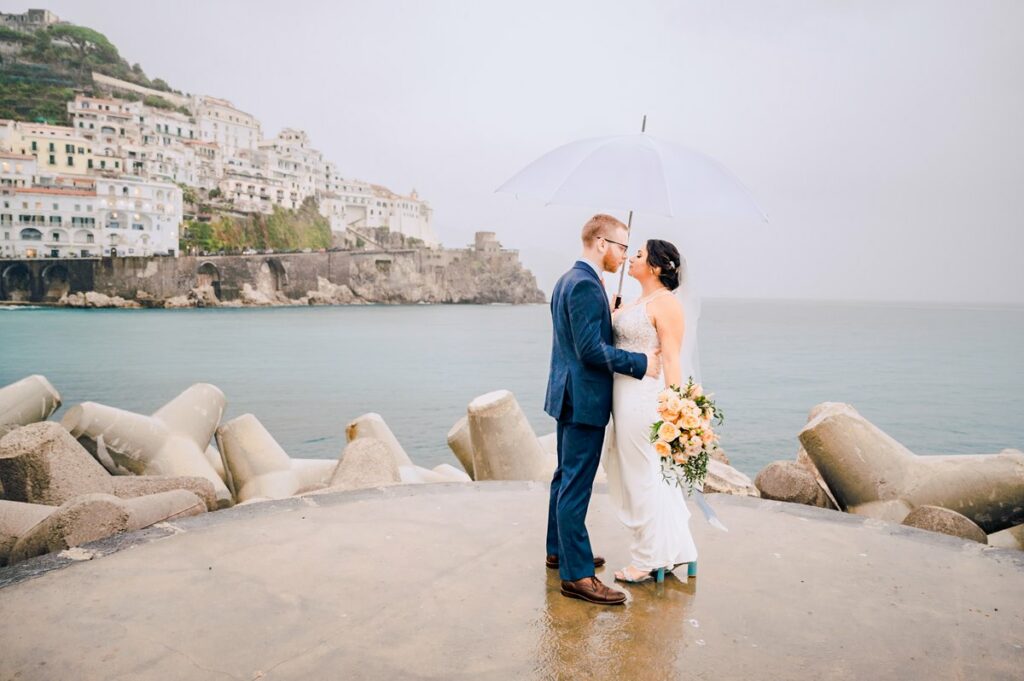
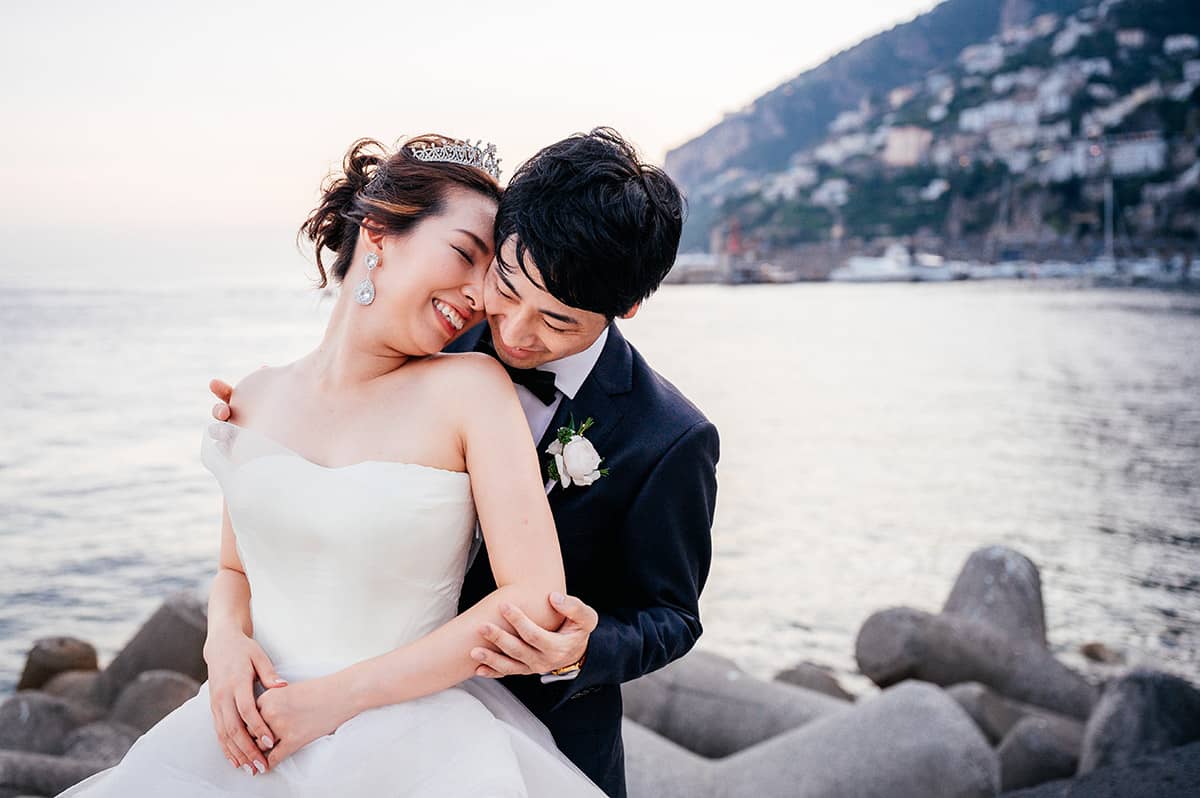
Then we climbed down onto the breakwater, where the sea defenses are a jumble of gray concrete tetrapods, and made the loosest photographs of the day. He came up behind her and put his arms around her and she laughed with her eyes shut, and behind them the lights of the town were beginning to come on up the hillside.
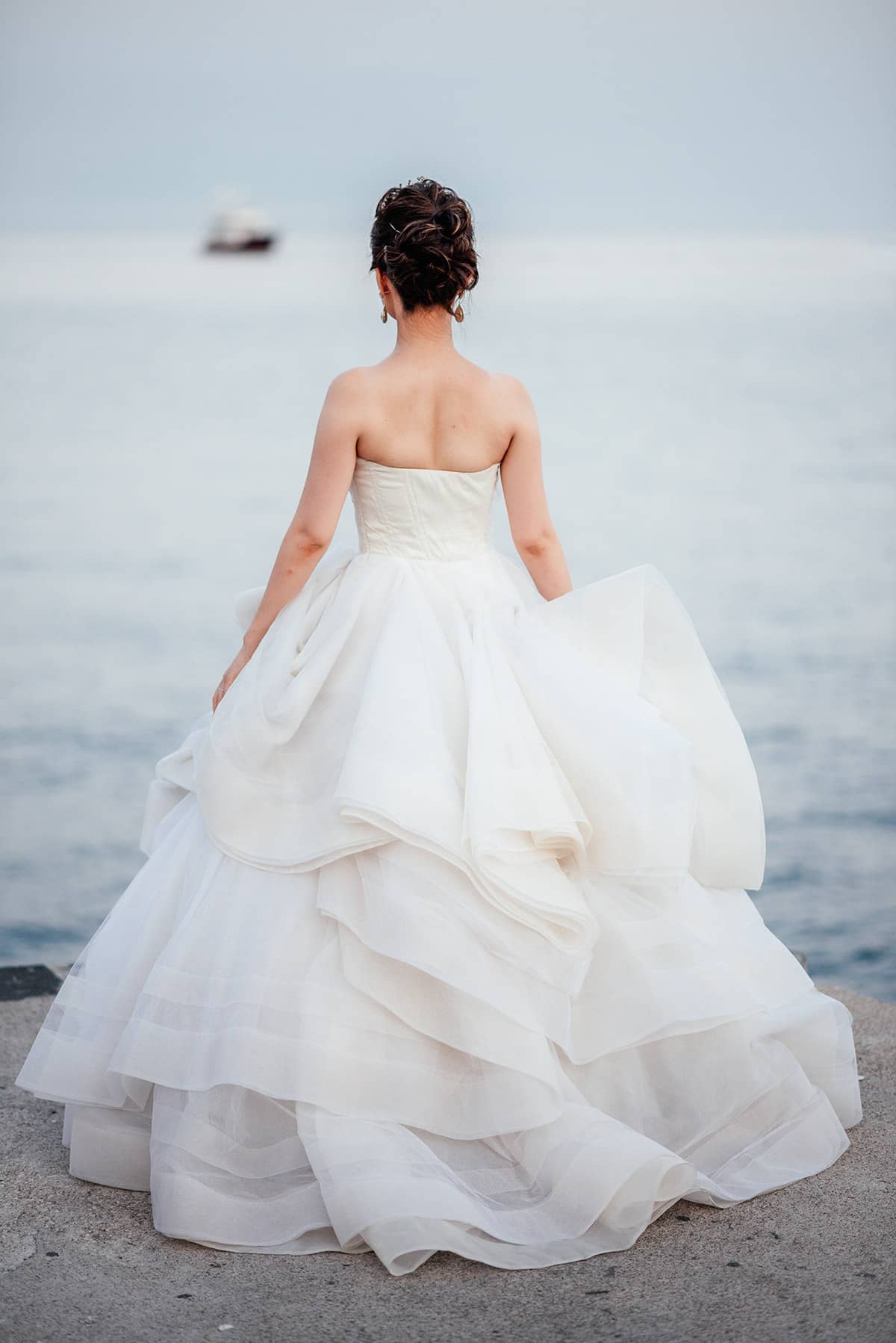
Last frame of the evening: Aiko alone on the concrete, back to camera, holding a fistful of that enormous skirt off the ground, looking out at a boat crossing a flat gray sea. If you did not know anything about the day you would not be able to tell whether that photograph was made before the wedding or after it. That ambiguity is the reason I like it.
Would I Recommend Marrying With Nobody There
For some couples, honestly, no. If your family will be hurt by not being invited, a photograph will not fix that, and I have watched couples spend their whole wedding day managing the feelings of people who were not in the room.
But if the decision is genuinely yours, a church wedding without guests on this coast is one of the few ways left to have something both formal and completely private. You get the building, the rite, the dress, the whole architecture of a traditional wedding, and none of the choreography. Nobody is timing you. Nobody needs feeding afterward. You can spend the hour after the ceremony walking around a town in a ball gown instead of standing in a receiving line.

Two practical notes for anyone considering it. A church wedding in Italy has its own paperwork, separate from the civil side, and it needs starting months earlier than most couples expect, which is where a planner who works regularly with parish offices earns their fee before you even land. And a coastal town parish is a working church with its own calendar: mass times, funerals, saints’ days. The empty basilica Hiroshi and Aiko walked into was empty because somebody had arranged for it to be, on a specific day, at a specific hour.
One Hotel, One Church, One Road
Hiroshi and Aiko crossed most of the planet for a ceremony that lasted under an hour, and the thing that made the day work was that they built almost nothing else around it. One hotel. One church. One road between the two, booked with far too much time. One evening walk.
The temptation when you fly this far is to stack the day: three towns, a boat, dinner somewhere famous, all of it inside the same twelve hours. I have photographed those days too, and the pictures are fine, and the couple remembers a schedule. These two remember an empty church.
If you are planning something along these lines, whether a church wedding without guests or a full coastal wedding with everyone you know, the planning question worth asking early has more to do with how much silence you want in the day than with which venue holds it, and that is as true of an Amalfi Coast elopement as of a full wedding. An Amalfi Coast wedding planner can hold a church for an hour, but only if that is decided long before the invitations, which in this case were never printed. Tell me your date and what you have in mind, and I will come back with availability and the price.
 Written By Emiliano Russo