
Legal Wedding on the Amalfi Coast: Thirteen Comuni, Two Published Price Lists
Which of the thirteen town halls on this coast will marry you, in which rooms, on which days and for how much, plus the appointment two days beforehand that almost nobody builds into the trip.
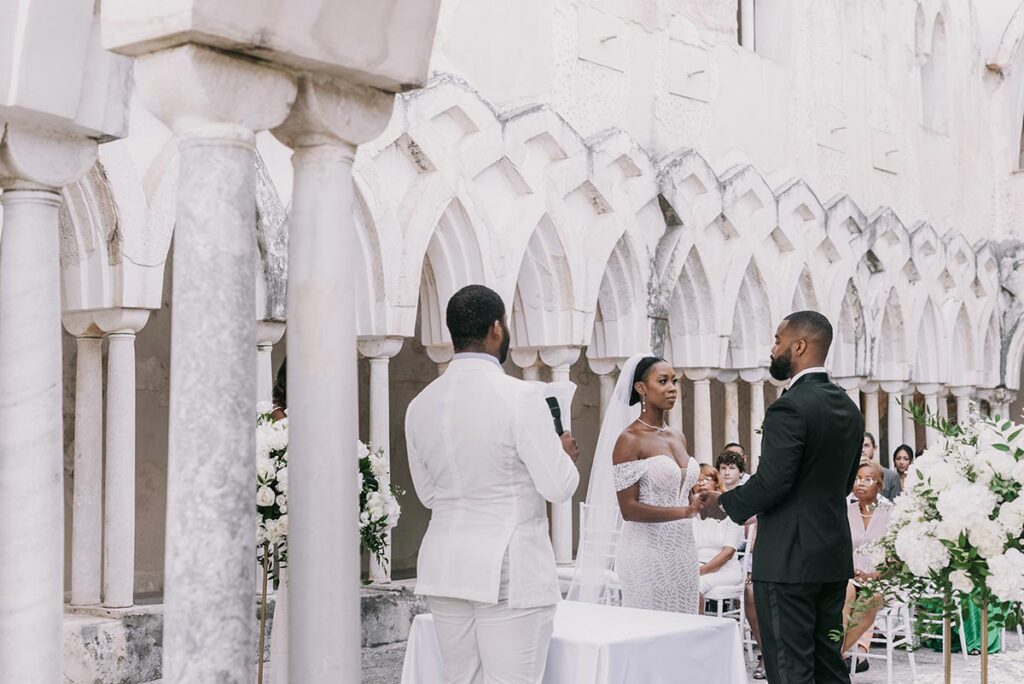
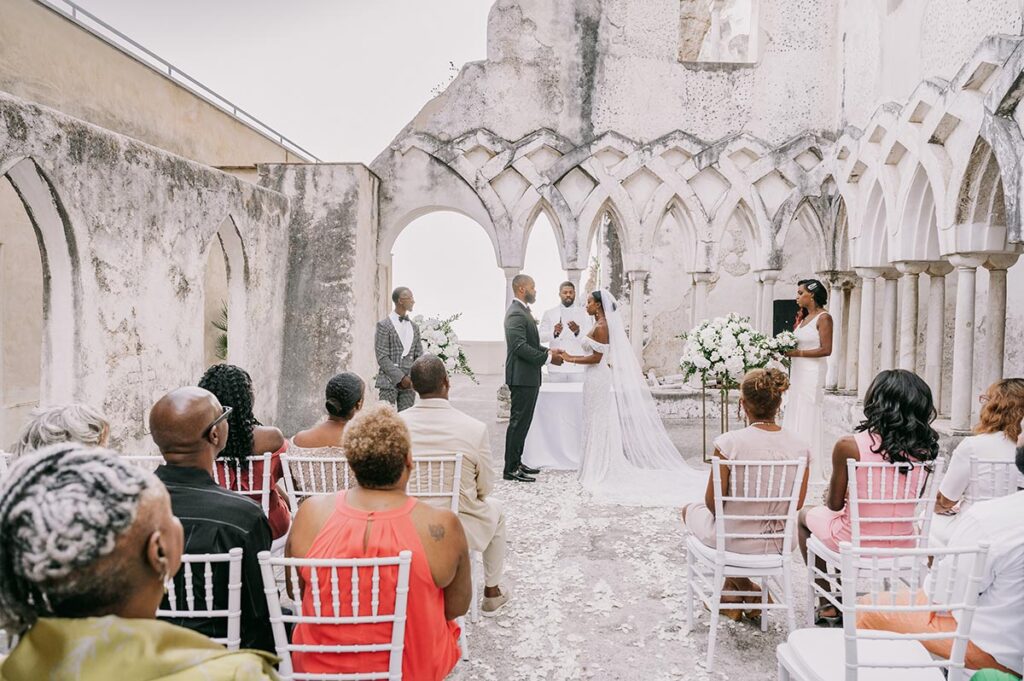

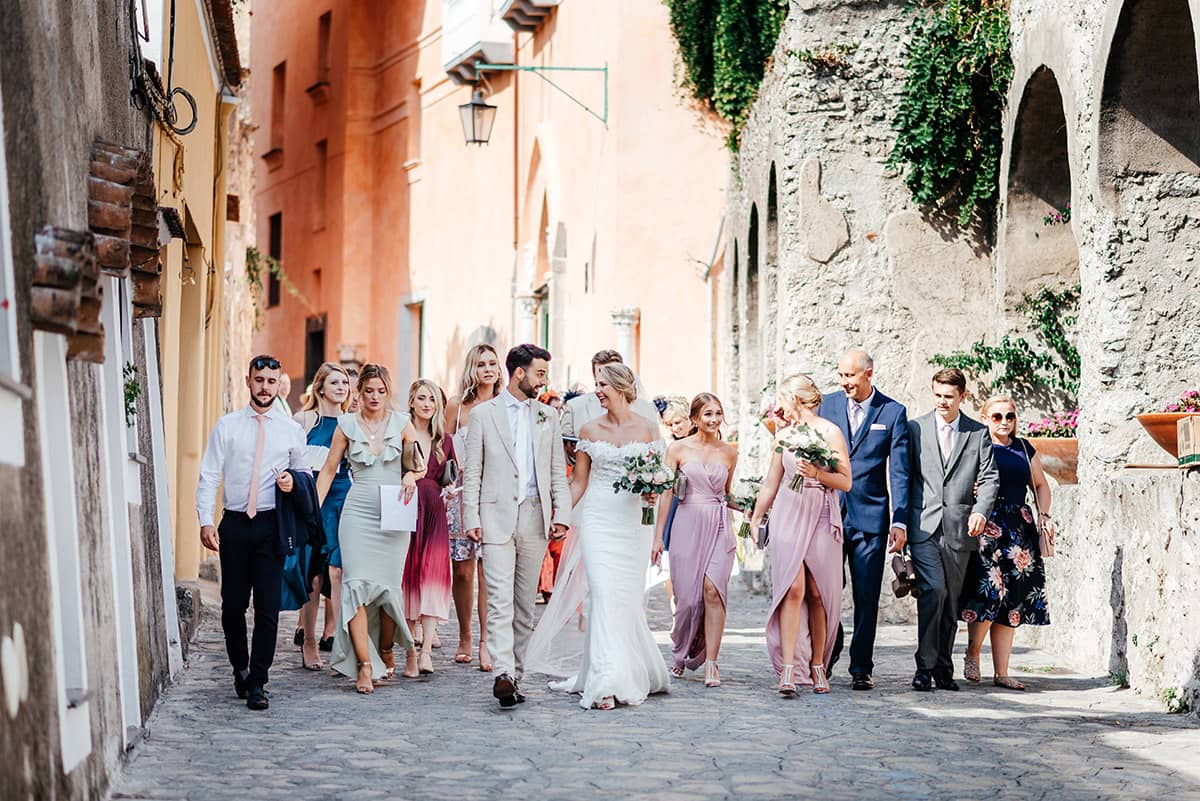
A legal wedding on the Amalfi Coast is granted by a comune, and the comune decides three things you cannot argue with: whether it will marry you at all, in which rooms, and for how much. Thirteen towns share this coastline. I checked every one of their websites in August 2026, and exactly two of them publish a price. Amalfi charges between 200 and 800 euros depending on the room, the day and the season. Ravello charges nothing to its own residents and up to 850 euros to you. The other eleven publish an office address, a phone number, and silence.

I am an Amalfi Coast wedding photographer and not a lawyer, so this page does one specific job. It collects what the town halls themselves say, with the sources attached, because the couples who write to me about this have usually read six planner blogs that contradict each other and one forum thread from 2019. The document trail your own country produces is a separate subject and it barely changes between Naples and Milan. What changes on this coast is the town.
Only a Comune Can Marry You, and Only Where It Says So
In Italy the power to conduct a legally binding marriage sits with the mayor of a comune or with an officer the mayor delegates, and it can only be exercised inside a building the comune has formally designated for the purpose. A hotel cannot grant it. A celebrant flown in from Ohio cannot grant it. The most beautiful terrace on this coast has exactly the same legal standing as a car park until the town council votes otherwise.
This is the fact that reorganizes the whole search. Couples arrive at the question from the direction of scenery, having already fallen for a property, and then discover that the property and the legal ceremony are two separate bookings in two separate places. If you are still at the scenery stage, my guide to Amalfi Coast wedding venues is the right page and this one is not.
Sede Distaccata: How a Hotel Terrace Becomes a Registry Office
One mechanism explains every apparent inconsistency you will run into, and it is worth understanding. A comune can establish a sede distaccata di stato civile, a detached branch of its own registry office, inside a building it does not own. The building is lent to the town, usually under a comodato, a loan agreement, and for the duration of that agreement the town’s authority extends into those rooms. That is why one hotel on this coast can host a wedding that counts and the hotel four kilometers along the same road cannot.
Nothing about the building decides it. The paperwork decides it, and the paperwork is between the owner and the town, not between the owner and you. When a property tells you it is “licensed for civil ceremonies”, the question that settles it is which comune, and whether that arrangement is current.
Maiori Wrote the Contract for It in 2022
Maiori’s own public record shows how ordinary this is. On the first of August 2022 the town’s giunta passed resolution 143, titled in the plainest possible Italian: celebration of civil rite marriages at a hospitality facility, provisions. The document published alongside it in the town’s albo pretorio was a template loan agreement. A town deciding, in a single afternoon, that a hotel could become a place where marriages happen.
Vietri sul Mare has gone a step further and published an open call inviting owners and managers of private buildings to offer the town rooms suitable for civil weddings, free of charge. Read the two together and you see what is really happening along this coast. The towns want the weddings, the buildings want the weddings, and the legal bridge between them is a short contract that nobody puts on a wedding website.
Two of Thirteen Comuni Publish What a Legal Wedding on the Amalfi Coast Costs
Here is the census of what a legal wedding on the Amalfi Coast costs, done by hand in August 2026 on the institutional sites of all thirteen towns between Positano and Vietri sul Mare. Amalfi and Ravello publish their venues and their full fee schedules. Positano publishes its venues and its hours but no price. Praiano publishes the most detailed guidance on this coast for foreign nationals and no price. Atrani, Minori, Tramonti and Conca dei Marini publish an office, its hours and a procedure for filing the marriage banns. Cetara, Scala, Furore and Maiori publish nothing findable at all about celebrating a wedding, and Maiori’s fee, if it has one, lives inside that 2022 resolution rather than on a page a couple would ever reach.
Two out of thirteen. I want to be careful about what that does and does not mean, because a town that publishes nothing is not a town that refuses. Every comune in Italy is obliged to marry people. What the silence means in practice is that the price arrives by telephone, in Italian, after somebody has asked, and that you have no way to check it against anything.
Amalfi Prices Three Rooms and Charges 77 Euros to Its Own
Amalfi is the most transparent town on the coast and it is worth reading its page as a model of what the others could publish. Three venues, each with its own scale:
- Ex Convento dei Cappuccini: 300 euros on a weekday, 400 on Saturday or Sunday, and 200 euros between the third of November and the thirty first of March.
- Salone Morelli, inside the town hall itself: 350 euros on a weekday within office hours, 500 outside them, 650 at the weekend.
- Arsenale della Repubblica: 500, 650 and 800 euros on the same three step scale.
Residents of Amalfi and the children of Amalfitani pay 77 euros wherever they marry, which is roughly what the town believes the ceremony costs to provide. Everything above that figure is what Amalfi charges for being Amalfi. You can read the schedule yourself on the Comune di Amalfi’s own Sposarsi ad Amalfi page, which is also where Amalfi’s rules on the declaration, the interpreter and refunds come from.
Ravello Charges Nothing to Residents and 850 to You on a Saturday
Ravello runs two venues, the Sala di Rappresentanza inside the town hall and the Giardini della Principessa di Piemonte just along the road from it, and prices them identically. If one of the two of you is resident in Ravello, either venue is free, any day of the week, holidays included. If neither of you is, the town charges 650 euros from Monday to Thursday and 850 euros from Friday to Sunday, per venue, on a schedule that has been in force since the first of January 2019. Villa Cimbrone isn’t on that list, so a couple set on the villa signs with the town and holds the ceremony their guests watch at Cimbrone.
Those gardens are the single most productive legal venue on this coast in my experience, and I have written about the ceremony itself at length in my guide to a Ravello town hall wedding. What matters here is the shape of the number. Ravello has one price for weekdays and one for the weekend and nothing in between, while Amalfi splits the weekday into office hours and after hours. Two towns, about seven kilometers apart by road, with genuinely different ideas about what they are selling.

The Eleven Town Halls That Publish Nothing
I expected the small towns to be quiet and they were. What surprised me is how quiet the famous ones are.
Positano Publishes Its Hours and Withholds Its Price
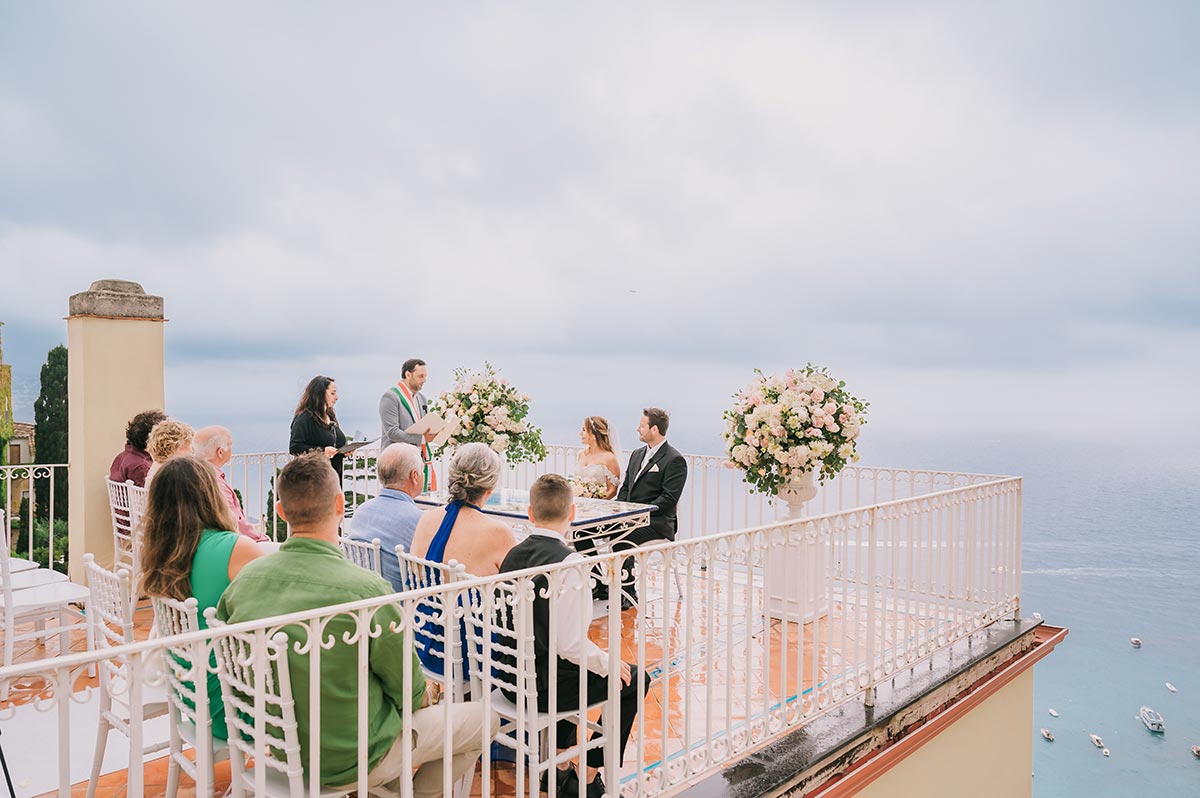
Positano has a proper page for weddings and describes its two spaces well: the municipal terrace suspended above the Fornillo end of town, and a majolica hall hung with paintings for the days when the terrace is unusable. It publishes its hours, which are genuinely useful. Ceremonies run Monday to Friday from eleven in the morning until eight at night, and on Saturday from ten until eight.
Read that twice, because it contains something no price list would tell you. There is no Sunday. Amalfi will marry you any day of the week including Sunday, and Ravello’s schedule runs Monday through Sunday too. Positano stops on Saturday evening. A couple who has flown thirty people to Italy for a Sunday in June is going to find that out late, and the fee, when it eventually arrives by email, is not published anywhere I could find. If Positano is where you want the ceremony, my post on a symbolic wedding ceremony in Positano goes through that town’s own paperwork trail in detail, including what the consulate in Naples takes and how long it takes.
Praiano Is the Only One That Explains Your Own Country’s Paperwork
Praiano publishes no fee either, but it does something none of the others do. Its service page breaks the requirements down by nationality, and it names the Americans, the Australians and the British separately. For a United States citizen it sets out the two step route: an affidavit sworn with two witnesses before an Italian authority, then a sworn declaration from the US Consulate whose signature is then legalized at the Prefettura. For Australians it accepts a sworn declaration from the consular authority. For British citizens it wants a certificate of no impediment from the home authority plus a bilingual sworn declaration.
That page is the best free legal reading on this coast and it belongs to a town of two thousand people. If Praiano is on your list at all, the practicalities of working there are in my guide to hiring a Praiano wedding planner, which quotes a figure for the town’s own ceremony room that I could not confirm on the comune’s site this month. Treat mine as the more recent reading and ask the town directly.

Amalfi Names Its Three Legal Venues in Public and Nobody Else Does
The Comune di Amalfi lists, by name, the only three places within its territory where a marriage will hold up: the Salone Morelli inside the Casa Comunale, the Arsenale della Repubblica down by the water, and the Ex Convento dei Cappuccini, the former Capuchin monastery high above the town that a hotel now occupies. Three addresses. Everything else in Amalfi, however old, however beautiful, however confidently described in a brochure, is a symbolic ceremony.
I have compared the three big hotels of Amalfi against each other elsewhere, including which of them that list contains, in my piece on Santa Caterina, the Convento and Borgo Santandrea. The point I want to make here is a different one and it is about the list rather than the buildings. Amalfi is the only town on this coast that tells you in advance which of its rooms are real. Everywhere else you find out by asking a property, and the property has an interest in the answer.
The Cheapest Legal Ceremony in Amalfi Falls Between November and March
The winter rate at the Ex Convento is 200 euros, which is a third of what the Salone Morelli costs on a Saturday and a quarter of the Arsenale. It applies from the third of November to the thirty first of March, a window that covers a great deal more of the year than most couples assume when they picture this coast. The cheapest legally binding wedding available in Amalfi is the one held in a thirteenth century monastery on a cliff in the low season, which is not the sentence anybody expects to read.
A second payment sits on top, made to whoever operates the building rather than to the town, and it is set by the space. The cloister runs about 1,600 to 1,700 euros plus tax. Each of the two terraces runs about 1,100 to 1,200 plus tax. The venue side of that arrangement, and what the building is actually like to work in, is covered in my page on the Convento di Amalfi as a wedding venue.
The Page Still Names a Hotel Brand That Left
One detail tells you how to handle every figure on this page, including mine. Amalfi’s official page still names NH Collection as the operator of the Ex Convento, and that brand was replaced some time ago by Anantara. The town has not updated the name. If the operator’s name is out of date on an official page, the numbers beside it might be too, and the correct response is not to distrust the town but to have somebody confirm the current schedule in writing before you build a budget on it. I republish these figures because two published price lists beat none, and I would still ask.
The Two Days Before, Without Witnesses
This is the rule I would put first if I were writing the Comune di Amalfi’s page for them. Foreign nationals who are neither resident nor domiciled in Italy have to appear before the registrar and sign a declaration that no impediment to the marriage exists, and that appointment has to happen at least two days before the ceremony itself. No witnesses attend it. It is the two of you, an official, and a document.
Almost nobody plans for it. Couples build a trip in which they land, spend a day recovering, get married, and start the honeymoon, and that itinerary does not contain the appointment. The trip has to be at least two full working days longer at the front than the wedding date suggests, and if a Sunday or a public holiday falls inside that window it is longer still, since the office is shut.
A Five Night Trip Has No Room for This Appointment
Run it forward and it stops being an administrative detail. You land on a Wednesday, jet lagged and probably late, because flights into Naples usually are. Thursday you sign the declaration in the town hall, which means being in the right town, at the right hour, awake and holding the right passports. Friday is the wedding. That leaves Saturday and Sunday, and every guest who flew in for the weekend has arrived after the only appointment that could have stopped the whole thing.
One spring a couple arrived on the Thursday for a Saturday wedding and found out on the Friday morning, in the corridor outside the registrar’s office, that the Friday was a local holiday. The office was shut. Nobody had told them, because nobody had asked. They spent the afternoon on the phone from a bar in the piazza while their guests were already checking in, and the wedding went ahead only because a registrar agreed to take the declaration first thing on the Saturday, hours before the ceremony, in a room with the shutters still down. I photographed that appointment. It is the least romantic set of pictures I have ever taken, and they keep them.
The version that works has the couple arriving three or four days early, treating the registrar’s appointment as the first fixed point of the trip rather than the last errand, and using the day between it and the wedding for a portrait session in daylight, when the coast is not yet full of your relatives. That day is also, incidentally, the best photographic day of the whole week.
An Interpreter Is Required and So Is Every Translation
If the spouses or the witnesses do not speak Italian, the comune requires an interpreter to be present. This is not a courtesy the town offers. The ceremony consists of an officer reading articles of the civil code aloud and asking you a question, and the law wants you to have understood the question. Amalfi states the requirement plainly on its own page, and so does every other Italian town that publishes anything on the subject.
The paper side runs on the same principle. Documents issued abroad have to be translated into Italian, and legalized with an apostille by the competent authority in the country that issued them. That means the apostille is obtained at home, before you fly, from an office in your own state or country, and it is the step that most often turns a comfortable timeline into an uncomfortable one. The US consulate’s sworn declaration, the nulla osta, is valid for 180 days, so time it to be still valid on your wedding day: collected too early, it expires and that step starts again. The broader Italian document trail, which is the same in every region, is laid out in my guide to getting married in Italy as a foreigner.
Who Can Stand In as Your Interpreter
The comune decides this and the practice varies more than you would like. Some towns accept a bilingual guest or a member of the planning team. Others want a professional, and a few will only accept someone on a list they hold. Ask the specific comune, in writing, and get the answer in writing, because a wedding held on a Saturday morning with an interpreter the registrar refuses is not a wedding that gets rescheduled politely.
Amalfi Marries on Sundays and Positano Stops on Saturday
The calendars diverge and the divergence costs money in a way that is easy to miss. Amalfi celebrates from Monday to Sunday, with public holidays available only as an exception and only if the officer who conducts ceremonies happens to be free. Ravello runs Monday to Sunday and splits the price at Friday, so Friday is charged as a weekend day. Amalfi splits it at Saturday. Positano stops at Saturday evening entirely.
Set those three side by side and a Friday wedding costs you 850 euros in Ravello and 350 in Amalfi, assuming you take the Salone Morelli inside office hours. That is a spread of 500 euros on the same day of the same week, about seven kilometers apart, for a ceremony that lasts about a quarter of an hour in both towns.
Why the Weekend Surcharge Is the Number Worth Watching
Every published schedule on this coast is built the same way. There is a base rate for a weekday inside working hours, and then two escalations: one for stepping outside office hours, one for stepping into the weekend. Amalfi charges both separately, so a Saturday at the Arsenale costs 800 euros against a Tuesday morning’s 500. In Ravello the two escalations are folded into one and the jump lands on Friday.
None of this is large money against the cost of a destination wedding, and I am not suggesting anybody choose a town over 300 euros. It is worth watching because it is the only part of the day whose price you can know in advance, and knowing one real number early is oddly steadying when everything else is still a quote.
The Money You Do Not Get Back
Amalfi states it in one line and I have never seen another town on this coast state it at all: if the marriage does not take place, sums already paid are not refunded. No conditions, no window, no exception written down.
Weddings on this coast get moved. Weather moves them, a delayed connection through Rome moves them, and one October a grandmother’s fall in Pennsylvania moved a whole wedding at four days’ notice, which is the kind of thing no schedule survives. The municipal fee is the smallest line in the budget and it is also, on the evidence of the town’s own page, the least recoverable. Pay it late rather than early where the town allows, and do not assume that a deposit works the way deposits work at home. Everything else that moves with a date change, the venue, the catering, the rooms, is covered in my wider Amalfi Coast wedding guide, and none of it behaves like the town hall does.
The 300 Day Rule Is Still on the Books
Every few months somebody tells me this rule was repealed. It was not. Article 89 of the Italian civil code still says that a woman cannot remarry until 300 days have passed since her previous marriage was dissolved or annulled, and Italian courts still publish the petition form for the exemption, which is granted by decree once pregnancy has been ruled out. I checked in August 2026 against current legal references and against a tribunal’s own published forms, because I had been told twice this year that the article was gone.
What I will not do is tell you whether it applies to you, because that is a genuine question of law rather than of photography. Italian private international law looks to each spouse’s own national law for the capacity to marry, which is exactly why your consulate has to certify that you are free to marry under it. Whether an Italian domestic condition reaches an American bride divorced in Illinois eight months ago is a question for the comune and for a lawyer, and the answer needs to arrive before flights are booked rather than after. If you are recently divorced, raise it in your first email to the town.
The Cheapest Slot Is Also the Worst Light
Here is where my own trade meets the fee schedule, and it is the part I have never seen anybody write down. The cheapest legal ceremony in every town on this coast is a weekday inside office hours. Office hours on the Amalfi Coast in summer run through the middle of the day. The rate card is quietly pushing every couple who is watching the budget into the two hours when this coast photographs at its absolute worst.
Amalfi at one in the afternoon in July is a wall of white light bouncing off stone and water, with shadows that sit directly under the eyes. The same ceremony at half past six is a different photograph entirely, and in Amalfi it costs 150 euros more, which is nothing against a wedding budget and everything against the instinct to take the cheaper slot because it is there. Take the expensive one. It is the only place in this entire process where 150 euros changes the pictures.
Booking the Convento on a Weekday in November
The exception, and it is a real one, is the winter rate at the Ex Convento. Between November and March the sun sits low enough all day that office hours stop being a problem, and the 200 euro rate applies to exactly those hours. A Tuesday morning in late November at the Convento is the cheapest legally binding ceremony on this coast and one of the best lit, and the cloister is empty, and the town below is full of people who actually live there. I photographed a ceremony up there on a Tuesday in the third week of November, four guests, coats on over everything until the moment the rings came out. The light came sideways through the arches for the whole hour and I never once had to move anybody out of a hard shadow. I have described that morning to couples who then booked a July Saturday anyway, which is their right, and I would still take the November Tuesday.
The Split Day, and Why It Keeps Working
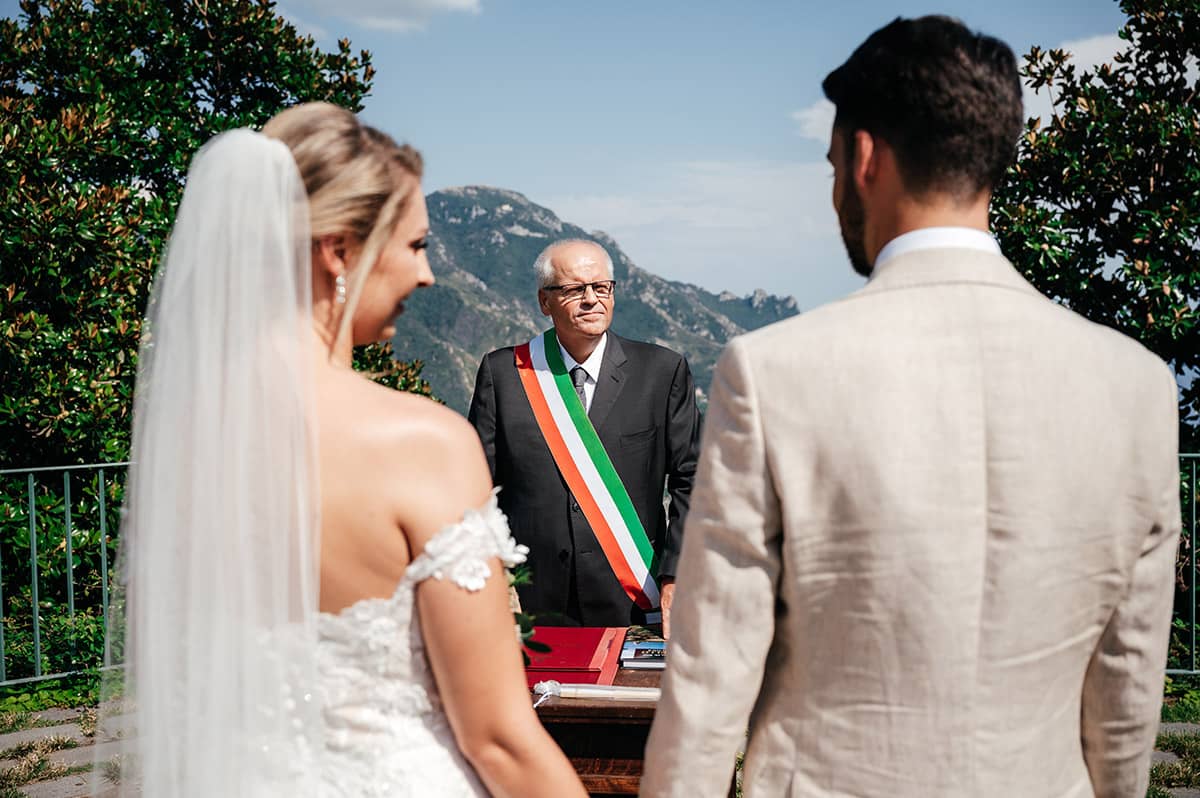
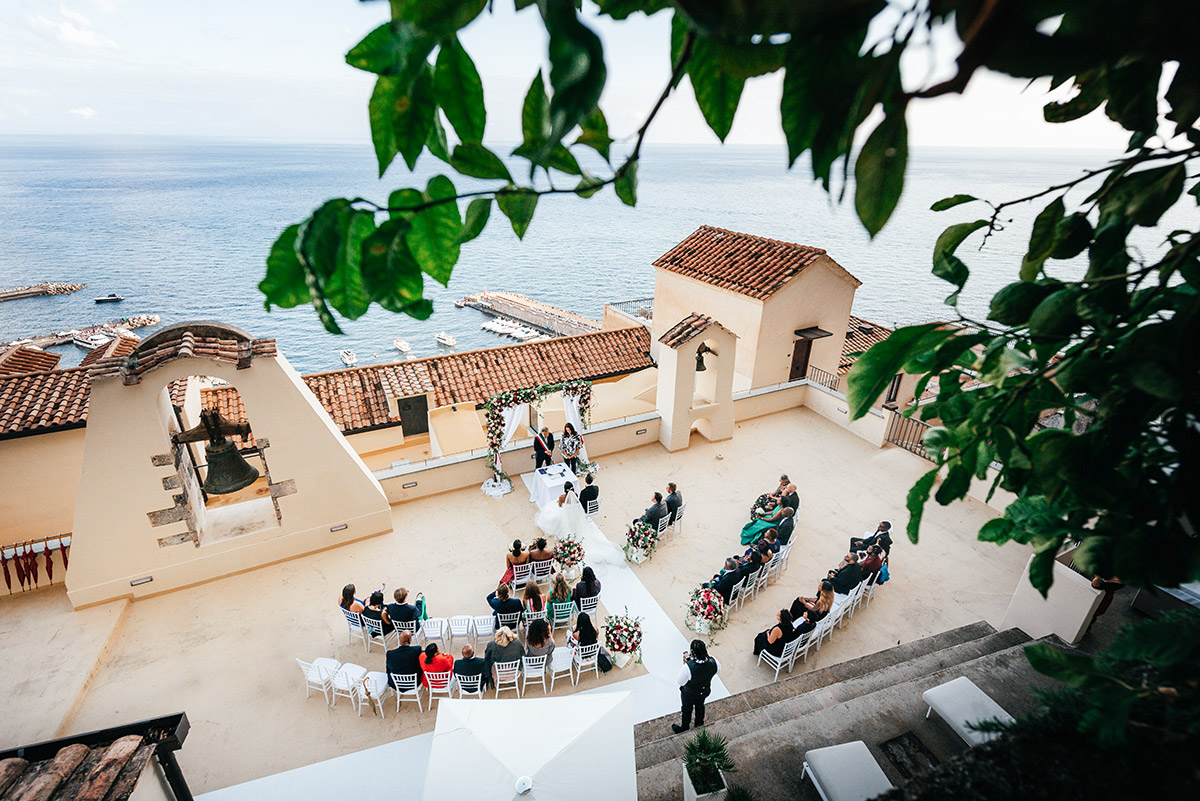
The couples I have seen solve this well end up with a split day, and the reason has nothing to do with avoiding paperwork. A couple books the comune for a weekday morning, does the legal ceremony in the town hall with two witnesses and an interpreter, and then holds the ceremony their guests attend at the venue, at the hour the light is worth having. The town gets its fifteen minutes and its fee. The wedding happens where the wedding was always going to happen.
What that buys is control of the clock, which is the only thing the comune cannot sell you. It also means the morning has its own set of photographs, unrehearsed and short, in a room with a sash and a register and an official who has done this four thousand times. Those frames age well. If the whole event is small enough that the town hall could simply be the wedding, my guide to an Amalfi Coast elopement covers that shape of day, and if it is not, an Amalfi Coast wedding planner is the person who should be having the conversation with the registrar rather than you.
Four Things to Ask, in the First Month
For a legal wedding on the Amalfi Coast, write to the comune, not to the venue, and write in the first month of planning rather than the sixth. Ask four things: which rooms the town can legally marry you in, what it charges on your specific day of the week, which days it does not celebrate at all, and when it needs you present for the declaration. Those four answers will reorder your shortlist more than any photograph of a terrace ever will.
If you would rather hand the whole thing to somebody who speaks to these offices weekly, that is a reasonable choice and it is most of what a planner is for on this coast. And if you want to talk about how a legal wedding on the Amalfi Coast photographs around a town hall slot, and which hour to fight for, write to me and tell me the town you are looking at. I will tell you what the light does there at the hour you have been offered.
Three questions
US Recognition, Paperwork Help and Witnesses for a Legal Amalfi Wedding
Whether the marriage counts in the US, who handles the paperwork, and who can be your witnesses.

Is a marriage in Italy valid in the US?
A marriage performed correctly by an Italian registrar is a marriage. Recognition happens through your own state’s rules for foreign marriage records, usually with the certified extract of the marriage act that the comune issues afterward, with an apostille. I tell couples to order more certified copies than they think they need while they are still in Italy.
Do we need a planner to handle the paperwork?
It isn’t required, but it runs through your consulate, the Prefettura and the comune, mostly in Italian. With photography only, you deal with the town hall yourselves and I tell you what I know of each town; if my in-house planners organize the wedding, they take the paperwork on.
Can our witnesses be friends who flew in with us?
Yes. Italian law asks for two adult witnesses with a valid ID, and they don’t have to be Italian or live here. If they don’t speak Italian, the interpreter covers them as well, and you bring copies of their documents to the town hall as the comune asks.
 Written By Emiliano Russo